The vet had The Talk with me about my cat Pavlov
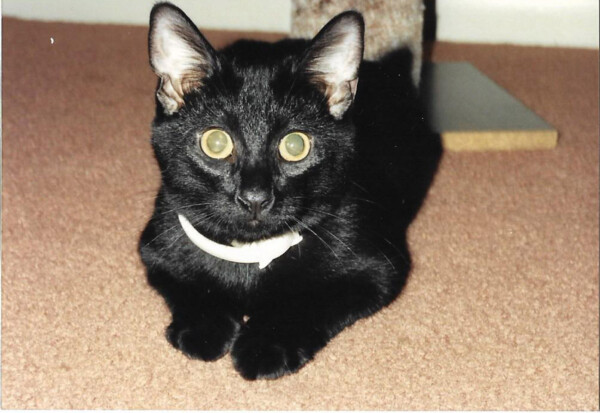
Photo courtesy of Del Stone Jr.
This morning I took Pavlov to the vet and she had The Talk with me.
The Talk amounted to this: If at any moment after today I look into his eyes and decide he’s had enough she would support my decision.
So. My old friend’s life is in my hands.
I am giving him double the insulin and double the fluids I was before. He has three kinds of food he can choose from. He gets a massage/brushing every day, a laxative to keep him from becoming constipated, and antibiotics for a persistent respiratory infection. Apart from that there’s nothing I can do.
He spends his day crouched on the Polo beach towel by the door to my office. He still eats, drinks and poops but that’s about it. Sometimes he will visit me on the couch but he always retires to the floor behind the stereo.
From a human perspective that’s not much of a life, but for a cat it may be exactly what he wants right now.
I don’t think he’s suffering. He doesn’t look like he’s in pain. But I can see he’s tired, maybe too tired. I don’t know.
Once before I said I’d give him a week. Sure enough he bounced back. But the news today suggests he may have used up all the reservoirs of strength he’s been running on.
We’ll see how he’s doing at the end of the week. I’ve got to give the insulin a chance to work.
If it doesn’t, however, then I guess I will do what a friend would do.
About the author:
Del Stone Jr. is a professional fiction writer. He is known primarily for his work in the contemporary dark fiction field, but has also published science fiction and contemporary fantasy. Stone’s stories, poetry and scripts have appeared in publications such as Amazing Stories, Eldritch Tales, and Bantam-Spectra’s Full Spectrum. His short fiction has been published in The Year’s Best Horror Stories XXII; Alfred Hitchcock’s Mystery Magazine; the Pocket Books anthology More Phobias; the Barnes & Noble anthologies 100 Wicked Little Witch Stories, Horrors! 365 Scary Stories, and 100 Astounding Little Alien Stories; the HWA anthology Psychos; and other short fiction venues, like Blood Muse, Live Without a Net, Zombiesque and Sex Macabre. Stone’s comic book debut was in the Clive Barker series of books, Hellraiser, published by Marvel/Epic and reprinted in The Best of Hellraiser anthology. He has also published stories in Penthouse Comix, and worked with artist Dave Dorman on many projects, including the illustrated novella “Roadkill,” a short story for the Andrew Vachss anthology Underground from Dark Horse, an ashcan titled “December” for Hero Illustrated, and several of Dorman’s Wasted Lands novellas and comics, such as Rail from Image and “The Uninvited.” Stone’s novel, Dead Heat, won the 1996 International Horror Guild’s award for best first novel and was a runner-up for the Bram Stoker Award. Stone has also been a finalist for the IHG award for short fiction, the British Fantasy Award for best novella, and a semifinalist for the Nebula and Writers of the Future awards. His stories have appeared in anthologies that have won the Bram Stoker Award and the World Fantasy Award. Two of his works were optioned for film, the novella “Black Tide” and short story “Crisis Line.”
Stone recently retired after a 41-year career in journalism. He won numerous awards for his work, and in 1986 was named Florida’s best columnist in his circulation division by the Florida Society of Newspaper Editors. In 2001 he received an honorable mention from the National Lesbian and Gay Journalists Association for his essay “When Freedom of Speech Ends” and in 2003 he was voted Best of the Best in the category of columnists by Emerald Coast Magazine. He participated in book signings and awareness campaigns, and was a guest on local television and radio programs.
As an addendum, Stone is single, kills tomatoes and morning glories with ruthless efficiency, once tied the stem of a cocktail cherry in a knot with his tongue, and carries a permanent scar on his chest after having been shot with a paintball gun. He’s in his 60s as of this writing but doesn’t look a day over 94.
Contact Del at [email protected]. He is also on Facebook, twitter, Pinterest, tumblr, TikTok, Ello and Instagram. Visit his website at delstonejr.com .
My friend Denise believes I should get out of journalism. She thinks I could make it as a fiction writer.
Making it as a fiction writer has long been a dream for me. For the rest of the world it’s been a nightmare, which is a crude way of saying New York and Hollywood haven’t beaten a path to my door. Yes, I’ve sold a few books, short stories and comic book scripts. But if you took every penny I’ve made from writing fiction and lumped it into a single check, I could probably muster a pared-down existence for six months.
Denise frequently e-mails me subtle reminders of the problems plaguing my industry. The latest, from TechCrunch, is titled: “Newspaper death spiral continues.”
I confess to a certain morbid curiosity about articles like this. I suppose there’s a kind of pleasure in being able to say “I told you so.”
I began to suspect something was wrong in 1995 when newspapers were making money hand over fist and increasing their circulation by healthy margins. Nobody wanted to hear the sky was falling.
But the web simply made too much sense. I couldn’t understand the logic, for instance, of publishing several pages of stock listings when the information was available with the click of a mouse. Or weather boxes. Or sports agate.
I was told that not everybody owns a computer, or that few people enjoy reading online. Computers are not portable, they said. You can’t take a computer to the beach, but you can take a newspaper.
Well, guess what?
People are reading at their computers. And they are reading on cell phones or devices like the Kindle, both of which can be taken to the beach. Habits change, and so do population demographics, which is a sterile euphemism for “death.” The generation that preferred receiving its information from a static artifact is dying off.
And the information transaction itself has changed. People are no longer willing to plod through long dissertations jumped to inside pages. They want their news quickly and efficiently, which is what the web is all about – the rapid and efficient delivery of information.
Fine, print media responded. We will simply migrate to the web.
It’s a good plan, and the virtues are obvious. Publishing on the web means no more circulation department. No more press crew, or press, or the staggering kilowatts of electricity required to run it. No more messy ink and no more warehouses filled with rolls of paper imported from China. No more mailrooms stacked with inserts and people to insert them. No more loading dock foremen or propane-powered forklifts to carry them to the delivery people who will hurl your morning newspaper into the azalea bushes.
The web is print media’s ace in the hole. As convergence ties together your TV, computer, radio, stereo and cell phone into a single device, newspapers will compete with – and conquer – broadcast media due to their superior information-gathering capabilities, i.e., their reporters.
But “Newspaper death spiral continues” confirmed a suspicion I have felt since the late ’90s: Are print media going about this transition the right way?
The gist of the article was this: Print media ad sales have been declining for 10 straight quarters. Total advertising revenue for newspapers in the third quarter of 2008 was down 18.11 percent compared to last year. More disturbing was that 3Q ad revenue for newspaper web sites was down 3 percent over last year, the second quarter in a row that such a decline was recorded.
This might be attributable to the overall economic meltdown for which 2008 will be remembered. But it might also represent a fundamental flaw in the approach to online migration by print media entities.
If my own browsing habits are typical of the web user, I would say this: Most internet users only skim the surface of what is available at a web site. They look at the landing page but rarely explore the innards of the site. Also, they are deterred from exploration by the site’s static environment, i.e., the appearance that not much has changed since the last time they visited.
That’s a problem for newspaper web sites because probably 95 percent of what’s available doesn’t appear on the front page. Link galleries and such don’t seem to make much difference, and I base this on being able to see what people look at on my newspaper’s web site.
What browsers respond to are images or story links that appear on the top half of the landing page. The headline must be written in such a way as to ignite curiosity. Everything else is doomed.
So. How do you get browsers to look at the remaining 95 percent of content?
Balkanize your web site.
In migrating to the web print media entities have tried to emulate their print products by placing everything under a single umbrella. The thinking is that web surfers seek information the same way print customers seek information. For decades the printed version of a newspaper has carried discrete sections – news, local news, sports, features, business, and so forth.
That probably works fine for a rolled-up and flung-into-the-azalea-bushes product, but it’s not the way people surf the web.
Search engines allow web browsers to find exactly what they want where they want it, and a site that specializes in a subject – say, prep sports in a particular region – will do better than a web site that tunes its attention to a multitude of subjects, prep sports among them.
This approach will give information providers a much more effective “bang for their buck.” It provides browsers with an opportunity to find what they want without having to explore a labyrinth of drop-down menus and links, and allows newspapers to charge more for their advertising – the primary revenue driver for print products (most people believe subscriptions bring in the most money for newspapers, but it is in fact ad rates that produce the lion’s share of income … this rate is usually determined by “page views” of the site).
The cost of hosting of separate web sites for each section of a newspaper should fall within the means of most print products. With proper care and culture they should prosper.
Also, newspapers should give some thought to the idea of changing up the presentation of their information on the web on a daily basis. It is a given that the front page of a newspaper will look different every day, depending on the stories and art placed there. Why should it be any different for the web? Variety in design, coupled with a standing architecture of surrounding elements, will give the site a daily freshness browsers will be unable to resist.
So I think it’s too early to declare the “death spiral” for newspapers. Given the right approach, newspapers should be able to position themselves as the dominant medium for information delivery.
It might not be a rolled-up stack of paper flung into the azaleas, but it should meet the needs of everyone involved.
About the author:
Del Stone Jr. is a professional fiction writer. He is known primarily for his work in the contemporary dark fiction field, but has also published science fiction and contemporary fantasy. Stone’s stories, poetry and scripts have appeared in publications such as Amazing Stories, Eldritch Tales, and Bantam-Spectra’s Full Spectrum. His short fiction has been published in The Year’s Best Horror Stories XXII; Alfred Hitchcock’s Mystery Magazine; the Pocket Books anthology More Phobias; the Barnes & Noble anthologies 100 Wicked Little Witch Stories, Horrors! 365 Scary Stories, and 100 Astounding Little Alien Stories; the HWA anthology Psychos; and other short fiction venues, like Blood Muse, Live Without a Net, Zombiesque and Sex Macabre. Stone’s comic book debut was in the Clive Barker series of books, Hellraiser, published by Marvel/Epic and reprinted in The Best of Hellraiser anthology. He has also published stories in Penthouse Comix, and worked with artist Dave Dorman on many projects, including the illustrated novella “Roadkill,” a short story for the Andrew Vachss anthology Underground from Dark Horse, an ashcan titled “December” for Hero Illustrated, and several of Dorman’s Wasted Lands novellas and comics, such as Rail from Image and “The Uninvited.” Stone’s novel, Dead Heat, won the 1996 International Horror Guild’s award for best first novel and was a runner-up for the Bram Stoker Award. Stone has also been a finalist for the IHG award for short fiction, the British Fantasy Award for best novella, and a semifinalist for the Nebula and Writers of the Future awards. His stories have appeared in anthologies that have won the Bram Stoker Award and the World Fantasy Award. Two of his works were optioned for film, the novella “Black Tide” and short story “Crisis Line.”
Stone recently retired after a 41-year career in journalism. He won numerous awards for his work, and in 1986 was named Florida’s best columnist in his circulation division by the Florida Society of Newspaper Editors. In 2001 he received an honorable mention from the National Lesbian and Gay Journalists Association for his essay “When Freedom of Speech Ends” and in 2003 he was voted Best of the Best in the category of columnists by Emerald Coast Magazine. He participated in book signings and awareness campaigns, and was a guest on local television and radio programs.
As an addendum, Stone is single, kills tomatoes and morning glories with ruthless efficiency, once tied the stem of a cocktail cherry in a knot with his tongue, and carries a permanent scar on his chest after having been shot with a paintball gun. He’s in his 60s as of this writing but doesn’t look a day over 94.
Contact Del at [email protected]. He is also on Facebook, twitter, Pinterest, tumblr, TikTok, and Instagram. Visit his website at delstonejr.com .

ChatGPT
This Christmas I will have time to rediscover the spirit of the season.
I won’t be shopping.
Instead, I will be snug in my toasty house – until the madly spinning electric meter forces the thermostat down to 62 – as I tell myself that steaming mug of Sweet-N-Low flavored tap water is really hot chocolate. I will roll pennies. I will argue with cell phone “customer care representatives” about reducing my minutes. I will submit to the ignominy of lowering my online connection speed.
The short of it? I am afraid.
Which is odd, because I am not unemployed. In fact I have a full-time job, one that pays a respectable salary and comes with benefits. Until recently I was able to pay bills, add money to savings, subscribe to magazines, even take a trip when vacation time rolled around. I never carried a balance on my credit cards and I almost always paid cash for my purchases.
I still pay bills, add money to savings, and never carry a balance on my credit cards. But the magazine subscriptions are out, as are vacation trips. I have reduced my TV cable to the 24-channel bare bones option, and the landline is gone.
Worse, extravagant gifts are a thing of Christmas past – and when I say “extravagant” I mean the box set of Season 3 of “24.”
How did this happen? Well, it was all very subtle.
The perks and bonuses I had come to expect slowly dried up. They amounted to only $100 here, or $200 there. They were welcome but not essential to my existence, or so I thought.
The price of gasoline nudged ever higher, propelled at times by hurricanes or futures speculation or supply and demand. The price of food became ridiculous – five skimpy plastic bags in my shopping cart amounted to an $80 ordeal. Utilities crept higher, abetted by taxes, as did insurance in hurricane-ravaged Florida.
But it was the “little” things too. The cost of pressing a pair of pants jumped from $2 to $4. Soft drinks from a machine became $1. Text messages went from a nickel to a dime.
And that’s how it happened – in nickels and dimes – until I noticed the checking account balance drawing lower and lower no matter how much money I threw at it.
Now, things go undone, things that never went undone. The truck needs a new window-washer pump and the exhaust manifold is making that awful clacking sound that means another $500 infusion of TLC will be necessary to silence it. All those watermarks on the ceiling left by Hurricane Ivan will stay there awhile longer. My jeans still bear the red-and-white livery of Tommy Hilfiger, so popular in the early 2000s and so glaringly out of style now. Not a damn thing I can do about that, either.
But what I hate about this slow economic apocalypse is that I can’t buy cool Christmas presents for my family and friends. I am one of those bizarre people who actually enjoys shopping, wrapping gifts, placing them in boxes fresh from Office Max and shipping them across country. Now, I’m afraid to buy stamps for Christmas cards.
That’s not an unreasonable fear. My money market accounts are earning a whopping 2 percent interest. Since January my 401(k) has lost about 40 percent of its value. Predictions are that by the time I retire Social Security will be insolvent, and I have no guarantee a company pension will be forthcoming. Yet the cost of living will spiral higher and higher.
The government wants me to spend money. It’s almost a patriotic duty – revitalize the economy with my purchases of “High School Musical” digital cameras and Transformer educational toys. They may even send me a check to jump-start the process.
Well, if they do send me a check, I’ll tell you where it’s going: straight into my checking account to pay bills.
Meanwhile, I hope my family and friends will forgive the $5 used DVD from MovieStop, or the heartfelt but cost-effective note in the 24-for-a-dollar cards from Walmart.
Because while it’s beginning to look a lot like Christmas, it’s beginning to feel a lot like the Great Depression.
About the author:
Del Stone Jr. is a professional fiction writer. He is known primarily for his work in the contemporary dark fiction field, but has also published science fiction and contemporary fantasy. Stone’s stories, poetry and scripts have appeared in publications such as Amazing Stories, Eldritch Tales, and Bantam-Spectra’s Full Spectrum. His short fiction has been published in The Year’s Best Horror Stories XXII; Alfred Hitchcock’s Mystery Magazine; the Pocket Books anthology More Phobias; the Barnes & Noble anthologies 100 Wicked Little Witch Stories, Horrors! 365 Scary Stories, and 100 Astounding Little Alien Stories; the HWA anthology Psychos; and other short fiction venues, like Blood Muse, Live Without a Net, Zombiesque and Sex Macabre. Stone’s comic book debut was in the Clive Barker series of books, Hellraiser, published by Marvel/Epic and reprinted in The Best of Hellraiser anthology. He has also published stories in Penthouse Comix, and worked with artist Dave Dorman on many projects, including the illustrated novella “Roadkill,” a short story for the Andrew Vachss anthology Underground from Dark Horse, an ashcan titled “December” for Hero Illustrated, and several of Dorman’s Wasted Lands novellas and comics, such as Rail from Image and “The Uninvited.” Stone’s novel, Dead Heat, won the 1996 International Horror Guild’s award for best first novel and was a runner-up for the Bram Stoker Award. Stone has also been a finalist for the IHG award for short fiction, the British Fantasy Award for best novella, and a semifinalist for the Nebula and Writers of the Future awards. His stories have appeared in anthologies that have won the Bram Stoker Award and the World Fantasy Award. Two of his works were optioned for film, the novella “Black Tide” and short story “Crisis Line.”
Stone recently retired after a 41-year career in journalism. He won numerous awards for his work, and in 1986 was named Florida’s best columnist in his circulation division by the Florida Society of Newspaper Editors. In 2001 he received an honorable mention from the National Lesbian and Gay Journalists Association for his essay “When Freedom of Speech Ends” and in 2003 he was voted Best of the Best in the category of columnists by Emerald Coast Magazine. He participated in book signings and awareness campaigns, and was a guest on local television and radio programs.
As an addendum, Stone is single, kills tomatoes and morning glories with ruthless efficiency, once tied the stem of a cocktail cherry in a knot with his tongue, and carries a permanent scar on his chest after having been shot with a paintball gun. He’s in his 60s as of this writing but doesn’t look a day over 94.
Contact Del at [email protected]. He is also on Facebook, twitter, Pinterest, tumblr, TikTok, and Instagram. Visit his website at delstonejr.com .

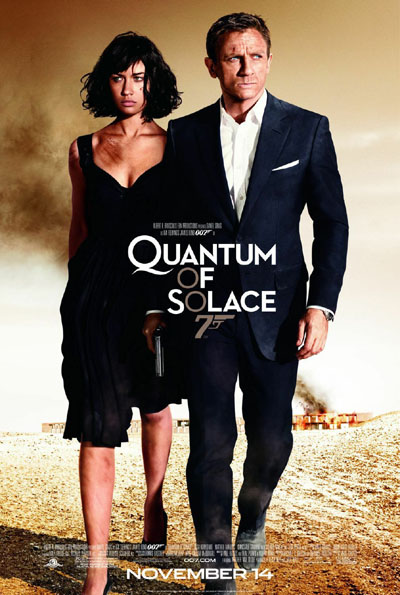
James Bond (DANIEL CRAIG) and Camille (OLGA KURYLENKO) walk through the Bolivian desert. Location: Chile
Image courtesy of MGM.
—
“Quantum of Solace” Starring Daniel Craig, Olga Kurylenko, Mathieu Amalric and Judi Dench. Directed by Marc Forster. 106 minutes. Rated PG-13.
Del’s take
Don’t ask a James Bond purist what he thinks of “Quantum of Solace.” He’ll likely curl his lip, let out an exasperated huff and mutter something to the effect, “They’ve ruined 007!”
And well they might. Like many fictional characters who have made the transition from 20th century escapism to 21st century realism, Bond has been transformed. “Quantum of Solace” continues that evolution.
(Warning: Spoilers follow.)
The plot is classic 007. A super-secret organization known only as Quantum angles to depose the current Bolivian government and replace it with a strongman willing to sign over that country’s most precious resource – water. Give the screenwriters credit: They anticipate the ferocious competition predicted by climatologists to result from global warming and its diminishment of potable water supplies.
Despite orders to the contrary from the redoubtable M (Judi Dench), Bond (Daniel Craig) travels to South America to discover exactly why it is ersatz environmentalist Dominic Greene (Mathieu Amalric) has taken such an interest in an apparently barren desert. Vengeance is a subplot. Bond seeks payback for the death of Vesper Lynd while Bond’s female counterpart, a Bolivian secret service agent, Camille (Olga Kurylenko) aims to kill the appointed strongman who murdered her parents.
The action is hyperkinetic and at times almost unwatchable as exquisitely choreographed fight scenes unfold at a blistering pace, leaving Bond a dirty, bloody shambles who nevertheless prevails over the bad guy de jour.
Almost lost amid Craig’s intensity is the humor – not the campy double entendres of Roger Moore’s Bond or the sly sophistication of a Sean Connery, but actual comedy that launches unexpectedly from the darkness. Upon arriving in Bolivia, Bond is escorted by a sexy British agent to a seedy hotel where they will pose as exchange teachers. Unhappy with the accommodations, Bond takes them to the ritziest hotel in town where he explains to the desk clerk, “We are exchange teachers – and we just won the lottery.”
But much goes missing in “Quantum of Solace,” and this is where purists will hold their noses. Lost is the suave, indefatigable James Bond who emerges from a wet suit wearing a tuxedo, his hair unmussed. Gone are the insane luxuries of the super-rich, the creatively dysfunctional devices of murder (death by laser emasculation) , and the over-the-top malevolence of the ultra-evil.
Worse, we see Bond bleed, and that is not part of the Sean Connery canon of an unreachable and untouchable super man. It is as if Bond has also been tainted by the economic meltdown and would trade his beloved martinis for a can of Miller Lite.
This new Bond is more Serpico than, well, James Bond, and while that may satisfy critics one must wonder if the paying public will believe its escapist dollars have been well spent. So far box office receipts have been excellent so it’s hard to argue with numbers.
Ultimately you must ask yourself: Why do people go to movies? If it is to see a reasonable facsimile of yourself then the new, evolved James Bond may work.
But if it is to see a spectacle that rises above the gritty ordinariness of life, expect a regime change in the James Bond pantheon of superheroes.
Del Stone Jr. is a former journalist and author.
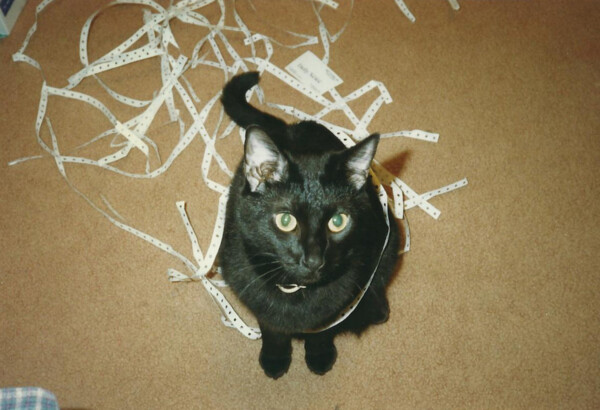
In this photo, Pavlov sits amid the ruins of tractor-feed perforation strips from my old Okidata dot-matrix computer printer. He loved playing with those strands of paper and usually created a huge mess. Photo by Del Stone Jr.
—
OK, so this blog is about a cat. Pavlov. MY cat. He’s sick and it scares me. I don’t want him to die.
Pavlov was here in 1992 when I was trying to recover from a catastrophic relationship. He didn’t know it but he helped me through that.
He was here on Oct. 4, 1995, when Category 4 Hurricane Opal roared across the Florida Panhandle. He didn’t know what was happening and his calm demeanor helped me cope with the terrifying destruction I watched fly past my window.
He was here in October 1998 when my father was dying and I finally broke down and cried for the first time in 25 years. He crawled into my lap and pawed at my chest as I sobbed.
He was here on Sept. 11, 2001 as I watched airplanes fly into buildings and could not comprehend the cruelty I was seeing on TV.
He was here on Sept. 15, 2004 as Hurricane Ivan laid waste to the Panhandle and I could not bear to sleep upstairs because the sound of debris hitting the roof frightened the living hell out of me.
And he was here in December 2005 when I made the decision to have Maggie, my other cat, put to sleep after she succumbed to the very same disease that is killing Pavlov now.
Pavlov is a chore. He must be given an IV every day. He needs laxatives to do his business. I hide vitamins in his food. He eats three different kinds of very expensive cat chow – at this point anything down his gut is a good thing. I give him an antibiotic twice a day. And he needs a special “massage” to keep his alopecia at bay.
It’s very expensive and time-consuming.
I think he’s still happy. He doesn’t appear to be suffering.
But it’s clear to me he’s heading downhill. He sounds different. He’s peeing around the house, which is never a good sign. I think his diabetes has returned.
I had Maggie put to sleep the week before Christmas, and I cried for weeks afterwards. I loved that cat.
I believed I didn’t feel the same about Pavlov, but I’m seeing now that isn’t true. It will be heartbreaking to make that drive to the vet in Destin.
No more pets.
—
Author’s note: Contact me at [email protected]. To read more of my opinion and humor pieces, visit delstonejr.com . I also write fiction – horror, science fiction and contemporary fantasy. If you’re a fan of such genres please check out my Amazon author’s page. Print and e-books are both available, and remember: You don’t need a Kindle device to read a Kindle e-book. Simply download the free Kindle app for your smart phone or tablet.
Video