I managed to live in the best of both worlds
Life has changed dramatically since I was a boy, so dramatically I sometimes must remind myself I’m the same person who got up to change the TV channel, then tune the correct color balance. The world of my childhood was much different than today, in some ways better but in many ways not.
When I was a boy, American cars ruled the road – not just Chevys, Fords and Chryslers, but Nashes, Ramblers and other makes from companies that no longer exist. “Foreign” cars consisted of Volkswagen Bugs, MGs and the occasional Triumph. There were no Japanese cars. Also, people tend to think of extended cab pickup trucks as a recent development, but Dodge made extended cabs back in the ’60s for the U.S. Air Force. And Ford produced a large van called the Falcon (not the car) that rivaled anything built by Chrysler these days.
TV sets were giant boxes that sat in the corner of the living room. They were furniture, not cute little devices that could be put anywhere, and they were filled with tubes that often burned out. When a tube burned out you had to take off the back of the TV, find the offending tube, take it to a hardware store and plug it in to a machine called a tube tester. Once the tube tester confirmed it had burned out, you bought a new tube and plugged it into the TV. If you were lucky, the TV would start working. If not, you had to find the other tube that burned out.
There were no remotes. You had to get up, cross the living room and manually switch the channel with a knob. Sometimes the contacts on the knob would wear out and the TV wouldn’t tune the channel. If you had a color TV – and we didn’t get one until 1966 – you had to manually adjust the color between each network, which at the time consisted of ABC, NBC and CBS. ABC tended to produce “hot” colors, lots of reds and oranges. CBS was in the middle and NBC produced “cold” colors, bland flesh tones that always needed warming up. My sister Sandie was the champion of color balancing the picture.
Telephones were hunks of metal sitting on their own table in a strategic location. Later, we graduated to Bakelite phones mounted on the wall. Rich people had extensions in their bedrooms. It was not unusual to share a “party line” with other houses in your neighborhood. You would pick up the phone and hear other people talking. Sometimes, you had to tell them to get off the phone so you could use it.
We didn’t have icemakers. We had ice cube trays – and not the bendable plastic trays where the ice cubes pop out. These were metal contraptions with a lift arm that bent the dividers, creating fractures in the ice. You dumped the cubes into the bucket and filled the tray with water and put it back in the freezer. It was a rule the last person to use all the ice was responsible for filling the trays. This produced violent arguments about which miscreant hadn’t filled the trays.
Only the better-off families could afford a dishwasher. We washed and dried dishes by hand. Again, whose turn it was to wash dishes became a source of friction in the household.
There were no video games but plenty of board games – Monolopy, Life, Yahtzee, CandyLand, and card games.
Microwave ovens came out in 1966 and we thought they were magical. Still, we wondered if they weren’t irradiating our food. In the early ’80s, cordless phones arrived. Again, we thought they were magical. I used to brag about being able to talk on the phone and do housework at the same time. We got cable TV in the mid-’60s and it was a gift from the rabbit-eared god – until the cable went out. I remember waiting all summer for a critical scene in the afternoon soap opera “Dark Shadows,” only to have the darned TV cable crap out just before it happened. VCRs and 8-track tapes came out in the late ’70s and early ’80s. You could buy a blank VCR tape for $20, while a pre-recorded movie cost between $80 and $90. Our first home computer was a “Trash 80” that you hooked up to your TV so you could have a “monitor.” Digital calculators emerged in the early ’70s but cost anywhere from $50 to over $200. I worked for Texas Instruments building calculators in the summer of ’74 – one of the best jobs I’ve ever had.
I got my first home computer in 1991, an IBM PS1, and you could access AOL or another online “community” whose name I’ve forgotten. Problem was internet usage cost by the minute, so going online was a costly affair. I sent my first e-mail in 1990 and was amazed when I got a response. It was to a friend who worked at Eglin Air Force Base. I thought it was the stuff of science fiction. In 1995 I purchased my first cellphone, a Motorola flip phone. The thing barely worked because the network of cellphone towers didn’t exist.
And that’s the way it went. Eventually ATM cards, satellite TV, smart phones, terrabyte hard drives, fuel injection and HDTV replaced the world I once knew. I confess it’s been a struggle trying to keep up with everything. Bulletin boards, Usenet and Gopher Space have been supplanted by Facebook and other social media networks. Frozen food tastes as good or better than fresh, despite my beloved “TV dinners” of Salisbury steak, peas and carrots, and mashed potatoes and gravy. On twitter I communicate directly with scientists, whereas in the past I would’ve mailed a typewritten letter and hoped for a response.
The new world has better technology. What I liked about the old was its innocence and focus.
But I feel lucky to have lived in both.
About the author:
Del Stone Jr. is a professional fiction writer. He is known primarily for his work in the contemporary dark fiction field, but has also published science fiction and contemporary fantasy. Stone’s stories, poetry and scripts have appeared in publications such as Amazing Stories, Eldritch Tales, and Bantam-Spectra’s Full Spectrum. His short fiction has been published in The Year’s Best Horror Stories XXII; Alfred Hitchcock’s Mystery Magazine; the Pocket Books anthology More Phobias; the Barnes & Noble anthologies 100 Wicked Little Witch Stories, Horrors! 365 Scary Stories, and 100 Astounding Little Alien Stories; the HWA anthology Psychos; and other short fiction venues, like Blood Muse, Live Without a Net, Zombiesque and Sex Macabre. Stone’s comic book debut was in the Clive Barker series of books, Hellraiser, published by Marvel/Epic and reprinted in The Best of Hellraiser anthology. He has also published stories in Penthouse Comix, and worked with artist Dave Dorman on many projects, including the illustrated novella “Roadkill,” a short story for the Andrew Vachss anthology Underground from Dark Horse, an ashcan titled “December” for Hero Illustrated, and several of Dorman’s Wasted Lands novellas and comics, such as Rail from Image and “The Uninvited.” Stone’s novel, Dead Heat, won the 1996 International Horror Guild’s award for best first novel and was a runner-up for the Bram Stoker Award. Stone has also been a finalist for the IHG award for short fiction, the British Fantasy Award for best novella, and a semifinalist for the Nebula and Writers of the Future awards. His stories have appeared in anthologies that have won the Bram Stoker Award and the World Fantasy Award. Two of his works were optioned for film, the novella “Black Tide” and short story “Crisis Line.”
Stone recently retired after a 41-year career in journalism. He won numerous awards for his work, and in 1986 was named Florida’s best columnist in his circulation division by the Florida Society of Newspaper Editors. In 2001 he received an honorable mention from the National Lesbian and Gay Journalists Association for his essay “When Freedom of Speech Ends” and in 2003 he was voted Best of the Best in the category of columnists by Emerald Coast Magazine. He participated in book signings and awareness campaigns, and was a guest on local television and radio programs.
As an addendum, Stone is single, kills tomatoes and morning glories with ruthless efficiency, once tied the stem of a cocktail cherry in a knot with his tongue, and carries a permanent scar on his chest after having been shot with a paintball gun. He’s in his 60s as of this writing but doesn’t look a day over 94.
Contact Del at [email protected]. He is also on Facebook, twitter, Pinterest, tumblr, TikTok, and Instagram. Visit his website at delstonejr.com .
“Attention grocery store shoppers: Mr. Stone has found the one item he intends to purchase and is heading to the front of the store. Drop what you are doing and RUN for the cash registers, NOW! Stampede if you must, but get there before he reaches the checkout aisle. There must be at least six people at every register. If you want to pay in rubles, that’s fine. A debit card with insufficient funds and no ID is also good. Or, our manager will be happy to approve your application for a personal check-cashing account, as soon as he gets back from his potty break. But under no terms must Mr. Stone be allowed to walk into the store, select an item, then proceed to the checkout and pay for it in a timely manner. That is all.”
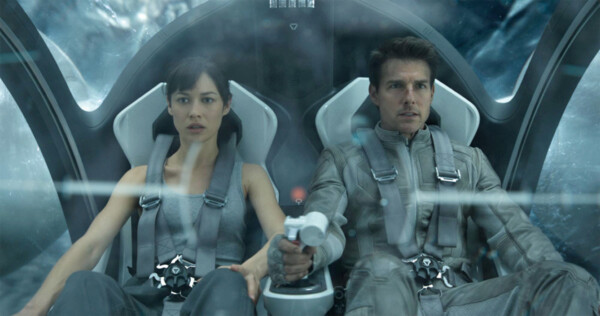
Image courtesy of Universal Pictures.
—
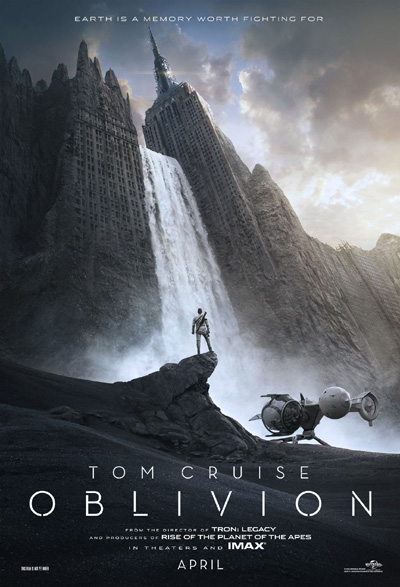
“Oblivion” Starring Tom Cruise, Morgan Freeman, Olga Kurylenko, Andrea Riseborough, Melissa Leo. Directed by Joseph Kosinski. 124 minutes. Rated PG.
Del’s take
And why did they choose the title “Oblivion”?
Because that’s how long the movie is.
It’s nice to look at, though. And the cast does a credible job. Critics dismiss Tom Cruise as an actor but he’s good – if you saw “Collateral” you’ll know what I’m talking about. Olga Kurylenko, Andrea Riseborough and Melisso Leo carry their weight, with Leo’s part trending toward Clicheland at the end. Morgan Freeman stars as Morgan Freeman.
“Oblivion’s” problem, however, lies in its veneer of a story. Casual science fiction fans will appreciate its sleek look and original ideas. Everybody else will look at those ideas, recognize they’ve been done time and again, and wonder what the fuss was about.
Here’s the story: Mankind has fought and won a war with alien invaders, but in the process they’ve rendered Earth uninhabitable. Everyone has fled to a sanctuary on Saturn’s moon Titan. Left behind are Jack (Cruise) and Victoria (Riseborough) who must oversee a fleet of drones that protects giant energy harvesters from scattered remnants of the alien invasion force. In two weeks’ time the harvesters will have collected enough energy to ensure mankind’s future on Titan. But a spacecraft crash lands on Earth and disgorges a crew of preserved human beings, including a woman Jack seems to remember from a former life. He begins to question everything he knows, including his current mission.
“Oblivion” relies on a couple of plot twists to deliver impact and I will not reveal them here. Suffice it to say the first act – no doubt intended as a character-building session by director Kosinski – is excruciatingly long and, dare I say, boring. Things pick up in the second act, and it was here I figured out what was really going on in the movie. The third act was mostly action-packed, though a word of warning: If trailers created the impression “Oblivion” is a grand-scale science fiction epic with sprawling CGI battles, think again. It’s mostly character-driven. Movie fans will recognize influences from “2001,” “Minority Report” and “Gattaca.”
Cruise is effective as the memory-wiped Jack struggling for rapprochement with the images he sees of a wife in a former life. Riseborough, his teammate, successfully evokes a slavish dedication to corporate dictates, at one point reminding Jack it’s their job not to remember. And Kurylenko brings to her role a sweetly devoted innocence that makes her worthy of Jack’s attentions.
Leo’s role, as the administrator of an orbiting station that monitors the drones, is constrained, but she nonetheless brings personality to her exchanges with the Earth-side crew until the very end of the movie, when she devolves into a caricature. Freeman has limited screen time and seems to channel Denzel Washington in “The Book of Eli.”
All of this is not to say “Oblivion” is a bad movie. But it’s not very original, it features long stretches of not much happening, and despite its beauty and the skill of its cast, it won’t create a lasting impression.
Mladen’s take
Walking from the theater, I asked Del, “What was the last good movie we saw?” We had just watched “Oblivion.”
“Cloverfield,” was the response after a few moments of thought.
Yet, Del has written a merciful review of “Oblivion.”
To be honest, I sympathize to some degree with his reaction. The actors sincerely and skillful portrayed their characters but were unable to subdue the movie’s weak script, clichéd ideas and too many subplots.
“Oblivion” is a sci-fi dystopian chick-flick fairy tale with some action.
Let’s start with the good.
The cinematography was lush and, somehow, sparing at the same time.
The special effects were very good.
Jack’s bubble engine-powered, high-performing V/STOL aircraft with a goldfish bowl cockpit was neat.
The autonomous spherical drones that protected gigantic water vaporizers were menacing despite their shape. Fast, heavily armed and assessing threats through HAL 9000-like sensor eyes, the unmanned combat aerial vehicles intimidated me not because of their role in the movie. They’re what the real mankind-induced future has in store for us.
Finally, there’s what the orbiting space station administrator would say when she finished giving Jack and Victoria their orders: “Are we an effective team?”
It’s exactly what many of us encounter during the course of a workday. A type of corporate cheerleading that’s all enthusiasm and smiles on the surface and brain-washing dogma beneath that reminds workers they better toe the line if they want to keep their jobs. Are you with us or against us?
Now, a few of the weaknesses of “Oblivion.”
Del mentioned that “Oblivion” has similarities with movies that came before it, “2001: A Space Odyssey,” “Minority Report,” and “Gattaca.” I add “The Matrix,” “Independence Day” and even “Battle: LA” to the list.
Maybe it’s impossible to devise a novel reason that aliens would invade earth. Maybe it’s impossible to end the invasion with other than nuking the mothership from the inside after gaining access to it through implausible deception. But, can’t someone, somewhere try?
“Oblivion” is a complex story. It weaves Jack’s nightmares with suspicions about the truth of his situation. For good measure, there are the battles that he has to fight with “scavs” whenever he has to repair a drone that has crash landed. And, another principal character is fully introduced about half-way into the movie.
Complexity doesn’t have to be bad. The problem is that it can be very tricky to develop as a screenplay. And, in the case of “Oblivion,” it took a long, long time to tie everything together. The effort including introducing a backstory to establish true identities.
As “Oblivion” dragged on, I became bored. Not even the questions that it raised periodically were enough to pull me back from the urge to look at my wristwatch.
I didn’t feel much sympathy for the characters when the movie ended.
And, I was thoroughly irritated by the arrogant dopiness of the lone, star-travelling alien that met its demise by ingesting a human-planted, uncontrolled nuclear chain reaction device. All the being needed was a couple of cloned TSA screeners and an X-ray machine to detect the nuke and it would have been on its way to destroy another planet in just a couple of weeks.
Mladen Rudman is a former journalist and public information officer. Del Stone Jr. is a former journalist and author.