Jeff Newell will not be the last of his kind, but he will be the best
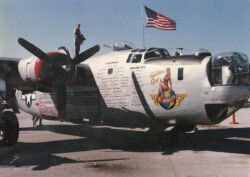
While the nose art indicates the name of this Collings Foundation B-24 is "Golden Girl," the plane was known as the "All American." Journalist Bruce Brewer stands atop the fuselage prior to the flight from Panama City to Crestview in March 1998. Image courtesy of Del Stone Jr.
The afternoon was cold, and Jeff Newell was trembling. “We get to go flying!” he enthused, rubbing his hands together, his voice rising and falling in a little boy’s sing-song. The freezing wind mattered little. More important was the aging… READ MORE
For the love of God and Pet of the Day
I get some interesting mail.
For instance, sitting on my desk is a letter from God.
Well.
I didn’t see THAT coming.
Why would God communicate with via the Postal Service? Why not a good old-fashioned bolt of lightning?
Relax. The God of the letter is not the God who lives in the infinity ZIP code.
This God is serving a prison term for robbery. He refers to himself as the “Jesus Satan himself,” and writes things like:
“I am d Lord they God. D author and finisher of d holy bible. Since u seek a proof of Christ Satan himself speaking in me.”
All righty then.
This God has nothing to do with eternal salvation. He writes: “I love them that love me, and those that seek me early shall find me, and I will fill their treasure … Call Western Union (at) 1-800-325-6000 … give them my name and DC # number with a credit car … give 500, get 25 million, 3,000 get 300 billions. …”
I think this God must be related to the fellow in Nigeria who wants to park his millions in my checking account.
If this God is the real deal he can make his own millions and call Western Union himself. He does not need me to tell him my credit card number. He should already know it. Right?
On another part of my desk I have a note from an unhappy Pet of the Day submitter.
Yes, I am the Pet of the Day editor. Your puppies and parrots and potbellied pigs go through me to reach the pages of the Daily News.
The Pet of the Day is not journalism, of course. It’s an amusement, like the crossword puzzle. But it is beloved, and I enjoy doing it.
To be fair, I publish the pets in the order I receive them. I will occasionally cheat if circumstances warrant, but for the most part Pet of the Day is a first-come, first-served service.
I have quite a backlog of Pet of the Day submissions, and sometimes the wait is so long people think I’ve rejected their kitties and cockatiels. That apparently was the case with this letter writer.
I published the photo of his pet, which I remember because it was very unusual. About two weeks later, while going through the Pet of the Day submissions, I encountered a second letter from this fellow. It read:
“Mr. Chicken(expletive deleted) – Candy(expletive deleted). Afraid to show (name of pet)’s picture? After 40 years , switching to U.S.A.”
Feel the love.
Apparently he thought I’d rejected the photo of his pet. Of course I didn’t, but he’ll never know because now he is reading “U.S.A.”
If a person can become that enraged over a photo of a pet, think of the damnation he might utter for something like world peace, or the election.
Best not let him and God get together. Otherwise, what rough beast, its hour come ’round at least, shall slouch toward Okaloosa County to raise Cain?
This column was originally published in the May 15, 2001 edition of the Northwest Florida Daily News and is reprinted with permission.
About the author:
Del Stone Jr. is a professional fiction writer. He is known primarily for his work in the contemporary dark fiction field, but has also published science fiction and contemporary fantasy. Stone's stories, poetry and scripts have appeared in publications such as Amazing Stories, Eldritch Tales, and Bantam-Spectra's Full Spectrum. His short fiction has been published in The Year's Best Horror Stories XXII; Alfred Hitchcock's Mystery Magazine; the Pocket Books anthology More Phobias; the Barnes & Noble anthologies 100 Wicked Little Witch Stories, Horrors! 365 Scary Stories, and 100 Astounding Little Alien Stories; the HWA anthology Psychos; and other short fiction venues, like Blood Muse, Live Without a Net, Zombiesque and Sex Macabre. Stone's comic book debut was in the Clive Barker series of books, Hellraiser, published by Marvel/Epic and reprinted in The Best of Hellraiser anthology. He has also published stories in Penthouse Comix, and worked with artist Dave Dorman on many projects, including the illustrated novella “Roadkill,” a short story for the Andrew Vachss anthology Underground from Dark Horse, an ashcan titled "December" for Hero Illustrated, and several of Dorman's Wasted Lands novellas and comics, such as Rail from Image and “The Uninvited.” Stone's novel, Dead Heat, won the 1996 International Horror Guild's award for best first novel and was a runner-up for the Bram Stoker Award. Stone has also been a finalist for the IHG award for short fiction, the British Fantasy Award for best novella, and a semifinalist for the Nebula and Writers of the Future awards. His stories have appeared in anthologies that have won the Bram Stoker Award and the World Fantasy Award. Two of his works were optioned for film, the novella “Black Tide” and short story “Crisis Line.”
Stone recently retired after a 41-year career in journalism. He won numerous awards for his work, and in 1986 was named Florida's best columnist in his circulation division by the Florida Society of Newspaper Editors. In 2001 he received an honorable mention from the National Lesbian and Gay Journalists Association for his essay “When Freedom of Speech Ends” and in 2003 he was voted Best of the Best in the category of columnists by Emerald Coast Magazine. He participated in book signings and awareness campaigns, and was a guest on local television and radio programs.
As an addendum, Stone is single, kills tomatoes and morning glories with ruthless efficiency, once tied the stem of a cocktail cherry in a knot with his tongue, and carries a permanent scar on his chest after having been shot with a paintball gun. He’s in his 60s as of this writing but doesn't look a day over 94.
I get some interesting mail. For instance, sitting on my desk is a letter from God. Well. I didn’t see THAT coming. Why would God communicate with via the Postal Service? Why not a good old-fashioned bolt of lightning? Relax…. READ MORE
You want election results? They’re going to cost you
We, the registered voters of Florida, are very happy the rest of you Americans have taken such a deep and abiding interest in our ballot-gathering process.
Indeed, we feel honored to hold such a position of, well, how shall I put it? Civic responsibility? Constitutional culpability?
Raw, naked power?
(Forgive me. I swoon.)
Given that the outcome of our vote will decide the fate of the nation for the next four years, we recognize and accept the important obligation that has been placed within our dot-coloring grasp: to resolve this issue in a way that facilitates the smooth transition of political authority from the current administration to the new leadership in Washington, D.C. – whomever we choose to let that be.
We feel confident we can work out any lingering questions about the voting results in Florida so the entire nation can get back to wondering why, now that the election is over, nobody from Congress is offering to wash their car.
But first, a list of our demands.
1. Life in Florida is more difficult than you might believe. For instance, we have lots of water here in the Sunshine State, and it can be very annoying. Also, we’re forever being struck by pesky hurricanes. As you can imagine, this has played havoc with the insurance industry, which has actually been forced in recent years to – Gasp! – PAY CLAIMS.
Because of this tragic and unforeseen circumstance, insurance companies have become reluctant to set foot in the state of Florida for fear of being set upon, like Faye Ray at a King Kong Convention.
So it would be helpful if the rest of the nation pitched in to help us. We’re talking fully subsidized flood and windstorm coverage for every property owner in Florida – even property owners who don’t live next to the ocean. I mean, we DO have lots of rivers and lakes here too, you know.
2. Florida has long been known as a tourist destination.
Well, we don’t want any more tourists. They’re rude, they’re pale, and they block traffic. Don’t send them here, ever again.
But do send their money. In fact, if every state would budget, oh, $100 million per year in a special Help Florida Recover Its Wits tax, we expect the collective IQ here in the Sunshine State would surge above the level required for the citizenry to color little dots next to the name of the highest bidder.
So please, help those who cannot help themselves.
3. Florida is confronted with a special circumstance:
The snowbird.
The snowbird migrates from Ontario, or Michigan, arriving in October and departing in March, once all the sales racks of stretchy-seat pedal pushers have been emptied.
Sometimes these snowbirds fail to leave in March and become permanent residents, like that whale in San Francisco that became confused and swam upriver. Such is the case with Palm Beach.
Unfortunately, nobody is detonating depth charges, or playing whale love songs, to lure these snowbirds back to Manitoba.
And just let me say, if you think these people are a menace in the voting booth, you should see them behind the wheel of a ‘93 Buick LeSabre. No storefront window is safe.
Or watch a flock of snowbirds hose out a buffet and you will discover religion, my brother. The horror; verily, the horror.
So if you northern states would lure these lost snowbirds back to their roosts in Waukegan, that would take a load off our ballot-counting shoulders.
4. Lastly, we registered voters in Florida are a little tired of all the teasing and jokes.
We’d like to remind the rest of the nation that here in Florida, we have F-15 strike aircraft, carrier battle groups, and submarines armed with nuclear missiles. We can deal a punishing blow to any carpet-bagging, interloping smarty-pants who thinks he knows more about rigging democracy than we do.
If the jokes and teasing don’t stop immediately, we’ll aim these weapons of mass destruction at a target you really care about:
Disney World.
Or Sea World.
Or even Reptile Land, home of the piano-playing duck.
Think of it, my fellow Americans. No more $3 Dove bars in the shape of mouse ears. Or the music box that plays “It’s a Small World After All’’ lying in a puddle of radioactive slag. Travel agents everywhere would hurl themselves from mountains of unsent baskets of fruit.
In conclusion, I’d like to say, Thank you, America, for giving the registered voters of Florida a chance to share with you our mutual concerns regarding the outcome of the presidential election. We are prepared to move forward as one nation, under God, indivisible, blah blah.
If YOU are prepared to ante up. And don’t tell us the check is in the mail; we’ve heard that before. And none of those annoying exploding paint packets.
This column was originally circulated by the Knight Ridder Tribune newswire in November 2000 and was published in various newspapers in the United States and Canada.
About the author:
Del Stone Jr. is a professional fiction writer. He is known primarily for his work in the contemporary dark fiction field, but has also published science fiction and contemporary fantasy. Stone's stories, poetry and scripts have appeared in publications such as Amazing Stories, Eldritch Tales, and Bantam-Spectra's Full Spectrum. His short fiction has been published in The Year's Best Horror Stories XXII; Alfred Hitchcock's Mystery Magazine; the Pocket Books anthology More Phobias; the Barnes & Noble anthologies 100 Wicked Little Witch Stories, Horrors! 365 Scary Stories, and 100 Astounding Little Alien Stories; the HWA anthology Psychos; and other short fiction venues, like Blood Muse, Live Without a Net, Zombiesque and Sex Macabre. Stone's comic book debut was in the Clive Barker series of books, Hellraiser, published by Marvel/Epic and reprinted in The Best of Hellraiser anthology. He has also published stories in Penthouse Comix, and worked with artist Dave Dorman on many projects, including the illustrated novella “Roadkill,” a short story for the Andrew Vachss anthology Underground from Dark Horse, an ashcan titled "December" for Hero Illustrated, and several of Dorman's Wasted Lands novellas and comics, such as Rail from Image and “The Uninvited.” Stone's novel, Dead Heat, won the 1996 International Horror Guild's award for best first novel and was a runner-up for the Bram Stoker Award. Stone has also been a finalist for the IHG award for short fiction, the British Fantasy Award for best novella, and a semifinalist for the Nebula and Writers of the Future awards. His stories have appeared in anthologies that have won the Bram Stoker Award and the World Fantasy Award. Two of his works were optioned for film, the novella “Black Tide” and short story “Crisis Line.”
Stone recently retired after a 41-year career in journalism. He won numerous awards for his work, and in 1986 was named Florida's best columnist in his circulation division by the Florida Society of Newspaper Editors. In 2001 he received an honorable mention from the National Lesbian and Gay Journalists Association for his essay “When Freedom of Speech Ends” and in 2003 he was voted Best of the Best in the category of columnists by Emerald Coast Magazine. He participated in book signings and awareness campaigns, and was a guest on local television and radio programs.
As an addendum, Stone is single, kills tomatoes and morning glories with ruthless efficiency, once tied the stem of a cocktail cherry in a knot with his tongue, and carries a permanent scar on his chest after having been shot with a paintball gun. He’s in his 60s as of this writing but doesn't look a day over 94.
We, the registered voters of Florida, are very happy the rest of you Americans have taken such a deep and abiding interest in our ballot-gathering process. Indeed, we feel honored to hold such a position of, well, how shall I… READ MORE
The history of design, from cave walls to hog trough
Try to relax.
We should have a conversation, you and I, about something we have in common. I’ll try not bore. But promise you’ll read this. It won’t hurt … not for long.
What we have in common is an interest in newspapers, and design, and a curiosity about the future. But first, let me set the stage. …
In the Beginning
When I laid out my first news page we sketched our grids on cave walls by firelight and the new hire who did not know to keep moving was snapped up by lizards the size of corporate logos on a Times Square message board which is how the layout style known as “minimalism” came into existence. …
OK. Would you believe we wrote our stories on the blade of Abraham Lincoln’s shovel and slogged six miles Donner Party-style through hip-deep snow to reach the office where sometimes out of necessity we devoured the Lifestyle editor, and our “health benefits” amounted to a Flintstones chewable. …
No?
The truth, then, as my fading memory will allow.
I laid out my first newspaper page in 1979. Computers were so new that none of us realized the TV-like object on our desk was not a “computer” at all but a “terminal,” slaved to a machine which brooded in a special room, HAL-like, plotting the downfall of civilization. God help us if the temperature in that room rose above a bracing 68 degrees – we might spend the rest of the night shouting the news from a street corner as the machine choked on its fumes. (This actually happened, so don’t shake your head.)
Those of us affiliated with The Associated Press received photographs over something called a Laserphoto receiver which regular jammed, scratched pictures, or the guys in Sports would never change the film despite receiving an unfair number of pictures, which meant on Sunday afternoon there would be three photographs in the tray instead of the required 150, and of those three, two would be mug shots of forgettable celebrities like Charo and the other would be a weather map. You’d get the machine fixed in time for 150 football photos to spew forth.
We laid out our pages on yellow “dummy” sheets, which often referred to the person using the sheet. The drawing of dummy sheets became an art itself, much the way doctors write prescriptions. It was a brave (but mostly foolish) copy editor who approached his or her dummy sheet with an ink pen.
Once the page was drawn, we wrote our headlines and dispatched our copy to an electronic typesetter, often forgetting to include the markup commands (think HTML) which set the text in body copy format. The result was something called Texas Agate – a 50-inch story set in 36-point Helvetica could chew up a $15 roll of film in about two seconds flat. In 1979, $15 was over half a day’s pay.
The culmination of this chaos was a pile of film that was run through a waxer, and a battle with Sports over which person in the Production Department took his or her razor blade, trimmed off all the descenders on your headlines and “built” your page. We had our surgeons and our butchers, and again God help the copy editor who was out of favor with the “backshop.” He or she ended up with Ol’ One Thumb, who routinely sliced off various body parts while trying to get the Letters to the Editor evened out.
You will never see any of this hanging in a museum, but trust me: The entire process, start to finish, was art as art will ever be. Its practitioners were artists, and its audiences were patrons of the arts.
Times and technology change, and this is not a sentimental lament for a bygone era because frankly, the copy editor is a much more powerful creature today than in the past. Still, a Brave New World of design, and journalism as a whole, threatens. …
Viva la revolucion
The early 1980s brought a new lifeform into existence:
The page designer.
The distinction between layout and design, and copy editor and designer, is one that eluded most newspapers then, and probably many newspapers today. Simply put, the people who decided how pages look were copy editors who followed a few basic rules of layout – don’t bump heads, don’t tombstone, don’t bump art – and concentrated mostly on headline accuracy, rooting out garble in wire copy, and deadlines. Appearance was a nice but not essential icing on the cake that was tomorrow morning’s edition.
They didn’t make much money. Ho ho ho, at least that hasn’t changed.
But other advancements – the technology of computers and scanners, coupled with an increasing sensitivity to non-traditional ideas like “marketing” and “business” – threw open the musty doors of objectivity, actual journalism, and attention to detail. What spellcheck couldn’t catch, the public needn’t worry about either.
If you detect a whiff of sarcasm, please continue reading. The point will eventually be drawn.
Shot Number 1: Color emerged from the primordial ooze of ink.
At first, it was “spot” color – a single, primary color used on borders and boxes, or the occasional tint block, carefully laid down with “screens” which had to be carefully aligned so the dot patterns wouldn’t produce unintended paisley print. A sports editor I knew was fond of these tint blocks and often used a bright magenta for the top story, an eye-peeling yellow for the middle and a rich, velvety cyan for the bottom story. We called these “Marvel Comics pages” – no insult to Marvel Comics intended.
Then, “process” color in photographs began to appear with increasing regularity.
And then, the shot that was heard ‘round the world: a little thing called USA Today.
We laughed at USA Today. Actually, what we did was “laff.” We laffed at the tiny stories that carried no depth. We giggled at the goofy graphics with the little men marching up the spires of a bar chart. We shook our heads at the profligate use of color, in everything from nameplates to graphics to photographs. We laffed and laffed, and predicted doom for this amazing waste of money and talent.
But as the national attention span grew shorter and shorter, we tried to emulate USA Today, or better, improve it, because while nobody outside of Gannett High Command would have admitted it at the time, all that color, and all that artwork, and all that copy did look kinda neat. So we hired artists and bought expensive laser scanners and set aside entire pages for single stories. …
And it was somewhere around that moment when “layout,” in a DaVincian spark of revolution, became “design.” At least that’s the way it was for us.
Brave New World
The march forward has carried us to the here and now, where I exist in a continuous state of slack-jawed amazement. We have our own snooty club, the Society for News Design, with thousands of members who live and work everywhere in the world. We have computers on our desks, not terminals, and each one of these plastic prima donnas can do more, in less time, than a hundred of those hulking, AC-sucking brutes back in 1979. We dummy our pages electronically, grabbing photographs from electronic archives that exist thousands of miles away. We print them in perfect register at higher resolutions, and it happens instantly – unless the damn machine crashes, or Ol’ One Thumb forgets to load the image setter with film (she’s cross-training for a job in Sports).
And were this not sufficiently drool-inducing, we stand on the edge of another revolution, (to borrow one of the hateful buzzwords beloved by the Orwellian Mass Mind that hangs over us all like an old-fashioned woodcut of a smiling man on the moon) a “paradigm shift” which either threatens or promises – your choice here – to change utterly the way we find out if it’s gonna rain tomorrow.
The traditional (and some might say static) venue of print on paper is about to give way to the active and adaptive and infinitely flexible and dynamic World Wide Web, and to quote somebody, I don’t know who, “Things will never be the same again.”
Animal Farm
Change is in the air. A fresh breeze, or the stench of a hog trough.
The Web may do to newspapers what movies and TV did to theater – it may reduce print media to a small-market backwater. That’s not to say journalism will die. Stories will still need writing and editing. Photographs and video will need shooting and editing. New opportunities will arise as newspapers become like TV stations with depth, and TV stations become like newspapers with style.
Greater threats – or “changes,” to appease the PollyAnnas – face the Land of News, most seriously the increasing emphasis on the economics of journalism, the old P and L, the bottom line, the Show Me the Money or Get Outta My Face. “Just win, baby,” was the famous mission statement articulated for the NFL’s Oakland Raiders by owner Al Davis, who knew that points on the scoreboard amounted to money in the bank. And as it is with the NFL, and other houses of entertainment, so it is with print media. And with non journalists caught up in the process, newspapers, and magazines, and all the former uncorruptibles of the information world, will take on a perky new patina of irrelevancy as cash registers take over where the ink-stained wretches died off.
The Web may save journalism. Give a disgruntled old fart a digital camera, a laptop computer and a handful of megs on a server, and maybe he’ll do what the folks like the moneytenders who mishandled the Staples Center deal in Los Angeles apparently never knew:
Tell the truth.
We’ll see. We’ll see.
Meanwhile, what of the designer? What of the pica stick, the proportion wheel, the sliced-off appendages, the beautiful pages, and the information conveyed by story placement, headline size, and type font?
Think about this: Could the CD liner ever equal the album cover for “Aqualung”?
Will we rise to the surface, take a deep breath, then plunge into the Land of Click, the linear, artless, static realm of web design?
I assume that’s why you’ve read this far, and if I’m correct, then I assume you’ll continue. Be of good cheer; everything that follows is shorter, and more entertaining, and perhaps more caustic. It’s about the thing we have in common: design and its future. In order to explain my future I had to show you the past. But relax, because it’s over now and we can move on.
As we do, however, I want to you to keep an image in your mind, of the closing scene in Orwell’s “Animal Farm,” where the pigs, and the men, are sitting at the table, planning the future. I want you to constantly ask yourself:
“Which one am I?”
About the author:
Del Stone Jr. is a professional fiction writer. He is known primarily for his work in the contemporary dark fiction field, but has also published science fiction and contemporary fantasy. Stone's stories, poetry and scripts have appeared in publications such as Amazing Stories, Eldritch Tales, and Bantam-Spectra's Full Spectrum. His short fiction has been published in The Year's Best Horror Stories XXII; Alfred Hitchcock's Mystery Magazine; the Pocket Books anthology More Phobias; the Barnes & Noble anthologies 100 Wicked Little Witch Stories, Horrors! 365 Scary Stories, and 100 Astounding Little Alien Stories; the HWA anthology Psychos; and other short fiction venues, like Blood Muse, Live Without a Net, Zombiesque and Sex Macabre. Stone's comic book debut was in the Clive Barker series of books, Hellraiser, published by Marvel/Epic and reprinted in The Best of Hellraiser anthology. He has also published stories in Penthouse Comix, and worked with artist Dave Dorman on many projects, including the illustrated novella “Roadkill,” a short story for the Andrew Vachss anthology Underground from Dark Horse, an ashcan titled "December" for Hero Illustrated, and several of Dorman's Wasted Lands novellas and comics, such as Rail from Image and “The Uninvited.” Stone's novel, Dead Heat, won the 1996 International Horror Guild's award for best first novel and was a runner-up for the Bram Stoker Award. Stone has also been a finalist for the IHG award for short fiction, the British Fantasy Award for best novella, and a semifinalist for the Nebula and Writers of the Future awards. His stories have appeared in anthologies that have won the Bram Stoker Award and the World Fantasy Award. Two of his works were optioned for film, the novella “Black Tide” and short story “Crisis Line.”
Stone recently retired after a 41-year career in journalism. He won numerous awards for his work, and in 1986 was named Florida's best columnist in his circulation division by the Florida Society of Newspaper Editors. In 2001 he received an honorable mention from the National Lesbian and Gay Journalists Association for his essay “When Freedom of Speech Ends” and in 2003 he was voted Best of the Best in the category of columnists by Emerald Coast Magazine. He participated in book signings and awareness campaigns, and was a guest on local television and radio programs.
As an addendum, Stone is single, kills tomatoes and morning glories with ruthless efficiency, once tied the stem of a cocktail cherry in a knot with his tongue, and carries a permanent scar on his chest after having been shot with a paintball gun. He’s in his 60s as of this writing but doesn't look a day over 94.
Try to relax. We should have a conversation, you and I, about something we have in common. I’ll try not bore. But promise you’ll read this. It won’t hurt … not for long. What we have in common is an… READ MORE
Del reviews ‘The Road Stops at Nowhere’
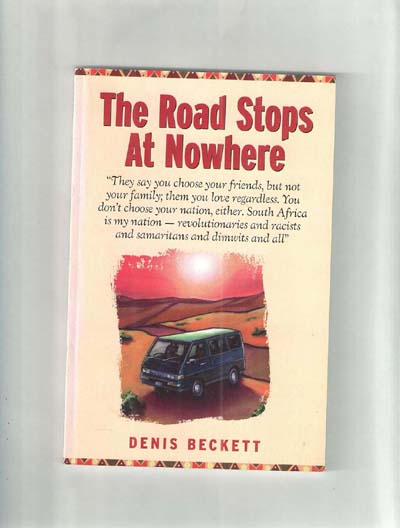
"The Road Stops at Nowhere," by Denis Beckett, 80 pp, NDA Press, 1998.
It was our annual summer ritual: a long vacation trip by automobile.
Each of us had our roles in this undertaking: We kids were responsible for collecting our entertainment and farming out the bowl of sacrificial goldfish to Aunt Erma for possible safekeeping in her ferociously chlorinated tap water. Mom packed our bags and scoured the grocery store for provisions -- forbidden treats I now realize were bribes to keep us from strangling one another in the back seat of the car and, later, in the tent. Dad was our navigator, and also our mechanic. He spent nights prior to our departure hunched beneath the hood of our '68 Ford Fairlane, inspecting hoses and belts and fluid levels and batteries. Unlike today, 1968 America did not provide an Auto Zone on every corner. Breakdowns were matters of real concern.
But Dad was a good mechanic, and parts for the Fairlane were readily available. What breakdowns there were, we greeted with more annoyance than fuss, because that too was part of the vacation ritual.
But events could have played out much differently. Suppose, for instance, we'd been driving a Mitsubishi van outfitted with more parts from as many different sources than Dr. Frankenstein's monster? And instead of threading our way through the alligator-and-orange-juice emporiums of Central Florida we'd been navigating a desert big as the right-handed corner of the continent?
And just suppose our government, a repressive autocracy of minority rule, were tottering on the brink of a well-deserved but unfathomable change -- a rewriting of the old social order that might come about with a bang or a whimper, bringing to our lives new ways neither tested by their advocates nor trusted by their detractors.
Not exactly "What I Did on My Summer Vacation."
More precisely, it is "The Road Stops at Nowhere," a slender volume describing the events of a summer vacation that did not go according to plan.
When South African journalist Denis Beckett loaded his bags and his family into their Mitsubishi Starwagon and set out for the Eastern Cape for a midsummer vacation at the beach, he could not have known this simple excursion would become an odyssey of baffling mechanical breakdowns and even more baffling repair jobs, both of which occurred with fateful unpredictability in an environment that was as arid socially and culturally as it was meteorologically.
Beckett writes with humor and directness as he describes his family's journey across the Karoo, a "timid desert" by the standards of its parched neighbors, the Kalahari and Namib. A timing chain on the Mitsubishi breaks. Then the oil pump goes. Then the pistons seize. Promised repairs go undone -- not because the mechanic is dishonest. Here in the wastes, a different concept of time exists, where "Wednesday night, for sure, definite" means whenever the parts come in.
Beckett ferries his family on to Cape Town by train, intending to return for the crippled van, which has now developed water pump problems. But his daughter breaks her arm, necessitating a whirlwind introduction to the vicissitudes of South African emergency medicine.
Which is only the beginning. The Mitsubishi is bewitched with more breakdowns. The repairs are similarly afflicted. The family is smitten with more trips by train.
The vacation is in peril.
Throughout this incredible litany of bizarre and often hilarious misadventures, Beckett provides a running narrative about the political and social climate of pre-democracy, not-quite-post apartheid South Africa that both enlightens and unhinges. While most Americans, freighted with their own perceptions of racial injustice, viewed the unfolding of events in South Africa as a simple contest between good and evil, Beckett reveals the invariable shades of gray that color in any human conflict, best exemplified by this excerpt, which describes the state of racial affairs at that moment:
"South Africa lacks the normal symbols of national unity, like flag and anthem, but we at least have a slogan that applies all round. It is: `I Am Not A Racist But ...'
"In town, a white woman has said there's no work for whites. `The bosses in Johannesburg tell their managers: `We're against apartheid so you must employ non-whites.' Then they pay them less so they get more profits.' Two coloureds (Indians) have told me there's no work for coloureds: `The Boers like the blacks because they'll work for slave wages.' Now I'm told there's no work for blacks: `The Boers take coloureds, who speak their language and won't stand up for workers' rights.' "
While sometimes depressing, Beckett's narrative is suffused with hope -- not the drippy smarm of prime time TV network fare, but a pragmatic acknowledgement that while things were bad and may get worse, down the line they may get a whole lot better. This was, after all, pre-democracy South Africa, when idealism was slowly tipping the scales toward a day when blacks and whites would share responsibility for running the country.
While the new South Africa faces serious growing pains, Beckett neatly articulates his expectations of what is happening in his nation, and what will happen in the years to come, with this scene that takes place in an auto repair shop. The Mitsubishi lost its starter, which has just been repaired from scavenged parts by the shop's two owners, a white man and a coloured, both of whom are named Frans:
"I am proudly presented with what one Frans calls the most bastard starter he ever saw, with portions of Ford and Toyota and Massey-Ferguson in its ancestry."
The starter may be ugly, but it works.
Beckett has a long history of speaking out against white-only rule in South Africa, having edited the publication Weekend World, which was banned in 1977. He then managed The Voice, which faced banning orders in 1978 and 1979. From 1980 to 1990 he was owner and editor of Frontline magazine.
He now appears on "Beckett's Trek," a weekly television program. He also publishes a socio-political journal titled Sidelines.
With humor and pathos, Beckett writes about a nation soon to be born, and a people who must grow into democracy, and perhaps forgiveness, too.
In their struggle we see America past and present, what we have gone through, and what lies ahead -- bastard starter and all.
"The Road Stops at Nowhere" is available from NDA Press, 10469 Sixth Line, RR#3, Georgetown, Ontario L7G 4S6, Canada. $10 U.S.; $14 Canada. Tel: 905.702.8600 or fax 905.702.8527. E-mail: [email protected].
Del Stone Jr. is a professional fiction writer. He is known primarily for his work in the contemporary dark fiction field, but has also published science fiction and contemporary fantasy. Stone's stories, poetry and scripts have appeared in publications such as Amazing Stories, Eldritch Tales, and Bantam-Spectra's Full Spectrum. His short fiction has been published in The Year's Best Horror Stories XXII; Alfred Hitchcock's Mystery Magazine; the Pocket Books anthology More Phobias; the Barnes & Noble anthologies 100 Wicked Little Witch Stories, Horrors! 365 Scary Stories, and 100 Astounding Little Alien Stories; the HWA anthology Psychos; and other short fiction venues, like Blood Muse, Live Without a Net, Zombiesque and Sex Macabre. Stone's comic book debut was in the Clive Barker series of books, Hellraiser, published by Marvel/Epic and reprinted in The Best of Hellraiser anthology. He has also published stories in Penthouse Comix, and worked with artist Dave Dorman on many projects, including the illustrated novella “Roadkill,” a short story for the Andrew Vachss anthology Underground from Dark Horse, an ashcan titled "December" for Hero Illustrated, and several of Dorman's Wasted Lands novellas and comics, such as Rail from Image and “The Uninvited.” Stone's novel, Dead Heat, won the 1996 International Horror Guild's award for best first novel and was a runner-up for the Bram Stoker Award. Stone has also been a finalist for the IHG award for short fiction, the British Fantasy Award for best novella, and a semifinalist for the Nebula and Writers of the Future awards. His stories have appeared in anthologies that have won the Bram Stoker Award and the World Fantasy Award. Two of his works were optioned for film, the novella “Black Tide” and short story “Crisis Line.”
Stone recently retired after a 41-year career in journalism. He won numerous awards for his work, and in 1986 was named Florida's best columnist in his circulation division by the Florida Society of Newspaper Editors. In 2001 he received an honorable mention from the National Lesbian and Gay Journalists Association for his essay “When Freedom of Speech Ends” and in 2003 he was voted Best of the Best in the category of columnists by Emerald Coast Magazine. He participated in book signings and awareness campaigns, and was a guest on local television and radio programs.
As an addendum, Stone is single, kills tomatoes and morning glories with ruthless efficiency, once tied the stem of a cocktail cherry in a knot with his tongue, and carries a permanent scar on his chest after having been shot with a paintball gun. He’s in his 60s as of this writing but doesn't look a day over 94.
“The Road Stops at Nowhere,” by Denis Beckett, 80 pp, NDA Press, 1998. It was our annual summer ritual: a long vacation trip by automobile. Each of us had our roles in this undertaking: We kids were responsible for collecting… READ MORE
That’s it. I give up. I’m throwing in with the developers
Image courtesy of Del Stone Jr.
I give up. I’m tired of the evil looks. I’m tired of the snarky remarks. I’m tired of the short end of the stick. So I’m defecting to the other side. I’m joining the opposition. I am now pro-development. Gosh,… READ MORE
Mladen and Del review ‘The Thirteenth Floor’
Image courtesy of Columbia Pictures.
Starring Craig Berko as Douglas Hall and another, Gretchen Mol as Jane Fuller and another, Vincent D’Onofrio as Jason Whitney, Dennis Haysbert as Larry McBain, Armin Mueller-Stahl as Hannon Fuller, and others. Directed by Josef Rusnak. 1 hour, 40 minutes…. READ MORE
The giving of advice has become an industry
Image courtesy of Flickr user Got Credit by way of a Creative Commons license. https://www.flickr.com/photos/gotcredit/
A word of advice: Ever get the feeling you’re being overwhelmed with advice? I have here a press release from the National Headache Foundation, which I’ve been keeping since last month. The NHF wanted me to have a “headache-free Valentine’s… READ MORE
It’s time to put a stop to cellular hellular
Image courtesy of Mike Skoropad by way of a Creative Commons license. https://www.flickr.com/photos/192905932@N07/51156116220
They got mail: Last week I asked you guys to e-mail birthday greetings to Karen Jarnigan (formerly Wolf) and Tavel Bell (formerly Cowen), who both used to work at the Daily News and then moved along to bigger and better… READ MORE
Okaloosa Island development plans smell fishy
Image courtesy of Del Stone Jr.
Good morning, Okaloosa County, and welcome to $4.3 million worth of new development on Okaloosa Island, courtesy of park leaseholders Surfside Ventures and your overly friendly County Commission. Say what? You didn’t know about any development proposal for Okaloosa Island?… READ MORE