Mladen and Del review ‘Project Hail Mary’
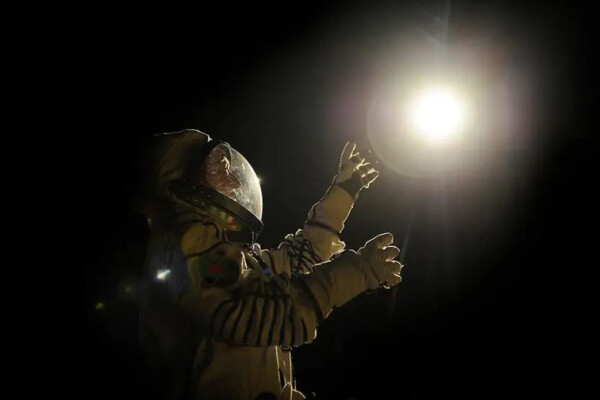
Image courtesy of Amazon-MGM.
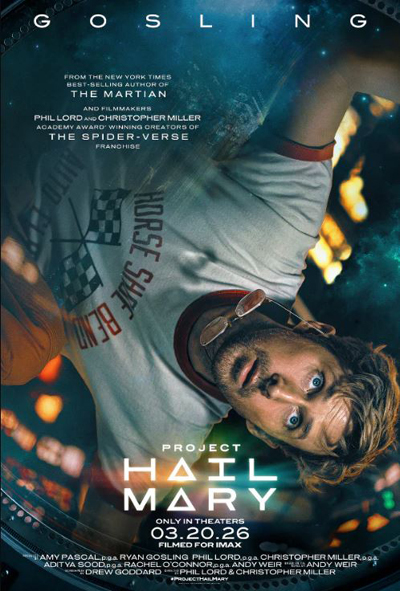
“Project Hail Mary” Starring Ryan Gosling as an insufficiently curious xenobiologist Ryland Grace; James Oritz as (eventually) the voice of Rocky the alien; Sandra Huller as the stone‑cold yet bewilderingly attractive Project Hail Mary program manager Eva Stratt; and others. Directed by the duo of Phil Lord and Christopher Miller. Runtime a too-long 2 hours, 36 minutes. Rated PG-13. Theatrical release.
Plot summary: The Sun is threatened by a species of microorganism (Grace calls them “astrophages”) that consumes stars, which puts Earth in danger. If the sun dims too much, photosynthesis will decline and everything, including civilization, will go the way of democracy. The planet’s governments come together (yeah, right) to send an expedition to a star light years away that has somehow beaten back the astrophages eating everything else in our neck of the galactic woods using fusion to produce light and heat. Things go wrong. Our hero encounters an alien – his/hers/their planet is in trouble, too, because their sun is on the menu – and the two of them cooperate to find a way to defeat the star eaters.
Spoilers: Not if you read the book.
Mladen’s take
I can think of a couple of very good movies featuring humans and space aliens becoming buddies, “Enemy Mine” (1985) and “Alien Nation” (1988). The Star Treks and Kirk and Spock. More recently, there’s “Predator: Badlands.” Yes, yes, there are technically no humans in Badlands but synthetics Thia and Tessa are close enough.
In that regard, “Project Hail Mary” misses the mark. It isn’t Gosling’s fault as Grace or Oritz’s depiction of Rocky that made their friendship in the movie seem, ah, inert. The trouble is seeing Rocky for what the alien is, rock‑like. I’m used to placing rocks in my aquarium without worrying that I’m drowning a living being. Also, to me, anyway, rocks are repositories of past life – fossils – rather than sentient, self-aware creatures alive today who multiply by what, sexual sedimentation or crack fissuring.
The problem with “Project Hail Mary” is that it came in book form first and I read the book. Though I can’t recall the details in the book, I can recall that my imagination allowed me to interpret Rocky as some sort of fauna rock, an animal that was also vegetable and mineral. No such luck in the film. The Eridian – that’s the name of Rocky’s species – was there for me to “see” with my eyes.
Rocky is constructed of short columns of jointed hard material that made fingers and limbs, which articulated, and a thorax holding it all together. What held him together, allowed him to move? A pliant crystalline matrix like fiber-optic cabling? Ammonia‑soluble tendons that deformed whenever Rocky’s iron ore other‑than‑nervous system rusted on command? How the hell could the Eridian chitter like an insect? Golly, and this is terrible, I had the urge to vivisect Rocky to see what made him tick.
B+ “Project Hail Mary” is worth the time to see in a movie theater. There is enough action, even if that action is, in part, dependent on an implausibly maneuverable space ship, to justify dropping extra change for a Dolby theater seat. The scene where Grace and Rocky trawl the upper atmosphere of a planet to collect astrophages and something else is darned good.
I looked forward to scenes with Huller as Stratt. It was the precision of her diction when speaking English. It was her unapologetic focus on saving humanity, though it required sacrificing individuals who belong to that humanity. It was her humorous severeness and knack for taking a line of reasoning or an excuse to avoid doing this or that to the end of the line. Something like, “Grace, you say you want to stay on Earth to teach children. Well, if you stay, there will be no children to teach.” What a guilt trip. And, I must say, I loved Grace for ignoring it.
Del’s take
Mladen is too generous with his review of “Project Hail Mary.” I didn’t fall asleep once during the movie, but not because it was exciting. The theater was freezing and I’d left my hoodie in the car. I thought “Hail Mary” was boring – B-O-R-I-N-G. And it was stupid – this, from a guy who not only grew up reading science fiction but wrote a few SF stories of his own.
I wish Amazon had taken some of the $$$ it spent on “Melania” and used it to make “Hail Mary” better, maybe a little more scientifically plausible, maybe a little less slapsticky. As it stands, the movie is structurally too complicated, is inconsistent in tone, is way too long, and it failed to convince me to suspend my disbelief.
According to Mladen, “Hail Mary” is 2 hours and 36 minutes. It felt like 2 days and 36 hours. It was a two-bathroom-visits movie for me. To paraphrase a British critic who reviewed one of my books, it could have benefitted from a savage pruning of excess beats. As Mladen pointed out, the movie was not about teaching English to an alien; it was about figuring out how to kill the little bastards eating our sun, so the whole teaching-the-alien bit could have been left on the cutting room floor. And other parts should have qualified for a savage pruning. I’ll get to those in a minute.
Is “Hail Mary” a comedy? At times I thought it was. There were moments of physical comedy – actual slapstick – and the script was mostly a series of jokes and verbal pratfalls that at first were cute but soon became irritating and distracting. It was impossible to take anything I was seeing on the screen very seriously because the movie did not take itself very seriously. That may sound like a good thing but trust me, a movie about the end of the world should not be funny. Satirical? Maybe. “Don’t Look Up” and “Doctor Strangelove” come to mind. But comedic? Hardly.
The story is told through a series of flashbacks woven through a current-time narrative, and that proved to be difficult to follow, especially at the beginning when Grace awakens aboard the spacecraft with no memory of how he got there. Again, I would ask: Is that what this movie is about? No? Then why waste the audience’s time telling them things that have no bearing on the outcome of the story?
In films from the Star Trek and Star Wars universes I can accept scientific implausibilities – hyperlight, the Force, teleportation. Those movies are more fantasy than science fiction. But in a movie like “Hail Mary,” which grounds itself in science, the implausibilities become much more glaring and harder to forgive. Gosling’s character awakens after four years of zero-G induced coma. His bones should have looked like a plastic McDonald’s straw. Yet he’s able to bound around and grab hurtling spaceship parts as if he were Thor. No effing way is that gonna happen. And again, as Mladen pointed out, the spaceship maneuvering was just impossible – comedically impossible. And there were others – Rocky’s seemingly endless supply of food and air, and Grace’s endless supply of crap that would never be allowed on a starship having to contend with mass constraints. Deus ex machine was Grace’s co-pilot.
A plus was Gosling’s performance, which I thought was superb. And Mladen was right about Huller. She was spectacular. In fact, of all the characters in “Hail Mary” she was the only one I could relate to in any human sense.
“Hail Mary” is cleaning up at the box office and moviegoers are giving it Rotten Tomato scores in the 90s. Amazon needs the movie to pull in around $400 million to break even, and that will probably happen. All said, that makes me look like a cranky, impossible-to-please old fart. Maybe so. But judging by all the movies I’ve given A scores to over the years, I’d say that’s not true. I just want my movies to be really, really good, and for all the reasons I’ve listed here, I don’t think “Project Hail Mary” meets that description. Feel free to go see it and judge for yourself.
I’m giving it a score of a B-, and I think that’s generous. Maybe a C+.
Mladen Rudman is a former journalist and technical writer. Del Stone Jr. is a former journalist and writer.

Image by Raw Pixel.
My God, I’ve seen this comment more times than I can count.
People will say, “I’m tired of illegal aliens coming into this country and using my tax dollars to get free food, free welfare and free health care.”
So let’s take a look at the realities of this situation.
Do undocumented immigrants receive food stamps from the federal government?
The answer is no, they do not.
Do undocumented immigrants receive welfare benefits from the federal government?
The answer is no, they do not.
Do undocumented immigrants receive free health care from the federal government?
The answer is no, they do not.
Do undocumented immigrants receive any kind of benefits from the federal government?
The answer is no, they do not. They can’t. They aren’t documented. They don’t have Social Security numbers.
Having said that, I hasten to add individual states do have the option of providing meager benefits to this beleaguered population if they want to. The complainers can’t fuss about that.
Remember when the Supreme Court overturned Roe vs. Wade? The complainers were quick – and vocal – to support the notion of states rights. They boarded the ship of states rights, and now that ship has sailed. If they live in a state that provides meager benefits to this beleaguered population, they can’t complain because they support states rights.
How many states provide benefits to undocumented immigrants?
Fourteen. Out of 50.
Many of the undocumented immigrants come into this country illegally, I’ll concede that. They do need to go through the process. But they come here and do the jobs Americans refuse to do, pay taxes but don’t get the benefits, and the complainers have a problem with that?
Could it be they don’t like undocumented immigrants because their skin is a different color and they speak a different language?
Is it time for some self-examination?
I think so.
About the author:
Del Stone Jr. is a professional fiction writer. He is known primarily for his work in the contemporary dark fiction field, but has also published science fiction and contemporary fantasy. Stone’s stories, poetry and scripts have appeared in publications such as Amazing Stories, Eldritch Tales, and Bantam-Spectra’s Full Spectrum. His short fiction has been published in The Year’s Best Horror Stories XXII; Alfred Hitchcock’s Mystery Magazine; the Pocket Books anthology More Phobias; the Barnes & Noble anthologies 100 Wicked Little Witch Stories, Horrors! 365 Scary Stories, and 100 Astounding Little Alien Stories; the HWA anthology Psychos; and other short fiction venues, like Blood Muse, Live Without a Net, Zombiesque and Sex Macabre. Stone’s comic book debut was in the Clive Barker series of books, Hellraiser, published by Marvel/Epic and reprinted in The Best of Hellraiser anthology. He has also published stories in Penthouse Comix, and worked with artist Dave Dorman on many projects, including the illustrated novella “Roadkill,” a short story for the Andrew Vachss anthology Underground from Dark Horse, an ashcan titled “December” for Hero Illustrated, and several of Dorman’s Wasted Lands novellas and comics, such as Rail from Image and “The Uninvited.” Stone’s novel, Dead Heat, won the 1996 International Horror Guild’s award for best first novel and was a runner-up for the Bram Stoker Award. Stone has also been a finalist for the IHG award for short fiction, the British Fantasy Award for best novella, and a semifinalist for the Nebula and Writers of the Future awards. His stories have appeared in anthologies that have won the Bram Stoker Award and the World Fantasy Award. Two of his works were optioned for film, the novella “Black Tide” and short story “Crisis Line.”
Stone recently retired after a 41-year career in journalism. He won numerous awards for his work, and in 1986 was named Florida’s best columnist in his circulation division by the Florida Society of Newspaper Editors. In 2001 he received an honorable mention from the National Lesbian and Gay Journalists Association for his essay “When Freedom of Speech Ends” and in 2003 he was voted Best of the Best in the category of columnists by Emerald Coast Magazine. He participated in book signings and awareness campaigns, and was a guest on local television and radio programs.
As an addendum, Stone is single, kills tomatoes and morning glories with ruthless efficiency, once tied the stem of a cocktail cherry in a knot with his tongue, and carries a permanent scar on his chest after having been shot with a paintball gun. He’s in his 60s as of this writing but doesn’t look a day over 94.
Contact Del at [email protected]. He is also on Facebook, twitter, Pinterest, tumblr, TikTok, and Instagram. Visit his website at delstonejr.com .

Image courtesy of 20th Century Studios.
—
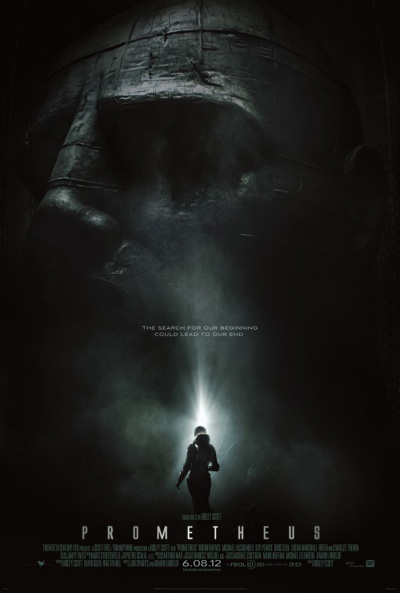
“Prometheus” Starring Noomi Rapace, Michael Fassbender, Logan Marshall-Green, Charlize Theron. Directed by Ridley Scott. 124 minutes. Rated R.
Del’s take
Going into “Prometheus” I warned myself against indulging expectations; I had, after all, been savoring this moment since learning “Alien” director Ridley Scott was returning to the creepy, Gigeresque universe he so famously created in 1979.
Coming out of “Prometheus” I again warned myself against expectations: The movie was probably not as disappointing as my gut reaction would have me believe.
After much reflection, I can’t help but feel “Prometheus” is so much less than it could have been. Visually, the film is gorgeous. But the script is a muddle, the score incompatible with the movie’s tone, and some of the casting decisions simply don’t work.
The plot is straightforward. A pair of archeologists (Noomi Rapace as Elizabeth Shaw and Logan Marshall-Green as Charlie Holloway) discover a kind of star map in the glyphs of ancient terrestrial civilizations separated by time and distance. A corporation builds a starship, the Prometheus, to visit the location denoted by the map, so that the company’s founder can discover the secret to life … and perhaps extend his own. Once there they find mankind’s progenitors were not as paternalistic as they expected. All manner of wriggling, predatory horrors put human beings at the bottom of the food chain as they plan a planet-wide buffet.
The film’s exteriors are lush, sweeping and grandiose, but the interiors convey nothing of the shuddery claustrophobia evoked by “Alien.” The technology seems far advanced from “Alien,” which takes place after “Prometheus.” I don’t have a problem with that: The Nostromo was a tired old factory ship with outdated technology; “Prometheus” is a brand-new ship of exploration, likely equipped with the latest gadgets and gewgaws, despite its 30-year handicap.
Michael Fassbender delivers an Oscar-worthy performance as the amoral android David, and Charlize Theron is icily cool as the daughter of the Weyland Corporation’s founder. Less impressive are Sean Harris as the expedition’s geologist, and Rafe Spall as the team’s biologist. Neither display the kind of intellectual curiosity peculiar to scientists. Worse are Noomi Rapace and Logan Marshall-Green, who are completely unconvincing in their roles as the expedition’s ostensible scientific leadership. Ridley Scott has a love of strong female characters, but in “Prometheus” Rapace seems lost and dependent, besotted with a perpetual starry-eyed, doll-baby affect that seems incongruent with that of a true Scott survivor type. And let’s not talk about the film’s science, or the scientific method. “Prometheus” abandons even the most cursory protocols any scientist worth his salt would follow.
But that’s partially the fault of the script, which at times tries to take “Prometheus” into the realm of “2001,” while mostly devolving to “Starship Troopers” or even “Lost.” Blame that on co-writer Damon Lindelof, an alum of “Lost,” who seems stricken by the idea coy logic flaws represent depth. A true brain tease provokes curiosity, not irritation. Gone is the stark, narrowly focused conflicts of “Alien,” “Blade Runner” or “Thelma and Louise.” In its place is a taco-pizza-cheeseburger of a story that satisfies nobody.
“Prometheus” may have strands of “Alien” in its DNA, as Scott hinted during the movie’s production, but it’s a recessive gene. You see little of the “Alien” genius and lots of what I would call “current” storytelling, which seems less satisfied with delivering a credible tale than setting up a sequel.
In space, nobody can hear you scream. But in movie theaters they can hear you crying foul, and that’s what I heard.
Mladen’s take
When I need Del to be merciless, he delivers a review that searched for a bright side to a dim movie. Del, can you hear me screaming in Fort Walton Beach, though we’re a couple of miles apart?
It was good “Prometheus” didn’t come with a money-back guarantee for the audience because the production companies that financed this unfathomable film would go broke. My review is short because I stopped paying attention to the movie about halfway through it’s all too long runtime.
“Prometheus” was billed as the prequel to “Alien,” one of the finest movies of all time, and that was a severe error. Though directed by the same man, Ridley Scott, “Prometheus” and “Alien” are worlds apart.
“Alien” is a sci-fi horror movie, pure and simple and completely engrossing. “Prometheus” is just gross, while suffering from an identity crisis. Is it sci-fi horror like “Alien” or sci-fi action like “Aliens”? In fact, it’s more like “Hostel” meets “Event Horizon” meets “The Human Centipede.”
Almost from the beginning, the movie starts to meander toward the unexplained.
There are 17 people aboard spaceship Prometheus, which is about 10 too many. Only a handful of the 17 characters are developed and all of them are, at best, mildly interesting or, at worst, unlikable.
There are metallic vases oozing black liquid, an aggressive slug breaking an arm and then swimming down the victim’s throat, and an absolutely foul scene were one of the protagonists endures a vividly portrayed Cesarean section inside a healing chamber and then fights the creature just pulled from her abdomen.
None of the scientists behaved like scientists, including the decision to reanimate in the open the head of a hominid-like being because it looked like something abnormal was growing from it when its owner died.
In “Prometheus,” events just happened that seemed unconnected or arbitrary. The story lacked cohesion. It failed to explain the reason our creators were so unflinchingly hostile to us, their children, so to speak.
“Prometheus” could have explored the questions it awkwardly raised. Is there God? Can science and religion co-exist? Is mankind a controlled experiment with Earth the incubator? Instead, we get a mish-mash of themes and banal dialogue.
There are no Oscar contenders in this movie. Not for script. Not for acting. Not for score. Hell, not even for visual effects. The movie was disappointing.
Mladen Rudman is a former journalist and technical editor. Del Stone Jr. is a former journalist and author.

Image courtesy of Credo Entertainment Group and USA Pictures.
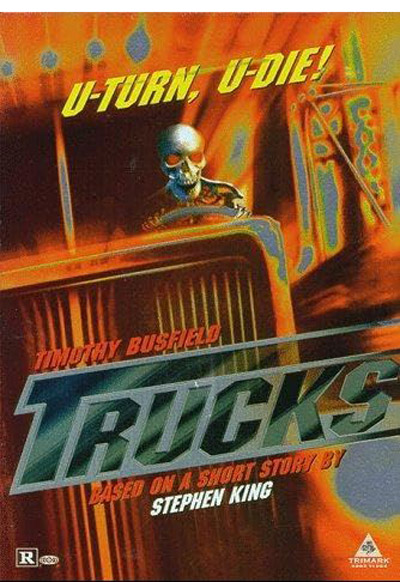
“Trucks” stars Timothy Busfield as Ray, Brenda Blake as Hope, Brendan Fletcher as Logan, Amy Stewart as Abby, and others. Directed by Chris Thomson. Rated PG-13 with a 95-minute run time. See it on Amazon Prime, Tubi, Apple TV and Vudu.
Mladen’s take
To recuperate my manliness after Del forced me to watch and review “Barbie” and “Wham!,” I made him watch 1997’s “Trucks.” And, what a film it is. From its big rig practical effects to the bonkers scene involving a Tonka-looking radio-controlled toy truck, the movie plows through your disbelief and eye rolling like a convoy of rabid Teamsters through a school zone.
Here, feel free to skip to the next paragraph. Del wants a movie summary in each review, so I’m giving you one, like it or not. “Trucks” is based on a Stephen King short story. In “Trucks,” trucks come alive, herding people into crappy buildings in a dusty town not far from Area 51. The trucks terrorize the huddled humans and, when needed, run over or otherwise murder a few. The self-driving, bloodthirsty machines, who talk to each other by flashing their headlights and switching windshield wipers on and off, are animated by … I’m not sure. The victims talk about mysterious satellite dishes erected at the nearby Air Force base, aliens attracted to Earth by SETI, a stolen election for president, the contents of Hunter Biden’s laptop, and, wait, I think I’m confusing one government conspiracy with another.
“Trucks” has flaws that go unremedied. There’s no nudity. The swearing is mild. The violence is not as graphic as it could’ve been, though the fire axe-wielding hazmat suit scene in a disaster response van is pretty damn terrific. And, let’s not forget the toy truck and mailman incident that unfolds about half-way through the film. It’s imaginative. It’s ridiculous. It’s carnage laced. In short, it’s perfect.
“Trucks” also has flaws that get remedied. For example, the killer trucks are autonomous but have no way of refueling themselves. So, through much of the film, I’m like, “Stupid rednecks, sit tight until the monstrous machines run out of gas.” Then comes along our principal scared, bewildered, and desperate protagonist (“Ray” portrayed by Timothy Busfield) who notices that the trucks had chances to kill him but didn’t. Why? Why did he live while some of his fellow captives died? Well, the trucks signal the answer to him. You see, Ray is the town’s gas station owner. The machines spared Ray because they needed him to refuel them. If he didn’t, they’d splatter his son and nascent girlfriend all over the desert sand. Come on, concede that’s a clever way for the trucks (and the movie’s plot) to overcome their lack of hands with opposable thumbs to pump diesel.
Because “Trucks” is based on a King short story and King often sways toward the bleak, the film’s ending is somewhat discombobulating. But, don’t worry, the ending is nothing like the heavily traumatizing conclusion of another movie based on King’s writing, “The Mist.”
Del’s take
I was confused.
Fifteen minutes into “Trucks” and still no Emilio Estevez. What the hell was going on?
A quick dive into the Internet Movie Database disabused me of my mental fog. “Trucks” is not “Maximum Overdrive,” the cheesy ’80s-vintage scifi-horror movie directed by none other than horror author Stephen King. Instead, “Trucks” is a cheesy ’90s-vintage scifi-horror movie based on the same short story, “Trucks,” that inspired “Maximum Overdrive.” And that story was written by none other than horror author Stephen King.
That’s about as clear as my soap-scum infused glass shower doors.
I’d describe “Trucks” as a genre hybrid, falling somewhere between a classic ’50s big bug movie and a Robert Rodriguez grindhouse gorefest, Why anybody thought “Trucks” was worthy of a remake escapes me, especially when King wrote many other memorable stories – the one about the guy who drinks bad beer and turns into a giant escargot comes to mind every time I pop the tab on a can of Natty Light. But then, why are there 27 “Children of the Corn”s or 91 “Lawnmower Man”s? The answer, of course, is that Americans have no bottom when it comes to schlock.
And that’s what “Trucks” is – schlock. It’s one of those movies that’s so bad, it’s good – except “Trucks” isn’t good. It’s terrible, and Mladen owes me big time. At least when I make him watch something out of his comfort zone it’s something decent, and good. “Trucks” is a Baby Ruth bar floating in the swimming pool of moviedom. The acting is awful. The script is laughably inept. No cliché is left behind. And there are plot holes big enough to … ahem … drive a truck through. It’s like watching political aides trying to teach Ron DeSantis how to eat pudding with chopsticks. In other words, it’s a mess.
Here’s an example of the breathtaking dialogue:
Teenage girl: “Why does everybody keep dying?” (Hmmm? Could it possibly have anything to do with the fact that they’re being RUN OVER BY TRUCKS?)
Old man: “I don’t know. I’m just an old hippie.”
??????????????????????
The trucks, we are told, have been brought to life by either Area 51, a toxic gas cloud, the Earth sailing through a comet’s tail, aliens … or maybe “Trucks” is a cautionary tale, warning against the unintended consequences of electing a fascist as president of the United States and then letting him skate when his crimes become public knowledge. Either way, I think everyone involved in the movie sailed through a comet’s tail because if “Maximum Overdrive” proves that horror authors should stick to writing horror stories and not directing horror movies, “Trucks” proves that even dedicated filmmakers can sometimes screw up, and “Trucks” is a Godzilla-sized Phillips-head of a screw(up).
Mladen didn’t assign a letter grade to “Trucks” so I’ll assume he’s giving it an F. I’ll be generous and award a D- seeing as how it’s truer to the short story than “Maximum Overdrive.”
When they come out with a scifi-horror movie titled “Night of the Killer Prius,” I’m there. But “Maximum Overdrive” and “Trucks” is a two-movie convoy of 18-wheeled schlock. For a vastly superior killer truck movie, check out “Duel.” Meantime, I’ll stick to the passing lane.
Mladen Rudman is a former journalist and technical writer. Del Stone Jr. is a former journalist and writer.