Mladen and Del review ‘The Dog Stars’
20th Century Studios
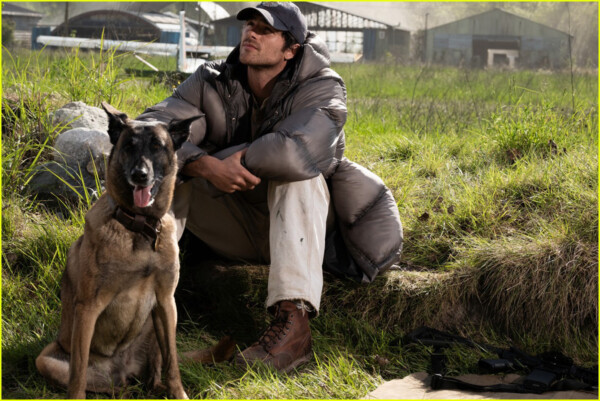
“The Dog Stars” starring Jacob Elordi as the boy next door Hig, Margaret Qualley as the girl next door Cima, Josh Brolin as no‑mercy Bangley, Guy Pearce as goodly hearted gruff Pops, Allison Janney as perfect religionist Darlene, and others. Directed by Ridley Scott. Written by Peter Heller, Mark L. Smith, and Christopher Wilkinson. Score composed by Harry Gregson‑Williams. 1 hour, 58 minutes. Rated R. Theatrical release.
Plot summary: The world has ended. Correction, civilization has ended but the Earth is doing just fine, thank you. A virus has drop-kicked most of humankind between the uprights of the goalpost called Oblivion. Of course, there are survivors. Some are good folk and the rest MAGA. Who prevails? Can either type of Homo sapiens find Shangri La amid the urban, suburban, and rural desolation and bursts of savagery?
Spoilers: Yeah, but, hell, we don’t tell you how the movie ends.
Mladen’s take
Ever watch an anti‑insomnia screen saver playing gently falling rain or wind blowing through tree tops or fish swimming in an aquarium? Well, that’s “The Dog Stars” in a nutshell, mostly.
The film is a mellow take on the end of the world with bits of violence thrown in to add noise. And, this surprises the shit out of me, I could’ve done without the bloodshed. Sure, bullets have to cackle, grenades have to explode, and watchtowers must topple, but it all could’ve happened off-screen or in low light.
What I enjoyed consistently about “The Dog Stars” was the sweeping cinematography, all of it accompanied by a barely noticeable, though hypnotic, score. The panoramic moments when the little Cessna is flying below mountain tops or turning to track a river were soothing. Then, before you know it, some Hellraiser is launching an RPG at one of our heroes or there’s a bunch of horseback‑riding hooligans shooting at the above mentioned Cessna at close range without knocking the Little Airplane That Could out of the sky. Remarkable luck for Cima, Hig, and Pops, no?
As for what you’re about to read, all I can say is this. It’s not my fault. The languorous flow of the story, the loveliness of the land outside cities, forced me to put this to paper. I liked watching the relationship between Cima and Hig unfold. The kids were wounded. The kids adored each other. But the kids never succumbed to lust. Cima was patient with Hig as he tried to shed the past. Hig knew all along that Cima was beyond great. Dang, I’m almost teary eyed.
The best part of the film, by far, however, was the 10 minutes of screentime by Janney as Darlene. I could’ve used a whole lot more of Darlene’s menacing and maniacal presence as a lethal Holy Roller. Man, it was reminiscent of the role played by Marcia Gay Harden as Mrs. Carmody in “The Mist” (2007). Harden should’ve earned the Best Supporting Actress Oscar for that superb bit of acting. Still pissed, I am, that she didn’t. The way Harden escalated the religion‑fired fanaticism in the grocery store was brilliant. The way Janney sprinted from welcoming air traffic controller Darlene to getting set on fire was terrific. Somehow, in the short span that Janney was on the screen, the Grand Junction airport terminal scene went from suspiciously friendly to grotesquely inhumane without faltering into the absurd. Well done and it was all her.
I’m giving “The Dog Stars” an A- because of its narcotic effect on me. It made me feel that the end of civilization won’t be so bad after all. And, thank goodness, the dog died. Take it away, Del.
Del’s take
I didn’t actively hate this movie but I DID actively hate the damn dog.
Talk about annoying. Man, I HATED that damn dog. He was overeager. He was into everything. He was constantly yipping or whining. At one point I thought he was going to fly the fucking airplane. His attitude could have been improved with Adderall but I guess Ridley Scott didn’t think that far into it.
Annoying pooches notwithstanding, what about “The Dog Stars” itself? Well, to be blunt, I never knew the end of the world could be so boring. This movie somnambulates between threatless and dare I say racist action scenes to maudlin periods of introspection and hyperglycemic pastoral myths, all told through a drab, bluish color palette and mumbling dialogue that does little to advance the plot, shed light on the characters or build tension.
Hig (Jacob Elordi) is a former mechanic who survived a world-ending viral pandemic and is hiding out at a remote Colorado airstrip with Bangley (Josh Brolin), a cynical and coldly realistic survivalist who shoots anybody who approaches their redoubt. Hig spends his time delivering supplies to a nearby Mennonite community and visiting his old home in Denver, where he grieves the death of his pregnant wife. The appropriately named Bangley passes his days scanning the treeline for intruders, his trusty high-powered rifle at the ready.
During a flight, Hig hears a radio transmission from a sender in Grand Junction and decides he should investigate. This decision underlines the essential difference between Hig and Bangley: Hig craves community and togetherness. Bangley is content with the isolated safety of their status quo. After an attack by intruders claims the life of his beloved pooch, Jasper (damned irritating dog), Hig’s mind is made up: He’s going to Grand Junction.

Along the way his plane develops engine trouble and he lands near a ranch, where he meets Cima (Margaret Qualley) and her father, Pops (Guy Pearce). Over time the inevitable romance blooms between Hig and Cima, hobbled by mutual guilt: They’re both reluctant to abandon the memories of their spouses, who died as a result of the virus. But an attack by savages forces their hand and all three flee in Hig’s newly-repaired plane. They fly to Grand Junction, where they encounter a large enclave of people living pretty much as they did before the pandemic. Except they aren’t. I’ll let that part be a surprise.
Mladen correctly points out the cinematography is superb. The sight of Hig’s yellow Cessna sailing between the craggy peaks of the Rocky Mountains is breathtaking. And there’s a pleasing note of nostalgia to one of the movie’s core themes, that maybe we could actually shed the technological impositions of the 21st century – smart phones, artificial intelligence and social media – and return to our simpler, agrarian roots. Who knows? Maybe we’d find happiness there. We sure as hell ain’t finding it here.
But “The Dog Star”’s liabilities outweigh its virtues.
Almost no explanation is given for the existence of the ferals, who bear an uncanny resemblance to similar characters in the Mad Max movies and “The Walking Dead.” And there were moments during one of the attack sequences when I could swear I was watching a scene from a 1950s-vintage cowboy vs. injuns movie. I could even hear war whoops in the background.
The segment involving Grand Junction, a critical plot element, comes and goes with such rapidity that one wonders why it was even included in the story, unless it was to buttress Bangley’s assertion that risking happiness is stupid and will get you killed. That message won’t resonate with modern audiences. It didn’t resonate with me and I’m an old fart! Also, Elordi plays Hig with a kind of fumbling earnestness I assume is meant to be endearing, but honestly, I found it to be suggestive of somebody who’s on the spectrum. Bangley is a stereotype who we know, by movie’s end, will emerge from his chrysalis of cynicism. Won’t any movie director challenge us with a character we haven’t met a thousand times before?
Overall, I thought “The Dog Stars” was an expenditure of pointless energy. I’m not sure what I was supposed to get out of it – that change is bad? Be satisfied with what you have? Never risk happiness? Beats the hell out of me.
Mladen was far too generous in his score. He’d been to a birthday party in the hours before the movie and I think that slice of birthday cake must have screwed up his blood sugar. There is no way in hell “The Dog Stars” is worth an A-. I’d give it a C, and that’s being generous.
Mladen Rudman is a technical writer and former journalist. Del Stone Jr. is a writer and former journalist.
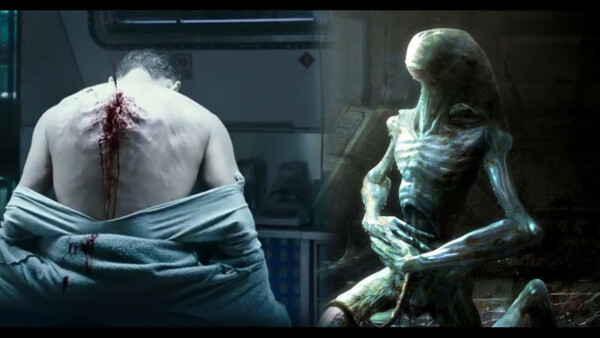
Image courtesy of 20th Century Fox.
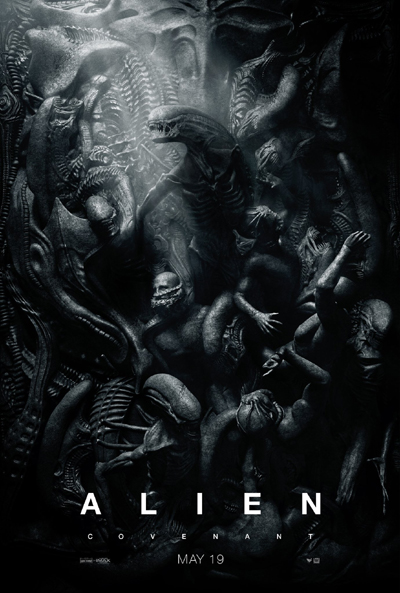
“Alien: Covenant” Starring Michael Fassbender, Katherine Waterston, Billy Crudup, Danny McBridge, Demian Bichir. Directed by Ridley Scott. 122 minutes. Rated R.
Del’s take
“Alien: Covenant” is probably the movie you wish “Prometheus” had been.
It has a lot going for it: Storytelling is slick and efficient, eschewing junked-up plots and mystical mumbo-jumbo. Characterization is improved, with believable people speaking believable lines. And it does a creditable job of untangling the execrable birds’ nest of plotlines and unanswered questions presented by the afore-mentioned predecessor.
Director Ridley Scott sticks with the familiar and tries to evoke the grime and claustrophobia of “Alien,” while at the same time throwing in the rough-hewn desperation of “Aliens.” That’s where “Covenant” goes awry. In parts it is not so much an homage to the first two and best entries in the “Alien” canon but a blatant ripoff worthy of a J.J. Abrams flick.
Still, it’s not a bad movie and it puts the “Alien” franchise back on course with the possibility of future interesting sequels. For those all these reasons you should see it.
The movie stars Michael Fassbender as David or, schizophrenically, Walter, the yin and the yang of the story’s synthetic characters. Walter is a newer, more hepped up version of David who, unfortunately or fortunately, depending on your point of view, has been stripped of his ability to “create.” That ability also prevents him from slaughtering human beings; feel free to decide if that’s a good or bad thing. I personally feel it’s bad, but hey – no judgments here.
Walter is on board a colony ship headed for a distant planet when suddenly a neutrino storm strikes and the ship is disabled. The crewmembers are awakened from their hibernation pods to deal with the crisis and discover a closer planet more conducive to life. They are made aware of its existence by an incoming signal.
Hmmm. Where have we seen THAT before?
Upon awakening Katherine Waterston, who plays Daniels, almost immediately becomes the victim of a tragedy, one that ultimately brings the entire ship, crew and passengers into the jaws of peril. The tragedy potential is compounded when the decision is made to check out this signal, and this great new party spot on this interstellar pub crawl.
They land on a stormy planet to find a shattered city and the mummified corpses of thousands of its residents, the tall beings from “Prometheus.” Oh, and there’s another weird wreck of a U-shaped spaceship and finally David, who has lived here over the 10 years since the Prometheus disappeared.
They say idle hands are the devil’s playthings, and David has been very, very idle, or should we say very, very busy. Busy with what I won’t say, because that represents an answer to a critical question and it sets up the premise of the sequel. Suffice it to say Walter’s creators had good reason to leave out his creativity chip.
Apart from an opening soliloquy which could have been omitted without any loss to the film, “Covenant” moves along at a brisk pace, alternating between explanation and action. It does not feel like a two-hour movie. Scott, when he isn’t hobbled by a crappy screenplay, can still direct a lean and mean fighting machine of a film.
Fassbender is again superb as David and Walter, slipping back and forth between a polished Oxford and Midwest twang of accents with ease. Waterston is a kind of Signourney Weaver lite trying to fill the Ripley bandolier, but she doesn’t quite carry it off. Billy Crudup makes for a good sniveling Oram, the indecisive, overly religious mission commander who wants the crew to both love and respect him and succeeds at neither, The others are functionally cannon fodder who do rise above their meager contributions, so overall the acting component is effective.
The problem with “Covenant” is that it harkens back too often and too distinctly to “Alien” and “Aliens.” Let me count some of the ways:
1. The crew is summoned to an alien moon by a signal of unknown origin – check.
2. Crawling through dark passageways lit by strobes and punctuated by screaming alarms – check.
3. A rough ride to the surface in a drop ship led by a cowardly commander – check.
4. A tough female lead telling her fellow survivors, “We will seal off the accessways hatch by hatch and blow this motherfucker into outer space” – check.
5. The same tough female lead doing battle with the monster using a large piece of equipment – check.
Even the soundtrack borrows heavily from “Alien,” “Aliens” and “Prometheus.”
There were moments when I thought I was watching Ripley do battle with her extraterrestrial antagonist – THAT’s how similar the tone, pacing and more subtle ingredients, like color palette, were to those earlier movies.
That’s a problem for “Covenant” because those elements don’t mix well. “Alien” and “Aliens,” while sharing a similar premise, are two dramatically different movies, each with its own formulary for pacing and tension. You can’t blend the two and come away with a terrific cinematic experience no more than you can blend a pizza with a cheesecake and come away with a terrific gastronomic experience.
“Covenant” achieves a kind of limited success by answering questions and propelling the series into the realm of sequels, but its reliance on what has come before renders it into a derivative mashup that handicaps its ranking in the “Alien” pantheon. Of all the movies I would rate “Alien” the best with “Aliens” running a very close second. “Alien 3” was essentially a music video that nonetheless had an interesting look and feel, although it squandered all the grandeur of its predecessors. The Winona Ryder “Alien” was insipid and banal, and “Prometheus” was an unmitigated disaster.
Therefore I would place “Covenant” at a distant third on the list, and give it a generous grade of B.
Del Stone Jr. is a former journalist and author.
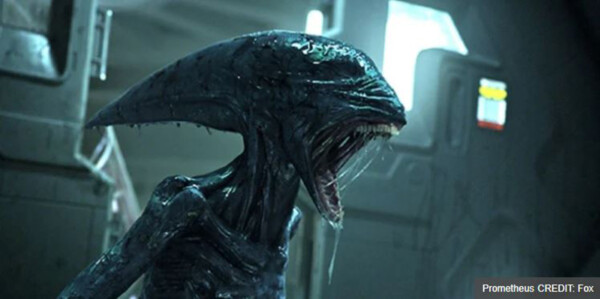
Image courtesy of 20th Century Studios.
—
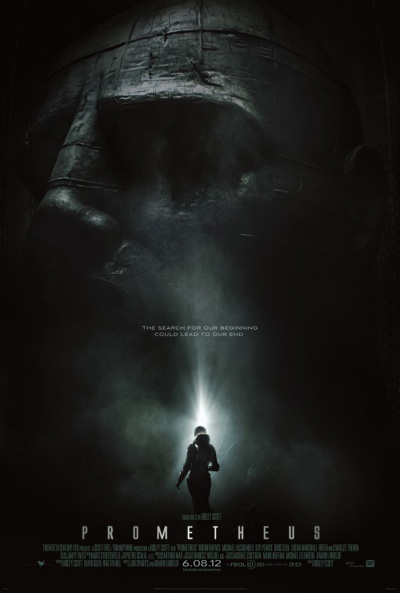
“Prometheus” Starring Noomi Rapace, Michael Fassbender, Logan Marshall-Green, Charlize Theron. Directed by Ridley Scott. 124 minutes. Rated R.
Del’s take
Going into “Prometheus” I warned myself against indulging expectations; I had, after all, been savoring this moment since learning “Alien” director Ridley Scott was returning to the creepy, Gigeresque universe he so famously created in 1979.
Coming out of “Prometheus” I again warned myself against expectations: The movie was probably not as disappointing as my gut reaction would have me believe.
After much reflection, I can’t help but feel “Prometheus” is so much less than it could have been. Visually, the film is gorgeous. But the script is a muddle, the score incompatible with the movie’s tone, and some of the casting decisions simply don’t work.
The plot is straightforward. A pair of archeologists (Noomi Rapace as Elizabeth Shaw and Logan Marshall-Green as Charlie Holloway) discover a kind of star map in the glyphs of ancient terrestrial civilizations separated by time and distance. A corporation builds a starship, the Prometheus, to visit the location denoted by the map, so that the company’s founder can discover the secret to life … and perhaps extend his own. Once there they find mankind’s progenitors were not as paternalistic as they expected. All manner of wriggling, predatory horrors put human beings at the bottom of the food chain as they plan a planet-wide buffet.
The film’s exteriors are lush, sweeping and grandiose, but the interiors convey nothing of the shuddery claustrophobia evoked by “Alien.” The technology seems far advanced from “Alien,” which takes place after “Prometheus.” I don’t have a problem with that: The Nostromo was a tired old factory ship with outdated technology; “Prometheus” is a brand-new ship of exploration, likely equipped with the latest gadgets and gewgaws, despite its 30-year handicap.
Michael Fassbender delivers an Oscar-worthy performance as the amoral android David, and Charlize Theron is icily cool as the daughter of the Weyland Corporation’s founder. Less impressive are Sean Harris as the expedition’s geologist, and Rafe Spall as the team’s biologist. Neither display the kind of intellectual curiosity peculiar to scientists. Worse are Noomi Rapace and Logan Marshall-Green, who are completely unconvincing in their roles as the expedition’s ostensible scientific leadership. Ridley Scott has a love of strong female characters, but in “Prometheus” Rapace seems lost and dependent, besotted with a perpetual starry-eyed, doll-baby affect that seems incongruent with that of a true Scott survivor type. And let’s not talk about the film’s science, or the scientific method. “Prometheus” abandons even the most cursory protocols any scientist worth his salt would follow.
But that’s partially the fault of the script, which at times tries to take “Prometheus” into the realm of “2001,” while mostly devolving to “Starship Troopers” or even “Lost.” Blame that on co-writer Damon Lindelof, an alum of “Lost,” who seems stricken by the idea coy logic flaws represent depth. A true brain tease provokes curiosity, not irritation. Gone is the stark, narrowly focused conflicts of “Alien,” “Blade Runner” or “Thelma and Louise.” In its place is a taco-pizza-cheeseburger of a story that satisfies nobody.
“Prometheus” may have strands of “Alien” in its DNA, as Scott hinted during the movie’s production, but it’s a recessive gene. You see little of the “Alien” genius and lots of what I would call “current” storytelling, which seems less satisfied with delivering a credible tale than setting up a sequel.
In space, nobody can hear you scream. But in movie theaters they can hear you crying foul, and that’s what I heard.
Mladen’s take
When I need Del to be merciless, he delivers a review that searched for a bright side to a dim movie. Del, can you hear me screaming in Fort Walton Beach, though we’re a couple of miles apart?
It was good “Prometheus” didn’t come with a money-back guarantee for the audience because the production companies that financed this unfathomable film would go broke. My review is short because I stopped paying attention to the movie about halfway through it’s all too long runtime.
“Prometheus” was billed as the prequel to “Alien,” one of the finest movies of all time, and that was a severe error. Though directed by the same man, Ridley Scott, “Prometheus” and “Alien” are worlds apart.
“Alien” is a sci-fi horror movie, pure and simple and completely engrossing. “Prometheus” is just gross, while suffering from an identity crisis. Is it sci-fi horror like “Alien” or sci-fi action like “Aliens”? In fact, it’s more like “Hostel” meets “Event Horizon” meets “The Human Centipede.”
Almost from the beginning, the movie starts to meander toward the unexplained.
There are 17 people aboard spaceship Prometheus, which is about 10 too many. Only a handful of the 17 characters are developed and all of them are, at best, mildly interesting or, at worst, unlikable.
There are metallic vases oozing black liquid, an aggressive slug breaking an arm and then swimming down the victim’s throat, and an absolutely foul scene were one of the protagonists endures a vividly portrayed Cesarean section inside a healing chamber and then fights the creature just pulled from her abdomen.
None of the scientists behaved like scientists, including the decision to reanimate in the open the head of a hominid-like being because it looked like something abnormal was growing from it when its owner died.
In “Prometheus,” events just happened that seemed unconnected or arbitrary. The story lacked cohesion. It failed to explain the reason our creators were so unflinchingly hostile to us, their children, so to speak.
“Prometheus” could have explored the questions it awkwardly raised. Is there God? Can science and religion co-exist? Is mankind a controlled experiment with Earth the incubator? Instead, we get a mish-mash of themes and banal dialogue.
There are no Oscar contenders in this movie. Not for script. Not for acting. Not for score. Hell, not even for visual effects. The movie was disappointing.
Mladen Rudman is a former journalist and technical editor. Del Stone Jr. is a former journalist and author.