Del and Mladen review ‘Godzilla vs. Kong’

Image courtesy of Warner Bros. and Toho.
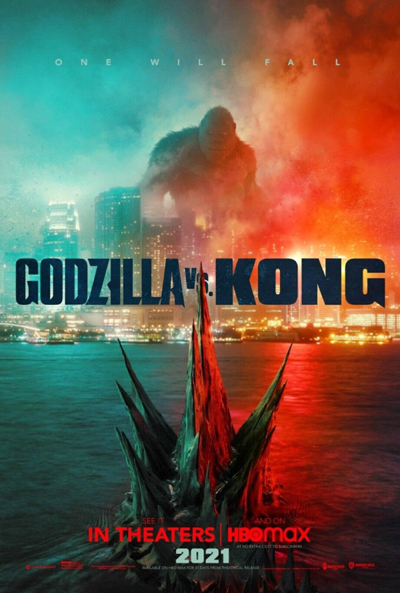
“Godzilla vs. Kong” Starring Alexander Skarsgard, Millie Bobby Brown, Rebecca Hall, Shun Oguri and others. Directed by Adam Wingard. 113 minutes. Rated PG-13. Theaters and HBO Max.
Del’s take
It’s quite the compliment to the Florida Panhandle that “Godzilla vs. Kong” opens with the king of the kaiju unleashing radioactive hell on the Apex Cybernetics facility in Pensacola, though I doubt the Chamber of Commerce is holding mixers to revel in its newfound celebrity. Still, it’s cool for us nerdists and might help the next Pensacon recruit some real celebrity muscle.
Meanwhile, that maiden salvo of destructo-porn sets the pace for this third installment of the “new” Godzilla, who in my book looks a lot less charming or even convincing than the original guy in the rubber suit. Freshened up with modern FX and a 21st century sensibility, Godzilla stomps onto the screen as an avenging angel out to punish mankind for making such a sloppy mess of the Earth. But then he’s always done that.
Next you’ve got Kong, the giant ape, who has received an updated and politically correct sentience PLUS a sense of morality to boot. When the two square off it’s not a clash of titans but a clash of value systems, with an evil corporation – yes, there’s always an evil corporation – operating as the fulcrum for the conflict.
“Godzilla vs. Kong” is the story – well, it’s three stories really – of Kong’s attempt to finally go “home,” Godzilla’s attempt to make sure he remains at the top of the apex predator heap and Apex Cybernetics’ attempt to obtain a new and powerful energy source that will allow them to engage full-throttle in various evil, shadowy, corporation-y things.
The particulars are a lot more confusing and I will go into them only to the extent of setting the stage: The Apex Corporation has discovered a new source of energy in a hollow realm at the center of the Earth and needs this energy to adequately power a “project” it is working on. It hires expert Nathan Lind (Alexander Skarsgard) to lead an expedition there, assisted by Dr. Ilene Andrews (Rebecca Hall) and her hearing-impaired daughter Jia (Kaylee Hottle), who are studying Kong. Apex needs Kong to show them the source of this new energy. Meanwhile, Godzilla, responding to its natural imperative to be the biggest and baddest monster of ’em all, senses the presence of Kong and goes on the offensive, much to the chagrin of Monarch Project scientist Mark Russell and his monster-attuned daughter Madison (Millie Bobby Brown). She teams up with conspiracy investigator and podcaster Bernie Hayes (Brian Tyree Henry) to investigate Godzilla’s newfound aggression and whatever link that might have to Apex, and drags along her buddy Josh Valentine (Julian Dennison) as comedic ballast.
Did I mention it was complicated?
Suffice it to say that all three storylines converge and loose strings are tied after some romp ’em stomp ’em, bad-ass kaiju/Kong butt-kicking. Some of the resolutions are happy while others are merely satisfying. The point is, the viewer will have been entertained for two hours and Legendary Entertainment and Warner Brothers will have earned another $200 million, which should keep the lights on over the next few weeks.
The performances are all good. I would single out young Kaylee Hottle as Jia, the remaining member of a tribe that was extinguished on Skull Island by a natural disaster, as the showcase of the lot. She and Kong were kindred spirits in loss, and her performance effectively portrayed that subtextual link in their relationship.
The rest of the movie was not as compelling. The original “Godzilla” exhibited a kind of primeval ferocity that has endured over the past 66 years and inspired countless sequels and remakes, most of which traded the animal nobility of the original for cheap yucks and self-parody. The modern iterations – “Godzilla,” “Godzilla: King of the Monsters” and now “Godzilla vs. Kong” – exchange parody for politically correct, touchy feely emotional imperatives that are no more satisfying to the palate than a quivering plate of tofu prime rib.
What saves “Godzilla vs. Kong” are the spectacular special effects, the fight scenes between Kong and Godzilla, and Kong’s humanity, which worked a lot better than it should have. It really felt like Kong was one of the characters and not merely a CGI-generated killer ape.
If the story had been as strong as the acting and special effects, I’d give the movie an A. As it is, “Godzilla vs. Kong” gets a B. It’s better than some other B-graded movies but not as good as others, and I think that’s fair. I can’t advise you to see the movie in a theater in the middle of a global pandemic, but I expect it’s a visual spectacle on the big screen.
Mladen’s take
“Godzilla vs. Kong” is a bonkers movie. Del’s modulated review of the film is, ah, too modulated. Because “G v. K” is utterly bonkers, the film deserves an extreme grade, A or F. But, because I saw the movie at an Imax theater my perception has been distorted. Let me tell you, Imax sound makes my fairly sophisticated, newish AVR-driven, 7.1 surround-sound system sound like an AM broadcast from 1930.
“G v. K” is an F, if you’re interested in a story that links the Monsterverse’s previous three movies to its fourth. I was insulted by the film’s flimsy, disingenuous effort to make it seem part of a continuity. Particularly distasteful was the improper dose of homage to the name of Serizawa. Depending on my mood, I may even characterize it as insulting. The physics of Hollow Earth is bonkers. Godzilla and Kong balancing while they fight on a ship that’s, I don’t know, a magnitude lighter and significantly less wide than the beasts are tall is bonkers. G and K fall overboard to fight underwater and the humans try to help Kong by launching Hedgehog-like depth charges to disorient the reptile and it worked. Bonkers. Why wouldn’t Kong get disoriented, too, and continue on his merry way to drowning? Huh? If the Kong whisperers were worried about Godzilla sniffing out Kong if the ape left his Skull Island containment facility, why would they transport Kong by boat across the Pacific? Godzilla is amphibious. Godzilla lives in the ocean. Godzilla has, apparently, extrasensory power to detect an Alpha interloper. Transport by water was bonkers. Hell, a few scenes later, the humans are moving the ape to Antarctica via sling and a lot of helicopters. Bonkers storytelling to the left of me. Bonkers storytelling to the right. I bonked my head a few times to orient myself to the insane worldbuilding, the deconstruction of the storyline in the preceding three Godzilla films, or the uselessness of the daughter of the bad guy. What the hell happened to the eco-terrorist dude in “Godzilla: King of Monsters” who bought a severed Ghidorah head from some down-on-their luck fishermen?
In the areas – vision, plot, script writing, directing – that make or break a movie, “G v. K” is sheer F-ness. Really. No joke. I’m serious. The fact that the visual and sound effects are so good augments the F-ness. It’s clear that producers and the director thought they could substitute coherence and the internal logic an impossible movie premise must generate for a lot of spectacular FX fighting and some damn fine sound effects. The soundtrack is good as is most of the acting. Where Del the modulator gives the kid in the film kudos, I bow to Rebecca Hall’s Andrews. Her delivery of lines and an assortment of gestures help mitigate the harshness of the dys-reality of the realm created in G v. K. Hall did for “G v. K” what Mila Kunis’s Jupiter did for “Jupiter Ascending,” plausibly explain or soften the absurdity of what unfolds on the screen.
Yes, I’ll probably see “G v. K” in an Imax theater, again. Yes, I’ll buy the movie in Blu-ray format when it becomes available. But, listen to me, “G v. K” is crappy, unless you’re sound-o-phile.
Mladen Rudman is a former journalist and technical writer. Del Stone Jr. is a former journalist and author.

Image courtesy of Netflix.
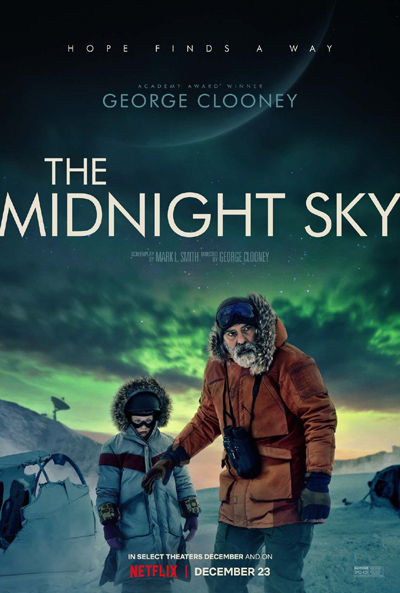
“The Midnight Sky” starring George Clooney, Felicity Jones, David Oyelowo, Caoilinn Springall, Kyle Chandler, Demian Bichir, Tiffany Boone, and others. Directed by George Clooney. Runtime 118 minutes. Rated PG-13. Netflix
Mladen’s take
Rank the essential components – acting, directing, score, cinematography, and script – of “The Midnight Sky” individually and the results vary from good to very good. Combine the essential components of this Netflix production and the result is mediocrity.
It’s not that “Midnight,” despite its Adam-and-Eve ending and a twist that turned out to be, what, a terminal-cancer-driven hallucination, is entirely disappointing. It’s that its subplots weren’t particularly absorbing. Nor were its way-too-many characters consistently worth caring about.
In “Midnight,” the year is 2049 (maybe that’s a nod to 2017’s “Blade Runner 2049”) and the jig is up for humanity. Actually, it’s the end for anything that breathes air as we know air today – mostly nitrogen, some oxygen, and a little bit of carbon dioxide, i.e. not enough to poison us. Before our planet’s atmosphere turned into a swirl of unbreathable toxic gases, mankind mounted an expedition to a newly discovered Jovian moon that could support complex life. The crew of the vessel was on its way home from a recon of moon K-23 when Mother Earth, reacting to our abuse of her, transformed into Serial Killer Earth. Augustine, portrayed by George Clooney, and accompanied by a young girl, has to make way for a weather station that likely has the capability to communicate with the spaceship returning to Earth. He wants to warn the crew that our planet is no longer habitable and offer a suggestion – return to Jupiter’s moon to re-plant our species on a pristine solar system body.
Why cosmologist Augustine feels he has to alert the crew of a spaceship built to probe a moon for signs it can support life that Earth is unsafe for them is beyond me. As the spaceship approached Earth, it was clearly visible to its crew that the planet’s atmosphere, now a green-yellow, had changed since they departed two years earlier. I’m no astronaut, but a discolored home world would have me saying something like, “Ensign, give me scans of the planet in UV and IR. What’s the spectroscopy saying about chemical composition of the atmosphere?”
The spaceship has a crew of five, one of them Felicity Jones’s Sully, a pregnant communications specialist. As the spaceship’s sub-story unfolds through a course deviation, collisions with space rocks, and an assortment of personal anguish, one crew member dies, two decide to return to Earth the Stomper of Life via a lander, and two slingshot back toward K-23.
I predict Del will like this movie, giving it a B+. He’s like one of the dudes in “Midnight” who decides to go home, though home will kill you for sure. Del will strain to find the positive in “Midnight” like the movie’s Earth returners hoped to find family still alive. Don’t be fooled. “Midnight” ain’t that good.
The best you can expect from “Midnight” is a few bits of good storytelling backed by consistently good acting. The film’s score is sturdy, if not exceptional. It helps the tale by setting up moods. The visual effects in “Midnight” are very good. I enjoyed the cinematography the most when it conveyed the austere and stark blue whiteness of snow cover and ice pack in the North Pole. But, even that simple joy was harassed by an achy nagging at the back of my brain. As mentioned above, “Midnight” takes place in 2049. Ain’t no way there’ll be any ice pack or glaciers anywhere on Earth in 28 years. Want ice then? Place your glass beneath the ice dispenser on your refrigerator.
“The Midnight Sky” gets a C+ from me. Del, on the other hand, will likely nominate it for a best picture Oscar.
Del’s take
Merry Christmas, you old coot. Sounds like you’re sipping more of the “nog” than the “egg.”
You think I liked “The Midnight Sky”?
Piffle. Do I like any movie?
Folks may think I’m a serial hater but trust me, there are movies I adore – “Being There,” “Doctor Strangelove,” and “Die Hard” to name a few. “Midnight Sky” ain’t one of them.
Not to nerd out on all three of our readers but “Midnight” lost me at the opening narrative where we are informed mankind has discovered a “new moon” around the planet Jupiter, one that has the ability to support terrestrial life.
Oh, sweet Jesus, somebody hand me one of George Clooney’s barf bags.
To put it politely, that’s a preposterous crock of ca-ca. There is no more an undiscovered moon of Jupiter capable of supporting “The Property Brothers” than the Earth is flat, climate change ain’t happening and Donald Trump was an effective and cordial president.
(Yes, I did have to get my Trump bash in.)
With all the space probes we’ve sent to Jupiter – hell, we’ve got one there right now photographing everything from moons and lightning bolts to Jupiter getting out of the shower – the chances of a large moon escaping our carefully studied inspections are nil. Not almost nil. Totally, completely and incontrovertibly nil. Nil nil nil, as in where have you been the past 30 years and you’re an idiot for even suggesting such a stupid departure from reality.
Seriously, it isn’t written in stone that a movie’s science must be accurate. Obviously the science of “Star Wars” is so far off the mark it qualifies as fantasy, and let’s not talk about movies like “Godzilla” and “Transformers.” But if you, the moviemaker, present the science as a pillar of the film’s premise, then you must make sure it’s consistent – or at least plausible – with what we already know. Had the makers of “Midnight” consulted a single astronomy buff they could have adjusted their ca-ca premise.
OK, enough nerd stuff. I can see two of our readers are asleep. Suffice it to say the scientific implausibilities that I mentioned, along with those Mladen noticed even in his nogged-out state, pretty much ruined the movie for me.
The rest of “Midnight” is a depressing pastiche of tropes and science fiction clichés interspersed with scenes of George Clooney throwing up. Was anybody else grossed out by the vomit in his Unabomber beard? Funny, the ca-ca Hollywood thinks people want to see. As for Mladen’s “consistently good acting,” I’m sorry but what the hell was he smoking? Clooney’s narcoleptic performance failed to impress despite the bombastic promotionals. The only actor who showed the tiniest sign of life was Kyle Chandler, who uttered one laugh-out-loud line. The plot consisted of a series of contrived and impossible cliffhangers. The script seemed inspired by “A Recipe for Seduction” in terms of silliness and the movie as a whole struck me as Frankensteined from bits and pieces of “Gravity,” “Interstellar” and other mediocre SF films.
By the way, “We messed up” is not sufficient explanation for the end of the world.
What’s good about “The Midnight Sky”?
The special effects are pretty. Sound of crickets chirping. I can’t think of anything else.
What irritates me is “Midnight” could have been an excellent movie. The problems could have been fixed easily enough so that grouchy old bastards like Mladen and me could go back to grumping about our prostates. It’s just sloppiness and laziness, and as a storyteller myself it pisses me off.
I’ve recommended a lot of Netflix movies lately but if you miss this one you haven’t missed much. I give it a C-.
Mladen Rudman is a former journalist and technical writer. Del Stone Jr. is a former journalist and author.

Image courtesy of Netflix.
“The Block Island Sound” Starring Chris Sheffield, Michaela McManus, Matilda Lawler, Neville Archambault, and others. Directed by Kevin McManus and Matthew McManus. 99 minutes. Unrated. Netflix.
Mladen’s take
Del warned me to avoid spoilers when I recapitulate the plot of “The Block Island Sound” because the film relies on keeping the source of the troubles endured by our protagonists secret.
So, here are a couple of sayings to help you meander through this review while I try to explain what the sci-fi-like, horror-ish “The Block Island Sound” is about without giving away the neat ending. To appreciate the ending, by the way, be sure to pay attention to the beginning of the movie. It’s the scene between mother and daughter talking about studying animals.
I’m borrowing the first indirect explanation of “The Block Island Sound” storyline from a couple of Star Trek movies: “The needs of the many outweigh the needs of the few.” I believe that’s a Spockism.
Then there’s “What’s good for the goose is good for the gander.” I have no idea where that saying originated.
The movie also portrays and warns about doing onto others, in this case marine fish, what you wouldn’t want done unto you. That truism is derived from the Bible or some other piece of historical fiction.
“The Block Island Sound” is a slo-mo film that constantly has the viewer wondering what the hell is going on. By slo-mo I mean action is limited and the story unfolds through the tension of a family that doesn’t get along. There are a couple of drunkards, the father and the son; a smart and altruistic sister and her cute daughter; an unempathetic and punitive sister; and a dead mother.
Other characters in the film are the gossip and law enforcement attitudes of a small, somewhat isolated community. A kook expounding all sorts of conspiracies about the Government, parasites, and I can’t recall what else is in the movie, too.
Semi-mass dyings of fish and birds and an apparition are also parts of the story.
“The Block Island Sound” takes place in the American Northeast, somewhere in the vicinity of Nantucket. The sea is blue-gray, as is the sky. The movie’s moodiness is similar to “The Vast of Night” or “Cosmos.”
The acting is good, even if the smart sister seems to be dumb occasionally though she’s a scientist. Chris Sheffield, playing emotionally tortured Harry, executes again and again some one of the finest examples of walking catatonia, the vacant stare and slackened face, the blank expression, a hypnotic state, describe it as you wish, I’ve seen in a movie.
Be patient watching “The Block Island Sound.” Everything is tied together at the end in pretty cool fashion. Disregard, to some degree, the family dysfunction that’s regurgitated throughout the film. It annoyed me, but I hung on until the credits rolled to see what caused the strangeness on the island and its local waters.
“The Block Island Sound” earns a B, just scraping past a B-, from me.

Del’s take
I won’t be as charitable as Mladen in grading “The Block Island Sound.” The movie was a tad schizophrenic for my tastes.
To amplify Mladen’s plot summary, the story is about a man caring for his Alzheimer’s-stricken father at the ancestral home on an island somewhere in the Northeast. His sister, who works for the Environmental Protection Agency, returns to the island with her daughter to study a series of bird and fish kills. When the father turns up missing and then deceased, another daughter, the bitchier of the two sisters, joins her siblings for the funeral. The brother resents his sisters for abandoning him to the care of their father. And now he’s seeing things. He’s drinking heavily. He’s falling apart.
For the most part the movie is competently made, and casting and script are fine (faint praise). My gripe is with the metastory. There are two stories at work here, and the McManus brothers do a much better job of telling one. The second story is not original in content or presentation.
Most interesting is the interaction between the siblings, all finely drawn by the actors. Sheffield does a good job as Harry, the suffering son who has remained behind to take care of his dementia-addled father while his two sisters pursue their lives unencumbered by familial obligations. McManus and Heidi Niedermeyer are equally effective as the two sisters who have left their ailing father in the hands of their brother, then snottily fault him for crumbling under the pressure of caregiving. The interplay between these three is sufficiently interesting to compel a watch, despite the fact that none of them is very likeable.
And the second story? It emerges slowly over the course of the action, until sometime in the second act when the climax is telegraphed, resulting in an anti-climax to wrap that branch of the narrative and the movie itself.
As many character studies go, the pacing of “The Block Island Sound” is slow, abetted by a depressing color palette of grays and steely blues, always cloudy skies, and a choppy Atlantic Ocean that does not give up its secrets. Likewise the tone is dark and funereal. You are watching the dissolution of a family as much as a mystery about dying fish and crows flying into windshields.
My sense is the overarching thematic imperative is one of loss – loss of soul due to the escalating infirmity of cognitive decline, loss of life on the part of those in the caregiver role, loss of empathy for those who have shirked their responsibilities and in the end, loss of humanity.
That’s a lot to digest in a movie that’s pitched in its trailer as being about something more congruent with a horror movie. Who wants to be entertained by grim reality when there’s a fun universe of exploding heads to be explored?
If the McManus brothers had left out the fish kills, bird kills and all the nonsense that followed, “The Block Island Sound” would have earned a B+ from me. As it is, the movie gets a C.
Mladen Rudman is a former journalist and technical writer. Del Stone Jr. is a former journalist and author.
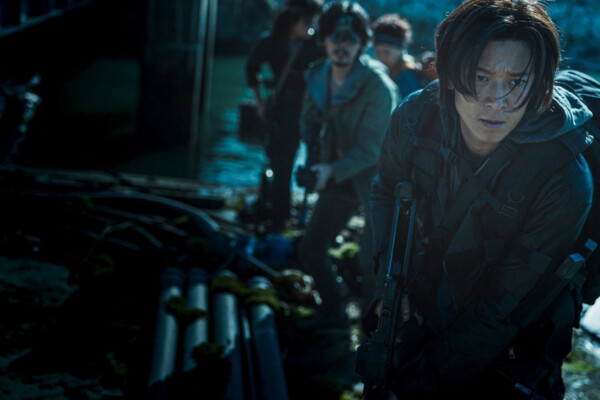
Image courtesy of Next Entertainment World.
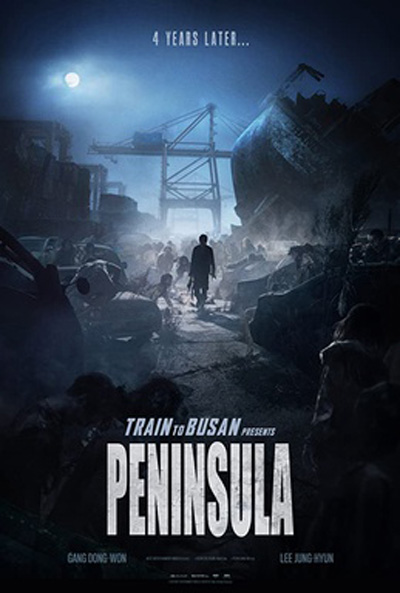
“Train to Busan Presents: Peninsula.” Starring Lee Jung-hyun, Dong-won Gang, Re Lee, Ye-won Lee, Hae-hyo Kwon, Kyo-hwan Koo, and others. Directed by Sang-ho Yeon. 115 minutes. Rated PG-13. Amazon pay-to-stream
Mladen’s take
There I sat, wavering. It was about three-fifths of the way through the South Korean movie “Train to Busan Presents: Peninsula.” My qualms included a meditation on the film’s weird title, which was clearly an example of success exploitation marketing. Was this semi-sequel to the excellent film “Train to Busan” worthy of a good grade or does it deserve a bad grade? And, then, came the straight-faced line: “Let’s get Mom.” Poof, I dropped into the “Better than Average” column, but only just.
Before I sum the plot, you’re owed a warning. Del the zombie-phile will praise this movie, maybe even slip it an A-. He’ll be wrong. The movie is one full grade lower, but worth watching. It cost me 55 cents to lease a 48-hour viewing window on Amazon.
Recall that “Train to Busan” introduced us to some very good action horror with an unremarkable plot very well executed. A bioengineering laboratory accidentally releases a contagion that transforms people into something akin to the rampaging quasi-dead hungry we first met in 2010’s “28 Hours Later.” In “T to B,” the story was driven by a father trying to keep his daughter alive, if I recall accurately, as the infected multiply and the state rapidly loses control of law and order. “T to B” possessed stunning special effects. The locomotive slowly motoring along while zombies clinging to the back of the machine pile on each other to make a squirming, yet flowing tail of organic debris was something else.
That “something else” was missing in “Peninsula.” The computer-generated special effects lacked believable physics of motion. The vehicles bulldozing through zombies, jumping roads, or smashing into each other seemed like Matchbox cars running the gauntlet of a plastic race course. Also, at times, “Peninsula” seemed very “Casshern”-like or “Alita: Battle Angel”-ish. The difference is that “Casshern,” a 2004 Japanese movie, and “Alita” of 2019 intentionally deployed the tinge of anime as part of the storytelling. “Peninsula,” which imagined quarantined South Korea four years after the “T to B” virus was unleashed, often portrayed dilapidated urban terrain or action scenes with the patina of a video game that had mated with anime to create an almost-cartoon. In short, the visual effects in “Peninsula” were surprisingly crappy.
Oh, the plot. A South Korean soldier loses his sister and nephew to zombie-itis, but manages to save his brother-in-law. A few years later, the pair gets sucked into returning to South Korea to retrieve a truck load of American dollars for an American gangster based in Hong Kong. If they and a couple of others succeed, they get half of $20 mil. That’s money that would get them out of the political limbo of being microbe-induced refugees. Naturally, the return to the Peninsula, get it, goes astray. Dong-won Gang, playing South Korea Army Capt. Jung Seok, gets pulled off a zombie dinner plate by feisty, hard-driving teenager Jooni, played by Re Lee, and her younger sister Ye-won Lee as Yu Jin. They flee to their hideout, where Jung meets resourceful, determined, and very pretty Min Jung. Min is played by Lee Jung-hyun. She’s the mom in “Let’s get Mom.” While Jung, Min, and the girls are good and likeable characters in the film, most of the bad guys are all pretty much clichés and fail to be unlikeable. The exception was Captain Seo, nicely portrayed by Kyo-hwan Koo as desperate and scheming to the end. He has no trouble shooting the old man and Mom to get the hell off the Peninsula.
The soundtrack in the film is good enough. There was a moment when I thought I heard a few stanzas, verses, whatever you call pieces of music, that sounded like an adventure tune in the video game “Halo.”
OK, Del, take it away with your take. Please don’t let the blubbery family scenes in “Peninsula” color your judgment as they did when you watched the last film we reviewed. We owe it to our growing readership to assess correctly the merits of a film.
Del’s take
It was I who recommended to Mladen that we review “Peninsula.” It was not I who recommended that he tap the cooking sherry before writing his review.
He’s correct when he describes the putative prequel to “Peninsula,” “Train to Busan” as excellent. I remember foraging through Netflix one night, searching for something to watch, when I stumbled across “T to B.” Another hokey foreign zombie flick, I warned myself, before clicking the “play” button. Imagine my surprise when I discovered a modern classic in science fiction-horror, one I’ve added to my DVD collection. “T to B” is that good. I would rate it up there with the Zack Snyder remake of “Dawn of the Dead.”
So it was with great expectations that I forked over my 99 cents to watch “Peninsula.” (I’d like to know how Mladen managed to do that for 55 cents. Did he get the cooking sherry discount?)
To put it succinctly, I was not impressed. For these reasons:
1. It’s derivative. Take the premise of “28 Weeks Later,” throw in some “Escape from New York” and using crude, Frankensteined stitches graft on any road chase sequence from the “Mad Max” movies and you’ve got “Peninsula.”
2. Mladen was right about another aspect of the film – the special effects. They weren’t just bad. They were cartoonish, on par with “Speed Racer.” They completely ruined the movie for me because I’ve seen car chases and motorized mayhem done right – all that metal-crunching comprises a story of its own. You want a car chase? Consult George Miller. You don’t hand it to the CGI folks, and that’s what the creators did with “Peninsula.” Those scenes screamed “Fake!” and threw me out of the zombie-infested universe Sang-ho Yeon sought to create.
3. Many of the major characters were unlikable. As Mladen explained, the point of this group’s return to zombie-infested South Korea is to recover a truckload of American dollars. The deal is a small group will find the truck and drive it back to an Inchon dock, where it will be loaded aboard a ferry. The group gets half the $20 million and the crooks get the other half. Ahem. Of course. The crooks will most definitely abide by their end of the deal. Have you never heard of honor among thieves?
The movie is really about Gang Dong-won’s character attempting to redeem himself after refusing to help a family in need during the initial, hyper-frantic days of the zombie outbreak. As subtexts go it’s about as subtle as a Mar-a-Lago powder room and Jung-seok is such a weak and altruistic tormented-soul type that by mid-movie you’re hoping one of his putrid antagonists makes a snack of him.
4. Nitpicks. Why does a director spend a considerable chunk of screen time building tension and setting a deadline, and when that deadline arrives the director allows his characters to engage in long, deadline-busting soliloquies and dénouements?
How is it that a car will start after sitting idle four years?
Why are children always precocious and infallible?
Why are the elderly characters always expendable?
Why does a highway choked with wrecked and abandoned vehicles always have a lane open?
Why was South Korea simply abandoned? Is its net worth beneath the scope of recovery?
5. The version I saw was not subtitled. It was dubbed. Have I ever told you how much I hate dubbing? When you can see the character’s mouth moving while the dialogue track stopped three seconds ago?
Enough fussing. Bottom line: I was hoping for a movie that matched the off-the-rail entertainment punch of “Train to Busan” and what I got for my 99 cents (Really, Mladen? Fifty-five cents?) was something altogether different and, dare I say, less everything. I could wax all movie-review poetic and talk about the film’s emotional core or its resonance to the genre template but this is not a thirst trap for pretty words. Suffice it to say “Peninsula” was a disappointment.
For much better fare about the undead try “Cargo” or the unbelievably good series “Black Summer,” both on Netflix at no extra charge. For an even weirder take on the zombie genre try Arnold Schwarzenegger in “Maggie,” which you can find in some DVD bargain bins.
“Peninsula” gets a grade of C from me.
Mladen Rudman is a former journalist and technical writer. Del Stone Jr. is a former journalist and author.

Image courtesy of Netflix.
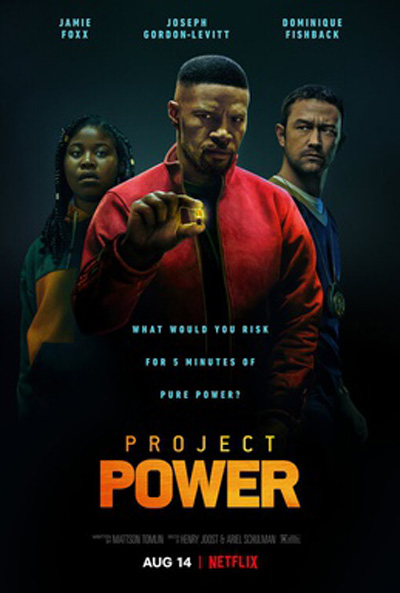
“Project Power” Starring Jamie Foxx, Joseph Gordon-Levitt, Dominique Fishback, and others. Directed by Henry Joost and Ariel Schulman, 113 minutes. Rated R. Netflix.
Mladen’s take
I watched “Project Power” a couple of weeks ago and, because the film isn’t worth re-watching, I’m writing this review from memory. Don’t misunderstand, cantankerous Del. “Project Power” is fine for a one-time seeing. Its plot is decent. The acting is good. Visual effects are good. I appreciate the effort the directors made to convey some of the movie from an artsy perspective like the basement room brawl and shootout. Hell, there was one scene toward the end of the film that made me chuckle, though it was a take on the old, “No, your other left.” And, I don’t care that one of our protagonists melodramatized the strength of the strike of a mantis shrimp. Or, was it the pistol shrimp? Or, are they the same species of Odontodactylus?
In “Project Power,” a rogue defense contractor/pharmaceuticals company disallowed to trials test a powerful physiology-altering drug that either kills you or infuses you with a unique power starts selling it as street smack. To gather lessons learned, collect proof of its discovery’s potential to the rich and connected assholes of the world, and elude mainstream press coverage, the pharma moves from city to city using pre-screened drug dealers to push its wares. Where pharma’s potion draws coverage, it’s snippets reported by the local media. One such unbelievable story was the claim that a suspect outran a police car on foot. Toss in a father’s (portrayed by Jamie Foxx) search for his kidnapped daughter, a smart young woman’s (portrayed by Dominique Fishback) need to raise money to help her mother with medical bills, and a New Orleans cop’s (portrayed by Joseph Gordon-Levitt) urge to protect his city and “Project Power” becomes a movie with too many anecdotal, though tolerable, moments.
The principal trouble with “Project Power” is its blunt-force-trauma wokeness. Blending so forcibly and pedantically the prejudices faced by blacks into a sci-fi thriller, paradoxically, weakened the message all of us non-Trumpers, anti-McConnells, and Baby Gaetz-Jerkoff Jordan-Supplicant Nunnes haters want reinforced. Racism and lack of economic opportunity for blacks is disgraceful, immoral, and illegal, but you have to be careful about whining because it’ll trigger those among us who’ll happily respond to Black Lives Matter by flippantly saying all lives matter as though there’s no history of, oh, slavery and Jim Crow in this country. In “Project Power,” unfortunately, the wokeness takes the tone of a dry, set-piece lecture.
One of the film’s strongest points is the clever and authentic way it melded the story of “Henrietta” into its script. From the ACLU website: “In 1951, doctors harvested cells from Henrietta Lacks while she was receiving treatment for cervical cancer and discovered that her cells had an amazing capacity to reproduce. ‘The Immortal Life of Henrietta Lacks,’ which aired … on HBO and is based on the book of the same name, tells the dramatic story of how scientists used the ‘HeLa’ cells in research for decades without the knowledge of her family.” As it turns out, Foxx’s character in “Project Power” is chasing pharma because it kidnapped his daughter to study and weaponize her superpower to heal. Neat.
Fishback, who plays Robin in the film, is very good. She does a wonderful job creating her character, a spunky and smart high schooler caught in an untenable dilemma. To help her mother buy health care, Robin pushes pharma’s power pill to drug users. Foxx as Art goes smoothly from appearing to be a bad guy to showing himself as the good guy, after all. Frank, Gordon-Levitt’s role, is a smart-aleck cop who pops a power pill to don his special attribute, very tough skin and/or bones that can absorb a 9-mm round to the temple from pointblank range with only bruising. He just wants to save New Orleans from itself and grifters with links, if I recall correctly, to the federal government. That subplot got a little blurry for my aging brain. Wonder if there’s a pill for lapsing mental acuity?
“Project Power” is sprayed with violence, car chases, and such. All of it good. The CGI approached to top-notch, barring the flaming dude at the beginning of the movie. He looked like he was engulfed by flaming paper streamers or one of those eerie two-story-tall inflatable marketing tubes that bop and wave at you as you drive by. I can’t remember the score, suggesting it was unnoteworthy.
Shit, I don’t know. Maybe “Project Power” is worth a second viewing. I’ll think about it. You, meanwhile, feel free to enjoy this solid B of a movie for its fairly common sequences of good moviemaking. Del, how about you getting off your ass to see this film, so that we can satisfy our loving readers with yet another good review by me and whatever it is that you slap together?
Del’s take
Yes, Mladen, there is a pill for lapsing mental acuity. It’s called Prevagen and I gave you a bulk gift basket from Sam’s Club for Christmas last year. Or have you forgotten?
I watched “Project Power” because Netflix flogged it as “No. 1 in America,” the trailer had cool special effects and it starred Joseph Gordon-Levitt, of whom I am a big fan. I know. Those are judgments based on the book cover principle. But let’s not be coy: We all judge books by their covers, regardless of aphorisms and scolding admonitions. The “Project Power” looked cool.
I thought it was an OK movie. Not great; not terrible. An acceptable use of almost two hours of my entertainment ration. Gordon-Levitt and Foxx are excellent. Dominique Fishback is exceptional. The special effects were terrific and the script was airtight. Plus it was nice to see New Orleans as the setting; I’ve been there many times and it is a unique city, unlike any other in the country. In some ways it reminds me of Spain (a tactic urban planners could adopt for future American developments – cultural design).
I didn’t have as much a problem with the “wokeness” as Mladen put it, though I would agree the delivery of that important message was clumsy and heavy-handed. It leaned more toward telling, not showing, a cardinal sin for all storytellers.
My big problem with “Project Power” was this: They took a big idea and married it to a small story.
Imagine being able to take a pill that would give you a superpower for five minutes. Imagine the potential, not just for warfare but crime, sports, law enforcement, even entertainment? Imagine such a capability in the hands of a rogue player – North Korea, or a school shooter? With this technology you have the ability to completely revolutionize society, and in the process tell a big, world-spanning story. Instead, “Project Wastes” it on drug deals and a man trying to find his daughter. It’s like discovering a cure for cancer and using it to clear up those unsightly liver spots on your hands.
Also, was I mistaken or did the movie suggest taking this drug exacted a physical toll from the user? Because some of the folks looked a little worse for wear following their excursions into the world of superpowers. I don’t believe that aspect of the story was explored to any depth.
Believe it or not, Mladen, I agree with your grade of B for “Project Power.” It has big ambitions but wastes them on a small story that, in the end, doesn’t really change anything.
If you’re looking to invest two hours of movie-watching time in a gritty, science-fictiony universe, catch “Project Power” on Netflix. But unlike its magic pill, your mind will not have been expanded after the experience.
Mladen Rudman is a former journalist and technical writer. Del Stone Jr. is a former journalist and author.

Image courtesy of Warner Bros.
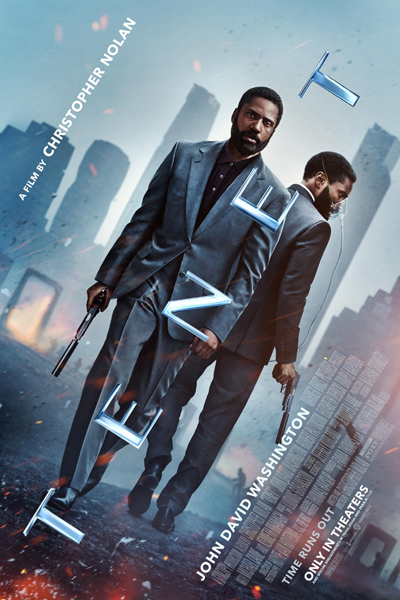
“Tenet” Starring John David Washington, Robert Pattinson, Elizabeth Debicki, Aaron Taylor-Johnson, Kenneth Branagh, and others. Directed by Christopher Nolan. 150 minutes. PG-13. Pay-per-view on YouTube, Google Play, Amazon Prime, Vudu, DVD.
Del’s take
In my dodderage I’ve become less enamored of puzzle boxes, Russian dolls, hidden meanings, subtext within subtext, Rubik’s cubes and other gimmicks, tricks, deflections and distractions – anything capable of making me believe something that isn’t true. We live in an age Qanon, ignorance on an industrial scale, conspiracy theories, corporate subterfuge and red hat-wearing politicians who not only lie shamelessly but revel in their malevolent deceit. Is it asking too much of a movie to just be a freaking movie and entertain me for a couple of hours instead of making me do a bunch of work?
I spent $15.99 on the “Tenet” DVD and I really, really wish I could get that money back. “Tenet” is well made and several of the performances are excellent, but it’s unwatchably dense and about as warm as a guest at the county morgue.
I can’t effectively summarize the plot because I’m still not sure I understand it. John David Washington is a CIA agent who, after an attack at a Russian opera performance, is recruited into an effort called “Tenet.” (Did I mention none of the characters have names?) Tenet is a war between us and the future. We have doomed the future with climate change, and the future is not happy about it. Future scientists have invented a way to “invert” the entropy of people and objects, allowing them to travel backward in time. Instead of using this inversion nonsense to head off climate change, the future would track down a cache of plutonium pilfered from a Russian ICBM … for what purpose? We don’t know. Is plutonium what they’re really looking for? We don’t know. What’s this about “The Algorithm” – has Facebook also pissed off the future, or is The Algorithm some kind of world-ending secret weapon invented by a future scientist and hidden in the past? Well, we don’t know, but since they bring it up. …
It’s a migraine-inducing onion of riddles hidden within paradoxes layered with feints and false flags, and to be honest I found it exhausting and unrewarding.
What’s good about “Tenet” is the cinematography, the locations, costumes, and some of the performances. Washington is excellent as the CIA agent and in my book would make a fine replacement for Daniel Craig when all those catalogs for Medicare start showing up in his mailbox. Also excellent were Robert Pattinson as Washington’s sort-of partner and Elizabeth Debicki as the suffering wife of a wicked Russian oligarch who may or may not be trying to acquire The Algorithm for his own demented death-bed purpose.
What I did NOT like about “Tenet” was the blink-your-eyes-and-miss-critical-plot-points narrative, the mumbled and often indecipherable dialogue, the lack of any pathos (which is typical of Christopher Nolan’s fare) and the unfathomable density of the plot. It seems Nolan is making movies for himself, not his audience.
After everything that has happened the past four years, my brain is only capable of processing movies like “Hobo with a Shotgun” or “The Man Who Killed Hitler and then the Bigfoot.” I would need a few less pandemics, insurrections and climate catastrophes before I could enjoy “Tenet.”
If acting and cinematography were the only criteria I could give “Tenet” an A-. But its hard-to-hear dialogue, lack of an emotional heart and black-hole density bring that grade down to a B. If you’re up for doing the work Nolan seems to ask of his fans, knock yourself out. I wasn’t.
Mladen’s take
Alas, I share Del’s frustration with “Tenet.” Despite his dodderage and, believe me, it’s advanced, he’s correct about the film. “Tenet” is a mess in execution.
Actually, I’m more frustrated than Del because I disliked the suffering wife/doting mother character played by Elizabeth Debicki. She damn near caused the destruction of 7 billion people in our time because she didn’t want her one son to be traumatized by, oh, hell, I forgot the reason.
“Tenet” is based on a neat concept. In this nicely shot film, people are able to move backward or forward in the same space. The spacetime of “Tenet” (the word reads the same backward or forward) can be separated into space and time by scientists from the future, which, as Del notes, are waging war against the present by allying with, and supporting the martyrdom of, a Russian oligarch portrayed beautifully by Kenneth Branagh.
Demonstrating the usefulness of the capability to manipulate time – again, a neat concept – is badly mangled in “Tenet.” Particularly difficult to understand are the “temporal pincer movements” unfolding on the screen as opponents move along the time continuum in which every direction they thought would produce tactical advantage. So, for example, you have cars moving forward and backward in the same lanes. Or, you have one unit of troops starting, executing, and completing a mission and another completing, executing, and starting the same mission on the same battleground. Hell, in this film, a man can fight himself, one version of him being from the present and the other “inverted” or from where, the future? Now that I think about it, there might not be a present, past, and future in “Tenet.” In this film, time is jumbled and coils around itself, like a ball of yarn, rather than being a point-to-point, straight line event. Maybe.
The most annoying part of “Tenet” to me, for some reason, was the film insisting that an “inverted” bullet – that is, a bullet exiting your body in the same direction it had entered (I think) – would cause more damage than a bullet entering your body from the same direction it would exit. Wouldn’t a bullet reversing course and leaving your body return your body to its pre-bullet state? If the phenomenon is someone shooting you who’s inverted – while you’re what, verted? – why would there be damage at all?
I’m tempted to give “Tenet” some slack. The idea of time travelers moving in opposite directions while sharing the same space in a way that affects the outcome of the present and the future simultaneously is far out and wonderful. “Tenet” still has me thinking about time inversion, which is different, apparently, than merely time travel. “Tenet” also has some very good acting. And, I enjoyed the score. It was propulsive. My surround-sound AVR has a separate volume control for the center channel speaker, which broadcasts the dialogue in a film. I was able to listen to the words because I was able to turn-up their volume without also increasing the volume of the many explosions and much gunfire in “Tenet.” Del, I did hear the dialogue but it didn’t help me understand the movie any better.
Finally, “Tenet” was ripe for R-rated action. Yes, not showing graphically a man getting beaten to death with blows to the head using a gold bar is a terrific way of capturing violence. More is left to the imagination. But, much of the movie is loads of people shooting at each other or getting their asses mortar-ed. That would have benefitted from vivid blood splatter, heads disintegrating, and limb amputations. Making “Tenet” PG-13 was an error. This movie is not for teenagers nor will teenagers watch it. “Tenet” pushes toward cerebral. Teens ain’t interested in cerebral on the big screen. They want crude, sexual, and narcissistic, the kind of film one-term, poser president, loser Donald Trump would watch.
“Tenet” is a C because it promises top-notch sci-fi adventure and then fails to deliver.
Mladen Rudman is a former journalist and technical writer. Del Stone Jr. is a former journalist and author.

Image courtesy of Sony Pictures.
“Sputnik” Starring Oksana Akinshina, Fyodor Bondarchuk, Pyotr Fyodorov, Anton Vasiliev and others. Directed by Egor Abramenko. Music by Oleg Karpachev. 113 minutes. Amazon Prime. Should be rated R for at least gore.
Mladen’s take
If the commie pinko fascist reds of the Putin regime savaging Russia today ever build an economy and arsenal like a few of that luckless nation’s citizens built the film “Sputnik,” the U.S. is in trouble. “Sputnik” is Grade A sci-fi horror nicely balanced with the correct doses of well acted storytelling, a world class score, and sophisticated, non-overbearing CGI. The movie is in Russian, so it’s captioned. Inevitably, something must’ve been lost in translation to English, but don’t let that discourage you from seeing the film. The captioning is good enough to convey its neat ideas and the character of the characters.
The Soviet Union is only seven years from disintegrating when this movie takes place. It’s 1983. It’s still the first Cold War. And, the Politburo needs a nationalistic win to boost the country’s sagging morale. The U.S.S.R. war in Afghanistan ain’t going well. Consumer goods are in short supply, unless you’re privileged. The Communist Party is going through leaders like Donald Moron Trump goes through unqualified cabinet secretaries. So, the addled Soviet Union turns to one of its few semi successes, space travel, for a taste of accomplishment. Two of its cosmonauts go into low-earth orbit, but three passengers return.
What unfolds next will have movie reviewers inevitably drawing comparisons between “Sputnik” and one of the two greatest sci-fi horror films ever, “Alien.” Labeling “Sputnik” an “Alien” derivative would be a false equivalency, however. It’d be like bashing “Alien” for mimicking “Invasion of the Body Snatchers.” There’s nothing new in moviedom about films creature featuring critters living inside us. “Invasion” with Donald Sutherland is a terrific movie, as is “Alien” with Sigourney Weaver. In “Sputnik,” Oksana Akinshina is top notch as her character, neuropsychiatrist Tatyana Klimova. Amiably menacing Fyodor Bondarchuk as Colonel Semiradov, charming survivor cosmonaut Konstantin Veshnyakov played by Pyotr Fyodorov, and Anton Vasiliev donning the role of ambitious but riven Dr. Yan Rigel are excellent, too. Even the movie’s title is well executed. “Sputnik” means “fellow traveler” or “companion,” but, generally, in a friendly way. That’s not what we get here.
“Sputnik” is one of the finest sci-fi movies I’ve seen in years. It’s better than “Life,” “Annihilation,” “High Life” or “Ad Astra.” It approaches “Europa Report” and “Arrival” in quality in terms of applying science to decipher what’s occurring, as well as acting and atmosphere. As with “Arrival,” for example, there’s a strong and intelligent female as the principal player in “Sputnik.” There’s tension and a twist or two as the characters develop. There’s realism. In “Arrival” the militaries of the world take the lead in trying to understand the aliens that have parked ships above certain spots on Earth. In “Sputnik,” the Soviet army’s Semiradov is trying to weaponize the trilling, cute-ish, slimy symbiont emerging nightly from the esophagus of Veshnyakov to feed. Pay attention to that part, the feeding. The food the alien needs is produced by a human’s endocrine subsystem. The way the creature ensures that happens is one of the movie’s provocative and original ideas. Loved it.
Come to think of it, there’s one other parallel between “Arrival” and “Sputnik.” This one falls into the category of irritating with a caveat. Both films have annoying time spanning flashes that involve children. Where that was needed to tell the story in “Arrival,” it was not needed to tell the story in “Sputnik.” But, that’s a minor quibble.
Disregard Del’s take, if he even suggests in his introduction that the film stinks. To dislike “Sputnik” is to demonstrate short-circuited sensory response, poor reasoning, a flawed recollection of movie history, moral turpitude and full-on soullessness. Watch “Sputnik.” It’s so good that I’m hoping to buy the film on Blu-ray. This way, when some National Security Agency trained, white hat hacker blows up the internet in anger after losing his Luke Skywalker figurine still in the original package that he put up as collateral to speculate on cryptocurrency futures, I’ll be able to watch this film again and again without worrying about access to a streaming service.

Del’s take
Man, what a stinker!
(I am picturing Mladen frothing at the mouth, his eyes goggling out like one of those squishy rubber chickens.)
On second thought, mark your calendars, folks, because today is one of those rare occasions – snow falling on Labor Day, the Florida unemployment compensation site actually working – when Mladen and I agree on something. “Sputnik” is a splendid film, the kind once made in America before the MBAs took over Hollywood.
“Sputnik” is a period piece, set in that happy time frame – for the United States, anyway – of the 1980s when MTV played music videos, imported beer became all the rage and many of us had waistline measurements that did not begin with the number 4. Except in “Sputnik” we are mired in the drab, run-down Soviet Union where people seem drab and run-down themselves, perhaps wearied by the relentless and dispiriting reality of communism. Neuropsychiatrist Tatyana Klimova, who has lost her job because of her unorthodox methods, has been summoned to a remote military facility to examine one of two recently returned cosmonauts – the other is deceased – who is experiencing amnesia. Except there’s a complication and I like the way Mladen put it: “Two of its cosmonauts go into low-earth orbit, but three passengers return.”
That’s a creepy premise and the movie delivers on creep, offering start-to-finish tension that lets up only briefly to set the stage of an original and surprising finish, one I’m surprised Mladen didn’t crab about seeing as how it’s laden with sentimentality.
Mladen is right. “Sputnik” has drawn comparisons to “Alien,” but the world of fiction, be it print or moving picture, provides a surfeit of tales about small groups confined to small spaces facing a singular threat – the Agatha Christie novel “And Then There Were None,” the lighthouse couple in “Day of the Triffids,” and even the happy gang of “The Walking Dead” to name a few. “Sputnik” may tread familiar ground but it strikes its own path.
It is no coincidence a movie about a man afflicted with a destructive internal force and the woman determined to save him takes place in a creaky totalitarian regime that is rotting from the inside, and Americans should pay heed to the cautionary aspects of the movie, which equally reflect the intellectual and moral rot eating the heart out of this country. That comment may not sit well with the Sieg Heil crowd that seems to be running Washington these days, but you know what? They’ll get over it.
The Russians and Chinese are improving their movie-making skills – “Winter of the Dead” and “The Wandering Earth” are two examples – and “Sputnik” continues that trend. I don’t draw any political conclusions from this fact – I think the improvements have come in spite of their no-fun, no-inspiration political and economic systems. Like Klimova of “Sputnik,” some moviemakers in those repressed states have risen above their hopeless surroundings to find some measure of success. Let’s hope that trend is just the beginning.
I give “Sputnik” an A.
There, Comrade Mladen. Are you happy now?
Mladen Rudman is a former journalist and technical writer. Del Stone Jr. is a former journalist and author.
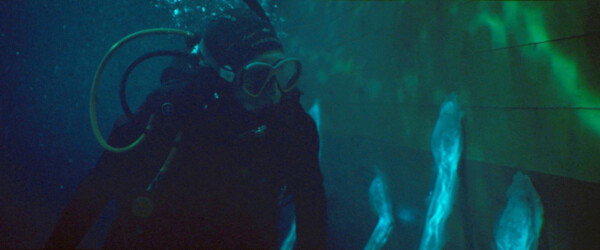
Image courtesy of Signature Entertainment.
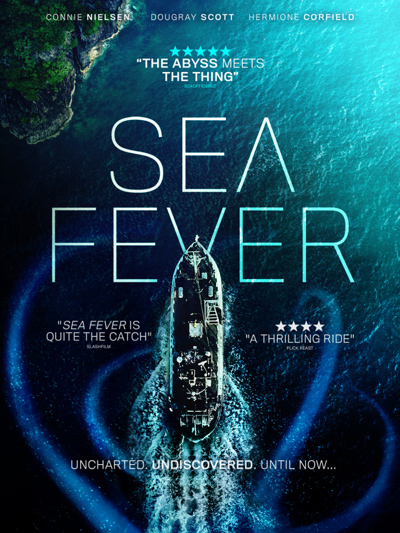
“Sea Fever” Starring Hermoine Corfield, Dag Malmberg, Jack Hickey, Dougray Scott and others. Directed by Neasa Hardiman. 95 minutes. Unrated. Hulu, Vudu, Google Play, Amazon Prime, Apple TV+, YouTube.
Del’s take
Oh goodie. Let’s distract ourselves from the pandemic by watching a movie about a pandemic.
Not a pandemic per se but a parasitic infection that threatens to wipe out the crew of an Irish fishing trawler plying the chilly waters of the North Atlantic. That’s the gist of “Sea Fever,” a pretty good little monster movie from director Neasa Hardiman. If films speak to the times, “Sea Fever” is the voice of our COVID-19 consciousness, transposing our empty streets and restaurants with the vacant horizon of the open ocean.
The plot is familiar to fans of “Alien,” “The Thing” and even “The Shining.” Lonely, friendless PhD student Siobhán (Hermoine Corfield) has booked passage on the Niamh Cinn Óir, a rust bucket Irish fishing trawler, to study the behavior patterns of aquatic fauna. The Niamh Cinn Óir is owned and operated by the husband-and-wife team of Gerard (Dougray Scott) and Freya (Connie Nielson); and a crew of four others. Life has not been grand for Gerard and Freya, and they need a good haul this trip or they’ll lose the trawler.
On the trip out they detect a large mass of fish which unfortunately lies within a government-declared exclusion zone. It would be a terrible thing if they accidentally drifted into that exclusion zone and caught a hold full of mackerel, thus saving the Niamh Cinn Óir from receivership and preserving the crew’s livelihoods. Well gosh darn it, guess what happens.
Sometimes exclusion zones exist for more reasons than bureaucratic capriciousness, especially in movies that isolate a small group of people and pits them against a seemingly unbeatable antagonist. It is at this point “Sea Fever” becomes a metaphor for the COVID-19 pandemic as the fishing trawler crew battles a weird aquatic parasite that threatens to kill them all.
But “Sea Fever” operates on a second level, one that addresses the pandemic of loneliness that has infected the world since the invention of digital technology. On her first field study, Siobhán is forced to step out of her reclusive shell and interact, if not befriend, the crew, especially after they discover she’s a redhead (apparently redheads are considered bad luck among Irish fishermen). As the movie progresses along its somewhat predictable trajectory, Siobhán becomes more and more human as her environment descends into science fiction nightmare.
Somehow indie directors always manage to find strong actors to fill their roles and “Sea Fever” is no exception. All the performances are very good but my favorite was Olwen Fouéré as Ciara, the boat’s cook, who carried herself with a chafing blue collar dignity that seemed to perfectly capture the soul of the part. Another strong performance was delivered by Ardalan Esmaili as the boat’s principled and skillful engineer. Weakest was Dougray Scott, whose character hovered somewhere between effective leader and simpering cad. He seemed incapable of communicating the moral ambivalence of a man caught between financial necessity and obeyance of the law.
My gripes with “Sea Fever” are that it wraps up with an anticlimax that feels rushed and out of character for protagonist Siobhán, and the crew’s attempts to resolve their problem seem truncated and drama-less. What would Ellen Ripley have done had she been aboard the Niamh Cinn Óir? That might have elevated the tension considerably.
Still, “Sea Fever” is, as I said, a pretty good little monster movie and your time will not have been wasted, if monster movies are your bag. As American movies become more and more templated by the MBAs working in Hollywood these days, it’s nice to see a movie that still has character and a beating heart.
I grade “Sea Fever” a B or maybe even a B+.
Mladen’s take
Desperation. Superstition. Science. And, a cnidarian. Say it with me, “cnidarian.” I adore that word. It wasn’t in my plain old lexicon of the English language. I had to look it up in my Oxford Dictionary of Science. Cnidarian. Cnidaria is a phylum of aquatic invertebrates that includes hydra, jellyfish, sea anemones, and coral, by the way.
In “Sea Fever,” the crew of the fishing vessel Niamh Cinn Óir become the victims of a cnidarian unknown to humanity. First, the oversized spineless predator whose centrally placed orifice is both mouth and anus, attacks their boat and then it attacks them with its eye-eating larvae.
Where Del sees a SARS-COV-2 angle to “Sea Fever,” I see a straight-up Nature will always kick Man’s ass statement in the film. Humanity believes it controls the planet. The planet disagrees. That disagreement takes many shapes. Climate change. Water shortages. Invasive species. A snowstorm in Texas that has Tumbleweed Cruz abandoning the state he represents in the U.S. Senate to flee to warm and socialist Mexico.
Though the encounter with the cnidarian drives the plot of “Sea Fever,” the story is also about society-induced desperation. The boat owner, who’s married to the captain, has to land a good catch to earn euros to keep the vessel. With that thought plaguing the couple, the captain takes a risk and then the boat owner takes a risk. Both prove fateful.
There is superstition aboard Niamh Cinn Óir. Marine biologist Siobhán, on the boat to conduct field research that her PhD advisor ordered her to do, has red hair, which, as Del points out, the crew consider bad luck. But, there’s also the superstition of religion. There is prayer for a safe journey. There is prayer for a good haul of fish. There are prayers for the dearly departed. And there’s the belief that God will yet protect the crew.
There is science aboard the boat. Siobhán, applying her knowledge, figures out enough about the big cnidarian to give the crew somewhat of a fighting chance to live.
But, in the end, neither God nor science are much help. What mattered was one person sacrificing for another.
“Sea Fever,” as Del claims, is a pretty good little monster movie. I would amend that observation with, “pretty good little sci-fi monster movie.” Though not laden with science, the movie has moments of science-y jargon – “cnidarian” for example – and “bioluminescence” and “holopalegic” and a portable, computer-powered microscope, and talk of water filtration system design. There was the hypothesis that the cnidarian normally parasitizes whales (the fishing boat was in an exclusion zone that existed to protect cetaceans and their calves) and might have mistook the passing shadow of the vessel as a sign of its normal prey.
Between trying to stay alive while a gelatinous, tentacled predator treats them as a larder for its babies and keeping themselves from going berserk under the pressure of looming infection, the crew has to struggle with a bigger question. Is it ethical to return to port when some, if not all, of the crew are nurseries for a novel parasite that could, or is it would, infect landlubbers? Poof, see you later, humanity.
The problem with “Sea Fever” is that it added baggage that didn’t need to be in the film. Too much time was used to set up Siobhán as a loner and it was unconvincing. Del mentioned that the cook carried herself “with a chafing blue collar dignity.” Chafing she was, but it was me who got chafed. The cook went from a semi-pleasant grandmotherly type to an old crone who wanted to kill my beloved Siobhán. What would be the point of killing the one person who had the technical know-how to help people stay alive?
Regrettably, I find myself in the unforgivable situation of agreeing with Del. “Sea Fever” is a B. But for a couple of tweaks, including more encounters with momma cnidarian, this movie would have easily catapulted to an A.
Mladen Rudman is a former journalist and technical writer. Del Stone Jr. is a former journalist and author.

Image courtesy of Lionsgate.
“Fast Color” Starring Gugu Mbatha-Raw, Christopher Denham, Lorraine Toussaint and Sanniya Sidney. Directed by Julia Hart. 100 minutes. Rated PG-13. Hulu.
Del’s take
“Fast Color” is pitched as a superhero movie but it is unlike any superhero movie you’ve ever seen, and I would venture to say it is not a superhero movie at all but a story about three women battling forces, both seen and not, that isolate them from the world but bind them as a family.
It is also one of those quiet, semi-science fiction dramas that slip into and out of the stream of pop entertainment garbage so noiselessly that it will not be noticed unless somebody draws attention to it.
As I watched “Fast Color” I thought of Zenna Henderson’s series of books about The People, immigrant aliens who arrive at Earth after their own world is destroyed. I also thought of the Tim Robbins movie “Code 46,” which also came and went without much fanfare but was a fine, overlooked gem of a film.
In “Fast Color,” Ruth (Gugu Mbatha-Raw) is a mother on the run, pursued by Bill (Christopher Denham), a government scientist eager to exploit Ruth’s psychokinetic abilities to cause earthquakes during the seizures that wrack her body. Ruth flees to her mother Bo’s (Lorraine Toussaint) home where Ruth’s daughter Lila (Sanniya Sidney) lives. Bo is raising Lila because Ruth is broken, a poetic way of saying she’s been struggling with substance addiction and other issues. Bo and Lila also have powers – they can take things apart and put them back together. But something that’s broken? It can’t be fixed – not by their telekinetic powers, at any rate.
That theme of brokenness operates throughout “Fast Color” – in Ruth by her moral flaws, Bo by her inability to fix Ruth and even Lila for her life of concealment, something every gay man and woman on the face of the Earth already understands. The government is broken, usually the case in movies where it is made the antagonist, and even the Earth is broken with climate change rendering water a commodity so precious America’s standard of living has descended to something that resembles the Third World.
The movie also tells us that while magic cannot fix things already broken, love may find a way. As the story winds toward its resolution we see Ruth, Bo and Lila seeking their own paths to redemption, with nary a caped crusader, death ray or dollop of the-fate-of-the-universe-lies-in-their-hands bullshit thrown in for dramatic tension.
The movie unfolds at a languid pace, which I felt was sometimes too slow, and reveals its secrets along the way requiring a patient audience. Its scope is limited and simultaneously expansive as it, like “Nomadland,” is set in the parched Southwest with its infinite horizons and empty landscapes.
The best performance of the film – and many of them are good – was by Toussaint as the suffering mother/grandmother Bo. She brought a regal dignity to the role and succeeded in avoiding the clichés and tropes of the put-upon matriarch who would suffer to spare her children.
I did not like the way Hart chose to end the film as it tended to confirm some of those clichés repudiated by everything that led up to the climax – in fact, the climax seemed more of an anticlimax and could have been reworked to provide more subtextual pop.
Still, “Fast Color” will entertain for its 100 minutes and it’s a good antidote to a lot of the nonsense that passes for science fiction in cinema these days.
I would grade it at a B+.

Mladen’s take
I enjoyed “Fast Color,” though it is incorrectly billed, as Del correctly noted.
That the streaming service, producers, studio, whoever or whatever, tried to sucker me with the claim the film is a science fiction adventure doesn’t bother me too much. “Fast Color” is a good, girl relationships movie with occasional doses of a superpower on exhibit. The superpower, by the way, comes in two flavors: controllable by its practitioner or beyond control.
The three women in the film have brains with the capability to deconstruct and reconstruct objects. When our heroines explode objects into millions of sand grain pieces and return those grains to their original uniform form, the process comes with bright, streaking stripes of color.
Best as I can tell, our heroines use the word “color” in their conversations as code for their power. “She sees colors.” “I can’t see colors.” “Does anyone else beside us three see colors?”
Bo, Ruth, and Lila have to talk carefully because they recognize that there are a whole bunch of people on the rain-starved Earth of the future who would try to weaponize their telekinesis, rather than do good with it.
Also, best as I can tell, our heroines are mortal. So, they could be snubbed by the Government if deemed a threat or some Trump-loving nationalistic fascist racist patriot citing God as his source of inspiration and authorization to cancel from the world the un-godly as he defines them.
Personally, though, had I fast color, I wouldn’t be cowering from the billions of stupid people on this planet. I’d discern ways to let those reds, greens, and blues rip to achieve world peace while I worked toward enabling the power to allow me to live forever so that I could travel to edge of the universe.
I can’t recall the soundtrack for “Fast Color,” which is good and bad. Bad in the sense that the score, at least to me, failed to add to the film. Good in that the music didn’t distract the plot. I did enjoy the song about a new day coming about halfway through the film.
“Fast Color” has a pleasantly subdued dystopian feel. The world is dry as in “Mad Max: Fury Road,” but there’s no hyperviolence among warring tribes. In fact, there’s very little violence in “Fast Color.” The director conveys desperation and dearth by showing poor pickins’ on store shelves. More effective is the unceasing reminder that the water well is going dry. Water is ladled into and out of plastic containers marked with red for maximum volume, usually about half of the actual capacity of a jug. There must be no spillage. Check into a motel and you pay for the room and the water. Faucets are useless, bathing wasteful.
However, the reason I give “Fast Color” a B+ like Del is this: Though essentially a girl movie, there’s almost no romance. The lack of romance allows me to forgive the studio for lying about the film’s true genre.
Mladen Rudman is a former journalist and technical writer. Del Stone Jr. is a former journalist and author.

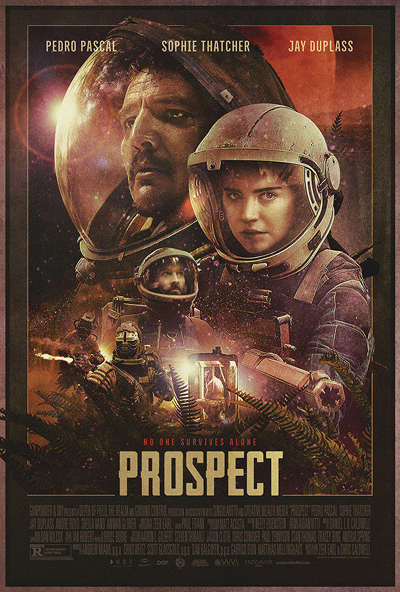
Image courtesy of Dust.
“Prospect” Starring Sophie Thatcher, Jay Duplass, Pedro Pascal and others. Directed by Christopher Caldwell and Zeek Earl. 100 minutes. Rated R. Netflix.
Del’s take
I’m always a little nervous when Mladen chooses the movie to be reviewed. There’s no telling what he’ll come up with – some giant thing crawling out of the muck to wreak havoc on mankind, most likely. But this time Mladen resisted his misanthropic tendencies to recommend a fine little science fiction movie called “Prospect,” and it’s one I think some of you will enjoy.
The plot is simple: A down on his luck prospector and his teenage daughter travel to an alien moon where a cache of valuable gemstone-like objects awaits. Recover those objects and they’ll be able to pay off their debts and lift themselves from the wretchedness of their current existence. But along the way they encounter a couple of rogues who want to jump their claim. And there’s a ticking clock – the freighter they arrived on will depart in a few days and this will be its final trip to the alien moon with its poisonous forests.
The viewpoint character is Cee (Sophie Thatcher), who loves her father but has grown weary of his ne’er-do-well ways and yearns for the life of a normal teenager. Her father Damon (Jay Duplass) is one quick get-rich scheme away from having to chase every other quick get-rich scheme that comes along. On the moon’s surface they encounter Ezra (Pedro Pascal), who in my opinion steals the show as the murderous but ultimately human claim-jumper, he of a dubious but malleable moral code.
What fascinates me about “Prospect” is the world Caldwell and Earl created to frame their story. Gone is the usual sleek, antiseptic science fictiony setting with its focus on technology, gleaming metal and blinking telltales. The world of “Prospect” is littered with garbage, tchotchkes, an alien alphabet and people who are as trashy and disposable as everything around them – in other words, a world very much like the one we live in.
The plot itself is thin, but it works. More money and bigger talent might have cluttered the story with unnecessary and distracting plot subordinates and crappy special effects, but “Prospect” plods along with relative efficiency, focusing on a single imperative: getting off this infernal moon. I say “plod” because at times the action does seem to wallow in needless internal conflict and naval-gazing. It isn’t a plot suitable for an action movie anyway, but the directors could have slain at least a few of their little darlings and moved things along more briskly, with no harm to the pacing and tone.
Another anachronistic artifact – Ezra’s peculiar diction, a strangely stilted form of speech, almost as if he were quoting from 19th century literature – struck me as distracting and superfluous. It reminded me of the dialogue in “Bone Tomahawk” and I still can’t figure out what purpose it served in supporting the character or story. In “Bone Tomahawk” it lent a weird, offbeat humor to the proceedings, but I doubt that was the intent here. Perhaps it was intended to boost the gain of the vaguely western theme? I dunno.
I loved the look and feel of “Prospect.” It was unique and different, and I have not encountered unique and different in a long, long time. The directors eschewed many of the special effects you might expect of a sci-fi flick and that works to the movie’s advantage, enhancing its grungy look and amplifying the dirt-track poverty of its three primary characters.
I think sci-fi fans will appreciate “Prospect’s” virtues but I’m not sure a general audience will feel the same. It enjoyed a brief theatrical release but from there went to video-on-demand.
I’m giving it a B+. Caldwell and Earl did a lot of things right in making this movie and I look forward to their future efforts.
But Mladen gets only a C+ for choosing it. He should have been choosing movies like this all along and not clinkers like “Ice Spiders.”
Mladen’s take
Del, though praising “Prospect,” has failed to adore this terrific piece of sci-fi sufficiently. B+ my ass. The sleeper film is an A top to bottom, left to right, and diagonally. “Prospect” is intimate sci-fi such as “Sputnik,” “Arrival,” or “Children of Men,” albeit less provocative intellectually.
There are nothing but exemplary performances in “Prospect.” Where Del chooses Pascal portraying Ezra as the show stealer, I give Thatcher’s Cee equal billing and praise.
Ezra is cunning, but abides the thief’s code of right and wrong as a “fringeling” prospecting and “digging” for gems created by living organisms. I wonder if the beasties, which eat limbs if improperly neutralized because accessing their “aurelac” requires sticking arms into their mouths, were modeled on oysters. Like oysters produce pearls from grains of ingested sand that irritate them, the whatevers on Green seem to create fist-sized aurelac the same way. Neat idea.
Ezra is a well-spoken rogue with boundaries. He has a chance to shoot Cee during a tumultuous encounter, but doesn’t. The way he demonstrates aversion to killing a child is wonderful. Nor did he sell her to god-fearing, convoluted-thinking, brazenly hypocritical religionists for a case full of neatly packed aurelac.
Cee’s reaction, measured in facial expression, when the religionists offer Ezra gems for the “girl” is compelling and authentic. It’s as though the youngster was able to imagine herself actually getting sold like property. Thatcher as Cee demonstrates uncanny acting again and again. From getting high chewing laced gum to a subtle hint of calculation and greed when Ezra offers her the prospect of collecting a fortune in aurelac to the way she urges him to keep moving with the wave of the rail gun in her hand, Thatcher is perfectly comfortable with her role as a resourceful teenager with still girlish interests. Why hasn’t she appeared in more movies? Give me more Pascal, while we’re at it. Caldwell and Earl get your asses in gear and make another movie as excellent as “Prospect.” Feel free to use Thatcher and Pascal again. They were a charismatic de facto father and daughter in “Prospect.” I imagine they could be, say, an effective mercenary duo on Earth or beyond fighting for Mankind’s survival. Maybe giving Thatcher the role of a queen reclaiming her kingdom from an alien race known as the Grist. Pascal could be a cyborg playing both sides until he witnesses the horror of Grist assimilating people.
Directors Caldwell and Earl understand that the guts of a movie is the story as captured by a good script. Visual effects can augment, never replace, solid writing and acting. In “Prospect,” the VFX are spot-on. A worn-down hi-tech world is assumed. The sound effects – the thunk of lander latches releasing, the rumble of thrusters, materials vibrating during re-entry, the clanking of “thrower” projectiles sent into hypervelocity motion – are very good, too. A soon-to-be-discontinued commuter line runs to the aurelac moon. Why discontinued? Probably because it’s no longer profitable now that the gem rush has come and gone. Who gives a shit about flora and fauna on Green, or studying it, when there ain’t no more money to be made? As the major points out in the less good, though still worth watching “Ad Astra,” humans are world eaters. Always will be.
“Prospect” is the whole works wrapped into a precise and efficient plot. The whole works includes the score. I paid attention to the soundtrack watching the movie and I listened to the soundtrack as its own medium. It’s very, very good. Have to hand it to composer Daniel L.K. Caldwell. He chose the correct orchestra and boys choir to immerse me in the moodiness of the story.
Yup, this film will be added to my Blu-ray collection. It’s that good.
Mladen Rudman is a former journalist and technical writer. Del Stone Jr. is a former journalist and author.