Beach-cleaning may not have been a fun vacation, but it was an education
I recently had an opportunity to take a midwinter vacation, and because I didn’t want to spend a lot of money traveling somewhere, I decided to spend this week right here in Florida, the tourist capital of the United States,
So … what does one do when vacationing in Florida? He goes to the beach, naturally, and that’s what I did. But early February isn’t exactly a boom season for beach-lounging.
I picked up garbage.
At this point you must be thinking, “He’s finally done something to earn one of those jackets with no sleeves and permanent residency in a padded cell.” Picking up garbage might not constitute a vacation you write home about, but if nothing else, it was an education for me.
A few years ago I took another midwinter vacation, and I spent that week exploring nearby places I had never seen. One stretch of beach particularly impressed me with its unspoiled beauty. It must have looked that way for hundreds of years. Except for the garbage.
The garbage had been left there by boaters and explorers like myself who were less appreciative of the natural wonder about them. It made me angry, and this time I decided to do something about it.
I spent only four days picking up garbage. It rained three days and I took off a day because I hurt my back with all that bending over and lifting. But in those four days I hauled 30 bags of garbage from a stretch of land I’d estimate to be 200 yards in length.
In a way it was fun, because you wouldn’t believe some of the junk I found. Empty flare cartridges. Light bulbs – who takes light bulbs to the beach? Disposable diapers (yech!). Shot cups from shotgun shells. Broken toys. Shoes. Socks. Photos that apparently had fallen from somebody’s wallet. Somebody’s boat registration (It was sealed in a plastic bag, and the owner’s address was printed on the front, So I returned it to him. Water had gotten inside the bag, but I think he could dry it in the oven).
But 90 percent of the garbage consisted of bottles and plastic, and I am now convinced this state needs a bottle deposit law. You simply would not believe the number of bottles I found. Some had been broken in horrifying ways. It was commonplace to find huge, jagged pieces of glass protruding from the sand. If someone had stepped on the glass, he would have needed a trip to the hospital.
And the plastic! Bags and pieces of rope and plastic containers were scattered everywhere. They were ensnarled in tree roots; they littered the dunes and thatches of beach scrub.
Seeing this kind of thing can give you an unhealthy disrespect for your fellow man.
You read stories and you watch television programs about the environment and how mankind’s disregard for the world around him is laying nature to waste. You never see those stories about this area, though. Everything is supposed to be generally OK in these parts.
Well, if this is OK, I’d hate to see the really bad places. Because nothing must live there, not even people.
This column was originally published in the March 3, 1988 edition of the Northwest Florida Daily News and is used with permission.
About the author:
Del Stone Jr. is a professional fiction writer. He is known primarily for his work in the contemporary dark fiction field, but has also published science fiction and contemporary fantasy. Stone’s stories, poetry and scripts have appeared in publications such as Amazing Stories, Eldritch Tales, and Bantam-Spectra’s Full Spectrum. His short fiction has been published in The Year’s Best Horror Stories XXII; Alfred Hitchcock’s Mystery Magazine; the Pocket Books anthology More Phobias; the Barnes & Noble anthologies 100 Wicked Little Witch Stories, Horrors! 365 Scary Stories, and 100 Astounding Little Alien Stories; the HWA anthology Psychos; and other short fiction venues, like Blood Muse, Live Without a Net, Zombiesque and Sex Macabre. Stone’s comic book debut was in the Clive Barker series of books, Hellraiser, published by Marvel/Epic and reprinted in The Best of Hellraiser anthology. He has also published stories in Penthouse Comix, and worked with artist Dave Dorman on many projects, including the illustrated novella “Roadkill,” a short story for the Andrew Vachss anthology Underground from Dark Horse, an ashcan titled “December” for Hero Illustrated, and several of Dorman’s Wasted Lands novellas and comics, such as Rail from Image and “The Uninvited.” Stone’s novel, Dead Heat, won the 1996 International Horror Guild’s award for best first novel and was a runner-up for the Bram Stoker Award. Stone has also been a finalist for the IHG award for short fiction, the British Fantasy Award for best novella, and a semifinalist for the Nebula and Writers of the Future awards. His stories have appeared in anthologies that have won the Bram Stoker Award and the World Fantasy Award. Two of his works were optioned for film, the novella “Black Tide” and short story “Crisis Line.”
Stone recently retired after a 41-year career in journalism. He won numerous awards for his work, and in 1986 was named Florida’s best columnist in his circulation division by the Florida Society of Newspaper Editors. In 2001 he received an honorable mention from the National Lesbian and Gay Journalists Association for his essay “When Freedom of Speech Ends” and in 2003 he was voted Best of the Best in the category of columnists by Emerald Coast Magazine. He participated in book signings and awareness campaigns, and was a guest on local television and radio programs.
As an addendum, Stone is single, kills tomatoes and morning glories with ruthless efficiency, once tied the stem of a cocktail cherry in a knot with his tongue, and carries a permanent scar on his chest after having been shot with a paintball gun. He’s in his 60s as of this writing but doesn’t look a day over 94.
Contact Del at [email protected]. He is also on Facebook, twitter, Pinterest, tumblr, TikTok, and Instagram. Visit his website at delstonejr.com .

Image courtesy of Quinn Dombrowski by way of a Creative Commons license. https://www.flickr.com/photos/quinnanya/
As a homeowner, I have had my eyes opened to a range of marvelous new experiences, many of them requiring the absence of money. One such experience is a clogged drain.
In the halcyon days of my youth, a clogged drain meant waiting until 2:30 when Dad would come home from work to fix it. Now, a clogged drain means that I, as an adult male and, by default, the head of the household, am expected to flail at the accursed thing for at least an hour before calling Dad, who must come home from work and then drive across town to my house to fix it.
I was taking a shower recently when I noticed that my kneecaps were submerged. My keen powers of perception told me that water was not draining from the bathtub, and with my equally acute powers of deductive reasoning, I swiftly determined that something – probably a big wad of mutant hairballs – had plugged the drain.
Minutes later I entered the bathroom dressed for battle: a plumber’s snake dangled from my fist like a bullwhip. The furrows in my forehead, plowed there by grim determination, were dotted with beads of sweat, or perhaps bath water, because I had forgotten to towel off.
You are probably asking yourself: What is a plumber’s snake? Is it one of those things you read about that swims up into toilets and gives elderly ladies heart attacks?
No. Basically, a plumber’s snake is a long metal device that you use to damage shower tiles and small children if they happen to be in the same voting precinct when you are cranking it.
I began ramming the snake down the drain. I immediately encountered an obstruction, because the snake kept wanting to spring back out of the drain as if it were some mad jack-in-the-box. The obstruction turned out to be a bend in the pipe.
More of the snake began to slip into the drain. I could hear it clearly … so clearly that my powerful intellect was able to guide me to the conclusion that it had gone UP the pipe instead of DOWN, and would have inserted itself into my ear had it not been for a metal plate covering the opening beneath the faucet.
I reasoned that if I could remove that metal plate, I could force the snake DOWN, and it could go nowhere but into the drain pipe, unless it bored through the pipe and into Earth’s crust.
So I set about unscrewing the screw that held the plate in place. I did not know the screw hadn’t been moved since man developed metallurgy, and no sooner than I could say, “What hath God wrought,” the screw broke, the plate fell off and I was staring at a slime-encrusted hole that resembled a biblical description of hell.
Ever the opportunist, I inserted the plumber’s snake into the hole and began merrily plunging away, and half an hour later I had slime all over the bathroom, the drain was plugged worse than ever and it was almost time to go to work.
That’s when I called Dad.
I’m happy to report the drain is now clear and the lid to hell has been capped and you can all return to your homes. Except the kitchen faucet is dripping.
This column was originally published in a February 1988 edition of the Northwest Florida Daily News and is used with permission.
About the author:
Del Stone Jr. is a professional fiction writer. He is known primarily for his work in the contemporary dark fiction field, but has also published science fiction and contemporary fantasy. Stone’s stories, poetry and scripts have appeared in publications such as Amazing Stories, Eldritch Tales, and Bantam-Spectra’s Full Spectrum. His short fiction has been published in The Year’s Best Horror Stories XXII; Alfred Hitchcock’s Mystery Magazine; the Pocket Books anthology More Phobias; the Barnes & Noble anthologies 100 Wicked Little Witch Stories, Horrors! 365 Scary Stories, and 100 Astounding Little Alien Stories; the HWA anthology Psychos; and other short fiction venues, like Blood Muse, Live Without a Net, Zombiesque and Sex Macabre. Stone’s comic book debut was in the Clive Barker series of books, Hellraiser, published by Marvel/Epic and reprinted in The Best of Hellraiser anthology. He has also published stories in Penthouse Comix, and worked with artist Dave Dorman on many projects, including the illustrated novella “Roadkill,” a short story for the Andrew Vachss anthology Underground from Dark Horse, an ashcan titled “December” for Hero Illustrated, and several of Dorman’s Wasted Lands novellas and comics, such as Rail from Image and “The Uninvited.” Stone’s novel, Dead Heat, won the 1996 International Horror Guild’s award for best first novel and was a runner-up for the Bram Stoker Award. Stone has also been a finalist for the IHG award for short fiction, the British Fantasy Award for best novella, and a semifinalist for the Nebula and Writers of the Future awards. His stories have appeared in anthologies that have won the Bram Stoker Award and the World Fantasy Award. Two of his works were optioned for film, the novella “Black Tide” and short story “Crisis Line.”
Stone recently retired after a 41-year career in journalism. He won numerous awards for his work, and in 1986 was named Florida’s best columnist in his circulation division by the Florida Society of Newspaper Editors. In 2001 he received an honorable mention from the National Lesbian and Gay Journalists Association for his essay “When Freedom of Speech Ends” and in 2003 he was voted Best of the Best in the category of columnists by Emerald Coast Magazine. He participated in book signings and awareness campaigns, and was a guest on local television and radio programs.
As an addendum, Stone is single, kills tomatoes and morning glories with ruthless efficiency, once tied the stem of a cocktail cherry in a knot with his tongue, and carries a permanent scar on his chest after having been shot with a paintball gun. He’s in his 60s as of this writing but doesn’t look a day over 94.
Contact Del at [email protected]. He is also on Facebook, twitter, Pinterest, tumblr, TikTok, Ello and Instagram. Visit his website at delstonejr.com .
Who knew I had such deep thoughts?
Filmmakers would have you believe every hour of every day is fraught with adventure. The typical cinematic day begins with an illicit love affair followed by a mysterious telephone call, a car chase and a narrowly thwarted assassination attempt.
But life rarely imitates art. This occurred to me recently as I was standing in an office supply store. The clerk had just told me IBM manufactures a ribbon cassette that is compatible with my Royal typewriter. That made me happy – inordinately happy. And I didn’t know why.
After all, small success stories such as these are not the stuff of which entertainment is made. Had I not been taught by 25 years of watching television and movies that a person could not be truly happy unless he were realizing his most extravagant dreams?
It had been a good day, so far, and as I went over the events that had made it that kind of day, I began to remember something many of us often forget under the barrage of video and celluloid fantasies.
That morning, I finally discovered a place where our writers’ group could meet. I belong to the Redneck Riviera Writers Group. We get together twice a month and compare notes on the business of writing. We had been meeting at people’s homes, or local eateries, but it soon became obvious that if we were to expand beyond our current membership of five people, we would have to find a permanent meeting place. After a fruitless search, we found a new home at the YMCA, courtesy of Joe Lukaszewski. That made me feel good.
Something else nice happened that morning. I found a book of Ramsey Campbell short stories I hadn’t known existed. I’m a student of the short story and Campbell is a bona fide master. The book should be fascinating.
I also picked up what I think will be the perfect gift for a friend. It, too, is a book of short stories, but these are special. I had never seen the book outside of the one copy I’d been hoarding for myself. Now she can enjoy it too.
Pop artist Andy Warhol died recently. In one of his obituaries I came across a reference to a movie of his titled “Sleep.” The movie depicted a person sleeping. That’s it. Two hours of a person sleeping. The entertainment virtues of the film are less than dubious and the artistic virtues debatable, but I think I understand what Warhol might have been saying.
The small, mundane successes and failures – things that would end up on the cutting room floor – are the body and texture of life. They are what make life an endlessly fascinating experience. Spilling coffee on the living room carpet. Finding a letter from a friend in your mailbox. The thousand things that you forget a day after they’ve happened. They are what get us through accomplishments to crises.
So it was a pretty good day. Not great, but not horrible. Just something to be thankful for.
This column was published in the Sunday, January 10, 1988 edition of the Northwest Florida Daily News and is used with permission.
About the author:
Del Stone Jr. is a professional fiction writer. He is known primarily for his work in the contemporary dark fiction field, but has also published science fiction and contemporary fantasy. Stone’s stories, poetry and scripts have appeared in publications such as Amazing Stories, Eldritch Tales, and Bantam-Spectra’s Full Spectrum. His short fiction has been published in The Year’s Best Horror Stories XXII; Alfred Hitchcock’s Mystery Magazine; the Pocket Books anthology More Phobias; the Barnes & Noble anthologies 100 Wicked Little Witch Stories, Horrors! 365 Scary Stories, and 100 Astounding Little Alien Stories; the HWA anthology Psychos; and other short fiction venues, like Blood Muse, Live Without a Net, Zombiesque and Sex Macabre. Stone’s comic book debut was in the Clive Barker series of books, Hellraiser, published by Marvel/Epic and reprinted in The Best of Hellraiser anthology. He has also published stories in Penthouse Comix, and worked with artist Dave Dorman on many projects, including the illustrated novella “Roadkill,” a short story for the Andrew Vachss anthology Underground from Dark Horse, an ashcan titled “December” for Hero Illustrated, and several of Dorman’s Wasted Lands novellas and comics, such as Rail from Image and “The Uninvited.” Stone’s novel, Dead Heat, won the 1996 International Horror Guild’s award for best first novel and was a runner-up for the Bram Stoker Award. Stone has also been a finalist for the IHG award for short fiction, the British Fantasy Award for best novella, and a semifinalist for the Nebula and Writers of the Future awards. His stories have appeared in anthologies that have won the Bram Stoker Award and the World Fantasy Award. Two of his works were optioned for film, the novella “Black Tide” and short story “Crisis Line.”
Stone recently retired after a 41-year career in journalism. He won numerous awards for his work, and in 1986 was named Florida’s best columnist in his circulation division by the Florida Society of Newspaper Editors. In 2001 he received an honorable mention from the National Lesbian and Gay Journalists Association for his essay “When Freedom of Speech Ends” and in 2003 he was voted Best of the Best in the category of columnists by Emerald Coast Magazine. He participated in book signings and awareness campaigns, and was a guest on local television and radio programs.
As an addendum, Stone is single, kills tomatoes and morning glories with ruthless efficiency, once tied the stem of a cocktail cherry in a knot with his tongue, and carries a permanent scar on his chest after having been shot with a paintball gun. He’s in his 60s as of this writing but doesn’t look a day over 94.
Contact Del at [email protected]. He is also on Facebook, twitter, Pinterest, tumblr, TikTok, and Instagram. Visit his website at delstonejr.com .

Lt. Col. Oliver North testifying before Congress in the summer of 1987. Photo courtesy of The Associated Press
“There they go,” the man said, glancing at the image of Lt. Col. Oliver North on the television. “Crucifying Ollie.”
It was only the first day of North’s testimony before the congressional committees investigating the Iran-Contra affair, but the hearts and minds of people all across America, apparently, had already been won by this David as he defiantly challenged the bureaucratic Goliath.
By the time North concluded his testimony, he had become a hero. Even committee members seemed consternated by the public’s infatuation with the man, leavening their tepid criticism of his actions with praise and apologies.
This groundswell of support for North was the product of many factors: North wore a military uniform – Americans cannot resist a uniform; North eloquently expressed his patriotism; North distanced himself from the Washington paper pushers, whom most Americans regard with disdain.
But the roots to North’s popularity go much deeper than that. If the letters, telegrams and bumper stickers may be considered a barometer of American sentiment, it would seem approval for what North did was not so much a motivating element as disapproval for what Congress had been doing.
In letters to this newspaper, in radio polls and roadside signs, the public has vilified Congress for meddling in the president’s foreign policy initiatives, for vacillating on the issue of confronting communism, for grandstanding before cameras for votes. North happened to be in the right place at the right time; anybody could have thumbed his nose at the investigating committees and America would have cheered.
Which leads to a fundamental shortcoming in the public’s perception of this affair. Regardless of which side of the fence you stand concerning North’s guilt or innocence, the fact is we, the voters, are responsible for what has happened.
Why?
Because many of us do not take time before an election to acquaint ourselves with the candidates. Because we tend to choose the candidate with the most effective advertising campaign. Because we vote straight-party tickets instead of considering each candidate on his unique merits. Because we don’t even bother to vote.
It seems hypocritical of Americans to take Congress or the administration to task, when Americans elect Congress and the president. Did nobody hear President Reagan say he would solicit aid for the Nicaraguan Contras? Has nobody heard their congressmen take a stand on this issue?
If you believe Lt. Col. North is guilty of crimes, and you have neglected your responsibilities as a voter, then you have no one to blame but yourself.
Likewise, if you believe that Congress’s sloppy stewardship is at fault, and you have neglected your responsibilities as a voter, then you have no one to blame but yourself.
This column was originally published by the Playground Daily News in the 1980s and is used with permission.
About the author:
Del Stone Jr. is a professional fiction writer. He is known primarily for his work in the contemporary dark fiction field, but has also published science fiction and contemporary fantasy. Stone’s stories, poetry and scripts have appeared in publications such as Amazing Stories, Eldritch Tales, and Bantam-Spectra’s Full Spectrum. His short fiction has been published in The Year’s Best Horror Stories XXII; Alfred Hitchcock’s Mystery Magazine; the Pocket Books anthology More Phobias; the Barnes & Noble anthologies 100 Wicked Little Witch Stories, Horrors! 365 Scary Stories, and 100 Astounding Little Alien Stories; the HWA anthology Psychos; and other short fiction venues, like Blood Muse, Live Without a Net, Zombiesque and Sex Macabre. Stone’s comic book debut was in the Clive Barker series of books, Hellraiser, published by Marvel/Epic and reprinted in The Best of Hellraiser anthology. He has also published stories in Penthouse Comix, and worked with artist Dave Dorman on many projects, including the illustrated novella “Roadkill,” a short story for the Andrew Vachss anthology Underground from Dark Horse, an ashcan titled “December” for Hero Illustrated, and several of Dorman’s Wasted Lands novellas and comics, such as Rail from Image and “The Uninvited.” Stone’s novel, Dead Heat, won the 1996 International Horror Guild’s award for best first novel and was a runner-up for the Bram Stoker Award. Stone has also been a finalist for the IHG award for short fiction, the British Fantasy Award for best novella, and a semifinalist for the Nebula and Writers of the Future awards. His stories have appeared in anthologies that have won the Bram Stoker Award and the World Fantasy Award. Two of his works were optioned for film, the novella “Black Tide” and short story “Crisis Line.”
Stone recently retired after a 41-year career in journalism. He won numerous awards for his work, and in 1986 was named Florida’s best columnist in his circulation division by the Florida Society of Newspaper Editors. In 2001 he received an honorable mention from the National Lesbian and Gay Journalists Association for his essay “When Freedom of Speech Ends” and in 2003 he was voted Best of the Best in the category of columnists by Emerald Coast Magazine. He participated in book signings and awareness campaigns, and was a guest on local television and radio programs.
As an addendum, Stone is single, kills tomatoes and morning glories with ruthless efficiency, once tied the stem of a cocktail cherry in a knot with his tongue, and carries a permanent scar on his chest after having been shot with a paintball gun. He’s in his 60s as of this writing but doesn’t look a day over 94.
Contact Del at [email protected]. He is also on Facebook, twitter, Pinterest, tumblr, TikTok, and Instagram. Visit his website at delstonejr.com .
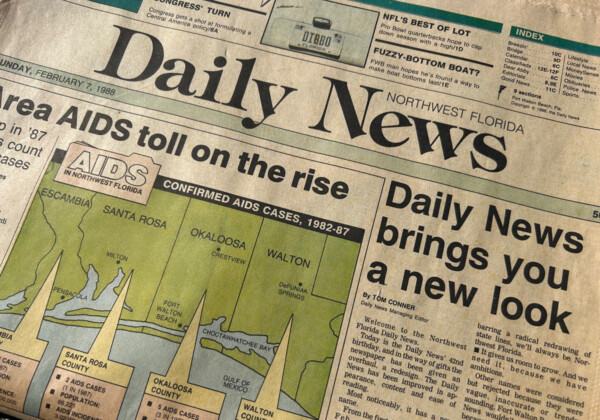
This is the Sunday, Feb. 7, 1988 edition of the Northwest Florida Daily News featuring the new name and new look. Image by Del Stone Jr.
Our newspaper, the Daily News, has embarked on an ambitious redesign project which I am overseeing, and this has given me the opportunity to investigate many important design questions, foremost among them the question of how much am I going to be paid extra for doing this.
The staff and I have become like brothers and sisters during this project, and though my sisters and I fought to near-death until we were older and wiser and could hire trained killers to manage our inter-family relationships, I have nothing but optimism for the redesign’s eventual success, though I may be witnessing that happy event from the great newsroom in the sky.
If I were to offer a single piece of advice to an editor contemplating a redesign, it would be to lie down and take several pills until the feeling passes or you die. But newspapers must change if they are to survive, which what the last Neanderthal man said as the tool-making Cro-Magnon man sedated him with a large clubbing tool. So to avoid the tar pits I have blundered into, you should consider the following:
WHAT GOES THERE? The most difficult aspect of a redesign involves choosing an identity for your newspaper. Presumably, your newspaper’s identity should be derived from your community’s identity, unless your community consists of a penal colony, an industry that has been rendered obsolete by talking Japanese toy robots and a rehabilitation clinic for serial ax murderers. In that case you should put a large brown bag over your community and kidnap subscribers from other communities.
If felony is not an option and your community has no identifiable identity, it would be best if you published your newspaper under what is known as an Assumed Identity, which will then impart an Assumed Identity to your community so that nobody will know who anybody else really is, and your community will probably be crossed off the map, as if it were participating in a federal witness protection program.
WHAT’S IT GOING TO LOOK LIKE? Will your newspaper be gray and drab and remind the reader that he really should get going and have that will made out? Or will ti feature high-candlepower, dazzling color photographs, eye-popping graphics and multi-chromatic bar treatments, so that when the reader opens the page he is charred by third-degree powder burns?
Decisions, decisions. You can save yourself some trouble if you take this precaution: If the redesign looks bad, stick to your guns, at least for the first 10 minutes, then blame it on someone else such as the Advertising Department or the community. You can even blame it on the federal witness protection program. At any rate, it certainly wasn’t YOUR fault.
PRODUCING MOCKUPS: A number of pitfalls await the designer at this stage of the project.
1. You will be tempted to use may different typefaces so that your pages resemble ransom notes. Do not do this. Stick to only several hundred typefaces, and carefully regulate their usage, as in, “Helvetica may only be used when the Pope canonizes another street dweller” or, “Perpetua is reserved for stories about hang glider pilots who find religion in the clouds, not to mention birds of prey.”
2. You will be tempted to box as many stories and photographs as you can, which will look as if a spider’s web has been sucked into the press. It’s much easier if you use fewer rules but compensate by increasing the thickness of the rule. For example: DON’T use 400 one-point rules on a page. Instead, use a single 400-point rule.
3. Many, many years ago, as far back as the early ’80s even, it was decided that tint blocks could break up a gray page with the really novel approach of putting even more gray on the page. Now that pages resemble aerial photographs of Nebraska farmland, you may be tempted to refine the process by screening only selected passages of stories, as if your page had passed through the hands of Israeli censors.
I suggest you screen the entire page.
GETTING READY FOR THE REDESIGN: Eventually, you will actually have to do something to bring the redesign closer to reality, such as talking about having a negative of something made. This will require expertise in negotiating with the cameraroom, which means you should spend few hours each week at a pistol range before you actually go into the cameraroom to negotiate.
This is how the conversation might go if you are unprepared:
You: Excuse me, sir, but could you please make a negative of this? I know it’s an imposition and I promise to make it up to you somehow, though I can’t say when because little Billy needs an operation to remove my wife’s pacemaker from his stomach, which he accidentally swallowed when he was giving mouth-to-mouth resuscitation to his older sister after she tried to hock the pacemaker to a neighborhood crack dealer and the FBI raided the place and she put it in her mouth to hide the evidence and then fainted because she’s hypoglycemic, and the only reason little Billy was there to save her was because she was supposed to be babysitting him since my wife is in the hospital having her intestines scraped.
Camerarooom dweller: Die and go to hell.
You: Yes sir, and thank you sir. You’ve been more than generous with your time.
But with adequate preparation, you can have the cameraroom eating out of your hands.
You: Hands up against the wall. Spread ’em! Make a negative of this and don’t give me any backtalk or I’ll blow your brains out all over the mounting plate with this .357 Magnum.
Cameraroom dweller: YES SIR! You’re a rough and tough newspaper designer, and I’m going to do exactly what you say right now! And how else may I serve you, Master?
CHANGE, CHANGE AND MORE CHANGE: At some point during the redesign process, probably between the “Developing of High Concepts” stage and the “Just Chewing the Fat about It” stage, keener minds will begin to suspect that a redesign might alter the newspaper’s appearance.
This must be avoided at all costs. Nobody must know anything – not even you. Otherwise, you will seriously reduce the level of confusion when the redesign debuts.
WHEN THE REDESIGN DEBUTS: You will know if the redesign is a success if you walk into the newsroom and are greeted with thunderous applause and the publisher hands you a check for $20 skillion dollars, in which case you should thank your producer, your director and all the little people who helped you.
But just to be on the safe side, have a Lear jet standing by with the engines running.
About the author:
Del Stone Jr. is a professional fiction writer. He is known primarily for his work in the contemporary dark fiction field, but has also published science fiction and contemporary fantasy. Stone’s stories, poetry and scripts have appeared in publications such as Amazing Stories, Eldritch Tales, and Bantam-Spectra’s Full Spectrum. His short fiction has been published in The Year’s Best Horror Stories XXII; Alfred Hitchcock’s Mystery Magazine; the Pocket Books anthology More Phobias; the Barnes & Noble anthologies 100 Wicked Little Witch Stories, Horrors! 365 Scary Stories, and 100 Astounding Little Alien Stories; the HWA anthology Psychos; and other short fiction venues, like Blood Muse, Live Without a Net, Zombiesque and Sex Macabre. Stone’s comic book debut was in the Clive Barker series of books, Hellraiser, published by Marvel/Epic and reprinted in The Best of Hellraiser anthology. He has also published stories in Penthouse Comix, and worked with artist Dave Dorman on many projects, including the illustrated novella “Roadkill,” a short story for the Andrew Vachss anthology Underground from Dark Horse, an ashcan titled “December” for Hero Illustrated, and several of Dorman’s Wasted Lands novellas and comics, such as Rail from Image and “The Uninvited.” Stone’s novel, Dead Heat, won the 1996 International Horror Guild’s award for best first novel and was a runner-up for the Bram Stoker Award. Stone has also been a finalist for the IHG award for short fiction, the British Fantasy Award for best novella, and a semifinalist for the Nebula and Writers of the Future awards. His stories have appeared in anthologies that have won the Bram Stoker Award and the World Fantasy Award. Two of his works were optioned for film, the novella “Black Tide” and short story “Crisis Line.”
Stone recently retired after a 41-year career in journalism. He won numerous awards for his work, and in 1986 was named Florida’s best columnist in his circulation division by the Florida Society of Newspaper Editors. In 2001 he received an honorable mention from the National Lesbian and Gay Journalists Association for his essay “When Freedom of Speech Ends” and in 2003 he was voted Best of the Best in the category of columnists by Emerald Coast Magazine. He participated in book signings and awareness campaigns, and was a guest on local television and radio programs.
As an addendum, Stone is single, kills tomatoes and morning glories with ruthless efficiency, once tied the stem of a cocktail cherry in a knot with his tongue, and carries a permanent scar on his chest after having been shot with a paintball gun. He’s in his 60s as of this writing but doesn’t look a day over 94.
Contact Del at [email protected]. He is also on Facebook, twitter, Pinterest, tumblr, TikTok, and Instagram. Visit his website at delstonejr.com .
Let me bore you with the story of our trip to the Bahamas. I’ll tell it in sequence, since that’s the way it is in the police reports.
Day 1: Long road trip to Tampa. I won the “Who Can Spot the First Wild Palm Tree” contest. I saw a whole row of them growing next to a house.
Tampa International Airport. The metal detector went haywire when it spotted the case of beer in our luggage.
I anesthetized myself at the airport, so the flight to Miami was OK, as was the flight to the Bahamas.
The baggage-carrier mangled my luggage. I had to chase it around in circles, yanking on it like one of those dumb games your dog plays with the clothes on the line at night. I think I was even growling.
The rental car was a disaster. I sat in the parking lot for 10 minutes racing the engine without the car ever moving. I discovered the clutch had to be let out all the way before the gears would engage. The muffler was about to fall off. The steering wheel had palsy. So did the brakes.
Day 2: I was lying by the pool, reading a book, when a Bahamian man scaled a palm tree above me. Suddenly, coconuts were thudding to the ground like artillery rounds, bouncing all around me, giving me reason to fear for my life. Dave hacked at a coconut with a knife for 30 minutes before uncovering a puny rind of meat and a squirt of juice that tasted like goat spit.
Sand and Dave took the car for a spin. The car broke down 10 miles from home. They ad to push-start it back to the rental agency. They got a new car with a muffler that was falling off, a goofy clutch – all the standard rental-car features.
Day 3: We stocked up on supplies – Captain Crunch, chocolate chip cookies, chips and dip, orange juice, etc. A case of beer cost $24.
We also stopped by a road sign that said “LITTERING IS UGLY AND STUPID” for a photo of us throwing litter on the ground.
We paid Flossy for the bread, but you’ve already heard the gory details.
Goombay Festival by the pool. The Amazing somebody did tricks with flaming sticks; we waited for her to ignite herself.
Day 4: Snorkeling on the reefs. We rode out on a big boat that swayed back and forth, back and forth, until the previous night’s gluttony threatened to make reappearance. The reefs were very beautiful; the see-through bathing suits were very beautiful.
We had a picnic on the beach. I stood on my head underwater and got salt water permanently deposited in my sinuses.
I also managed to flatter the cook and got a gigantic piece of barbecued chicken as my reward.
We went swimming afterward (No, Mom, I didn’t wait an hour after eating!). Some snorkelers nearby told us a 700-pound stingray was swimming directly below us. I decided it was time to towel off.
Next week: Losing money the Bahamian way.
This column was originally published in the Playground Daily News in 1987 and is reprinted with permission.
Recently, many of you were shocked and saddened to learn that I was living at my parents’ home because the newspaper publisher refuses to pay the piddling $4,000 per week necessary for me to buy a home of my own.
The outpouring of grief and sympathy was heartwarming, and I truly appreciate the thousands of letters of support I received from real estate agents.
You will be happy to learn, though, that I have finally purchased a house. Now you can go back to worrying bout other things, such as nuclear war and the trade deficit.
It was all rather sudden. In fact, I’m still not sure if I actually bought the house or will live in it as an indentured servant. At any rate, I signed many papers and learned how to repeat difficult-to-pronounce terms such as “soffit,” “escrow,” “bankrupt” and “debtor’s prison.”
Looking for a house was an exciting experience. It ranks alongside having hemorrhoids surgically removed. The problem is that no matter how nice a house you find, you are hesitant to commit yourself to 30 years of payments, especially if you are under the influence of alcohol. But I was assured everything would be fine after a week of diarrhea.
As a potential buyer, I was given vast powers. I could barge right into a house – even if the occupants were having dinner, reproducing, hiding dead bodies or planning the overthrow of the government. This experience taught me two very important lessons: (1) Many of us are slobs, and (2) do not enter a slob’s house until the dog is chained up.
Before I went looking for a house, I prepared a rigorous checklist of important features that a prospective house would have to meet:
1. Did I see roaches during my inspection?
2. Was the house constructed on an ancient Indian burial site?
3. Did the neighbors have moats or gun ports on their houses?
4. Was there any indication that devil worshipers had conducted midnight rituals involving goats on the premises?
5. Was the house within staggering distance of a pub?
Fortunately, the house of choice exhibited none of these characteristics, and even offered several pluses, such as a telephone in the utility room; so now, as suds spew from the washing machine, I can call Mom and ask, “You mean you’re not supposed to use the entire box of soap?”
When my working companions learned I had purchased a house, they wanted to know one thing: When is the party?
The party, my good friends, is when you cough up the microwave ovens and rocker-recliners and wall-to-wall bookshelves. I guess that means never.
Perhaps years from now, when my neighbors are assured that I won’t be raising llamas in the back yard or renting out the spare room to a heavy-metal guitarist, I will have a housewarming party.
But first, I have to get a couch.
This column was originally published in the May 20, 1987 edition of the Northwest Florida Daily News and is used with permission.
About the author:
Del Stone Jr. is a professional fiction writer. He is known primarily for his work in the contemporary dark fiction field, but has also published science fiction and contemporary fantasy. Stone’s stories, poetry and scripts have appeared in publications such as Amazing Stories, Eldritch Tales, and Bantam-Spectra’s Full Spectrum. His short fiction has been published in The Year’s Best Horror Stories XXII; Alfred Hitchcock’s Mystery Magazine; the Pocket Books anthology More Phobias; the Barnes & Noble anthologies 100 Wicked Little Witch Stories, Horrors! 365 Scary Stories, and 100 Astounding Little Alien Stories; the HWA anthology Psychos; and other short fiction venues, like Blood Muse, Live Without a Net, Zombiesque and Sex Macabre. Stone’s comic book debut was in the Clive Barker series of books, Hellraiser, published by Marvel/Epic and reprinted in The Best of Hellraiser anthology. He has also published stories in Penthouse Comix, and worked with artist Dave Dorman on many projects, including the illustrated novella “Roadkill,” a short story for the Andrew Vachss anthology Underground from Dark Horse, an ashcan titled “December” for Hero Illustrated, and several of Dorman’s Wasted Lands novellas and comics, such as Rail from Image and “The Uninvited.” Stone’s novel, Dead Heat, won the 1996 International Horror Guild’s award for best first novel and was a runner-up for the Bram Stoker Award. Stone has also been a finalist for the IHG award for short fiction, the British Fantasy Award for best novella, and a semifinalist for the Nebula and Writers of the Future awards. His stories have appeared in anthologies that have won the Bram Stoker Award and the World Fantasy Award. Two of his works were optioned for film, the novella “Black Tide” and short story “Crisis Line.”
Stone recently retired after a 41-year career in journalism. He won numerous awards for his work, and in 1986 was named Florida’s best columnist in his circulation division by the Florida Society of Newspaper Editors. In 2001 he received an honorable mention from the National Lesbian and Gay Journalists Association for his essay “When Freedom of Speech Ends” and in 2003 he was voted Best of the Best in the category of columnists by Emerald Coast Magazine. He participated in book signings and awareness campaigns, and was a guest on local television and radio programs.
As an addendum, Stone is single, kills tomatoes and morning glories with ruthless efficiency, once tied the stem of a cocktail cherry in a knot with his tongue, and carries a permanent scar on his chest after having been shot with a paintball gun. He’s in his 60s as of this writing but doesn’t look a day over 94.
Contact Del at [email protected]. He is also on Facebook, twitter, Pinterest, tumblr, TikTok, and Instagram. Visit his website at delstonejr.com .
I consider myself fortunate to be living in a day and age when I can experience the miracle of a 24-hour TV weather station.
Until recently, only the most rudimentary of services were provided on a 24-hour basis, such as murders or foreclosure proceedings on your house brought about by a computer that has confused your credit rating with that of Joan Collins’ most recent ex-husband.
But now, any time of the day or night, you can turn on your television and see colorful maps depicting the spread of rainfall, the spread of hot or cold temperatures, the spread of mold spores, the spread of radiation from the latest reactor meltdown, the spread of Republicans, the spread of Joan Collins’ ex-husbands or the Earth tilting on its axis.
These maps are extremely complicated, requiring a crack team of TV weather station personality clones to interpret them for us numbskulls out in television-viewer land.
For instance, a map featuring a gargantuan green blob in the center of the United States with a little arrow pointing to it that says “RAIN” might be interpreted many different ways, such as the spread of mold spores or Republicans.
But the TV weather personality clone will clear up any misunderstandings. “Yes, it looks like there’s a gargantuan green blob of rain in the center of the United States,” he will explain.
The problem with weather is that you can talk about it for only so long. But the weather station has solved that with:
1. Tomorrow’s forecast for the known universe.
2. The extended forecast for 100 years into the future.
3. The fire danger for various household closets.
4. Helpful tips on how weather kills.
5. The weather forecast for inside your house, as opposed to the weather forecast outside your house, and how you shouldn’t let the two mix or you could cause a tornado the size of Jupiter to suck up your television and then you wouldn’t be able to watch the clever weather station personality clones make faces at one another while on camera and break into jovial, weather-related laughter.
The weather station offers various public-service hints, such as how to avoid dehydration in case of a 10-alarm fire at your house, or when to take out your houseplants and have them shot.
The weather station personality clones will also interrupt their riveting, blow-by-blow description of the fog in Napa Valley to broadcast documentaries on weather phenomena. You probably never knew the lost continent of Atlantis was done in by incorrectly flushed automobile coolant systems and cheap antifreeze, and if the Antlanteans had used advanced-formula coolants, why, we would all be speaking Atlantic right now.
Yes, it is truly a miracle that I can tune in any time, day or night, and check on the spread of Joan Collins’ ex-husbands.
This column was published in 1987 in the Playground Daily News and is used with permission.
About the author:
Del Stone Jr. is a professional fiction writer. He is known primarily for his work in the contemporary dark fiction field, but has also published science fiction and contemporary fantasy. Stone’s stories, poetry and scripts have appeared in publications such as Amazing Stories, Eldritch Tales, and Bantam-Spectra’s Full Spectrum. His short fiction has been published in The Year’s Best Horror Stories XXII; Alfred Hitchcock’s Mystery Magazine; the Pocket Books anthology More Phobias; the Barnes & Noble anthologies 100 Wicked Little Witch Stories, Horrors! 365 Scary Stories, and 100 Astounding Little Alien Stories; the HWA anthology Psychos; and other short fiction venues, like Blood Muse, Live Without a Net, Zombiesque and Sex Macabre. Stone’s comic book debut was in the Clive Barker series of books, Hellraiser, published by Marvel/Epic and reprinted in The Best of Hellraiser anthology. He has also published stories in Penthouse Comix, and worked with artist Dave Dorman on many projects, including the illustrated novella “Roadkill,” a short story for the Andrew Vachss anthology Underground from Dark Horse, an ashcan titled “December” for Hero Illustrated, and several of Dorman’s Wasted Lands novellas and comics, such as Rail from Image and “The Uninvited.” Stone’s novel, Dead Heat, won the 1996 International Horror Guild’s award for best first novel and was a runner-up for the Bram Stoker Award. Stone has also been a finalist for the IHG award for short fiction, the British Fantasy Award for best novella, and a semifinalist for the Nebula and Writers of the Future awards. His stories have appeared in anthologies that have won the Bram Stoker Award and the World Fantasy Award. Two of his works were optioned for film, the novella “Black Tide” and short story “Crisis Line.”
Stone recently retired after a 41-year career in journalism. He won numerous awards for his work, and in 1986 was named Florida’s best columnist in his circulation division by the Florida Society of Newspaper Editors. In 2001 he received an honorable mention from the National Lesbian and Gay Journalists Association for his essay “When Freedom of Speech Ends” and in 2003 he was voted Best of the Best in the category of columnists by Emerald Coast Magazine. He participated in book signings and awareness campaigns, and was a guest on local television and radio programs.
As an addendum, Stone is single, kills tomatoes and morning glories with ruthless efficiency, once tied the stem of a cocktail cherry in a knot with his tongue, and carries a permanent scar on his chest after having been shot with a paintball gun. He’s in his 60s as of this writing but doesn’t look a day over 94.
Contact Del at [email protected]. He is also on Facebook, twitter, Pinterest, tumblr, TikTok, and Instagram. Visit his website at delstonejr.com .

Image courtesy of Healthline Gate. CC license.
I estimate that by the time my yard is covered with real grass, the ozone layer will have disappeared and life on Earth will cease to exist.
As it stands, my yard is covered with a lush, green carpet of weeds, some of them requiring power tools to keep at bay if you dare walk among them. The weeds bear a passing resemblance to grass when mowed to within a quarter inch of the ground, but they grow at the slightest provocation, say, if the world hasn’t tilted on its axis in at least a week.
What the weeds lack in attractiveness they make up for in variety. I have your basic stickers that could disable construction vehicles; I have bushy, green things with purple berries that would wipe out the population of mainland China if eaten; I have tall, hairy things which I’ve been trying to pass off as fruit tree saplings; I even have dollar grass, which is called dollar grass because you have to spend several million dollars in herbicides to get rid of it.
The weeds are home to a menagerie of various crawling and slithering life forms you hear about in those little newspaper stories about some Third World inhabitant who had all of his blood sucked out by a new species of butterfly.
The other day I was clearing some thatch with a front-end loader when I noticed whole herds of black beetles scrambling madly to hide. I assume they were black beetles. I didn’t get too close on the chance they were roaches. They’re still out there, but I expect they’ll be taken care of by the flesh-eating scorpions.
Occasionally I see hints of movement in the taller weeds, and from watching television I know this means a member of the reptile kingdom is out there and if I were smart, I would let Jim handle it while Marlin Perkins watches from the helicopter and talks about term life insurance. “You know,” Marlin says, “seeing Jim being devoured by that python is a handy reminder that you should take out a Mutual of Omaha life insurance policy, because you never know when you’re going to run up against a snake in the grass. THAT’S IT, JIM! KICK HIM IN THE GROIN!”
My plan to conquer the yard with real grass is to sprig it. Sprigging is to yards what the Chinese water torture is to human beings. The successful sprigger must follow a careful series of steps if he is to sprig a yard correctly:
1. Obtain the sprigs, usually by stealing them from your neighbor’s yard after they’ve gone to bed.
2. If felony isn’t an option, search your own yard for sprigs. Sprigs only grow in the wild next to houses or in sidewalk cracks.
3. Rid a small area of weeds. Use dynamite if necessary.
4. Plant sprigs. You way want to protect the young sprigs from Mother Nature’s voracious sprig predators by building a reinforced concrete bunker around the sprigged area.
5. Hope the ozone layer holds up until you can have sod trucked in.
This column was originally published in the Northwest Florida Daily News and is used with permission.
About the author:
Del Stone Jr. is a professional fiction writer. He is known primarily for his work in the contemporary dark fiction field, but has also published science fiction and contemporary fantasy. Stone’s stories, poetry and scripts have appeared in publications such as Amazing Stories, Eldritch Tales, and Bantam-Spectra’s Full Spectrum. His short fiction has been published in The Year’s Best Horror Stories XXII; Alfred Hitchcock’s Mystery Magazine; the Pocket Books anthology More Phobias; the Barnes & Noble anthologies 100 Wicked Little Witch Stories, Horrors! 365 Scary Stories, and 100 Astounding Little Alien Stories; the HWA anthology Psychos; and other short fiction venues, like Blood Muse, Live Without a Net, Zombiesque and Sex Macabre. Stone’s comic book debut was in the Clive Barker series of books, Hellraiser, published by Marvel/Epic and reprinted in The Best of Hellraiser anthology. He has also published stories in Penthouse Comix, and worked with artist Dave Dorman on many projects, including the illustrated novella “Roadkill,” a short story for the Andrew Vachss anthology Underground from Dark Horse, an ashcan titled “December” for Hero Illustrated, and several of Dorman’s Wasted Lands novellas and comics, such as Rail from Image and “The Uninvited.” Stone’s novel, Dead Heat, won the 1996 International Horror Guild’s award for best first novel and was a runner-up for the Bram Stoker Award. Stone has also been a finalist for the IHG award for short fiction, the British Fantasy Award for best novella, and a semifinalist for the Nebula and Writers of the Future awards. His stories have appeared in anthologies that have won the Bram Stoker Award and the World Fantasy Award. Two of his works were optioned for film, the novella “Black Tide” and short story “Crisis Line.”
Stone recently retired after a 41-year career in journalism. He won numerous awards for his work, and in 1986 was named Florida’s best columnist in his circulation division by the Florida Society of Newspaper Editors. In 2001 he received an honorable mention from the National Lesbian and Gay Journalists Association for his essay “When Freedom of Speech Ends” and in 2003 he was voted Best of the Best in the category of columnists by Emerald Coast Magazine. He participated in book signings and awareness campaigns, and was a guest on local television and radio programs.
As an addendum, Stone is single, kills tomatoes and morning glories with ruthless efficiency, once tied the stem of a cocktail cherry in a knot with his tongue, and carries a permanent scar on his chest after having been shot with a paintball gun. He’s in his 60s as of this writing but doesn’t look a day over 94.
Contact Del at [email protected]. He is also on Facebook, twitter, Pinterest, tumblr, TikTok, and Instagram. Visit his website at delstonejr.com .
Weeks ago I told you that on our previous visit to the Bahamas we had skipped out on a $2 debt for a loaf of bread. I theorized Flossy, our resort manager at the time, was sticking pins in a voodoo doll to exact revenge.
I promised that when we returned I would repay Flossy so the mysterious car breakdowns and diseases would stop. Well, this is what happened.
It was early on a Monday. I remember that much. The sun had not yet crossed the yardarm (whatever that is), so the rum punch sat untouched in the refrigerator.
Tracy and I were driving to the grocery store to stock up on provisions. The store, for some perverse reason, had closed early Saturday and hadn’t opened at all on Sunday, depriving us of the pleasure of paying $3,50 for a loaf of bread. But now it was Monday and we were starving and $3.50 for a loaf of bread didn’t seem unreasonable.
We had taken a different route that morning – in other words, we were lost – and there, lo and behold, appeared the resort where we had stayed two years ago. It loomed above the pine trees and broke beer bottles like the house above the Bates Motel.
“Let’s stop and pay Flossy!” I suggested.
Tracy gave me one of those “You-don’t-have-to-do-this-just-because-you-said-in-your-column-you’d-do-it”looks and said, “OK.”
We pulled into the parking lot. I expected to see Flossy standing at the gate, hands on hips, glowering at us the way voodoo debt collectors glower at their victims.
We entered the front office. There she sat. I think I said, “You’re not going to believe this.” Tracy and I blurted our confession.
Flossy started laughing.
“You came all the way back here to pay for a loaf of bread?” she snickered. “I’ve never heard of such honesty.”
I never said we came all the way back just to pay for a loaf of bread, but if she wanted to think that, fine. Maybe she’d give us a free loaf.
At any rate, she cheerfully accepted our $2 and I assumed the curse had been lifted. Wrong-O.
Later that week, as we were preparing to leave for a sightseeing expedition to the other side of the island, Tracy announced she couldn’t find her purse. Then a wallet turned up missing.
Apparently, as we were sleeping, someone had slipped into our unit and robbed us.
The slimeball ripped us off for about half our vacation bankroll. He stole IDs, credit cards, even the green shorts that contained the wallet.
What followed was a panicky ransacking of the unit, search-and-destroy missions into nearby woods, calls to police, cursing and so on.
The stolen items were never found, although we spent the next three days looking for a happy Bahamian in green shorts.
It was explained to me later that the “momentum of Flossy’s curse” had carried over into the robbery. If that was the case, I may have to return – to pay her interest on the $2.
This column was published in the Playground Daily News in 1987 and is reprinted with permission.
About the author:
Del Stone Jr. is a professional fiction writer. He is known primarily for his work in the contemporary dark fiction field, but has also published science fiction and contemporary fantasy. Stone’s stories, poetry and scripts have appeared in publications such as Amazing Stories, Eldritch Tales, and Bantam-Spectra’s Full Spectrum. His short fiction has been published in The Year’s Best Horror Stories XXII; Alfred Hitchcock’s Mystery Magazine; the Pocket Books anthology More Phobias; the Barnes & Noble anthologies 100 Wicked Little Witch Stories, Horrors! 365 Scary Stories, and 100 Astounding Little Alien Stories; the HWA anthology Psychos; and other short fiction venues, like Blood Muse, Live Without a Net, Zombiesque and Sex Macabre. Stone’s comic book debut was in the Clive Barker series of books, Hellraiser, published by Marvel/Epic and reprinted in The Best of Hellraiser anthology. He has also published stories in Penthouse Comix, and worked with artist Dave Dorman on many projects, including the illustrated novella “Roadkill,” a short story for the Andrew Vachss anthology Underground from Dark Horse, an ashcan titled “December” for Hero Illustrated, and several of Dorman’s Wasted Lands novellas and comics, such as Rail from Image and “The Uninvited.” Stone’s novel, Dead Heat, won the 1996 International Horror Guild’s award for best first novel and was a runner-up for the Bram Stoker Award. Stone has also been a finalist for the IHG award for short fiction, the British Fantasy Award for best novella, and a semifinalist for the Nebula and Writers of the Future awards. His stories have appeared in anthologies that have won the Bram Stoker Award and the World Fantasy Award. Two of his works were optioned for film, the novella “Black Tide” and short story “Crisis Line.”
Stone recently retired after a 41-year career in journalism. He won numerous awards for his work, and in 1986 was named Florida’s best columnist in his circulation division by the Florida Society of Newspaper Editors. In 2001 he received an honorable mention from the National Lesbian and Gay Journalists Association for his essay “When Freedom of Speech Ends” and in 2003 he was voted Best of the Best in the category of columnists by Emerald Coast Magazine. He participated in book signings and awareness campaigns, and was a guest on local television and radio programs.
As an addendum, Stone is single, kills tomatoes and morning glories with ruthless efficiency, once tied the stem of a cocktail cherry in a knot with his tongue, and carries a permanent scar on his chest after having been shot with a paintball gun. He’s in his 60s as of this writing but doesn’t look a day over 94.
Contact Del at [email protected]. He is also on Facebook, twitter, Pinterest, tumblr, TikTok, and Instagram. Visit his website at delstonejr.com .