Mladen and Del review ‘Phase IV’
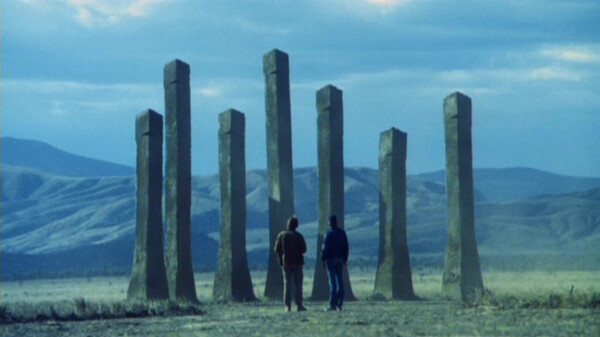
Image courtesy of Paramount Pictures.
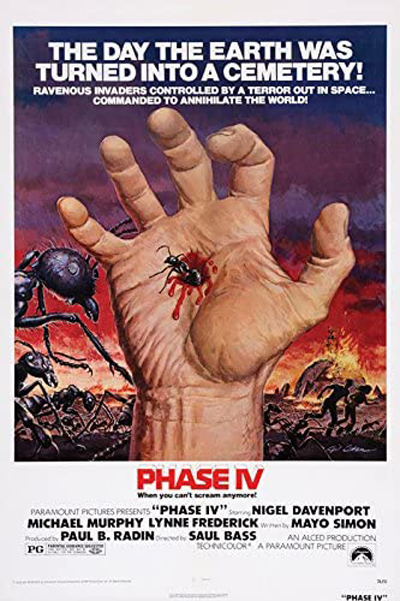
“Phase IV” Starring Nigel Davenport, Michael Murphy, Lynne Frederick, Lots of Ants and others. Directed by Saul Bass. 84 minutes. Rated PG. Hulu, Prime.
Mladen’s take
“Phase IV,” lovingly built in 1974 with an admirable effort at incorporating animated and computer graphics to enhance the film, is sci-fi at its finest – provocative and enthralling.
Remember, we’re talking about 1974 here. 1974 was 47 years ago. 1974 was the year of another Republican dickhead president’s impeachment (Nixon). Hell, I was but a sprite in 1974.
Del always bellyaches about my inadequate summaries of film plots, so I’ll give it a better shot this go-around. The problem? A completely thorough plot summary gives away the story, which, I assume, makes a movie less fun to watch.
The “Phase IV” plot: Mankind drops to the bottom of the food chain. Sufficient summary, Del? No? OK.
A burst of celestial energy, detected early and highly anticipated by scientists because of what it could do to life on Earth, passes through our planet without causing obvious change or damage. One lone entomologist, however, notices something odd unfolding in Arizona post-energy wave. Ants of different species are no longer feuding, are systematically cooperating to extinguish their predators, and appear to be gathering at pow-wows to talk strategy. The ant tribes build a half-dozen cooling towers for their massive collective nest. No big deal, right? Some regular ants (and termites) have built elevated structures to help condition the air flowing through their underground homes for tens of thousands of years, probably longer. But, the Arizona ant colony chimneys are symmetrical and constructed at right angles. They’re topped with triangular slits inside squares that face in exactly the same direction and tilt upward and back slightly. The chimneys are symbolic structures, too, maybe even a form of religious worship. The entomologist (Davenport as Dr. Ernest D. Hubbs) concludes the energy burst has rendered the ants intelligent. Trouble is on the way unless the “natural order” is restored, he advises a panel. The panel authorizes construction of a research facility smack dab in the middle of the territory of the sectarian smart ants. Hubbs recruits Lesko (Murphy) to staff the laboratory. Lesko is a numbers theorist and cryptographer with expertise in deciphering languages. There’s a third person in the story, Lynne Frederick as teenager Kendra, but she’s used to help the movie along to reach Phase IV of the Ant plan for humanity. In short, Hubbs and Lesko end up fighting the six-legged version of Star Trek’s Borg. Very, very neat.
“Phase IV” is remarkable for its capture of real ants performing ant-like duties in organized, methodical, and adaptable fashion. The humans and the smart ants duel, each species countering the other’s moves of conquest and domination. Wait until you see how the ants flush the scientists and the girl from their geodesic dome laboratory. Hell, Lesko even devises a way to communicate with the ant queen controlling the millions (billions?) of worker ants working to control the humans. She’s in no mood to negotiate a settlement or foster inter-species compromise. That’s very human-like. No?
“Phase IV” is an unambiguous A. You need to watch this blast from the past, something Del has come around to calling a “stream gem.”
Del’s take
I’ve seen bits and pieces of “Phase IV” over the years but never the entire movie until Mladen got a bee in his bonnet and suggested we review a film about super-smart ants.
I could tell it was a ’70s-vintage flick because of the Lazenby Computer Smooth font used in some of the typography. It seems every movie, book or magazine that sought to appear “modern” in the 1970s used Lazenby Computer Smooth. Now, of course, it makes me think “old.”
But that’s OK because “Phase IV” is a darned good little movie, much better than what the movie reviewers like Mladen – oops, that just slipped out – said about it. (Remember how the movie reviewers trashed “The Terminator”? Yeah. Those guys. Can’t believe a word they say.)
Mladen finally, after much ridiculing from yours truly, provided a decent plot summary, so I can get right into the critique itself.
You can’t judge “Phase IV” by today’s production standards. The music is contrived and hokey (though “modern” for its day), the characters behave in ways that would earn them a social media drubbing (Dr. Hubbs smokes!) and the special effects resemble those you and I would create if somebody handed us an 8mm movie camera and told us to revise “Plan 9 from Outer Space.”
My big gripe with “Phase IV” is that the characters seem incidental to the plot. Hubbs is a throwback to the misguided scientist who seemed to occupy every big bug movie produced in the 1950s, while his dashing sidekick – in this case Murphy’s James R. Lesko – seems more interested in 16-year-old Kendra Eldridge (Lynne Frederick) than solving the mystery of the ants, creepy even for that era. Everyone else was cannon fodder so by the end I didn’t care as much about their fates as I should have.
But the ideas! Spectacular and original barely describe them. Director Bass doesn’t limit his ants’ intelligence to mere acts of malice but has them building oddly designed towers, drilling symmetrical holes in animal flesh and using unconventional warfare to flush out their human antagonists from their protective geodesic dome. The towers alone are worth the watch, standing creepily over the desert like mysterious Easter Island statuary, festooned with alien glyphs and designed with an architecture that weirdly, at least to me, suggested a non-human intelligence.
The inventiveness of the ant intelligence is under-appreciated by movie fans not including the cult worshippers “Phase IV” has amassed over the years, and it is one of those movies you should not only watch but add to your collection, along with “Day of the Triffids,” “The Day the Earth Stood Still” (original) and “Forbidden Planet,” to name a few.
I was surprised to learn the movie was not shot in Arizona but Kenya, and that it was a box office flop, which sealed Bass’s fate as a director. That’s too bad because “Phase IV” is a classic science fiction film and a wonderful cautionary tale about mankind’s hubris.
I give it an A despite its flaws.
Mladen Rudman is a former journalist and technical writer. Del Stone Jr. is a former journalist and author.

This photo, taken Dec. 10, 1967, shows the path of a tornado through the Belaire Subdivision of Fort Walton Beach. Our house is at the bottom, slightly left of center.
I wrote this essay on March 25, 1972, which would have made me 16 years old at the time.
TORNADO!
We, being myself, my parents, my younger sister and at the time, my older sister, live in the town of Fort Walton. Fort Walton is a bustling community of about 20,000 people on Florida’s northwest Gulf Coast. Like most other communities of this day, it is threatened by the incessant pincers of commercialism, but of course, that has nothing to do with my story. Although I was only 12 at the time, I remember that morning more vividly than any other day of my life.
On December 10, 1967, at exactly 3:00 AM, I was awakened by the sound of thunder. There was a terrific thunderstorm in progress, one of the most severe I had ever experienced. There had been tornado warnings issued for our county along with several others the night before, bat at the moment, this did not even enter my mind. The lightning was incredible, it was flashing almost continuously and the thunder never halted in roaring. I lay there for 5 minutes listening to the din, when I decided to make a game of it. Using a scale between 1 and 10, I would rate each flash of lightning according to it’s intensity. If an extremely bright flash occurred, I would give it a rating of 7 or 8, and if a dim flash occurred, I would rate 2 or 3. I played this game for 10 minutes, until to my disappointment, the lightning mysteriously ended. The time was 3:15 AM. I lay back, bored once again, and listened to the steady drum of rain upon the roof. Occasionally, one enterprising raindrop would strike one of the pipes that jutted from the roof, sending a tiny “clang” down into the house. I had, by that time, decided to go back to sleep, when something terrible happened.
There was a stupendous flash of light, almost brighter than description. It would compare with confining a person to a pitch black room then suddenly setting a flashbulb off in their eyes. The light was bluer than it was white, and at first, I had thought lightning had struck the house, or either a tree out in the yard. I prepared myself for the thunder that would follow a flash of that proximity, but I was not prepared for what did follow.
A tremendous roar filled the air. Immediately I caught the sound of glass breaking and wood splintering. I kept asking myself what was happening, and I could not believe that this was our house I was hearing destroyed. By now I knew this was not thunder, and could not figure out what was happening. I sat up in bed and turned my head just in time to see a section of glass strike the wall and shatter into a thousand pieces. The terrible roar continued, nearly drowning out the rest of the sounds. The house shook as if some giant hand had grabbed it and was trying to empty it of it’s contents. Even though the curtains were drawn, my room was as bright as day. I have heard that tornadoes are often accompanied by spectacular displays of lighting; this one certainly was. This whole conglomeration of smashing, tearing and roaring took place over a period of about 15 seconds, and I still had not figured out what was going on.
Finally, the sounds grew fainter, then ceased. It grew quiet as death. The next thing I heard was the sound of my mother walking down the hall from her room, assuring me that everything was alright and not to be afraid. Personally, I am certain that she was much more afraid than I, for she would always tell us of her nightmares concerning tornadoes, she has had them years before this happened. I told her that I was alright and asked what had happened. Her reply was that a “little windstorm” had occurred, and it was then that it finally dawned upon me that we had just experienced a tornado. My father was checking on my sisters. After he had done that he retrieved the gas lantern from the utility room, while my mother and older sister started cleaning up the mess. I was not allowed to get out of bed because of the glass on the floor, and I was unable to see because of the lack of light. The lantern was with mother in my sister’s room, and my father had our only flashlight with him in the living room while he covered broken windows with cardboard.
Naturally, a child’s curiosity is the strongest, and after a minor search I discovered a section of one of my old toys that had a flashing light; as good as I could come up with in that situation. The light would stay lit for 2 seconds, then would flash off for 2 seconds, then flash on for 2 seconds. This proved to be aggravating and revealed little. After much persuasion, I managed to wheedle my parents into letting me look around. I went into the living room and stared in amazement at the damage. Almost every window in the system of small rectangular windows that made sort of a picture window were broken out. They had been covered by pieces of plywood and cardboard. Small pine branches, slivers of wood, boards and glass dotted the floor. We found one spear of wood, a wedge shaped piece about a foot long, that gone through the front window, struck the T.V. taking a gouge out of it, then had struck the dining room table and skidded across the surface leaving scratch marks on it, then had struck the dining room window and partially gone through it.
I then visited my sister’s room and saw about the same thing, broke glass, tree branches, and wood. According to my older sister, Sandy, she had been awake when the storm had struck, and looked up just in time to see the windows bulge to an amazing degree, then break.
My parents had both been awake when the storm struck. My mother jumped from her bed and tried to open the door to my sister’s room, but she couldn’t budge it, while my father tried to close one of the open bedroom windows.
After everything had been attended to inside, my father started investigating the damage outside. We had just bought a brand new boat, an aluminum 14 footer, the very day before the storm struck. According to my father who came in about 10 minutes later, it was in our neighbor’s yard against a tree. While outside he had gotten into a comical conversation with that neighbor. It ended with the neighbor saying, “Would you mind getting your boat out of my yard?”
We sat and talked of the storm among ourselves for awhile, in the meantime 2 more of our neighbors came over, each giving his own account of what had happened, and a fireman knocked on the door to see if any of us were injured. After a few more minutes of talk we went to bed. It was 4:00 AM.
Sleep was impossible. It had begun to rain again, though very lightly. During the times of 4:30 and 5:00 AM I heard another rise in the wind and thought we were due for a second performance. It continued to rise but then dropped off. Another peculiar thing happened during this time. I heard a sound similar to chimes ringing in the wind. It sounded as if small pieces of glass were falling to earth. Both my mother and I heard this sound, as we have finally come to the conclusion that it was glass returning to earth, glass that had been sucked up by the storm.
At 6:00 AM we could remain in bed no longer. I remember rising out of bed and dressing myself. This reminded me of Christmas, the contemplating of what was to be seen from those remaining windows like a child will sit and wonder what lies in those gaily decorated packages under the tree. I looked first from my bed room window. There was a large triangular section of a roof that had been stabbed into the yard off to the left. Other than minor debris I could see nothing else from this vantage point. Looking out my sister’s window that faced our next door neighbor, I could see one downed scrub oak tree. The view from my parent’s room offered the best perspective of all. From it I could see twisted trees and sections of homes from who knows where, garbage and objects from patio. But the amazing sight was the house without a roof. We had not known the extent of the damage inflicted upon the area, and we were simply amazed that this had occurred.
As soon as my father had dressed, he, my younger sister and I piled into our 1966 Fairlane, and after dodging downed powerlines we managed to get out of the stricken area and to a gas station to buy fuel for our portable heater, stove and lantern. On the way back to the house we were halted by a National Guardsman. Even after my father explained to him that we lived in the area and had to get back to our house, he still refused to let us pass. Fortunately I knew of a side road we could take, and minutes later we were home, with nothing short of a flat tire.
My mother cooked breakfast, then we all went out to inspect the damage and to proceed with the inevitable cleaning up job.
Some of the tricks the tornado pulled were really amazing and quite frightening. The boat had been latched to it’s trailer and the trailer had been chained to an 18 or more inch thick pine tree with a chain built to resist 700 lbs of pull. Of course, the boat as you know was in our neighbor’s back yard, but the amazing thing was that the chain holding the trailer ahd been snapped and the trailer was lying in the same place, upside down with at least 50 feet of telephone wire wrapped around it! We had 2 garbage sitting beside each other before the storm, but after, one had been carried off, but not before it’s contents had been emptied over the yard. A short needled pine at least 2 feet thick and been twisted 3 times at the base of the trunk and it now lay upon our roof.
These are just a few of the tricks this monster pulled on Fort Walton. A compact car was found in a tree, a man, bed and all was carried into the middle of a 4 lane highway.
Some of the grimmer aspects of the storm was the 3 year old child killed by flying debris, the scores that were injured and hundreds made homeless. The funnel touched down in a major residential area, crossed a small bayou and smashed into another residential area, then after destroying a few businesses and a major discount store of the Gibson chain, it lifted into the clouds. Debris was found more than 20 miles away.
All in all, it was the worst disaster to ever befall Fort Walton. Over 5 million dollars in damage was done, and the city was declared a disaster area by Governor Kirk.
I know that I will never forget it; the story will be told by myself and members of my family for ages to come.
About the author:
Del Stone Jr. is a professional fiction writer. He is known primarily for his work in the contemporary dark fiction field, but has also published science fiction and contemporary fantasy. Stone’s stories, poetry and scripts have appeared in publications such as Amazing Stories, Eldritch Tales, and Bantam-Spectra’s Full Spectrum. His short fiction has been published in The Year’s Best Horror Stories XXII; Alfred Hitchcock’s Mystery Magazine; the Pocket Books anthology More Phobias; the Barnes & Noble anthologies 100 Wicked Little Witch Stories, Horrors! 365 Scary Stories, and 100 Astounding Little Alien Stories; the HWA anthology Psychos; and other short fiction venues, like Blood Muse, Live Without a Net, Zombiesque and Sex Macabre. Stone’s comic book debut was in the Clive Barker series of books, Hellraiser, published by Marvel/Epic and reprinted in The Best of Hellraiser anthology. He has also published stories in Penthouse Comix, and worked with artist Dave Dorman on many projects, including the illustrated novella “Roadkill,” a short story for the Andrew Vachss anthology Underground from Dark Horse, an ashcan titled “December” for Hero Illustrated, and several of Dorman’s Wasted Lands novellas and comics, such as Rail from Image and “The Uninvited.” Stone’s novel, Dead Heat, won the 1996 International Horror Guild’s award for best first novel and was a runner-up for the Bram Stoker Award. Stone has also been a finalist for the IHG award for short fiction, the British Fantasy Award for best novella, and a semifinalist for the Nebula and Writers of the Future awards. His stories have appeared in anthologies that have won the Bram Stoker Award and the World Fantasy Award. Two of his works were optioned for film, the novella “Black Tide” and short story “Crisis Line.”
Stone recently retired after a 41-year career in journalism. He won numerous awards for his work, and in 1986 was named Florida’s best columnist in his circulation division by the Florida Society of Newspaper Editors. In 2001 he received an honorable mention from the National Lesbian and Gay Journalists Association for his essay “When Freedom of Speech Ends” and in 2003 he was voted Best of the Best in the category of columnists by Emerald Coast Magazine. He participated in book signings and awareness campaigns, and was a guest on local television and radio programs.
As an addendum, Stone is single, kills tomatoes and morning glories with ruthless efficiency, once tied the stem of a cocktail cherry in a knot with his tongue, and carries a permanent scar on his chest after having been shot with a paintball gun. He’s in his 60s as of this writing but doesn’t look a day over 94.
Contact Del at [email protected]. He is also on Facebook, twitter, Pinterest, tumblr, TikTok, and Instagram. Visit his website at delstonejr.com .
Note: I wrote the following piece when I was 16 years old.
It is an everyday Saturday morning. You have just finished drinking your coffee and reading the paper, and you are now watching a television program for a few minutes before you plan your day’s activities.
Suddenly, your program is interrupted and you see the letters EBS flash onto the television screen. Your first thought is that this is another test of the Emergency Broadcast System. A frantic announcer’s voice appears and says, “This is not a test, I repeat, this is not a test. Northern based radar stations have detected the launching of hundreds of missiles, the estimated time for their arrival is 30 minutes. I repeat, you have 30 minutes to reach safety. …”
Immediately you panic. You circle the room, terrified, completely ignorant as to what to do. You begin to calm yourself so that you can think straight. Your first decision is to reach a bomb shelter, but you have no idea as to where the nearest one is. You center your attention once again to the announcer. He seems to have calmed somewhat also, because he is now busily rattling off street names and the appropriate shelter for these streets.
You listen, and soon he announces your street along with a few neighboring streets and gives the location of their bomb shelter. You are thankful you live in a large city where adequate protection may be found. After hearing the location of your shelter, you hurriedly change your clothes, then go outside, unlatch the garage door and drive to the location.
You are greeted by a locked door. A few others are pounding piteously on it, trying to gain entrance. The shelter has been filled to capacity in minutes. You are sick to your stomach. You shake uncontrollably, and curse yourself for not preparing for this day.
A policeman advises you to go home and construct a makeshift shelter in your basement, if you have one, using heavy furniture for the shelter’s walls. Your hope in renewed.
You return to your car to only discover it has been completely encompassed by other automobiles, making it impossible to move. Forgetting about it, you begin to run home, making it in 3 minutes. You now have 20 minutes left to prepare for the attack.
You stagger into your living room, exhausted from the run, and descend into the basement to inspect the area you have in mind for the makeshift shelter.
A 6 foot long section of concrete, about 5 feet high, protrudes from the wall. It had been constructed for some unknown purpose by the previous owner of the house. You decide to use it plus your couch, two bookshelves and a chester drawers for the remaining walls.
You manage to drag the bulky couch down the stairs and arrange it to your liking, but in the process, you break off one of the legs. The remaining pieces of furniture are easier to carry down. For the roof, you use the only thing possible, a big square slab of plywood. After the shelter has been completed, you turn to gathering supplies.
To your dismay you discover there are no large containers in our house to store water in. You do manage to find a quart container that once held bleach, but the mainstay of your water supply containers are glass jars that you have been cleaned and saved for a recycling project you were part of. There are only 9 of these, and you hare forced to empty a few more jars of food that would normally require refrigeration. After you have gathered your water and hauled it to the shelter, you begin gathering food. You pick out several canned items from the shelf, along with a few containers of milk that will have to be drunk quickly lest they sour, and a few eating utensils. After this has been taken care of, you begin to gather clothes, blankets, and a first aid kit that you have previously bought for your car in case of an accident but had failed to put in the trunk.
You glance at your watch and see that you have 10 minutes left. You get one more jar of water and a few more items to eat. You are terrified, but you feel more secure.
You bend to your knees and pray to God, asking him for his help in your survival. Your prayer is interrupted by a bright flash. It is blinding, even in the center of your home where the light of day rarely falls. You dash down the stairway and enclose yourself in the shelter. Seconds later, there is a terrific thud and a wave of heat. A glass window, the only one in the basement, smashes, showering pieces on the plywood roof. Other windows break. The ground heaves as in an earthquake, causing slight structural damage to your home. It is lucky for you that you live on the outskirts of the city or the damage might have been greater. The foundation of the house shudders and several pipes are ruptured. You sit in pure terror, your heart thudding as never before. The situation you are now in has provided many an author the subject for books, and you did not even enjoy reading them, much less taking part in them. The air becomes incredibly stuffy, and one of your precious jars of water has been broken by the shock wave of the explosion.
You lay there, cramped, hot, damp from the water, you feel sick. It is pitch dark, preventing you from even making out the outline of the walls that surround you. Sleep comes hard. You wake up several times during the night. Once you hear someone prowling about the house and you wish you had a gun. Later that night you wake up and have to use the bathroom. Before the explosion occurred you had arranged a garbage can for a makeshift toilet, and even had a supply of plastic bags to store the waste in. After you finish you tightly bundle the bag with a wire twist, then you remove a drawer from the chester drawer and drop the bag in the can, then, you put the lid on and return the drawer to it’s berth. A highly efficient operation, you think, and commend yourself for your ingenuity. You again sleep till you are unable to any longer. You smell the faint odor of gas and hope that the leak does not poison you. You drink a jar of your water and open a can of mixed vegetables. You then drink the entire quart of milk that you brought along. Your legs ache, and you frequently have to rub cramps out of them. The air is constantly stuffy; you never seem to be able to get enough oxygen. As the day progresses, you become more and more bored. At first, you listen to the sounds of the outside world. Occasionally you hear the sounds of people talking, and once you hear the sounds of a savage fight between two dogs. But other than that, there is complete silence.
You eat, drink, and sit. You become so bored that you frequently daydream and resort to reading the labels on the cans. During the day, a slight amount of light managed to filter it’s way into the shelter, but as it progressed, this decreased in intensity, then disappeared.
You go through the same cycle you did the night before until the next day when the light entered the shelter. You begin exploring the perimeter of your shelter trying to discover something previously unknown. To your surprise and pleasure, you discover a book in one of the drawers. There is not enough light to read by, so you search through your belongings and produce a candle and a book of matches. You set up the candle so that it will not topple, then, taking a match from the book, you light it. There is a “puff” and your enclosure is engulfed in flame for a second. Your hair, eyelashes, nostrils and other portions of your body are burned. Thankfully the shelter did not, but you are flabbergasted by what happened. You wince in pain as you apply a sav from the first aid kit to the worst areas. You later deduce that the gases from the broken pipeline had been trapped in the shelter. You try piteously to read the book, but it is to much of a strain. Feeling sorry for yourself, you burst into tears. After a period of crying, you feel better and sleep.
You wake the next day with a fever. Later in the day you become sick to your stomach, but fight off the urge to vomit. During the night mosquitoes have completely riddled your arms and legs, but you are too sick to care. You do not eat anything that day, and you drink little. The next day you feel better, but because you did not get a tight lid for your garbage can toilet, a terrible stench has resulted. You decide that day you will come out of your shelter. You have been crammed into a tiny area for days, sick, thirsty, cramped, and near death from sheer boredom. You did not know it at the time but you had a mild case of radiation sickness. You eat, use the bathroom, and remove one of the drawers so you may have light to read your book by. When it gets dark, you drink the last container of water, and are able to finally get a decent night of sleep. The next morning you awaken to find yourself totally soaked, and a thin layer of water covering the floor. Somewhere, a water pipe had broken and water was draining into the basement. You rise and unbarricade yourself. It feels wonderful to stretch your weary self. A bright beam of sunshine streaks through the broken window, displaying the cracked woodwork above your head.
You ascend the stairs and explore the house. The water is coming from the kitchen. A broken pipe juts through the floor amid broken glass. In fact, every window in your house is broken. The house across the street has completely burned to the ground. Down the street you can see a camp with many tents and a Red Cross truck parked nearby.
You find the gas valve and shut it off, take a drink of water that remains in the pipes, then change your filthy clothes, and leave your house to see what has become of the world.
This has been a story of what could happen to anyone in a time of nuclear war. The person in the story was extremely lucky in surviving.
What did he (or she) do wrong?
The first thing was that she panicked. No mater how hard it may seem, you must stay calm in a situation like this. One cannot think clearly if in a panic.
The worst thing she did was not planning ahead. She did not know where the bomb shelter was among a multitude of other things. You should know the location of the nearest bomb shelter to your home. In the story, when she did discover the shelter’s whereabouts, she took no supplies with her, and she drove to it. Bomb shelters are limited in the amounts and types of supplies they can carry. You should take clothing and any other materials needed for your family. You should not drive unless you can park somewhere out of the way. The roads should be left open for emergency and military vehicles.
If you do not think you could reach a public shelter, construct one of your own in your basement or back yard. A temporary shelter can be constructed out of heavy furniture such as the one in the story. It would be best to take advantage of any shielding you can possibly find. If you happen to have a piece of furniture in your temporary shelter with drawers in them fill them with sand. Be sure that your shelter is well ventilated.
You should have several plastic gallon containers handy for the storage of water.
You should also have food that can be kept over long periods of time without spoiling. Items such as clothes, blankets, utensils and medical supplies are also very important. You should make sure your utilities are shut off (gas and water), because like in the story, a pipe could be broken and you could be poisoned or catch some diseases from water that has flooded your shelter.
A makeshift toilet can be made from a garbage can. Small portable toilets can be bought, the garbage can is used for disposal. Make sure the lid fits tight or you could wind up like the person in the story. You should also carry some type of insect spray.
There are hundreds of other suggestions I could give you, but probably the most important is to acquire a Civil Defense manual. In this book, everything you would like and need to know is covered and written simple enough for nearly anyone to understand.
It could, some day, save not only your, but your family’s life.
About the author:
Del Stone Jr. is a professional fiction writer. He is known primarily for his work in the contemporary dark fiction field, but has also published science fiction and contemporary fantasy. Stone’s stories, poetry and scripts have appeared in publications such as Amazing Stories, Eldritch Tales, and Bantam-Spectra’s Full Spectrum. His short fiction has been published in The Year’s Best Horror Stories XXII; Alfred Hitchcock’s Mystery Magazine; the Pocket Books anthology More Phobias; the Barnes & Noble anthologies 100 Wicked Little Witch Stories, Horrors! 365 Scary Stories, and 100 Astounding Little Alien Stories; the HWA anthology Psychos; and other short fiction venues, like Blood Muse, Live Without a Net, Zombiesque and Sex Macabre. Stone’s comic book debut was in the Clive Barker series of books, Hellraiser, published by Marvel/Epic and reprinted in The Best of Hellraiser anthology. He has also published stories in Penthouse Comix, and worked with artist Dave Dorman on many projects, including the illustrated novella “Roadkill,” a short story for the Andrew Vachss anthology Underground from Dark Horse, an ashcan titled “December” for Hero Illustrated, and several of Dorman’s Wasted Lands novellas and comics, such as Rail from Image and “The Uninvited.” Stone’s novel, Dead Heat, won the 1996 International Horror Guild’s award for best first novel and was a runner-up for the Bram Stoker Award. Stone has also been a finalist for the IHG award for short fiction, the British Fantasy Award for best novella, and a semifinalist for the Nebula and Writers of the Future awards. His stories have appeared in anthologies that have won the Bram Stoker Award and the World Fantasy Award. Two of his works were optioned for film, the novella “Black Tide” and short story “Crisis Line.”
Stone recently retired after a 41-year career in journalism. He won numerous awards for his work, and in 1986 was named Florida’s best columnist in his circulation division by the Florida Society of Newspaper Editors. In 2001 he received an honorable mention from the National Lesbian and Gay Journalists Association for his essay “When Freedom of Speech Ends” and in 2003 he was voted Best of the Best in the category of columnists by Emerald Coast Magazine. He participated in book signings and awareness campaigns, and was a guest on local television and radio programs.
As an addendum, Stone is single, kills tomatoes and morning glories with ruthless efficiency, once tied the stem of a cocktail cherry in a knot with his tongue, and carries a permanent scar on his chest after having been shot with a paintball gun. He’s in his 60s as of this writing but doesn’t look a day over 94.
Contact Del at [email protected]. He is also on Facebook, twitter, Pinterest, tumblr, TikTok, and Instagram. Visit his website at delstonejr.com .
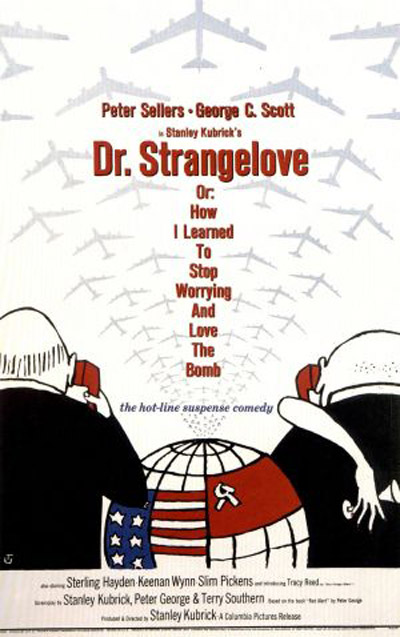
“Dr. Strangelove or: How I Learned to Stop Worrying and Love the Bomb” Starring Peter Sellers, George C. Scott, Sterling Hayden, Keenan Wynn, James Earl Jones and Slim Pickens. Directed by Stanley Kubrick. 93 minutes. Rated “approved.”
Mladen’s take
Ever have one of these days?
You can’t find the car keys until you’re already late for work. Then, the starter clicks a couple of times before cranking the engine. Finally on the road, you get a flat tire. While you’re changing the flat, the vehicle slips off the jack and crushes your foot. In the ER, you get a doctor who has prescribed himself a few too many medications and he mucks repairing your foot. An infection comes along while you’re recovering from the faulty service. Antibiotics fail and the only way to contain the infection is by amputating your leg. The intern performing the amputation sneezes during the procedure, severing your femoral artery. You die.
The simile illustrates, roughly, what happens in Stanley Kubrick’s masterpiece, “Dr. Strangelove or How I Learned to Stop Worrying and Love the Bomb.”
I watched the 1964 movie a couple of weeks ago. It’s clear that “Dr. Strangelove” is entirely relevant today. In short, Kubrick imagines thermonuclear Armageddon unfolding as a series of seemingly absurd, unlikely events stacking atop each other until the only people left alive are the ones who made the all-destructive atomic war possible.
The idea in “Strangelove” that mistakes, be they failures of thought or products of psychosis would lead to the planet’s fiery, H-bomb-induced demise could have come from today’s headlines. A USAF bomber was flown from North Dakota to Louisiana in August 2007 with six nuclear warhead-tipped cruise missiles hanging from a rack. No one at the wing, including the flight crew, knew the nukes were aboard the bomber until it arrived at Barksdale Air Force Base. A year earlier, American supply troops sent ICBM nose cone fuzes to Taiwan thinking they were helicopter parts.
Attention to details, particularly the movie’s calm demeanor as the B-52 crew receives the order to nuke an adversary and the meticulous, as-a-matter-of-fact way it arms a warhead, left me feeling that war was largely a bureaucratic affair uprooted from consequences. Following procedures, rather than questioning them, drove humanity over the edge in “Strangelove.”
To me, “Strangelove” offers sardonic relief best captured in the military motto – “Peace is our profession” – that frequently appears in the movie. I know nuclear holocaust is on the way. You know nuclear holocaust is on the way. Kubrick and “Strangelove” allow me to laugh at the prospect.
Del‘s take
At the risk of dating myself I remember the Cuban missile crisis, backyard bomb shelters and drills where we kids would be hustled into an interior room at the school to ride out the onslaught of inbound ICBMs.
It was not funny.
But that was life in the early ‘60s and oddly my recollection of those events seems framed in a black-and-white panorama of worry and fear, much like “Dr. Strangelove,” which deploys its dark humor to accentuate the absurdity of mutually assured destruction.
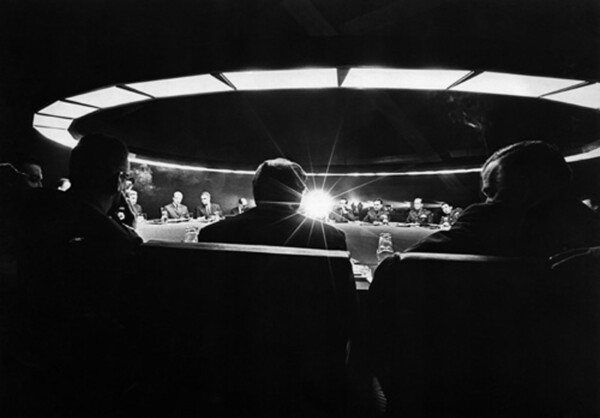
For those of you who missed this cinematic classic, here’s the plot: An Air Force general becomes convinced the communists are subverting America through fluoridated water. He dispatches a wing of nuclear-armed B-52s to destroy the Soviet Union. The Strategic Air Command is made aware of the situation and huddles with the president in the “War Room” to devise a strategy for recalling the bombers. The Russian ambassador is brought in and reveals the existence of a “doomsday device,” a network of cobalt-jacketed hydrogen bombs that will spread lethal radiation across the world if Russia is nuked. The bombers are recalled, but one, damaged by an anti-aircraft missile, continues on its mission. …
“Strangelove” provides a canvas for stunning performances by George C. Scott, Sterling Hayden, Keenan Wynn, Slim Pickens and most notably Peter Sellers of “Pink Panther” fame, who plays three roles, that of R.A.F. Group Captain Lionel Mandrake, President Merkin Muffley and Dr. Strangelove himself, a wheelchair-bound Nazi scientist who wages a minute-by-minute battle with his black-gloved hand for control of his loyalties – to his new American friends or his old friends at the Reichstag.
But “Strangelove’s” best performance comes from the screenplay, written by director Stanley Kubrick, which skewers all the institutions Americans relied on to guide them through the Cold War: the military, the government, and what most people would call common sense. As the B-52s streak toward the Soviet Union, Scott’s Gen. Buck Turgidson argues for an all-out attack – and why not? “We could catch them with their pants down!” Turgidson enthuses.
“Strangelove” is so steeped in historical context that nobody under the age 45 is likely to grasp its sophistication and nuance – a skill of perception sadly lacking in contemporary audiences. Yet “Strangelove” is one of the 20th century’s greatest films, serving up a damning indictment of bureaucracy, the military-industrial complex and a simple-minded us-or-them worldview that cannot exist in today’s interconnected global village.
“Gentlemen!” President Muffley shouts as Turgidson and Russian ambassador Alexi de Sadesky grapple over a secret camera. “You can’t fight in here! This is the War Room!”
As John McCain might say, “That, my friends, is ‘Dr. Strangelove. ’ ”
Mladen Rudman is a former journalist and technical editor. Del Stone Jr. is a former journalist and author.
Video
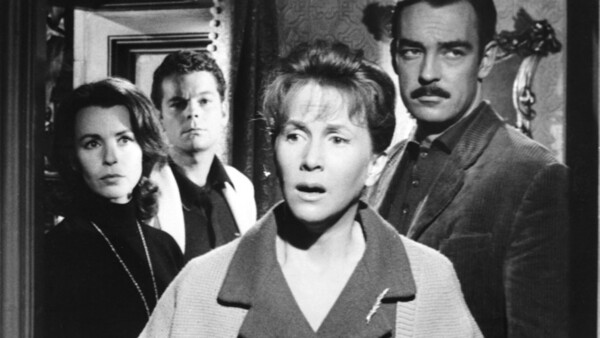
Image courtesy of MGM.
“The Haunting” Starring Julie Harris, Claire Bloom, Richard Johnson, Russ Tamblyn, and Lois Maxwell. Directed by Robert Wise. 1 hour, 52 minutes. Rated G. Shudder.
Del’s take
The opening paragraph of Shirley Jackson’s “The Haunting of Hill House,” upon which “The Haunting” is based, may be the finest paragraph of fiction ever written:
“No live organism can continue for long to exist sanely under conditions of absolute reality; even larks and katydids are supposed, by some, to dream. Hill House, not sane, stood by itself against its hills, holding darkness within; it had stood for eighty years and might stand for eighty more. Within, walls continued upright, bricks met neatly, floors were firm, and doors were sensibly shut; silence lay steadily against the wood and stone of Hill House, and whatever walked there, walked alone.”
That paragraph sets the bar for excellence in writing. To match that standard of excellence in another medium, a movie, represents a challenge almost as frightening as the story itself. Robert Wise almost succeeded with “The Haunting,” a scary, atmospheric adaptation of Jackson’s novel released in 1963.
To critique a movie 58 years after the fact seems unfair. Times, people and technology change. By today’s standards “The Haunting” looks silly and shrill. But strip away years of desensitization, computer-generated movie effects and a few evolved cultural standards and “The Haunting” becomes a terrifying excursion into the unknown.
The story is about Eleanor (Julie Harris), in every sense an “old maid” to borrow an expression from that time, who yearns to escape her past. She spent the better part of her adult life caring for her disabled mother and carries a great deal of guilt for not answering her mother’s call for help the night she passed away. When she is invited to participate in a paranormal experiment at Hill House by an anthropologist, Dr. John Markway (Richard Johnson), she takes the family car against her sister’s wishes and drives off into the New England countryside. At Hill House she is joined by a purported psychic, Theodora (Claire Bloom) and young Luke Sanderson (Russ Tamblyn) who is due to inherit the house. The four are besieged by spooky goings-on, including things that go bam bam bam in the night, and ultimately must decide if these are actual events or if they have been primed by the house’s menacing ambiance to imagine them.
Both the book and movie present a question about ambiguity – are there really ghosts at Hill House, as events would suggest, or is poor Eleanor, driven near to madness by a life of caring for her demanding mother while her sister and family go about their lives with purposeful ignorance, simply imagining the voices, loud noises, and sinister airs of that rambling Victorian mansion? One thing is certain: Eleanor is desperate for attention and Hill House gives it to her, and while she seems to recognize the poisonous consequences of that attraction she doesn’t seem to care. She wants to be wanted and she never wants to leave. Hill House has become her lover.
“The Haunting” shows its age with voiceovers to communicate the neurotic internal monologues of Jackson’s protagonist, and quick zooms to suggest a ghostly presence pounding at the bedroom door. A more subtle approach would have more effectively conveyed Nell’s escalating emotional tension (see Jack Clayton’s 1961 production of “The Innocents”). We can also assume a modern audience would not sit still for the slow pacing. Other efforts – Jan de Bont’s 1999 iteration, or the recent Netflix mini-series loosely based on Jackson’s novel – reflect a more modern approach, although one could argue they were not nearly as scary as the Wise production as the novel’s menace is communicated by nuance and implication, not monsters jumping out of closets.
It might not be possible for any filmmaker to successfully capture all the dark corners of “The Haunting of Hill House,” but of the efforts so far, the Wise version most faithfully represents Jackson’s acclaimed book. It is not supremely excellent, like Wise’s 1951 effort “The Day the Earth Stood Still,” but it’s spooky as hell and well worth the nearly two hours of viewing time.
It deserves an A-.
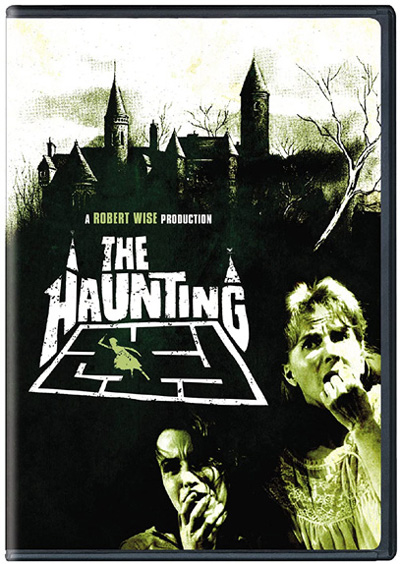
Mladen’s take
A-, Del?
Have you already eaten too much corn candy in anticipation of Halloween?
Has the lingering sugar high distorted your ability to review a movie accurately?
C, Del. “The Haunting” is a C. The film is somewhat entertaining shlock. It’s shlockiness can’t be excused because it was made in 1963.
“Nosferatu” was released in 1922. Still bone chilling. Still eerie.
“Invasion of the Body Snatchers,” 1956. Still ghastly. Still gruesome.
“Psycho” psyched audiences in 1960. Still oedipally demented. Still remembered.
“The Haunting” hovers on just this side of watchable.
“The Haunting” is pinned to an emotionally traumatized person as is “Psycho.” Eleanor, like Norman, can’t help herself. That’s where the similarity between the two films ends.
“Psycho” pulls a stunner at the end. Norman turned victimhood into rage, disorientation, and remorselessness potent enough to rationalize murder. All that “The Haunting” does is keep Eleanor a victim to the disappointing end. First, she is mistreated as a child by her family. Then she’s mistreated as an adult by the diabolical house that also stars in “The Haunting.” Pathetic.
Norman is malevolent. Eleanor mews.
“The Haunting” has some merit. The movie mocks fire-and-brimstone Christianity. It allows for the possibility of the paranormal.
The movie has a couple of solid horror moments, too. Who’s holding Eleanor’s hand during a nightmare? Couldn’t have been Theodora. She was sleeping on the other side of the bedroom. There’s the doorknob and restless door. Both scenes are decent creepiness left to the imagination.
The film’s story is coherent. The first-person exposition pushing “The Haunting” along not too annoying.
The soundtrack would have been better suited for a sci-fi movie of that era rather than a horror flick. Once you’ve heard the simple high key tapping of the piano in “Halloween,” it’s tough to withhold comparison to other horror films no matter the year they were made.
The men in “The Haunting” were dressed as stereotype required. Tweed for anthropology Professor John and a fine jacket with some sort of emblem on the breast pocket for playboy capitalist Luke. Costume design for the ladies was appropriate, as well. Eleanor wore poofy 1950s dresses with flared skirts and sufficiently tight bodices to silhouette perky breasts. Theodora, and I believe this was done to show defiance of social norm and fit her character, wore black, including slacks. She, like Eleanor, was nicely sculpted.
C, Del.
And, this is the finest opening paragraph in fiction:
“Call me Ishmael. Some years ago – never mind how long precisely – having little or no money in my purse, and nothing particular to interest me on shore, I thought I would sail about a little and see the watery part of the world.”
The finest opening sentence in any paragraph of any fiction book written is:
“Listen: Billy Pilgrim has come unstuck in time.”
Mladen Rudman is a former journalist and technical writer. Del Stone Jr. is a former journalist and author.
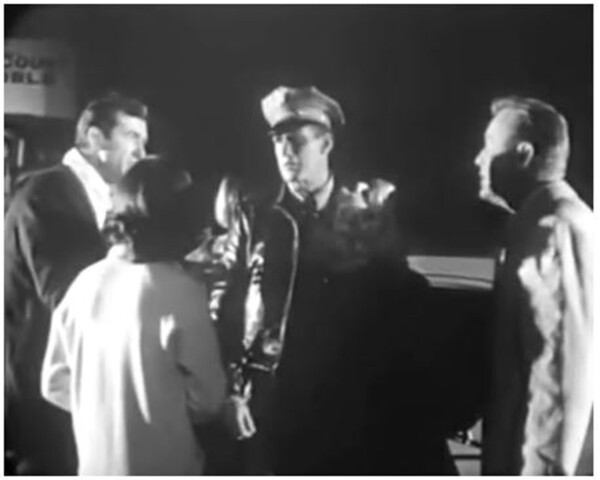
Image courtesy of GPA Productions.
“This Is Not a Test” Starring Seamon Glass, Thayer Roberts, Aubrey Martin, Mary Morlas, Michael Greene and others. Directed by Frederic Gadette. 1 hour, 13 minutes. Unrated. Streaming on YouTube, Internet Archive.
Plot synopsis: A sheriff’s deputy sets up a roadblock on a lonely mountain road early one morning after receiving word of a possible nuclear attack. Soon several motorists gather at the checkpoint and must work together to save themselves.
Are there spoilers in this review: No.
Del’s grade: C-
—
Del’s take
The Bulletin of Atomic Scientists has published a Doomsday Clock, a metric to measure the risk of nuclear war, since 1947 when the clock was set to 7 minutes to midnight.
In 2024 that clock was set to 90 seconds to midnight. Given recent events in Ukraine, Gaza and Israel-Iran, 90 seconds is not only prudent but generous. It reminds those of a certain age that while the Cold War may have been waged 60 years ago, history has an odd way of repeating itself when humanity takes its eye off the ball.
A number of movies from that era reflect the national angst over atomic warfare, movies like “On the Beach,” “Fail Safe” and “Doctor Strangelove.” Add to that cinematic paranoia the 1962 film “This Is Not a Test,” a low-budget production that comes nowhere near the quality of a “Fail Safe” or “Doctor Strangelove” but serves one useful purpose, that of cautionary tale. It’s just not the “cautionary” you might expect.
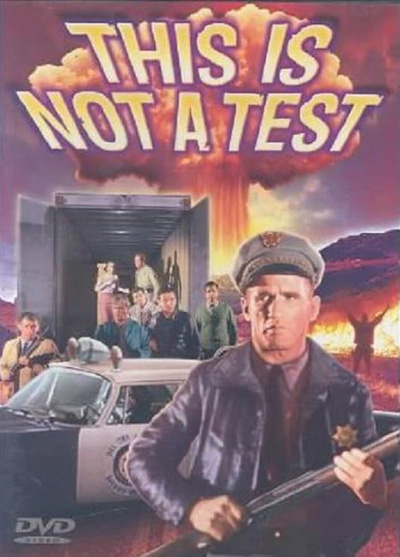
“This Is Not a Test” was filmed in 1962 in Los Angeles County. Because none of the actors are known, they aren’t listed in the credits. No release date was given, but the studio was listed as GPA Productions.
How is the movie cautionary?
Apart from the obvious – that nuclear war is bad – it serves as a reminder to those who would take us back to the “good old days” (Are you listening, MAGAts?) that those times weren’t really all that good. Watching “This Is Not a Test” in 2024 shows us how far we’ve come as a society, and how far we’ll fall if we give in to the forces of ignorance and hate that would turn back the clock, in this case toward a social doomsday.
In “This Is Not a Test” the characters exhibit blind obedience to and trust in authority, embodied by the sheriff’s deputy, who over the course of the film evolves into a cruel autocrat. The motorists, i.e. “voters,” follow his commands without complaint or question, handing over their car keys and unloading a truck to use as a makeshift bomb shelter. I’m hard pressed to say people of today would behave like that given the sizeable number of voters who would entrust their freedoms to a criminal and traitor. But at least some of us have grown as human beings over the years.
Women are treated like property. That was often the case in movies from this period, but in “This Is Not a Test” women operate almost exclusively as instruments of male dominance and facilitators of their own downfall. A wife cheats on her husband with another man and the husband meekly skulks away. One man wins, another man loses, and the woman? She means no more to the story than a knife or a gun, used to achieve those ends.
Booze unloaded from the truck becomes a symbol for disrespect, not only for the deputy’s authority but for human decency itself. Those who consume it are depicted as morally bereft and unworthy of salvation.
And then there’s cruelty to animals, horrifying by today’s standards. In one scene a mentally ill man destroys crates carrying chickens and hurls live birds into the ground. In another scene the deputy chokes a woman’s poodle to death because it’s using up all their oxygen. Animals don’t even figure into the equation of life.
So yeah, the “good old days” weren’t really all that good, and while I understand that when people yearn for the past they’re talking about gas that cost 30 cents a gallon or Momma’s homemade biscuits, they need to remember there were other things about the past that weren’t so great, and maybe what we have today ain’t so bad.
“This Is Not a Test” is not particularly well written or acted, and it doesn’t measure up to those other movies I mentioned. But it’s useful in showing us just how much we’ve grown as a society, and how far we’ll fall if we turn the clock back to the doomsday of the past.
I give it a C-.
Del Stone Jr. is a former journalist and writer.
About the author:
Del Stone Jr. is a professional fiction writer. He is known primarily for his work in the contemporary dark fiction field, but has also published science fiction and contemporary fantasy. Stone’s stories, poetry and scripts have appeared in publications such as Amazing Stories, Eldritch Tales, and Bantam-Spectra’s Full Spectrum. His short fiction has been published in The Year’s Best Horror Stories XXII; Alfred Hitchcock’s Mystery Magazine; the Pocket Books anthology More Phobias; the Barnes & Noble anthologies 100 Wicked Little Witch Stories, Horrors! 365 Scary Stories, and 100 Astounding Little Alien Stories; the HWA anthology Psychos; and other short fiction venues, like Blood Muse, Live Without a Net, Zombiesque and Sex Macabre. Stone’s comic book debut was in the Clive Barker series of books, Hellraiser, published by Marvel/Epic and reprinted in The Best of Hellraiser anthology. He has also published stories in Penthouse Comix, and worked with artist Dave Dorman on many projects, including the illustrated novella “Roadkill,” a short story for the Andrew Vachss anthology Underground from Dark Horse, an ashcan titled “December” for Hero Illustrated, and several of Dorman’s Wasted Lands novellas and comics, such as Rail from Image and “The Uninvited.” Stone’s novel, Dead Heat, won the 1996 International Horror Guild’s award for best first novel and was a runner-up for the Bram Stoker Award. Stone has also been a finalist for the IHG award for short fiction, the British Fantasy Award for best novella, and a semifinalist for the Nebula and Writers of the Future awards. His stories have appeared in anthologies that have won the Bram Stoker Award and the World Fantasy Award. Two of his works were optioned for film, the novella “Black Tide” and short story “Crisis Line.”
Stone recently retired after a 41-year career in journalism. He won numerous awards for his work, and in 1986 was named Florida’s best columnist in his circulation division by the Florida Society of Newspaper Editors. In 2001 he received an honorable mention from the National Lesbian and Gay Journalists Association for his essay “When Freedom of Speech Ends” and in 2003 he was voted Best of the Best in the category of columnists by Emerald Coast Magazine. He participated in book signings and awareness campaigns, and was a guest on local television and radio programs.
As an addendum, Stone is single, kills tomatoes and morning glories with ruthless efficiency, once tied the stem of a cocktail cherry in a knot with his tongue, and carries a permanent scar on his chest after having been shot with a paintball gun. He’s in his 60s as of this writing but doesn’t look a day over 94.
Contact Del at [email protected]. He is also on Facebook, twitter, Pinterest, tumblr, TikTok, and Instagram. Visit his website at delstonejr.com .

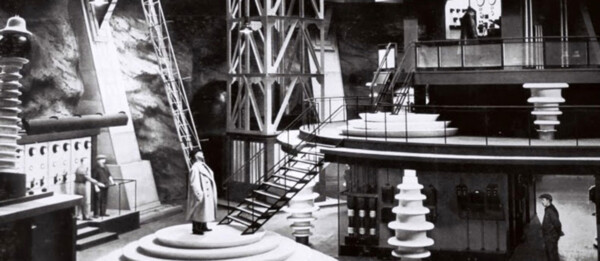
Image courtesy of United Artists.
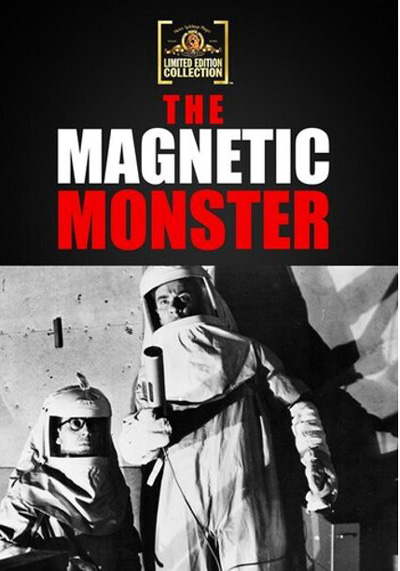
“The Magnetic Monster” Starring Richard Carlson, King Donovan, Jean Byron, and others. Directed by Curt Siodmak and Herbert L. Strock. Writers Curt Siodmak and Ivan Tors. 76 minutes. Rating: Approved. Amazon Prime.
Mladen’s take
The Atomic Age fuses with a quark-y idea, valent script writing, and energetic performances to form the nucleus of “The Magnetic Monster.”
This elemental gem of a sci-fi movie is only 76 minutes but tells the story, and captures the fear of the unknown about radioactivity, in 1953 with panache.
There are no goofy sound effects in “The Magnetic Monster.” No overdone dumbing-down of science. There are no mad scientists, though there’s one not-too-bright physicist, in the film. There’s gentlemanly sexism. Dare not there be a woman engineer or researcher. Instead, we get a clever pregnant wife, a diligent switchboard operator, and a very athletic store clerk with one helluva body.
Now that I irritated, or is it irradiated, Del long enough by withholding a film summary, here you go.
An appliance and hardware store near a Government facility populated by “A-men” (atomic men) is magnetized. Watch out for the engineless push lawnmower with some dastardly looking blades bolting at you because you’re in the way of the pull of the polarized attractor with thirst for pure energy. A-men Drs. Jeffrey Stewart (Carlson) and Dan Forbes (Donovan) are dispatched by the Office of Scientific Investigation chief scientist to uncover the facts and cure the problem. Geiger counters tick. A man is found dead in a secret, makeshift laboratory. Off go Stewart and Forbes to get to the bottom of the incident.
The disaster that unfolds isn’t a nuclear reactor going China syndrome. The disquiet and radioactivity haven’t been released by a detonating A-bomb. “The Magnetic Monster” menace is tough to find and, when found, tough to throttle. It has to be fed to keep contained. Each subsequent feeding requires magnitudes more food and, in one instance, takes blacking out a city to provide the needed electricity. The magnetic monster grows after it eats like the Republican party bloats as it chews our democracy. That means the next monster feeding will require a bigger source of power. How long before the Earth, the solar system, the galaxy, the constellation, or the universe are consumed because the beast needs matter converted to energy to stay satiated? Oh, Einstein, what have you caused with that E=mc2 thing.
I loved this black-and-white movie for its effort to pay attention to science. For showing us wavy lines on cathode ray tubes. For demonstrating how fast those new-fangled jet-powered airplanes with straight wings can fly. For the cool, realistic explosion of a volt-injecting machine the size of a building. Thank you for at least making the effort to show that decaying metals are heavy, literally. And, dadgum, you made a block of gray material smaller than a breadbox the plausible villain.
A-, Del. “The Magnetic Monster” is an A-. Need a rationale? If you think “The Haunting” is an A-, there’s no way you can think anything less of “The Magnetic Monster.”
Del’s take
A- my ass.
“The Magnetic Monster” is at best a C. It has a couple of things going for it and a lot of things that don’t, so let’s touch on the positives first.
Number 1, forget the story. “The Magnetic Monster” is a time capsule of life in the 1950s, and while much of that life is better left to history, other aspects invoked a pleasant nostalgia for conduct and commodities that I wish existed today.
For instance, the cars. The cars are behemoths of chrome and steel, fitting of all the old nicknames – land yachts, battle cruisers and road hogs. No doubt they got crappy gas mileage and polluted the environment, but man, they sure were nice to look at. Designers back then were still trying to create art, not aerodynamically efficient blob mobiles. We all could use a little more art in our lives.
Men and women dressed for work. The ladies wore dresses and skirts with hats and gloves, while the men were clad in suits and ties. Call me old-fashioned but I think a more formal workplace dress code imparts a more formal manner of job conduct and thinking. Much of the work today seems like it was done by somebody wearing a bathrobe and house slippers.
People back then – at least in the movies – seemed more articulate. Their speech was almost patrician, with a whiff of an English accent in some – a welcome departure from the onslaught of slurred, mispronounced vulgarities we are subjected to these days.
From there “The Magnetic Monster” sleds downhill.
I’ll be first to point out life in the ’50s might have been grand for white males but not many others. Women, as illustrated in “The Magnetic Monster,” occupied the lower rungs of the corporate ladder or were kept at home in the kitchen, barefoot and pregnant. In many of these movies you don’t see people of color unless they’re about to be devoured by the title threat.
Value judgments aside, the movie makes a laudable attempt to sell a scientific plausibility, and unlike many B movies of the ’50s you never see an actual “monster.” That’s because the monster is radiation, though I was confused about the relationship between magnetism and radioactive particles that sicken and kill people.
From what I’ve read, much of the “science” in “The Magnetic Monster” is nonsense, which is not necessarily a cause for dismissing the movie. The science in virtually all science fiction movies these days is nonsense. Don’t get me started on “Star Wars.” Still, while it must have sounded impressive to an audience of that era, I heard mostly nonsense.
The movie itself relies on special effects “borrowed” from a German science fiction film of the 1930s called “Gold.” It also features brief cameos by a computer called “M.A.N.I.A.C.,” which are good for a chuckle. I’d wager an Apple Watch has millions of times more computing power. Such is the march of technology.
“The Magnetic Monster” was the first movie of a trilogy, which included “Riders to the Stars” and “Gog,” both shot in the mid-1950s.
I mentioned two things in the movie’s favor. The other is that it’s short, a hair over an hour.
I enjoyed some aspects of “The Magnetic Monster” but mostly I thought it was boring. The ’50s produced some wonderful science fiction movies – “The Day the Earth Stood Still” and “Forbidden Planet,” but this is not one of them. It’s a product of the days when people feared the atom, the Russians and the unknown. Now, we know that climate change, incompetent politicians, corporate greed and evolving pathogens present a much greater threat.
Come to think of it, I wouldn’t mind returning to those simpler days. At least in some ways.
Sorry, Mladen. C.
Mladen Rudman is a former journalist and technical writer. Del Stone Jr. is a former journalist and author.
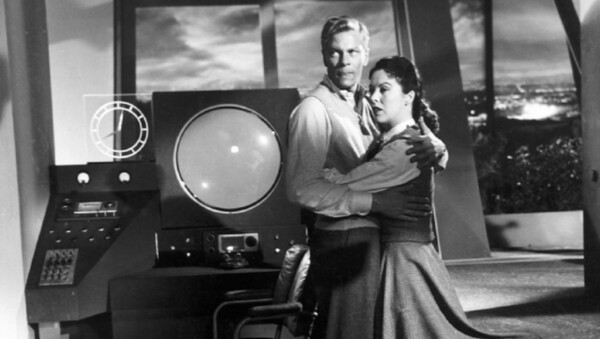
Image courtesy of United Artists.
Del reviews ‘Red Planet Mars’
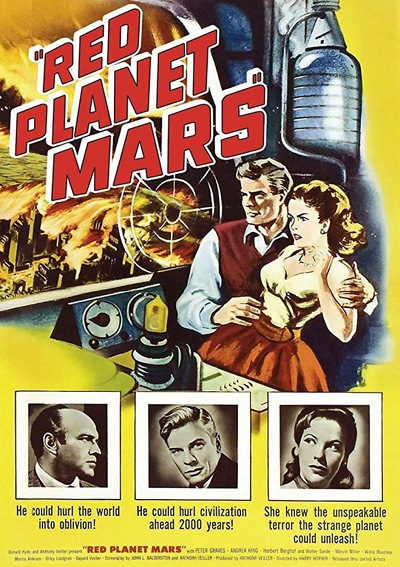
“Red Planet Mars” Starring Peter Graves, Andrea King and Herbert Berghof. Directed by Harry Horner. 87 minutes. Rated approved.
Del’s take
Maybe you’ve noticed I’m reviewing more Netflix, Prime and Hulu offerings these days. That’s no accident.
My MoviePass account expires at the end of this month and I won’t be renewing. When I first joined, the MoviePass deal was unbeatable – watch as many movies as you like in one month for a piddling $7. I wondered how they could make money and they didn’t. Soon they were altering the terms, adding steps and otherwise making it impossible to use your MoviePass for anything but low-rated matinees only once per week. With my new work schedule I could not have seen more than one movie per month, if that. Not much of a deal.
I subscribe to Netflix, Prime, Hulu, Shudder and Curiosity Stream. I can also choose from Vudu and Tubi TV. Needless to say I am not deprived of video content.
But finding the good ones can be a challenge. More than once I’ve searched Google for the best hidden gems on Netflix. I even have a browser extension that lets me search all the “hidden” categories Netflix does not include with its interface.
It stands to reason if I am having this problem, others likely are too. And that is the direction I am taking “Movie Faceoff.”
I will continue to review theatrical releases when I see them, and if I can ever coax Mladen away from the Great American Novel he’s working on, we’ll do them together. Meantime, I am reviewing some of the gems – and dogs – I find on my streaming services. And that brings me to this latest offering, “Red Planet Mars.”
“Red Planet Mars” is one of the most remarkable science fiction movies I have ever seen. Released in 1952 by United Artists, the movie stars a very young Peter Graves at the height of his Nordic grandeur.
The basic plot of the story is as follows: Astronomers spot what appear to be artificial canals on Mars that are transporting water from a rapidly diminishing polar ice cap. At the same time an American scientist (Graves) has established a kind of crude radio communication with the inhabitants.
At first, the communication is a simple repetition of signals sent from Earth. But Graves’ son, Stewart (Orley Lindgren) suggests transmitting the numerical value of pi to see if the Martians, if they are indeed Martians, will carry those values to the next decimal point. They do, and a dialogue is established after the cryptographers who decoded the Japanese military signals during World War II figure out how to interpret their language.
The Martians soon reveal an astonishing grasp of science, informing Graves that they live to be 300 years old, use cosmic energy as an energy source and grow enough food on a single acre to feed an entire city.
When these messages are revealed to the world, the world responds with panic and hysteria. Farmers, afraid their crops will be rendered valueless by new growing methods, demand government compensation. The oil industry freaks out (they wouldn’t do THAT, would they) and the medical community has a shit fit. The stock market collapses, riots spread across the country and the western world grinds to a halt.
Simultaneously an evil subplot is playing out. The Russians have a spy listening in on the broadcasts, a Nazi scientist who invented the technology that enables Graves to contact the Martians. The Russians intend to use the chaos as a means to subjugate the west and take over the world.
That is until the messages from Mars detour from the standard our-technology-is-superior-to-yours script and move off in a weird, unanticipated direction. Tables get turned and “Red Planet Mars” becomes something that rises above the modest aspirations of a killer B movie.
The clothes, home furnishings and cars are vintage 1952, but the giant flat-panel TV mounted on Graves’ wall is anything but, suggesting “Red Planet Mars” is set in an alternate universe.
But what’s astonishing about the movie is its willingness to address the deep issues of first contact, or the Cold War conflict between east and west. It does so in surprisingly thoughtful ways, so atypical of the ’50s B movies with their bug-eyed monsters and giant insect predators.
Don’t get me wrong. I’m not saying “Red Planet Mars” is a “good” movie. It’s definitely a product of its time. The viewer must make a deal with himself to overlook the overacting, the offensive patriarchal viewpoints, crappy special effects and script clinkers so common of movies of that day. But do that and you may be surprised.
I will say I liked the movie a lot. It entertained me right to the end.
I would grade “Red Planet Mars” at B+ purely on the merits of its ambition.
Stone is a former journalist and author.