My cat is sick and it scares me. I don’t want him to die
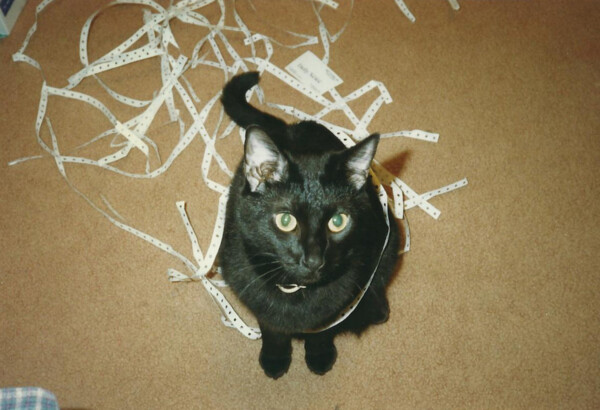
In this photo, Pavlov sits amid the ruins of tractor-feed perforation strips from my old Okidata dot-matrix computer printer. He loved playing with those strands of paper and usually created a huge mess. Photo by Del Stone Jr.
—
OK, so this blog is about a cat. Pavlov. MY cat. He’s sick and it scares me. I don’t want him to die.
Pavlov was here in 1992 when I was trying to recover from a catastrophic relationship. He didn’t know it but he helped me through that.
He was here on Oct. 4, 1995, when Category 4 Hurricane Opal roared across the Florida Panhandle. He didn’t know what was happening and his calm demeanor helped me cope with the terrifying destruction I watched fly past my window.
He was here in October 1998 when my father was dying and I finally broke down and cried for the first time in 25 years. He crawled into my lap and pawed at my chest as I sobbed.
He was here on Sept. 11, 2001 as I watched airplanes fly into buildings and could not comprehend the cruelty I was seeing on TV.
He was here on Sept. 15, 2004 as Hurricane Ivan laid waste to the Panhandle and I could not bear to sleep upstairs because the sound of debris hitting the roof frightened the living hell out of me.
And he was here in December 2005 when I made the decision to have Maggie, my other cat, put to sleep after she succumbed to the very same disease that is killing Pavlov now.
Pavlov is a chore. He must be given an IV every day. He needs laxatives to do his business. I hide vitamins in his food. He eats three different kinds of very expensive cat chow – at this point anything down his gut is a good thing. I give him an antibiotic twice a day. And he needs a special “massage” to keep his alopecia at bay.
It’s very expensive and time-consuming.
I think he’s still happy. He doesn’t appear to be suffering.
But it’s clear to me he’s heading downhill. He sounds different. He’s peeing around the house, which is never a good sign. I think his diabetes has returned.
I had Maggie put to sleep the week before Christmas, and I cried for weeks afterwards. I loved that cat.
I believed I didn’t feel the same about Pavlov, but I’m seeing now that isn’t true. It will be heartbreaking to make that drive to the vet in Destin.
No more pets.
—
Author’s note: Contact me at [email protected]. To read more of my opinion and humor pieces, visit delstonejr.com . I also write fiction – horror, science fiction and contemporary fantasy. If you’re a fan of such genres please check out my Amazon author’s page. Print and e-books are both available, and remember: You don’t need a Kindle device to read a Kindle e-book. Simply download the free Kindle app for your smart phone or tablet.
Video

Image courtesy of EFTI, Sveriges Television and Filmpool Nord.
—
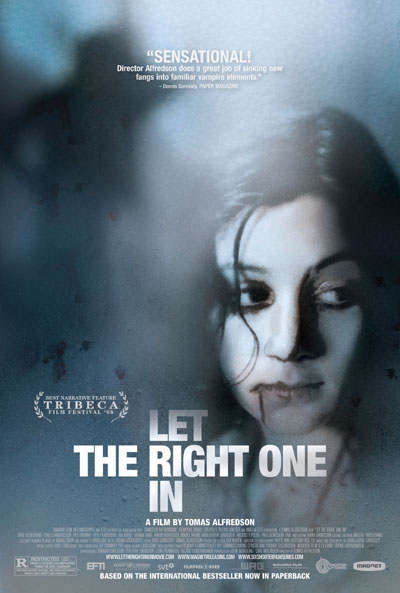
“Let the Right One In” Starring Kare Hedebrant, Lena Leandersson, Per Ragnar, Karen Bergquist. Directed by Tomas Alfredson. 115 minutes. Rated R.
Del’s take
You’re a 12-year-old boy and the bullies at school are eating your lunch. Wouldn’t it be nice if you could invoke the powers of your vampire girlfriend for a bloody session of attitude adjustment?
That’s the premise of “Let the Right One In,” a Swedish vampire flick that eerily and effectively reminds us that love comes along when it’s least expected, and from the unlikeliest of angles.
Oskar (Kare Hedebrant) is a pale, frail wisp of a boy who receives the unwanted attentions of a trio of bad boys at his school in the Stockholm suburb of Blackeberg. He fantasizes about revenge, sticking a knife into a tree and clipping newspaper articles about murders.
His home life isn’t much better. His parents are divorced. His alcoholic father lives in the country with a male friend while his mother works full-time and comes through the front door frazzled and worried. He spends much of his time at his apartment complex’s playground, dreaming of the escape he will never make happen.
He meets Eli (Lena Leandersson), the strange girl who has moved into the unit next door. She only comes out at night and seems impervious to the Swedish cold. Despite her pronouncement that she doesn’t want to be friends the two are drawn to each other, perhaps by their mutual strangeness.
Soon, bizarre murders haunt the streets of Blackeberg and Oskar, with Eli’s encouragement, stands up to his tormentors – the results are tragic. Still, “Let the Right One In” provides an option for hope.
But its most powerful virtue is the subtle elegance of its storytelling. “Let the Right One In” is flecked with moments of brutality, as any good 21st century vampire story must be. But it is also a serene journey through quiet, nighttime snowfalls, the unremitting gray of winter and the inevitable slide into dissolution that in this case is tempered by a weird redemption.
American audiences will not like the subtitles but never fear, in the tradition of “The Ring” and “The Grudge,” an Americanized version is due out this year.
“Let the Right One In” is not a movie for children or adults with timid constitutions. For everyone else it is a strange poem that will leave an uneasy impression that like water – or blood – love finds a way into the hardest of hearts.
Mladen’s take
It’s clear by watching “Let the Right One In” that a vampire-friend would be useful if you’re the victim of bullies in middle school. Any middle school. Even a middle school in Sweden, where this very good, intermittently troubling film was made.
Before proceeding, let me stress that the penultimate scene in “Let the Right One In” offers one the finest pieces of cinematic slaughter ever created. Like much of the rest of the movie, its director, Tomas Alfredson, filmed the segment sparingly but punctuated it with bits of vivid dismemberment. The soundless incident was mesmerizing, not ghastly, though the victims were a couple of pre-teenagers and one adolescent.
“Let the Right One In” defies Hollywood-homogenized vampire film plots. It isn’t a sappy romance such as “Twilight” or a bloodletting similar to “30 Days of Night.”
It’s a movie about friendship, exploring the nature of honesty, loyalty, and trust. The protagonists are 12 years old but their struggles resonate with what we face as adults.
In one scene the dark-haired vampire cutie Eli accepts Oskar’s unvoiced gesture to enter his home, though he knows she must be invited verbally. Eli willingly placed her life in his hands by crossing the threshold and endured near-disintegration before he blurted “Come in” to end the horror.
Friendships have a darker side, too.
There’s the matter of making choices that close doors leading to other forms of happiness. There’s the urge to reciprocate. And, we inevitably become a little like the people considered friends.
Eli, shortly after the threshold incident, pounces on Oskar. She urges him too become more like her, something that, in fact, had been happening since the two met. Pay attention. At this moment and a couple of others, Eli’s young, creaseless face transforms, betraying the true age of her worn soul.
The movie ends with the impression that Eli had become more mankind-like and Oskar, more vampire-like, but both were human. Each of the two beings, it seems, had let the right one in.
Mladen Rudman is a former journalist and technical editor. Del Stone Jr. is a former journalist and author.
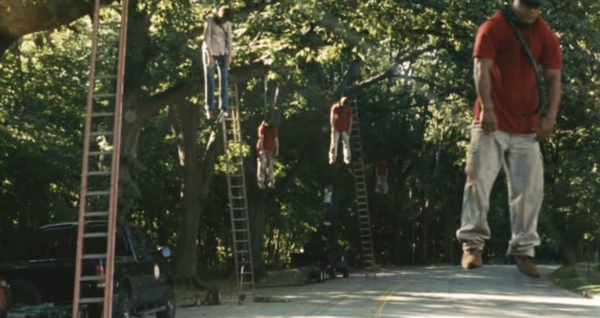
Image courtesy of 20th Century Fox.
—
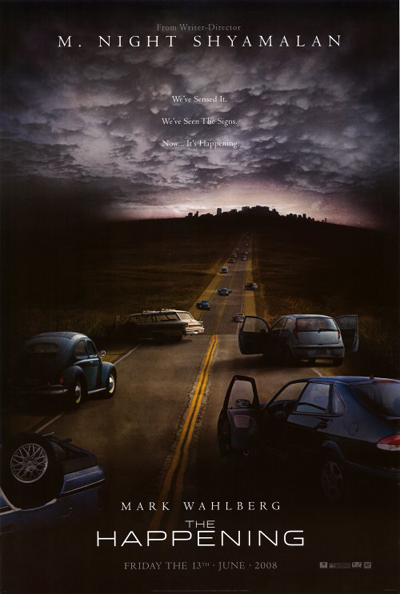
“The Happening.” Starring Mark Wahlberg, Zooey Deschanel, John Lequizamo, and others. Directed by M. Night Shyamalan. 91 minutes. Rated R.
Del’s take
Terrorists have just attacked your city. An airborne agent is causing people to commit suicide en masse. You are standing in line to board what may the last train out of the danger zone. Do you:
(a) Get in line as quickly as possible and hope you actually find a seat on the train, or
(b) Make everyone wait as you and your wife have a long, soulful conversation about the strains in your marriage.
If this is an M. Night Shyamalan movie the answer is (b) of course, and that scene is emblematic of the problems with what could have been a nifty little horror movie, “The Happening.”
Two giant flaws will keep “The Happening” from joining my DVD collection – at least until it reaches the discount bin at Walmart: writing and direction. Shyamalan has been living off the good will generated by “The Sixth Sense” for many years, but he may have used up that charity. “The Happening” is an unrecoverable mess.
The movie begins with such promise. People in Central Park suddenly begin killing themselves in a plague of violence that spreads across the city. The first five minutes offer some really scary scene-setting – construction workers hurling themselves off a building, and cops shooting themselves in the head with their own guns.
Science teacher Mark Wahlburg is summoned from his classroom after telling kids that some events are merely natural cycles that will never be explained (Galileo must be spinning in his grave) and learns a terrorist attack has threatened New York City. He calls his wife, Zooey Deschanel, and arranges to meet with a friend at the train station to evacuate. It is there that they have their marriage encounter as mobs of terrified civilians scramble to get aboard the train.
As they flee the city and the contagion spreads, they begin to realize the event is not a terrorist attack at all but a response from plants to the assault on the natural world by humankind.
The movie is filled with quietly gruesome scenes – a man lies down to allow a riding lawnmower to chop him to bits, or tree-trimmers hang themselves from the branches they were preparing to cut.
But it is the inane and distracting subplot between Wahlburg and Deschanel that ruins “The Happening.” Civilization is crumbling around them yet they pause – usually during moments of duress – to fret about their troubled relationship, which on the face of it doesn’t appear to be that troubled: Deschanel went out with a male coworker to enjoy an ice cream cone.
Not exactly “Who’s Afraid of Virginia Woolf.”
One more gripe: Throughout the movie the attack is referred to as “the event,” yet the title is “The Happening.” Why?
I think Shyamalan has succumbed to the bane of the untouchable creator – he who cannot be edited most desperately needs editing. It’s a shame because with a decent script and a more grounded director, “The Happening” could have been another sleeper like “The Sixth Sense.”
Del Stone Jr. is a former journalist and author.
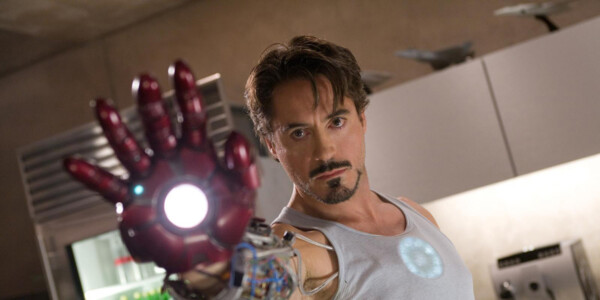
Image courtesy of Marvel Studios.
—
“Iron Man” Directed by Jon Favreau. Starring Robert Downey Jr., Jeff Bridges, Terence Howard and Gwyneth Paltrow. 126 minutes. Rated PG-13
Mladen’s take
Here’s a viewer’s guide to “Iron Man,” the blockbuster movie: DO NOT pay attention to details but DO stop thinking about the film the moment it ends.
“Iron Man” is light, entertaining fare suitable for matinee viewing.
Below is the partial list of flaws. Remember, the devil is in the details. Details are important to me if I’m going to swallow the director’s effort to make Iron Man a plausible do-gooder by setting him in the real world.
— Why would the planet’s premier weapons maker and billionaire playboy Tony Stark — Iron Man-to-be — go to Afghanistan to personally demonstrate a surface-to-surface artillery missile, an Army weapon, to a bunch of guys in the Air Force. Stark’s 19-billion-square-foot concrete mansion and adjoining property consume much of the western seaboard, so they must border the White Sands Missile Range. Wouldn’t it have been easier to test fire the Jericho missile there?
— If Stark, played by Robert Downey Jr., is the world’s premiere weapons designer and all-around genius, why does he use flares to try to defeat a radar-guided air-to-air missile fired at him while he’s in Iron Man mode? Shouldn’t he have dispensed chaff?
— Pepper Potts, Stark’s personal assistant, is played by breathtaking Gwyneth Paltrow. Why would it take womanizer Stark years to recognize her beauty and smarts and make a play for her. The romantic tension is the movie’s only awkward part.
— Why is an active-duty airman, a lieutenant colonel played by Terence Howard, attached to Stark as he roams the globe? The half-colonel also is one of Stark’s spokesmen.
— Why did Del automatically get a senior citizen discount from the elementary-school looking youngster in the ticket booth though he’s far from being a senior. I paid $2.50 more than Del to see “Iron Man,” a fact still stuck in my craw.
No question, “Iron Man” is over-hyped. It lacks the zest of the last truly iconic blockbuster released, “Jaws.” But, as long as you don’t pay full price for the ticket, the metal homo sapiens will keep you pleasantly distracted for some two hours.
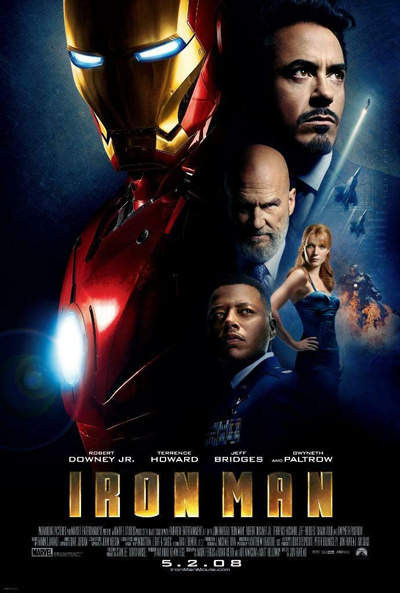
Del’s take
If it’s any consolation, Mladen, that senior citizen’s discount is stuck in my craw too. But $2.50 is half a gallon of gasoline and geezers like me need that gas to drive to all those cheap buffets around town.
And I wouldn’t say “Jaws” is the last iconic blockbuster. “E.T.,” “Aliens,” “Terminator 2” and “Titanic” all fit that category, to name a few.
But I agree. “Iron Man” doesn’t live up to the hype. It’s a decent enough movie … NOT another “Cloverfield” or “Dawn of the Dead,” which is the best movie ever made.
“Iron Man” is about a weapons developer who travels to Afghanistan and sees firsthand the horrors his products have inflicted on the innocent. He’s captured by terrorists, who force him to build a diabolical weapon for their nefarious use.
Instead, he builds a crude Iron Man exo-suit and uses it to escape his captors. Once back in the States he fabricates a superior version of the suit and vows to put the terrorists out of business permanently.
It’s all silly fun as Iron Man dodges jet fighters and decimates evil mujahideen while defying the physical laws of the universe. The movie requires a Herculean suspension of belief – science is non-existent as Iron Man flies from California to Afghanistan on a single tank of gas, plummets into the ground at hundreds of miles per hour only to arise unhurt, and crashes through the roof of his mansion to crush a sports car … try doing that in a Kia and see how far you get on your senior citizen’s discount.
Forget Robert Downey Jr. The real star of “Iron Man” is Jeff Bridges, who perfectly embodies the suave, lizard-tongued CEO of Stark Industries out to make a buck at the expense of friend, family and nation.
I think “Iron Man” is a good rental movie, not one to see in theaters – unless you’re getting in for $2.50 less than Mladen.
Mladen Rudman is a former journalist and technical editor. Del Stone Jr. is a journalist and author.

Image courtesy of Warner Brothers.
—
“Speed Racer” Directed by Andy and Larry Wachowski. Starring Emile Hirsch, Christina Ricci, John Goodman, Susan Sarandon. 135 minutes. Rated PG.
Del’s take
I hate animated films about as much as I hate films that synthesize animation with live action. And unless it’s “Batman” I am sick to death of comic book- and cartoon-inspired movies.
But instead of throwing up my lunch I simply threw up my hands and went with the hackneyed, cliched and utterly simple-minded “Speed Racer,” a movie in want of an audience dumb enough to enjoy it.
Despite its lurid color palette and fairy-tale plot, “Speed Racer” isn’t something kids will digest with their Happy Meals. Rather, it’s suffused with pell-mell destruction and adult themes of corruption, blackmail and death, most of which will go over the kiddies’ heads. But Mommy and Daddy can expect a grinding case of road rage over the money wasted on this interstate highway pileup of a flick.
The story goes like this: Young Speed (Emil Hirsch) grows up idolizing his older brother, Rex (Scott Porter), who is killed in a horrific wreck and accused of racing dirty, thereby sullying the family name. When Speed follows in Rex’s footsteps he is wooed by a large racing conglomerate headed by Mr. Royalton (Roger Allam), who threatens destruction upon the Racer family when Speed turns down his offer. Meanwhile the Togokahn racing organization, facing a hostile takeover by Royalton Industries, vows to win a final race, The Crucible, a cross-country destructo-derby where dirty tricks are the norm. They enlist Speed as a driver. If Togokahn wins the price of their stock will rise, bankrupting Royalton and exposing their race-fixing, and salvage the Racer family name.
Sounds like any number of little-guy-vs.-big guy potboilers, but what puts “Speed Racer” behind the pack is its lack of focus, thuddingly dense dialogue, dismissal of simple physics and jarring cinematography.
Where to begin? The brain swoons at the prospect. Is this a children’s movie or what? Should adults take it seriously? Are the overblown CGI effects a kind of commentary on the illusory nature of reality or merely the product of overzealous computer geeks?
Ultimately “Speed Racer” comes across as a rendering of “The Matrix” on Ecstasy, which is no coincidence: It was created by the Wachowski brothers, who guided the perpetually dazed and confused Keanu Reeves through his role as Neo in the otherworldly “Matrix” trilogy.
But unlike the original “Matrix” and the immensely satisfying “V for Vendetta,” the Wachowskis’ efforts are less successful here.
“Speed Racer” does not earn the checkered flag.
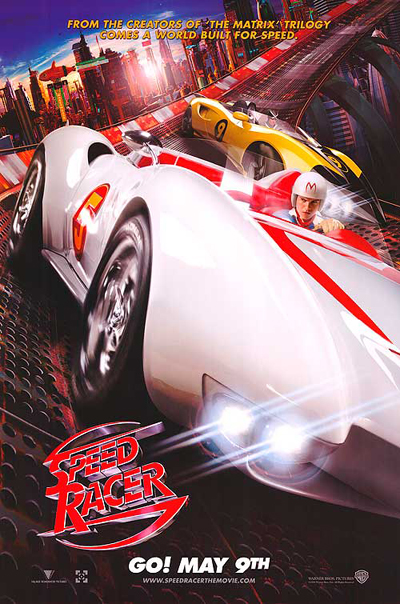
Mladen’s take
Ignore the bona fide movie critics, and Del, who pan the latest Wachowski brother’s effort. Rent “Speed Racer.” Make sure your subwoofer is working.
The plot is difficult to discern and the storytelling as blurry as the race scenes but what’s the big deal? No film is perfect.
Flashing unearthly psychedelic colors make the pseudo-animated movie a vivid delight. “Speed Racer” juxtaposes the dark plot with the cheerfulness of bright colors to say that shiny surfaces often disguise the evil beneath.
Pleasing-to-the-eye Christina Ricci, as Trixie, plays the role of an indomitable but discreet instigator with effective lightheartedness.
The actors portraying Spridle and ChimChim – or however the hell their names are spelled – add humor to the movie.
And, no kidding, John Goodman as Pops looks exactly like Pops in the “Speed Racer” cartoons.
Racers employ all sorts of dirty tricks against each other to keep, or get, lucrative corporate sponsorships. Races are fixed by bookies, an idea that the film’s makers could have ripped off from watching BCS college football computer models at work.
The vehicles depicted in the movie are beautiful. Powered by interlocking dihedral fusion c60 bucky balls or some such thing, the machines handle turns, loops, dips, jumps, sand, ice, rain, hot, cold, sideswipes, rearenders, frontenders, rocket-propelled grenades, hypoxia and the common cold with ease. It’s a wonder the driver’s weren’t fitted with G suits. Yes, the powerful Mach 5 and, later, Mach 6, have the gadgets featured in the cartoons and even some of the sound effects. Remember the “sproing” of the doohickeys that make the Mach 5 jump?
I would have preferred that “Speed Racer” the movie use as a plot something other than big business corruption and one boy’s push to keep the spirit of racing alive. What nonsense. All sports at all levels are about making money.
In fact, a pure action movie with no moral would have been ideal.
So, here’s the story for “Speed Racer” the sequel. A CG race against the Mammoth Car with the Car Acrobatic Team as its escort will blow off peoples’ socks. A subplot involving Racer X and the evil scientist who created the armored and tracker Car With A Brain must be worked in somehow. Finally, it would be helpful if in the sequel Speed reacts to Trixie’s sexiness with a thrill rather than dour sentimentality.
“Speed Racer” is worth watching. I’m thinking of adding it to my meager DVD collection, though not until the price drops to $5, or less.
Mladen Rudman is a former journalist and technical editor. Del Stone Jr. is a former journalist and author.
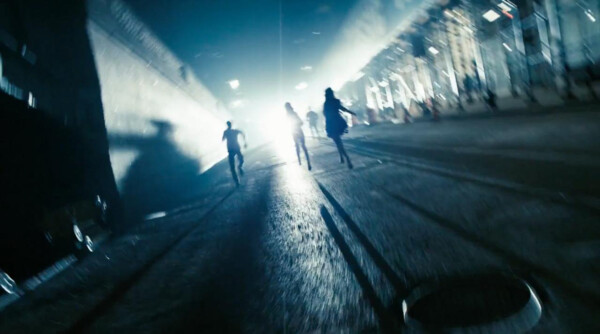
Image courtesy of Paramount Pictures.
—
“Cloverfield” Starring Lizzy Caplan, Jessica Lucas, T. J. Miller, Michael Stahl-David. Directed by Matt Reeves; created by J.J. Abrams. 85 minutes. Rated PG-13.
Mladen’s take
An amphibious monster, stories tall or a couple of blocks long, depending on the way you want to measure the beast, attacks Manhattan and it’s plausible.
That’s what makes “Cloverfield” work — the director takes the movie’s premise seriously.
Though “Cloverfield” sucks as a title, the movie becomes riveting after it finally cuts to explosions, toppled buildings, gunfire and missile and bomb attacks.
“Cloverfield” is realistic because it’s shot from the street-level point of view of a handful of people while the scaleless monster rampages through New York. The frenetic, jittery perspective you see on the big screen is captured by one of the survivors, who’s wielding a camcorder with the longest-lasting battery ever manufactured.
The CGI and the real blend flawlessly in this movie.
At any moment I expected cameraman Hud to focus on a still-functioning TV at an electronics story being looted as mayhem sweeps the island. President Bush comes on, the TV screen flickering.
“My fellow Americans, we are in a long war with monsters,” he would have said. “I don’t know when it will end, maybe never, but we will achieve victory. To protect you, I’m suspending all civil liberties and disbanding Congress. I can do that. It’s in the Constitution. Ask Dick Cheney. There’s no time for silliness like democracy while radical Islamic fundamentalist jihadist terrorists unleash such furry — ah, fury — on the good, holy people of America. God bless me, your savior.”
Like GM and Ford are finally starting to build cars that can compete with Japanese brands, Hollywood has finally released a movie that can compete with Japanese giant monsters such as Godzilla and Gamera.
See “Cloverfield” while it’s in theaters. Go to the bathroom and buy popcorn sometime during the movie’s first 20 minutes, which are spittle, and then prepare for a jolt.

Del’s take
“Scaleless monster”? Mladen. I never thought of you as a dermaphobe.
Still, “Cloverfield” is a romp ’em stomp ’em bad ass monster of a movie, and anybody who disagrees needs to have his aura adjusted by a Marine drill sergeant.
OK, so the first 20 minutes are more “Quarterlife” than “Die Hard.” So what? That’s the part where we learn the viewpoint characters are as insipid and selfish as we. How else could we know that Rob is a metrosexual wussie who believes “commitment” is a dish best served cold?
But once the infrastructure starts rolling down the streets it’s a cinema verite grudge match featuring the icons of order vs. the forces beyond our control in a mighty metaphor for what’s happening in the world around us. If the U.S. could have dropped the “Cloverfield” monster on Fallujah, Barack Obama would be running a distant third.
Yes, we can niggle. How could that monster jump at a helicopter? What happened to Marlena behind the curtain? And in the movie’s final scene, did you really see something fall into the water? Oooh.
I just wish people would stop Blair Bitching about the jiggly camera motion – take a dramamine and call me in the morning. Ever read “The Sound and the Fury”? William Faulkner thought of the idea decades ago. If you can live with it on YouTube you can live with it in “Cloverfield.”
I think J.J. Abrams has kicked some serious Godzilla booty. This is not narrative storytelling. It’s slice-of-death moviemaking for a generation of voyeurs and narcissists who measure their worth in terms of the body count on their Facebook friends list.
In the movie’s penultimate scene we hear two very loud noises. Those were the sounds of a genre cracking under the weight of its own inertia and crashing into a new and limitless ocean of creative expression.
Let’s hope “Cloverfield” sinks a few ships.
Mladen Rudman is a former journalist and technical editor. Del Stone Jr. is a former journalist and author.

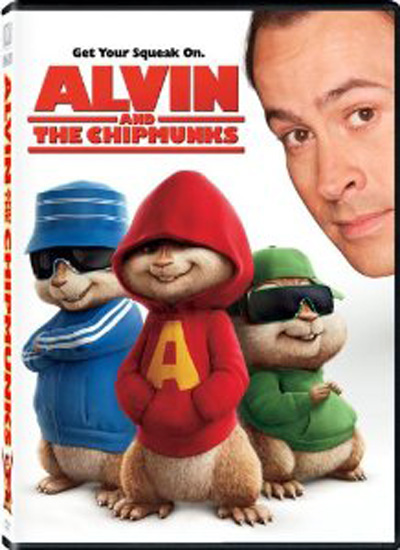
Simon, Alvin and Theodore beam at the prospects of their first holiday together with Dave Seville.
“Alvin and the Chipmunks” Starring Jason Lee, David Cross, Cameron Richardson and the voices of Justin Long, Matthew Gray Gubler and Jesse McCartney. Directed by Tim Hill. 92 minutes. Rated PG.
Del’s take
I spent more time watching the clock than “Alvin and the Chipmunks.”
But hey, it’s a kids’ movie … a 92-minute long kids’ movie that takes three days and a barf bag to watch.
Seriously, I found no fatal flaws in “Alvin and the Chipmunks.” I’m sure it’s a perfectly serviceable kids’ movie – despite the tired, hackneyed, derivative plot elements that seem cut and paste from about every animated/CGI-generated kids’ movie of the past 10 years.
In “Alvin and the Chipmunks,” our three favorite rodents (not counting Bush, Cheney and Rumsfeld) show up at the home of failed music writer Dave Seville (Jason Lee) and wreak havoc. Dave shows them the door – but invites them back when he discovers they can sing … just the “latest thing” to galvanize his music career.
From there the movie becomes a predictable and boring pastiche of cliches – the chipmunks become rock stars and are exploited by greedy businesspeople … Dave starts to think of the chipmunks as his kids … Dave nearly loses the girl but with the chipmunks’ help gets her back … blah blah blah.
But hey, it’s a kids’ movie, so who cares?
Sorry, but I just couldn’t overlook the property damage, career setbacks and disgusting personal hygiene issues wrought by these rodents. Fart jokes and eating a poop? Pass the Pepto-Bismol.
At my house these rats would be singing the blues as I sic the cat on them.
Mladen’s take
Maybe I liked “Alvin and the Chipmunks” because it had only one fart gag.
Maybe it was the clever scene where Alvin inhaled helium from a balloon and his voice got lower.
Maybe I like the film because Del doesn’t. What’s the big deal about Simon eating Theodore’s poop pellet, anyway? Aren’t chipmunk’s vegetarians? So, it’s not like the pellet was all fetid and putrid with flies swarming.
“Alvin and the Chipmunks” is funny much of the time and avoids being annoying, no small feat because the chipmunks’ testosterone-less voices could drive a person nuts.
“Dave,” played by Jason Lee, does a good job of imagining the singing rodent trio exists.
The same skillful ability to see what isn’t there is applied by the bad guy music industry executive exploiting Alvin, Simon and Theodore for all they’re worth. As it turns out, the money isn’t in the singing but the merchandising.
Nor does the movie wear out its welcome by being too long or using double entendre to appeal to adults.
The chipmunks are the film’s only CGI, adding a sense of reality that makes the movie feel authentic even if grumpy Del insists the plot is re-tread.
If you have kids, don’t rent the movie, buy it.
“Alvin and the Chipmunks” is very likely a film they’ll want to see more than thrice, which means it’ll pay for itself in no time.
Mladen Rudman is a former journalist and technical editor. Del Stone Jr. is a journalist and author.
Video
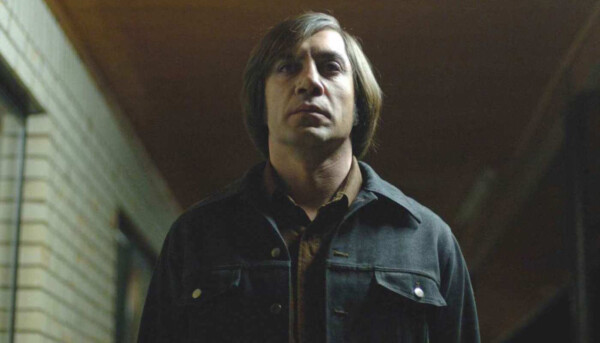
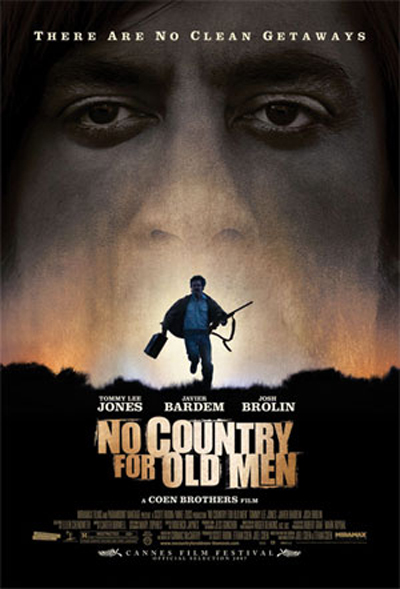
“No Country for Old Men” Directed by Ethan and Joel Coen. Starring Tommy Lee Jones, Javier Bardem, Josh Brolin, Woody Harrelson, Kelly MacDonald. 122 minutes. Rated R.
Mladen’s take
The most interesting part of “No Country for Old Men” comes at the end of the film during the credits.
The film’s makers claim, “This is a carbon neutral production: 100% of carbon emissions offset with Native Energy.”
Dang, what a bold, confident statement. How did producers know the movie is carbon-neutral with such certainty? Did they calculate the oil- or natural gas- or coal-based energy it took to train the animals in the film? Or the noxious, atmosphere-heating gases produced by a burning car? Or using blanks in the silencer-equipped, 12-gauge shotgun wielded by the delightfully remorseless killer portrayed by Javier Bardem?
“No Country for Old Men” is a good movie, regardless of its carbon-neutrality. Why it got the nod for best motion picture of the year is beyond me, though.
It’s a slick film with Texas’ austere plains and mountains as backdrop. Dialogue is good and all of the characters interesting but “No Country for Old Men” is, essentially, little more than a shoot ’em up movie. The plot is tired, despite the penumbra of some hifalutin philosophical talk and events looking at the way fate plays with mankind.
“No Country for Old Men” lacks the dastardly humor of the Coen brothers’ “Fargo” or the flippant violence in “Raising Arizona,” which are better films.
If you go to a video store and “No Country for Old Men” is rented, don’t worry; it’s not a must-see despite its credentials.
Del’s take
Like Mladen asked, “No Country for Old Men” was a good movie but was it worthy of an Oscar?
Maybe in a weak year. Apparently 2007 was just such a year.
In “No Country for Old Men,” Josh Brolin stumbles across a drug deal gone bad. He makes off with the cash. Meanwhile, the druggies hire Javier Bardem to track him down. Tommy Lee Jones is the sheriff who seems to be one step behind the bad guys – on purpose.
The visuals are excellent. Dialogue is excellent. Performances range from good to excellent – I wasn’t impressed by Brolin’s interpretation of the Llewelyn Moss character but Bardem truly deserved an Oscar for his portrayal of killer Anton Chigurh.
I’m not sure what to make of the movie’s overall subtext. I mean, clearly it meant to say: The country has gone to hell in a hand-basket. Bardem’s character is a killer who attributes his amorality to fate, an easy balm for the conscience. Jones’ character is easily understandable as the reluctant sheriff who only wants to survive until retirement. But dirty deeds done dirt cheap have been with us a long, long time, and I’m not sure you can attribute them to Mom and Dad letting Britney dye her hair green.
Bardem is T-boned in an accident that leaves a bone protruding from his arm. He buys the shirt off a teenaged boy’s back and uses it to make a sling. Then he walks away from the accident as sirens wail in the distance. Is this an illustration of the amorality of fate, or a kind of karmic balancing of the equation?
“No Country for Old Men” doesn’t answer that question, and I think that’s where it falls short.
I would say watch it and make your own judgment.
Mladen Rudman is a former journalist and technical editor. Del Stone Jr. is a former journalist and author.
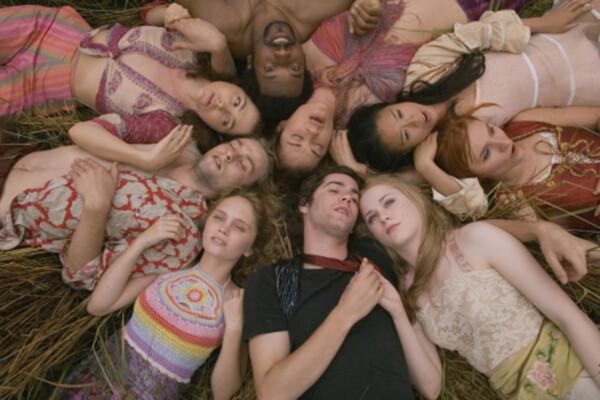
(Clockwise from top) Martin Luther McCoy as Jo-Jo, Dana Fuchs as Sadie, T.V. Carpio as Prudence, Ekaterina Sknavina as Rita, Evan Rachel Wood as Lucy, Jim Sturgess as Jude, Kiva Dawson as MaxÕs Girl, Joe Anderson as Max, and Halley Wegryn Gross as Max's Girl in Revolution Studios' "Across the Universe." Photo Credit: Abbot Genser SONY PICTURES ENTERTAINMENT INC.
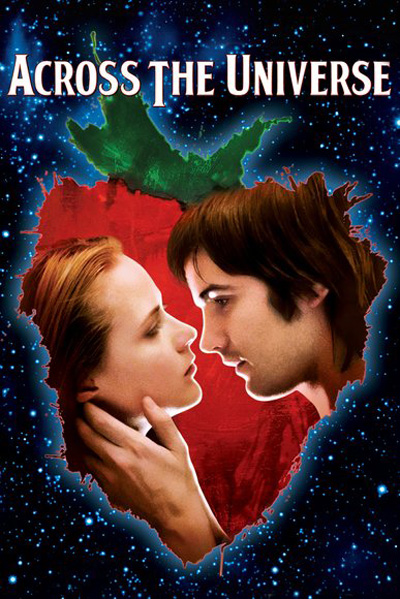
“Across the Universe” Starring Evan Rachel Wood, Jim Sturgess, Joe Anderson, Dana Fuchs, Martin Luther, and T.V. Carpio. Directed by Julie Taymor. Rated PG-13. 131 minutes.
Del’s take
About 15 minutes into “Across the Universe” I decided a review massacre was in order. By movie’s end, however, I had changed my mind. The movie didn’t work for me and I wanted to know why.
I thought about it all night. I used up precious REM sleep grinding my teeth on the issue. And sometime between bedrise and showertime I hit upon the answer:
Its moment had passed.
But not for the reasons you think.
“Across the Universe” is a homage to The Beatles, the ’60s, Vietnam War protests and the civil rights movement. It features Jude, a mop-topped lad from Liverpool who comes to America to find his father, who abandoned his mother in the Old Sod after World War II. Jude meets Max and falls in love with Max’s sister, Lucy. This unlikely trio hooks up with a New York crowd of artists and protesters who experiment with LSD, reinvent music and get clubbed in the head by truncheon-wielding cops.
The characters have an annoying habit of lapsing into song at almost every turn – re-mastered Beatles tunes as it were. The ratio of singing to storytelling is about 10 to 1. Unless you’re a huge fan of the Fab Four you’ll catch yourself rolling your eyes as Jude, frustrated by Lucy’s evolving radicalization by the anti-war movement, manifests his angst through a singing and strawberry-flinging hissy fit.
But the problem with “Across the Universe” is that it no longer works. The Beatles’ were replaced by new wave, grunge, hip-hop and emo. The “turn on, tune in, drop out” moment doesn’t exist. We have another Vietnam raging in the Middle East, and the civil rights movement has become a pale shadow of its former self.
More significantly, young people no longer feel the passion that once energized those social changes.
Back in the 1980s the kids were known as the “Me Generation.” But self-absorption on a cultural scale didn’t exist until the 2000s, when the gadget-pampered, media-beatified children of the ’80s and ’90s came of age.
The young people of the ’60s did what they did, no matter how wrong or stupid, because they were charged with a passion for revolution. At least some of them believed they could change the world.
But that passion is gone. Instead, we have a pretense of passion whose underlying motivation is self-aggrandizement, and it just rings hollow. People don’t march through the streets to bring change; they march through the streets to get on TV.
That’s why “Across the Universe” didn’t work for me. It was like watching Howdy Doody shout, “Hell no, we won’t go!”
When I see mobs of long-haired, placard-carrying hippies surrounding the White House and demanding that Bush pull out of Iraq, I’ll change my mind about “Across the Universe.”
Until then, I give it 10 big yawns.
Mladen’s take
A movie’s place in time shouldn’t influence its entertainment value.
“Across the Universe” is set in the turbulently kitschy 1960s but that doesn’t mean the movie needed to suck in the attention-deficit-disorder 2000s.
“Across the Universe” would have been crap in 1965, too.
Sweeping aside Del’s huffing and puffing about our selfish, publicity-seeking youth by noting that’s what all youth everywhere are at any given moment, leaves only the prospect of reviewing “Across the Universe” on its own merit.
The movie is little more than a montage of The Beatles songs. It would have been tolerable if more nudity and violence were offered, but that’s only two of several mistakes.
The creators of “Across the Universe” took Fab Four tunes and built a movie around them.
What they should have done was write a coherent script and cherry-picked The Beatles songs that fit. The result could have been both a good movie and a celebration of the Fab Four.
That said, I should come clean with a couple of prejudices.
First, the only thing good about The Beatles was Paul McCartney and that’s only after he founded Wings. “Live and Let Die” is one of the greatest songs ever.
And, second, “Across the Universe” fails to use The Beatles most whimsical and charming song, “Yellow Submarine.”
How can you produce, direct or act in a movie featuring The Beatles songs without using “Yellow Submarine?”
“Across the Universe,” in part, uses Vietnam War-era unrest in the United States as a component of its shtick.
“Yellow Submarine” could have been the song that gaps the inane decisions made by politicians back then with the gallingly obtuse decisions made, and being made, by the Bush administration today.
That would have had two effects.
First, Del might have been less grumpy in his review of “Across the Universe” because it had a link to the present.
And, second, the movie would have helped me survive the next 10 months of Bush.
After all, couldn’t we all “sail on to the sun until we found a sea of green and (live) beneath the waves in our yellow submarine” prosperously in international waters until Jan. 21, 2009?
Mladen Rudman is a former journalist and technical editor. Del Stone Jr. is a former journalist and author.
Video
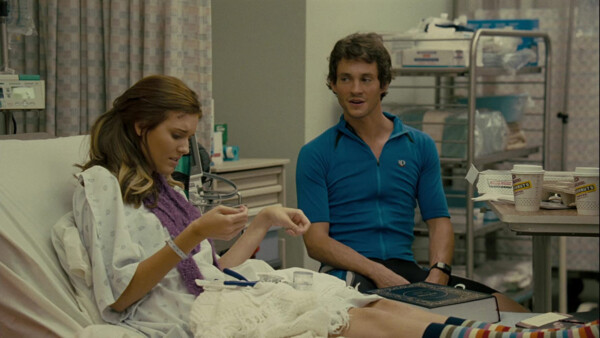
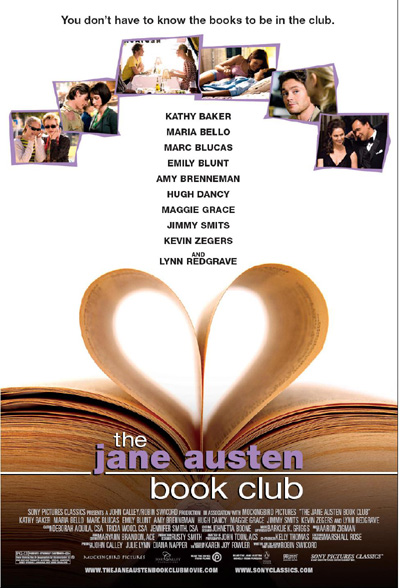
“The Jane Austen Book Club” Starring Maria Bello, Emily Blunt, Kathy Baker, Amy Brenneman, Maggie Grace, Jimmy Smits, Hugh Dancy. Directed by Robin Swicord. 106 interminable minutes. Rated PG-13.
Del’s take
When I suggested to Mladen we review something other than science fiction or horror I had no idea he’d go soft and squishy. But after consulting some of the ladies in our presence he came up with “The Jane Austen Book Club” which set my skin to crawling.
The words “Jane Austen” conjure an image of a spinster snuggled on the couch with her embroidery and her kitty cat, listening to classical music and fondly remembering the one and only night of her life that a beautiful man French-kissed her.
“The Jane Austen Book Club” stars the entire female population of Planet Amazonia, and Hugh Dancy. It is about a group of demasculating, wine-guzzling, teenage boy-seducing harpies who plot to subjugate the men in their lives by proposing an ultimatum: Read Jane Austen … OR ELSE. At least that’s what I got out of it.
Incredibly, the men cave to this ridiculous coercion and the movie wraps with a stomach-turning group cootie exchange.
Did I just give away the ending? Oh hell, I don’t care.
I find myself irritated by movies like “The Jane Austen Book Club.” The characters live in the most expensive state in the nation, wear stylish clothes, drive $40,000 Volvos, own mansions, don’t appear to ever work for a living … and wring their hands because hubby would rather watch a basketball game than rhapsodize about some lame English romance writer who died almost 200 years ago.
Gimme a break.
After watching “The Jane Austen Book Club” I felt the need to cleanse my palate with something more uplifting, like “Reservoir Dogs.”
Guys, do the words “chick flick” mean anything to you?
Stay away. Stay far, far away.
Ten million yawns.
Mladen’s take
I watched “The Jane Austen Book Club” on a Sunday night and the following day took a shower using French vanilla and cinnamon toast-scented shampoo.
I’m surprised Del, who’s far more cosmopolitan than me, didn’t react the same way.
The movie is a delicate, often charming, introspective about a group of people coping with maturing lives.
It was refreshing to learn that regular folks in Jane Austen’s time — she died in 1817 — also had to deal with the complexities of lovers found and lost and friends found and lost. Just knowing others across centuries have experienced what I have experienced is comforting.
The movie made me a more complete man.
OK, I’m lying.
“The Jane Austen Book Club” is a standard, putrid take on comfortable middle class people looking for purpose.
They use each other, commit adultery, make poor choices and, in the end, it all seems appropriate and normal and good and healthy. In short, it’s like the reading club members are running for president.
But, more than anything, what good is a movie that doesn’t need 7.1-channel, 75-watt per channel, DTS Neo:6 Cinema-filtered sound amplification to help get its message across?
None.
“The Jane Austen Book Club” has a running time of about 1 hour, 46 minutes and that means it was about 1 hour and 45 minutes too long.
Mladen Rudman is a former journalist and technical editor. Del Stone Jr. is a journalist and author.