Well, goodbye, little house. I sure did love you. I sure did

My 1987 Nissan Pulsar is parked in front of my old townhouse, Unit 3F at 215 Hughes Avenue in Fort Walton Beach behind Uptown Station. I lived there 24 years. Image by Del Stone Jr.
I’m gone from the townhouse.
It was a sad moment. I spent the morning hauling boxes of books and photo albums from the upstairs bedroom, what was once my office where I wrote “Dead Heat,” “Black Tide” and “I Feed the Machine,” among many other works of fiction. I vacuumed the place, swept the floors, scrubbed the toilets and cleaned the oven.
When I moved to the townhouse, way back in June 1990, I thought I had died and gone to heaven. For the first time in my adult life I had central air and heat. A swimming pool. Wall-to-wall carpeting. A dishwasher! I didn’t use the dishwasher the first year I lived there. I was not accustomed to such luxury.
As I vacuumed, I studied the dimples in the carpet. Memories flooded in. There sat the love seat, where I sobbed when it finally sank in that Dad was dying. I lay on that love seat one night, praying for the telephone to ring as I died of a broken heart.
The sliding glass door still bore faint imprints of masking tape I used when Opal smashed ashore in October 1995. The upstairs toilet had a padded seat with a small tear from the cats using the toilet as a drinking fountain. I owned a set of barbells that left trenches in the carpet. One night, Chris and I lay next to those barbells and oohed and ahhhed as an electrical storm fizzled and popped outside.

My cats lived their entire lives at that townhouse and today as I cleaned I found a spot where Pavlov threw up when he was so sick he’d retired to a spot behind the TV, waiting for death.
I remember coming home on the night of Sept. 11, 2001, exhausted and horrified, and turning on HGTV because I could not stand to watch another building explode. I remember coming home one night in 1993 and finding a letter in the mailbox from Bantam Books, what I thought was a rejection of my story “The Googleplex Comes and Goes.” It was not a rejection. It was an acceptance. And after I finished whooping and hollering, I got in the car, drove to Whataburger, bought a chocolate milkshake, and drove around town at 1 in the morning, chair dancing to the radio and basking in a glow of relief and satisfaction. It was my first professional sale.
The townhouse was my shelter, my refuge. I stayed there during the awful days and nights of Opal and Ivan. I was there when the economy tanked in 2007, and when the 1990s became the 2000s and nobody knew what to call them. I moved to the townhouse when I was 35 and moved out when I was 59. You can’t live in a place for 24 years without some of it rubbing off on you, and some of you rubbing off on it.
I am not the same person I was in 1990. I hope I am better – smarter, wiser, more patient. But who knows?
As I vacuumed, I spotted something lying on the carpet. A cat claw. The cats, they were always chewing their nails. Maggie died in 2005. Pavlov in 2009. Yet here, on this day in 2015, I found something they left behind, a little piece of DNA that would mean nothing to nobody but me.
I finished cleaning the oven. I put the cleaning materials in the car, and cinched up the ties on a plastic bag of garbage for the long walk to the Dumpster. I was finished.
As I headed for the front door for the last time, I stopped in the hallway and looked back to the living room. I said, “Well, goodbye little house. I sure did love you. I sure did.”
And then I went outside, locked the door, and left.
About the author:
Del Stone Jr. is a professional fiction writer. He is known primarily for his work in the contemporary dark fiction field, but has also published science fiction and contemporary fantasy. Stone’s stories, poetry and scripts have appeared in publications such as Amazing Stories, Eldritch Tales, and Bantam-Spectra’s Full Spectrum. His short fiction has been published in The Year’s Best Horror Stories XXII; Alfred Hitchcock’s Mystery Magazine; the Pocket Books anthology More Phobias; the Barnes & Noble anthologies 100 Wicked Little Witch Stories, Horrors! 365 Scary Stories, and 100 Astounding Little Alien Stories; the HWA anthology Psychos; and other short fiction venues, like Blood Muse, Live Without a Net, Zombiesque and Sex Macabre. Stone’s comic book debut was in the Clive Barker series of books, Hellraiser, published by Marvel/Epic and reprinted in The Best of Hellraiser anthology. He has also published stories in Penthouse Comix, and worked with artist Dave Dorman on many projects, including the illustrated novella “Roadkill,” a short story for the Andrew Vachss anthology Underground from Dark Horse, an ashcan titled “December” for Hero Illustrated, and several of Dorman’s Wasted Lands novellas and comics, such as Rail from Image and “The Uninvited.” Stone’s novel, Dead Heat, won the 1996 International Horror Guild’s award for best first novel and was a runner-up for the Bram Stoker Award. Stone has also been a finalist for the IHG award for short fiction, the British Fantasy Award for best novella, and a semifinalist for the Nebula and Writers of the Future awards. His stories have appeared in anthologies that have won the Bram Stoker Award and the World Fantasy Award. Two of his works were optioned for film, the novella “Black Tide” and short story “Crisis Line.”
Stone recently retired after a 41-year career in journalism. He won numerous awards for his work, and in 1986 was named Florida’s best columnist in his circulation division by the Florida Society of Newspaper Editors. In 2001 he received an honorable mention from the National Lesbian and Gay Journalists Association for his essay “When Freedom of Speech Ends” and in 2003 he was voted Best of the Best in the category of columnists by Emerald Coast Magazine. He participated in book signings and awareness campaigns, and was a guest on local television and radio programs.
As an addendum, Stone is single, kills tomatoes and morning glories with ruthless efficiency, once tied the stem of a cocktail cherry in a knot with his tongue, and carries a permanent scar on his chest after having been shot with a paintball gun. He’s in his 60s as of this writing but doesn’t look a day over 94.
Contact Del at [email protected]. He is also on Facebook, twitter, Pinterest, tumblr, TikTok, and Instagram. Visit his website at delstonejr.com .
My final memory of that training day – Saturday, May 26, 1979 – was Jim Shoffner handing me a fat three-ring binder to study. It was the instruction manual for the ECRM 7600 (today they’re in PDF form online and called “documentation”).
As I was heading home, driving my dad’s truck down Denton Boulevard in Fort Walton Beach, who should I see but Scott Jacobs, a member of my boy’s tennis team, running along the roadside carrying his saxophone case. I think he was in the Pryor Junior High School Band and was heading to some band event. He stopped and waved; I waved back and kept going. It didn’t occur to me until days later that maybe he thought I’d give him a ride. Sorry about that, Scott!
Then I went home, spread out on my bed, and studied the manual. By today’s standards it was fairly simple – how to copy a file, route a file from one queue to another, create and delete a file, and how to mark up copy for typesetting. Headlines used a code (delta) h (delta) p and then the typesize. Body copy codes were formatted into simple markup codes – (delta) f1, f2, f3 with default widths for each. If you wanted a different width you had to tack on a “set-measure.” For instance, for the width to be 16 picas instead of 12.3 picas, you used (delta) f3@sm1600@ .
Good lord. I can’t believe I still remember that.
Somehow I learned the computer system. New hires were terrified of the computer system and later I would become responsible for training them, a job I still perform, although there’s much, MUCH more to teach these days. Luckily, most people come into the office already knowing how to use a computer.
Back then, never!
About the author:
Del Stone Jr. is a professional fiction writer. He is known primarily for his work in the contemporary dark fiction field, but has also published science fiction and contemporary fantasy. Stone’s stories, poetry and scripts have appeared in publications such as Amazing Stories, Eldritch Tales, and Bantam-Spectra’s Full Spectrum. His short fiction has been published in The Year’s Best Horror Stories XXII; Alfred Hitchcock’s Mystery Magazine; the Pocket Books anthology More Phobias; the Barnes & Noble anthologies 100 Wicked Little Witch Stories, Horrors! 365 Scary Stories, and 100 Astounding Little Alien Stories; the HWA anthology Psychos; and other short fiction venues, like Blood Muse, Live Without a Net, Zombiesque and Sex Macabre. Stone’s comic book debut was in the Clive Barker series of books, Hellraiser, published by Marvel/Epic and reprinted in The Best of Hellraiser anthology. He has also published stories in Penthouse Comix, and worked with artist Dave Dorman on many projects, including the illustrated novella “Roadkill,” a short story for the Andrew Vachss anthology Underground from Dark Horse, an ashcan titled “December” for Hero Illustrated, and several of Dorman’s Wasted Lands novellas and comics, such as Rail from Image and “The Uninvited.” Stone’s novel, Dead Heat, won the 1996 International Horror Guild’s award for best first novel and was a runner-up for the Bram Stoker Award. Stone has also been a finalist for the IHG award for short fiction, the British Fantasy Award for best novella, and a semifinalist for the Nebula and Writers of the Future awards. His stories have appeared in anthologies that have won the Bram Stoker Award and the World Fantasy Award. Two of his works were optioned for film, the novella “Black Tide” and short story “Crisis Line.”
Stone recently retired after a 41-year career in journalism. He won numerous awards for his work, and in 1986 was named Florida’s best columnist in his circulation division by the Florida Society of Newspaper Editors. In 2001 he received an honorable mention from the National Lesbian and Gay Journalists Association for his essay “When Freedom of Speech Ends” and in 2003 he was voted Best of the Best in the category of columnists by Emerald Coast Magazine. He participated in book signings and awareness campaigns, and was a guest on local television and radio programs.
As an addendum, Stone is single, kills tomatoes and morning glories with ruthless efficiency, once tied the stem of a cocktail cherry in a knot with his tongue, and carries a permanent scar on his chest after having been shot with a paintball gun. He’s in his 60s as of this writing but doesn’t look a day over 94.
Contact Del at [email protected]. He is also on Facebook, twitter, Pinterest, tumblr, TikTok, and Instagram. Visit his website at delstonejr.com .
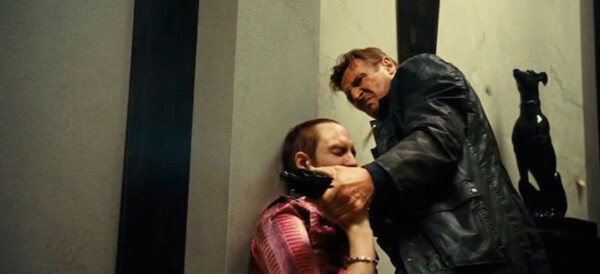
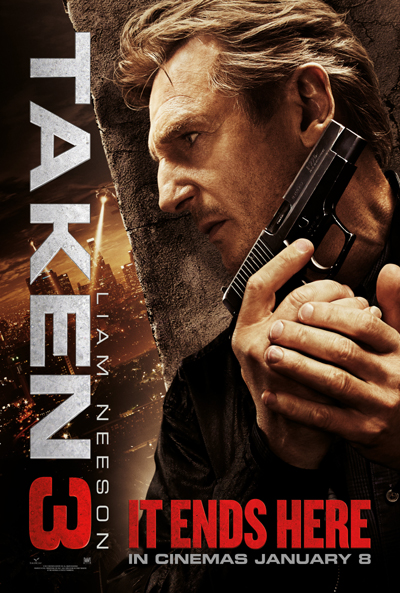
Image courtesyof 20th Century Studios.
“Taken 3” Starring Liam Neeson, Forest Whitaker, and Maggie Grace. Directed by Olivier Megaton. 109 minutes. Rated PG-13
Del’s take
There were three of us and we wanted to see three different movies. The candidates were “Blackhat,” “The Imitation Game” and “Taken 3.” Guess which “mindless entertainment” prevailed?
Watching 63-year-old Liam Neeson beat up half of Albania isn’t mindless entertainment for this geezer, who remembers playing tennis from dawn to dusk, and could no sooner do that now than pass a high school algebra test. It’s validation that if I really, really wanted to do it, I could lose the gut, get back into shape, and menace the bad guys in ways that don’t involve flashing my AARP card in their faces.
That’s what I tell myself, anyway.
In “Taken 3” we return to the world of Bryan Mills, an ex-covert ops specialist who’s family has been favored by kidnappers. This time the action takes place in a version of Los Angeles that does not feature traffic-choked freeways and cynical journalists – clearly we’re talking science fiction. Mills is framed for a murder he didn’t commit and after beating up a sizeable contingent of cops he escapes to a bolthole where he’s able to refresh, replenish, and re-apply the Grecian Formula. Cars crash, fists fly and guns blaze. Somehow Neeson comes out of it with nary an adult diaper mussed.
The first act is excruciatingly slow, prompting Mladen to ask if “Taken 3” was a documentary. No, Mladen. It’s a frightening representation of most people’s lives. But I agree to an extent – I’m tired of the soap opera theatrics between Mills, his ex-wife and her current husband. And I hope the daughter, now enrolled in college, is majoring in something other than Being a Victim because her sullen helplessness grates on my nerves.
Acts two and three are where “Taken” earns its stripes as “mindless entertainment.” The action is almost non-stop as Neeson gallomps (not “gallop” … he’s too old for that these days) from one cliffhanger to the next with Forest Whitaker in tepid pursuit. The Big Reveal is telegraphed fairly early in the story, and one plot element fails spectacularly – I won’t say what except it involves the functionality of a certain device.
Neeson still rocks as Bryan Mills but I’d say “Taken 3” is the weakest of the three. Everyone and everything is limned in a kind of drabness that suggests the vein has been mined, and it’s time to move on.
If the menu calls for mindless entertainment, “Taken 3” might by worth a taste. Be sure to ask for the senior citizen discount.
Mladen’s take
Del has done you a disservice. “Taken 3” isn’t mindless entertainment. For me it was very thought-provoking as I developed the list to mock the movie.
“Taken 3” is partly a sensitive chick flick-like film. The director gives you lots of tight face shots that amply demonstrate it’s better to be young than old. Less wrinkles. Better teeth. Sparklier eyes. Megaton infects a large chunk of the film with ordinary life dialogue to try to force viewers into liking the characters. What? Was he thinking the Academy would give him the nod with a best director nomination for an Oscar? No. Megaton has created a megaflop.
The movie also goes to great lengths to explain itself. I counted at least three plot summaries or, maybe more accurately, plot-gap fillers. And, unfortunately, the ending suggests that “Taken 4” is on the way.
Other weaknesses:
- A decent supporting villain … until the end. First, the Russian thug, a former Soviet Union special operations soldier, is unable to hit Mills at close range with a submachine gun. When the Russian finally drops Mills – apparently the old man just got tired running from bullets that always missed – what happens? The Russian gets talkie instead of shooting the American several times in the head and chest. Mills recovers, takes two well-placed shots with a pistol, etc.
- Cliches. There are plenty of stupid cops. There’s the now obligatory scene in Hollywood’s films of a woman sitting on a toilet with her panties pulled to her knees. And, of course, there’s a water-boarding torture scene. Enhanced Interrogation Techniques have become fashionable as a way to give movies that touch of reality. Nice. All that was needed in the background was a picture of Dick Cheney hanging on the wall.
- The car chase scenes were Transformer-like. You know, the machines switch between robot and vehicle in a blur of detail-less, almost nauseating sequences. The same trick of cinematography applies to “Taken 3” road action, flashes of cars crashing, a truck jack-knifing, pieces flying, all without connection to spacetime or gravity.
“Taken 3” could have risen to semi-good, but no higher, with a simple touch.
The movie should’ve been made with an R rating in mind. There were plenty of opportunities for hard-core cussing and graphic violence. Instead, the viewer gets a slit throat that leaves a couple of drops on the floor and a blouse its original color. When a hit man blows out his brains through the mouth rather than fess up about his boss, there’s no gray and white matter splatter or remains on the glass of the convenience store refrigerator behind him.
The line at the theater box office was long. Kari, I saw “Taken 3” with her and Del, got to the theater first and bought our tickets. Because she, colluding with Del, forced me to strike 109 minutes from my life to watch this silly movie I have no intention of paying her back.
Mladen Rudman is a former journalist and technical editor. Del Stone Jr. is a journalist and author.
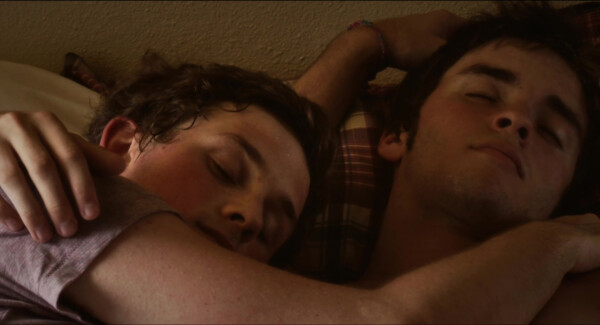
Image courtesy of Queer Culture Cinema.
—
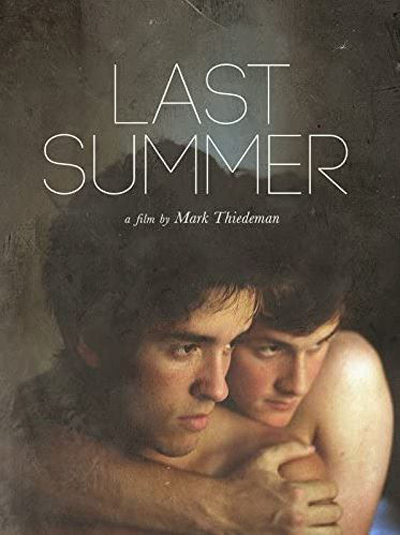
“Last Summer” Starring Samuel Pettit, Sean Rose. Directed by Mark Thiedeman. 1 hour, 13 minutes. Rated TV-13. Streaming on Vudu.
Del’s take
Director Mark Thiedeman’s tone poem about two high school lovers, bound together over the course of their short timeline and doomed to inevitable separation, wanders somewhere between touching and maudlin before seeping through its layers of its meaning to reach a final, love-torn conclusion.
Told through a series of loosely connected and artistically crafted images, “Last Summer” articulates the final, dying weeks of the relationship between Luke (Samuel Pettit), and Jonah (Sean Rose), who are nearing the end of their high school days and headed on different trajectories in life. Luke is a “slow learner” who struggles with schoolwork and will never leave their rural Arkansas town, while Jonah is a “gifted” student who fails at prep sports but succeeds at everything else.
The two have been together since they were 4 years old, Luke’s mother having passed when he was a child and Jonah having been adopted by his parents – both sets of circumstances functioning as archetypes for the boys themselves, Luke as the hometown boy struggling with limitations of family and book smarts, and Jonah as the outsider who was always destined to become an outsider again. Now, the two are going separate ways and nobody knows if their love will survive.
The movie is not about homosexuality; in fact, both boys’ families and the community at large seem to accept and encourage their relationship with no judgment passed. The larger imperative is the tragedy of departure and love lost. Jonah tells Luke to ask him not to leave but Luke, who understands Jonah could never be satisfied with the limitations of small town life, refuses to make that gesture, and Jonah refuses to remain despite his obvious affection for Luke.
The pacing of “Last Summer” is languid to the point of glacial, which must be the point. But it all comes across as at least a little pretentious, with Thiedeman’s lingering close-ups of plaster patterns, or a spider web decorated with dew, framed against Schubert piano solos. That, and the lack of narrative, or even dialogue, make for a solemn, sleepy communiqué about lives diverging and the cooling of ardor that had once been so strong.
Thiedeman’s vision is stylish and poetic, but viewers hoping for an actual story will not find that here. “Last Summer” is more about a mood, and in this case, the mood is sadness.
I grade this movie a B-.
Del Stone Jr. is a former journalist and author.

Image courtesy of Sony Pictures.
—
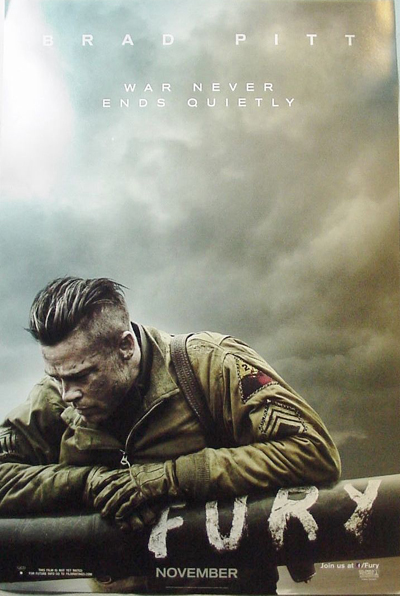
“Fury” Starring Brad Pitt, Shia LaBeouf, Logan Lerman, Michael Pena, and Jon Bernthal. Directed by David Ayer. 134 minutes. Rated R.
Mladen’s take
Remember Donald Rumsfeld, the Bush administration’s principal civilian architect of the disastrous and destabilizing ongoing war in Iraq? He once sniped, if my tired old memory serves, something like, “You don’t go to war with the Army you want. You go to war with the Army you have.” Well, maybe America didn’t go to World War II with the tanks it wanted, but the ones it had – Shermans, as the opening narrative of the film “Fury” suggests.
Fury is the name of the Sherman crewed by the movie’s imperfect protagonists. The setting is April 1945 in Germany, where an American tank platoon is fighting what remains of the Wehrmacht and SS.
“Fury” stars Brad Pitt as war weary tank commander “Wardaddy,” Shia LaBeouf as superstitious gunner “Bible,” Michael Pena as unflappable driver “Gordo,” Jon Bernthal as savage mechanic and main gun loader “Coon-ass,” and Logan Lerman as idealistic and baby-faced assistant driver and hull machinegun gunner “Machine.” Fury, by the way, could just as easily refer to something burning inside each of the tank’s crewmen. Aside from newcomer Machine, they had been fighting together in North Africa and then Europe since 1942.
I have a hard time rating the film. It’s good, but something is missing.
An obvious plus is the movie’s grit, gore, and cussing. Another big plus is that it portrays warfare from a tank crew’s perspective. We’ve seen Hollywood depict WWII from the viewpoint of infantrymen, tin can sailors, and airmen, but not tankers. Also noteworthy are the visual effects. To me, it always looked like real Shermans in column churning muddy dirt roads or squashing hedges or trying to avoid the 88 mm gun of a Tiger tank during a point-blank showdown in a clearing.
LaBeouf as “Bible” was very good as the tank’s scripture quoting dead-eye gunner. For me, no war movie is complete without a character who sees God’s grace amid the carnage and upheaval of hellfire that is bullets, shells, bombs, and rockets. His faith was unshakeable as it tends to be, I imagine, among people desperately trying to make sense of whole-scale, legal murder and destruction of property known as war.
Bernthal as “Coon-ass” was sincerely unlikable. Uneducated and mean-spirited, Coon-ass was hardcore badass until an out-of-character lapse toward the end of the movie. But, he cared for his fellow tankers on the battlefield and that’s all that really mattered.
Pena as “Gordo” was pleasant but memorable for only one reason: He tells a weird story about slaughtering horses while Fury’s crew is occupying a German woman’s apartment. The woman is Romanian actress Anamaria Marinca, In the film, Marinca as “Irma” tries to protect her young, voluptuous cousin, “Emma,” portrayed by German actress Alicia von Rittberg, from the invading horde of GIs. (Check below for Del’s Take on the director’s take of Yankees during the late-war push into Germany. I didn’t realize it until Del and I had our usual movie post-mortem analysis session.)
Lerman as “Machine” did a decent job of losing his humanity as Fury pushed farther into Naziland. He went from avoiding killing to taking part with the best of them.
Let me start by noting Brad Pitt is one of my favorite actors. So, it’s tough to rap his knuckles, but, if “Fury” misses its target even a little, it’s because of him.
Pitt’s effort to portray “Wardaddy,” the Sherman’s staff sergeant commander as a man torn by, or wallowing in, what he has seen and done fails subtly. Wardaddy offers neither good-natured evil like, say, SS Col. Hans Landa in Quentin Tarantino’s and Eli Roth’s “Inglourious Basterds” nor bad-natured goodness like, I don’t know, Schwarzenegger’s T-101 in “Terminator 3: Rise of the Machines.” Wardaddy is arbitrarily menacing, which may leave some filmgoers unsatisfied.
“Fury” feels authentic. The acting is proficient, the story plausible. “Fury” is a good movie and should be seen on the big screen. But, I felt little sympathy for the main characters. To me, the film’s most moving moment was the tank crew’s encounter with Irma and Emma, two souls protecting each other amid a world at war until their building is blown apart by their counter-attacking, fellow countrymen.
Del’s take
“Fury” follows a long tradition of war movies with a conscience, starting with “All Quiet on the Western Front” and following more recently with “Platoon,” “Full Metal Jacket” and “Saving Private Ryan.” It avoids Oliver Stone and Stanley Kubrick’s politics and pretty much adheres to the theme “War is hell – for most folks.”
I say pretty much.
I think that’s where Mladen is hung up. The movie wanders from its thematic impetus, pulling in tendrils of meaning from a variety of predecessors, from Stone and Kubrick to Kathryn Bigelow’s “The Hurt Locker,” so when it’s over you’re left wondering what to think.
It’s a nice bit of storytelling, though. I enjoyed the unique perspective – a tank crew. Don’t think I’ve ever seen that in a war movie. Nor do I remember a war movie from that time period, the waning days of World War II. By April 1945 the war in Europe was pretty much over and everybody knew it, even the Brown Shirts and lizardly SS henchmen who went scuttling to their burrows in South America.
The characters were nicely flawed but a tad overdrawn for my tastes. Each seemed almost a caricature of his “type,” the possible exception being Shia LaBeouf, who impressed me with his pathos. He pulled off a neat trick – reconciling his religious beliefs with the necessities of his job. And when somebody he loved was killed he showed convincing grief. I felt for him.
Jon Bernthal played virtually the same character he portrayed on “The Walking Dead.” If Bernthal isn’t careful, he’ll be typecast as a redneck. Logan Lerman as the innocent clerk dragooned to shoot Germans and drive the tank if necessary is nicely callow if just a little too good to be true. His conversion to killing machine struck me as slightly suspect – was he trying to save his hide or fit in with his tank crew? Doesn’t matter; the result is the same.
Brad Pitt? What can I say about his role? On the one hand he was the rock solid killer who loved being in his tank, calling it “the best job I’ve ever had” with barely an aftertaste of sarcasm. He was the most amoral of the bunch. But at the same time he showed odd lapses into humanity that didn’t seem to fit his “Wardaddy” persona. I’m not sure if he were a hero, a psycho who loved war, or just didn’t care whether he lived or died.
Nor am I sure of the movie’s politics, if it had any. All the immoral acts we saw on the screen were committed by Americans. Ordinary German soldiers and civilians were portrayed as victims; only the SS committed similar acts of inhumanity, and they were presented as after the fact. I don’t know if that was intentional or merely a figment of my imagination.
The movie is structured similarly to “Saving Private Ryan” and there are similarities in characters, although “Ryan” masterfully tones down their flaws.
In the end, I’d give “Fury” a solid B. I enjoyed the action sequences and special effects, and the attempt to tell more than just a story. I was put off by some of the character extremes and the apparent dilution of thematic consistency.
Mladen Rudman is a former journalist and technical writer. Del Stone Jr. is a former journalist and author.

Image courtesy of Roadshow Films.
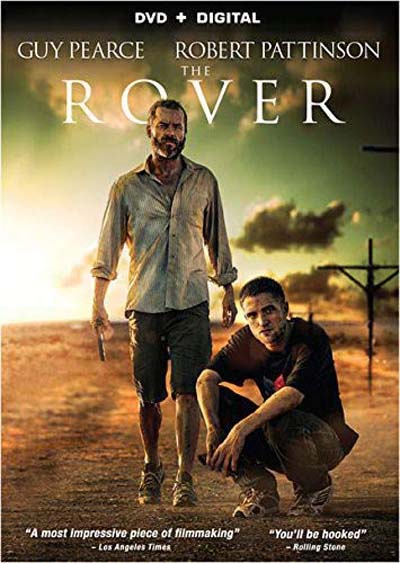
“The Rover” Starring Guy Pearce as Eric, Robert Pattinson as Rey, Scoot McNairy as Henry, and others. Directed by David Michod. 1 hour, 43 minutes. Rated R. Streaming on most major platforms except Netflix.
Plot summary: It’s the end of the world and Eric’s (Guy Pearce) car has been stolen. He wants it back and sets off to find the thieves. Along the way he encounters the brother of one of the thieves, Rey (Robert Pattinson), who says he knows where his brother Henry (Scott McNairy) is holed up. The two embark on an unlikely adventure across the post-apocalyptic Australian Outback, one in search of justice, the other in search of company.
Spoilers quotient: Low
Del’s grade: B
Mladen’s grade: A-
Del’s take
“The Rover” takes place in Australia, “10 years after the collapse.” I read that and thought, “Hot diggity, a new Mad Max movie.”
Alas, “The Rover” is no Mad Max. It’s one of those “long-stare” movies – you know, the kind where the characters perpetually stare into the distance, at times squinting, like me trying to read the fine print in my homeowner’s insurance policy. Those long stares should be accompanied by something Nietzschean – an abyss, a monster, just some expression of Teutonic fatalism. Alas, there is nothing, which means things have really gone downhill.
What we do get is blood, violence, and cynicism, which is not to say “The Rover” is a bad movie. For what it is, it’s pretty good. But if I want to give up on humanity I’ll watch the 6 o’clock news.
And that’s the thematic imperative of “The Rover” – people are scumbags and the world is for shit. The viewpoint character, Eric, sees people in one of two ways – expendable impediments, or means to an end.
That is until he meets Rey, brother of one of the trio who stole his car. Rey is simple-minded and as such, he functions as an archetype for mankind in its undiluted state, innocent and corruptible, the perfect Petri dish for Eric’s contagious cynicism. And that’s what Eric sets out to do – make Rey as hardhearted as he is. He calls it “learning to fight,” but it’s nothing more than learning not to give a shit about anyone but yourself.
It’s at this point we see a chink in Eric’s armor. As he watches Rey descend into scumbaggery he seems to regret what he’s done, a theme later reinforced by Henry, Rey’s brother, who screams at Eric, “What did you do to him?”
In the final scene we learn why Eric was hellbent on finding his car, offering yet another peek at his shredded humanity while simultaneously illustrating his decline into spiritual suicide. I was hoping for a gesture of redemption and I guess it could be seen that way. More likely it was a final middle finger to the human race.
Framed against the dusty wastes of the Australian Outback, “The Rover” delivers a more depressing statement about the nature of man than many other post-apocalyptic tomes. Everything in its universe is violent, bloody and cynical – in other words, what America will be when the Republicans get through with it.
“The Rover” was well made but it’s depressing as hell. Like I said, if I want a dose of bleakness I’ll watch the 6 o’clock news.
Mladen’s take
This is a chicken-or-egg question. Did the first John Wick movie release before “The Rover” or after? I ask because both films are 2014 cinema and both revolve around the plot point of a man, his car, and a dog, albeit under different conditions. For a moment, I wondered if “The Rover” was a riff on “John Wick” but I dismissed the idea for a couple of reasons. This allowed me to dwell on the austere beauty and simplicity of “The Rover.”
I empathize with the notion that a man’s car is his castle. Where Wick wanted his ’69 Ford Mustang returned, our “The Rover” anti-hero Eric wanted his stolen Holden Commodore back. The Commodore is a sleeper, clean ovoid lines with only its quad exhaust suggesting there are serious newtons – using horsepower to measure engine output is primitive – under the hood.
As Eric roves the Australian outback searching for his Commodore and the contents of its trunk, he finds Rey, the brother of one of the thugs who stole the Holden. Their unlikely partnership serves as the backbone of the movie, which unfolds per my motto in life, “Steady as she goes until you have to pull the trigger.”
Del complains that “The Rover” is a long-stare movie. Sure, in some instances. But you must always keep in mind that it’s staring straight at mankind’s future. And, it’s clear Del wasn’t paying attention when he wiggled his arthritic index finger back and forth at those moments in the movie when very little, if anything, was happening. The disquieting quiet in “The Rover” is backed by a terrific score. When Eric’s broken and nearly remorseless heart allows stoic calm, the score provides the heat.
The acting in “The Rover” is very good even when the script falters here and there. Pattinson as Rey is perfect. Del described Rey as simple-minded and the film’s Eric as a half-wit. Not the case. As it turned out, Rey had a hard time making decisions but, when he finally decided on a course of action, it was executed very effectively. Rey sure as hell had a keen instinct for survival.
“The Rover” is bleak. It is punctuated by violence. The way Eric concluded his first business-like transaction surprised the hell out of me. But, the movie’s atmosphere is plausible. Though the Collapse had occurred, some level of social organization was still present. The norm that killing people was bad still had some sway. The Australian government was trying to enforce laws. Cargo trains still ran. Food, water, and gas were available for the properly denominated payment.
I give “The Rover” an A-. There are a couple of notable bits of dialogue. The movie isn’t too long and, as I already mentioned, the acting is very good and the score top notch. The high rating, a portion of it anyway, might be an artifact of the trauma Del dropped on my head with the last two movies he had me watch. Compared to “Leave the World Behind” and “Saltburn,” the version of dystopia portrayed in “The Rover” seemed uplifting.
Mladen Rudman is a former journalist and technical writer. Del Stone Jr. is a former journalist and writer.
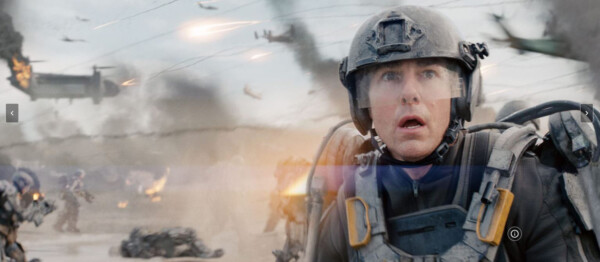
Image courtesy of Warner Brothers.
—
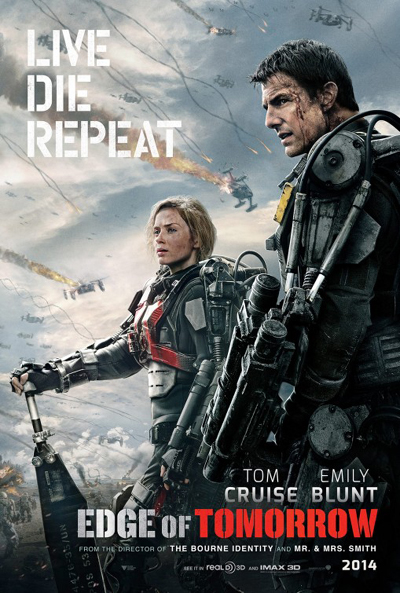
“Edge of Tomorrow” Starring Tom Cruise, Emily Blunt, Bill Paxton. Directed by Doug Liman. 113 minutes. Rated PG-13.
Del’s take
Didn’t Mladen, at some point during one of his hyperbolic rants, swear he’d never see another PG-13-rated movie? Didn’t he say they were all crap?
Well, guess what?
He broke his vow and attended “Edge of Tomorrow,” the latest Tom Cruise sci-fi vehicle, and after the movie was over you should have heard him, squealing like a little girl who’d just been given a peck on the cheek by Justin Bieber. He not only saw another PG-13-rated movie but he loved it.
Mladen, you phony.
His enthusiasm, however, is well-deserved. “Edge of Tomorrow” is a terrific summer movie, carrying the right balance of humor, tension, and spectacle. Your ticket-buying dollars will not have been wasted on this one.
In “Edge of Tomorrow,” an alien race we call “Mimics” has invaded the earth and is swallowing up Europe. Unless they’re stopped, mankind faces the same fate he inflicts on so many animal species of this planet. Cruise’s character, Major William Cage, is sent to the fight despite his credentials as a public information officer for the military. During the battle he kills an “alpha,” a particular kind of alien that, in dying, bestows him with the ability to restart the day each time he dies. (Believe me, there are no groundhogs in this movie, and if there were, they’d all be exterminated.) Through repeating his experiences he’s able to learn and survive a little longer, until he meets up with Sgt. Rita Vrataski (Emily Blunt), who underwent the same experience and learned there’s a very bad alien pulling all the strings. Their mission, which they choose to accept, is to exterminate that alien.
This movie presents so many pluses it’s hard to list them all. The writing is excellent. The dialogue is snappy, at times hilarious, at other times deadly earnest. Pacing, internal logic, respites from tension – they’re all handled with a canniness that speaks to the skills of the writers and the director.
Acting is top notch. Tom Cruise is a sympathetic and realistic character in the bones of the unwilling and frightened Major Cage, and he grows throughout the movie. Emily Blunt is a tough badass who has her vulnerabilities – and might I add it’s a pleasure to see a strong woman in a movie again – and Bill Paxton is funnier than his role in “Aliens.”
Speaking of which, the aliens in “Edge of Tomorrow” are truly alien. I take my hat off to the person who designed them. They look like nothing you’ve seen.
“Edge of Tomorrow” is not “deep,” meaning it won’t be in line for a best picture award. But it’s nice to see Cruise in a winner. It’s nice to see a movie that isn’t based on a sequel or a prequel or a remake of a remake. It’s nice to see a well-written, smart, funny and exciting film again. I was beginning to wonder if I ever would.
I almost clapped at the end of “Edge of Tomorrow,” and if a movie review can make a sound, that’s likely what you hear. Go see the movie. I’d rate it a solid A.
Mladen’s take
It would be easy to dismiss “Edge of Tomorrow” as a trite film because the trailers make it look and sound like “Ground Hog Day” meets “Halo.” But, that would be an error.
Despite its flimsy PG-13 rating, “E of T” is very good. The script and acting – Tom Cruise as Cage and Emily Blunt as Vrataski in the lead roles and Bill Paxton supporting as Farrell – were top notch. Plus, computer-generated graphics were used to enhance the plot, rather than conceal poor writing, silly coincidences that keep a weak story flowing, and crappy, underdeveloped characters typical of summer blockbusters.
Del summed the movie nicely, so I won’t bother. “E of T” is a film worthy of the big screen and big ticket prices moviegoers have to endure these days.
“E of T” is a sci-fi adventure built around its stars. Don’t get me wrong, there’s plenty of gun and grenade play and lots of CV-22-like machines blown out of the sky, but it’s the movie’s characters that keep your attention.
Cage transitions nicely from a selfish and naïve military public affairs propagandist at the beginning of the film to a man clearly thinking about someone other than himself by the end. He dies many times, often in funny ways.
Vrataski is tough from the get-go and the brains behind the operation to whack the Omega, a time-warping brain, that controls the Mimics, hyper-mobile alien troops that have conquered continental Europe.
“Edge of Tomorrow” isn’t perfect, but could have been – yeah, Del, here it comes – if the studio dedicated it to entertainment for adults by going R. Yes, the producers would have made less money, but, in exchange for less change, “E of T” could have gone down in moviedom sci-fi history as masterful. Was “Alien” rated PG(-13)? Was “The Matrix” rated PG(-13)? Was “District 9” rated PG-13? No, no, and no. More realistic battle scenes would have helped “E of T.” Vivid blood spray, graphic skin, muscle, and organ disintegrations after impacts by projectiles or crashes, full-bore cussing, and reproductive urge tension between handsome Cage and beautiful Vrataski would have burnished the movie’s credentials. Instead, we get sterilized deaths and constrained language even when Mimics are running amok and slicing through exoskeleton-equipped human soldiers.
Lukewarm rant aside, I would see “Edge of Tomorrow” again in the theater if I could afford it. And, “E of T” will become part of my Blu-Ray collection when it’s released for home viewing.
Though it troubles me to no end, I completely agree with Del on this one. “Edge of Tomorrow” is a solid A.
Mladen Rudman is a former journalist and technical editor. Del Stone Jr. is a former journalist and author.

Image courtesy of Warner Brothers.
“Godzilla” Starring Aaron Taylor Johnson, Elizabeth Olsen, Brian Cranston. Directed by Gareth Edwards. 123 minutes. Rated PG-13.
Mladen’s take:
The obvious first. The new Godzilla film stinks. Don’t let Del’s opinion fool you. He doesn’t know Godzilla from Godthab … the capital of Greenland.
Discussing the movie’s plot and acting is pointless because its star is nothing more than Godzilla-like. For example, I’m Brad Pitt-like because I’m an upright walking biped.
So, let’s talk monster morphology and physiology from a purist’s perspective.
I’ll use Toho Studio’s last major Godzilla type, the one that debuted in the film “Godzilla 2000.” It’s labeled AG for “Authentic Godzilla.” The Godzilla-like animal in the new film is “Poser.”
Godzilla from afar.
• AG: An upright walking monster with distinct body parts, such as a neck, prominent spine plates mimicking curved blades, and contoured limbs. The tail is longer than AG is tall.
• Poser: A hunched garden slug-like silhouette with a small head attached to an anorexic body that terminates in legs with, get this, cankles. Its back plates are stunted and the tail short, almost stubby.
Godzilla up close.
• AG: Sleek, cat-like head large, expressive eyes looking forward and a mouth featuring large, expressive canines.
• Poser: Small head with nearly colorless beads for eyes tucked into a puffy face, as though the animal was dehydrated from an all-night drinking party. Put together, the face is a blur with its major components – snout, forehead, and jaw – blending into each other almost indistinguishably.
Godzilla’s fire breath.
• AG: A searing plasma, white-amber in color and liquid in texture, projected from the monster’s mouth. It’s launched with a head movement. AG’s head rotates sideways 30, 40 degrees and then juts forward. The monster sometimes takes a step toward its target, maybe to brace against the death ray’s recoil. When the fire breath hits, it explodes, engulfing the target. It is preceded by the spine plates glowing the same vivid color. They heat the air around them, causing convection currents.
• Poser: A feeble blue that looks like its origin is a LED light someone stuck into Poser’s throat. Come on, the death ray is supposed to be generated by nuclear fission, not your local electric company. The spines glow the same soothing blue. There’s nothing intimidating about Poser’s fire breath attack and it barely damages the critter it’s fighting.
A caveat before I address Godzilla’s signature physiological trait, the one that stays the same no matter the monster’s Toho iterations. It could have rescued the new Godzilla film, though the creature’s morphology was sullied.
I appreciate the director taking Godzilla seriously. The monster isn’t mocked as it was in the other Hollywood re-make of Godzilla starring Matthew Broderick. And, there a couple of deferential nods to the Godzilla franchise’s early years.
That three, let alone one, giant monster, can exist today is treated plausibly and sincerely. The acting wasn’t bad and the plot good.
It’s just tough for me to accept that there’s not enough imagination out there in moviemaking land despite the graphics computing power available to modern-day producers and directors to render a classic Godzilla as a force of nature by making it look, well, natural and fearsome and indestructible.
Okay, now the one indelible physiological must for all Godzillas: its roar-screech.
• AG: A growling rumble rapidly ascending in pitch to a banshee wail that then trails off. I don’t know, it’s the sound of a titanium spike scraping across a steel ingot with the frequency slowed and amplified. Or, the roar-screech mimics an elephant’s trumpet inside an echo chamber that amplifies lower tones, while distorting all of the sound.
• Poser: A grizzly bear with laryngitis.
I give the new Godzilla an A for effort and C+ for execution.
And, I’m still trying to figure out why Godzilla faints near the end of the movie. Was it tired from its battle against the other monsters, which resembled a cross between the Gyaos in Gamera movies and the alien invader in “Cloverfield.”
Or, was the director trying to build sympathy for the monster by making it look like it had died to save mankind?
If it was the latter, the director failed because he never developed Godzilla’s personality and, believe me when I say, Godzilla in past renditions had a lot of it.
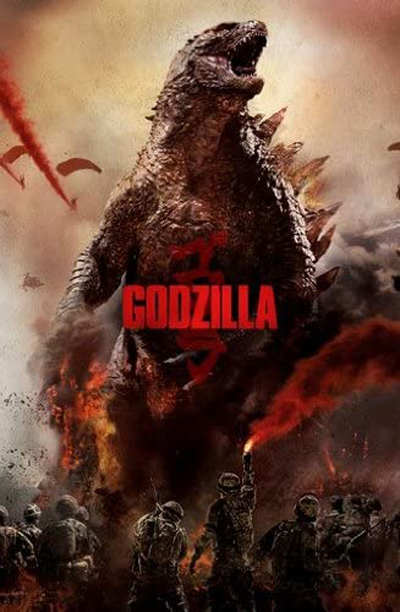
Del’s take:
I broke Mladen’s heart because I wouldn’t come to his house and listen to a proper Godzilla roar in Dolby SurroundSound.
Sorry, Mladen. Godzilla’s roar, or whether he was fat, or if his head was too small, weren’t on my list of priorities.
What I wanted from “Godzilla” is what I want from every movie – interesting characters who generate empathy, a decent plot, dialogue that works, and a set of rules consistent with the movie’s internal logic.
What I got was boring characters about whom I cared little, a bullet-riddled plot, flat-affect dialogue, and a set of rules that were indeed consistent with the movie’s absurd internal logic.
“Godzilla” opens with a cool segment of backstory: The Pacific nuclear “tests” of the 1940s and ’50s were attempts to kill the giant serpent. The movie then segues to a Fukishima-style disaster at a nuclear facility in Japan. Brian Cranston’s character is the director of the facility, and during the disaster his wife dies in a reactor breach. Jump to today – Cranston’s son, played by Aaron Taylor Johnson, is an explosive ordnance disposal technician who flies to Japan to bail his father out of jail. Seems daddy believes Japanese authorities are hiding something at the reactor disaster site and he’s right – a giant monster has been feeding on the radiation and springs into the world – make that “stomps” – just as Cranston and son arrive at the site.
What follows is a jaunt halfway across the world as the monster makes its way to Yucca Mountain, America’s nuclear waste disposal site (which, by the way, contains no nuclear waste, as its commission was halted by the Obama administration) to meet up with a second MUTO (massive unidentified terrestrial organism) and hatch a batch of monster babies (totally overlooking the two Diablo Canyon nuclear facilities between Los Angeles and San Francisco).
Luckily for mankind, Godzilla is in pursuit as its place as the top alpha predator is threatened by the MUTOs (which bear more than a family resemblance to the monster in “Cloverfield”).
Cranston is able to imbue his role with emotion, but Johnson and Olsen spend most of the film gazing dumbly into the distance. They simply have nothing to say, and it was impossible for me to develop any affection for either. A Japanese scientist, played by Ken Watanabe, is kept by the military as an adviser, but spends most of his time mouthing gassy admonitions about the perils of pissing off Mother Nature.
The characters are wasted.
Special effects are superb, though I grew tired of the gray and brown color palette. The score is at times shrieky, helping the action on the screen to lapse into farce. Edwards’ directorial style is interesting, though I’d say he relied to heavily on foreshadowing. After we’ve seen the monsters, there’s no point in showing us the aftermath of their rampages. Let’s see the buildings tumble!
To me, Godzilla is a metaphor for whatever issue rules the day – nuclear warfare, man tampering with nature, you name it.
But in “Godzilla,” the monster strikes me as a metaphor for the inability of modern storytellers to tell a decent tale.
Overall, I’d rate it a C+.
Mladen Rudman is a former journalist and technical editor. Del Stone Jr. is a journalist and author.
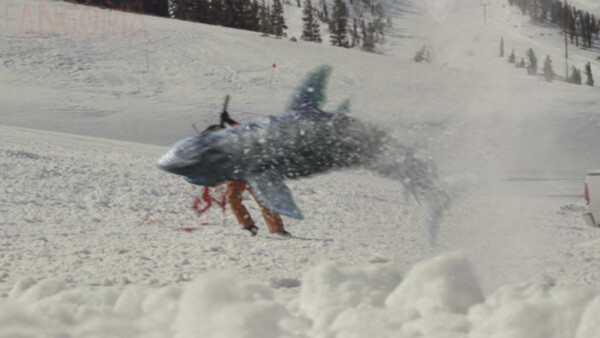
Image courtesy of Sony Pictures.
“Avalanche Sharks” Starring Alexander Mendeluk, Kate Nauta, Benjamin Easterday, Eric Scott Woods, and others. Directed (if you can call it that) by Scott Wheeler. Amazon Prime. 82 minutes. Not Rated
Mladen’s take
This is an embarrassing confession. Maybe the error was caused by my growing age precipitating a memory malfunction. It certainly wasn’t caused by me worrying about wasting Del’s time. He needs some sort of life that doesn’t include moping. I asked Del to watch the wrong film. I recommended that we review “Avalanche Sharks,” a movie that was far worse than I recalled – see, there goes the bad memory thing again – but I intended for us to watch “Ice Spiders,” which is a pretty good film. Why the confusion? Well, both take place at ski resorts and both involve unnatural animals. The difference is that “Ice Spiders” has a dose of decent acting lead by Patrick Muldoon. You may remember him as the pilot in “Starship Troopers” who got his brain sucked graphically by a very large, maggot-y bug through its hinged, two-piece, straw-like proboscis.
“Avalanche Sharks” is a nearly perfectly bad movie. I give it a generous D-. Paradoxically, that grade makes it worth watching. It’s the script and the acting combined that render the film so damn crappy and entertaining. The crappiness generated a giggle or two as the movie shifted from portraying one dumb-ass victim to another. In between, I was bewildered by the crappy script and the crappy acting. Am I repeating myself? Have I already said that the script and acting were crappy? Damn memory.
None of the characters in “Avalanche Sharks” were likeable, so who cared what happened to them or their dogs. The good guy was a dork. I didn’t care that he was a Marine on R&R after fighting somewhere. I assumed he had been to Afghanistan or Iraq, which was the movie’s vague attempt to add a sense of the real and create empathy for our hero. The bad guy and his Olympics skiing bronze medal were annoying. The women in the film were nicely configured, but terribly uninteresting as humans. The kook who tells the spring breakers at the ski resort that they’ll all die was among the worst actors I’ve ever seen. There was the nerd always trying to pick up babes, but, to be honest, I can’t remember why he had to be in the movie. Wait, it just came back. About halfway through “Avalanche Sharks” he explained to a gum-chewing snow bunny in tight leggings what they were and who cast the spell that created them. The shark maker was a shaman called Snookum, Skoonum, Spoonim, Spatula, something like that. His sharks existed to avenge the deaths of a native people extinguished by greedy settlers and protect their once-home, the mountain where the ski resort was built.
Snow sharks defending sacred ground is a neat idea for a movie. Had “Avalanche Sharks” been executed properly, like the movie “Big Ass Spider!” Del and I reviewed most recently, I’d be clamoring for a sequel. Instead, because I’m always searching for the slimmest glimmer of good in the very bad such as the Donald Moron Trump poser presidency and its straight-up lying about the risks of the COVID-19 pandemic, I’m forced to conclude the unearthly man-eating spirits in “Avalanche Sharks” were the movie’s only redeeming quality. Some effort and a little bit of computing power was spent to present the light blue predators. Their crystalline and armored dorsal fins looked pretty cool slicing through snow. The fins left narrow ruts. Nice touch. When the sharks lunged from the snow to snack on humans, the special effects, including whole shark bodies and blood splatter, were good. The practical physical effects were misses much more often than hits. Yes, the legs severed mid-chin with boots still on or the disembowelment looked not bad. “Avalanche Sharks” failed miserably when it tried to make snow look blood stained, however. That mattered because there was a lot of snow turning red in the movie. The color of the blood was neither deep red to suggest low oxygenation nor bright red to illustrate oxygen saturation. Rather, it was a semi-fluorescent-pinky-not-quite-chartreuse that looked like the color a kindergartner might choose to draw a tomato.
Look, the bars are closed or should be. Eating at a restaurant is absurd. The shopping mall was long ago buried by Amazon. It isn’t a good idea to visit your grandma or work out at the gym. You’ve already re-watched the Brady Bunch reunion 13 times. Like Del, see “Avalanche Sharks” because you have nothing better to do.

Del’s take
If I croak tomorrow I won’t finish “Away” Season 1, and it’ll be Mladen’s fault for making me watch the dreadful “Avalanche Sharks.” I hope feeling guilty about that keeps him awake an extra hour tonight.
Did I say “Avalanche Sharks” was “dreadful”? I meant “awful” – not the towering awful of a “Plan 9 From Outer Space” or the hilarious awful of its obvious progenitor, “Sharknado,” but a tired, shopworn awful, apparently from people trying to pull off a low-fi cash grab, a Monday morning Yugo of movies.
The story goes like this: A group of spring breakers descends (ascends?) on a ski lodge for some mid-semester fun. Unfortunately for them – and the local sheriff who was hoping for a quiet season – some unknown entity is devouring the tourists. There’s a crazy old coot from the deep forest who warns the sheriff, ski lodge owner and town mayor that they have returned, but the mayor is having none of this talk about theys, thems or any other sinister-sounding pronoun, to the agreement and delight of the ski lodge owner. The sheriff and brother of one of the disappeared set out to solve the riddle of the missing fratboys with their fatty liver disease, and that’s when the fake bloody snow flies.
Where to begin enumerating “Avalanche Sharks’ ” avalanche of sin?
The script appears to have been written by a study hall committee of horny teenage middle school boys. Acting was on par with the displays at Madame Tussauds. Every character in the movie is so unlikeable in some way you hope they end up being chomped in half by the “sharks.” If you took the essential parts of “Jaws” and “Animal House,” stapled them together and made them awful, you’d have the plot.
I mean, throughout the 82 minutes required to endure this crap, I felt like I was watching a version of “Alien” edited for C-Span.
The charm, if that is the right word, of these crappy D-level movies is that their makers usually know they are crappy D-level movies and play off the crappiness for laughs. “Sharknado” is a prime example. But “Avalanche Shark” neither acknowledges its crap quotient nor tries to capitalize on it. It is a long, dreary slide down the bunny run of cinematic stupidness that would not even pass muster on “Mystery Science Theater 3000.”
Mladen gave “Avalanche Sharks” a D- and that sounds about right for me. I am saving my F’s for movies that infuriate me with their incompetence and this one didn’t do that. I just didn’t care enough to hate it.
Mladen Rudman is a former journalist and technical writer. Del Stone Jr. is a former journalist and author.

Image courtesy of Epic Pictures Group.
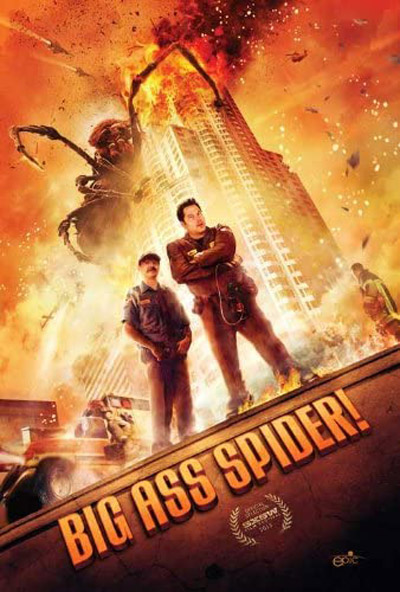
“Big Ass Spider” Starring Greg Grunberg, Clare Kramer, Lombardo Boyar, Lin Shaye and Ruben Pla. Directed by Mike Mendez. 80 minutes. Rated PG-13. Amazon Prime.
Del’s take
I’m shocked – SHOCKED, I tell you – that Mladen consented to review a movie rated PG-13.
Wasn’t it on these very pages he vowed to never again sully his pristine sensory apparati with a lowly PG-13-rated film? Wasn’t he worried that such unwashed entertainment might detract from his snarly joie de vie?
Yet here he is, slumming with “Big Ass Spider,” a PG-13-rated farce that even my cynical ass got a kick out of. I guess Mladen’s moratorium on almost-family-friendly films doesn’t apply to comedies.
Although I wouldn’t call “Big Ass Spider” a comedy per se. It’s more of a lighthearted romp … with a giant, man-eating spider that skewers half of Los Angeles, a military commander who wants to blow up the other half of Los Angeles, and a lowly exterminator who, despite his modest lineage and lack of leading man pecs, sets out to overcome this eight-legged nonsense, winning the girl and the day.
The gossamer-thin plot goes like this: A spider escapes from an experimental military facility and starts eating its way across LA. The more it eats, the bigger it gets. It takes up residence in a hospital – a veritable buffet for a large carnivore – which draws the attention of nice-guy exterminator Alex Mathis (Greg Grunberg), who is a patient at the hospital after being bitten by – can you guess – a spider. The hospital agrees to write off his bill if Alex will write off whatever critter just sank its chompers into the staff mortician. Meanwhile, the military swoops in and declares martial law, allowing Alex to fall for a cute L.T., Karly Brant (Clare Kramer). Alex is determined to win Karly’s heart, despite her withering disdain for his, and sets off with sidekick Jose Ramos (Lombardo Boyar), a hospital security guard, to kill the now house-sized spider, save Los Angeles and make an impression on Karly.
“Big Ass Spider” is like “Godzilla” on helium. It’s all silly fun – except for the thousands of people who die – which lands the movie in the not heavily populated science fiction-horror-comedy category. You’ll find yourself giggling because the movie makes no attempt to take itself seriously, except for the pretty good special effects, and you’ll be rooting for Alex because he strikes you as the kind of guy who might park his battered van in your driveway to clean out the trap in your kitchen drain. He’s just a regular Joe, overweight, overworked and underpaid. Boyar is pretty funny as Ramos, the timid security guard who grows a pair of cojones over the course of the movie, though I’m surprised the Thought Police haven’t protested his caricature of Hispanic males. The other performances made less of an impression on me. They fit the standard models for their characters.
I had never heard of this movie until Mladen suggested it, and when I looked it up I also found several TV episodes of the same name. Don’t be confused – this is the 2013 movie by director Mike Mendez.
“Big Ass Spider” was favorably received by the public but of course, movie reviewers trashed it as schtick. I might have thought the same before I had that corncob removed from my ass. “Big Ass Spider” is not high art, not that high art is very entertaining. Like I said, it’s silly fun. I can think of far worse ways to spend 80 minutes of my life.
I give it a B.
Mladen’s take
Leave it to Del to try to upend my unfettered enthusiasm for a movie. Until I read his review, I had no idea “Big Ass Spider!” was PG-13. There’s at least one face melting and shots of faces that had already been melted. There’s blood splatter. But, there wasn’t big-ass swearing or, unfortunately, nudity. So, yeah, no R-rating.
Until Mr. Corncob Now Removed dropped the rating thing in my lap, my only beef with “Big Ass Spider!” was the spelling. Did the filmmakers want the movie’s title to be descriptive or reflect the fact the arachnid is a new species? The spider is large. It eventually grows a few building stories tall and wider than a boulevard. So, should the film title have included a hyphenated compound adjective, as in “Big-Ass,” to let the viewer know from the get-go that the movie is about a huge beast. If the goal was to simply name a specimen fresh to nature, “Big Ass Spider!” remains acceptable. I contend the movie title should’ve been hyphenated because the beast is a man-induced mutation, a combination of Martian DNA and a black widow-like (note the hyphen) spider native to Earth. “Big Ass” describes the spider, rendering the hyphen necessary. “Big Ass” isn’t the spider’s scientific name, which would have disallowed hyphenation.
“Big Ass Spider!”, hereafter referred to as “BAS!” to shield our moral readers from the cuss word “ass,” is a delightful farce that mocks sci-fi horror films by incorporating many of the tropes of the genre. Examples are:
- One person going after a creature he/she suspects to be dangerous by himself/herself, often in a dark, forbidding place where no one can here you scream
- A military officer saying, “God helps us now” or something akin to, “That’s my job”
- Radio communication failures
- Relationship banter amid a crisis between the likable but geeky, portly, and uncool-job wielding hero and an attractive gal at least initially uninterested in copulating with the good guy
- Coincidences such as protagonists continually bumping into each other through the movie or a solution to a problem materializing from thin, dry air
- Jump from your seat moments such as the creature moving as a blur in the foreground of a scene as the hero expresses fear and doubts about the wisdom of his/her choice to chase the animal
- Buxom females playing a sport that makes breasts bounce or gratuitous displays of cleavage via tight, low-cut T-shirts (more hyphens)
The advantage of a farce is that it can pull off the tropes by making them amusing. “BAS!” does that very well. The script is solid and the actors do the dialogue sincerely and mirthfully. They were enjoying themselves. The visual effects, both computer-generated and of material substance such as monster goo and webs, are surprisingly pleasing and when they’re not such as the “BAS!” fires, you don’t care because the film is a farce by design.
“BAS!” is not a B-movie, though it cost, I’m guessing, $8.37 to make. It’s significantly better than at least a couple of expensive A-movies and by those I mean Alien3, Prometheus, and Alien: Covenant. Sure, “BAS!” steals a little bit from the very good “Starship Troopers” and the excellent “Aliens,” but that’s the point. By mocking the good and the bad of sci-fi effectively, “BAS!” fulfills its purpose.
The movie also made the best of shooting in real-world locations that fit inside its, ah, limited budget. There was no travel to exotic locales to get the background of a lush tropical forest or towering mountains. When the action was outdoors, it was filmed amid the brownish hue of what I took to be Southern California. The spider’s raid on a park full of people was darned entertaining, including the child in jeopardy. I detest when movies put children in danger. With “BAS!” I was OK with it for some reason.
“BAS!” has a sparing run time of 80 minutes. In moviemaking these days that seems an unfathomably short duration. And, it’s also one of the reasons I give “Big Ass Spider!”, despite its misspelled title and PG-13 rating, an A. Everyone tied to making the film stayed true to its character, including length. One minute longer and the movie would’ve failed.
Mladen Rudman is a former journalist and technical writer. Del Stone Jr. is a former journalist and author.