Del and Mladen review ‘Space Truckers’
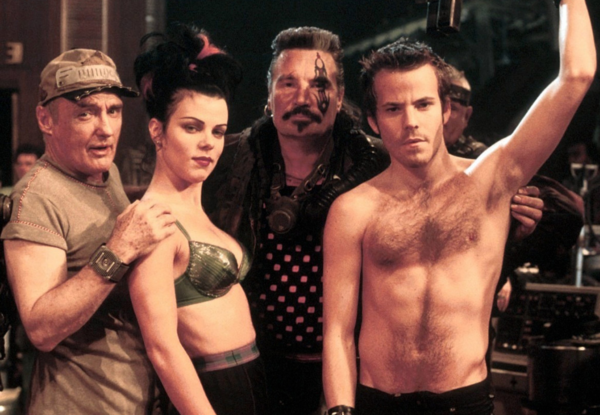
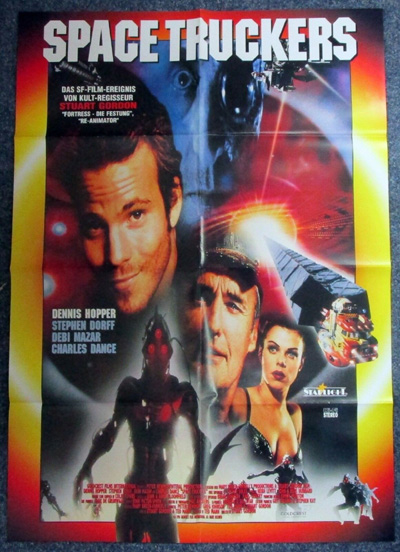
“Space Truckers” Starring Dennis Hopper, Debi Mazar, Stephen Dorff, Charles Dance, George Wendt and others. Directed by Stuart Gordon. 1 hour, 35 minutes. Rated PG-13. Amazon Prime.
Del’s take
“Space Truckers” is Mladen’s revenge for “A Recipe for Seduction.”
He’s been stewing for months about being forced to watch that dreck, and plotting ways to make me pay. Well, he came up with a doozy. “Space Truckers” has a cult following – of kooks with bad taste. Trust me, it’s boring schlock.
Director Stuart Gordon, who captained some pretty good movies like “Reanimator,” intended this to be a lowbrow sci-fi comedy. He succeeded with lowbrow but the comedy part fails, and it fails miserably. I can’t think of a single funny moment in this movie.
It features some real talent – Dennis Hopper, a young Stephen Dorff, Charles Dance and George Wendt – but the problem with “Space Truckers” is the script. It falls flat and I doubt defibrillator paddles could shock some life into this toe-tag of a screenplay.
The story goes like this: Hopper is the last of the independent “space truckers” driving goods and whatnot from one planet to the next. After a late delivery of square pigs and only partial payment, he takes on a sketchy consignment from a shady group headquartered at the Neptunian moon Triton for rapid delivery to Earth. As you might expect, “rapid delivery” becomes anything but after an encounter with space pirates, and then the load itself becomes problematic when it turns out to be a swarm of Terminator-like robots bent on killing all humans.
In theory this kind of movie should work. Ironically, a day or two after I finished “Space Truckers” another comedy – this one very funny – was playing on cable: “Airplane.” I was struck by the differences in the two movies – “Airplane” has a similarly thin plot but that’s OK – the movie is nothing but one rapid-fire joke delivery after another. In “Airplane” some jokes are visual, some physical, and some are embedded in dialogue. “Space Truckers” exhibited none of those qualities. It was an hour and a half of Dennis Hopper glaring and leering at the camera Quint-style with Debi Mazar almost flashing her boobies and Stephen Dorf showing off a not-bad stack of abs.
Comedy relies to a great extent on timing and “Space Truckers,” like its bumbling space truck-driving Hopper, misses delivery time and time again. He could never get a job with intergalactic Fed-Ex. Couple that with nonsensical special effects – I mean you can see the wirework in the scenes of weightlessness – and you get a movie that’s not quite “Plan 9 from Outer Space” but darned close, maybe “Plan 8.”
I expect some folks love this movie and will sniff at my dismissal as the grumpy curmudgeoning of a foul-tempered old man. Maybe Mladen will be one of them. I’m good with that.
I didn’t like “Space Truckers” and I don’t mind saying so. It rates a solid D on my grade scale.
And that’s a 10-4 good buddy.
Mladen’s take
There is absolutely zero wrong with Debi Mazar almost flashing her boobies in “Space Truckers.” If there is a problem, Del, it’s that the “almost” does not become an actual.
“Space Truckers,” despite the way bona fide critics and Del have characterized the movie, is not a comedy.
Yes, it has elements of farce which, I suppose, can be construed as a form of comedy. The space truck space lane approach to Triton is lined with ugly billboards like a U.S. highway. The message? Leave it to mankind to fuck up even deep and beautiful outer space with its garish drive to sell shit.
Yes, cyborg Macanudo (Charles Dance) trying to start his mechanical penis’ erection by pulling a cord as you would do to start an uncooperative chainsaw is clearly intended to be humor and it works.
But this 1996 film – let me say that again – this 1996 film – that’s three years before “The Matrix” hits the big screen – gives it its all to take advantage of emerging computer-generated visual effects and provide an action-adventure joy ride.
To enjoy “Space Truckers” requires a pinch of mercy, a dollop of appreciation for effort and two tablespoons of understanding. Del lacks all three.
Mercy because “Space Truckers” is imbalanced. Set design and costumes are good, as is most of the acting. The special effects – models and electronic visuals – ain’t bad either. The movie is tainted, as Del noted, by the often-visible suspension wires used to make it look like people are floating or tumbling in low gravity. I have no idea why that significant flaw wasn’t disguised in film post‑production.
Appreciation because other movies of that era, “Escape from LA,” for example, directed by the great John Carpenter had crappier computer-driven animation. You have to appreciate “Space Truckers” for what it is: A movie made as the landscape of moviemaking was changing with the introduction of the microchip and graphic arts software to a director’s pallet.
Understanding because … see Mercy and Appreciation above.
I didn’t know that “Space Truckers” had a cult following until Del mentioned it in his review. And, though I’m not a cultist except as it regards Godzilla movies, I can understand why the movie would draw a particular kind of audience. “Space Truckers” is campy, studded with absurd characters, hampered by not infrequent special effects malfunctions, and, if your tolerant of imperfections, fun.
I give “Space Truckers” a B for effort and the likelihood it’ll appeal to 1 out of 7 viewers despite its flaws.
Mladen Rudman is a former journalist and technical writer. Del Stone Jr. is a former journalist and author.
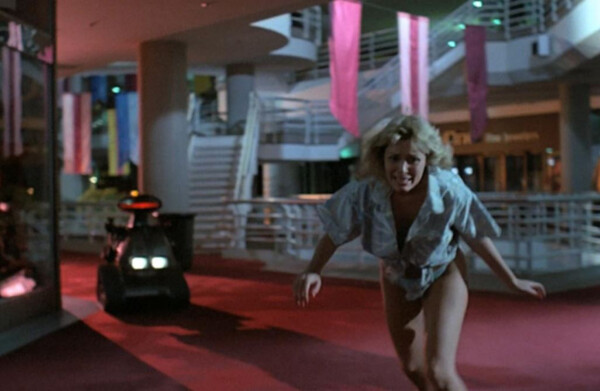
Image courtesy of Concorede Pictures.
“Chopping Mall” stars Kelli Maroney as Alison Parks, Tony O’Dell as Ferdy Meisel, Russell Todd as Rick Stanton, Karrie Emerson as Linda Stanton, Barbara Crampton as Suzie Linn, and Nick Segal as Greg Williams. Directed by Jim Wynorski. Rated R with a 1-hour, 17-minute run time. See it on Amazon Prime and Tubi.
Del’s take
“Chopping Mall” is a product of the incomparable Roger Corman, king of the independent, low-budget exploitation film.
Corman began his career in the mid-1950s making science fiction/horror movies (“The Beast with a Million Eyes”) and Westerns (“Five Guns West”), and became known as the “King of the Drive-In.” He continued in the 1960s with a series of opulent gothic horror movies based on the works of Edgar Allen Poe (“The Pit and the Pendulum”) and worked with stars such as Vincent Price, Basil Rathbone, Boris Karloff, Ray Miland and Peter Lorre.
Eventually Corman established his own studio, New World Pictures. He is credited with starting the careers of numerous A-list actors and directors, including Francis Ford Coppola, Jack Nicholson, Martin Scorcese, Peter Bogdanovich, James Cameron and Jonathan Demme, to name a few.
Corman produced “Chopping Mall,” along with his wife, Julie. It was shot mostly at the Sherman Oaks Galleria mall in Los Angeles in 20 days, with two days of studio filming. The film is described as a parable of Reaganesque consumption and has become a bit of a cult hit over the years.
The plot is fairly straightforward: A group of teenagers holds an after-hours drinking and sex party at a furniture store in a shopping mall on the same night a trio of security robots goes online for the first time. Unfortunately for the teenagers, a lightning strike damages the robots’ programming and they embark on a killing spree. Armed with tranquilizing darts, tasers and directed-energy weapons, the robots are more than a match for a group of oversexed teens … or are they?
Originally marketed as “Killbots,” (a superior title in my opinion) “Chopping Mall” was filmed at the same location as “Fast Times at Ridgemont High.” But trust me, it bears little resemblance to that classic coming-of-age movie. “Chopping Mall” is mostly a bloody excess of exploding heads, lots of jiggling breasts, tacky ’80s-esque music, some seriously terrible dialogue (which was mostly ad-libbed from what I understand) and crappy special effects – heck, they even poached the ray gun sound effects from the George Pal version of “War of the Worlds.”
But as an artifact of the ’80s, “Chopping Mall” is a fascinating time capsule. As I watched the movie I made a list of some of the uniquely ’80s features: big hair, designer jeans, pay phones, landlines, popped collars, circular glasses frames, pastels, Better Cheddar, CRTs, gun stores in a mall, cigarette machines (a pack of smokes cost $1.25), suspenders, button-down shirts, wooden skateboards, handheld calculators the size of mobile phones, khakis with pleats and shoulder boards.
Wow, those were the days. Not.
Look, “Chopping Mall” isn’t high art. It’s a low-budget exploitation film, squarely within the Roger Corman mode of a moviemaking. As silly entertainment it’s just fine. I can think of worse ways to waste an hour and 17 minutes of my life. Go into it with low expectations and you won’t be disappointed. Just be prepared for some serious gore.
I give “Chopping Mall” a grade of B. Anything higher would dishonor its low-budget aspirations. But I’m guessing Mladen will gush – it’s right up his alley. So expect multiple A’s, maybe even with a bullet. Or an exploding head.

Mladen’s take
Yeah, I was hyped when Del used the phrase “jiggling breasts” in his review. All of a sudden, I was looking forward to watching “Chopping Mall.” But trouble soon arrived. The problem? The bared breasts were front-loaded. So, the remaining four-fifths of the movie was barely tolerable to me. No more nudity, just hokey – even for a Corman film – analog-ish visual effects and blood splatter. Let’s face it, despite years of writing movie reviews with Del as my antagonist, he still has no ability to distinguish between cartoonish depiction of slit throats or exploding heads and realistic, honest-to-goodness, stomach-churning graphic violence.
Where to begin evaluating “Chopping Mall?” How about the old saying, “lightning never strikes twice in the same place?” Why? Because in “Chopping Mall” lightning struck THREE times in the same place to send the trio of Bobcat tractor-like killerbots on a hunting spree. Sheesh. From there, the movie gets better in the sense that it gets worse.
We start with four heterosexual couples and then there were three and then there were two and then one. I concede, the couples countdown was a tidy way to knock off the subadults portrayed in the film. The systematic, one-couple-slaughtered-at-a-time pace of the movie generated anticipation. “Ah,” I’d say to myself, “she bought it because she was unable to use a Molotov cocktail correctly. Burning to death sucks. How will her boyfriend meet the Grim Reaper?” Wait a few minutes and, pow, a killerbot grabs the boyfriend and drops him from the mall’s third floor. Thud, and we’re shown a pool of diluted ketchup pooling around the boyfriend’s cracked skull.
For Christ’s sake, the movie didn’t even have a decent soundtrack and it was made in the decade, 1980s, that generated some of the best songs ever. Yes, Corman’s studio did things on the cheap but, come on, why not drop a bit of change for the right to use Blondie’s “Rapture?”
Why the f— Del thought I’d like this movie, I have no idea. Maybe he thought I’d like it because it has gained somewhat of a cult following over the years. Maybe he just wanted to insult my taste in movies. No matter, “Chopping Mall” deserves no better than a C-. But, I don’t want to discourage filmgoers from watching other “Gore”man flicks. There are a lot of them. Del, here are a few that I watched and enjoyed: “The Wasp Woman,” “Carnosaur,” “Death Race 2000” and its sequel, “Death Race 2050,” and let’s not ignore “Sharktopus vs. Pteracuda.”
Mladen Rudman is a former journalist and technical writer. Del Stone Jr. is a former journalist and writer.
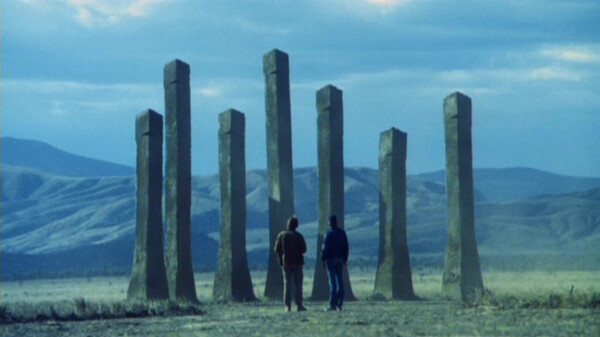
Image courtesy of Paramount Pictures.
“Phase IV” Starring Nigel Davenport, Michael Murphy, Lynne Frederick, Lots of Ants and others. Directed by Saul Bass. 84 minutes. Rated PG. Hulu, Prime.
Mladen’s take
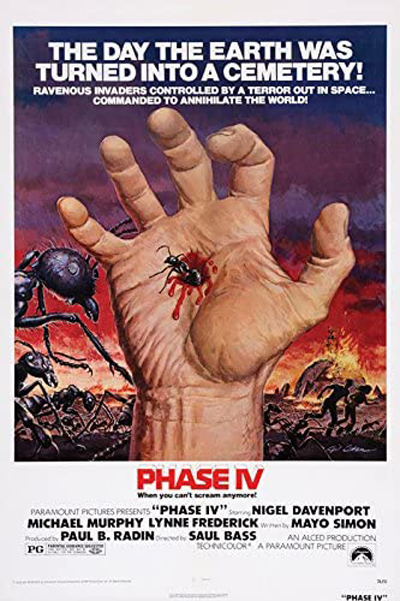
“Phase IV,” lovingly built in 1974 with an admirable effort at incorporating animated and computer graphics to enhance the film, is sci-fi at its finest – provocative and enthralling.
Remember, we’re talking about 1974 here. 1974 was 47 years ago. 1974 was the year of another Republican dickhead president’s impeachment (Nixon). Hell, I was but a sprite in 1974.
Del always bellyaches about my inadequate summaries of film plots, so I’ll give it a better shot this go-around. The problem? A completely thorough plot summary gives away the story, which, I assume, makes a movie less fun to watch.
The “Phase IV” plot: Mankind drops to the bottom of the food chain. Sufficient summary, Del? No? OK.
A burst of celestial energy, detected early and highly anticipated by scientists because of what it could do to life on Earth, passes through our planet without causing obvious change or damage. One lone entomologist, however, notices something odd unfolding in Arizona post-energy wave. Ants of different species are no longer feuding, are systematically cooperating to extinguish their predators, and appear to be gathering at pow-wows to talk strategy. The ant tribes build a half-dozen cooling towers for their massive collective nest. No big deal, right? Some regular ants (and termites) have built elevated structures to help condition the air flowing through their underground homes for tens of thousands of years, probably longer. But, the Arizona ant colony chimneys are symmetrical and constructed at right angles. They’re topped with triangular slits inside squares that face in exactly the same direction and tilt upward and back slightly. The chimneys are symbolic structures, too, maybe even a form of religious worship. The entomologist (Davenport as Dr. Ernest D. Hubbs) concludes the energy burst has rendered the ants intelligent. Trouble is on the way unless the “natural order” is restored, he advises a panel. The panel authorizes construction of a research facility smack dab in the middle of the territory of the sectarian smart ants. Hubbs recruits Lesko (Murphy) to staff the laboratory. Lesko is a numbers theorist and cryptographer with expertise in deciphering languages. There’s a third person in the story, Lynne Frederick as teenager Kendra, but she’s used to help the movie along to reach Phase IV of the Ant plan for humanity. In short, Hubbs and Lesko end up fighting the six-legged version of Star Trek’s Borg. Very, very neat.
“Phase IV” is remarkable for its capture of real ants performing ant-like duties in organized, methodical, and adaptable fashion. The humans and the smart ants duel, each species countering the other’s moves of conquest and domination. Wait until you see how the ants flush the scientists and the girl from their geodesic dome laboratory. Hell, Lesko even devises a way to communicate with the ant queen controlling the millions (billions?) of worker ants working to control the humans. She’s in no mood to negotiate a settlement or foster inter-species compromise. That’s very human-like. No?
“Phase IV” is an unambiguous A. You need to watch this blast from the past, something Del has come around to calling a “stream gem.”
Del’s take
I’ve seen bits and pieces of “Phase IV” over the years but never the entire movie until Mladen got a bee in his bonnet and suggested we review a film about super-smart ants.
I could tell it was a ’70s-vintage flick because of the Lazenby Computer Smooth font used in some of the typography. It seems every movie, book or magazine that sought to appear “modern” in the 1970s used Lazenby Computer Smooth. Now, of course, it makes me think “old.”
But that’s OK because “Phase IV” is a darned good little movie, much better than what the movie reviewers like Mladen – oops, that just slipped out – said about it. (Remember how the movie reviewers trashed “The Terminator”? Yeah. Those guys. Can’t believe a word they say.)
Mladen finally, after much ridiculing from yours truly, provided a decent plot summary, so I can get right into the critique itself.
You can’t judge “Phase IV” by today’s production standards. The music is contrived and hokey (though “modern” for its day), the characters behave in ways that would earn them a social media drubbing (Dr. Hubbs smokes!) and the special effects resemble those you and I would create if somebody handed us an 8mm movie camera and told us to revise “Plan 9 from Outer Space.”
My big gripe with “Phase IV” is that the characters seem incidental to the plot. Hubbs is a throwback to the misguided scientist who seemed to occupy every big bug movie produced in the 1950s, while his dashing sidekick – in this case Murphy’s James R. Lesko – seems more interested in 16-year-old Kendra Eldridge (Lynne Frederick) than solving the mystery of the ants, creepy even for that era. Everyone else was cannon fodder so by the end I didn’t care as much about their fates as I should have.
But the ideas! Spectacular and original barely describe them. Director Bass doesn’t limit his ants’ intelligence to mere acts of malice but has them building oddly designed towers, drilling symmetrical holes in animal flesh and using unconventional warfare to flush out their human antagonists from their protective geodesic dome. The towers alone are worth the watch, standing creepily over the desert like mysterious Easter Island statuary, festooned with alien glyphs and designed with an architecture that weirdly, at least to me, suggested a non-human intelligence.
The inventiveness of the ant intelligence is under-appreciated by movie fans not including the cult worshippers “Phase IV” has amassed over the years, and it is one of those movies you should not only watch but add to your collection, along with “Day of the Triffids,” “The Day the Earth Stood Still” (original) and “Forbidden Planet,” to name a few.
I was surprised to learn the movie was not shot in Arizona but Kenya, and that it was a box office flop, which sealed Bass’s fate as a director. That’s too bad because “Phase IV” is a classic science fiction film and a wonderful cautionary tale about mankind’s hubris.
I give it an A despite its flaws.
Mladen Rudman is a former journalist and technical writer. Del Stone Jr. is a former journalist and author.
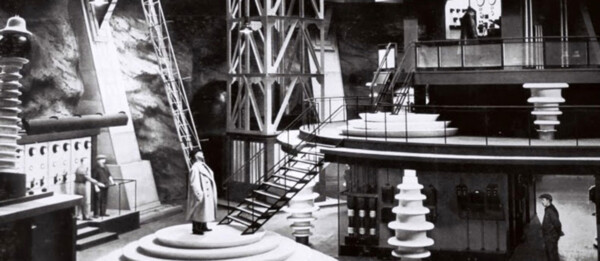
Image courtesy of United Artists.
“The Magnetic Monster” Starring Richard Carlson, King Donovan, Jean Byron, and others. Directed by Curt Siodmak and Herbert L. Strock. Writers Curt Siodmak and Ivan Tors. 76 minutes. Rating: Approved. Amazon Prime.
Mladen’s take
The Atomic Age fuses with a quark-y idea, valent script writing, and energetic performances to form the nucleus of “The Magnetic Monster.”
This elemental gem of a sci-fi movie is only 76 minutes but tells the story, and captures the fear of the unknown about radioactivity, in 1953 with panache.
There are no goofy sound effects in “The Magnetic Monster.” No overdone dumbing-down of science. There are no mad scientists, though there’s one not-too-bright physicist, in the film. There’s gentlemanly sexism. Dare not there be a woman engineer or researcher. Instead, we get a clever pregnant wife, a diligent switchboard operator, and a very athletic store clerk with one helluva body.
Now that I irritated, or is it irradiated, Del long enough by withholding a film summary, here you go.
An appliance and hardware store near a Government facility populated by “A-men” (atomic men) is magnetized. Watch out for the engineless push lawnmower with some dastardly looking blades bolting at you because you’re in the way of the pull of the polarized attractor with thirst for pure energy. A-men Drs. Jeffrey Stewart (Carlson) and Dan Forbes (Donovan) are dispatched by the Office of Scientific Investigation chief scientist to uncover the facts and cure the problem. Geiger counters tick. A man is found dead in a secret, makeshift laboratory. Off go Stewart and Forbes to get to the bottom of the incident.
The disaster that unfolds isn’t a nuclear reactor going China syndrome. The disquiet and radioactivity haven’t been released by a detonating A-bomb. “The Magnetic Monster” menace is tough to find and, when found, tough to throttle. It has to be fed to keep contained. Each subsequent feeding requires magnitudes more food and, in one instance, takes blacking out a city to provide the needed electricity. The magnetic monster grows after it eats like the Republican party bloats as it chews our democracy. That means the next monster feeding will require a bigger source of power. How long before the Earth, the solar system, the galaxy, the constellation, or the universe are consumed because the beast needs matter converted to energy to stay satiated? Oh, Einstein, what have you caused with that E=mc2 thing.
I loved this black-and-white movie for its effort to pay attention to science. For showing us wavy lines on cathode ray tubes. For demonstrating how fast those new-fangled jet-powered airplanes with straight wings can fly. For the cool, realistic explosion of a volt-injecting machine the size of a building. Thank you for at least making the effort to show that decaying metals are heavy, literally. And, dadgum, you made a block of gray material smaller than a breadbox the plausible villain.
A-, Del. “The Magnetic Monster” is an A-. Need a rationale? If you think “The Haunting” is an A-, there’s no way you can think anything less of “The Magnetic Monster.”
Del’s take
A- my ass.
“The Magnetic Monster” is at best a C. It has a couple of things going for it and a lot of things that don’t, so let’s touch on the positives first.
Number 1, forget the story. “The Magnetic Monster” is a time capsule of life in the 1950s, and while much of that life is better left to history, other aspects invoked a pleasant nostalgia for conduct and commodities that I wish existed today.
For instance, the cars. The cars are behemoths of chrome and steel, fitting of all the old nicknames – land yachts, battle cruisers and road hogs. No doubt they got crappy gas mileage and polluted the environment, but man, they sure were nice to look at. Designers back then were still trying to create art, not aerodynamically efficient blob mobiles. We all could use a little more art in our lives.
Men and women dressed for work. The ladies wore dresses and skirts with hats and gloves, while the men were clad in suits and ties. Call me old-fashioned but I think a more formal workplace dress code imparts a more formal manner of job conduct and thinking. Much of the work today seems like it was done by somebody wearing a bathrobe and house slippers.
People back then – at least in the movies – seemed more articulate. Their speech was almost patrician, with a whiff of an English accent in some – a welcome departure from the onslaught of slurred, mispronounced vulgarities we are subjected to these days.
From there “The Magnetic Monster” sleds downhill.
I’ll be first to point out life in the ’50s might have been grand for white males but not many others. Women, as illustrated in “The Magnetic Monster,” occupied the lower rungs of the corporate ladder or were kept at home in the kitchen, barefoot and pregnant. In many of these movies you don’t see people of color unless they’re about to be devoured by the title threat.
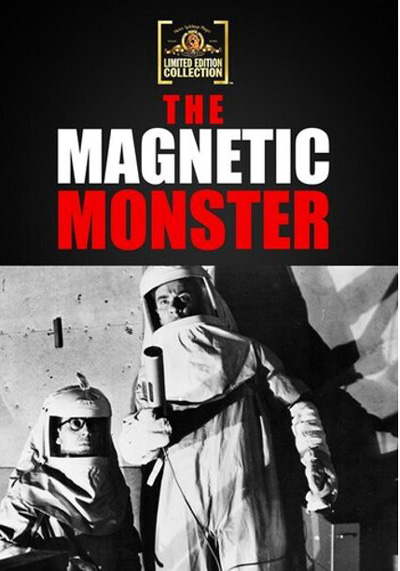
Value judgments aside, the movie makes a laudable attempt to sell a scientific plausibility, and unlike many B movies of the ’50s you never see an actual “monster.” That’s because the monster is radiation, though I was confused about the relationship between magnetism and radioactive particles that sicken and kill people.
From what I’ve read, much of the “science” in “The Magnetic Monster” is nonsense, which is not necessarily a cause for dismissing the movie. The science in virtually all science fiction movies these days is nonsense. Don’t get me started on “Star Wars.” Still, while it must have sounded impressive to an audience of that era, I heard mostly nonsense.
The movie itself relies on special effects “borrowed” from a German science fiction film of the 1930s called “Gold.” It also features brief cameos by a computer called “M.A.N.I.A.C.,” which are good for a chuckle. I’d wager an Apple Watch has millions of times more computing power. Such is the march of technology.
“The Magnetic Monster” was the first movie of a trilogy, which included “Riders to the Stars” and “Gog,” both shot in the mid-1950s.
I mentioned two things in the movie’s favor. The other is that it’s short, a hair over an hour.
I enjoyed some aspects of “The Magnetic Monster” but mostly I thought it was boring. The ’50s produced some wonderful science fiction movies – “The Day the Earth Stood Still” and “Forbidden Planet,” but this is not one of them. It’s a product of the days when people feared the atom, the Russians and the unknown. Now, we know that climate change, incompetent politicians, corporate greed and evolving pathogens present a much greater threat.
Come to think of it, I wouldn’t mind returning to those simpler days. At least in some ways.
Sorry, Mladen. C.
Mladen Rudman is a former journalist and technical writer. Del Stone Jr. is a former journalist and author.
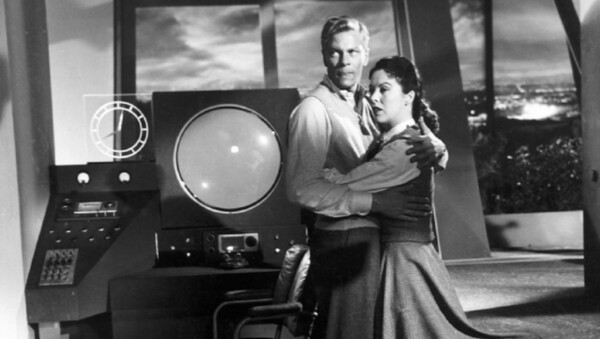
Image courtesy of United Artists.
Del reviews ‘Red Planet Mars’
“Red Planet Mars” Starring Peter Graves, Andrea King and Herbert Berghof. Directed by Harry Horner. 87 minutes. Rated approved.
Del’s take
Maybe you’ve noticed I’m reviewing more Netflix, Prime and Hulu offerings these days. That’s no accident.
My MoviePass account expires at the end of this month and I won’t be renewing. When I first joined, the MoviePass deal was unbeatable – watch as many movies as you like in one month for a piddling $7. I wondered how they could make money and they didn’t. Soon they were altering the terms, adding steps and otherwise making it impossible to use your MoviePass for anything but low-rated matinees only once per week. With my new work schedule I could not have seen more than one movie per month, if that. Not much of a deal.
I subscribe to Netflix, Prime, Hulu, Shudder and Curiosity Stream. I can also choose from Vudu and Tubi TV. Needless to say I am not deprived of video content.
But finding the good ones can be a challenge. More than once I’ve searched Google for the best hidden gems on Netflix. I even have a browser extension that lets me search all the “hidden” categories Netflix does not include with its interface.
It stands to reason if I am having this problem, others likely are too. And that is the direction I am taking “Movie Faceoff.”
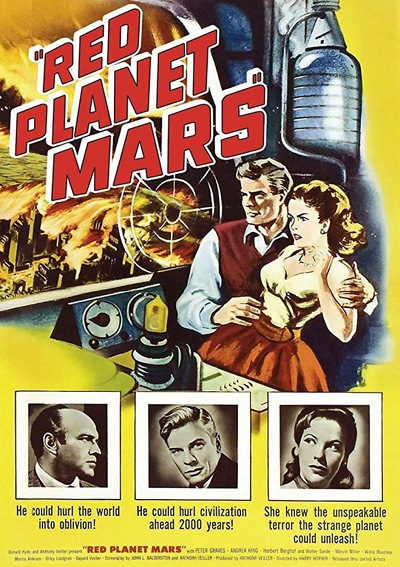
I will continue to review theatrical releases when I see them, and if I can ever coax Mladen away from the Great American Novel he’s working on, we’ll do them together. Meantime, I am reviewing some of the gems – and dogs – I find on my streaming services. And that brings me to this latest offering, “Red Planet Mars.”
“Red Planet Mars” is one of the most remarkable science fiction movies I have ever seen. Released in 1952 by United Artists, the movie stars a very young Peter Graves at the height of his Nordic grandeur.
The basic plot of the story is as follows: Astronomers spot what appear to be artificial canals on Mars that are transporting water from a rapidly diminishing polar ice cap. At the same time an American scientist (Graves) has established a kind of crude radio communication with the inhabitants.
At first, the communication is a simple repetition of signals sent from Earth. But Graves’ son, Stewart (Orley Lindgren) suggests transmitting the numerical value of pi to see if the Martians, if they are indeed Martians, will carry those values to the next decimal point. They do, and a dialogue is established after the cryptographers who decoded the Japanese military signals during World War II figure out how to interpret their language.
The Martians soon reveal an astonishing grasp of science, informing Graves that they live to be 300 years old, use cosmic energy as an energy source and grow enough food on a single acre to feed an entire city.
When these messages are revealed to the world, the world responds with panic and hysteria. Farmers, afraid their crops will be rendered valueless by new growing methods, demand government compensation. The oil industry freaks out (they wouldn’t do THAT, would they) and the medical community has a shit fit. The stock market collapses, riots spread across the country and the western world grinds to a halt.
Simultaneously an evil subplot is playing out. The Russians have a spy listening in on the broadcasts, a Nazi scientist who invented the technology that enables Graves to contact the Martians. The Russians intend to use the chaos as a means to subjugate the west and take over the world.
That is until the messages from Mars detour from the standard our-technology-is-superior-to-yours script and move off in a weird, unanticipated direction. Tables get turned and “Red Planet Mars” becomes something that rises above the modest aspirations of a killer B movie.
The clothes, home furnishings and cars are vintage 1952, but the giant flat-panel TV mounted on Graves’ wall is anything but, suggesting “Red Planet Mars” is set in an alternate universe.
But what’s astonishing about the movie is its willingness to address the deep issues of first contact, or the Cold War conflict between east and west. It does so in surprisingly thoughtful ways, so atypical of the ’50s B movies with their bug-eyed monsters and giant insect predators.
Don’t get me wrong. I’m not saying “Red Planet Mars” is a “good” movie. It’s definitely a product of its time. The viewer must make a deal with himself to overlook the overacting, the offensive patriarchal viewpoints, crappy special effects and script clinkers so common of movies of that day. But do that and you may be surprised.
I will say I liked the movie a lot. It entertained me right to the end.
I would grade “Red Planet Mars” at B+ purely on the merits of its ambition.
Stone is a former journalist and author.