My one and only San Diego Comicon
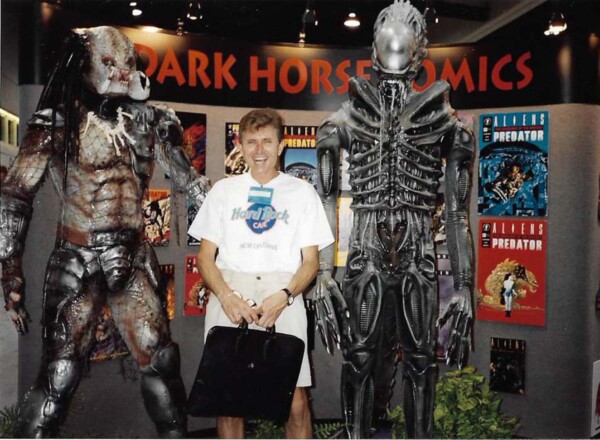
The author at the '94 San Diego Comicon. Image courtesy of Lurene Haines
In the summer of 1994 I participated in the San Diego Comicon as a guest. It was to be my first and last visit.
My credentials hardly qualified me as a “guest.” I went there largely on the coattails of cover artist Dave Dorman and his then-wife, Lurene Haines. I’d known Dave and Lurene since the early ‘90s; Lurene joined our science fiction-horror writers group, which at the time consisted of me, my friend Ray Aldridge, Ed Sears and his daughter Vicki, and Richard Bamberg. We usually met at a local saloon named Chan’s, which sat on the limb of a tranquil bayou. Our meetings were anything but tranquil. Fueled by too much beer, we raucously critiqued each other’s work, and usually extended the meeting to a nearby poolhall, Starcade. Sometimes Dave would join us. That’s how we met.
Lurene was constantly encouraging us to try our hands at scripting comic books. As a kid I’d read comics – in Spain, where there was no TV and precious little radio. We had no other option … well, I suppose I could’ve read a book, but c’mon! I was 6 years old. But as I grew older and passed through my TV-watching stage, I turned to books, and as I began writing my own stories it was in the narrative style of novels and short stories, not the scripted style of comics.
Still, when Lurene told us about the money to be made, I was tempted – especially when she floated a possible project with Marvel Comics. Seems their Epic imprint was looking for scripts for Clive Barker’s “Hellraiser” series. I’d read Barker’s “Books of Blood” and “The Hellbound Heart” upon which “Hellraiser” was based, and I knew the basic premise – successfully manipulate the Lament Configuration (and you could do so only if you were deservingly evil) and a lifetime of torment followed.
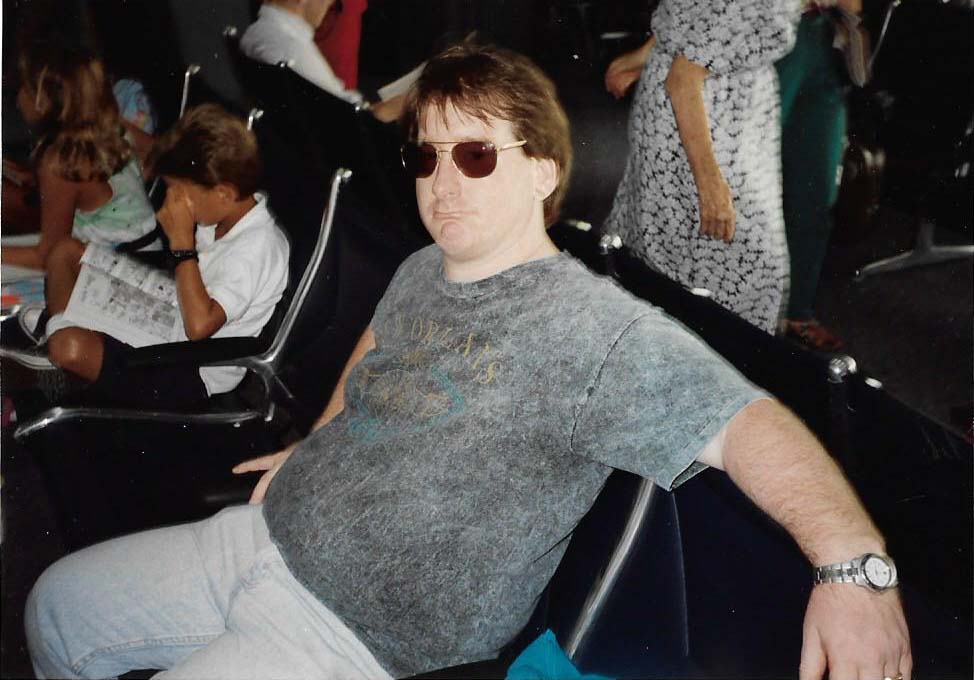



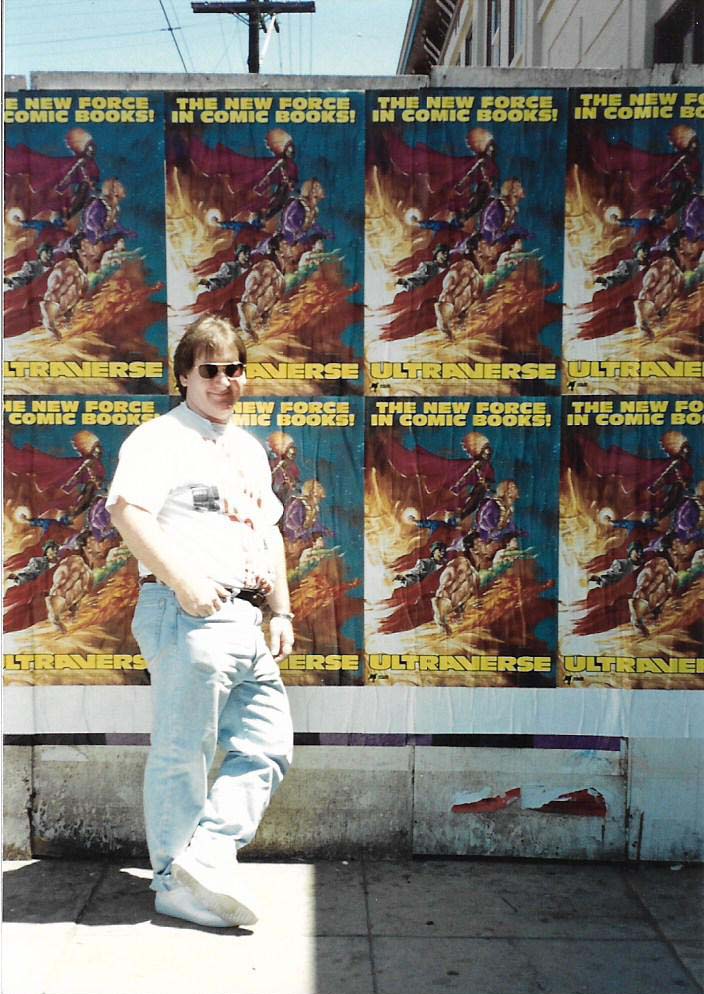
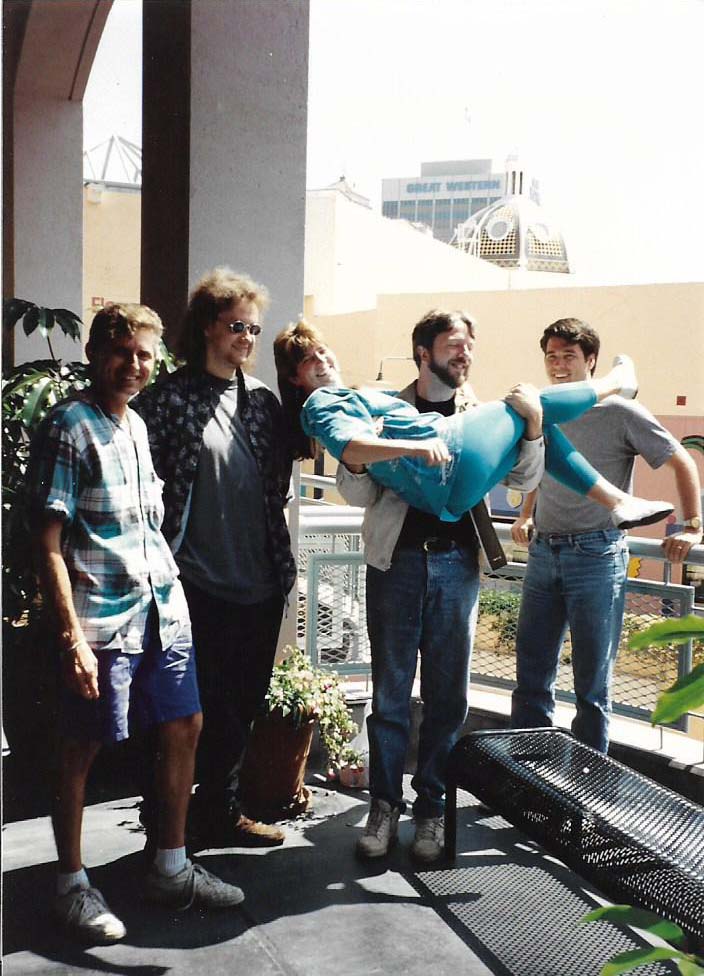

I sat down and wrote my first script, modeled on the style of a script Dave and Lurene loaned me. When I was done I gave it to Lurene, who submitted it with a script she had written for “Hellraiser” editor Dan Chichester. A few weeks later, voila! Both were accepted and suddenly I was a comic book writer. About the same time I sold my first short story to a professional publisher, Bantam-Spectra’s “Full Spectrum” anthology series. Now I as a dual-track writer – comics and prose.
A year or so later I was commiserating with Dave and Lurene about my future as a writer, and how I’d like to do the job full-time. They’d been encouraging me to take on more work in comics, and they wanted me to start going with them to conventions. I knew from experience that if you wanted writing jobs you had to attend conventions – that’s where you meet editors, make impressions, and get future jobs. It’s also where you learn about future projects that aren’t advertised to the public body of writers. That was one of my greatest frustrations as a beginning writer – it seemed a vast body of markets existed just beyond my reach, simply because I didn’t know about them, or hadn’t been invited to submit. And that was because none of these editors knew I existed. I didn’t attend conventions.
So I sat down with Dave and Lurene one afternoon and basically said “Yes, I’ll go to conventions with you. I want to get into comics.” Hence, my departure for San Diego one summer morning in 1994.
I really didn’t know how lucky I was – to have an entre to the professional world of comic book publishing at the hands of Dave Dorman, one of the greatest cover artists of our time … he opened far more doors for me than I deserved. I’ve never had a good opinion of myself as a writer. Bottom line? I’m not really very smart. Most writers I know are smart people who can not only come up with a story idea but conceive it both artistically and mechanically, something that was impossible for me to do. My approach was to jump in, see what worked, and rewrite – not the most efficient process. And if you asked what I was attempting to “say” with a particular work I likely couldn’t tell you. I just didn’t know. I didn’t know because I wasn’t very smart.
But I did know comic book artists were perhaps not the best storytellers – visually, yes. But plot-wise? Maybe not. Some were. But based on what I was seeing in contemporary comics, the stories to a large extent seemed thin, the artwork overpowering. So maybe there was a place in comics for a prose writer, even a lame, half-assed prose writer like myself.
You may remember in the late ’80s through the mid-’90s comics enjoyed a renaissance thanks to the collectibles market. We were part of that boom. There was good money to be made – excellent money – if you could get the work. And Dave was getting the work, so much he couldn’t keep up with it all. This was prior to the wave of comics-to-movies but you could see that coming down the road as science fiction, fantasy and horror inserted themselves into the popular entertainment medium. It really did look like the sky was the limit.
In 1994 Comicon was not the gigantic multi-media con it is today. Mostly it concentrated on comics and graphic novels. You did see the occasional celebrity but nothing like the extravaganza that just played out in San Diego.
Here are my impressions:
The flight to San Diego: I could never become a habitue of the convention circuit because I hate flying, and most of the big cons are located across country. Comicon is in San Diego. Chicago hosts another big comic convention. The World Fantasy, World Horror and World Science Fiction conventions travel around the country.
I remember the flight from Pensacola to San Diego as an endurance test of counting the minutes. In fact, it inspired me to write a short story, “The Fear of Fear Itself,” which was published in the Pocket Books anthology “More Phobias.”
As we were on final approach to San Diego International Airport, Lurene said, “Hey Del, look out the window.” I did, and all I could see were buildings – we were flying between skyscrapers! The airport sits in the middle of town, right on the water, and sometimes the approach takes you through buildings on the hills around the harbor. It was very scary for somebody who doesn’t like to fly.
The airport: I was astonished at how small the airport was. Space is at a premium in San Diego, and the tiny airport is a product of that confined area. Our plane didn’t even park next to a skyramp – we climbed down stairs and walked across the tarmac to the terminal, which was very dark and somewhat run-down. As I looked back to the airplane I saw a fluid dripping from one of the engines. Thank God I hadn’t seen that before we took off.
San Diego itself: Because of its small area for such a large city, San Diego is very tightly and efficiently laid out. It’s got lots of restaurants, hotels and shopping areas, including a very neat vertical shopping center, Horton Plaza, that lay within walking distance of the Westin San Diego, where we were staying.
Jogging with a DC editor: Every morning Lurene and I arose before sunup and went jogging with an editor from DC. I believe it was John Nee though I may be mistaken. He set a “brisk pace,” which is to say I was nearly exhausted by the time we finished. I remember talking with him in the hotel lobby one morning. I turned the subject to comic books and he very quickly said, “That’s work. Let’s not talk about work.” I learned at that moment many editors attend conventions to socialize, not network per se, and that knowledge served me well over the coming years.
The Convention Center: The San Diego Convention Center epitomizes what convention centers should be about. It’s a large, modern structure, right on the water, and becomes the focal point of the hotel, restaurant and shopping district. I also remember it being very hot inside – you cram 10,000 fanboys-girls into a confined space with multi-media platforms running at virtually every booth and you get some serious heat. I remember sweating the entire time I was there. I remember when I was there peeking behind a curtain at a Ford display of the new model Mustang. Interesting!
The fans: Even in 1994 the convention was packed! You could barely navigate the walkways and it was difficult to approach a booth. Many fans were dressed in costumes, which is not unusual. I’d attended enough conventions to become inured to that reality. Many of the costumes I couldn’t identify – I simply wasn’t that familiar with comics.
Kij Johnson: I met one other prose writer there, Kij Johnson. We were so relieved to run into one another. We chatted for a few minutes then went our separate ways, but it was nice to encounter a kindred soul of prose.
The celebrities: I encountered only two celebrities while I was there, Clive Barker and John Ritter. Barker was making his way through a crowd and I didn’t get to speak to him. You’ll laugh when I saw this, but I thought he’d be taller. Ritter was standing in the Westin parking garage with a passel of kids, waiting for his car to be brought to him by the valet. I didn’t get a chance to talk to him either.
The convention: I say this for the sake of honesty: I felt like a fish out of water. I was unfamiliar with the comic book monde and I knew none of these people. Lurene was pressuring me to “do business” and I’m sure any “business” I did was counterproductive as there was no way to disguise my ignorance. The extent of my comic book work consisted of one “Hellraiser” story and a novella titled “Roadkill,” published by Caliber. Consequently, nobody knew who I was either and they were not willing to waste time on an unknown quantity like yours truly. So I spent the first two days wandering the convention hall, picking up as many business cards as I could and talking to whomever would listen to me. It didn’t seem my time there was very productive yet I was spending a small fortune on plane fare, the hotel, and eating at pricey restaurants. So finally on Day 3 I said to hell with it and spent the day at Horton Plaza, shopping. I was exhausted and more than a little depressed. It seemed I had no place there and wouldn’t have until I’d educated myself about the world of comics, and published a few more projects. I spent one more day at the convention, basically accomplishing nothing, and thankfully we left the next day.
The ride back: The flight out of San Diego was turbulent. By this time Lurene had assumed the role of official Calmer of Del on the Plane Flight and spent the first 30 minutes assuring me these bumps and bounces were perfectly normal. My God, I couldn’t think of anything more awful than being trapped in a metal tube five miles above the ground with nowhere to go and nothing to do if anything went wrong. When we arrived in Pensacola that night I dropped to my knees in the parking lot and kissed the ground. It was the end of our convention travels for the year. I think they got a picture of that.
Shortly thereafter I suffered a kind of existential overload and temporarily called an end to my convention travels. Work was overwhelming, I was experiencing a great deal of turmoil in my personal life, and I was not happy with my writing life. Dave was getting me tons of work, but over time I began to realize that while my ego and my bank account liked comics, my heart belonged to prose. But all was not well in the prose world either. I was receiving invitations to themed anthologies, but found myself balking at the write-a-story-to-fit-the-premise requirement. Worse, I had just gotten access to the Internet and found myself wondering if the web would allow time in anyone’s day to read a book, and if reading itself would fall out of fashion. The prospects for a barely competent writer like myself making a living of novels seemed daunting at best.
Toward the end of the ’90s and into the 2000s, I found myself writing less. I was constantly distracted by online stuff, and the idea of sitting behind the computer for hours on end, doing something that was similar to what I did at work all day, struck me as unfathomable. I did manage to finish a novella which became a finalist for the British Fantasy Award, and I took a great deal of pride in that (although it was savaged by British critics). I managed to publish a short story here and there. But it seemed the momentum was lost. Today, I wouldn’t even know how to go about submitting a written work to a publication, and I know nothing about the self-publishing industry. Seeing as how that’s where books like “Twilight” and “Fifty Shades of Gray” came from, perhaps I should.
I always be indebted to Dave and Lurene for trying to help me.
But I don’t think I’ll be attending any more Comicons.
About the author:
Del Stone Jr. is a professional fiction writer. He is known primarily for his work in the contemporary dark fiction field, but has also published science fiction and contemporary fantasy. Stone’s stories, poetry and scripts have appeared in publications such as Amazing Stories, Eldritch Tales, and Bantam-Spectra’s Full Spectrum. His short fiction has been published in The Year’s Best Horror Stories XXII; Alfred Hitchcock’s Mystery Magazine; the Pocket Books anthology More Phobias; the Barnes & Noble anthologies 100 Wicked Little Witch Stories, Horrors! 365 Scary Stories, and 100 Astounding Little Alien Stories; the HWA anthology Psychos; and other short fiction venues, like Blood Muse, Live Without a Net, Zombiesque and Sex Macabre. Stone’s comic book debut was in the Clive Barker series of books, Hellraiser, published by Marvel/Epic and reprinted in The Best of Hellraiser anthology. He has also published stories in Penthouse Comix, and worked with artist Dave Dorman on many projects, including the illustrated novella “Roadkill,” a short story for the Andrew Vachss anthology Underground from Dark Horse, an ashcan titled “December” for Hero Illustrated, and several of Dorman’s Wasted Lands novellas and comics, such as Rail from Image and “The Uninvited.” Stone’s novel, Dead Heat, won the 1996 International Horror Guild’s award for best first novel and was a runner-up for the Bram Stoker Award. Stone has also been a finalist for the IHG award for short fiction, the British Fantasy Award for best novella, and a semifinalist for the Nebula and Writers of the Future awards. His stories have appeared in anthologies that have won the Bram Stoker Award and the World Fantasy Award. Two of his works were optioned for film, the novella “Black Tide” and short story “Crisis Line.”
Stone recently retired after a 41-year career in journalism. He won numerous awards for his work, and in 1986 was named Florida’s best columnist in his circulation division by the Florida Society of Newspaper Editors. In 2001 he received an honorable mention from the National Lesbian and Gay Journalists Association for his essay “When Freedom of Speech Ends” and in 2003 he was voted Best of the Best in the category of columnists by Emerald Coast Magazine. He participated in book signings and awareness campaigns, and was a guest on local television and radio programs.
As an addendum, Stone is single, kills tomatoes and morning glories with ruthless efficiency, once tied the stem of a cocktail cherry in a knot with his tongue, and carries a permanent scar on his chest after having been shot with a paintball gun. He’s in his 60s as of this writing but doesn’t look a day over 94.
Contact Del at [email protected]. He is also on Facebook, twitter, Pinterest, tumblr, TikTok, and Instagram. Visit his website at delstonejr.com .
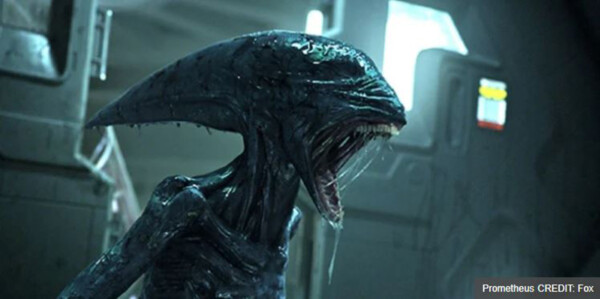
Image courtesy of 20th Century Studios.
—
“Prometheus” Starring Noomi Rapace, Michael Fassbender, Logan Marshall-Green, Charlize Theron. Directed by Ridley Scott. 124 minutes. Rated R.
Del’s take
Going into “Prometheus” I warned myself against indulging expectations; I had, after all, been savoring this moment since learning “Alien” director Ridley Scott was returning to the creepy, Gigeresque universe he so famously created in 1979.
Coming out of “Prometheus” I again warned myself against expectations: The movie was probably not as disappointing as my gut reaction would have me believe.
After much reflection, I can’t help but feel “Prometheus” is so much less than it could have been. Visually, the film is gorgeous. But the script is a muddle, the score incompatible with the movie’s tone, and some of the casting decisions simply don’t work.
The plot is straightforward. A pair of archeologists (Noomi Rapace as Elizabeth Shaw and Logan Marshall-Green as Charlie Holloway) discover a kind of star map in the glyphs of ancient terrestrial civilizations separated by time and distance. A corporation builds a starship, the Prometheus, to visit the location denoted by the map, so that the company’s founder can discover the secret to life … and perhaps extend his own. Once there they find mankind’s progenitors were not as paternalistic as they expected. All manner of wriggling, predatory horrors put human beings at the bottom of the food chain as they plan a planet-wide buffet.
The film’s exteriors are lush, sweeping and grandiose, but the interiors convey nothing of the shuddery claustrophobia evoked by “Alien.” The technology seems far advanced from “Alien,” which takes place after “Prometheus.” I don’t have a problem with that: The Nostromo was a tired old factory ship with outdated technology; “Prometheus” is a brand-new ship of exploration, likely equipped with the latest gadgets and gewgaws, despite its 30-year handicap.
Michael Fassbender delivers an Oscar-worthy performance as the amoral android David, and Charlize Theron is icily cool as the daughter of the Weyland Corporation’s founder. Less impressive are Sean Harris as the expedition’s geologist, and Rafe Spall as the team’s biologist. Neither display the kind of intellectual curiosity peculiar to scientists. Worse are Noomi Rapace and Logan Marshall-Green, who are completely unconvincing in their roles as the expedition’s ostensible scientific leadership. Ridley Scott has a love of strong female characters, but in “Prometheus” Rapace seems lost and dependent, besotted with a perpetual starry-eyed, doll-baby affect that seems incongruent with that of a true Scott survivor type. And let’s not talk about the film’s science, or the scientific method. “Prometheus” abandons even the most cursory protocols any scientist worth his salt would follow.
But that’s partially the fault of the script, which at times tries to take “Prometheus” into the realm of “2001,” while mostly devolving to “Starship Troopers” or even “Lost.” Blame that on co-writer Damon Lindelof, an alum of “Lost,” who seems stricken by the idea coy logic flaws represent depth. A true brain tease provokes curiosity, not irritation. Gone is the stark, narrowly focused conflicts of “Alien,” “Blade Runner” or “Thelma and Louise.” In its place is a taco-pizza-cheeseburger of a story that satisfies nobody.
“Prometheus” may have strands of “Alien” in its DNA, as Scott hinted during the movie’s production, but it’s a recessive gene. You see little of the “Alien” genius and lots of what I would call “current” storytelling, which seems less satisfied with delivering a credible tale than setting up a sequel.
In space, nobody can hear you scream. But in movie theaters they can hear you crying foul, and that’s what I heard.
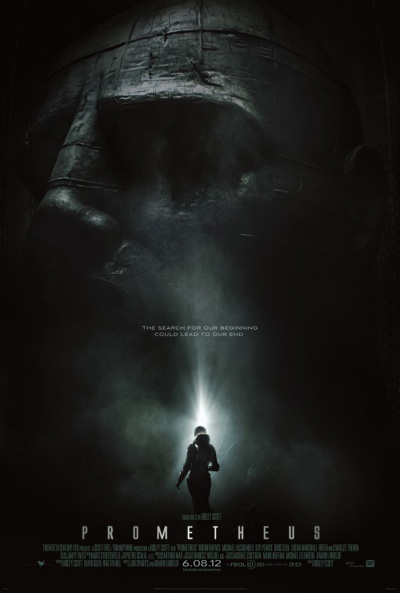
Mladen’s take
When I need Del to be merciless, he delivers a review that searched for a bright side to a dim movie. Del, can you hear me screaming in Fort Walton Beach, though we’re a couple of miles apart?
It was good “Prometheus” didn’t come with a money-back guarantee for the audience because the production companies that financed this unfathomable film would go broke. My review is short because I stopped paying attention to the movie about halfway through it’s all too long runtime.
“Prometheus” was billed as the prequel to “Alien,” one of the finest movies of all time, and that was a severe error. Though directed by the same man, Ridley Scott, “Prometheus” and “Alien” are worlds apart.
“Alien” is a sci-fi horror movie, pure and simple and completely engrossing. “Prometheus” is just gross, while suffering from an identity crisis. Is it sci-fi horror like “Alien” or sci-fi action like “Aliens”? In fact, it’s more like “Hostel” meets “Event Horizon” meets “The Human Centipede.”
Almost from the beginning, the movie starts to meander toward the unexplained.
There are 17 people aboard spaceship Prometheus, which is about 10 too many. Only a handful of the 17 characters are developed and all of them are, at best, mildly interesting or, at worst, unlikable.
There are metallic vases oozing black liquid, an aggressive slug breaking an arm and then swimming down the victim’s throat, and an absolutely foul scene were one of the protagonists endures a vividly portrayed Cesarean section inside a healing chamber and then fights the creature just pulled from her abdomen.
None of the scientists behaved like scientists, including the decision to reanimate in the open the head of a hominid-like being because it looked like something abnormal was growing from it when its owner died.
In “Prometheus,” events just happened that seemed unconnected or arbitrary. The story lacked cohesion. It failed to explain the reason our creators were so unflinchingly hostile to us, their children, so to speak.
“Prometheus” could have explored the questions it awkwardly raised. Is there God? Can science and religion co-exist? Is mankind a controlled experiment with Earth the incubator? Instead, we get a mish-mash of themes and banal dialogue.
There are no Oscar contenders in this movie. Not for script. Not for acting. Not for score. Hell, not even for visual effects. The movie was disappointing.
Mladen Rudman is a former journalist and technical editor. Del Stone Jr. is a former journalist and author.

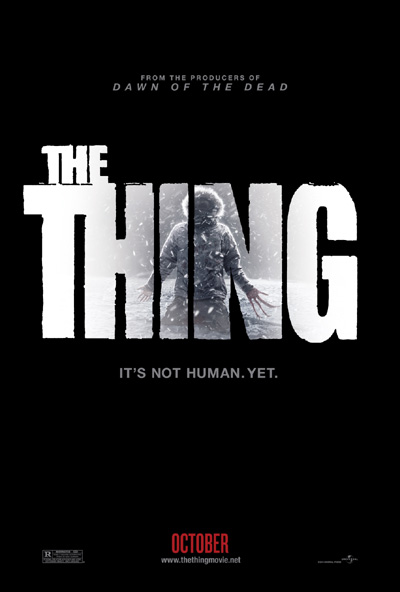
Image courtesy of Universal Pictures.
—
“The Thing” Starring Mary Elizabeth Winstead, Joel Edgerton and Ulrich Thomsen. Directed by Matthijs van Heijningen Jr. 103 minutes. Rated R.
Mladen’s take
Let’s call Director John Carpenter’s 1982 film “The Thing, A.” Let’s call Director Matthijs Van Heijningen’s released-on-Friday movie “The Thing, B.” I do that for two reasons. Those are the grades each movie deserves – actually it’s A+ and B+, respectively. And, it’ll be easier to keep track of which movie I’m referring to because comparisons are inevitable. “The Thing, B” is the prequel to “The Thing, A.”
The “Thing, A” in one of the two finest sci-fi horror movies made. The other is “Alien.”
The formula for success is retained in “The Thing, B.” An isolated group of humans, in this case a multinational research team in the Antarctic. A creature that mercilessly and vividly parasitizes bodies. And, suspense.
My pal Del will probably disagree with the last attribute. Always grumpy and a quibbler, he’d exchange “suspense” for “cheap-shot fear” because there are at least three jump-out-of-your seat moments in “The Thing, B.”
To a degree, I agree with Del.
In the superb “The Thing, A,” the body-snatching, body-cloning alien is portrayed as an amorphous, almost cautious being. It’d prefer to nail you when you’re handy and lashes out only when pursued. That makes the creature scarier because it’s clearly thinking.
In the “The Thing, B,” the alien has a shape of its own. In its original state, the technologically sophisticated arthropod looks like an overgrown wood louse. And, rather than being an ambush predator, like say a praying mantis, it’s an aggressive stalker of anything that moves, like say former U.S. vice president Dick Cheney. That makes the creature more of a monstrosity.
There are implausible moments in the “The Thing, B.” The lead Norwegian scientist ignores American paleontologist Kate Lloyd, portrayed very effectively by Mary Elizabeth Winstead, when she urges that carefully controlled laboratory techniques, including isolation, be used to un-entomb the alien from the ice in which it’s frozen.
Also, the soundtrack used to frame “The Thing, B” is very weak. A day after seeing the film, I’m unable to recall its rhythm or tempo. This is in stark contrast to Ennio Morricone’s foreboding, subtly pulsing, and ingenious score in “The Thing, A.” Sometimes, simple is better. Much, much better.
But, let’s not quibble.
“The Thing, B” takes advantage of the unique elements at its disposal.
Computer-generated graphics are very good and used to enhance the plot, not substitute for it.
Van Heijningen imagines very nicely what would likely happen to a small group of humans confronted by a terrifying fact: If it walks like a human, if it talks like a human, if it behaves like a human, it might not be a human. The scientists act rationally and irrationally as each tries to avoid becoming food for the alien’s DNA. Most notably, as the situation at the Antarctic research outpost deteriorates, the Norwegians and Americans periodically rely on nationality as a source of trust to form us-against-them alliances, though the Thing is uninterested in which flag would hang above its next human victim’s grave. Assuming, of course, there’s anything of the victim’s own remains to recover.
There’s another reason to see “The Thing, B” while it’s in theaters.
Van Heijningen pays tribute, maybe it’s more like deference, to Carpenter’s “The Thing.”
To appreciate the gesture, make sure you’ve seen Carpenter’s film before seeing Heijningen’s and stick around for the credits. Many in the audience started to leave, only to stop, while standing, to watch the end of “The Thing, B.”
Del’s take
Despite Mladen’s warning that I “expect to be disappointed,” I sat down to watch “The Thing” with a degree of hope and not a few questions:
Billed as a prequel to John Carpenter’s 1982 horror-science fiction classic of the same name, would 2011’s “The Thing” merely replicate its masterful predecessor or bring something new to the story?
Would it scare me intellectually or, like so many “scary” films today, employ a CGI festival of fake gore and monsters jumping out of closets to generate cheap thrills?
How successfully would director Heijningen marry this film to – again – Carpenter’s 1982 horror-science fiction classic? (And I emphasize that Carpenter’s film is a classic despite the scorn of critics and moviegoers of the Reagan era. “The Thing” is a testament to tension done right. Heijningen stands much to lose by treading on such ground, as did the creators of the Keannu Reeves sapfest “The Day the Earth Stood Still”).
First, a word about “The Thing’s” lineage. In 1938 author-editor John W. Campbell wrote a novella for a pulp magazine, Astounding Stories, called “Who Goes There?” about a group of Antarctic explorers who discover a crashed UFO and its pilot frozen into the ice. They accidentally destroy the ship but recover the pilot’s body which, upon thawing, reanimates and begins assimilating the crew, mimicking their appearances and manners. What ensues is the familiar, creepy tale of a small group of human beings struggling for survival against a faceless foe, a story that resonates well with today’s terrorism-infused culture in which the enemy walks among us, unseen.
In 1951 “Who Goes There?” became a movie, “The Thing from Another World,” directed by Christian Nyby (although many consider Howard Hawks the real director). It was loosely based on Campbell’s story but deviated in significant and disappointing ways. In 1982 Carpenter’s iteration more closely followed the plot laid down by Campbell and featured nausea-inducing special effects and a depressing storyline that torpedoed the movie at the box office. Fortunately the movie survived in video, then digital form, to become a cult favorite and, dare I say, a mainstream draw for audiences inured to gory nihilism in moviemaking. Both movies effectively conveyed a building sense of dread that pitted an isolated group of humanity against an invisible enemy – in 1951 it was communism; in 1982 it was ourselves.
Along comes Heijningen’s prequel, which takes up a few days before Carpenter’s movie began. Kate Lloyd is an American anthropologist brought to Antarctica by Dr. Sander Halvorson (Thomsen) to examine a mysterious structure and “specimen” the Norwegians have discovered under the ice. When the specimen is recovered and an ill-advised tissue sample taken, shape-shifting hell breaks loose as the thing goes after the camp crew with the ultimate goal of reaching the larger world, where it can infect everybody.
I have a number of gripes with this “Thing,” some small, some not. The small stuff first:
Score: Marco Beltrami’s score is at best forgettable, at worst an opportunity lost. It conveys little of the tension so effectively embodied by Ennio Morricone’s score for the Carpenter film.
Continuity: As a period piece “The Thing” looks pretty much like a 1982 movie. Computer monitors are correctly hulking and snippets of popular music, from bands like Men at Work, reflect the flavor of the times. But then you have lines of dialogue from, let’s say, a character who’s been told to go and get something and answers, “I’m on it.” That expression wasn’t used in 1982 and I know this because I was around in 1982.
Who’s in charge? In Carpenter’s “The Thing” we knew from the first scene that Kurt Russell was in charge. Even when he wasn’t in charge, he was in charge. In this version Winstead oscillates between leadership and submission. You might think that’s an understandable consequence of a woman being immersed in a 1982-era all-male community, but that’s not what I’m talking about. Authority springs from viewpoint, and authority is not effectively conveyed through Winstead’s character. Sigourney Weaver has proved what an effective female lead can do within an all-male community.
My larger gripes include this iteration’s duplication of the Carpenter movie. At times I thought it was the Carpenter movie. Several scenes seem lifted directly from the earlier film, and the overall structure of “The Thing” copies what Carpenter did in 1982 – with some unfortunate exceptions:
While Carpenter filled his movie with quirky, quixotic characters – almost all of whom were dysfunctionally sympathetic – Heijningen’s prequel features only one person I actually cared about, a lethal deficiency for a horror movie. None of the characters stands out as an individual with a unique personality; they’re all just cardboard cut-outs filling roles as they scream their way down the alien’s gullet.
Worse, this version of “The Thing” does not emulate the brooding, palpable dread Carpenter built into his 1982 film. We are quickly thrown into the fray and forgettable people start dying, stalked by a malevolent force, yet another deviation from Carpenter’s classic. In that film you could almost feel a whiff of sympathy for the creature – it was, after all, a hapless castaway thrust into a hostile environment and was trying to survive the only way it knew how. But now we have a stalking predator that, if it wants to escape to the larger world and propagate, thwarts its own intentions time and again.
On a positive note Heijningen brings his movie to a perfect conclusion, matching it directly to Carpenter’s film. This takes place as the end credits roll so be sure not to leave the theater. It’s actually very cool.
Still, the 2011 “The Thing” has assimilated its earlier classic and produced an inferior copy. On a scale of 1 to 10 I would rate it a 5.
Mladen Rudman is a former journalist and technical editor. Del Stone Jr. is a former journalist and author.
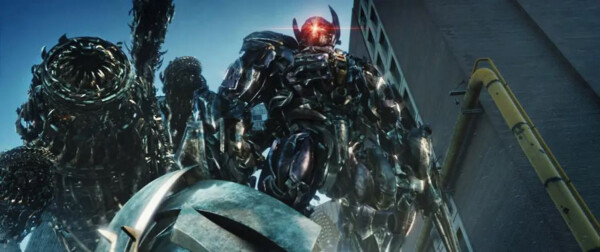
Image courtesy of Paramount.
—
“Transformers: Dark of the Moon” Starring Shia LaBeouf, Rosie Huntington-Whiteley, Tyrese Gibson, Josh Duhamel, Patrick Dempsey, Frances McDormand. Directed by Michael Bay. 157 minutes. Rated PG-13.
Mladen’s take
Two questions frequently visited my mind as I watched, in 3D, “Transformers: Dark of the Moon” on its opening weekend.
The first was: Where can I find the clearcoat that the Autobots use to protect their paint? The finish on every Autobot, when it was configured as a vehicle, shined brilliantly and the luster was undefeatable. Autobots would roll through a desert, but no dust clung to their paint. Autobots zigzagged through toppling, burning Chicago, but no soot attached to their exteriors. Amazing, I want protection like that for my non-GM car.
The second question was: When will this movie end?
Transformers 3 was “Battle: LA” multiplied by 2. Peril was interminable.
Every instance of Sam Witwicky, portrayed again by Shia LaBeouf, surviving a maelstrom of exploding light pulses and short-recoil hypervelocity projectiles was more absurd than the one that preceded it.
But, part of sitting down for a long time to watch this PG-13 blockbuster is suspending, completely, disbelief. That was made easier by the screenwriter’s effort to make Transformers 3 somewhat serious.
The film is coherent.
There are at least two betrayals in the toy-based movie. What Sentinel Prime, voiced by Leonard Nimoy, does to Optimus Prime would make former Vice President Dick Cheney flush with pride.
Humans, hit by photons, disappeared in puffs of gray ash, mimicking scenes in the 2005 remake of “War of the Worlds.”
The realism endures, though the director, I assume inadvertently, tried to wreck it.
Sam’s love interest is unconvincing.
Witwicky’s parents could have been deleted from the movie without it suffering one bit.
And, the film’s panoramic 3D shots looked childish. Cybertron at war was a tangle of metallic structures with fighting robots in stark relief against the background. They looked like plastic models set in motion. Air Force special operations airmen gliding through the Chicago skyline looked more like flying squirrels than hotshots trying to save Earth.
Product placement – I want to go buy a Lenovo computer now – is exceptionally annoying in 3D.
Another of the film’s strengths is decent acting.
America’s national director of intelligence is the woman who won the best actress Oscar for her portrayal of a cop in “Fargo.” One of the human bad guys, I was told by a friend, is the man who plays “Dr. McDreamy” in the TV show “Gray’s Anatomy.” John Torturro does an OK job reprising his quirky spy character.
“Transformers: Dark of the Moon” is the best movie of the franchise. Presumably, because the leader of the Decepticons, Megatron, is beheaded and his second-in-command, Starscream, blasted apart, there’ll be no others. There’s risk, of course, that the director and production company will opt for a prequel. Stay tuned, as I’m sure you will.
Transformers 3 is worth seeing in the theater, but the movie and all its mostly entertaining excess can be enjoyed without the extra several dollars you’d have to drop for 3D.

Del’s take
I don’t think Megatron is the only entity beheaded by this awful example of Hollywood bad-storytelling. Mladen must have been conked on the skull by a piece of Chicago’s falling skyline.
“Transformers: Dark of the Moon” is a disaster from top to bottom, the absolute worst of the three movies and the one that will convince me to never again waste my money on another Transformers movie.
Where do I begin? The bizarre score? The lousy acting and cheesy script? The absolute lack of internal logic? Or maybe the subtle discrimination. Everywhere I look in this movie I see: train wreck.
Let’s start with the score. It’s peppered with trendy clips from bands like Linkin Park, Stained, Skillet and My Chemical Romance, songs that have no business being in a rock ‘em sock ‘em action movie. It’s as if the movie’s makers wanted to endow their creation with a sound of currency, and introduce a note of empathy on the personal level. It didn’t work for me. Music is every bit a plot device as characterization, pacing and visuals. Movies like “A Clockwork Orange” and “Silence of the Lambs” used the score to, if you’ll pardon the pun, underscore the emotional amplitude of certain scenes. Here the music seems merely added on, as if cake icing were used to dress up a taco-cheeseburger-pizza.
There’s no fun in this script. There’s no fun in the actors’ performances. “Dark of the Moon” is 157 minutes of Shia LaBeouf screaming, “ GOTTA GO! LET’S GO! GO, GO, GO!” and “CARLY!” John Malkovich is a power player who looms large in LaBeouf’s employment future but becomes a simpering lap dog once the Autobots hit the fan, and the great Frances McDormand must surrender her role as national intelligence director who doesn’t care what LaBeouf did in the past to an irrelevant footnote once the Decepticons occupy Chicago and begin eradicating the populace. Critical scorn has been heaped upon Rosie Huntington-Whiteley, who plays LaBeouf’s love interest, but I found her performance to be one of the most consistent of the movie.
“Dark of the Moon’s” fatal flaw is the rampant contradictions of its own logic. I could compile a list as long as your arm but for brevity’s sake I’ll mention only two. Early in the movie the Autobots are told about a crash site on the moon that may contain the body of their leader, Sentinel Prime. They fly their own spaceship to the moon to recover his body. Yet when the Autobots are banished from Earth they must ride into space aboard a modified NASA shuttle. Um, what happened to the Transformer spaceship, guys? Second, when the Decepticons take over Chicago they seal off air access and shoot down anything trying to fly in, including speedy F-18 Hornets. Yet a flight of subsonic cruise missiles is able to penetrate their defenses, a formation of Ospreys manages to make it into the city, and soldiers hoofing it on the ground enter unmolested. It’s as if the rules of “Transformers” only apply for a few seconds.
Worse is the subtle discrimination the movie presents. Not to be a standard-bearer for all things politically correct but I was alarmed by the dialogue applied to LeBouf’s two “pet” robots, who tended to speak in black dialect and behave like clods. George Lucas took a hit for the same lapse with Jar-Jar Binks in “The Phantom Menace.” Also, an extended scene where a distraught Ken Jeong, in a men’s room stall, presents LaBeouf with evidence that the moon landings were a cover-up for something more insidious, struck me as an attempt to say, “People think we’re gay. Aren’t you embarrassed?” Would the audience have laughed if the joke had been at the expense of a Native American, a woman, or a disabled person?
“Dark Side of the Moon” has made a kabillion dollars at the box office, but I don’t care. It’s a lousy movie replete with contradictions, cheap stereotypes, a bad script and crappy acting. I’m tired of Sam Witwicky and his unbelievable foibles.
If this is what people consider quality entertainment I am clearly out of place with the times.
Mladen Rudman is a former journalist and technical editor. Del Stone Jr. is a former journalist and author.
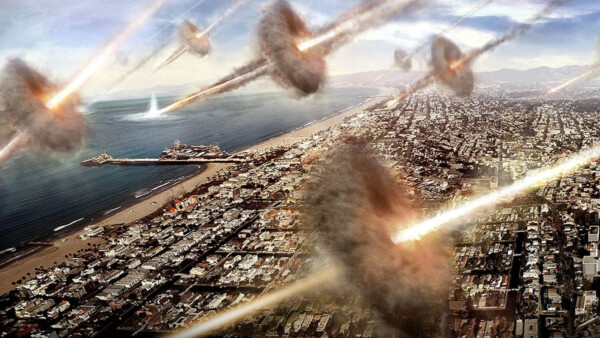
Image courtesy of Columbia Pictures.
—
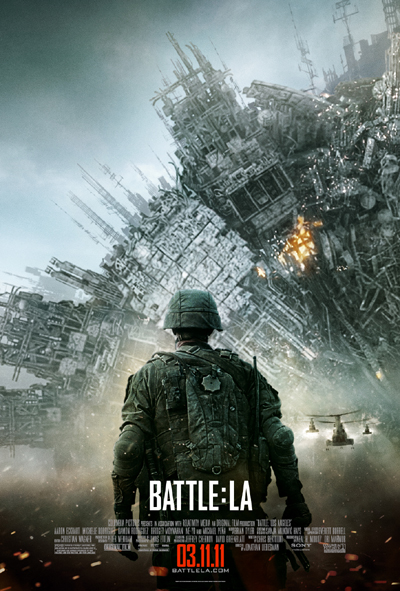
“Battle: Los Angeles” Starring Aaron Eckhart, Michelle Rodriguez, Bridget Moynahan. Directed by Jonathan Liebesman. 116 minutes. Rated PG-13.
Mladen’s take
Del and I exited the movie theater wondering why the flip no one in the American film industry can produce a good, original product anymore.
“Battle: Los Angeles,” a PG-13–rated sci-fi horror war film, is no exception.
A confession, first, though. I pledged some time ago to never again see a PG-13 movie. They trend toward sucking.
Then, a few weeks ago, I watched “Iron Man 2.” It was an entertaining film, so the PG-13 rating had at least temporarily redeemed itself in my eyes. But, answer one question for me. What happened to Mickey Rourke? No misunderstanding, please. Rourke did a fine job portraying a deranged, avenging Russian physicist in IM2. His appearance worried me, though. The actor’s aged body looked like it was sculpted by Donatello, but his face appeared to be the victim of a botched botox treatment.
Botoxicity might also be the cause of the shape of the heads of the aliens in “Battle for LA.” Their heads look like partially inflated pancakes suspended above elongated arms, legs, and torsos with the sheen of mercury.
“Battle,” Blair Witch Project-like, shadows a Marine squad fighting alien soldiers.
The heavily armed ETs invaded Earth to tap its substantial reserve of water in liquid state. Water is to the aliens what oil is to us, an energy source powering machinery.
“Battle” suffers many terminal flaws, among them:
– Incessant peril interrupted by spasms of unwarranted and unnecessary sentimentality or story backfill.
– Incessant violence that goes undeveloped because of PG-13’s ban on gruesome details in movies with adolescent boys as the target audience.
– An incessantly unoriginal plot, and …
– Incessant duration. “Battle” is 30 minutes too long, assuming it should have been made at all.
The film resurrected itself weakly very late into the story when two alien soldiers appeared aboard a floating gun platform that resembled something dear to my heart, the Wraith of “Halo” video game fame.
In fact, the visual and sound effects in “Battle” are the movie’s only plus.
It was clear that the water-dependent aliens cared nothing about ergonomics or aerodynamics while developing their ordnance and command, control, communication, and computer nodes. The alien arsenal looked primitive, almost gerrymandered, but offered hypersophisticated performance.
The water suckers punctured men, women, and children and toppled buildings with shrieking kinetic energy projectiles or booming chemical explosive warheads, just like mankind will do when it infests outer space. In the fight for LA, there’s no room for sissy laser guns or nukes, which would have contaminated everything.
Unfortunately, there was no room for provocative or consequential storytelling, either.
PG-13 movies are on my crap-list again. I just hope that I learned my lesson this time, once and for all.
Del’s take
Mladen, need I remind you the title of this feature is “Movie Faceoff”? How can we “face off” if we keep agreeing on everything?
To address your question about the American film industry’s inability to produce an original story I would answer: money. If you’re going to spend $70 million on a picture, the reputed budget for “Battle: Los Angeles,” you want assurances you’ll recoup that investment. In “Battle” those assurances amount to: known quantities.
I was expecting much of “Battle.” It would be the next “Dr. Zhivago,” a gritty telling of a society in transition and how the human spirit often transcends larger forces arrayed against it … ahem. Right. What I really expected was a kick-butt alien invasion movie that would hold me on the edge of my seat. For the most part “Battle” delivers on that expectation, but I’m troubled by its flaws, which are numerous and annoying.
The premise of the movie is fascinating – meteor swarms are crashing into the waters off large coastal cities to disgorge invading E.T. armies. The unfolding drama is revealed through televised news clips (though in “Battle’s” world social media don’t play much of a role … do “Battle’s” writers not tweet?). As Los Angeles retreats under the alien onslaught (a scene creepily reminiscent of tsunami footage from Japan) a squad of marines is sent to rescue a group of civilians stranded behind enemy lines.
Visual and sound effects are outstanding. The actors do their best with a script that lurches between predictability and ingenious levity (a Marine is called upon to hotwire a bus. Why him? Because he’s from New Jersey). Pacing is uneven as high-wire action scenes give way to slow, sleepy reflections on the human condition – which is not what I would be doing if alien jarheads were gunning their way into my little corner of the Starbucks fallout shelter.
The problems include what I would call logic flaws – the aliens are nearly impervious to gunfire until our band of brothers catches a live one and discovers its Achilles heel, a kind of heart that, when punctured by a bullet, sends E.T. to his great reward. Suddenly all the Marines – and even civilians – become crack shots and by movie’s end the aliens are falling to the stinkeye.
Also, this business of liquid water is pure and simple nonsense. We’ve known for years water is plentiful in the universe. Several moons in our own solar system are awash with water, both liquid and frozen. And if the aliens prefer their water in a liquid state, could they not grab a hunk of ice and … melt it? Agreed, watching ice melt is no fun. As every evil rancher knows, stealing somebody else’s water is so much more interesting. …
Which leads me to “Battle’s” greatest flaw: Its horrible cliches.
Early on as I struggled with “Battle’s” cinema verite shaky cam footage I decided I was watching “Saving Private Ryan” retold as “Black Hawk Down” with aliens. The visual storytelling technique Ridley Scott used in “Black Hawk” is duplicated here, and the story mirrors Steven Spielberg’s “Ryan” down to the climactic battle against German troops and tanks. In “Battle” we see otherworldly folk lurking on rooftops taking potshots at our squabbling squad, whose members struggle with the questionable leadership of their sergeant. C’mon, guys. “Known quantities” doesn’t mean “ripoff.”
And the ending, which I will not reveal, is just too corny for words.
“Battle: Los Angeles” would make a fine video game but as a movie it falls short in many fatal ways. If I had to rate it on a scale of A to F, I would give it a C-plus.
Save this one for Netflix streaming.
Mladen Rudman is a former journalist and technical editor. Del Stone Jr. is a former journalist and author.
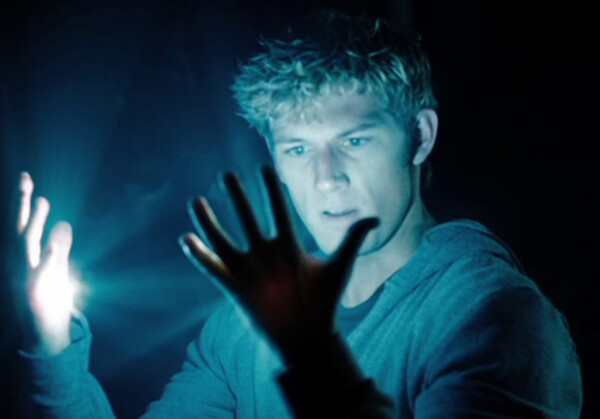
Image courtesy of Touchstone Studios.
—
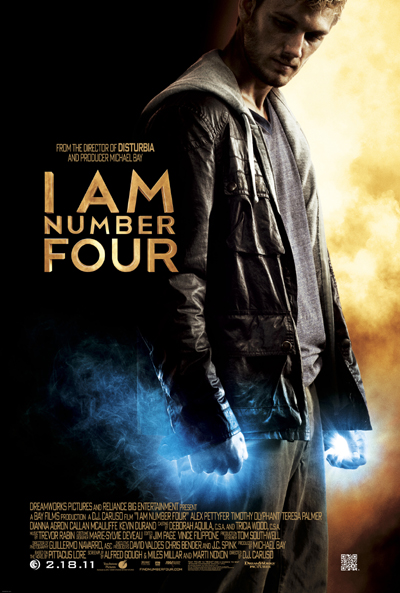
“I Am Number Four” Starring Alex Pettyfer, Timothy Olyphant and Dianna Agron. Directed by D.J. Caruso. 109 minutes. Rated PG-13.
(Note: Mladen Rudman could not make the screening of “I Am Number Four.”)
Sadly, “I Am Number Four” is not much more than a steaming pile of number two.
Why?
The film suffers from an extreme case of schizophrenia coupled with an identity crisis. Is it a love story? Is it an action movie? Is it “Twilight”? Is it a summer movie?
It is all of these things and consequently none, which leaves “I Am Number Four” hanging in sequel limbo, possibly lost forever to producers Michael Bay and Steven Spielberg who, along with novelist James Frey (writing as Pittacus Lore, upon whose books the movie is based ) clearly aimed to produce the next superhero teen-angst franchise.
The plot is simple … or maybe not. A small group of alien refugees has come to Earth after evil Mogadorians ransacked their world and slaughtered their people. They’re hiding among us, hoping to blend in, as a Mogadorian hit squad roams the world, killing them in order ( hence the title “I Am Number Four” ). Numbers one through three have been eliminated. John ( Pettyfer ) is next. He and his protector, Henri ( Olyphant ) arrive at a small town in Ohio where John enrolls in the local high school. He meets and develops feelings for the retro-chic Sarah ( Agron ); clashes with Sarah’s ex, Mark ( Jake Abel ), who happens to be the high school football team’s quarterback AND the son of the local sheriff; and hooks up with the school nerd, Sam ( Callan McAuliffe ), whose dad mysteriously disappeared while tracking down evidence of extraterrestrials. As the pecking order is sorted out the Mog hit squad arrives, looking very Matrixesque. All hell breaks loose. As hell is resolved and the potential for a sequel clarified, Number Six ( Teresa Palmer ) shows up and lends a gun to the climatic battle.
Is “Number Four” a love story? Well, sort of. Lots of quality time and kissing between John and Sarah, and not a wisp of romance between John and Number Six ( though Sam seems smitten by the blonde bombshell ). Clearly the two have a thing for one another, and Sarah has renounced her relationship with Mark. But – and this is a big “but” ( warning, spoilers follow ) – at the end of the movie John leaves Sarah ( or at least appears to do so … something that could easily be fixed in the next film) and we’re left wondering just how dedicated these two are to each other.
Is “Number Four” an action movie? It is if you stick around for the second half. In the first 30 minutes it’s nothing more than a massive info-dump and scene-setting vehicle. We see Number Three die and John and Henri leave their Florida hideout for the anonymity of Small Town Ohio. We see John go to high school and endure the alleged rituals peculiar to that stage of a person’s life. We get voice-over background about the Mog’s destruction of John’s home planet. Pretty boring stuff. Along about mile marker 34 things get interesting as the Mogs show up and John discovers the true extent of his alien powers ( lightning speed, super strength and flashlight hands! ). Meanwhile we also learn Sam’s dad’s disappearance might have had something to do with the Mogs, which makes him a permanent member of John’s growing retinue, and Number Six is closing in to make sure John doesn’t die ( What the heck is Number Five doing? Playing Farmville? ).
Is “Number Four” “Twilight”? You better believe it. Same target audience, same plot. I wouldn’t be surprised if Sam turns out to be a werewolf.
Lastly, is it a summer movie? Let’s put it this way: When the weather is cold I like to open a bottle of Redhook ESB, a hearty ale with a hefty bite that seems to keep the chills at bay. We’re talking “Winter’s Bone” or “The King’s Speech.” Come warmer weather, with its high heat and humidity, I switch to lighter, frothier fare, say a Corona Light. “Number Four” is definitely a Corona Light. It requires no thinking. So why was it released in February?
“I Am Number Four” is shot through with plot holes and logic flaws. No explanation is ever given for the Mogs inimical behavior, or why they must kill the refugees in order. John’s protector, Henri, is easily overcome and kidnapped by a couple of Ohio rednecks. Sarah’s picture-taking hobby seems peculiarly out of touch with the times as she uses ordinary film and develops her own prints. And only fleeting reference is made to why the Mogs must kill the alien refugees – apparently they’re capable of some great power, which begs the question: Why didn’t they use that power when their world was under attack?
Worse, “Number Four” is a cliché machine. Why must every new kid in high school fall in love with the ex-girlfriend of the football team quarterback who is the sheriff’s son? Why is the picked-on, shunned nerd really the smartest kid in school who has hidden strengths but doesn’t show them until a sexy protector arrives? Why must the viewpoint character discover his extraordinary powers while resisting school bullies? And why must every adult in the film be so clueless?
Acting was serviceable. Pettyfer is not a bad-looking fellow and Agron did as much with her role as she could. Better was McAuliffe, and my favorite character in the movie, the Mog commander, played by Kevin Durand, reveled in his evilness.
As of this writing “I Am Number Four” has made about $38 million at the box office. If it clears $100 million a sequel will probably be made.
Don’t hold your breath. The movie dropped 43 percent at the box office in its second week, which is a bad, bad sign. I expect it to top out in the $50 million to $60 million range.
“I Am Number Four” is, in my opinion, a Netflix movie. Save your ticket dollars for “Battle: Los Angeles.”
Del Stone Jr. is a former journalist and author.

Monsters-movie-image
Image courtesy of Magnet.
—
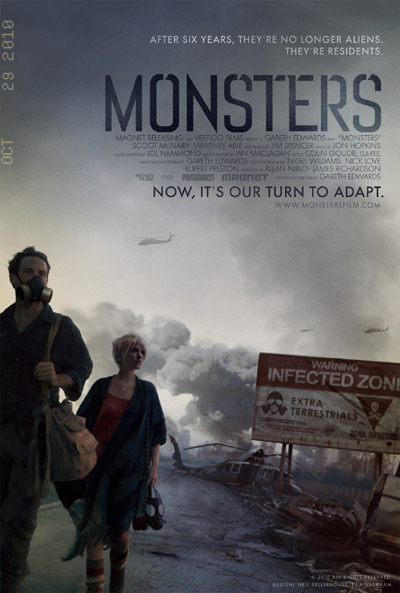
“Monsters” Starring Scoot McNairy and Whitney Able. Directed by Gareth Edwards. 94 minutes. Rated R.
Del’s take
Late in the movie “Monsters” there comes a moment a literary book reviewer might call “luminous.” Ever notice how literary book reviewers always bring the word “luminous” into play, as if to excuse the lack of plot, the unfolding of dreary characterization and the trendy massacre of clearly wrought prose? You will never hear a Larry Bond novel called “luminous.”
This illuminating moment takes place when our two protagonists, Andrew (Scoot McNairy) and Samantha (Whitney Able), witness two 300-foot tall walking squids engage in making out, foreplay, maybe actual intercourse – with all the flailing tentacles, bioluminescent pulsing and noble whale song-like groaning it’s hard to tell what’s going on. Andrew and Samantha watch in awe as these two leviathans perform the vertical bop and you expect them to whisper, “Beautiful” as they gaze adoringly at each other.
I was whispering “Will somebody please BLOW THESE THINGS UP?”
To paraphrase my friend Kari: “Monsters” is what happens when an indie filmmaker, the cinema equivalent of a literary writer, tells himself, “We have nothing to fear but fear itself … and monsters.”
“Monsters” isn’t about monsters, that’s for sure. The monsters are metaphors for Andrew and Samantha, or illegal immigration, or existential angst. But it is more about the message getting lost in a stew of competing thematic imperatives.
The story goes like this: NASA discovers evidence of life elsewhere in our solar system and dispatches a probe to recover a sample. The probe crashes somewhere in Mexico and shortly thereafter weird creatures begin disrupting the flow of cocaine to America. Andrew, a jaded photojournalist, goes into the “infected zone” to document the mayhem. But he somehow becomes responsible for escorting his publisher’s daughter, who has been in the area, back to the States. They try by land, sea and air but due to a series of setbacks, mostly caused by their own stupidity, they fail and must travel directly through the infected zone to reach the gigantic wall America has constructed along its border with Mexico. Along the way Andrew, who has a kid but not a wife, and Samantha, who is to marry a fellow she doesn’t love, discover a growing affinity for each other. Can you guess how this is going to end?
I will give Edwards credit: “Monsters” is ambitious. It is not another “Godzilla,” “The Mist” or “Cloverfield.” What I didn’t like about it, however, was the plodding pace, the incompetence of the characters and their forced transformations, which did not encourage me to suspend my disbelief.
Characterization is shaky. We are expected to dislike Andrew at first because of his cynicism, then bond to him as he realizes there’s more to life than shooting a prize-winning photo. In reality Andrew is a scummy opportunist who shacks up with prostitutes when Samantha won’t sleep with him, something he pursues with such diligence that Samantha could have had him arrested for sexual harassment. And Samantha, as the poor little rich girl, is a cipher with no real purpose for existence other than serving as an object of desire for Andrew.
At every critical juncture in their journey they pause, undecided, then embark on some irrelevant and unrealistic conflict that jeopardizes their success. For instance, at one point they must get off a boat and travel overland under the watchful eye of armed guards – except Andrew doesn’t want to because the guards are carrying guns. Um, excuse me, but what part of “armed” did he not understand? And in a land occupied by 300 foot-tall squids who like to squash human beings, would you rather your guards be armed with Nerf Frisbees?
And once they reach the wall, well. It’s every Tea Partier’s dream, a cement monolith designed to keep out “illegal aliens.” Except the aliens, as we see in the scene I referenced above, are nothing more than noble, benighted creatures who want nothing more out of life than a brief interlude of happiness amidst an uncaring world. Except they are 300 feet tall and like to squash humans. I say, “Will somebody please BLOW THESE THINGS UP?”
“Monsters” is an interesting movie but it has problems. On a scale of A to F I would rate it a C+.
Mladen’s take
Let’s start with a list.
They’re 300-foot-tall walking octopi, or is it octopuses? Get your mollusks straight, Del.
They do get blown up, you savage, it’s just not witnessed, and,
“Monsters” the movie has one of loveliest, mournfully serene soundtracks ever pasted to celluloid.
For me, the best way to characterize “Monsters” is this: The movie is deeply satisfying, but superficially disappointing.
It took me about 20 minutes to realize that the film was unlike a Godzilla smashfest, “Cloverfield,” or “The Mist.”
After that, I shed the expectation of carnage and allowed the movie to chart its own course. The story is about man’s inhumanity to man and our reckless belief that we can corral nature.
Samantha and Andrew are likable tools used to teach us a lesson. They do a good job leading us through the Infected Zone, where the alien creatures have established a sanctuary after being brought to Earth by a NASA probe that crashed.
Once in the zone, the duo exists to draw attention to the look of civilization as it’s consumed by its own folly.
Vines overtake hotels built for tourists.
An F-15 emerges from the depths of a river, playfully pulled through the black water by one of the tentacled beasts. It never bothers Samantha, Andrew, or the crew of the longboat hired at an exploitative price to help get the Americans back to America.
When the couple finally reaches the U.S.-Mexico border, it discovers that the zigzagging walled fortress separating one country from the other has been abandoned. The aliens had breached its ramparts. The fight has come to the Homeland.
Agreed, there’s some hokey symbolism in “Monsters.” Del already gave examples, but you have to give the director of the film credit for trying to create something original.
“Monsters” is an artsy film with a liberal message, which ain’t gonna play too good in these parts.
Sit back and enjoy the film, paying attention to events and scenes framing the relationship between Samantha and Andrew because that’s the movie’s strength.
Mladen Rudman is a former journalist and technical editor. Del Stone Jr. is a former journalist and author.
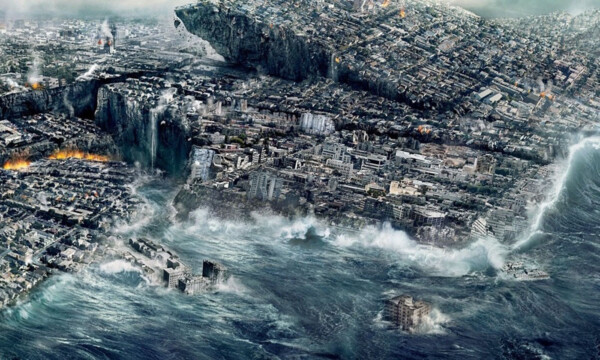
Image courtesy of Columbia Pictures.
—
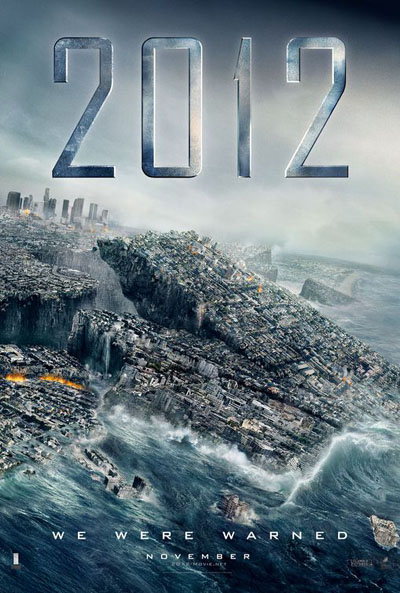
“2012” Starring John Cusack, Amanda Peet, Oliver Platt, Woody Harrelson and Danny Glover. Directed by Roland Emmerich. 158 minutes. Rated PG-13.
Mladen’s take
The film “2012,” now on DVD and Blu-ray disc, is a man-made disaster about a natural catastrophe.
“My gosh,” I said to myself about halfway through the longer than 2 1/2 hour movie, “can’t the world come to an end quicker?”
In “2012,” landmasses shift cataclysmically because mutant neutrinos from a solar flare superheat the Earth’s core. The Himalayas become the ocean’s flood plain. California becomes a part of the seafloor.
The upheaval results in hundreds of millions of deaths, unless you’re an Arab royal or Russian mobster who can afford to drop $1 billion euros per person for luxurious passage on secretly built “arks,” or happen to be a member of the Curtis family et al.
Ineptly, yet decisively, led by Jackson Curtis, as portrayed by John Cusack, the family ceaselessly eludes death by blunt trauma or scorching again and again and again and again.
The earth uplifts beneath their car, they escape.
Bridges collapse, they dodge.
The ground tears open at their feet, they scurry.
California explodes, they find an airplane to maneuver around toppling skyscrapers like a mosquito flying between raindrops.
A pyroclastic flow – ash spewing, acid sizzling, boulders flaming – comes gushing their way, but they outrun it.
Finally, don’t ask how, the Curtises reach the Himalayas, trudging through snow in search of the arks.
Just as they’re about to give up hope for the tenth time of surviving, along comes a Buddhist monk driving a pickup truck along a winding trail. He gives the Curtises a lift to a back entrance of the cavernous mountaintop shipyard where the monk’s brother, who helped build the arks, smuggles the whole lot aboard Ark 4, which belongs to America. What luck, eh?
The Curtises live and “2012” ends with three arks steaming for Africa, which apparently survived the churning core. Get it? Humans got their evolutionary start in Africa and now they’re returning to Africa for another beginning. “2012” teems with such philosophic wonderment and profound irony.
That the ships were called Arks, by the way, was the final straw for me.
I’m tired of sectarian references, in this case, ark as in Noah’s Ark, constantly appearing in catastrophe movies.
Why did “2012” director Roland Emmerich have to label the vessels that saved a small portion of corrupt, self-serving mankind, arks, as though the endeavor was noble?
It would have been more accurate to label the arks “survival ships for the filthy rich and slimy politicians.”
Or, the arks could have been called, “keep-the-privileged-alive semi-submersibles,” mimicking the DEA description of vessels drug traffickers use to move product along the coastlines of Central and South America.
Rent, do not buy, “2012” only if you have a potent surround sound system. The movie’s sound effects are its only merit.
Del’s take
Director Roland Emmerich blew up the White House in “Independence Day.” He knocked over the Statue of Liberty in “The Day After Tomorrow.” In “2012” he inundates, melts down and otherwise reduces to soggy molecules the entire world in an orgy of destruction that will leave you wondering what you did for entertainment before CGI made it possible to watch a tidal wave overwash the Himalayas.
If there is such a thing as “disaster porn,” “2012” is triple-X.
The storyline is simple: A freak burst of neutrinos from the sun is causing the earth’s core to heat up, resulting in an extinction-level event (to borrow a term from “Deep Impact”). Volcanoes the size of Wyoming will destroy vast swaths of countryside while earthquakes and tsunamis finish off what the volcanoes fail to vaporize.
The lead viewpoint character is John Cusack, a could-have-been writer who operates a limo service to pay the rent. He lives in a dump, oversleeps appointments and consistently lets down his ex-wife, Amanda Peet, and his two children. Peet has moved on to a new husband, a man with a solid job who provides her and the kids with a great house and lots of fun gadgets – not to mention contempt for Cusack’s fumbling inadequacies as a father and a man.
See where this is going?
Meanwhile strange events are unfolding around the world. Earthquakes open cracks along fault lines in California. Lakes boil away in Yellowstone Park. The church channel lady with the pink cotton candy hair shaves her head and gets a nose bob … OK, maybe that’s a little too weird but you get the picture.
What follows is a hair-raising series of improbable cliffhangers resulting in … well, let’s just say if you’re familiar with the Roland Emmerich formula you’ll not be disappointed.
“2012” is silly and stupid, but it’s also a lot of fun.
The science is non-existent. Take those pesky neutrinos. Neutrinos have no mass, which means they pass right through you and me, the buildings we inhabit, and the earth itself. How can something that has no mass heat the earth’s core?
In the movie we see a huge Russian transport airplane, an Antonov 225, perform a 60-degree power climb. Ain’t happening folks, not even with a crazy Russian hotdog of a pilot.
And “2012” seems to forget all about the nuclear winter hypothesis, which predicts that if you inject enough soot and dust into the atmosphere, the sun isn’t going to shine for months if not years.
I’m curious. Why do these disaster movies never take into account the hundreds of wrecked nuclear reactors around the world? All that plutonium has got to go somewhere.
And why does every disaster movie center around a divorced dad trying to win back the love of his children, if not his ex-wife? John Cusack’s role seems lifted directly from Steven Spielberg’s “The War of the Worlds” Tom Cruise character. Or “Independence Day.” Or even “The Day the Earth Stood Still.”
I guess we’re supposed to ignore those logic flaws as we watch an aircraft carrier of a surfboard take out the White House, or the San Andreas fault submerge the entire West Coast into the Pacific.
I can do that for two hours.
When “2012” debuted on DVD it blew away the competition. I had to ask the folks at the local Blockbuster if they had a copy behind the counter because the shelves were empty. As I waited, two more customers asked for it. (Speaking of which, don’t you hate the demise of the local DVD rental store? Netflix, Red Box and streaming are lousy substitutes for wandering the aisles as you check out the dust jackets on a DVD case.)
I give “2012” 3½ out of five stars, subtracting points for bad science and hackneyed storytelling, but awarding points for special effects and entertainment value.
Your $5 rental fee won’t have been wasted.
Mladen Rudman is a former journalist and technical editor. Del Stone Jr. is a former journalist and author.

Image courtesy of Warner Brothers.
—
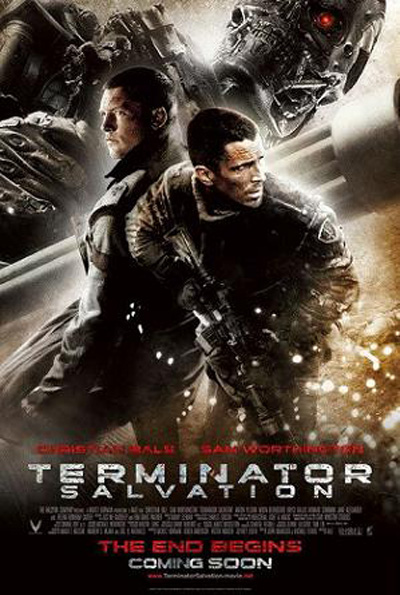
“Terminator Salvation” Starring Christian Bale, Sam Worthington, Anton Yelchin, Moon Bloodgood. Directed by McG. 114 minutes. Rated PG-13.
Mladen’s take
Take a little “Total Recall,” mix it with “Transformers,” sprinkle a tablespoon of “Mad Max,” bake at 350 degrees computer-generated special effects, and, voila, the result is “Terminator Salvation.”
“Salvation” is unable to compete with any of its three predecessors but it ain’t a bad film. One weakness is its PG-13 rating. There are plenty of explosions, but no close ups of bullets or shrapnel shredding bodies, or robo-hands tearing off heads.
The principal difference between “Salvation” and the other Terminator movies is that John Connor, humanity’s salvation, is now an adult and Kyle Reese, Connor’s father, is a child. Nevermind, it’s not worth explaining.
In the first three movies, the objective is to keep Connor alive. In the fourth, it’s making sure Reese avoids ingesting 40 7.67-mm rounds per second from a minigun.
Christian Bale, as Connor, plays what has now become a potentially career-ending typecast for him, a brooding, mopey hero.
The most interesting character in “Salvation” is the machine army’s first T-800 cybrid assassinator, which is unaware of its origin or allegiance. Sam Worthington portrays the cybrid, known as Marcus Wright.
Once you overlook the murkily explained way Wright becomes the next-generation terminator, his portrayal of a sentient machine enduring an identity crisis is fairly convincing.
Add to Worthington’s character the lovely and very human sidekick, A-10 pilot Blair Williams, and “Salvation” becomes more than palatable. Williams is played by Moon Bloodgood, a beautiful woman with the sexiest voice on the planet.
Typical of Armageddon-like movies, the post-apocalypse Earth in “Salvation” is drab browns, dark blues and assorted grays. Only flashing red lights and the orange of explosions adds color to the film.
It takes some suspension of contextual logic to consider mankind’s resistance against the encroaching world of a computer constellation with artificial intelligence plausible.
For example, if Skynet, the Vladimir Putin of the machinekind in “Salvation,” is so smart, lethal, and efficient, why did it fail to nuke all of America’s military bases and repair depots? I ask because the humans in the film have access to a broad range of weapons. From MV-22s to a nuclear-powered attack submarine, Connor and his troops avoid the uncomfortable position of fighting robots with clubs and rocks.
“Salvation” gets three stars out of five, if for no other reason than its respectful bow toward the end to the greatest terminator of all, the now politically besieged governor of California.
Del’s take
Let’s see if I can nail down the premise of “Terminator Salvage Operation”: John Connor must jack into the Matrix where his mentor Obi Wan has been captured by an alien face-hugger. There he meets Gandolf, who wields a mean club when the Road Warrior attacks, but they escape with the aid of Mr. Spock who is undergoing the colon-cleansing ritual of pon-fart.
I swear. There were times during “Terminator Salvation” when I thought I was watching “The Road Warrior,” “Transformers” and maybe just a wee bit of “Star Trek,” “Alien” and “Lord of the Rings.”
These science fiction franchises have become about as interesting and fun as a civil service employment application. They’re way too complicated and take themselves way too seriously, and their creators seem to have forgotten that story will always trump effects.
Worse, they’re all borrowing stuff from each other, sort of like a taco pizza cheeseburger.
Here’s the rundown on “Salvation”: It occurs after “Judgment Day,” the day a vast computer system called Skynet becomes self-aware and decides to pan-roast humanity with the nuclear bombs it has been put in charge of (and this date conveniently shifts from movie to movie. In the original “Terminator” it was Aug. 29, 1997. In “Terminator 2: Judgment Day” it’s July 25, 2004, presumably because of meddling in the timeline. In the TV show “Terminator: The Sarah Connor Chronicles” it’s moved to April 2011 … can’t they just settle on a date and be done with it?).
After pushing the button Skynet decides to rid the world of pesky human survivors by building a global network of machines that work 24/7 to hunt down human beings and kill them. Humanity, deprived of its Netflix popups and angry because of it, retaliates by organizing resistance fighters who live underground, eat rats, and have access to phase plasma rifles in the 40-watt range (an homage … get it?).
John Connor, the anointed savior of mankind, must make sure his dad, the teenaged Kyle Reese, lives long enough to go back in time and impregnate his mother, Sarah Connor. Meanwhile the first human-like Terminator awakens and thinks he is human, never believing he might have been programmed to do what he spends most of the movie doing. Amazingly he bumps into Reese, one of two survivors living in Los Angeles, and then the movie becomes one big fist punching, guns blazing, jets screaming, atomic-bomb exploding craptravaganza.
I was wrong. This isn’t a civil service employment application; it’s Donald Trump’s tax return.
Christian Bale becomes tiresome as the eternally brooding, always angry John Connor. I keep remembering that insane tirade (warning: extremely foul language) by Bale posted on the Internet where he threatened to beat the &@$% out of the director of lighting for interrupting his shot. Moon Bloodgood irritates me because her name is so obviously contrived. And how did Anton Yelchin (“Star Trek”) score two of the biggest movies of the summer season?
One bright note is Sam Worthington as the Terminator who doesn’t know he’s a Terminator. Oops! Spoiler? No problema, baby. It’s telegraphed in the first five minutes.
I have two regrets about “Terminator Salvation.”
No. 1: There was no “Battlestar Galactica” tie-in.
No. 2: I spent $7 seeing this in the theater when I could have waited for it to show up in the $5 bin at Walmart.
From what I hear there’s a T5 in the making.
I guess the Terminator will be back.
Mladen Rudman is a former journalist and technical editor. Del Stone Jr. is a former journalist and author.
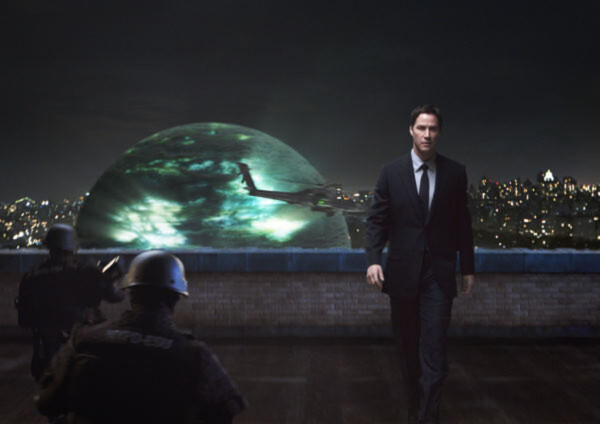
Klaatus (Keanu Reeves) arrival on Earth via a giant sphere, triggers a global upheaval.
Image courtesy of 20th Century Fox.
—
“The Day the Earth Stood Still,” starring Keanu Reeves, Jennifer Connelly, Kathy Bates, Jaden Smith, and John Cleese. Directed by Scott Derrickson, 103 minutes, rated PG-13.
Mladen’s take
Add the recently released re-make of “The Day the Earth Stood Still” to the ever-growing list of hokey films about redemption.
In fact, if you’re tired of watching Rudolph the red-nosed reindeer and his dwarf friend discover that they’re wonderful beings no matter what anyone else believes, consider “The Day the Earth Stood Still” as alternative holiday viewing fare. Here, the whole of humanity is redeemed.
There are no subtleties in this sci-fi movie.
Klaatu, the alien portrayed by Keanu Reeves, arrives aboard a cloudy, sparkling sphere. He’s an interstellar diplomat without portfolio sent by a god-like cabal of deep-space civilizations.
Klaatu’s mission is to evaluate Earth’s health. The prognosis ain’t good.
It isn’t too long before he tells astrobiologist and unwitting ally Helen Benson, played by Jennifer Connelly, that extra-galactic help would be needed to save the planet.
Benson assumes that means helping humanity but eventually figures out she’s mistaken. Klaatu had concluded that the only way to save Earth is by eradicating mankind.
The universal diplomat, protected by GORT, a very impressive gigantic automaton comprised of nano-sized wasps behaving as a single being, initiates Operation Roach Motel after explaining to Benson that, in essence, humanity is a cosmic error.
Meanwhile, what does the U.S. Defense Department do when it encounters hyper-intelligent, unbelievably technologically sophisticated entities from distant worlds? It tries to kill them, of course.
Throughout the movie, Klaatu or GORT turn military target acquisition devices, laser illuminators and high-performance aircraft against the troops using them. The aliens – masters of the electro-magnetic spectrum, severe traumatic injury repair, pure reason, and unemotive faces – gain control of the weapons systems by wireless hacking.
It takes Benson’s unceasing effort to protect her belligerent young stepson and a brief exchange of mathematical equations and a little conversation with a Nobel Prize-winning scientist for Klaatu to start recognizing that humanity ain’t all bad.
It seems – and this has never, ever, been expressed in other movies, books, poems, pamphlets, hieroglyphics or pre-Sumarian script – that humanity can become its best only after demonstrating its worst. The Nobel laureate argues that mankind has some kind of intrinsic sense that will let it know when there has been enough bloodletting and destruction of the environment, as well as the moral fortitude to correct those mistakes when the time comes.
Klaatu starts seeing the microscopic good among the overwhelming evil around him and reverses his decision to obliterate all traces of humanity. The mechanism for scraping clean the Earth’s surface is the neatest visual part of the movie. GORT dissolves into a swarm of flying nano-bots that consumes everything in its path, organic or inorganic.
The swarm is one of a few transparently biblical references in “The Day the Earth Stood Still.” Hell, at one point Klaatu even walks on water. Hallelujah.
“The Day the Earth Stood Still” is an OK movie, probably worth the price of a matinee ticket. But, I’m worried about Reeves. Come on, man, next time give me something as spectacular and revolutionary as “The Matrix.”
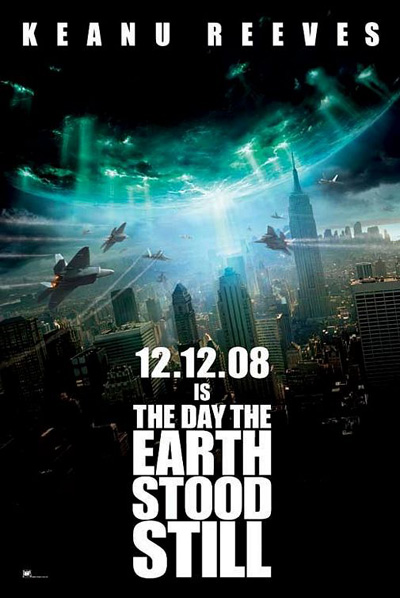
Del’s take
It isn’t the Earth that’s standing still – it’s Hollywood.
Talk about a movie that didn’t need remaking. “The Day the Earth Stood Still” circa 1951 is a Robert Wise classic that to this day presents a quietly dignified message about the follies of war.
“The Day the Earth Stood Still” circa 2008 is a diabetic coma-inducing fried Snickers bar of a mess, covered with sugar-dot cliches and gluey nuggets of contrived melodrama – all of it wrapped in a cloying caramel blanket of unconvincing CGI.
I’m still trying to figure out which cliché most nauseates me – the save-the-environment cliché, the racial-harmony cliché, the empowered woman cliché, the all-government-employees-are-evil cliché, the stupid-military cliché … see what I mean? One more cliche and you’d have a C-bomb big enough to do the aliens’ work for them.
Most of the characters in “The Day the Earth Stood Still” are cardboard cut-outs with Keanu Reeves winning the Oscar for Best Performance by a Stoned-Out Quualude Refugee. The lone exception is Will Smith’s kid, Jaden, who plays the rebellious and disrespectful stepson of Jennifer Connelly’s Helen Benson character (has there ever been a stepchild who liked his new mom or dad?).
Let’s not talk about logic flaws … well heck, let’s do.
Here’s the deal: The aliens have come to Earth because there are few habitable planets in the galaxy and humanity is ruining this one. To fix everything the aliens plan to unleash a biblical horde of tiny robots that will dismantle mankind molecule by molecule, restoring the earth to pristine form … presumably to serve as home base for a future alien megalopolis.
Stop and think about it – if E.T. has that kind of technology, why not unleash it on an uninhabitable world, making it habitable? Science calls the process “terraforming,” a piece of cake for Klaatu and pals.
But then there’d be no movie – albeit a stupid movie, and be $8 to the richer. And I could use that $8 to make the world a better place so we’d never again be afflicted with Keanu Reeves.
Or I could just buy beer to wash away the taste of this nasty movie.
Mladen Rudman is a former journalist and technical writer. Del Stone Jr. is a journalist and author.