Mladen and Del review ‘Project Hail Mary’
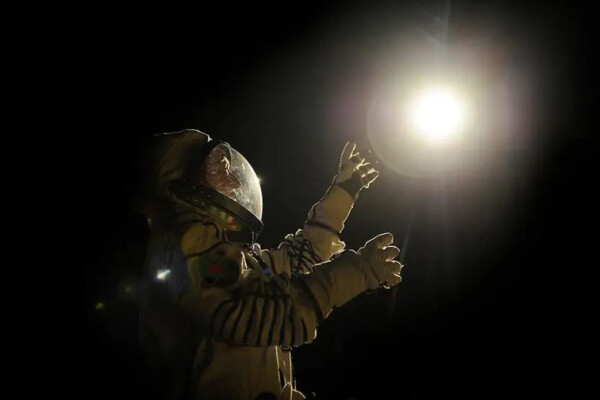
Image courtesy of Amazon-MGM.
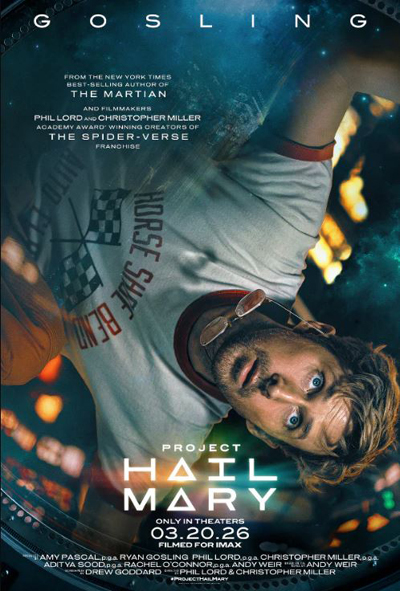
“Project Hail Mary” Starring Ryan Gosling as an insufficiently curious xenobiologist Ryland Grace; James Oritz as (eventually) the voice of Rocky the alien; Sandra Huller as the stone‑cold yet bewilderingly attractive Project Hail Mary program manager Eva Stratt; and others. Directed by the duo of Phil Lord and Christopher Miller. Runtime a too-long 2 hours, 36 minutes. Rated PG-13. Theatrical release.
Plot summary: The Sun is threatened by a species of microorganism (Grace calls them “astrophages”) that consumes stars, which puts Earth in danger. If the sun dims too much, photosynthesis will decline and everything, including civilization, will go the way of democracy. The planet’s governments come together (yeah, right) to send an expedition to a star light years away that has somehow beaten back the astrophages eating everything else in our neck of the galactic woods using fusion to produce light and heat. Things go wrong. Our hero encounters an alien – his/hers/their planet is in trouble, too, because their sun is on the menu – and the two of them cooperate to find a way to defeat the star eaters.
Spoilers: Not if you read the book.
Mladen’s take
I can think of a couple of very good movies featuring humans and space aliens becoming buddies, “Enemy Mine” (1985) and “Alien Nation” (1988). The Star Treks and Kirk and Spock. More recently, there’s “Predator: Badlands.” Yes, yes, there are technically no humans in Badlands but synthetics Thia and Tessa are close enough.
In that regard, “Project Hail Mary” misses the mark. It isn’t Gosling’s fault as Grace or Oritz’s depiction of Rocky that made their friendship in the movie seem, ah, inert. The trouble is seeing Rocky for what the alien is, rock‑like. I’m used to placing rocks in my aquarium without worrying that I’m drowning a living being. Also, to me, anyway, rocks are repositories of past life – fossils – rather than sentient, self-aware creatures alive today who multiply by what, sexual sedimentation or crack fissuring.
The problem with “Project Hail Mary” is that it came in book form first and I read the book. Though I can’t recall the details in the book, I can recall that my imagination allowed me to interpret Rocky as some sort of fauna rock, an animal that was also vegetable and mineral. No such luck in the film. The Eridian – that’s the name of Rocky’s species – was there for me to “see” with my eyes.
Rocky is constructed of short columns of jointed hard material that made fingers and limbs, which articulated, and a thorax holding it all together. What held him together, allowed him to move? A pliant crystalline matrix like fiber-optic cabling? Ammonia‑soluble tendons that deformed whenever Rocky’s iron ore other‑than‑nervous system rusted on command? How the hell could the Eridian chitter like an insect? Golly, and this is terrible, I had the urge to vivisect Rocky to see what made him tick.
B+ “Project Hail Mary” is worth the time to see in a movie theater. There is enough action, even if that action is, in part, dependent on an implausibly maneuverable space ship, to justify dropping extra change for a Dolby theater seat. The scene where Grace and Rocky trawl the upper atmosphere of a planet to collect astrophages and something else is darned good.
I looked forward to scenes with Huller as Stratt. It was the precision of her diction when speaking English. It was her unapologetic focus on saving humanity, though it required sacrificing individuals who belong to that humanity. It was her humorous severeness and knack for taking a line of reasoning or an excuse to avoid doing this or that to the end of the line. Something like, “Grace, you say you want to stay on Earth to teach children. Well, if you stay, there will be no children to teach.” What a guilt trip. And, I must say, I loved Grace for ignoring it.
Del’s take
Mladen is too generous with his review of “Project Hail Mary.” I didn’t fall asleep once during the movie, but not because it was exciting. The theater was freezing and I’d left my hoodie in the car. I thought “Hail Mary” was boring – B-O-R-I-N-G. And it was stupid – this, from a guy who not only grew up reading science fiction but wrote a few SF stories of his own.
I wish Amazon had taken some of the $$$ it spent on “Melania” and used it to make “Hail Mary” better, maybe a little more scientifically plausible, maybe a little less slapsticky. As it stands, the movie is structurally too complicated, is inconsistent in tone, is way too long, and it failed to convince me to suspend my disbelief.
According to Mladen, “Hail Mary” is 2 hours and 36 minutes. It felt like 2 days and 36 hours. It was a two-bathroom-visits movie for me. To paraphrase a British critic who reviewed one of my books, it could have benefitted from a savage pruning of excess beats. As Mladen pointed out, the movie was not about teaching English to an alien; it was about figuring out how to kill the little bastards eating our sun, so the whole teaching-the-alien bit could have been left on the cutting room floor. And other parts should have qualified for a savage pruning. I’ll get to those in a minute.
Is “Hail Mary” a comedy? At times I thought it was. There were moments of physical comedy – actual slapstick – and the script was mostly a series of jokes and verbal pratfalls that at first were cute but soon became irritating and distracting. It was impossible to take anything I was seeing on the screen very seriously because the movie did not take itself very seriously. That may sound like a good thing but trust me, a movie about the end of the world should not be funny. Satirical? Maybe. “Don’t Look Up” and “Doctor Strangelove” come to mind. But comedic? Hardly.
The story is told through a series of flashbacks woven through a current-time narrative, and that proved to be difficult to follow, especially at the beginning when Grace awakens aboard the spacecraft with no memory of how he got there. Again, I would ask: Is that what this movie is about? No? Then why waste the audience’s time telling them things that have no bearing on the outcome of the story?
In films from the Star Trek and Star Wars universes I can accept scientific implausibilities – hyperlight, the Force, teleportation. Those movies are more fantasy than science fiction. But in a movie like “Hail Mary,” which grounds itself in science, the implausibilities become much more glaring and harder to forgive. Gosling’s character awakens after four years of zero-G induced coma. His bones should have looked like a plastic McDonald’s straw. Yet he’s able to bound around and grab hurtling spaceship parts as if he were Thor. No effing way is that gonna happen. And again, as Mladen pointed out, the spaceship maneuvering was just impossible – comedically impossible. And there were others – Rocky’s seemingly endless supply of food and air, and Grace’s endless supply of crap that would never be allowed on a starship having to contend with mass constraints. Deus ex machine was Grace’s co-pilot.
A plus was Gosling’s performance, which I thought was superb. And Mladen was right about Huller. She was spectacular. In fact, of all the characters in “Hail Mary” she was the only one I could relate to in any human sense.
“Hail Mary” is cleaning up at the box office and moviegoers are giving it Rotten Tomato scores in the 90s. Amazon needs the movie to pull in around $400 million to break even, and that will probably happen. All said, that makes me look like a cranky, impossible-to-please old fart. Maybe so. But judging by all the movies I’ve given A scores to over the years, I’d say that’s not true. I just want my movies to be really, really good, and for all the reasons I’ve listed here, I don’t think “Project Hail Mary” meets that description. Feel free to go see it and judge for yourself.
I’m giving it a score of a B-, and I think that’s generous. Maybe a C+.
Mladen Rudman is a former journalist and technical writer. Del Stone Jr. is a former journalist and writer.

great review, thanks for the details, and Im not sure I will see it any time soon but I know that if I do, that I will need two nights to watch:)