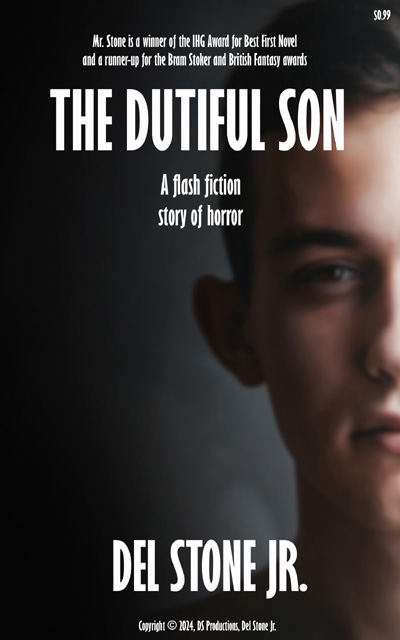
The Dutiful Son (a flash fiction horror story)

Image courtesy of Pxhere by way of a Creative Commons license. https://pxhere.com/en/photo/1222994
INTRODUCTION
The hardest thing you may ever have to do is bury a child. The second-hardest is burying a parent.
When my father passed away, only a year after I wrote this story, I felt like an orphan. Worse, I was now responsible for my mother. I had two siblings, but one lived 35 miles away and the other a thousand. I lived only a mile or two from Mom, so I became the go-to sibling for Mom Problems – the stopped-up sink, the car that wouldn’t start, the strange sound outside the door at night.
Was I up for the challenge? We’d soon find out.
Not a week after Dad passed, Mom was on the phone asking about a piece of paperwork from the bank. It was about her IRA. I came over to check. It looked like all the funds had been withdrawn. How was that possible? Mom started crying. She had no idea what to do, so I told her I’d take care of it, and the next day I was at the bank trying to find out what had happened.
Turns out, it was a kind of receipt. When the IRA was taken out of Dad’s name and put in Mom’s, a new account had to be created and the funds rolled over from Dad’s account to Mom’s. That’s all.
But it was the first of many, many jobs I had to do for Mom over the coming years. She passed in 2022, outliving my father by 24 years. That was 24 years of medical emergencies, hurricanes, car accidents, balky washing machines and scam artists who prey on the elderly I presided over. I look back on it and wonder how I managed – while working a full-time job and dealing with my own medical emergencies, balky washing machines and scam artists.
It was stressful and solutions were hard work – but nothing like the solution provided by the dutiful son in this short story!
You’ll be pleased to know this is NOT autobiographical, and it wasn’t based on real events.
If you’re not pleased about that, I sure am!
THE DUTIFUL SON
“It’s perfectly normal to feel guilt when your parents pass away,” Bob Harrison said quietly, his voice in resonance with the gloom that shrouded the living room. It was a dark day, and the curtains were drawn, and two kind and gentle people had just died.
The other man, young Ed Masters, reached to the side of his La-Z-Boy and yanked the lever that raised the footrest. Then he leaned back and stared Bob straight in the eye and said, “I should have spent more time with them, but that’s OK. My parents will live in me for the rest of my life.”
Harrison nodded. “Yes. In all of us.” He did not know if the words would comfort Ed, but he felt he must try. Barbara and Clayton Masters had been loving and devoted members of their Unitarian Universalist congregation for many years, and now they would have every answer to every question life had ever posed to them, having passed away within a day of one another, a rare partnership in existence that transcended mortal bounds. Harrison almost envied them, but he would mourn only their absence as they had gone to whatever better place lay in store for them.
But young Ed had rarely attended services, and Harrison doubted he harbored any belief system at all. So Harrison had dropped by to visit, to make sure Ed was holding up OK. It was the least he could do for Barb and Clay.
“Will there be services?” Harrison asked. Ed shook his head.
“Nope. Why should there? My parents are alive. In me.”
Harrison tried not to let a frown creep into his expression. Young Ed seemed firm in his convictions – too firm, for somebody who had just lost his parents. Harrison pressed on.
“Will your parents be buried or cremated?”
“Neither,” Ed said.
“I don’t understand.”
Ed rolled his eyes. “Look, I know you’re trying to help, but I don’t need it. Really.” He stretched in the recliner. “I don’t feel any guilt about not spending time with my folks. I’m with them all the time. I’ve taken care of that.”
“What have you done?” Harrison asked.
“I’ve taken care of it,” Ed answered evenly, a whiff of anger heating the words.
Harrison spread his hands. “I ask because Barb and Clay were well-liked by the members of our congregation, and we’d like to honor their memory somehow.”
“Then have your own services,” Ed snapped. “I’ve already had mine.”
Something was wrong here. That dull, boorish component to young Ed’s personality was hanging over the room like a thundercloud, grief-stricken or not. And he did not seem so grief-stricken at that, Harrison heard himself thinking. Young Ed seemed almost defensive.
“What became of the remains?” Harrison asked.
Ed glared at him. “Is that important?”
“Yes,” Harrison shot back. “Barb and Clay were my friends, and I want to know what you did with them.”
He could see the color rising in young Ed’s cheeks, the anger blooming there like some horrible, crimson flower. And then just as quickly it broke, and Ed let out his breath in a hitching sigh that somehow seemed contrived.
“Will you please just leave me alone?” he sobbed. “Yes, I should have spent more time with them, but I’ve taken care of that. They’ll be with me always now.”
Harrison stood up abruptly and glowered at him. This was an act, a facade, a pretense of grief to throw him off track. He had the horrible feeling that the bodies were here, in this house, and an image sprang to mind of two desiccated corpses being discovered in the back bedroom years hence. It was more than Harrison could bear. Barb and Clay deserved better than that.
He marched down the hallway and began searching the bedrooms. Behind him, he heard young Ed shouting, “What the hell are you doing? Have you gone crazy?”
He went through the bedrooms, and the back bathroom, and then he tromped down the stairs and into the basement. He climbed back upstairs and thumped up into the attic.
Nowhere. They were nowhere. He came back downstairs. Young Ed stood in the hallway by the kitchen, leaning insolently against the wall. Harrison drew up to him and hissed, “I don’t know what you’ve done, but I’m calling the law on this.”
Young Ed smirked, “Be my guest,” and crossed his leg, bumping the kitchen garbage can. The lid toppled over, but not before Harrison spotted the bone inside, gnawed to the gristle.
A lump formed in his stomach. His gaze wandered to young Ed’s eyes. For the first time, he saw the true insanity lurking there.
“I told you,” young Ed said, his voice devoid of any emotion that could be called human. “My folks are alive. In me.”
About the author:
Del Stone Jr. is a professional fiction writer. He is known primarily for his work in the contemporary dark fiction field, but has also published science fiction and contemporary fantasy. Stone’s stories, poetry and scripts have appeared in publications such as Amazing Stories, Eldritch Tales, and Bantam-Spectra’s Full Spectrum. His short fiction has been published in The Year’s Best Horror Stories XXII; Alfred Hitchcock’s Mystery Magazine; the Pocket Books anthology More Phobias; the Barnes & Noble anthologies 100 Wicked Little Witch Stories, Horrors! 365 Scary Stories, and 100 Astounding Little Alien Stories; the HWA anthology Psychos; and other short fiction venues, like Blood Muse, Live Without a Net, Zombiesque and Sex Macabre. Stone’s comic book debut was in the Clive Barker series of books, Hellraiser, published by Marvel/Epic and reprinted in The Best of Hellraiser anthology. He has also published stories in Penthouse Comix, and worked with artist Dave Dorman on many projects, including the illustrated novella “Roadkill,” a short story for the Andrew Vachss anthology Underground from Dark Horse, an ashcan titled “December” for Hero Illustrated, and several of Dorman’s Wasted Lands novellas and comics, such as Rail from Image and “The Uninvited.” Stone’s novel, Dead Heat, won the 1996 International Horror Guild’s award for best first novel and was a runner-up for the Bram Stoker Award. Stone has also been a finalist for the IHG award for short fiction, the British Fantasy Award for best novella, and a semifinalist for the Nebula and Writers of the Future awards. His stories have appeared in anthologies that have won the Bram Stoker Award and the World Fantasy Award. Two of his works were optioned for film, the novella “Black Tide” and short story “Crisis Line.”
Stone recently retired after a 41-year career in journalism. He won numerous awards for his work, and in 1986 was named Florida’s best columnist in his circulation division by the Florida Society of Newspaper Editors. In 2001 he received an honorable mention from the National Lesbian and Gay Journalists Association for his essay “When Freedom of Speech Ends” and in 2003 he was voted Best of the Best in the category of columnists by Emerald Coast Magazine. He participated in book signings and awareness campaigns, and was a guest on local television and radio programs.
As an addendum, Stone is single, kills tomatoes and morning glories with ruthless efficiency, once tied the stem of a cocktail cherry in a knot with his tongue, and carries a permanent scar on his chest after having been shot with a paintball gun. He’s in his 60s as of this writing but doesn’t look a day over 94.
Contact Del at [email protected]. He is also on Facebook, twitter, Pinterest, tumblr, TikTok, and Instagram. Visit his website at delstonejr.com .

Leave a Reply