The Dutiful Son (a flash fiction horror story)

Image courtesy of Pxhere by way of a Creative Commons license. https://pxhere.com/en/photo/1222994
INTRODUCTION
The hardest thing you may ever have to do is bury a child. The second-hardest is burying a parent.
When my father passed away, only a year after I wrote this story, I felt like an orphan. Worse, I was now responsible for my mother. I had two siblings, but one lived 35 miles away and the other a thousand. I lived only a mile or two from Mom, so I became the go-to sibling for Mom Problems – the stopped-up sink, the car that wouldn’t start, the strange sound outside the door at night.
Was I up for the challenge? We’d soon find out.
Not a week after Dad passed, Mom was on the phone asking about a piece of paperwork from the bank. It was about her IRA. I came over to check. It looked like all the funds had been withdrawn. How was that possible? Mom started crying. She had no idea what to do, so I told her I’d take care of it, and the next day I was at the bank trying to find out what had happened.
Turns out, it was a kind of receipt. When the IRA was taken out of Dad’s name and put in Mom’s, a new account had to be created and the funds rolled over from Dad’s account to Mom’s. That’s all.
But it was the first of many, many jobs I had to do for Mom over the coming years. She passed in 2022, outliving my father by 24 years. That was 24 years of medical emergencies, hurricanes, car accidents, balky washing machines and scam artists who prey on the elderly I presided over. I look back on it and wonder how I managed – while working a full-time job and dealing with my own medical emergencies, balky washing machines and scam artists.
It was stressful and solutions were hard work – but nothing like the solution provided by the dutiful son in this short story!
You’ll be pleased to know this is NOT autobiographical, and it wasn’t based on real events.
If you’re not pleased about that, I sure am!
THE DUTIFUL SON
“It’s perfectly normal to feel guilt when your parents pass away,” Bob Harrison said quietly, his voice in resonance with the gloom that shrouded the living room. It was a dark day, and the curtains were drawn, and two kind and gentle people had just died.
The other man, young Ed Masters, reached to the side of his La-Z-Boy and yanked the lever that raised the footrest. Then he leaned back and stared Bob straight in the eye and said, “I should have spent more time with them, but that’s OK. My parents will live in me for the rest of my life.”
Harrison nodded. “Yes. In all of us.” He did not know if the words would comfort Ed, but he felt he must try. Barbara and Clayton Masters had been loving and devoted members of their Unitarian Universalist congregation for many years, and now they would have every answer to every question life had ever posed to them, having passed away within a day of one another, a rare partnership in existence that transcended mortal bounds. Harrison almost envied them, but he would mourn only their absence as they had gone to whatever better place lay in store for them.
But young Ed had rarely attended services, and Harrison doubted he harbored any belief system at all. So Harrison had dropped by to visit, to make sure Ed was holding up OK. It was the least he could do for Barb and Clay.
“Will there be services?” Harrison asked. Ed shook his head.
“Nope. Why should there? My parents are alive. In me.”
Harrison tried not to let a frown creep into his expression. Young Ed seemed firm in his convictions – too firm, for somebody who had just lost his parents. Harrison pressed on.
“Will your parents be buried or cremated?”
“Neither,” Ed said.
“I don’t understand.”
Ed rolled his eyes. “Look, I know you’re trying to help, but I don’t need it. Really.” He stretched in the recliner. “I don’t feel any guilt about not spending time with my folks. I’m with them all the time. I’ve taken care of that.”
“What have you done?” Harrison asked.
“I’ve taken care of it,” Ed answered evenly, a whiff of anger heating the words.
Harrison spread his hands. “I ask because Barb and Clay were well-liked by the members of our congregation, and we’d like to honor their memory somehow.”
“Then have your own services,” Ed snapped. “I’ve already had mine.”
Something was wrong here. That dull, boorish component to young Ed’s personality was hanging over the room like a thundercloud, grief-stricken or not. And he did not seem so grief-stricken at that, Harrison heard himself thinking. Young Ed seemed almost defensive.
“What became of the remains?” Harrison asked.
Ed glared at him. “Is that important?”
“Yes,” Harrison shot back. “Barb and Clay were my friends, and I want to know what you did with them.”
He could see the color rising in young Ed’s cheeks, the anger blooming there like some horrible, crimson flower. And then just as quickly it broke, and Ed let out his breath in a hitching sigh that somehow seemed contrived.
“Will you please just leave me alone?” he sobbed. “Yes, I should have spent more time with them, but I’ve taken care of that. They’ll be with me always now.”
Harrison stood up abruptly and glowered at him. This was an act, a facade, a pretense of grief to throw him off track. He had the horrible feeling that the bodies were here, in this house, and an image sprang to mind of two desiccated corpses being discovered in the back bedroom years hence. It was more than Harrison could bear. Barb and Clay deserved better than that.
He marched down the hallway and began searching the bedrooms. Behind him, he heard young Ed shouting, “What the hell are you doing? Have you gone crazy?”
He went through the bedrooms, and the back bathroom, and then he tromped down the stairs and into the basement. He climbed back upstairs and thumped up into the attic.
Nowhere. They were nowhere. He came back downstairs. Young Ed stood in the hallway by the kitchen, leaning insolently against the wall. Harrison drew up to him and hissed, “I don’t know what you’ve done, but I’m calling the law on this.”
Young Ed smirked, “Be my guest,” and crossed his leg, bumping the kitchen garbage can. The lid toppled over, but not before Harrison spotted the bone inside, gnawed to the gristle.
A lump formed in his stomach. His gaze wandered to young Ed’s eyes. For the first time, he saw the true insanity lurking there.
“I told you,” young Ed said, his voice devoid of any emotion that could be called human. “My folks are alive. In me.”
About the author:
Del Stone Jr. is a professional fiction writer. He is known primarily for his work in the contemporary dark fiction field, but has also published science fiction and contemporary fantasy. Stone’s stories, poetry and scripts have appeared in publications such as Amazing Stories, Eldritch Tales, and Bantam-Spectra’s Full Spectrum. His short fiction has been published in The Year’s Best Horror Stories XXII; Alfred Hitchcock’s Mystery Magazine; the Pocket Books anthology More Phobias; the Barnes & Noble anthologies 100 Wicked Little Witch Stories, Horrors! 365 Scary Stories, and 100 Astounding Little Alien Stories; the HWA anthology Psychos; and other short fiction venues, like Blood Muse, Live Without a Net, Zombiesque and Sex Macabre. Stone’s comic book debut was in the Clive Barker series of books, Hellraiser, published by Marvel/Epic and reprinted in The Best of Hellraiser anthology. He has also published stories in Penthouse Comix, and worked with artist Dave Dorman on many projects, including the illustrated novella “Roadkill,” a short story for the Andrew Vachss anthology Underground from Dark Horse, an ashcan titled “December” for Hero Illustrated, and several of Dorman’s Wasted Lands novellas and comics, such as Rail from Image and “The Uninvited.” Stone’s novel, Dead Heat, won the 1996 International Horror Guild’s award for best first novel and was a runner-up for the Bram Stoker Award. Stone has also been a finalist for the IHG award for short fiction, the British Fantasy Award for best novella, and a semifinalist for the Nebula and Writers of the Future awards. His stories have appeared in anthologies that have won the Bram Stoker Award and the World Fantasy Award. Two of his works were optioned for film, the novella “Black Tide” and short story “Crisis Line.”
Stone recently retired after a 41-year career in journalism. He won numerous awards for his work, and in 1986 was named Florida’s best columnist in his circulation division by the Florida Society of Newspaper Editors. In 2001 he received an honorable mention from the National Lesbian and Gay Journalists Association for his essay “When Freedom of Speech Ends” and in 2003 he was voted Best of the Best in the category of columnists by Emerald Coast Magazine. He participated in book signings and awareness campaigns, and was a guest on local television and radio programs.
As an addendum, Stone is single, kills tomatoes and morning glories with ruthless efficiency, once tied the stem of a cocktail cherry in a knot with his tongue, and carries a permanent scar on his chest after having been shot with a paintball gun. He’s in his 60s as of this writing but doesn’t look a day over 94.
Contact Del at [email protected]. He is also on Facebook, twitter, Pinterest, tumblr, TikTok, and Instagram. Visit his website at delstonejr.com .
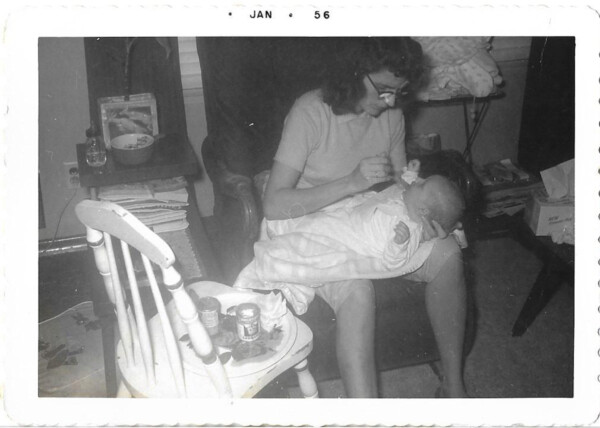
This photo, taken in January 1956, shows my mother, Laura Joyce Stone, feeding me. I was about a month-and-a-half old at the time. Photo courtesy of Del Stone Sr.
I scanned in this photo the other day. It was taken in January of 1956 and it shows me at age 1½ months being fed by my mom.
I decided to try an experiment.
I took the photo and I went to three different AIs – ChatGPT, Google and Grok – and I told each of them to colorize it. I used the identical command syntax for each AI.
Here’s the ChatGPT version.
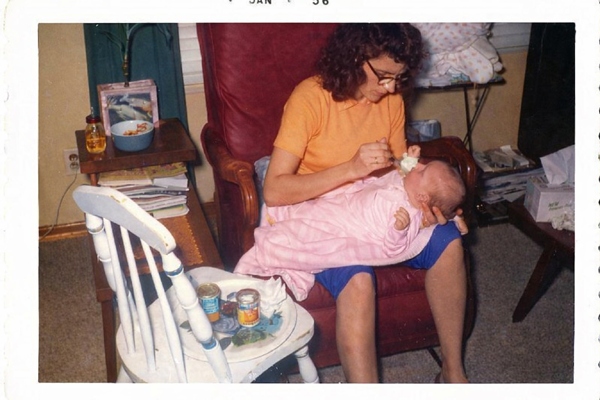
Here’s the Google AI version.

And here’s the Grok version.
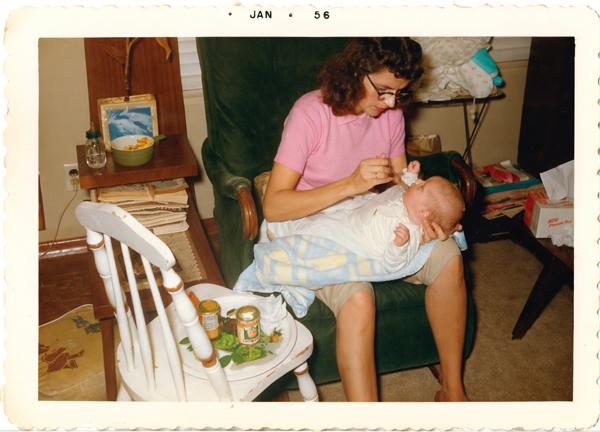
They all did a decent job of coloring the photo. But when I took a closer look at the images, I began to notice some strange differences.
Here’s the original photo again.
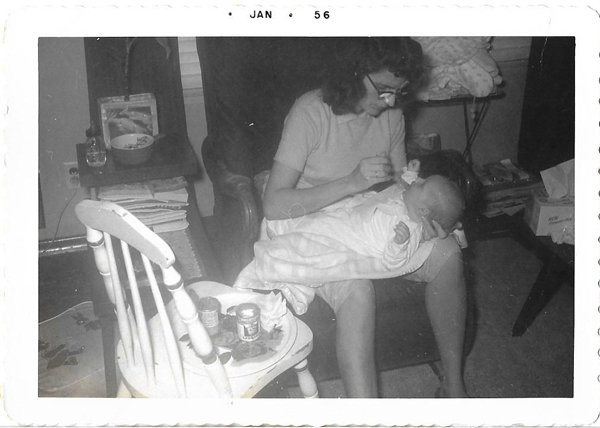
If you look at the bottom left, you can see something lying on the floor. It looks like a blanket or a pad or something. I don’t know what.
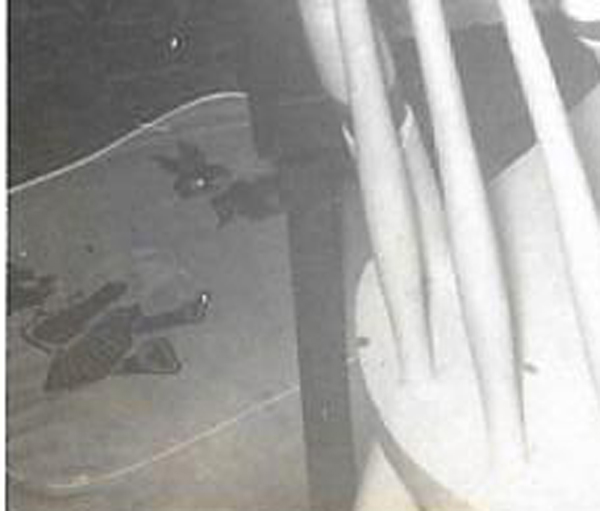
OK, so let’s take another look at the ChatGPT image.
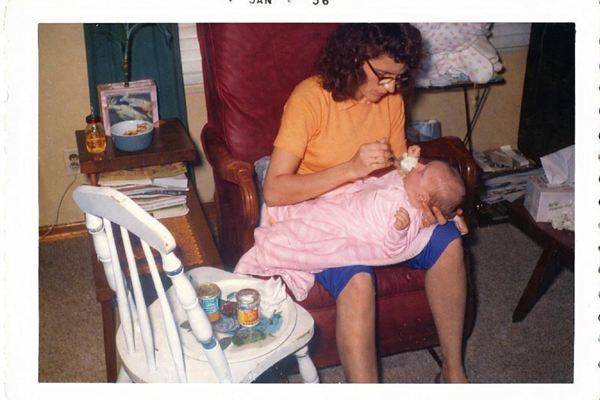
It looks like ChatGPT just deleted whatever that object was lying on the floor.

OK, so let’s take another look at the original image.
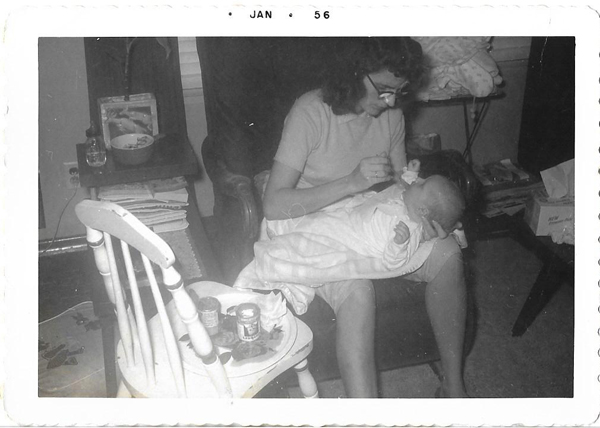
You’ll notice in the background to the left, there’s some kind of end table, with magazines on the bottom.
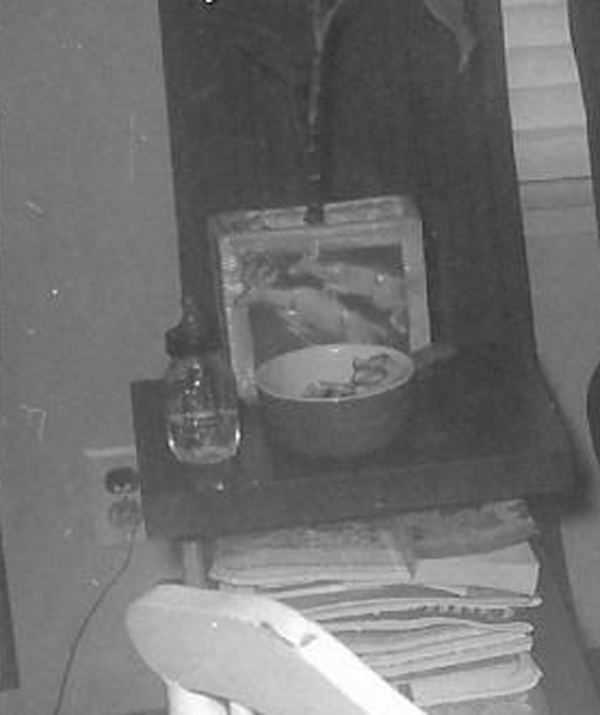
And on the top of the table there’s a flower pot with a plant growing out of it. Now let’s look at the Google version of that image.

Somehow, the flower pot has become three boxes of cereal,
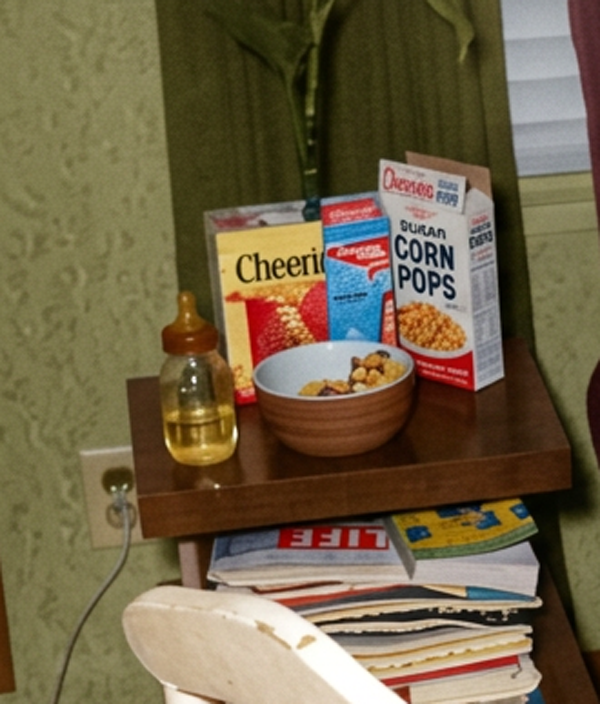
and there appears to be a plant growing out of a box of Cheerios.
Apparently, artificial intelligence is taking liberties with the historical record. It’s either deleting or reimagining content that it doesn’t know what to do with.
If it’s doing that with our photography, I can’t imagine what it’s doing with our video or the written word.
Oh, but it gets much worse.
According to a study conducted by the MIT Media Lab, people who use artificial intelligence develop a condition called cognitive atrophy, and their critical thinking skills go into decline. This comes at a time when a majority of Americans, 53 percent, can’t read above a sixth-grade level.
Artificial intelligence is not only meddling with the historical record, but it’s making us dumb.
AI is a dangerous technology, and we’re treating it as if it were a toy. It’s in the hands of for-profit corporations that have already demonstrated they do not have the public interests at heart.
The use of AI should be subject to stringent regulation and oversight, and it should not be available to the general public.
Otherwise, Orwell will have been proven right yet again.
War is peace.
Freedom is slavery.
Ignorance is strength.
About the author:
Del Stone Jr. is a professional fiction writer. He is known primarily for his work in the contemporary dark fiction field, but has also published science fiction and contemporary fantasy. Stone’s stories, poetry and scripts have appeared in publications such as Amazing Stories, Eldritch Tales, and Bantam-Spectra’s Full Spectrum. His short fiction has been published in The Year’s Best Horror Stories XXII; Alfred Hitchcock’s Mystery Magazine; the Pocket Books anthology More Phobias; the Barnes & Noble anthologies 100 Wicked Little Witch Stories, Horrors! 365 Scary Stories, and 100 Astounding Little Alien Stories; the HWA anthology Psychos; and other short fiction venues, like Blood Muse, Live Without a Net, Zombiesque and Sex Macabre. Stone’s comic book debut was in the Clive Barker series of books, Hellraiser, published by Marvel/Epic and reprinted in The Best of Hellraiser anthology. He has also published stories in Penthouse Comix, and worked with artist Dave Dorman on many projects, including the illustrated novella “Roadkill,” a short story for the Andrew Vachss anthology Underground from Dark Horse, an ashcan titled “December” for Hero Illustrated, and several of Dorman’s Wasted Lands novellas and comics, such as Rail from Image and “The Uninvited.” Stone’s novel, Dead Heat, won the 1996 International Horror Guild’s award for best first novel and was a runner-up for the Bram Stoker Award. Stone has also been a finalist for the IHG award for short fiction, the British Fantasy Award for best novella, and a semifinalist for the Nebula and Writers of the Future awards. His stories have appeared in anthologies that have won the Bram Stoker Award and the World Fantasy Award. Two of his works were optioned for film, the novella “Black Tide” and short story “Crisis Line.”
Stone recently retired after a 41-year career in journalism. He won numerous awards for his work, and in 1986 was named Florida’s best columnist in his circulation division by the Florida Society of Newspaper Editors. In 2001 he received an honorable mention from the National Lesbian and Gay Journalists Association for his essay “When Freedom of Speech Ends” and in 2003 he was voted Best of the Best in the category of columnists by Emerald Coast Magazine. He participated in book signings and awareness campaigns, and was a guest on local television and radio programs.
As an addendum, Stone is single, kills tomatoes and morning glories with ruthless efficiency, once tied the stem of a cocktail cherry in a knot with his tongue, and carries a permanent scar on his chest after having been shot with a paintball gun. He’s in his 60s as of this writing but doesn’t look a day over 94.
Contact Del at [email protected]. He is also on Facebook, twitter, Pinterest, tumblr, TikTok, and Instagram. Visit his website at delstonejr.com .
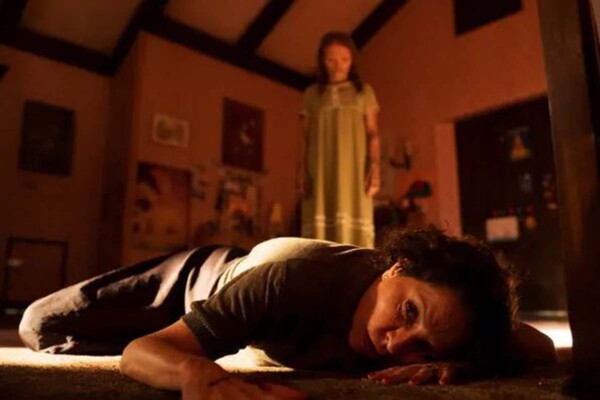
Image courtesy of Warner Bros. Pictures.
“Lee Cronin’s The Mummy” Starring Jack Reynor as Charlie Cannon, Laia Costa as Larissa Cannon, May Calamawy as Detective Dalia Zaki, Natalie Grace as Katie, and others. Directed by Lee Cronin. Two hours, 14 minutes. Rated R. Theatrical release.
Spoilers: Mladen took the week off so no, there shouldn’t be any.
Plot summary: An American family living in Egypt suffers a tragedy when their daughter is abducted by persons unknown. Eight years later, the family receives shocking news: Their daughter has been found. They bring her back to their home in the States only to discover she’s no longer the innocent child they knew and loved.
Del’s take:
If you were thinking “Lee Cronin’s The Mummy” is a re-imagining of the Brendan Fraser Mummy franchise of 1999, allow me to disabuse you of that notion. This is a different story in every way, and I can’t say I enjoyed it more than its romantic and adventurous predecessor.
“Lee Cronin’s The Mummy” belongs to a genre I call “gorror,” a portmanteau of “gore” and “horror,” because like many horror movies today it relies on gore, blood and cruelty to generate its tension. I long for the good old days when moviemakers understood the theater of the mind is the best venue for scary tales of the supernatural. Remember films like “The Innocents” or the Robert Wise production of “The Haunting of Hill House,” where the antagonists were rarely (if ever) seen? Those movies were terrifying because they allowed the audience to imagine what might be lurking in the shadows. Ridley Scott gave us only fleeting glimpses of the alien for that very reason.
I could give you a laundry list of shock-value scenes from “Lee Cronin’s The Mummy,” but I’ll keep it to just this one: At a funeral wake, the body is knocked from its coffin and a young girl laps up embalming fluid oozing from the corpse. Does that scare you, or make you want to vomit? You can share my plastic bag.
It’s a shame because I really wanted to like this movie. The premise was interesting enough: An American family is living in Egypt, where the father works as a journalist. One day their daughter Katie is abducted from their back yard by a mysterious crone. Authorities are unable to recover the girl and the family returns to America heartbroken. Eight years later they receive a call – Katie has been found. But she’s changed. She’s no longer verbal and suffers seizures and other health maladies. The family brings Katie to their home in Arizona where terrible things start to happen, embalming fluid-sipping notwithstanding.

From that point the movie degenerates into a series of scenes intended to revolt and disgust. These scenes are punctuated with moments of explanation – some might call it too much explanation though I’ll never complain about a movie making its intentions clear. At least the script attempts to capture some of the anguish a family would experience under those circumstances and Jack Reynor as the dad, Charlie Cannon, delivers the appropriate pathos, although at times his horror more closely resembles Moe from The Three Stooges finally noticing his hair is on fire. Natalie Grace is appropriately sinister as the altered Katie Cannon. The most memorable character was May Calamawy as Detective Dalia Zaki, who struck me as a kind of Egyptian Clarice Starling. She presented a quiet, sometimes callow dignity and determination that made me want to root for her. Verónica Falcón was also very, very good as Larissa Cannon’s mother, although her role wasn’t very large.
My problem with “Lee Cronin’s The Mummy” is its cruelty. As an up-and-hopefully-coming horror writer I was always told to never place a child in jeopardy, that audiences wouldn’t like it and editors wouldn’t buy it. Obviously that maxim doesn’t apply to cinema as kids in peril have existed in film for decades, long before “The Exorcist” gave us Linda Blair’s head spinning on a pole back in the early ’70s. But even that can be overdone and “The Mummy” takes its best shot, not just with children but everyone. Two hours of toenails being ripped out and tongues being lopped off, and I was ready for this movie to end.
I’m grading “The Mummy” a B-. I had meant to give it a C+ but I remembered some of my more generous grades for other movies that weren’t as skillfully put together and I reconsidered. “Lee Cronin’s The Mummy” is a well organized movie and its conceit is clever, but the relentless cruelty and its focus on body horror relegate it to mere gorror status.
I’m much more fearful of what the eye can’t see, but the imagination can. I hope Hollywood rediscovers this simple rubric sooner than later.
Mladen Rudman is a former journalist and technical writer. Del Stone Jr. is a former journalist and writer.

Image courtesy of Pickpik by way of a Creative Commons search.
INTRODUCTION
I’m trying to think back to the first moment I experienced a fear of heights. It has something to do with my father.
Lest you believe this sounds like a therapy session, I mean, quite literally my father.
I couldn’t have been more than 3 or 4 years old – I’m thinking 3. My dad was active duty Air Force and we were stationed at either Vancouver or Spokane, Washington. We were living in base housing.
One night, my dad picked me up and put me on his shoulders. I remember thinking I was about to fall off. I had nothing else to hold onto, so I grabbed his forehead in a death grip. We headed off down the hall. My head bonked against the opening to the hallway.
I remember being so afraid of the highness that I couldn’t wait for him to put me back down.
A couple of years later we flew to Spain, and I was not bothered by heights. I did have one episode of acrophobia in Spain. We were touring a castle and had to navigate a narrow board that crossed an abyss between two turrets. I had to get down on my knees and crawl, I was so afraid. But on the flight home I was fine.
Cut to age 14. I was flying to Detroit to spend part of the summer with my sister and her husband. Mom put me on a DC-9 out of Eglin Air Force Base in Northwest Florida. I was to fly from there to Dothan, Alabama, then to Atlanta, where I would change planes and fly direct to Detroit. I thought that was pretty cool, being able to do that by myself at age 14.
The plane hurtled down the runway and leaped into the air. I took one look out the window and my brain swooned. I remember thinking, “Oh my God, I’ve made a mistake,” and in a moment of panic I actually considered walking up to the cockpit – you could do that in those days – and asking the pilots to turn around and let me off. But I was paralyzed with terror so I averted my eyes from the porthole and looked straight ahead, up the aisle. Eventually, I was able to look out and not seize with fear. By the time I got to Detroit I was mostly OK.
Needless to say, I’m not a fan of flying. I have an irrational fear of heights. It’s not just airplanes – I find ladders difficult to manage, and climbing up on my roof to clear tree limbs and leaf litter has become a challenge. I realize airplanes are the safest way to get from Point A to Point B, that the odds of dying in a plane crash are lower than ridiculous … but I don’t care. I’ve beaten the odds many times before, in things totally unrelated to air travel, and I don’t want to be on an airplane the next time I defy the impossible. Lottery ticket, yes. Handsome boyfriend, yes. Delta 787, no way in hell!
So I wrote this story, an homage to my phobia about flying.
As an acrophobe I can’t imagine a fate worse than being stuck on airplane, terrified beyond words, alongwith a hostile individual hellbent on scaring the living shit out of you. That actually happened to me, on a flight from Pensacola to Los Angeles. I was seated next to a guy who was flying to Houston – he designed video games for a living. When he found out I was afraid to fly he spent the entire flight suddenly grabbing my arm and whispering, “WHAT WAS THAT SOUND?” Needless to say I wasn’t amused.
But there was something else I wanted to say in this story – that anger, hatred and vengeance are often unfocused. You see that so often in this world of 2024, especially involving politics and issues such as LGBTQ rights and the rights of women. People treat their hate as a matter of convenience without bothering to check the facts first. It’s sad that each of us must rediscover the wheel when it comes to the things we think we know, opposed to what is truly there.
I haven’t flown in 24 years. Now that I’m retired, travel is an option. I would love, for instance, to visit Spain, where we lived for three years, and try to find my boyhood house. But to get there will require a trip across the Atlantic Ocean aboard a jetliner. Does enough Xanax and Valium exist in the world to get me there with my wits intact?
If I find out, I’ll let you know.
Meanwhile, what’s that sound?
—
THE FEAR OF FEAR ITSELF
The first hour
From five miles up, Paul Westerbrook thought the ground resembled an impossible dream of heaven.
Impossible, he thought, his depth of focus shifting to his reflection in the airliner porthole. Impossible that I could be here and the ground could be so far away.
He watched his image. Shafts of sunlight slanted through the row of portholes on the opposite side of the cabin, back-lighting his head so that his face was masked in shadow. Darker pools filled in the spaces around his eyes and mouth.
He might have been staring at a skull.
And he could hear a rushing sound. Not the dull thunder of a flood but a fine sandpapery hiss, the sound of air whistling over the bright aluminum skin of the 767 as it hurtled through the thin atmosphere, its engines and wings maintaining a hair-trigger equilibrium between thrust and weight and lift, and he could feel the plane sinking and rising as variables of air density and wind velocity and engine compression altered the formula in tiny but noticeable increments that brought mists of perspiration to his forehead as he tried to calculate the forces of turbulence necessary to send the airplane spinning out of control –
He slammed the porthole visor down.
He squeezed his eyes shut.
And he recited a silent prayer: Please, God. I’ll do anything you want. Just get this plane on the ground safely.
Somebody was speaking to him. He blinked.
“Did you want something to drink, sir?” A flight attendant. She was older than most, with thin, blond hair, pale skin and high cheekbones. She had the calm look of a kindergarten teacher handing out waxed Dixie cups of warm Kool-Aid. The aniline blue uniform of South Air smoothed the curves of her body and gave her a confident, almost motherly aspect.
A bump rattled the plane. Paul grabbed the back rest of the seat in front of him and felt his palm slide greasily over the plastic upholstery.
Finally, he said, “A drink? Yes,” and was instantly ashamed of the tremor in his voice. “Bring me a couple of Valiums and a bottle of Crown Royal. That should do the trick.”
The attendant smiled warmly. “White knuckles, eh?” she whispered, and he nodded too quickly. He thought he must look to her like a contrite child.
“Do you fly often?” She was easing into the seat next to him, and he thought he could feel a shuddering vibration passing through the floor of the airplane and up through the frame of his seat. Or was that a change in engine pitch? Was the pilot throttling back as a warning light suddenly blinked red, or was a turbine starting to rattle as hairline cracks widened into chasms of flawed metal and the blades prepared to fly off the shaft like knives thrown by a blindfolded magician –
“Not much. But from now on, yes,” he said. And he had made the decision himself, hadn’t he? In spite of Gail’s subtle coercion, he had accepted the position of regional buyer for the McAndliss chain of department stores, a promotion that would give him more opportunities – a final chance as it were, because twice before he had refused offers like this for whatever reason had seemed important at the time, and if he’d refused again … Well. Gail would have said nothing, but her measured ways of doing things when she was angry would have spoken volumes. You are an indecisive and fearful man, she would have thought, adding: I don’t know why I married you.
So he’d accepted the offer.
But the job required flying.
“It’s nothing to be ashamed of,” the attendant said and laid an utterly cool palm on his hand. Her skin was as dry and smooth as a pool hustler’s chalked cue. “Most people experience a little anxiety while flying. Sometimes it’s acrophobia, claustrophobia, or even a combination of the two. Are you afraid of heights?”
Paul nodded once. Heights. God, yes.
She patted his hand. “My father used to say, ‘We have nothing to fear but fear itself,’” She shook her head sadly.
Paul nodded without enthusiasm. At that moment he didn’t care about borrowed aphorisms. He simply wanted to be on the ground.
“My father was an airline pilot.” She smiled mysteriously. “He never worried about … the unexpected.”
A staticky voice scratched from the cabin speakers. It was the captain, announcing that Air South’s non-stop service from Los Angeles to Atlanta had reached its cruising altitude, that passengers could remove their seatbelts, that their flight time would be about four hours and 45 minutes – Paul stopped listening. His heart seemed ready to jump out of his throat.
The attendant gave Paul’s hand a reassuring pat and stood up. “I’ll bring you a cocktail and check to see how you’re doing.” At that moment the whining throb of the engines shifted to a lower, almost subliminal pitch that seemed to resonate through Paul’s bones. His stomach looped into a tense knot.
She looked at him and said, “Try not to worry, Mr. Westerbrook,” and her gaze hardened for a moment, as if a layer of ice had formed over her eyes and melted, long enough for her to whisper, “If the plane crashes, all the worrying in the world won’t change a thing.”
Then she was padding silently toward the rear of the airplane, and the terror was swarming all over Paul again as he tried to remember when he had told her his name.
The second hour
Paul wondered what Gail was doing at this moment.
In his mind’s eye he saw her at the dining room table, her leather portfolio beside her with papers spilling between the teeth of the zipper – homework papers or tests to be graded, the things teachers carried with them. She would remove the papers and arrange them into neat stacks and attack them until they were back inside the portfolio.
That is, if she were there. And not next door.
When he landed at Hartsfield International Airport he would go home in a taxi. After 17 years, their marriage could no longer supported airport reunions.
But he envied her. He envied her discipline and her stubbornness and her immunity to fear.
“Here’s your drink, Mr. Westerbrook,” the flight attendant announced. Two other attendants were pushing a drink cart up the aisle, tossing ice cubes into plastic glasses like crap shooters and popping the tabs on cans of 7-Up and Coca-Cola.
He thanked her nervously and drained half the glass in a single swallow. The liquor seemed to cauterize the lining of his throat. Bourbon and Coke – mostly bourbon. He wasn’t a bourbon drinker, but anything with alcohol would have served the moment.
He glanced at her nametag: It said TESS.
She slid into the seat next to him and in a conspiratorial whisper said, “Do you like the drink? That’s the way my father liked them – heavy on the bourbon.”
Paul took another sip. Why hadn’t she asked him what he wanted to drink? He thought to ask, but said, “You mention your father often. You must love him very much.”
Her gaze became unfocused, and a tracing of a smile crossed her lips. “Yes,” she said. The smile dimmed to an expression Paul approximated with regret. Then she was back to business. “Now finish that drink because the first officer tells me we’re headed for some rough weather.”
Paul felt ice crystals forming in his blood. Rough weather? Turbulence? Something cold was sliding along the lifeline in his palm – a drop of moisture, either condensation from the cup or chilled sweat. He managed to stammer, “Will – will it be bad?”
The flight attendant – Tess – shrugged. “You never know, especially with this flight crew.”
He raised an eyebrow and took another hit off the drink.
“The first officer has been drinking since we left LAX,” she said.
The liquor burned like lye. It caught in his windpipe and he choked, spraying bourbon over the tray. He hacked until his eyes burned and tears smeared everything into watery blots of shadow and light. When he was finally able to breath, he wheezed, “But isn’t that – isn’t that against the rules?”
She frowned. “You’re darn right it’s against the rules. Honest to God. My father would have a heart attack if he could see what goes on in the cockpit these days.”
“But why doesn’t the Captain put a stop to it?” Paul babbled.
She shook her head wearily. “This sort of thing goes on all the time – it’s not unusual. All the airlines have problems with alcoholic pilots.” She hesitated and cocked an ear. “Did you hear that?” She listened a moment longer. “It sounded like they shut down an engine.” Paul felt his eyes goggling. She tittered, and it was a sound without mirth. “I guess not.”
She walked away, humming softly. Paul stared blankly at the seatback ahead of him. A pit seemed to have opened in his stomach, claiming everything inside him and giving back nothing but black fear.He wished he could fold himself into that pit and simply disappear until this ordeal was over. He wished he could return to the heavenly ground.
The third hour
Paul sat rigid in his seat. He could hear a metronomic pulsing, the sound a wheel bearing on a car makes when the grease has been reduced to sludge and metal is rubbing against metal and the entire wheel assembly is about to fly apart. He listened closely, his ear filtering out the extraneous noises of people chatting, and he could hear it: a droning throb modulated by regular basso pulses that seemed to beat through the airframe itself, the sound of weary machinery about to fail.
He listened.
It was the sound of his own heart.
God, he thought, if Gail could see me she’d – she’d –
Tess was suddenly in the seat next to him. “Did you enjoy your drink?” she asked happily.
Paul nodded, and asked distractedly, “And how is the first officer enjoying his drinks?”
“Fine, fine,” she said dismissively, ignoring the sarcasm.
“What about – ” Paul hated to say the word, as if saying it would make it real, “those storms. Are we through them yet?”
Tess’s eyes narrowed into a playful squint and she shook her head. She raised the visor and pointed. Paul risked a quick glance and then twitched his eyes away as the vertiginous change in perspective caused him to swoon. On the horizon he had seen … clouds. He was no meteorologist. But they resembled volcanos of turbulence and violence. He slid the visor back down.
“Cumulonimbus, Mr. Westerbrook,” she said gravely. “Thunderstorms. Hell breathers.” That last part came out in an overdone stage whisper. On the ground he would have laughed at her melodrama, but up here, trapped in this cabin, he could only stare, dumbstruck with terror.
“Those are the same clouds responsible for most airplane crashes,” she said. “For instance, the worst disaster in aviation history occurred on the Canary Island of Tenerife when two 747s collided during a thunderstorm. Over 500 people …” She clasped her fingers around an imaginary matchstick and blew silently.
Paul squeezed his eyes shut and turned away. Why was she telling him this? She knew he was afraid. Why was she doing this to him?
“To quote my father,” she said, her voice suddenly solemn, as if she were about to recite a catechism, “`God created thunderstorms to keep pilots humble.’ But then thunderstorms aren’t the only reason airplanes crash.” The fingers came up for another accounting. “Mechanical or structural failure is the second-leading cause, followed by pilot error, mid-air collisions – and did you know, Mr. Westerbrook, that even disturbances by passengers have been blamed for airplane crashes? Did you know that?”
He dared to open his eyes and look at her. She looked back with a knowing smile.
He heard loud voices from the rear of the airplane. Tess’s head went up like a wolf sniffing the air for deer scent. She hauled herself out of the seat with surprising litheness.
Paul looked back, fearful of what he might see. An elderly woman was standing by her seat and the man next to her – Paul could see only the man’s bald pate – seemed to be in some kind of distress. Paul settled into his seat and shivered.
A man wearing the South Air uniform appeared in the aisle, striding toward the rear of the plane. He was tall, his hair grayed at the temples and his face framed with lines. Paul thought he must be the captain, and the sight of him came simultaneously as a comfort and a shock. What could be happening that required the captain’s intervention?
After a few moments, the captain reappeared, moving toward the cockpit. Paul loudly cleared his throat.
The man stopped and Paul said quickly, “Is everything all right, Captain?” He thought his voice sounded muffled and indistinct, as if a ventriloquist had spoken the words for him.
The man grinned and said, “Everything’s fine. An elderly gentleman was having a problem with his ear.” He pointed to his own ear. “The pressure. But now he’s fine.” He hesitated and added, “Oh, and I’m not the captain. I’m the first officer.”
A tremor shook Paul. This man didn’t look intoxicated. But Paul had heard stories about pilots’ abilities to hold their booze. Maybe this first officer would return to the cockpit and knock back a stiff belt of bourbon and snicker about the chicken shit in seat C15 who was about to crap his drawers.
Without thinking, Paul asked: “Sir, are you drinking man?”
The first officer chuckled. “Excuse me? I’m a member of the LDS church. We don’t drink alcohol.”
“And what about the storms,” Paul blurted, hearing the panic rise in his voice but not caring. “We’re flying into storms, aren’t we? Thunderstorms. Hell breathers.”
The man looked baffled. “No,” he answered tentatively. “We’ve got a few stratocumulus at about 70 degrees compass heading, but no thunderstorms.” He tucked his tie into his shirt. “Just relax and enjoy the flight, sir. We’ll be in Atlanta in about two hours.” He walked away.
Paul felt a prickly sensation across his body, as if his skin were cooling and shrinking back around his bones.
Lies.
She’d lied to him.
In the jumble of his emotions a thought loomed – something he could never quite forget. A lie Gail had told him. About the man next door, and the afternoons she spent over there, “tutoring” his son. He remembered the vow he’d made to never believe anything anyone told him without confirming it himself.
Lied to. He’d let himself be lied to again.
“My God, I’m not believing this. I’m really not believing this.” Tess was in the seat next to him, smelling of spilled bourbon and petrouli and a faint whiff of sweat. “That man in B28 – he had a gun! He threatened to shoot up the airplane!”
Paul shook his head. He said, simply, “No more.”
“Thank God Karen – she’s the flight attendant responsible for rows 20 through 38 – saw what was happening and stopped him.”
Paul closed his eyes. “We’re not flying into bad weather.”
“She wrestled the gun away from him before he could pull the trigger,” Tess continued, a hard edge forming on her words.
“The first officer hasn’t been drinking, either,” Paul went on. “He’s a Mormon, for Christ’s sake.”
“Do you have any idea what a bullet would do to this airplane?” She seemed to be talking to no one but herself. “What would happen?” she murmured questioningly. “The cabin would lose pressure, and rapid decompression might damage the flight controls – no, this airplane has electronic flight controls. It’s the older jets with mechanical flight controls, like the 727, that might have problems. But the pilots could lose consciousness. The plane could crash, I suppose.”
“Have you heard anything I’ve said?” Paul asked, his voice rising. The plane jiggled and his heart raced a moment. “What were you trying to do? Scare the shit out of me?”
She shook her head, her gaze refocusing into a glare. “Mr. Westerbrook, are you familiar with desensitization therapy?”
That caught him off guard.
“It requires that a person who is afraid of something be repeatedly exposed to the source of his fear until he becomes desensitized to it.” She paused and sighed. “That’s what I was doing. I apologize if I frightened you, but it seemed the best way to handle the situation. Like my father said,” she added cheerfully, “You have nothing to fear but fear itself.”
Paul clenched the armrests until veins stood out on his hands. “Is that so? Well tell me, what do you think your father would say about a flight attendant who scares the living shit out of her passengers? That’s not exactly standard procedure.”
Her expression chilled to absolute zero. “He wouldn’t say anything, Mr. Westerbrook. My father is dead.”
Instantly, Paul’s anger swirled away. He mumbled, “Oh.”
Her stare was blank. “He was killed in a plane crash. Three years ago. In Houston.”
The breath eased from Paul’s lungs in a slow, defeated sigh. Some emotion, yellow and bitter like shame, began to gather inside as he tried to imagine the grief she must feel when she came aboard an airplane. He found that it was beyond his comprehension.
She picked at her jacket. “I was only trying to help.”
He nodded slowly. Maybe he had been too harsh. Finally, unsatisfactorily, he said, “OK, let’s just … forget it. No more fairy tales about storms or drunken copilots or crashes.”
Tess said, “Fine,” and got up to leave. Paul touched a finger to her sleeve and added, “The first officer told me the man in the back was having problems with his ears. So no more fairy tales about whackos shooting up the airplane. OK?”
She gave him a puzzled look. “I guess he was trying to reassure you. Truth is, the man really did threaten to shoot up the airplane. Karen took the gun away from him and gave it to me.” She whispered urgently, “Look, Mr. Westerbrook. This airplane is like a miniature city – all the things that happen in a city can happen up here, too. People fight, get drunk, die – “
“No more fairy tales!” Paul said out loud, fresh panic making the hairs on the back of his neck brush against his damp shirt collar. His voice warbled beyond the narrow perimeter of the seats around him. Another passenger, a young woman who was reading a novel, glanced his way. “We agreed. No more fairy tales!” He started to clamber out of his seat but realized he had no place to go, so he sat back down and stared stonily in the opposite direction.
Tess tapped him on the shoulder. He refused to look at her. So she said in an exasperated tone, “Does this look like a fairy tale?”
He looked. Resting in her palm was a tiny revolver.
The fourth hour
Impossible, Paul thought, squeezing a sweat-soaked lump of napkin as if he were pumping a vein to give blood. This is impossible.
The airplane had entered an area of clear-air turbulence. It roller-coastered through the ice blue sky like some kind of Six Flags ride, sliding down invisible flumes of air to abruptly surge higher. His inner ear told him this was all wrong, and the glands in his jaw began to ache, a prelude to motion sickness. But he promised himself he would not puke. He would not add that to his list of miseries.
He thought of the old man and the dainty gun Tess had showed him, and his heart pancaked into a spin. It made no sense. Why would the man want to kill himself and everyone else aboard?
Then a final question occurred to him: How could the man have smuggled a gun past the metal detectors and X-ray machines?
The first officer has been drinking since we left LAX.
Thunderstorms, Mr. Westerbrook. Hell-breathers.
And, finally, The man really did attempt to shoot up the airplane. Karen took the gun away from him and gave it to me.
Lies.
He couldn’t stand it. He undid his seatbelt and marched toward the rear of the airplane. An attendant who was sitting in the last row of seats spotted him, rolled her eyes and moved to get up, but he was already upon the bald man hunched in Seat B28.
Paul’s first impression was that the man had died a thousand years ago and the airline was returning his body, filched by graverobbers, to its rightful resting place in some Egyptian tomb. The man was old. His flesh was wrapped around his skinny bones like yellowed cellophane, and his hand shook with a palsy that seemed to consume all his energy so he could do nothing but squat in the seat and stare straight ahead, his drooping lips permanently bent into an atrophied frown.
Paul thought: This man couldn’t have brought a gun aboard.
The elderly woman sitting next to him glanced up. Paul asked, “How is the problem with his ears?” and the woman answered in a brittle rattle, “Oh, he’s doing much better – “
Somebody planted a hand on Paul’s shoulder and he jerked around, expecting to see Tess’s leering smile. But it was the other flight attendant. She said irritably, “Sir, you’ll have to return to your seat – “
Paul seized her by the shoulders and her eyes grew round and afraid. “Tess,” he hissed. “I don’t know what’s going on, but I think Tess has lost her marbles. She’s got a gun!”
The woman shook off his hands. “I don’t know what you’re talking about but you’d better return to your seat – “
“I’m talking about Tess!” he said angrily. “She’s got – “
“Keep your voice down!” she snapped. “You’ll cause a panic. I’ll make sure the Captain hears what you’ve got to say.”
The plane dropped suddenly and they both grabbed seatbacks to hold on. An overhead bin unlatched and the lid flew up with a plastic clatter that startled the woman with the novel, who glanced up apprehensively and then buried herself in the book with a look of ferocious concentration. Paul turned and scuttled down the aisle.
A newspaper clipping lay in his seat.
Next to it was a bullet.
He held the bullet before him like a jeweler assaying a gemstone, his emotions bouncing between fascination and outright terror. And then he turned to the clipping.
The headline read: “40 survive crash at Houston.” Paul could not stop himself from reading the story.
“An Air South jetliner carrying 62 people crashed at Houston’s International Airport on Monday, but only 22 people were killed in what authorities describe as a heroic effort by the flight crew to land the crippled jet.
“Air South Flight 6212 was only 1 1/2 hours into its nonstop flight from Atlanta’s Hartsfield International Airport to Los Angeles when the crew radioed a distress call and asked for emergency clearance to land at Houston.
“Emergency crews stood by as the Air South jet, a Boeing 727, attempted to make a wheels-up landing. The jetliner broke into three pieces before finally coming to rest on a taxiway.”
Paul scanned the story, and then his eye came to rest on a string of cold paragraphs midway through.
“FAA crash investigators on the scene said the pilot reported a rapid decompression incident at altitude that resulted in damage to the jetliner’s control systems.
“Officials would not comment on the `incident,’ but survivors who spoke with reporters said a hysterical passenger apparently opened an emergency hatch to `get off the plane.’
“Officials would not confirm the report, but one of the survivors, a man identified as Paul D. Westbock of Atlanta, was taken into custody by airport security personnel and later transferred to the federal detention facility in Kingwood.”
The date on the clipping was three years ago.
It all came to him, all of it, the pieces falling together, and Paul found that he could not sit down, that he had been overtaken by a kind of numbness as explanations finally meshed with events, and he would not sit down until this airplane was on the ground, his memory serving up a final shocking image of Tess and the dainty little gun – a lady’s gun, really. He had to tell the Captain what was happening. He had to. Because there was nothing left for Tess to do now but kill him.
He stepped out into the aisle and began hurrying forward.
As he approached the bulkhead that separated coach from first class he heard her say, “Where are you going, Mr. Westerbrook?”
She was sitting next to the emergency hatch. She motioned for him to sit down. He paused and weighed his chances of making a dash for the cockpit. The gun was cupped in her palm.
She stood and pushed him into the seat next to the hatch.
“You should be in your seat, Mr. Westerbrook,” she hissed.
“It wasn’t me,” he whispered. He heard his voice starting to crack. “The names aren’t even the same.”
“I was on that flight,” she said, ignoring him. “I tried to help the man who was afraid. But as you read, I didn’t do my job very well.” She swallowed noisily. “My father was the pilot. He died. But I lived. So did the man. He never undid his seatbelt.” A tremor ran through her. “Somehow that doesn’t seem right.”
Paul watched her hand. He wondered if he could grab the gun. In his mind he saw Gail laughing at him: Why would you even consider such an absurd thought; you’re an indecisive and fearful man. I should’ve divorced you and married Thornton next door.
“I want you to do something,” Tess said, and Paul knew she was no longer speaking to him. “I want you to make it right.”
Paul shook his head. “I don’t know what you mean,” he said, but he thought he knew exactly what she meant.
She turned and skewered him with a stony stare. “I want you to open that door.”
His heart clenched around the words. He tried to imagine doing that – grasping the release lever and pulling OUT, then UP, and the hatch popping away like a champagne cork and air blasting out, into a sky-blue void, sucking him with it, with nothing below but miles of tumbling emptiness and gyrating terror –
No, no, his mind rejected it with a convulsive shudder that brought real tears to his eyes and had him fumbling for his seatbelt.
“Unfasten your seatbelt and open the door,” she said evenly.
“No,” he whimpered, scrunching his eyes shut. “It wasn’t me.” He winched the belt tight and grabbed the armrests and sat that way a few trembling moments, daring to peek after nothing happened. He saw that Tess was gazing at him almost tenderly.
“Don’t you understand?” she asked softly. “I know it wasn’t you. But it doesn’t matter. You’ll do. You’re the best I can do.” Then her eyes narrowed into slits and the last inflection of sanity departed her voice and she whispered slyly, “Unfasten your seatbelt and open the door.”
He shook his head no. No. No.
He could see the rage building in her, a flaming, almost artificial blush of crimson rising in her cheeks. A vein pulsed in her neck. She appeared ready to explode.
She undid her seatbelt with a practiced snap and stood and glared down at him. The color of her uniform seemed to go from blue to black.
“All right,” she muttered hoarsely. “Then I’ll shoot the goddamned pilot and copilot, and we’ll all go down. And it’ll be your fault, Mr. Westerbrook. Just like before.”
Later, he would reflect on this moment either consciously or in nightmares and realize he had acted without thinking, in a way that was decidedly untimid, and that his actions came not in response to some admonition or coercion. He simply acted.
He grabbed the emergency hatch handle and pulled OUT –
– she turned and her face was a smiling rictus of triumph –
– and then he pulled UP –
– her expression collapsed into dawning horror –
And the cabin exploded as the hatch blew out and was snatched into the screaming slipstream and then everything was pouring through the socket in a bellowing shock wave of frigid air and papers and pillows and every loose thing inside the cabin that could fill the vacuum. The plane lurched sharply and began to dive. Paul felt himself being sucked into that freezing, screeching storm and grabbed the armrests of the seat next to him, his heart whamming with sledgehammer blows, until the seats themselves began to tear away from the cabin floor and jitterbug toward the opening.
Something larger flew overhead and banged into the hatchway.
Tess.
He peered over his shoulder and saw her clinging to the edge of the hatch, her body flapping against the 767’s aluminum skin, and beyond her was empty sky and clouds – a confluence of every terror Paul could imagine brought to horrifying reality only inches from his face. But again he acted without thinking, and this too he would look back on and wonder where the courage had come from.
He reached for her.
They locked eyes for a moment, and what he saw in her was malice refined to its purest essence. She mouthed two words. She gave him an evil smile.
And then, she let go.
All the hours afterwards
They let Paul go.
He passed every lie-detector test. The gun was registered to Tess. And another passenger, the woman who had been reading the novel, corroborated parts of Paul’s testimony.
So they let him go.
And when he returned to work, he told his superiors he could not do the job. He didn’t care what Gail thought.
Because Tess had told him, just before she let go.
She had said, “Next time.”
And there would not be a next time.
—
About the author:
Del Stone Jr. is a professional fiction writer. He is known primarily for his work in the contemporary dark fiction field, but has also published science fiction and contemporary fantasy. Stone’s stories, poetry and scripts have appeared in publications such as Amazing Stories, Eldritch Tales, and Bantam-Spectra’s Full Spectrum. His short fiction has been published in The Year’s Best Horror Stories XXII; Alfred Hitchcock’s Mystery Magazine; the Pocket Books anthology More Phobias; the Barnes & Noble anthologies 100 Wicked Little Witch Stories, Horrors! 365 Scary Stories, and 100 Astounding Little Alien Stories; the HWA anthology Psychos; and other short fiction venues, like Blood Muse, Live Without a Net, Zombiesque and Sex Macabre. Stone’s comic book debut was in the Clive Barker series of books, Hellraiser, published by Marvel/Epic and reprinted in The Best of Hellraiser anthology. He has also published stories in Penthouse Comix, and worked with artist Dave Dorman on many projects, including the illustrated novella “Roadkill,” a short story for the Andrew Vachss anthology Underground from Dark Horse, an ashcan titled “December” for Hero Illustrated, and several of Dorman’s Wasted Lands novellas and comics, such as Rail from Image and “The Uninvited.” Stone’s novel, Dead Heat, won the 1996 International Horror Guild’s award for best first novel and was a runner-up for the Bram Stoker Award. Stone has also been a finalist for the IHG award for short fiction, the British Fantasy Award for best novella, and a semifinalist for the Nebula and Writers of the Future awards. His stories have appeared in anthologies that have won the Bram Stoker Award and the World Fantasy Award. Two of his works were optioned for film, the novella “Black Tide” and short story “Crisis Line.”
Stone recently retired after a 41-year career in journalism. He won numerous awards for his work, and in 1986 was named Florida’s best columnist in his circulation division by the Florida Society of Newspaper Editors. In 2001 he received an honorable mention from the National Lesbian and Gay Journalists Association for his essay “When Freedom of Speech Ends” and in 2003 he was voted Best of the Best in the category of columnists by Emerald Coast Magazine. He participated in book signings and awareness campaigns, and was a guest on local television and radio programs.
As an addendum, Stone is single, kills tomatoes and morning glories with ruthless efficiency, once tied the stem of a cocktail cherry in a knot with his tongue, and carries a permanent scar on his chest after having been shot with a paintball gun. He’s in his 60s as of this writing but doesn’t look a day over 94.
Contact Del at [email protected]. He is also on Facebook, twitter, Pinterest, tumblr, TikTok, and Instagram. Visit his website at delstonejr.com .
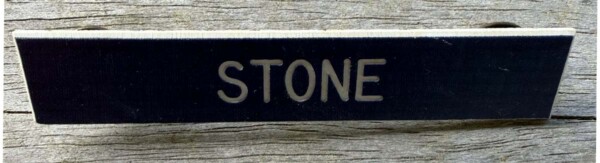
I joined the ROTC program at Choctawhatchee High School in Fort Walton Beach, Florida, in August 1970 and remained with it until graduation in May 1973.
I made lots of friends in ROTC, and we did some interesting things, like travel to Cape Canaveral for the final moon launch, Apollo 17. We also had our own bowling team.
One part of ROTC I hated was uniform day, which I believe was every Wednesday. We were required to wear – to school – one of our two uniforms, khakis or dress blues.
I didn’t like wearing my ROTC uniform because it made me look different than everyone else. Also, in this time period the Vietnam War was winding down. Hard to believe it, especially these days when the military is practically deified, but back then service members were treated like shit. Even we high schoolers saw some of the negativity. We were yelled at, mocked, and called “baby killers.”
Throughout those three years I wore this nametag on my uniforms. Apart from my memories, it is the only physical piece of my ROTC experience I saved.
I came across it the other day while going through the mountain of items I brought home from my storage unit. I held it in my hand, remembering Sgt. Joiner, Col. Wilmot, our tiny classroom that overlooked the school auditorium in 1970, our much larger classroom at the end of the building, trying on new uniforms in the storage room, and Corps Commander Gary Sintez calling on me to drill the troops when I was only a sophomore.
I remembered those things, smiled, took this photo of the nametag, and then tossed it into the trash.
That wasn’t a statement or anything like that. I was simply tired of carrying it around with me. I’ve had that nametag 53 years. I’ve seen it four or five times over the years. Being able to physically touch it does not bring back any more memories than looking at this photo, and I’m tired of lugging around it and all of this other junk. It takes up space and serves no purpose.
I suspect my therapist thinks I’m “tidying up,” getting rid of all my worldly possessions before shipping off to another world. Why the hell would I do that? When I die, some other poor bastard will deal with my junk. That’s no skin off my nose.
Nope, if I’m tidying up, it’s for me. After a lifetime of hauling mementos and keepsakes from one location to another I’ve realized I don’t need them anymore. A photo will do just fine.
So farewell, ROTC nametag.
Oh, and I really hated Wednesdays.
About the author:
Del Stone Jr. is a professional fiction writer. He is known primarily for his work in the contemporary dark fiction field, but has also published science fiction and contemporary fantasy. Stone’s stories, poetry and scripts have appeared in publications such as Amazing Stories, Eldritch Tales, and Bantam-Spectra’s Full Spectrum. His short fiction has been published in The Year’s Best Horror Stories XXII; Alfred Hitchcock’s Mystery Magazine; the Pocket Books anthology More Phobias; the Barnes & Noble anthologies 100 Wicked Little Witch Stories, Horrors! 365 Scary Stories, and 100 Astounding Little Alien Stories; the HWA anthology Psychos; and other short fiction venues, like Blood Muse, Live Without a Net, Zombiesque and Sex Macabre. Stone’s comic book debut was in the Clive Barker series of books, Hellraiser, published by Marvel/Epic and reprinted in The Best of Hellraiser anthology. He has also published stories in Penthouse Comix, and worked with artist Dave Dorman on many projects, including the illustrated novella “Roadkill,” a short story for the Andrew Vachss anthology Underground from Dark Horse, an ashcan titled “December” for Hero Illustrated, and several of Dorman’s Wasted Lands novellas and comics, such as Rail from Image and “The Uninvited.” Stone’s novel, Dead Heat, won the 1996 International Horror Guild’s award for best first novel and was a runner-up for the Bram Stoker Award. Stone has also been a finalist for the IHG award for short fiction, the British Fantasy Award for best novella, and a semifinalist for the Nebula and Writers of the Future awards. His stories have appeared in anthologies that have won the Bram Stoker Award and the World Fantasy Award. Two of his works were optioned for film, the novella “Black Tide” and short story “Crisis Line.”
Stone recently retired after a 41-year career in journalism. He won numerous awards for his work, and in 1986 was named Florida’s best columnist in his circulation division by the Florida Society of Newspaper Editors. In 2001 he received an honorable mention from the National Lesbian and Gay Journalists Association for his essay “When Freedom of Speech Ends” and in 2003 he was voted Best of the Best in the category of columnists by Emerald Coast Magazine. He participated in book signings and awareness campaigns, and was a guest on local television and radio programs.
As an addendum, Stone is single, kills tomatoes and morning glories with ruthless efficiency, once tied the stem of a cocktail cherry in a knot with his tongue, and carries a permanent scar on his chest after having been shot with a paintball gun. He’s in his 60s as of this writing but doesn’t look a day over 94.
Contact Del at [email protected]. He is also on Facebook, twitter, Pinterest, tumblr, TikTok, and Instagram. Visit his website at delstonejr.com .
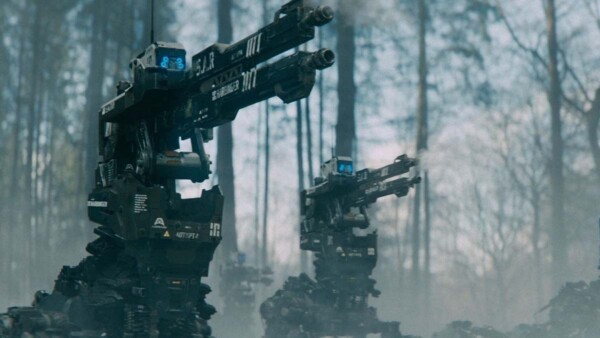
Image courtesy of Vertigo Films.
“Kill Command” Starring Vanessa Kirby as singularity Mills, Thure Lindhart as somewhat unlikeable Bukes, David Ajala as whoa-I-didn’t-expect-him-to-die-so-early Drifter, Mike Noble as hick Goodwin, Bentley Kalu as man-I-wish-I-had-those-biceps Robinson, and others. Directed by Steven Gomez. 1 hour, 39 minutes. Not Rated. Prime.
Plot summary: A squad of marines and a civilian are ordered to take part in a training exercise on a remote island. The purpose of the mission is unclear until the squad realizes they’re on the island to train a platoon of droids to fight like humans. The trouble? It’s a live fire exercise and the droids are OK with taking lives. Very human, indeed.
Spoilers: Everywhere, including the basic facts write-up and plot summary above
Mladen’s take
Unbelievable and, probably unintentional. Del, made me happy by suggesting we review “Kill Command.” He could’ve asked that we tackle “50 Shades of Gray.” Or, “Eat Pray Love.” Or, “Melanoma.” Excuse me, “Melania.” Instead, he chose this nifty 2016 movie that anticipated the soldier training equivalent of what we now know as Large Language Models.
Like LLMs steal, plagiarize, and unethically re-configure creations produced by talented humans, the quadrupedal droids in “Kill Command” Study Analyze Reprogram – SAR – the combat tactics of the marines.
Embedded with the marines is a human, Mills, who has been chipped. She is laptop, router, and Bluetooth in the organic body – a nice one at that – of a high‑level female scientist who developed the bloodthirsty droids for a robotics company.
So, we have set the scene for the mostly predictable tension between Mills and the marines. Can they trust her to help them? Must she be protected though it risks the lives of the squad? Is singularity Mills able to control the droids, to stop them from whacking the marines one at a time, but declines to take that step because she wants to witness how her AI‑driven metal warriors learn? All fair questions that get duly answered as “Kill Command” scoots along at a nice pace with a little bit of suspense here and there.
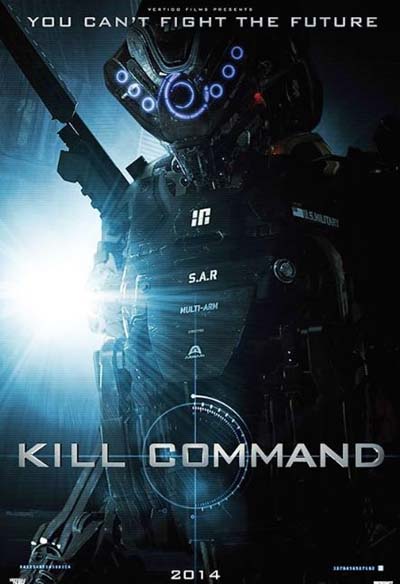
The beauty of “Kill Command,” however, is not the way the humans adapt to the menace of the gun-toting droids and their multi-blue-eyes leader. The film’s merit is the way the droids are presented, though I’m not sure that was consciously the director’s goal. The droids observe the marines continuously. They mimic the combat tactics of the marines. But, they never demonstrate humanity. Old Blue Eyes shows no loyalty to his underlings. There’s no hesitation to send them forward to get knocked off by a sniper round, or get claymore‑ed. The grunt droids show no hesitation to run into the line of fire or an open space while engaged. They never seek cover. And, there’s no apparent thoughts of mortality among the droids or their leader. The droids remain machines no matter how well their AIs SAR away.
“Kill Command” has weaknesses.
I’m still trying to figure out how Old Blue Eyes sweats, if that’s what a scene shows. There’s also a brief sequence where the leader droid seems to bleed from the seams of the clear shield covering its “face.” Or, maybe, I ain’t recalling that accurately.
A couple of the marines aren’t all that likeable. The couple who get droid-ed fairly early in the movie are.
And, there’s the ending. Two marines survive. Mills is alive but unconscious or, more accurately, off-switched because she got EMP-ed and, possibly, hacked by Old Blue Eyes before it expired from a big-caliber bullet to the face. What do the marines do? Board an unmanned flying droid transport to get off the island. Really? Most of your squad was offed by semi-thinking, no‑feeling robots but you willingly embark a pilotless aircraft that, for all you know, was built by the same company that developed and fielded Old Blue Eyes. Come on, considering the squad’s merciless encounter with AI, wouldn’t avoiding drones of any sort be wise while you think about what to do next?
This cool little movie is an A‑double‑minus. I can’t bear to give it a B+ because, despite its flaws, it works as commentary about the path mankind is trudging as AI takes control of the choices we make and the lives we lead.
Del’s take
“Old Blue Eyes,” Mladen? I guess that beats “Old Yellow Teeth.”
It’s purely coincidental I chose a shitty knock-off of “Aliens” and “Robocop” that pleased you, Mladen. I would never, EVER consciously do such a thing. You’d be as insufferable as the people I see online who really do believe Donald J. Trump is the incarnation of Jesus Christ. I wonder … if Jesus suddenly appeared at the White House, would Trump hand him over to ICE?
That’s my token political slap to the back of the head. Now, on to something really stupid, “Kill Command.” It’s not that stupid but throughout I kept asking myself, “How would James Cameron have handled this?” The answer was never way the Steven Gomez handled it.
I will agree with you, Mladen, on one point: The movie’s overriding theme, that AI will be the death of us all, is spot-on, maybe not the way “Kill Command” imagines it but spot-on just the same. In “Kill Command” the AIs are armed robots who want to destroy human beings … not a great way to start the day but yes, at least that’s a fairly straight up, in-your-face mode of conflict. The real AI killers are the ones we can’t see – the ones who lurk in the shadows, who twist and distort the truth just enough to make it seem real and plausible and easy to digest, so before you know it you’re believing the Earth really is flat, the moon landings were faked and climate change is a hoax. Those little bastards are the ones you gotta watch out for.
“Kill Command” reminded very, VERY much of “Aliens.” It’s the exact same set-up: A heroic female civilian enters a hazardous environment with a platoon of Marines. Things quickly go off the rails and team members die, one by one. Even the large robot, “Old Blue Eyes,” bears an uncanny resemblance to the giant, egg-laying queen in “Aliens.” We lack only a cute little girl by the name of “Newt.” (Which I never figured out. Who the hell would name their kid “Newt”? Then I learned “Newt” was a nickname. Ah, well, what can I say? My nickname in high school was “Chi-Com.” It’s a long story.)
But in other ways it reminded me of “Robocop” – the integration of man and machine in the form of Mills, the “super tech” who goes with the Marines on the island training exercise. She’s no Alex Murphy and at times must make some very human choices, but there’s enough of the machine in her to make me wonder where her allegiances lie. I’m not saying “Kill Command” is derivative of “Aliens” and “Robocop,” but I don’t think inspired by would be wholly inappropriate.
I have a few quibbles. The Marines have guns that never run out of ammo. Sometimes the robots are great shots; other times they couldn’t hit the broad side of my oversized ass, which makes them horrible shots. And why do the Marines tolerate the presence of those intrusive flying robot surveillance drones? In this movie you can’t take a piss without a giant hovering eye suddenly showing up to watch your every dribble. And they’re so quiet! Have you ever heard a drone in real life? It sounds like a flying weed whacker.
My big gripe is that everything in “Kill Command” seems so rushed. In “Aliens” Cameron gave us a back story and let us get to know the characters as individuals. In “Kill Command” we get a perfunctory introduction to the protagonist and spear carriers, and then it’s off to the bloodletting. The action is fast-paced and there’s a lot of it, but do I care? Not really. I don’t know these folks – at least not like I know Hudson, Hicks, Bishop, Vasquez and Spunkmeyer.
I dunno, Mladen. Your standards are depressingly lower than mine. You gave “Kill Command” a weird, not-quite-A-, not-exactly-B+. I’m giving it a very clear and confident B-. It was an OK movie for sitting on my ass at the house and not paying anything extra, but overall it was “Aliens”-lite, and the ending, which I have not mentioned until just now, was just plain corny.
Mladen Rudman is a former journalist and technical writer. Del Stone Jr. is a former journalist and writer.

Machinery gear close up image, public domain CC0 photo. More: View public domain image source here
INTRODUCTION
As I was writing “I Feed the Machine” I did not envision a future America where political criminals and religious fundamentalists might rule the land.
Yet here we are, in the summer of 2024. The corrupt Supreme Court has just ruled that presidents, in their capacity as commander in chief, are not subject to the rule of law, invalidating 248 years of American jurisprudence. Republicans are busy rewriting voting districts so that only they can be elected, and the GOP is silencing the ability of the loyal opposition to make its voice heard.
Simultaneously, religious fundamentalists are attacking the institutions that have made America such a wonderful experiment in democracy and egality. They would have us think and behave in their own drab perception of what is right and wrong, or good and bad.
And corporate entities are solidifying their hold over both the architecture of our leadership and the reins of our economy, ensuring that we remain indefinitely within their thrall.
Powerful forces are arrayed against us, forces that do not care about you or me, forces that have only their preservation and enrichment in mind.
I’m reminded of the following quote, taken from astronomer Carl Sagan in his book “The Demon-Haunted World”:
“I have a foreboding of an America in my children’s or grandchildren’s time – when the United States is a service and information economy; when nearly all the manufacturing industries have slipped away to other countries; when awesome technological powers are in the hands of a very few, and no one representing the public interest can even grasp the issues; when the people have lost the ability to set their own agendas or knowledgeably question those in authority; when, clutching our crystals and nervously consulting our horoscopes, our critical faculties in decline, unable to distinguish between what feels good and what’s true, we slide, almost without noticing, back into superstition and darkness. …”
“I Feed the Machine” is a fictional rendering of that quote. It is what happens when good people stop thinking and leave the solutions to others, or as the Rev. Charles Frederic Aked (not Edmund Burke) wrote, “It has been said that for evil men to accomplish their purpose it is only necessary that good men should do nothing.”
I contemplated the 2024 Fourth of July with no small degree of despair. It may well have been our last as a free people. A great evil has clouded the minds of otherwise decent and hardworking Americans, one that would have them support a felon and sex offender for the highest office in the land. And his odious Project 2025 is nothing less than a blueprint for 21st century fascism.
That is not what America is about, yet many people eagerly anticipate the calamity, as if it would solve their problems. It won’t.
Everything hangs in the outcome of the presidential election in 2024. Will America continue to be America, or will it become a Christo-fascist state with strutting, smirking potentates folding their arms, jutting their jaws and nodding at the adoring masses, abetted by evil religionists and fawning corporate parasites?
The choice, as I see it, is simple:
A vote for democracy.
Or a vote for “I Feed the Machine.”
We shall see. …
Del Stone Jr., July 5, 2024
—
I FEED THE MACHINE
I feed the machine.
I bring his breakfast, lunch, and dinner.
I have always done this. I always will.
The machine is a man. He is called a Tabulator. He performs calculations, and he is the company’s most valuable asset.
We live in the Redoubt, where the machine is served by me and others. Doctors. Teachers. Groomsmen. His breeding pool.
We have always lived here. We always will.
—
Sometimes the machine favors me with talk.
“Have you never traveled beyond these walls?” he asks. He knows I have not, but still he asks. “Have you never seen the mountains that conceal our fortress? Have you never seen the ocean, or the sky?”
Sometimes the machine speaks in these questions that are not really questions. He knows I was born here just as he, the fifth of his line. He knows we all were born here under the watchful eye of the company. Otherwise we might be set upon by martyrs from other companies who covet his calculations.
Or the infidels.
Mostly it is at dinner that the machine favors talk. I tell him my supervisor will punish me if I do not return at once, but the machine scoffs. “I have made it clear to the company that if I wish my servers to linger they will not be punished,” And when he finishes saying that he winks at me. It is flattering that a man of such value would favor my company, but my supervisor will be unhappy.
Still, I linger. I enjoy the machine’s questions.
—
What is a mountain? What is an ocean, or a sky?
I have heard of these things. A mountain is a mass of rock which protects us from martyrs and the infidels. An ocean is a great body of water. It separates us from the infidels, who live on the other side of the world. The sky is a great open thing from which the infidels might descend to destroy us all.
But I have never seen a mountain, an ocean, or a sky.
—
“Have you never loved?” the machine asks. His eyes are alive and glittering, and through them I see a sliver of the vast world his thoughts occupy. I tell him I have a great love of the company, and of The Rapture, our leaders of the government. He waves a hand to dismiss this answer. “We all love those things of course. I am speaking of the love of another person.”
The machine has always treated me with respect and affection. I tell him I love him.
He smiles warmly and says, “As I love you. But I am speaking of an even greater love, the love that exists between a man and a woman, or a man and a man as the case may be.”
I am horrified by his words. The love between a man and a man would be smitten by The Rapture as an abomination. And here at the Redoubt the love between a man and a woman is forbidden. It interferes with important work. We servers are given monthly inoculations to prevent it. I gaze about the dining room and my expression seems to convey more than my simple answer of no.
“It doesn’t matter if they are listening,” he says. “I am the company’s most valuable asset.” He is silent a moment. I gather his food, which he has barely touched, and as I leave he reveals to me, “I am in love.”
I cannot fathom such a thing. It is as mountain, ocean, and sky.
—
I live in a 500-square-foot room. I take my meals in a cafeteria. I have access to a gymnasium, a swimming pool, and a fitness room. For entertainment I look at approved books, compete in sporting events, or browse the aisles of the company store. I receive weekly sunlamp treatments and blood tests. I pray three times a shift at organized services. Once a month I receive a castration inoculation. I am allowed access to certain parts of the Redoubt and my whereabouts are reported by transponder. If I deviate from approved areas an explosive device with a blast radius of two centimeters will detonate inside my brain.
I have a busy and rewarding life. I have no room for love.
—
“I am in love with the Checker,” the machine whispers surreptitiously. I don’t understand.
A Checker is a person who checks a Tabulator’s work. He constructs proofs to validate or invalidate the Tabulator’s calculations. The proofs are then returned to the Tabulator, who either certifies or revises them. Once the calculations and proofs are certified by both Tabulator and Checker they are sold to the contractee, another company or The Rapture itself.
The Checker and the Tabulator are never allowed to meet. To do so might corrupt their work. They are kept away from one another and it is this I do not understand. How could the machine love a person he has never met?
“The Checker is a woman,” the machine says with a smile. “Her proofs are constructed with an intricacy that only a woman might understand and a man admire.”
The machine has been distressed. I wonder if these thoughts grow from that discontent. He is currently performing a set of calculations for The Rapture, the most important calculations any Tabulator has attempted to produce. If he is successful the menace of the infidel will be ended.
“I hide messages in my calculations,” the machine whispers to me, glancing suspiciously at the walls, “and she responds to them in her proofs.” The glitter in his eyes has been replaced with a desperate sheen.
“She validates my love, and I validate hers.”
I do not understand.
—
The infidels live on the other side of the world. They are a lost people who exist in moral squalor. They celebrate primitive animal desires: lust, greed, pleasure. They use devices wantonly and most abominable are the thinking devices, the ones that perform their calculations. They use these devices to support and export their evil culture. For their efforts they will suffer eternity in the Lake of Fire.
The Rapture wisely outlawed such devices and we are protected from the moral squalor they induce. Now only simple devices are allowed, such as the device inside my brain. The infidels would decry such a device as an invasion of personal freedom, but human beings are born with only one choice – the choice to accept or reject the Savior. I made my choice a long time ago. I am free.
—
“I have asked the company to let me see her,” the machine murmurs. “They will refuse and I will be forced to act.” The room has become cluttered with papers filled with inscrutable markings. Pages are attached to the walls and bear the frantic formulae of a genius who cannot write as quickly as he can calculate. I understand none of it, which is why I am allowed to see it.
“I am approaching a critical juncture in my calculations,” he says. He looks weary and perplexed. Perhaps he has encountered a problem he cannot solve. “If they do not allow me to see her I will be unable to complete their calculations.”
Had another person spoken these words he would have been smitten as a heretic. To threaten the company and The Rapture is unthinkable. But the machine is a genius and from him they seem words of uncanny insight, though I cringe to hear them. He says the very things we are told not to think.
“Let us hope they have the good sense not to retire us,” he says but I am not afraid. We will all be retired one shift and in some fashion. Should the machine fall from grace we servers will be retired with the push of a button, the devices in our brains detonating simultaneously. Should I slip poison into the machine’s afternoon tea I alone will be retired – not before I have been compelled to reveal the source of my corruption. Retirement is a fact of life.
But the machine seems to value something more than his life.
—
I bring the machine his breakfast. He is leaning back in a chair with his feet propped on the table. His smile is fat with glee.
“It has begun,” he gloats. “I have asked the company to let me see the Checker. They have refused. So I have told them I cannot complete the orbital calculations for The Rapture.”
I do not know what “orbital calculations” are, but I am familiar with the term “blackmail,” having been intensively studied in the dark arts of manipulation used by the infidels. I fear for the machine’s soul.
“The company will distribute my work among other Tabulators and they will fail. The company will then be required to grant my request. I expect this will take a week. Meanwhile, let’s eat!” he proclaims, rubbing his hands together. “Self-determination can give a man an appetite.”
He winks.
—
My supervisor tells me I will not feed the machine this shift.
Am I being retired?
No. It is a company intercession. The machine is not to be fed until further notice.
—
After seven shifts I am allowed to feed the machine.
He does not look healthy. His skin is sallow and hangs from his cheeks and elbows. His hair is coarse and gray. He has the sunken posture of an elderly man.
But his eyes are alive.
“The company has tried to starve me into submission,” he says, eating only a little of this and that as if his stomach were no longer capable of accepting food. “But I will not submit. I am a middle-aged man and soon a thing like romance will be lost upon me. I am determined to solve this problem.”
If he were to receive castration inoculations like the rest of us he would not be grappling with these feelings. But the chemicals might dull his ability to calculate, so the company refrains from giving them to him.
“They have promised to reconsider my request if I provide them with the first dimension of my calculations. I have agreed to do that. I will not, however, provide them with enough information to enable a second Tabulator to complete the calculations. Not until I have met with my sweet Checker.”
I do not understand why this liaison is so important but I relegate it to the body of arcane notions the machine sometimes shares with me. Perhaps I will understand it after I have seen a mountain, an ocean or a sky.
—
The machine is sobbing.
The sound is terrible. I have heard it only once in my life, during a sporting event when a fellow server was injured and suffered great pain. The machine must be suffering great pain. I cannot place his oatmeal on the table because he is resting his head there.
“The company has said it will not consider my request to meet the Checker until I’ve provided them with the second and third dimensions of my calculations.”
I don’t understand. The company said it would consider his request after he provided them with the first.
“They lied,” he says bitterly.
For a moment my thoughts go blank. The company cannot lie; lying is an abomination that would bring harsh sanctions from The Rapture.
“They said they were ‘revising’ the conditions of our agreement because of unforeseen circumstances. I asked them what those circumstances were and they said The Rapture was anxious to acquire my calculations and had advanced their deadline. They said the risk of having the results tainted by my meeting the Checker were too great, and that afterwards such a meeting might be arranged. But I know they are lying.”
This is the most vexing of all the new ideas the machine has shared with me and I truly fear for his soul. The company cannot lie. Truth is the foundation of our life here at the Redoubt.
“I will not submit,” the machine says in an unsteady voice.
Has he begun to fail?
—
At my nightly prayer ritual I ask that the Savior provide clarity of thought and moral guidance to the machine. My prayers are approved by the minister who presides over the service. He is a company man. He tells me the Savior will look kindly upon my request because the machine is providing an invaluable service for all who believe in The Rapture.
Later, in my room, I wonder: Should I have asked for my own clarity of thought?
—
“Did you need further proof the company lies?” the machine snarls as I bring him his dinner. “Look at this.”
He is shaking a piece of paper.
“They told me it was a message from the Checker! Bah!”
He does not offer me the piece of paper, which is just as well. I would not know what to make of anything written there.
“It has none of her personality or her insights. In every way it says nothing. An imposter wrote this!”
I struggle for a response. I suggest the Checker may not be able to express her thoughts outside of mathematics.
“It is signed by a man,” the machine mutters grimly. “They don’t know that I know.”
I do not want to say what occurs to me: that the machine has made an error, that the Checker in fact is a man and the messages hidden in the calculations are nothing more than coincidence.
“I performed the second dimension of calculations. I asked the Checker if she had written such a message. She vigorously denied doing so.”
For the first time in my life I am sick with uncertainty. The two pillars of my belief are at war with one another and I feel I am being asked to choose.
“They will never receive the completed calculations.”
I don’t know what to say.
—
My supervisor takes me aside. I am led to a room. I am introduced to a Disciple of The Rapture.
I fall to my knees.
He motions that I rise. I am humbled by his presence. He is one of only 12 and is second only to the Foremost who is the titular head of The Rapture. Apart from encounters with the machine I have never bowed in the presence of such wisdom and insight.
He asks me questions about the machine. What does he eat? When does he sleep. What are his interests? I answer each question truthfully. Then he asks if I know what the machine hopes to accomplish by meeting the Checker. In fact I do not, as the concept of love is as unknown to me as a mountain, ocean, or sky.
The Disciple ponders this a moment and then delivers a homily in which he confirms what I already know, that the machine is performing a set of calculations that will bring the menace of the infidels to an end and I should help him to finish his work by performing my server duties to the best possible extent.
I vow to do that (without pointing out that I have always done that) and I am dismissed. Outside the room others who serve the machine are called to question.
At the end of my shift I attend my nightly prayer ritual and I pray more fervently than ever for guidance. I could have told the Disciple about the machine’s communication with the Checker through their calculations but I did not. Was that a lie? And why was I protecting the machine?
—
The machine is ecstatic. I place his breakfast before him and he shovels great dripping spoons of oatmeal into his mouth. He is hardly able to speak between his appetite and his joy.
“I met with the Disciple and he has agreed to my request!” he blurts. I can barely understand him.
But I feel two things – an overwhelming happiness for the machine and an unspeakable sense of relief for myself. The conflict is resolved. Better, my faith in the forces around me has been restored. The company is good. The Rapture is wise. And the machine is as smart and virtuous as I have always believed. It is by my relief that I measure the depth of my uncertainty, which I suppose demonstrates that what The Rapture teaches us is true: Human beings are fallible creatures who must always reaffirm their faith in order to earn a seat at the Savior’s table in the Great Hereafter.
“I must hurry to prepare,” the machine whispers as he lifts the bowl to his lips and literally sucks down the remainder of the oatmeal. It is hot and burns his throat but he swallows anyway, grimacing with pain. The sight of the company’s greatest asset attacking his breakfast with the gusto of a 10-year-old is too comical for me to restrain a chuckle, and the machine sees this and winks at me.
“Always remember: The Savior did not place us on this earth to work and pray and never celebrate the marvel of life. Even the infidels, damned as they are, know this.”
I will not let his casual heresies spoil my good mood. I collect his plates and he lunges from the table to put away papers and restore order to his living area. I leave with a smile.
I am happy for him. I am happy for myself. I am happy for all of us.
—
At my midshift prayer ritual I am removed from the sanctuary and escorted to my room by company officiates. Each officiate is armed with an omnus, a wand-like device that can disable a person with a touch. Along the way, I see other servers being similarly escorted. I have never seen such a display of military authority and it frightens me. Are we under attack? Have the infidels invaded?
As I lie on my bed awaiting instructions my thoughts take a dour turn. Might this have something to do with the machine’s liaison with the Checker? Has calamity struck? Has their relationship been tainted?
Are we all to be retired?
I stay in my room for an entire service cycle. Then I am instructed to feed the machine.
—
A company officiate stops me as I prepare to enter the machine’s quarters. “You will not speak to him,” he says. “You will leave his food and collect the dishes from the previous meal. Any deviation from these instructions will result in immediate retirement. Do you understand?”
A chill passes through me and I feel my eyes growing wide. I can only nod. The officiate conducts me through the door.
Another officiate is standing in the corner of the room. He is holding an omnus which crackles ominously with electrical charge. He watches me the way I think a predator must study its prey.
The machine is hunched over his table. He looks worse than after his starvation and my heart aches for him. An oozing weal crosses his cheek and it is clearly the stinging mark of an omnus lash. That the company would treat their greatest asset with such harsh disregard troubles me more than any heresy the machine has spoken in my presence.
“How can I work with that infernal noise,” the machine mutters as I place his meal before him.
“Do not speak,” the officiate orders.
The machine looks up at me and his eyes are wild with rage. “The meeting was a fraud! They lied!”
The officiate snarls, “Do not speak, Tabulator!” but the machine shouts, “The woman was no Checker! She came from the breeding stock of some other Tabulator! She knew nothing of mathematics!”
The officiate advances. Evil purple feelers of electricity crawl menacingly across its tip. I step back and the machine hunches down over his sheets of calculations. But the rage still smolders in his glare.
“Leave,” the officiate tells me. I collect dishes and leave.
I ask to be excused from my midshift prayer ritual. I feel an emptiness inside.
—
I feed the machine.
He has not eaten the breakfast I brought him.
Slowly I place his lunch before him and as I collect the bowl of oatmeal he looks at me with a quiet desperation and whispers, “They say I have been corrupted by the infidels!”
The officiate strides across the room and lashes out with the omnus. The machine screams and arches his back. His face is pinched into an expression of agony so complete that for a long moment he does not breath. Then he collapses to the table and the air gushes out of his lungs in a pitiful moan.
I cannot stand the sight of it. Without being told I grab the dishes and hurry for the door.
—
I lie in my room. I think about things. What is a mountain, or an ocean, or sky? What is truth anymore?
I know the machine has not been corrupted by the infidels. Such a thing is not possible. We were all born here – the machine, the Checker, and all the servers who make his life possible. We have never left the Redoubt and nobody has ever entered. The company made it that way to protect us from corruption and retirement.
Each of us has faithfully executed his duties.
Something is happening to me that I don’t understand.
A slow transformation of belief.
What is this love the machine would give his life for?
I begin to cry.
—
I feed the machine.
The room is draped in shadow with only a small lamp in the center of the table providing illumination. The officiate is a dark shape in the corner and the flickering of his omnus somehow fails to reveal any further detail, as though light itself would shun his presence. The machine stares blankly at an empty sheet of paper.
He has not eaten his lunch and I expect he will have nothing to do with the dinner I have brought him. He seems reduced, as if pain were sucking the bone from his body. I wish he would eat but I know I cannot make him. I don’t expect I’ll be feeding him much longer.
As I have always done, I carefully place the bowls and plates on the table, avoiding the precious sheets of mathematics. I remove the bowls and plates I brought earlier. I prepare to leave. As I do so, the machine slowly looks up at me. He says, “I want you to know something.”
The officiate comes striding across the room.
The machine says, “I think you already know what I was going to say.”
The officiate raises the omnus to strike and I react without thinking.
I grab his arm.
He is strong, far stronger than I, having been bred for the purpose of striking people. But perhaps he hesitates because it is unthinkable that a food server who has been conditioned from birth to obey would defy that conditioning. Whatever the reason, I snatch the omnus from his grip and ram it into his chest and it discharges with a strangely satisfying explosion of sparks. The officiate’s muscles spasm and he grabs the shaft of the omnus and receives a second jolt that knocks him across the room, where he collapses and lies still.
The machine gazes up at me with wonder. He says, “God help us but thank you!” and leaps from his seat. I am stunned by what I have done and as the machine scuttles into the shadows to check on the officiate and then returns to our island of light I begin to sense the enormity of my actions. I try to sit down. The machine helps me.
I am an abomination, I whisper.
The machine shakes his head vigorously. When I don’t respond he takes my face into his hands. It is the first time he has ever touched me. His skin is rough, the fingers callused from all the years of scribbling and erasing and scratching out. He looks into my eyes and I see his vast intelligence, unfettered now by hierarchy or ritual, and it transcends everything I have been taught.
He says, “You are a human being, and I thank you.”
He lets go. He darts back across the room and returns with the omnus. He hefts it with his right hand and collects the basket of dishes with the other. He says, “May I borrow your frock? Perhaps they’ll think it is you.”
I ask him what he is doing.
“I mean to find her,” he answers.
But that’s impossible. He doesn’t know where she is.
“If I must search every room of the Redoubt, I will find her,” he says.
But he cannot do that. The device in his brain. If he goes beyond the areas that have been approved the device will. …
“Yes, I know.”
No, I blurt. I am lost in every way now. He sets the dishes down and crouches at my feet and takes my hand into his. “You must listen to me,” he says, “and you must listen carefully because this may be the last chance you and I have to speak and I have something very important to tell you.”
I nod without understanding.
“I will not finish my calculations for The Rapture.”
I stare at him without comprehension.
“I have a very good reason. Circling far above our world is a series of hateful devices placed there by the governments that preceded The Rapture,” he says. “These devices are similar to the ones inside our brains, but they are much larger, capable of retiring whole cities in a pulse of light that would destroy many millions of people and spread poison across the face of the world.”
I cannot conceive of such a thing.
“The Rapture intends to use these devices to destroy the infidels,” he says angrily, taking his eyes from me to swear softly, “and that is what I have been doing. Performing the calculations that will tell the devices where to fall. The calculations must be executed in three dimensions, and I am the only Tabulator capable of keeping all the variables in order.”
My thoughts are a storm of turmoil.
He hangs his head in silence a moment, but when he speaks his voice is firm.
“I know nothing of these infidels. Perhaps they deserve such a fate. But I do know if the infidels are corrupt they will answer to the Savior, not The Rapture. And that is what our leaders really want – a world rendered in their image, where love is imprisoned, watched over by guards and struck down when it defies them. That is not what the Savior intended when he placed us here. He expected us to celebrate life.
“He expected us to love.”
Enough. I cannot take it all in – devices and cities and love. It is too much and I feel my world falling away from me. I do not know whom to ask for guidance.
The machine stands and smiles down at me.
“This moment has brought me more joy than any other in my life,” he says, “and I thank you for it.”
I give him my frock. I don’t know what else to do.
He steals to the door. He opens it and lashes out with the omnus. The officiate tumbles to the floor.
The machine glances back at me. He winks. And then he is gone.
I sit in the chair.
Moments later, I hear the sharp crack of a detonation, and when I peer into the hallway the machine is lying on the floor, a fine mist of blood coating the opposite wall.
—
I am confined to my room for a period of seven shifts. I wait to be given absolution. I wait for the device inside my brain to detonate. I wonder if it will hurt. But it doesn’t happen. I am brought to face an inquiry. Officiates from the company and a Disciple are there. The officiate I attacked has not regained consciousness. No mention is made of the machine. They ask me what happened and I tell them the officiate attempted to strike the machine and I intervened. They seem almost amused. They tell me my loyalty to the machine is commendable but a greater loyalty to the company and The Rapture must be observed. I insist I am telling them the truth. They tell me I am lying. They tell me I have been corrupted by the infidels. None of these things are true and I become angry. They send me back to my room to await the Hereafter.
On the seventh shift my supervisor tells me to feed the machine.
—
He is lying in his bed. His head has been shaved, and a bandage covers the right hemisphere of his skull. A wheeled table that extends over his chest is covered in papers.
Calculations.
His eyes finally find mine. They are filled with defeat.
“It seems I have been outwitted,” he says, and his voice possesses none of the vigor I had always known. He throws a weak sigh and his gaze wanders to the ceiling. “The device inside my brain … it was implanted in such a way as to disable, not kill. I am paralyzed from the waist down.” A disappointed frown momentarily clouds his expression. “How was I to know?”
I tell him I am glad to see him. He shakes his head.
“I am happy they chose not to retire you. I told them I attacked the officiate. It seemed to fit their mode of thinking.”
I am overcome by equal parts sadness and gratitude. He lied – blatantly lied. But he did so on my behalf. That a man of his importance would sacrifice himself for a server – the idea fills me with a peculiar devotion that has nothing to do with anything I have learned in my life.
“And now I have finished their infernal calculations.”
I say nothing.
“I had no choice,” he explains, his voice heavy with misery. “They threatened to retire the Checker! They threatened to retire all of you! I could not allow it. What is life in a world without love?”
He sighs again. “So I will exchange the lives of millions of people for the love of a single woman. It is I,” he says gravely, “who is the abomination.”
I tell him he is not though I cannot say why. He dismisses my objection with a flick of a finger and draws me close so I may hear without being overhead. “The courier will be here soon to carry my work to the Checker. In it I have delivered a final message. I have explained everything to her. She will know what to do.” I don’t understand, but much of what the machine tells me I don’t understand.
“And then,” he continues wearily, “I will likely be retired. But I am hopeful they will honor their agreement and not retire the Checker, or any of you.”
He clears a space on the table for the food I have brought him but I don’t want to set it down. I want to linger and draw out my time with him, but he beckons me to get on with things.
I look back at him from the door. The enclosing fog of sadness clears a moment, and he does a curious thing.
He winks.
—
I try to picture it in my mind’s eye: a vast prominence of stone rising farther than the eye can see into a limitless void. A body of water unthinkably larger than the biggest swimming pool splashing against the foundation of that prominence. Millions upon millions of people occupying those reaches, coming and going as they choose without regard for approval.
I cannot get my brain around any of it. So I remember that moment when I grabbed the officiate’s arm and wrestled the omnus from his grasp and drove it into his body. I remember a shock of some unnamable emotion, compelled by a deeper feeling of … affection? As I sort through my memory I slowly realize that whatever the feeling was, it had been there a very long time, longer than I had realized.
Was it love?
—
“The Checker has approved my final calculations,” the machine tells me. His face is radiant. “She found no errors.”
—
We are summoned to a conclave. Everybody who lives at the Redoubt attends. Even the machine.
It is unprecedented.
A Disciple of The Rapture, the same Disciple as before, stands before us. He tells us in a righteous voice the menace of the infidel will be put to rest this very evening. He thanks us on behalf of The Rapture for our work.
As we leave, those of us who serve the machine are taken aside. We are led to the sanctuary where we are given absolution.
It can only mean one thing.
—
For the last time, I feed the machine.
—
“What do you think retirement will be like?” he asks.
I no longer care very much one way or the other. Retirement is a small issue now that life itself is false.
But I tell him retirement is a slow warmth that steals over the soul followed by an awakening in the Hereafter where all questions are answered. I have been taught to say that but I no longer believe it. Soon we will all know the truth.
“I disagree,” the machine chuckles around a crust of bread. “Retirement is not a transmigration of the soul. It is merely the physical collapse of the body. The brain’s electrical signals become randomized then cease altogether. Afterwards,” he pauses to swallow, “there is nothing.”
His table is set. I begin collecting dishes from the previous meal.
“Do you think the citizens of our land could live with such a thing?” he asks. I tell him no. It defies what they have been taught.
“Yes,” he nods. “It is a principle by which the infidels live. But what if it were true?”
I finish collecting the dishes. They must be arranged in the basket in a particular way and I kneel at his bedside and set about doing that. As I work, I tell him that if there were no Hereafter then this life would become much more important.
“Yes,” he agrees mischievously.” We would celebrate life, would we not?”
I look up at him. He beams down at me.
“I knew they would not honor their agreement,” he whispers. “I knew they would retire us all after they got what they wanted – the destruction of the infidels, and a world rendered in their grim likeness. I could not allow that either.”
His expression softens.
“For all your life you believed somebody would push a button and the device in your brain would detonate and you would float away to your cozy Hereafter. But might there be a different way?” He raises himself on an elbow. I wait for him to speak.
“Suppose I were to say you would be retired in a pulse of sanctifying white light that would carry your body out of this mountain and scatter it across the ocean and sky? Suppose parts of your body would be converted to energy itself and flung on an endless voyage across the universe. Suppose we would be together – you, me, the Checker, all of us at the Redoubt – rising into the sky and falling across the world and flying into the Savior’s realm forever.
“If I told you that do you think we could share one moment of peace before it happens?”
He looks into me and I see the vast world his thoughts occupy. And then God help me I see the answer – I see it, circling far overhead and falling toward me on the gravity of the machine’s supreme calculations and as it draws closer I see it with a clarity I have struggled to achieve for my entire life and I am struck speechless with wonder.
The machine lies back into the pillow. “She accepted my calculations,” he says, his face relaxing into a contented smile. “That is my celebration of life.”
I forget to breathe as I see myself in a wave of light that spreads across a world I have never seen, and belief pours into me and fills the empty places with a warmth I have been told comes only with the Hereafter.
I don’t know what to say. I don’t know what to do. It is more than my heart can bear.
I take the machine’s hand and press it against my cheek. Flesh against flesh teaches me more than a life of instruction.
And a miraculous thing happens.
The hand is withdrawn. A crust of bread appears.
And the machine feeds me.
About the author:
Del Stone Jr. is a professional fiction writer. He is known primarily for his work in the contemporary dark fiction field, but has also published science fiction and contemporary fantasy. Stone’s stories, poetry and scripts have appeared in publications such as Amazing Stories, Eldritch Tales, and Bantam-Spectra’s Full Spectrum. His short fiction has been published in The Year’s Best Horror Stories XXII; Alfred Hitchcock’s Mystery Magazine; the Pocket Books anthology More Phobias; the Barnes & Noble anthologies 100 Wicked Little Witch Stories, Horrors! 365 Scary Stories, and 100 Astounding Little Alien Stories; the HWA anthology Psychos; and other short fiction venues, like Blood Muse, Live Without a Net, Zombiesque and Sex Macabre. Stone’s comic book debut was in the Clive Barker series of books, Hellraiser, published by Marvel/Epic and reprinted in The Best of Hellraiser anthology. He has also published stories in Penthouse Comix, and worked with artist Dave Dorman on many projects, including the illustrated novella “Roadkill,” a short story for the Andrew Vachss anthology Underground from Dark Horse, an ashcan titled “December” for Hero Illustrated, and several of Dorman’s Wasted Lands novellas and comics, such as Rail from Image and “The Uninvited.” Stone’s novel, Dead Heat, won the 1996 International Horror Guild’s award for best first novel and was a runner-up for the Bram Stoker Award. Stone has also been a finalist for the IHG award for short fiction, the British Fantasy Award for best novella, and a semifinalist for the Nebula and Writers of the Future awards. His stories have appeared in anthologies that have won the Bram Stoker Award and the World Fantasy Award. Two of his works were optioned for film, the novella “Black Tide” and short story “Crisis Line.”
Stone recently retired after a 41-year career in journalism. He won numerous awards for his work, and in 1986 was named Florida’s best columnist in his circulation division by the Florida Society of Newspaper Editors. In 2001 he received an honorable mention from the National Lesbian and Gay Journalists Association for his essay “When Freedom of Speech Ends” and in 2003 he was voted Best of the Best in the category of columnists by Emerald Coast Magazine. He participated in book signings and awareness campaigns, and was a guest on local television and radio programs.
As an addendum, Stone is single, kills tomatoes and morning glories with ruthless efficiency, once tied the stem of a cocktail cherry in a knot with his tongue, and carries a permanent scar on his chest after having been shot with a paintball gun. He’s in his 60s as of this writing but doesn’t look a day over 94.
Contact Del at [email protected]. He is also on Facebook, twitter, Pinterest, tumblr, TikTok, and Instagram. Visit his website at delstonejr.com .
Image courtesy of Searchlight Pictures.
“Ready or Not 2 Here I Come” Starring Samara Weaving as Grace MacCaullay, Kathryn Newton as Faith MacCaullay, Elijah Wood as the lawyer, Sarah Michelle Gellar as Ursula Danforth, Shawn Hatosy as Titus Danforth, David Cronenberg as Chester Danforth and others. Directed by Matt Bettinelli-Olpin and Tyler Gillett. 1 hour, 48 minutes. Rated R. Theatrical release.
Plot summary: Sitting on the front steps of the Le Domas family mansion after the deadly events of “Ready or Not,” Grace MacCaullay finds herself swept up in a new, deadlier hide-and-seek style contest as members of four families vie for control of the High Council, a body that serves Mr. La Bail, aka Lucifer.
Spoilers: Does the Devil wear Prada?
Del’s take
Grace MacCaullay has just defeated the entire Lucifer-worshipping Le Domas clan in a night of bloody mayhem at their now flaming mansion. The authorities rightfully suspect Grace as having committed many felonies, but she’s injured. She’s taken to a hospital. She’s grilled by a detective who has already decided her guilt. Her estranged sister, Faith, is summoned, as Grace never removed Faith as her emergency contact. And then. …
She and Faith are brought before the shadowy High Council, where they learn (a) the Le Domas clan wasn’t the only collective of rich bitches who sold their souls to the devil for worldly wealth, (b) Grace’s destruction of the Le Domas family has created a vacancy at the head of a cabal of devil-worshippers called the High Council, and (c) four new families will compete for that vacant position – and the immense power it conveys – by sacrificing Grace and her sister to Mr. La Bail, aka the devil, before the sun rises the next day.
Sound familiar?
Yes, “Ready or Not 2” is about power. In an opening scene, Chester Danforth – before he is smothered by his children – watches a war play out on the TV news, then picks up his telephone, orders a cease-fire, and watches the breathless announcement of a cessation in hostilities on the very same news broadcast. And yes, “Ready or Not 2” is an eat-the-rich indulgence in wish fulfillment, especially in 2026, as the 1 percenters pad their velvet-upholstered cushion of wealth and control at the expense of poor suckers like you and me.
But what “Ready or Not 2” really wants to be is a John Wickian-style semi-comedy about the power of family, which is the weakest of its three subtextual pillars. The whole family-comes-first theme is largely irrelevant to the matters at hand – the bloody extermination of wealthy parasites and their useless scions as creatively and graphically as possible. In fact, the constant intrusion of guilt becomes annoying – how often can Faith remind Grace that she abandoned her little sister, that she “wasn’t there”? Americans are besotten with this notion of familial abandonment. It’s become trite, an easy fallback when an icing of emotional resonance is needed for tension or motivation.
The comedic aspects of “Ready or Not 2” are somewhat clever and operate on multiple levels, but the overall tone is one of satire, not slapstick, though some scenes definitely qualify as physical humor – the rocket launcher, for example. Dialogue has its moments, too, but the quality of the writing isn’t as sharp or as hilariously acerbic as something like “Doctor Strangelove.” Overall, the humor tends to trivialize, not satirize, making it impossible to view “Ready or Not 2” as anything but a trifle.
As is the case with many horror movies these days, even the ones alleged to be funny, “Ready or Not 2” is drenched in blood, and some of the violence crosses the line between horror and torture porn. For example, an extended battle between Titus and Faith became a teeth-loosening, rib-cracking orgy of mayhem that goes on far too long. Were Bettinelli-Olpin and Gillett were taking far too much pleasure seeing their female character get her ass kicked?
The first act is slow, but acts two and three pick up the pace, redeeming “Ready or Not 2” as an entertaining movie. But like a SnapChat message sent late at night, anything of significance fades by morning, relegating “Ready or Not 2” to the sales bin of disposable entertainment, stat. Again, it’s a trifle. Nothing more.
I’m giving it a B. See it in a movie theater.
Mladen’s take
Samara Weaving and Kathyrn Newton are very good actresses. Their faces express as much about what they’re thinking as the words they’re saying in “Ready or Not 2 Here I Come.”
Also praiseworthy is the pit massacre near the end of the movie. Clearly, it was modeled on the way the Trump administration operates.
Between the sisters’ back-and-forth squabbling and rehashes of family history and the pit, there are a few chuckle-inducing skits. I enjoyed watching Elijah Wood play the anti-Frodo, though his rendition of a Mephistopheles wedding prayer and ritual could have been more joyful.
But, none of these bits of the positive make “Ready or Not 2” good.
Again and again and again, the protagonists and the antagonists make damnably poor choices, because, I don’t know, the scriptwriters were too unimaginative to come up with more realistic ways folks end up making dumbass decisions. Either the estranged but re-uniting sisters prolonged their misery by, say, not shooting or beheading the brother-and-sister team trying to kill them to get the chairman’s seat on the bedeviled High Council or the antagonists, whose souls have been sold to Satan, turn out to be remarkably poor shots or too conniving for their own good or just too maniacal. Come on, you’re allied with Beelzebub. Wouldn’t that automatically imbue you with capacity to have at least one of the, oh, dozen, 50-caliber bullets you fired from a high-end sniper rifle find its mark?
One other bit in the movie irritated me. It’s the poor choice of vocabulary. Whenever one of the devil worshippers violated a devil worship bylaw, they would metamorphose into a fountain of gelatinous goo that had a large splash radius. The younger MacCaullay called those splatter events “combustion.” No, no, no. The evildoers didn’t catch fire. They didn’t burn. They exploded, goddamnit.
More deeply disappointing, though, was that my building hope was dashed. As “Ready or Not 2” progressed, I started to hope that the elder MacCaullay would figure out a way to knock off Lucifer or at least subvert Hell by turning it into an alternative Heaven. No such luck. The best she was able to do was initiate the pit mayhem, which, though much appreciated, felt like she had failed to finish what she was dragged into.
I have not watched the first “Ready or Not” and I had no expectations for “Ready or Not 2.” In fact, when Dusty asked us if we’d like to see the movie, I confused it with another title that appeared in theaters in late 2025, “Now You See Me: Now You Don’t.” I knew nothing about “Ready or Not 2” before I saw it. So, my review is sincere, my counsel untainted. You can wait for this one-notch-above-a-C+ movie to hit the streaming circuit.
Mladen Rudman is a former journalist and technical writer. Del Stone Jr. is a former journalist and writer.
Image courtesy of A24.
“Undertone” Starring Nina Kiri as Evy, Michèle Duquet as Mama, and Adam DiMarco as Justin. Written and directed by Ian Tuason. 1 hour, 34 minutes. Rated R. Theatrical release.
Plot summary: A podcaster who is caring for her terminally ill mother begins to see parallels between her personal situation and a series of terrifying audio files.
Spoilers: No.
Del’s take
Mladen was unable to join me for “Undertone.” He was in Tennessee, hunting fossils. I’ve told him repeatedly if he wants to find an old stone he’s got my number, but he never listens.
His loss, because “Undertone” is quite a good movie. It eschews the modern approach to horror – jump scares, gore, full frontal monster – and relies on the viewer’s imagination to conjure the deepest scares, reminiscent of “The Innocents,” the Robert Wise production of “The Haunting of Hill House,” and Ridley Scott’s “Alien,” all masterpieces of horror. But where “Undertone” shines is its use of light and sound as a storytelling device.
The story is about Evy (Nina Kiri), a podcaster who is caring for her terminally ill mother (Michèle Duquet). She is living in her mother’s house, a small, claustrophobic relic from a bygone era. At odd hours of the morning Evy manages to squeeze in her paying job, that of a podcaster focusing on paranormal events. She is a skeptic; her creative partner, Justin (Adam DiMarco) is a believer, an obvious parallel to the relationship between Dana Scully and Fox Mulder of “The X-Files.”
Justin has received a collection of 10 audio files from an unknown contributor that are believed to prove the existence of a demon, Abyzou, a creature of European folklore who steals children because she cannot have a child of her own. As the audio files are played countdown-style over a period of days, Evy begins to realize they describe events taking place in her personal life, and her grasp on reality begins to slip.
“Undertone” is rife with subtext – religious guilt, familial guilt, and weightier issues such as Evy’s pregnancy, and whether she should keep the child or have an abortion, and her growing exhaustion in caring for her mother. But “Undertone” is as much a vibe as it is a story. The spooky atmospherics operate like a fourth character. Tuason directs the eye to a darkened doorway behind Evy, as if we should expect to see something there. The house is perpetually cloaked in shadow, just as Evy’s life is at the moment. Sounds reverberate throughout – a clock ticking loudly, the refrigerator cycling on – but there are other sounds heard by Evy – a crying baby, a nursery rhyme played backward that may contain a summons. Are they real? We don’t know. When Evy puts on her headphones, all sound ceases and the silence becomes monolithic. These elements enhance the suffocating milieu of Evy’s predicament and amplify the themes of guilt and isolation.
Nina Kiri is excellent as Evy – she appears in virtually every scene – while Adam DiMarco’s Justin, who appears only as a voice on the phone, is the rational appositive to what may be Evy’s descent into madness. Or is it possession? Again, we don’t know. Michèle Duquet’s Mama rarely moves, but when she does, be prepared for the unexpected.
“Undertone” is Tuason’s first movie and cost about half a million dollars to make. Expect more from this talented writer and director. I appreciated the dearth of modern horror movie tropes and the ingenious use of light and sound to convey dread.
“Undertone” rates a B+, maybe an A.
Del Stone Jr. is a former journalist and writer.

Image courtesy of StockVault.
INTRODUCTION
This story is about a hypocrite.
A particular kind of hypocrite. The Republican kind of hypocrite.
Full disclosure: For most of my life I was registered as a Republican. The Republican Party was the party of reason. It was the party of moderation. It was the only responsible political choice for people like me – decent, simple, hard-working individuals who believed in living within their means and delaying gratification.
The Democratic Party represented a wholly different set of values. The Democratic Party was about taking your money and hard work and giving them to somebody else, usually somebody who was unwilling to work hard or delay gratification. The Democrats were about welfare, and socialism, and a new set of values that eschewed the traditional strengths of American culture.
So I remained a registered Republican for most of my adult life. But along the way, the Republican Party changed.
This change began in the 1980s, during the presidency of Ronald Reagan. Christian conservatives, through instruments like the Moral Majority, began to organize and seize control of the Republican Party. Over the years this lingering conservativism, masquerading as religionism, held on and festered until it found a new champion in Donald J. Trump.
Trump was, in my estimation, the worst president in the history of the United States. I won’t belabor his sins, but suffice it to say he wrecked the country AND he divided it. Maybe you don’t share that opinion. Maybe you’re wrong.
The end result is a group of people who not only don’t mind if their leaders lie, cheat and steal, but a generation of Americans who believe lying, cheating and stealing are normalized.
What an astonishing departure from everything I’ve known over my lifetime. To think, these folks believe lying, cheating and stealing aren’t so bad because everybody does it, including the president!
Worse, they lie to themselves, and that’s what “The Fire People” is about.
Here we have a woman who outwardly presents as a religious, conservative, moral person. But look beneath the veneer and you find somebody who isn’t what they seem, somebody who aspires to a different kind of life, one that they outwardly condemn when it’s somebody else but secretly embrace for themselves.
Fate has a way of tripping up people like that, and that’s exactly what happens to the protagonist of “The Fire People.”
She gets what she thinks those other people deserve.
I wrote this story in the late ’90s but sadly, it’s more relevant today than it was back then. I guess it’s true that the more things change, the more they stay the same.
Del Stone Jr., July 18, 2024
—
THE FIRE PEOPLE
… and if I die before I wake,
I pray the lord my soul will take …
It was the smoke alarm that hauled Gabby out of a dream-filled sleep, a barb of sound hooking through her left ear, through the center of her brain, piercing muzzy, subconscious images of guilt and sin and virginity.
She did not know what was happening, and staggered out of bed to answer the telephone or thumb the buzzer on the alarm clock or remove the clothes from the dryer. But after a moment of eye-rubbing she recognized the shriek, and her skin seemed to shrink around her bones. Oh my, she gasped to herself, and she almost said it. She almost spoke the sacrilege:

Oh my God.
She reached for the doorknob without thinking and – too late now – it was hot, hotter than the little travel iron set on “cotton,” and the door swung open as she jerked her hand away, a surprised gasp whistling through her lips. A wave of twisting heat and light rolled into the bedroom, as if she had just popped the door on the oven after baking a tray of dinner rolls.
Fire – fire – fire –
Flames blew up the stairwell with a roar, chewing along the pebbled ceiling and gnawing at the banister and reaching for the register at the top of the landing. The air was filled with the cauterizing stench of chemicals and woodsmoke, and Gabby could think only stupid thoughts: How did this happen? What did I do to deserve this?
And then she was crawling for the sliding glass door at the other end of the bedroom, which opened to the fourth-floor balcony – never mind what she would do then; all that mattered was escape. And as a part of her brain tallied the losses – her clothes and furniture, the photographs of her Sunday school students and her great-grandmother’s Bible and the gold-plated crucifix pendant given to her by the Reverend Thomas Miller for her years of service to the Antioch Baptist Church – another part of her glanced back resentfully at the advancing flames, and that was when she saw them. Sinister movement amid the ugly glare.
The fire people.
Her muscles froze, and the breath eased out of her so that her belly grazed the furry nap of the carpet. Although she knew she must get out now or die, she could not tear herself from the sight of them.
People, in the fire. Of the fire.
People with huge, swaying breasts that seemed filled with jellied gasoline, and bulbous penises that twitched and sprayed bright arcing gobbets of lava. Copulating. Fornicating.
People fucking.
They raced across the ceiling in a kind of frantic insectile glee to roll against the draperies so that the fabric exploded in flames, or shoved impossibly long, bright, arms into the air register so that it fumed inky smoke, or rolled across the bubbling carpet toward her, shimmying under the bed where she kept her magazine photos of naked men … Oh no, don’t find them, I didn’t put them there, not mine … and then the closet doors jumped open and the fire people swept napthic penises and breasts down the breadth of her wardrobe, and the other things in there, the little box of sex things, the gels and straps and mechanical devices, so that the contents erupted in a righteous blaze that flanked her, a gallery of jittering, undulating shapes rising between her and the balcony.
Now I lay me down to sleep; I pray the lord my soul will keep … the children’s catechism sprang perversely to her mind, and as the fire people circled her and drew closer, reaching out with the promise of an embrace that would boil the meat from her bones, the next verse of that simple prayer hovered at the back of her thoughts, and she knew exactly what she had done to deserve this, and which lord had come to take her away … and keep her. …
About the author:
Del Stone Jr. is a professional fiction writer. He is known primarily for his work in the contemporary dark fiction field, but has also published science fiction and contemporary fantasy. Stone’s stories, poetry and scripts have appeared in publications such as Amazing Stories, Eldritch Tales, and Bantam-Spectra’s Full Spectrum. His short fiction has been published in The Year’s Best Horror Stories XXII; Alfred Hitchcock’s Mystery Magazine; the Pocket Books anthology More Phobias; the Barnes & Noble anthologies 100 Wicked Little Witch Stories, Horrors! 365 Scary Stories, and 100 Astounding Little Alien Stories; the HWA anthology Psychos; and other short fiction venues, like Blood Muse, Live Without a Net, Zombiesque and Sex Macabre. Stone’s comic book debut was in the Clive Barker series of books, Hellraiser, published by Marvel/Epic and reprinted in The Best of Hellraiser anthology. He has also published stories in Penthouse Comix, and worked with artist Dave Dorman on many projects, including the illustrated novella “Roadkill,” a short story for the Andrew Vachss anthology Underground from Dark Horse, an ashcan titled “December” for Hero Illustrated, and several of Dorman’s Wasted Lands novellas and comics, such as Rail from Image and “The Uninvited.” Stone’s novel, Dead Heat, won the 1996 International Horror Guild’s award for best first novel and was a runner-up for the Bram Stoker Award. Stone has also been a finalist for the IHG award for short fiction, the British Fantasy Award for best novella, and a semifinalist for the Nebula and Writers of the Future awards. His stories have appeared in anthologies that have won the Bram Stoker Award and the World Fantasy Award. Two of his works were optioned for film, the novella “Black Tide” and short story “Crisis Line.”
Stone recently retired after a 41-year career in journalism. He won numerous awards for his work, and in 1986 was named Florida’s best columnist in his circulation division by the Florida Society of Newspaper Editors. In 2001 he received an honorable mention from the National Lesbian and Gay Journalists Association for his essay “When Freedom of Speech Ends” and in 2003 he was voted Best of the Best in the category of columnists by Emerald Coast Magazine. He participated in book signings and awareness campaigns, and was a guest on local television and radio programs.
As an addendum, Stone is single, kills tomatoes and morning glories with ruthless efficiency, once tied the stem of a cocktail cherry in a knot with his tongue, and carries a permanent scar on his chest after having been shot with a paintball gun. He’s in his 60s as of this writing but doesn’t look a day over 94.
Contact Del at [email protected]. He is also on Facebook, twitter, Pinterest, tumblr, TikTok, and Instagram. Visit his website at delstonejr.com .