The Miracle Strip has been replaced by a monument to greed
Del Stone Jr.
I was privileged to have grown up on the Miracle Strip.
To my loss – and everyone else’s loss – the Miracle Strip is now a thing of the past.
It has been replaced by an asphalt and concrete monument to greed.
This is what I want to tell you.
—
The Miracle Strip as it once existed, the Miracle Strip of the 1950s, ’60s and even the ’70s, possessed a unique charm, a kind of innocent simplicity dipped in yellow cornmeal and buttermilk, then deep-fat fried and served with melting butter. That recipe for charm still exists in places with names like Sopchoppy and Wewahitchka, but it has long since vanished from the Greater Destin-Fort Walton Beach Hellplex.
Most striking were the beaches – radiant and opalescent, their snow-white sands and turquoise waters exceeding the color-saturated promises of every postcard ever printed. They were everywhere, wherever you wanted them to be, mile after mile of trackless miracle. You parked your car along a berm of crushed oyster shells, threaded your way through sandspurs and sea oats, and set up shop on an infinite expanse of sand so white it threw sunshine into the sky, a halo of silvery, divine light. The water was the color of bluish-green you dreamed beaches in heaven looked like, and it was warm and calm.
It was all so restorative … to lie in the sand, sit at the water’s edge, listen to the gentle sussing of wind and waves, and swim out to the sandbar. The natural quiet opened places inside you had forgotten existed. You could think. And yes, you could dream.
If you lingered at the beach until your skin burned you were in trouble. You needed to swath yourself in vinegar water to ease the pain. You went around smelling like a salad and three days later you were molting like one of those green lizards that lived below your front porch light, but at least you didn’t scream when somebody slapped you on the back. Or maybe you did.
On the way home you might pull off at one of the roadside shanties for shrimp or boiled peanuts. There were restaurants that fried the pompano living near that sandbar swam to, and even a few fast-food joints where you could get a milkshake for a quarter and fries for 15 cents. You sat in the parking lot, on the hood of your car, and wondered where Bob had gotten the money for that ’57 Chevy, and you knew Mark had rolled his bangs on a pencil to get that flip when a dab of Brylcreem would have done just as well. Stupid boys.
The boat ramps were uncluttered and the fish so thick you could track down schools of feeding blues in Choctawhatchee Bay just by looking for the froth. In those days the bay was big enough for Sunfish sailboats and Glastron ski barges, and the water was so clear you could see starfish on the bottom, or seahorses clinging to the marsh grass by the Yacht Club.
The only traffic to speak of is when they held the Billy Bowlegs Ski Show on this side of the Cinco Bayou Bridge. Rugged-looking guys wearing boxy swimming trunks would ski off ramps and sail through the air. Pretty girls in clingy one-piece bathing suits would glide past the crowd, waving their flags. It was all so daring.
After the show, a couple of drunks would putter out into the middle of the bayou and light off a batch of sky rockets they had bought from a roadside stand just north of the Florida border. Then everybody would climb into their cars and go home, except the folks stopping at the Grants or the Delchamps just around the corner. There was also a Piggly Wiggly at the corner of Hollywood and Eglin and by God it had those fancy automatic doors, the kind that opened without you having to do a thing.
It was a wonderful place to grow up because although there was nothing to do, there was everything to do, from hanging out with the teenagers at Tower Beach to bird hunting at First American Farms in Freeport or tonging for oysters on the Choctawhatchee River delta. Your fun wasn’t made for you. You invented your own, and even that was fun.
But now?
Compared to then, now is just … ugly.
—
These days, summers on the Miracle Strip are challenging, not just for locals but tourists, too.
That’s because everybody’s trying to make a buck.
From hotels, resorts and condos to restaurants, T-shirt shops and attractions, everybody’s trying to make a buck.
And that has made the Miracle Strip ugly.
For locals and tourists who aren’t staying at a beachside hotel or condo, or a nearby facility with guaranteed access, getting to the beach is … challenging.
That’s because decades ago the local leadership did not recognize the beach belongs to everybody, not just the monied haves. In other parts of Florida the beaches are available to all, but in the Greater Destin-Fort Walton Beach Hellplex they were put up for sale. The haves slithered in and snapped them up, like gators scratching and hissing over a chicken carcass at one of those South Florida reptile attractions.
And then the haves put up their “no trespassing” signs and fences, and called law enforcement when they saw people “trespassing” on “their beach.”
These days, folks who don’t own Gulf-front property are restricted to a few public beach accesses which are hopelessly overcrowded. That is no exaggeration. They are hopelessly overcrowded.
But why bother?
The beach-going experience has been made ugly by money, from aggressive beach chair and umbrella vendors to advertising boats and banner-towing aircraft hawking restaurants and bars. Parasails, sightseeing helicopters, dolphin cruises, personal watercraft rentals – all of it has reduced the beach vacation to a vulgar sales pitch designed to separate people from their money.
Away from the water it’s not much better. Hotel rooms go for $600 a night and higher. Meals at a sit-down restaurant will set you back $50-plus per person. Gas along the coast and the interstate exits costs a lot more than everywhere else. In some places you have to pay for parking.
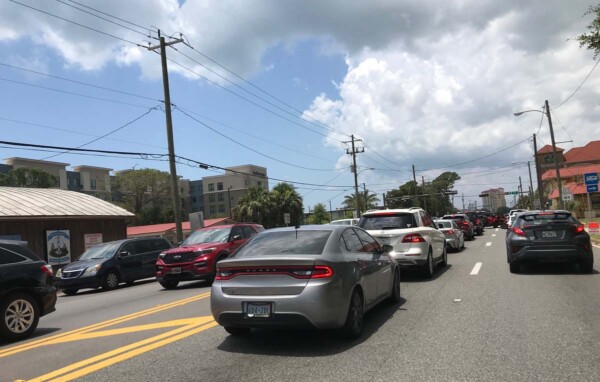
That’s the new ad slogan for the Miracle Strip – pay, pay, pay – all for the dubious pleasure of being stuck in never-ending gridlock, standing in long lines, and peeling bills out of your wallet.
—
There were those who warned against uncontrolled growth, but they were demonized as NIMBYs, opponents of progress, or Negative Nellies.
Turns out, Nelly was right. In fact, Nelly was an optimist.
The haves moved in and made their fortunes and created jobs – some good jobs but mostly low-paying jobs that provide no benefits. The haves made their millions and are enjoying the benefits of “progress.”
But for the rest of us “progress” has brought misery – a paralyzed infrastructure, exorbitant cost of living, rents so astronomical that fewer and fewer of us can afford to live here, and endless, ceaseless, hopeless crowds, noise and traffic.
This isn’t “progress” for us.
This is the sad destruction of what was once a paradise.
—
In the future, the haves will live and play on the Miracle Strip. The have-nots will be trucked in to reroof the houses, water the gardens, wash the cars and raise the kids. Fort Walton Beach, with its ample supply of storage units, gas stations, car washes and convenience stores, will become a service hub for points east.
Isn’t that the way it always goes? Money wins because everybody wants it.
But in the scrabble for a buck, an ugliness emerges that cheapens life itself. It is the ugliness of concrete monads standing like tombstones on what was once an opalescent beach. Of endless car windshields baking in the sun as traffic oozes from one quick-buck “attraction” to the next. Of credit cards being accepted and somebody, somewhere, growing fatter and richer while everybody else suffers just a little bit more.
And those lost afternoons of kneeling at the surf line, immersing yourself in the gentle ministration of wind and waves?
Gone.
The peace, serenity, and sense of place – no, make that sense of home. …
All gone.
About the author:
Del Stone Jr. is a professional fiction writer. He is known primarily for his work in the contemporary dark fiction field, but has also published science fiction and contemporary fantasy. Stone’s stories, poetry and scripts have appeared in publications such as Amazing Stories, Eldritch Tales, and Bantam-Spectra’s Full Spectrum. His short fiction has been published in The Year’s Best Horror Stories XXII; Alfred Hitchcock’s Mystery Magazine; the Pocket Books anthology More Phobias; the Barnes & Noble anthologies 100 Wicked Little Witch Stories, Horrors! 365 Scary Stories, and 100 Astounding Little Alien Stories; the HWA anthology Psychos; and other short fiction venues, like Blood Muse, Live Without a Net, Zombiesque and Sex Macabre. Stone’s comic book debut was in the Clive Barker series of books, Hellraiser, published by Marvel/Epic and reprinted in The Best of Hellraiser anthology. He has also published stories in Penthouse Comix, and worked with artist Dave Dorman on many projects, including the illustrated novella “Roadkill,” a short story for the Andrew Vachss anthology Underground from Dark Horse, an ashcan titled “December” for Hero Illustrated, and several of Dorman’s Wasted Lands novellas and comics, such as Rail from Image and “The Uninvited.” Stone’s novel, Dead Heat, won the 1996 International Horror Guild’s award for best first novel and was a runner-up for the Bram Stoker Award. Stone has also been a finalist for the IHG award for short fiction, the British Fantasy Award for best novella, and a semifinalist for the Nebula and Writers of the Future awards. His stories have appeared in anthologies that have won the Bram Stoker Award and the World Fantasy Award. Two of his works were optioned for film, the novella “Black Tide” and short story “Crisis Line.”
Stone recently retired after a 41-year career in journalism. He won numerous awards for his work, and in 1986 was named Florida’s best columnist in his circulation division by the Florida Society of Newspaper Editors. In 2001 he received an honorable mention from the National Lesbian and Gay Journalists Association for his essay “When Freedom of Speech Ends” and in 2003 he was voted Best of the Best in the category of columnists by Emerald Coast Magazine. He participated in book signings and awareness campaigns, and was a guest on local television and radio programs.
As an addendum, Stone is single, kills tomatoes and morning glories with ruthless efficiency, once tied the stem of a cocktail cherry in a knot with his tongue, and carries a permanent scar on his chest after having been shot with a paintball gun. He’s in his 60s as of this writing but doesn’t look a day over 94.
Contact Del at [email protected]. He is also on Facebook, twitter, Pinterest, tumblr, TikTok, and Instagram. Visit his website at delstonejr.com .