My memories of the near-apocalypse of Hurricane Opal
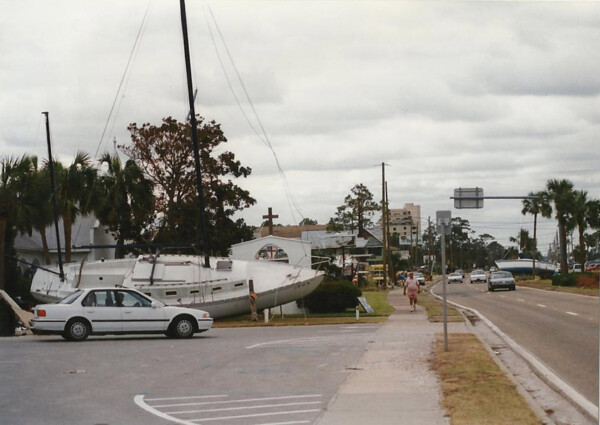
Photo by Del Stone Jr.
On Tuesday, Oct. 4, 1995, I was sitting in a staff meeting listening to the disaster plan should Hurricane Opal come our way.
I remember that day for two reasons. O.J. Simpson had just been found innocent of murder and Opal was in the southwest Gulf of Mexico, a trifling 90 mph storm predicted to move northeast and strike the north-central Gulf Coast sometime Thursday.
I remember the wrongness of it all – the wrongness of the verdict and the wrongness of the forecast. Surely after everything that had happened with Simpson a rational jury would convict. Hadn’t he tried to flee before a national television audience? And how could the National Hurricane Center believe Opal would dither in the gulf until Thursday when a vigorous cold front was approaching. Hadn’t previous experience suggested cold fronts act as siphons, pulling tropical weather systems along their boundaries at high rates of speed?
On the way back to the newsroom I told the editor I thought Opal would arrive much sooner – as of Wednesday. He expressed surprise. That wasn’t in the forecast. And of course I’m not a weather forecaster. Still, I’d seen it before, most notably with Eloise in ’75. I was sure the storm would strike the next day.
I don’t remember what I did that night but I remember being awakened at 5:30 Wednesday morning by the telephone. It was one of my feature writers, whose voice sounded thin as cellophane. Opal had intensified rapidly during the night and was racing for the Northwest Florida coast with winds of 135 mph. She wanted to evacuate – could she please evacuate?
Now now, I laughed. Let me take a look at the forecast and I’ll call you back.
I turned on the TV and dialed in The Weather Channel. There sat TWC’s septuagenarian hurricane expert, John Hope, who gravely confirmed everything my feature writer had told me. In fact the news was worse – Opal could further strengthen before moving onshore.
I called her back and said yes, she could evacuate. “OK thanks ‘bye” she blurted. No comma stops in that declaration. I imagine 30 seconds later her car was screeching out of the driveway.
Then I called my parents. They live close to the water and Mom has no love of hurricanes. I knew they’d want to evacuate. The sound of a phone ringing early in the morning can bring nothing but bad news but they took my storm warning in stride. The day would mean a long drive to Huntsville, Ala., where they’d rent a hotel room and watch it unfold on TV. At least they wouldn’t be here, where I’d worry about them.
I showered, shaved and drove to work. It was a dark, gloomy morning, but traffic was light and I made the trip quickly. I worried a little about my cats back at the townhouse. Would they be OK if I had to remain at the office during the storm?
The time was 6:30 a.m.
When I got to work few people were about. I called the editor and roused him from bed. He called the publisher. We’d have a meeting at 7:30. The telephones were ringing like crazy, people wanting to know what was going on and old coworkers who had moved on to other locales calling to ask if we were OK. Well, no, we weren’t OK. We were about to be clobbered by a category 3 hurricane. That’s never OK.
The editor and publisher showed up. We met. We discussed options – publishing a special edition before the storm, or another special edition after the storm.
Then, one of our columnists burst through the newsroom door and shouted, “The winds are up to 150 mph and it could become a category 5!”
I could think of nothing else to say except, “You’re lying.”
“No! I’m not! Check The Weather Channel!”
We turned the TV to The Weather Channel and sure enough, there sat John Hope announcing Opal had continued its rapid intensification and was now a category 4 storm with winds of 150 mph. Further intensification was possible and Opal could become a category 5 storm as it struck the Florida Panhandle later that afternoon. He said, “If you’re in the Florida Panhandle you need to get out. You’ve got to get out of there.” Or something to that effect.
My stomach turned to mush. Category 5. What would that do to our community?
At that point the publisher made his decision. We would not publish a Thursday edition. Most of the staff had left – not just the reporters but the press crew, mailroom employees and carriers too. Even if we could produce a special section, nobody would be available to print it or distribute it. And who would be available to read it? He urged everybody to evacuate. We were told we could shelter at the building or go to our homes. God help us.
About 8 a.m. I left the newspaper. I knew better than to shelter there. I would be up all night with no sleep. When the real work was needed, the next day, I’d be in horrible shape to do it. I decided to go home, ride out the storm with my cats, and report to work the next morning.
I drove to the main thoroughfare through town. All three lanes heading north were jammed bumper-to-bumper with cars moving at about 3 mph. All three lanes heading south were empty. I think that was the moment I became most scared – as I turned right and began heading south, the lone car on the road. It was as if the people in those cars heading north knew something I didn’t. I felt utterly and terribly alone.
I had to drive to the southernmost intersection of town to find a place where I could cross to the other side of the road. I took back streets until I found myself sitting in my parents’ driveway. Their car was gone and the house locked up. I became even more frightened. I was truly on my own.
I drove to my townhouse. There, everything seemed normal. The lights were on, the AC running and my cats were nonchalantly curious as to why I was interrupting their solitude on a work day. I vacuumed the house, made a pot of coffee and for the first time ever, filled up a five-gallon jug with drinking water.
Throughout the morning vicious rain bands rolled onshore dumping copious amounts of water. At one point the parking lot where I live began to flood. I knew from previous experience the storm drain gutter must be plugged up – it traps leaves and debris preventing the rain from draining. So I donned my wet shoes, grabbed a plastic bag and went outside to clean out the drain. It needed to be done. If not I might have a foot of stormwater sloshing around in the townhouse.
As I stuffed handsfulls of leaves into the bag a Jeep Grand Cherokee plowed through a lake in the road, sending a tsunami of foul stormwater crashing over me. I stopped, gazed balefully at the Jeep and shook my fist. The Jeep driver had stopped, but having thought escape was the better part of valor he drove off, leaving me standing there soaking wet.
Luckily the parking lot emptied once I got the storm drain cleaned out and I was able to return home and take the last hot shower I’d enjoy for the next four days. Then, perversely, the battery in my TV remote went dead. You wouldn’t think a dead remote battery would be a major concern with a category 4 storm approaching but to me it was a crisis – I needed a new battery. Otherwise I’d have to get off the couch and manually change the channel. Horrors!
I live across the street from a major shopping center – one with a Radio Shack – so I decided to stroll over there and buy a new battery.
Surprise. All the stores were closed.
That’s when the enormity of the impending disaster struck me – when I couldn’t buy a stupid battery for my TV remote.
This is the end of Part 1 of this narrative. I will post Part 2 later.
I was sitting in my Nissan Pathfinder, staring at a deserted shopping center at 11 o’clock in the morning, and I thought, This is what the end of the world will look like.
The parking lot, which should have been jammed with cars, was empty. Dim lights shone from the stores but no shoppers browsed the aisles. The streets on either side of the shopping center were empty. I was the only moving thing in that forlorn rectangle of commerce except for the stray piece of trash picked up the wind.
The sky to the south was the color of a nasty bruise, the deep bluish-gray some people describe as purple. A brisk southeasterly wind came in fits and starts, shaking the Pathfinder as I nudged it through the parking lot. Pools of standing rainwater rippled with the gusts.
I debated trying to find another store that might be open but finally decided to get myself back home and finish storm preparations. I had much to do. The computer needed protection and my floppy discs, which contained a lifetime of writing, would have to be put somewhere so that if a window shattered they wouldn’t be destroyed by water.
When I arrived the parking lot was blessedly free of lakes. I guess a dowsing was worth the peace of mind. Inside, the TV continued a never-ending, manic outpouring of storm “information,” most of it bullshit as the reporters and talking heads ad libbed their way into realms of coverage for which they were not adequately prepared. Disgusted, I turned to The Weather Channel. At least John Hope knew what he was talking about, even if he were a doomcaster.
At one point I found myself praying the storm would weaken. I am not an atheist but I don’t believe in organized religion. Don’t get me wrong. I think religion does a lot of good, despite the obvious bad wrought in the name of Jesus, Mohammed and other prophets. But I think God looks out for us after a fashion and I called upon him to look out for me and my community as this cyclonic devil bore down on us.
The 11 a.m. advisory had just come in and saints be praised, Opal had weakened! Winds were down to a mere 135 mph. Later I would learn Opal had passed over the “Gulf loop,” a whorl of super warm water in the central gulf that sometimes develops from currents flowing up from the Caribbean. That had contributed to Opal’s latest burst of intensification. But now Opal was undergoing what weathermen call an “eyewall replacement cycle” in which a tight inner eye cannot be sustained by the available heat and moisture so it collapses, to be replaced by a larger eye that diffuses the wind field.
Given time and energy Opal would redevelop that tight, inner eye. With luck she’d go inland before that happened.
I trudged upstairs and encased the computer in a plastic garbage bag. I put the floppies in a zipper-top bag and relocated them to the bathroom linen closet. Then I set about covering the windows with rows of masking tape. I glared balefully at my neighbor’s upstairs patio. The asshole had left a potted impatien in one of those macrame holders swinging from the railing. I could picture it being snatched up by the wind and dashed against my upstairs sliding glass door. I wanted to strangle her.
Sometime between 11 a.m. and noon the power went off. I felt myself frowning. The weather didn’t seem that bad just yet. Why had the power gone off? And it wasn’t as if I could call Gulf Power and report an outage. I shook my head and got out the candles and flashlights. Luckily I had set the thermostat to 68 degrees so the AC had been running all morning. It would be a few hours until the temperature inside the townhouse became clammy and uncomfortable.
Now there was nothing to do but wait.
At about 1 p.m. the wind began blowing really hard. The trees were gyrating so violently I wondered why they didn’t snap in half and crash to the ground. The air was filled with flying leaves – that and the notorious sideways rain you hear about. Once or twice that afternoon I stepped outside to witness the storm firsthand. Just opening the door was an ordeal – apparently the pressure inside the house was greater than outside because I had to put some muscle into getting the door open.
You can’t really know what a hurricane is like until you’ve experienced one. The world outside your door is a cacophony of swishing – the wind is hurling itself against your house, your car and the trees in your yard. Anything unable to withstand the gale is swept away. Meanwhile a basso roar insinuates itself beneath the higher frequency hissing of wind. That would be the Gulf of Mexico thundering against the barrier island that protects Fort Walton Beach, my hometown. The island, which we call Okaloosa Island, lies a mere half mile from shore. It is a thin ribbon of sand that stretches from Destin all the way to Pensacola, 45 miles to the west. It rises above sea level a mere 3 or 4 feet, except where sand dunes tower to as high as 30 feet. Thanks to development many of these sand dunes have been leveled. The gulf is free to visit the mainland.
I could hear this as I stood on the front porch, and truth be told it terrified me. A hurricane’s most insidious power over a human being is its assertion of authority. You have absolutely no control over what’s happening. You can tape windows, light candles and pray, but the hurricane will do to you what it chooses. I felt tiny, almost insectile, as I stood there watching the world fly by me.
The next four hours were probably the worst four hours of my life. The townhouse shivered as gusts of wind over 120 mph battered the building. I heard loud knocks and thuds as debris struck the roof. The windows began leaking around the edges. At times the entire townhouse seemed to shrink, then expand, and the air pressure changed from one minute to the next causing my ears and sinuses to pop. I saw objects flying through the air – I didn’t know what they were. I went upstairs a few times to call the newspaper and make sure everybody was OK – I had a landline phone up there that was still working – and the building shimmied beneath my feet. I felt the constant urge to duck as something heavy and loud rumbled across the roof.
About 5 o’clock that afternoon the sky turned a sickening shade of green. Clouds raced overhead and I could see small objects sailing overhead – for God’s sake they were birds, flocks of birds! What would birds be doing out in a storm of this magnitude? Then I looked closer and realized they weren’t birds at all. Debris. Roofing shingles. Flashing. Flotsam and jetsam, picked up by the wind. I wondered how many miles they would sail, and who would puzzle over them once they descended to earth.
Then an incredible thing happened. I heard whoops of joy and saw a group of men dash from a nearby townhouse and hurl themselves into the courtyard swimming pool. They were GIs, probably from nearby Eglin Air Force Base. I guess they were having a hurricane party and had gotten drunk and would now enjoy a brisk splash in the pool as the eye of Hurricane Opal crossed the coast.
And indeed that was what happened. I’d brought downstairs my boombox and was listening to a local radio station that had a correspondent stationed at the local emergency operations center. The center of Opal crossed the coastline somewhere near Navarre Beach, about 20 miles to our west, at about 5 p.m. Finally – blessedly – the worst was behind us.
Darkness fell. I lit candles and turned on the flashlight. At one point I turned off the radio – I couldn’t stand listening to the frantic declarations of the announcer. Any and all rumors were being broadcast. Somebody had reported a major bridge had been toppled and they broadcast the information without any verification – turns out no bridge had collapsed. They reported a body had washed up on the northern shore of Choctawhatchee Bay. That wasn’t true either, although the real story was far more interesting. A truck driver trying to make the dash from Destin to Fort Walton Beach had been tossed from his rig and floated across the bay to land on its northern shore. What they did report, and what turned out to be true, was that the Gulf of Mexico had breached Okaloosa Island. Never in my decades of living in this area had that happened.
Late that night I trudged upstairs and went to bed. It was difficult finding sleep. The wind howled through the pergola on my upstairs patio and it sounded too much like a human being screaming … or maybe not a human being. At some point I fell asleep. …
… To awaken to gloriously blue skies and refreshing fall temperatures. Apparently the cold front that had sucked up Opal and spit her out on our shores had passed through. Our weather was splendid. I took a freezing cold shower, got dressed, cleaned out the litter boxes, gave the kitties an extra helping of food and water, then headed out.
My first stop was Mom and Dad’s house. I wanted to make sure everything was OK there. The drive over was dicey – trees were down and floodwaters still made some of the roads impassible. In some spots the road was clogged with debris or fallen power lines. Eventually I got there and was shocked by what I saw – giant trees I’d known all my life lay like fallen brontosauruses in the back yard. Something big had taken off the corner of the roof. The fence was crushed in several locations. Overall the damage appeared manageable but Dad would have his hands full the next few days.
I toured the neighborhood. I was horrified to see the water from Choctawhatchee Bay had come up over the street abutting Mom and Dad’s back yard. A few more hours of southerly winds and my folks might have had the bay in their house.
The trip to work was equally revelatory. Damage was everywhere – buildings with their roofs torn off, signs down, trees lying prone, debris wrapped around telephone poles. Each time my tires crunched over mounds of shingles I wondered if a nail would immobilize my Pathfinder.
When I got to work I was greeted by what struck me as an insurmoutable tableau of chaos. A Honda generator chugged on the sidewalk with extension cords running through the door to inside. The newsroom was pitch black. Reporters who had sheltered there staggered about, sleep deprived and unable to function. One reporter was bleery-eyed drunk, as was one of the management team. The phone rang endlessly. Most ominously, I was the senior editor present. How the hell would I make sense of this?
As the morning wore on the news became grim, then grimmer. The Gulf of Mexico had breached the island and everything there was in a state of destruction. We’re talking million-dollar-an-acre real estate, home to McMansions, giant condos and pricey restaurants. The main thoroughfare from Fort Walton Beach to Destin – U.S. Highway 98 – had been utterly destroyed. Boats and hotels were lying in the roadway in downtown Fort Walton Beach. The Sheriff’s Office had set up a blockade on the county’s borders.
I took out a yellow legal pad and began breaking down the catastrophe into manageable chunks. Our coverage would mirror our beats. We would fill the newspaper with stories and photos – especially photos – of what had happened. Every municipality around us would get its own story, unless the reporter covering that beat failed to make an appearance. I felt like a triage nurse, salvaging what could be salvaged. But I believed it was the only manageable way to deal with the situation.
Throughout the day editors and reporters came in and the business of managing the crises became easier and easier. It was all falling into place. What had seemed like a disaster of news coverage that morning had become a manageable – albeit difficult – issue of coordination by late afternoon.
Speaking of which, about 5 p.m. I stepped outside to smoke a cigarette. I strolled past the electric meter on the side of the building and noticed an orange glow inside the meter. The proverbial light bulb clicked. Electricity. Somehow electricity was reaching the meter but not being transferred to the building itself. I tracked down the maintenance man and made him come outside with me. When I showed him the meter he slapped his head and declared, “Damn, I forgot!”
Prior to Opal’s arrival he’d shut off the main circuit breakers, fearing damage to the computers and AC systems. We made our way into the mailroom, where the breaker box was located. He shoved the switches up and the lights burst forth in a blaze of fluourescent glory! The ACs kicked into gear. We had electricity!
You could hear the cheer reverberate throughout the building.
Because we were a “priority customer,” due to our public information role, Gulf Power had worked hard to get us back online. Never was an electric pencil sharpener more welcome.
After that, getting out the newspaper became a snap. Our reporters were able to write their stories at their own PCs. Our paginators were able to design the pages. Our photographers could develop their film. The press crew could print the paper, and what carriers showed up could deliver it.
I drove home at midnight in utter blackness. Traffic signals weren’t working so we relied on the honor system at intersections. Those of us who remained behind fastidiously observed this system in negotiating major byways in town. When I arrived home the kitties were just fine. It was cool inisde. I had a lovely dinner of soggy, half-thawed hotdog buns and chicken bullion.
Over the next few weeks we would cover Opal like we’d never covered any story before. We were national news. Opal had killed 63 people and caused $3 billion in damage. Our shorelines were in ruins. And to this day we are still dealing with the aftermath – Opal wiped out many of the dunes on Okaloosa Island, which means every tropical storm that visits the Florida panhandle threatens to overwash the island, damaging the properties there and bringing floods to the mainland. Hurricanes Ivan, Dennis and Katrina exacerbated the problem. Even Hurricane Ike, which came nowhere near us, overwashed part of the highway between Fort Walton Beach and Destin.
But we are still here.
I remember a letter to the editor shortly after Opal struck. I can’t quote it verbatim but it went something like this: “No lights, no phone, no TV, no water. But by God my newspaper was in the driveway.”
I felt proud to be a journalist.
About the author:
Del Stone Jr. is a professional fiction writer. He is known primarily for his work in the contemporary dark fiction field, but has also published science fiction and contemporary fantasy. Stone’s stories, poetry and scripts have appeared in publications such as Amazing Stories, Eldritch Tales, and Bantam-Spectra’s Full Spectrum. His short fiction has been published in The Year’s Best Horror Stories XXII; Alfred Hitchcock’s Mystery Magazine; the Pocket Books anthology More Phobias; the Barnes & Noble anthologies 100 Wicked Little Witch Stories, Horrors! 365 Scary Stories, and 100 Astounding Little Alien Stories; the HWA anthology Psychos; and other short fiction venues, like Blood Muse, Live Without a Net, Zombiesque and Sex Macabre. Stone’s comic book debut was in the Clive Barker series of books, Hellraiser, published by Marvel/Epic and reprinted in The Best of Hellraiser anthology. He has also published stories in Penthouse Comix, and worked with artist Dave Dorman on many projects, including the illustrated novella “Roadkill,” a short story for the Andrew Vachss anthology Underground from Dark Horse, an ashcan titled “December” for Hero Illustrated, and several of Dorman’s Wasted Lands novellas and comics, such as Rail from Image and “The Uninvited.” Stone’s novel, Dead Heat, won the 1996 International Horror Guild’s award for best first novel and was a runner-up for the Bram Stoker Award. Stone has also been a finalist for the IHG award for short fiction, the British Fantasy Award for best novella, and a semifinalist for the Nebula and Writers of the Future awards. His stories have appeared in anthologies that have won the Bram Stoker Award and the World Fantasy Award. Two of his works were optioned for film, the novella “Black Tide” and short story “Crisis Line.”
Stone recently retired after a 41-year career in journalism. He won numerous awards for his work, and in 1986 was named Florida’s best columnist in his circulation division by the Florida Society of Newspaper Editors. In 2001 he received an honorable mention from the National Lesbian and Gay Journalists Association for his essay “When Freedom of Speech Ends” and in 2003 he was voted Best of the Best in the category of columnists by Emerald Coast Magazine. He participated in book signings and awareness campaigns, and was a guest on local television and radio programs.
As an addendum, Stone is single, kills tomatoes and morning glories with ruthless efficiency, once tied the stem of a cocktail cherry in a knot with his tongue, and carries a permanent scar on his chest after having been shot with a paintball gun. He’s in his 60s as of this writing but doesn’t look a day over 94.
Contact Del at [email protected]. He is also on Facebook, twitter, Pinterest, tumblr, TikTok, and Instagram. Visit his website at delstonejr.com .