Del reviews ‘Obsession’
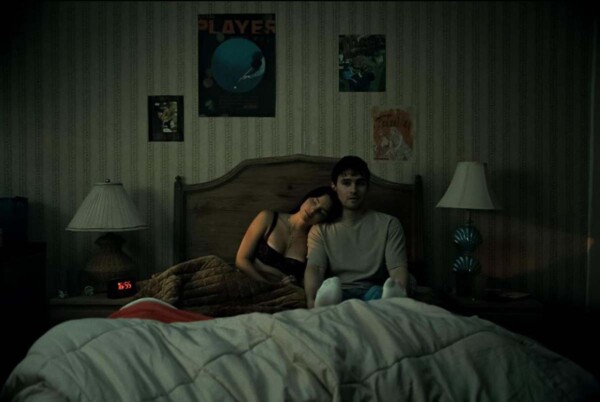
Image courtesy of Focus Features.
“Obsession” Starring Michael Johnston as Bear, Inde Navarrette as Nikki, Cooper Tomlinson as Ian, Megan Lawless as Sarah, and others. Written and directed by Curry Barker. 1 hour, 48 minutes. Rated R. Theatrical release.
Plot summary: A man who’s hopelessly in love with a pretty girl but can’t summon the nerve to tell her uses a novelty item to ask for a wish, that she love him more than anyone else. And she does. And does. And does. And does, ad finitum.
Spoilers: There aren’t many to spoil, but I’ll try to avoid doing that anyway.
Del’s take
Mladen was too busy telling children that Santa Claus doesn’t exist, and telling Trumpers that no, they won’t be getting a $5,000 check from DOGE, to see “Obsession” with me. Too bad because he missed a pretty good horror flick. After “Obsession” you’ll be canceling your Tinder profile and swearing off romance for the rest of your life, because like the good folks in AA say, “Moderation in all things,” has zero to do with this movie.
“Obsession” is scary, but not in the typical horror movie way. Imagine your next-door neighbor telling you his house is infested with Formosan termites, and they’ve been swarming the past three nights. It’s that kind of scary, a kind of subterranean dread that rumbles through your bones as events careen to their inevitable conclusion.
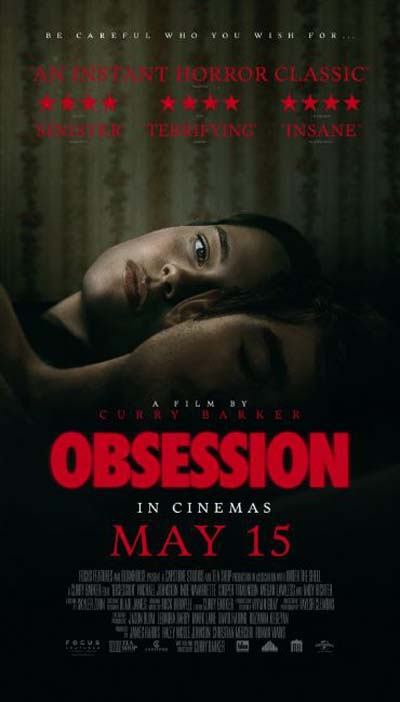
The story is about a man, nicknamed Bear, who’s crushing on Nikki, a cute coworker and member of his friend group. Bear’s too much of a scaredy cat to ask Nikki out – she even hands him an invitation on a sliver platter and he wusses out, the spineless coward. Instead, he takes the path of least risk. He buys a novelty item called a One Wish Willow, wishes that Nikki loved him more than anyone else in the world, then breaks the stick as per the instructions.
Big mistake.
Nikki doesn’t just love him. She becomes infatuated with him, to the point he can’t even take a shit without her wanting to be in the bathroom with him. That gets old pretty fast, but hang on, Nikki’s not done – oh no, she’s just getting started. And there is nothing – I mean N-O-T-H-I-N-G – Nikki won’t do to be at Bear’s side 24/7.
“Obsession” is a cautionary tale, the proverbial “be careful what you wish for – you just might get it.” It’s also about the claustrophobia of codependency and how we as human beings sometimes opt for the shiny bauble when the more sensible choice would be the less exotic but more authentic alternative. We see a hint of that with Sarah, who has plans for the future and seems to genuinely like Bear for who he is.
Inde Navarrette steals the movie with her portrayal of the bewitched and batshit-obsessed Nikki, and Megan Lawless is authentically warm and vulnerable as Sarah. Cooper Tomlinson’s Ian is a stereotyped lowbrow guy pal and didn’t leave much of an impression with me. Michael Johnston’s Bear, the movie’s viewpoint character, is my only significant gripe with “Obsession.” Bear is weak and often zoned-out or confused, to the point of irritation. At times I wondered if he was on the spectrum. And throughout the movie he continues to try to salvage this ill-gotten relationship with Nikki despite some horrendously (and criminal) actions on her part, which leads me to wonder: Who is the more obsessed, Nikki, or Bear? Do Bear’s creep credentials run a lot deeper than I suspected? It’s an annoying bit of ambiguity.
Despite that one fault, “Obsession” is a nifty movie that should strike a chord with the dating app crowd. It won’t keep you up at night, and it won’t lurk in your nightmares, but you’ll think about it before you swipe right. I’m giving it a B+.
Director and writer Curry Barker, a young dude from Mobile, Alabama, is quickly making a name for himself in Hollywood. “Obsession” cost less than a million bucks to make and so far has bought in $215 million, as per June 22, 2026. Those are the kind of numbers Hollywood pays attention to.
“Obsession” should keep Barker’s momentum going.

Image courtesy of PickPic by way of a Creative Commons license.
INTRODUCTION
Does comedic horror exist?
The producers of the “Scream” movies would say so, I think. But in fact, is “Scream” funny?
Well, it is my studied opinion that within the context of horror, yes, it is funny. I would call it gallows humor. It is funny the same way that “American Werewolf in London” and even the “Evil Dead” movies are funny.
These movies, and their cousins in book form, don’t take themselves seriously, not like “The Exorcist” or “The Shining.” And you know what? That’s OK. There’s a place for black humor in horror. Elvira, Mistress of the Dark, would give that statement a thumbs up. I think.
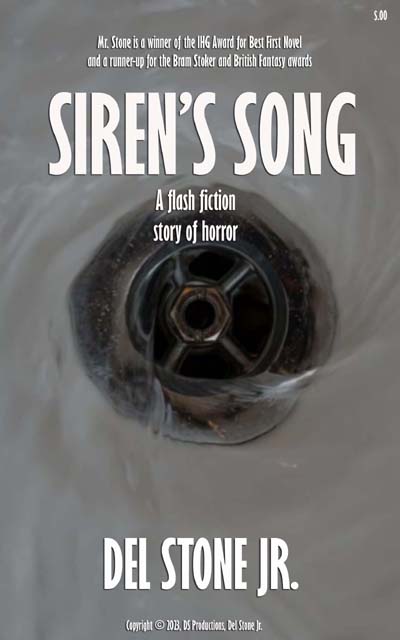
When I sat down to write “Siren’s Song” I didn’t intend to produce a work of comedic horror. That’s just how it happened. I mean, c’mon. How could you write a story about a man who kills and dismembers his wife because of her relentless singing and now she haunts him from the faucets, toilet and shower drain where he disposed of her body, and it not be funny? That’s humorous, not in a literal, family relations kind of way. For horror, anyway.
So here you go. Meet Myron, long-suffering husband to Phyllis, who yodeled her way to an untimely demise. Myron carved her into small pieces and flushed her down the toilet or pushed her down the shower drain, and now she’s singing his … well, certainly not praises. More likely his negative attributes. And that’s where they exist at the moment of this writing, an uneasy, horror-stricken balance of power between murder and retribution.
And isn’t that the way it goes so many times in a marriage, two negatives holding each other in a kind of check – not mate, just check – that goes on and on until their collective life comes to and end. …
Or does it?
—
SIREN’S SONG
Myron heard his wife singing in the shower.
Only problem was, Myron was in the shower too. And Myron’s wife was dead.
“Not fair,” Myron said miserably, staring at the drain – your average, Norman Bates “Psycho” shower drain – from which his wife’s warbling song emanated. “Phyllis deserved to die.”
And it was true. Phyllis had deserved to die. A frustrated Ethel Merman – and only a person of Myron’s generation would have known who Ethel Merman was – Phyllis had sung to Myron and sung and sung and sung until one day, Myron had simply –
“MOOOOON RIVERRRRRR,” the drain squalled –
– snapped, like the proverbial rubber band wound too tight.
Myron left the water running but stepped out of the shower. He tiptoed across the icy tiles to the vanity and opened the cabinet. He caught a glimpse of himself in the mirror; “Oh God,” he shuddered and slammed the cabinet shut.
Every bit of 58 years. With tits like his grandmother’s and that poochy, old man’s gut between his navel and his dick. And gray chest hair, for God’s sake. Gray chest hair smeared in cold, slimy strands across his sagging, grandmotherly titties.
“Not fair,” he muttered and scuttled back to the shower. He remembered a day when he liked what he saw in the mirror, when he could run his hands over his flat chest and press his palms into taut skin and let his fingers wander to his crotch, imagining they were Sophia Loren’s fingers, or more forbiddenly, Mrs. Andrew Williamson’s fingers as she handed him a Coke while he throttled back the lawnmower. She’d wanted him all right. But he’d been too stupid to know it, a kid mowing lawns for spending money. But she’d wanted him.
“YOUUUU LIGHT UP MY LIFEEEEEE!” the drain yodeled. Myron sighed and stepped into the warm spray.
Then Phyllis had come along, and he’d settled for her, the operative word being “settled.” Thirty years he’d settled for her, their marriage no less than hell’s mortgage where you paid off the principal the first year and spent the rest of your life trying to overtake an interest load that only grew larger and larger, no matter how much money or attention you threw at it. The debts and the misery and the anger had piled so high Myron could see nothing else, and Phyllis had sung through it all no matter how many times he’d told her just to shut the hell up, her off-kilter contralto ever reminding Myron that he had been a fool for marrying her and a coward for not leaving her.
“THAT’S THE WAY – UH HUH UH HUH – I LIKE ITTTTT!” the drain tittered, and Myron rolled his eyes. Disco? Death did not become Phyllis. But then she had not died easily, Myron thought, remembering the afternoon when she had launched into a verse of “Ave Maria” and he had gone after her with a machete. She had fought him the good fight, screeching all the way, and he had liked the sound of her screams. But in the end he had cut her into tiny pieces, rinsing all the gooshy stuff down the bathtub drain; the bigger chunks he’d flushed. The last to go had been her tongue, still languidly waggling as he yanked the trap from the bathtub drain and forced it down the pipe with the handle of a plunger.
Then the singing had begun.
Petula Clark. The Cure. Threepenny Opera tunes. Diana Ross. Nursery rhymes. And Ethel Merman, god forbid, baaaaad Ethel Merman. It hooted from the drain pipes and gurgled from the toilets, and while Myron could not put a stop to it, he had one way of changing Phyllis’ tune.
“Just shut the hell up, Phyllis,” Myron whispered, squatting in the bathtub, his old man’s belly pooching out even farther. He uncapped the bottle of lye and poured it down the Norman Bates drain.
The song faltered, and became a hitching scream.
Now that, Myron said to himself, his knees creaking as he stood, was something he thought he could live with.
About the author:
Del Stone Jr. is a professional fiction writer. He is known primarily for his work in the contemporary dark fiction field, but has also published science fiction and contemporary fantasy. Stone’s stories, poetry and scripts have appeared in publications such as Amazing Stories, Eldritch Tales, and Bantam-Spectra’s Full Spectrum. His short fiction has been published in The Year’s Best Horror Stories XXII; Alfred Hitchcock’s Mystery Magazine; the Pocket Books anthology More Phobias; the Barnes & Noble anthologies 100 Wicked Little Witch Stories, Horrors! 365 Scary Stories, and 100 Astounding Little Alien Stories; the HWA anthology Psychos; and other short fiction venues, like Blood Muse, Live Without a Net, Zombiesque and Sex Macabre. Stone’s comic book debut was in the Clive Barker series of books, Hellraiser, published by Marvel/Epic and reprinted in The Best of Hellraiser anthology. He has also published stories in Penthouse Comix, and worked with artist Dave Dorman on many projects, including the illustrated novella “Roadkill,” a short story for the Andrew Vachss anthology Underground from Dark Horse, an ashcan titled “December” for Hero Illustrated, and several of Dorman’s Wasted Lands novellas and comics, such as Rail from Image and “The Uninvited.” Stone’s novel, Dead Heat, won the 1996 International Horror Guild’s award for best first novel and was a runner-up for the Bram Stoker Award. Stone has also been a finalist for the IHG award for short fiction, the British Fantasy Award for best novella, and a semifinalist for the Nebula and Writers of the Future awards. His stories have appeared in anthologies that have won the Bram Stoker Award and the World Fantasy Award. Two of his works were optioned for film, the novella “Black Tide” and short story “Crisis Line.”
Stone recently retired after a 41-year career in journalism. He won numerous awards for his work, and in 1986 was named Florida’s best columnist in his circulation division by the Florida Society of Newspaper Editors. In 2001 he received an honorable mention from the National Lesbian and Gay Journalists Association for his essay “When Freedom of Speech Ends” and in 2003 he was voted Best of the Best in the category of columnists by Emerald Coast Magazine. He participated in book signings and awareness campaigns, and was a guest on local television and radio programs.
As an addendum, Stone is single, kills tomatoes and morning glories with ruthless efficiency, once tied the stem of a cocktail cherry in a knot with his tongue, and carries a permanent scar on his chest after having been shot with a paintball gun. He’s in his 60s as of this writing but doesn’t look a day over 94.
Contact Del at [email protected]. He is also on Facebook, twitter, Pinterest, tumblr, TikTok, and Instagram. Visit his website at delstonejr.com .
Universal Studios
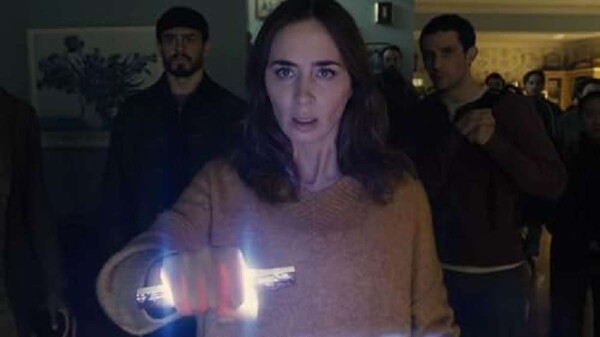
“Disclosure Day” Starring Emily Blunt as Margaret Fairchild, Josh O’Connor as Dr. Daniel Kellner, Colin Firth as Noah Scanlon, and others. Directed by Steven Spielberg. Two hours, 25 minutes. Rated PG-13. Theatrical release.
Plot summary: Dr. Daniel Kellner is being pursued by agents of the Wardex corporation because he stole information the company has been hiding for decades. He intends to release that information in hopes of changing the world. He’s abetted by weathergirl Margaret Fairchild, who has mysteriously developed the ability to read minds and speak foreign languages.
Spoilers: Does the UFO make crop circles in the wheat field?
Del’s take
I would probably have liked “Disclosure Day” a lot better had anyone but Steven Spielberg directed it. But because my expectations of Spielberg are higher than mere mortal directors, I was not overwhelmed. Don’t get me wrong. “Disclosure Day” is a decent movie. But I don’t think it’s one of his better efforts.
“Disclosure Day” marks a return to familiar grounds for Spielberg, those of the misunderstood alien who arrives on Earth and strikes up an alliance with sympathetic humans to survive. We saw it in “E.T. the Extraterrestrial” and “Close Encounters of the Third Kind.” “Disclosure Day” is, in terms of structure, very similar to “Close Encounters” and tonally it resembles the glittery sentimentality of “A.I. Artificial Intelligence.”
That’s one of the problems with “Disclosure Day.” We’ve seen it all before.
The movie features two-track storytelling duties divided between Dr. Daniel Kellner (Josh O’Connor) and Margaret Fairchild (Emily Blunt). Kellner, a former employee of the Wardex corporation, has stolen secrets that, if revealed to the general public, could momentarily distract people from an impending showdown between Russia and the United States. At the same time Fairchild has mysteriously acquired the ability to speak Russian and Korean, and can read people’s minds. She begins to sense the presence of Kellner and feels a compulsion to help him, despite not knowing who he is or what he’s trying to do.
From there the movie becomes an extended chase scene as Kellner and Fairchild careen from one life-threatening situation to another in a desperate quest to release Kellner’s pilfered data to the world.
“Disclosure Day” is a fast-paced, entertaining movie that does not feel as long as its 2½-hour run time. The actors are well cast and do an excellent job – Blunt in particular stands out as the funny, disheveled and thoroughly baffled TV weathergirl-turned potential savior of mankind. And Wyatt Russell, son of Kurt Russell and Goldie Hawn, steps away from his duties at “Monarch, Legacy of Monsters” to provide a convincing performance as Fairchild’s confused boyfriend, Jackson. Colin Firth and Josh O’Connor are also excellent.
Everything else about the movie reflects Spielberg’s meticulous attention to detail, and the score, another stellar John Williams composition, is rousing but, in my opinion, forgettable. All in all it’s a well-assembled product from the most talented movie director of our time.
But as I said, “Disclosure Day” is not one of Spielberg’s better movies. Apart from it being a pastiche – if not thematically then tonally – of “E.T.,” “Close Encounters” and “A.I.,” it asks the audience to accept an idea I found impossible to embrace – that people would freak out and stop believing in God if they discovered aliens exist. The material Kellner and Fairchild are working so hard to “disclose,” alien autopsies and crashed UFO video clips, are presented by Spielberg as mind-altering bits of information that would leave the world spellbound.
No, they wouldn’t.
You can search on YouTube right now and find any number of alien autopsy videos and crashed flying saucer clips. Not just YouTube – they’re all over the internet. They’re as good or better than the fictional Wardex videos. People would see the Wardex clips as nothing more than AI-generated slop, like the crap that’s already online. And after 70 years of “Star Trek,” “Star Wars,” “Close Encounters,” “The Day the Earth Stood Still” and tens of thousands of other movies and TV shows about alien civilizations, people are no longer awed by the idea of E.T. They expect E.T. to be out there. What “Disclosure Day” demonstrates more than anything else is that Spielberg, as a 70-something year old dude, is a little bit out of touch with the times.
The movie asks us to be more empathetic, an appropriate message for a time when the least empathetic among us are calling the shots, and it is yet another effort by Spielberg, with themes of innocence and wonder, to articulate and celebrate his and our youth.
But because I expect more from a Spielberg movie, and because it strikes so many familiar Spielbergian notes, and because it asks us to believe something I can’t and won’t believe, I’m giving it a grade of B.
“Disclosure Day” is a well assembled, entertaining movie, but in the end, we’ve seen it all before.
Mladen’s take
In 2025, it was “Sinners.” In 2026, it’s “Disclosure Day.” What’s the common thread? Both films were hyper‑hyped and both failed to deliver.
See the Movie Faceoff review of “Sinners,” if you want to know why that movie misfires. See below to get a bead on “Disclosure Day” faults.
“Disclosure Day” is an almost compelling movie driven by a shitload of sentimentality and some historical fiction a la the Bible.
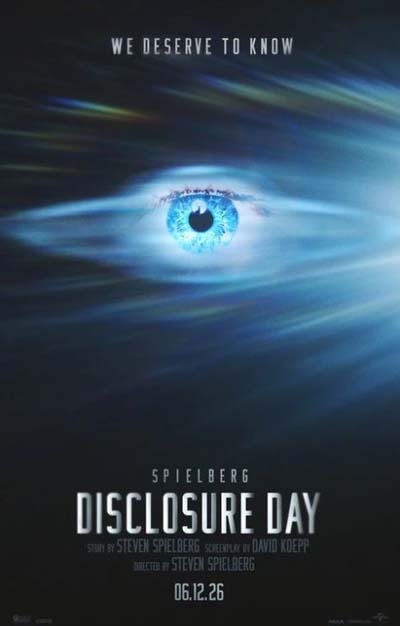
Hell, I’m surprised Del didn’t mention the Adam and Eve thingy that unfolded as the movie careened toward an annoying ending. Toss in some mysticism, telekinesis, at least two poor decisions by Kellner, corporate mercenaries rampaging through cities and the countryside, an annoying scene in a train car, and you have yourself a story that left me, ah, a touch miffed rather than a whole lot hopeful.
Oh, almost forgot to mention this scene. To contain the film to a simple, two-sided good v. evil donnybrook, Spielberg inserted a 20-second scene that showed a corporate whack job convince a couple of gung‑ho U.S. military generals that the Department of Defense should NOT be getting involved in resolving a situation of, literally, cosmic significance. No way that would happen. Persuading DoD to NOT get directly involved in the chase to secure other-than-earthly information and stuff would be like trying to persuade Trump NOT to be stupid – futile.
Look, Blunt as Fairchild did everything Spielberg asked. And she did it credibly and with panache. No question. Blunt is one of the Top Five actors working today. O’Connor’s Kellner also helped Spielberg accomplish his “Disclosure Day” vision. The trouble? The vision is incorrect.
I start with a minor quibble. Again and again, I hear that mathematics is a universal language. No, it’s not. Mathematics, like the flushing toilet or the NASA Space Launch System, is just technology. Because math is a technology, there’s a nearly 0 percent chance that Earthmen could understand non-Earthmen through symbology because their symbologies would be incompatible. I say that with an assurance rate of 99.9 percent with a line over the top of the “9” to the right of the decimal point. For a more realistic take on talking science with an alien, see “Project Hail Mary.” The human and the animate rock in that story had to learn each other’s language, including the babble of science.
Now, the bigger woe. “Disclosure Day” is propelled by the notion of “empathy.” If only humans were more empathetic to (with?) each other, we’d be happier, kinder, and un‑violent. Wrong. I cannot ever understand what another person feels because I have not led that person’s life. Neither can you. What I, and you, can be is sympathetic. Sympathy is sufficient because it requires that we only understand each other’s basic needs. I need not ever have gone hungry to know that starving sucks. I need not have ever injured myself, gone to the emergency room, and then been asked to pay $5,000 for three stitches because I had no health insurance. That, too, would suck. I also know that living in a house is better than living on the street, though, so far, anyway, I have not been houseless.
One other point about “empathy,” at least the way it was portrayed in the film. One of our two protagonists wielded the capacity to empathize. The “emphatizer” targeted the “empathizee” by using names, dates, and events that mattered most to the latter. Essentially, the empathizer manipulated the brains of empathizees to achieve the Disclosure Day mission. Humanity was lucky because the empathizer was channeling a do‑gooder. But could not empathy also be used to achieve evil? Yes, commander of the submarine, sorry you weren’t nominated for promotion to Rear Admiral. Yes, you deserved it. You worked hard. You endured much. Sorry about that backstabber. Everything will be alright if you just give me the launch codes for nuclear warhead‑tipped, sea‑launched ballistic missiles 2, 3, 7, and 9. Promise, I’ll set their yields to a mere 250 kilotons each because 500 would be too much.
“Disclosure Day” has its heart in the right place. But it didn’t move me and I’m a pretty sensitive guy. I sympathize with the lesson it tries to teach. We do need to be nicer to each other. But that has been the case since Homo sapiens started clumping into villages of more than 500 people thousands of years ago. Why didn’t Spielberg show me something I didn’t already now?
“Disclosure Day” is a B- largely because Blunt pulled the movie along despite its silliness.
Mladen Rudman is a former journalist and technical writer. Del Stone Jr. is a former journalist and writer.
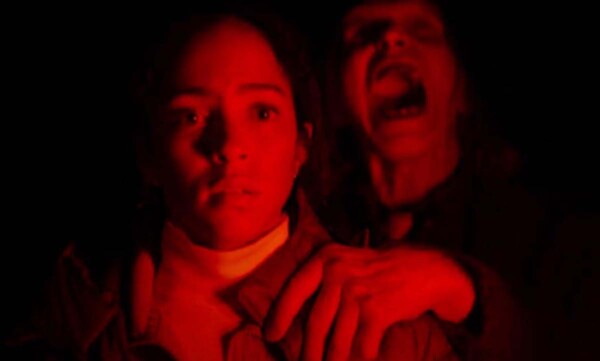
Image courtesy of Paramount.
“Passenger” starring Lou Llobell as not-always-making-the-best-choice Maddie Brecker, Jacob Scipio as not-always-making-the-best-choice Tyler Genocchio, Melissa Leo as damn-I-didn’t know-that-a-neck-could-do-that Diana Larson, Miles Fowler as Lucas Tedesco and Alan Trong as Daniel, the onset victims, and others. Directed by André Øvredal. Score Composer Christopher Young. Script Writers Zachary Donohue and T.W. Burgess. One hour, 34 minutes. Rated R. In theaters.
Plot summary: Maddie and Tyler are yuppies tired of the grind. To shed their lives in Brooklyn, they buy a van camper to hit the road. And the road they hit when they make the mistake of stopping on a dark rural route somewhere out west to aid a car crash victim. Don’t look now, but there’s something in your rearview mirror and it’s inside your costly Benz.
Spoilers: Sure.
Mladen’s take
I start with a disclosure. There’s a small chance that I’m giving this satisfactory movie a lower grade than it deserves because it was made by Paramount Skydance Corp., which bribed the Imbecile Poser President to allow a merger with CBS by firing Stephen Colbert of The Late Show. What am I going to do now that the Trump‑loving, piece‑of‑shit entertainment company has bought venerable Warner Bros Discovery?
More important, how am I going tell our treasured Del that I ain’t seeing a movie from now on if it’s made by that piece‑of‑shit fascist‑adoring business? Huh?
“Passenger” features good acting, a fabulous score and soundtrack, and a top‑notch soundscape. Too bad it’s made by a piece‑of‑shit studio. Oh, I’ve said that already.
Llobell as Maddie is convincing as a young adult realizing there’s a malevolent supernatural something targeting her and her somewhat fiancé because … why? The vanpers stopped to help a car crash victim. Scipio’s Tyler is solid as a skeptic about what Maddie is telling him as they travel here and there living the life he wants.
Oddly, the most interesting part of “Passenger” is the way Maddie and Tyler evolve as a couple while trying to avoid getting killed. They highlight the subdued horror that often accompanies a relationship when one person is only doing something for the other person’s sake. Of course, Tyler recognizes the folly of his ways but it takes an evil force wearing the collar of a priest to help him come around.
That’s another decent, though clichéd, component in the film, the religiosity. It’s the whole good v. bad, God v. Satan thing running along at a clip that doesn’t overwhelm the moviegoer with sanctimonious tripe. The spirit of the movie is that our beloved couple is protected by the saint of travelers and hunted by a fraudulent monk who was once the saint’s sidekick. Good enough.
And, finally, there’s the movie’s atmosphere. The roads are tunnels formed by the canopy of towering trees or traverse a ceaseless brown dessert. No street lights on the highway to hell. “Passenger” does a nice job integrating Hobo lore as part of its story.
“Passenger” malfunctions in the usual way for horror movies or, for that matter, sci‑film films. People make stupid choices because they ain’t responding to the call of self‑preservation. Even if they’re just being curious, we all know what curiosity does to the cat. Yes?
Maddie, if you’re walking to your parked Benz van and it keeps moving farther from you by itself without the engine ever starting every time you look away because you heard a spooky noise, it’s time to return to the 24‑hour gym where your boy is working out.
Yes, Tyler, I discourage you from driving the van down a desolate, rutted gravel road into a foggy forest where no one can hear you scream, let alone get ghosted‑ed. Good God, man, can’t you see that your pseudo‑betrothed is shitting bricks from her nicely shaped ass because she’s afraid of the night?
“Passenger” is a C. I say that, in small part, because the Culture Wars demon has hardened my heart. I respect Llobell’s and Scipio’s acting, sure as hell loved the music and sound effects, but they did their good work for a studio driven by the inverted Pentagram or the Orange Blob with cankles and dementia. Take your pick. Either is bad.
Del’s take
You’ve got to hand it to Mladen: Once he gets his rage on he’s like a Michigan snowbird closing in on a $10 breakfast buffet. You get in his way and you’ll be squashed flatter than a McDonald’s hamburger patty.
But he’s right. My opinion of Paramount – after its lily-livered culling of Stephen Colbert at the behest of President Harkonnen, and its castration of “60 Minutes” – ranks down there with being on the receiving end of a digital prostate exam administered by Freddy Kreuger. I have no problem abiding by Mladen’s boycott of Paramount “content” – I’ll add it to my ever-growing list of corporations that will never see one nickel of my meager assets – Chick-fil-A, Hobby Lobby and Target.
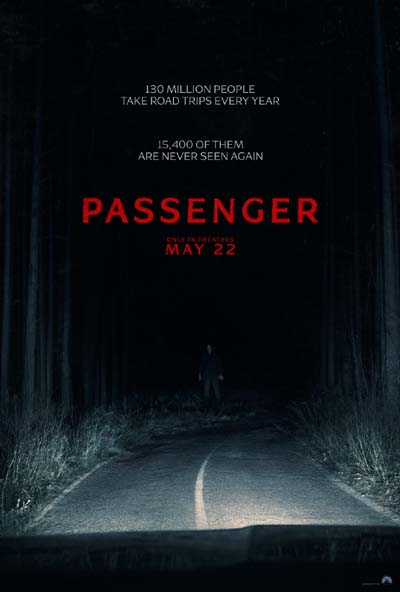
As for “Passenger,” what can I say? I haven’t been terrified by a horror movie since 2004 when Sarah Michelle Gellar watched a very pale, hairy Japanese ghost lady crawl across the ceiling in “The Grudge.” And who can forget the most ravishing woman in all of time, Naomi Watts, answer the most sinister spam call in all of time in 2002’s “The Ring”? That’s one she definitely should have let go to voicemail.
“Passenger” does have its moments.
It begins with a pre-title sequence, just like “The Mandalorian,” that actually scared me. Two young men are driving through a forested area – at night, of course – when they stop because one young man with the world’s tiniest bladder needs to pee. While Mr. Micro-Bladder is in the bushes doing his thing, strange sounds emerge from the forest. Then, the car horn blows continuously. At first, Mr. Micro-Bladder thinks it’s his buddy good-naturedly harassing him and returns to the car. But then he discovers the car is empty. …
From that point the movie follows a fairly predictable trajectory. Maddie and Tyler, the true viewpoint characters of the story, come across Mr. Micro-Bladder and his wrecked Honda and stop to help, and in that moment a transfer takes place where whatever had been stalking the two young men now latches on to our newly engaged couple. That’s why you should never stop and render aid at the scene of a car accident, the movie repeatedly warns. I’m sure law enforcement and medical authorities are thrilled with that message.
Running parallel to this surface plot is the conflict between Maddie and Tyler, who seem at odds over the direction their life together should take. Tyler loves the idea of working remotely and going wherever the road takes them. Maddie had too much of that vagabond existence in her childhood and wants the stability of a home base. This is where the movie becomes somewhat annoying because neither Tyler nor Maddie will actually sit down and have an adult conversation about their differences. For God’s sake, people. Talk!
Where “Passenger” shines is in its atmospherics. As Mladen correctly pointed out (for once), director Øvredal makes effective use of the absence of light, the glance askance, and the power of suggestion to generate his spooky tension. Cars driving through a densely forested region at night bore tunnels of light from the dark. Parking lot lights illuminate a small patch of asphalt but make the surrounding areas look oh so much darker. A quick glance in the rear-view mirror suggests somebody might be sitting behind you, but when you look directly, nobody is there.
For me, the most masterful use of light takes place when Maddie and Tyler are watching a movie at a forest camp site. Something comes out of the woods and attacks them. They use the movie projector as a kind of flashlight, creating a very eerie effect as Jimmy Stewart’s face is projected against trees, shrubs and other surfaces. Very creepy!
Øvredal hides his monster through about two-thirds of the movie but finally succumbs to the temptation of Showing Us What He Looks Like, which for me was a buzzkill. I’m an adherent of the Ridley Scott school of filmmaking, which requires the monster be hidden until the very end, if shown at all. Again, human imagination is usually the root of all fear.
“Passenger” touched on ideas presented in other movies. Itinerate workers living in their vans and RVs was the central theme of “Nomadland.” The modern Western road milieu, with the monsters who inhabit that realm, harkens back to movies like “The Hitcher” and “Near Dark.” And the idea of a thing relentlessly stalking an innocent passerby reminds me of one of my favorites, “It Follows.”
“Passenger” was better than most of the horror movies I’ve seen lately, but in the end it did not create a lasting impression – not like “The Ring.” For that reason I’m giving it a B. I won’t penalize it for being a Paramount project, though I wish another studio would buy the rights to “Star Trek” so I can watch some of the newer shows.
See “Passenger” in the theater, if for no other reason than to experience the superb sound.
Mladen Rudman is a former journalist and technical writer. Del Stone Jr. is a former journalist and writer.