Mladen and Del review ‘Crawl’
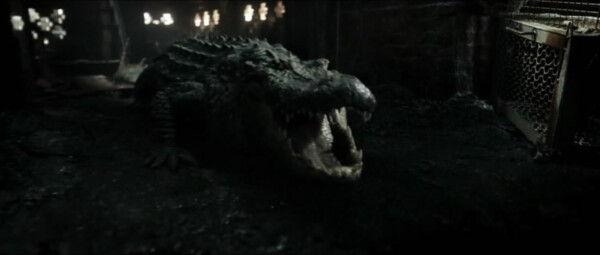
Image courtesy of Paramount Home Entertainment.
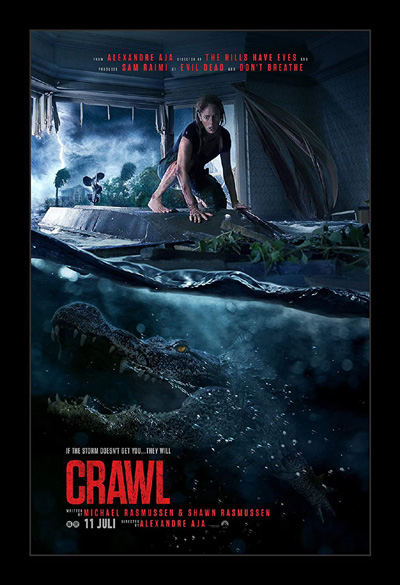
“Crawl” starring Kaya Scodelario, Barry Pepper, Morfydd Clark. Directed by Alexandre Aja. 127 minutes. R rated.
Mladen’ take
The film “Crawl” is a model of efficiency and efficacy. In the first, oh, 10 minutes, the audience is introduced to the fact that our heroine Haley is a good swimmer who wants to be gooder; that there’s tension in her family; that a powerful hurricane changed course unexpectedly and is heading for South-ish Florida; that first responders will be unable to help if you’re stranded; that Dad isn’t answering calls or texts; and that the family’s dog faces peril. Hell, even the film’s title is efficient because much of the action takes place in a “Crawl” space beneath a home “Crawl”ing with particularly vicious alligators.
“Crawl” has been graded by IMDB viewers as a mediocre horror movie. They’re wrong. This film is an A-, though it misfires here and there. For example, the first couple of gators to attack Dad and Haley hiss, which is OK, and grumble‑moan like they have larynxes. During courtship, bull gators do generate low-frequency sonic vibrations through the water to show-off their manliness to breed and designate territory. But, in “Crawl”, the gator sonics happen in a largely dry, for the moment, “Crawl” space when, I imagine, the gators were thinking about something other than mating. Don’t misunderstand. The gator grumble‑moans were nothing like the shark in “JAWS IV” (or was that “V”?), breaching and then roaring. Still, making the gators make intimidating noise to add menace to the movie was a tad contrived. Also, the film’s depicted family strife is unneeded and the occasional pep talk from Dad for his daughter Haley’s benefit when her tenacity, spirit, resourcefulness, guts, or hope flag amid heavy rainfall, a flooding house, and death‑by‑gator of a childhood friend languorous. And, yes, there’s the questionable decision to leave the house after Haley and Dad finally escape from the reptile‑infested “Crawl” space to reach a boat by wading a couple of hundred feet through murky, hip-high water.
The boat, by the way, was parked at an inundated gas station and convenience store. It was to be used as the escape vehicle by three people who wanted to steal the store’s ATM. Can you guess what happens to the robbers? The fate of the trio is an example of the many times that “Crawl” excels as creature feature horror.
Del will complain about the jump-out-of-your-seat moments in this movie, but I loved the hell out of them. The gator busting through a staircase. The lightning bolt that illuminates a big‑ass meat eater, jaw agape, behind Haley. And, there’s suspense. Lots and lots of suspense. Reaching from a somewhat safe perch across flood water strewn with floating debris that obstructs your view to get your dead friend’s Glock – he was a sheriff’s deputy – for protection. The dog swimming through a long, darkened hallway to reach Dad. All delightful.
“Crawl” also provides a solid dose of gore. Water turning red as gators bite and thrash their human prey. A death roll. A gator gripping Dad near the elbow, snapping his arm in half and then tearing it off. Floating corpses. Wait to you see how Haley dispatches a gator that has taken hold of her. Dad, too, before losing his arm later in the movie, whacks a gator after trapping it in a clever way.
Sit back, if you can, and enjoy “Crawl”. It’s a masterful little film with likeable characters facing cold‑blooded, almost plausible, threats.
Del’s take
“Crawl” is a two-hour and seven-minute wet T-shirt contest, which explains why Mladen likes it so much.
Me? I can take it or leave it. I have nothing against standard-issue potboilers, even if they’re shameless cash grabs, in this case by the studio and a slumming Barry Pepper, who usually chooses more artistically meritorious projects. But schlock is like Hooters chicken wings – to enjoy them one must be in the mood for them, assuming one can focus on the wings and not the breasts. Maybe I wasn’t in the mood for a serving of grease delivered by a perky coed.
As Mladen explained, the protagonist, Haley, travels two hours south of Gainesville to look for her dad as a cat five hurricane approaches. Dad isn’t answering his phone and Haley’s sister up north fears the worst. Haley and Dad are especially close; she’s a college swimmer and he was her coach throughout her youth. But now she’s having doubts after losing a relay, and somehow that means Dad is a monster, or something like that. You know … something conflicty.
As she treks to the AWOL Dad’s seaside abode she passes a flooded alligator farm. These are the Special Super Intelligent Mind-Reading Alligators from Mars or something based on what happens later in the movie. She finds Dad in the crawl space beneath his house, clawed to damn near bloody ruin by … well, OK. I should let you watch the movie to find out, but, Psssttt! It crawls.
What follows is a string of predictable pitfalls, emotional ups and downs and cliché after soggy, growly cliché. I will give “Crawl” credit – in most of these movies the protagonist is a crack shot who always dodges the falling asteroid and ambles into the sunset with the girl – or boy – slung over his or her shoulder. In “Crawl,” no such immunity is granted, and since it’s a father and daughter there will be no ambling into the sunset. Well, maybe an AARP lecture or two.
No, Mladen, I didn’t object to the jump scares. What I did object to was the stupidity – like helicopters flying in a cat five hurricane. Like people strolling the flooded streets in a cat five hurricane. Like a one-armed guy able to bludgeon his way through a roof with his bare hand.
If you go into “Crawl” with sufficiently low expectations you’ll enjoy it, because it’s a decently entertaining movie with not bad special effects. But that’s all we’re talking here – entertainment. Not art.
I give it between a B- and a C+. Make it a B- because the hurricane actually looked somewhat realistic (although heads up, moviemakers: We just had a cat five here in the Panhandle and there’s tons of footage on YouTube if you’d care to educate yourself about what a storm like that looks like).
Mladen Rudman is a former journalist and technical writer. Del Stone Jr. is a former journalist and author.
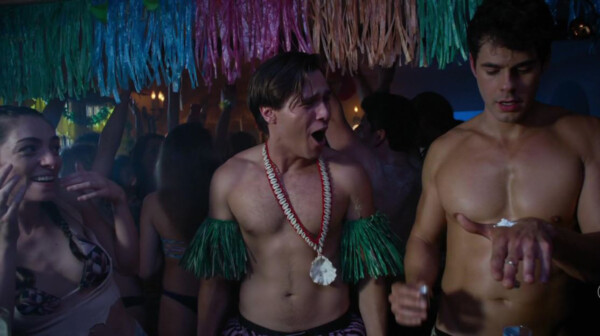
Image courtesy of Benaroya Pictures.
“Haunting on Fraternity Row” starring Jacob Artist, Jayson Blair and Shanley Caswell. Directed by Brant Sersen. 99 minutes. Rated TV-MA.
Del’s take
There’s no explaining my Netflix whims, but they have introduced me to surprisingly good films (“Troll Hunter, “Birdbox”) and some real stinkers ( “Open House,” “IO”).
Then there’s that gray area between, where movies that are neither good nor awful fall. “Haunting on Fraternity Row” fits that realm. You can’t expect much from a movie with the word “fraternity” in its title and “Haunting” doesn’t provide much. It’s a frat party punch bowl of clichéd characters and their predicaments that you have seen a thousand times before minus these silly details.
The story is about a group of frathouse seniors on the day of their last big bash before graduation, the annual Luau Party. They want this to be a party for the ages because although it’s never said, they seem to collectively understand their time together is soon to end and they don’t want these days to be forgotten (although they will). So the boys are busy abusing pledges, stocking the shelves with booze and kegs, setting up Hawaiian-themed decorations and flirting with sorority cleaning girls.
Speaking of kegs, the hapless pledges drop one down the basement stairs and it punches a hole through a wall, revealing a tunnel that opens into a scary room with scores of light fixtures. One of the boys refers to it as a place where “you can’t see your shadow.” Oooh-weeee-ooooh.
The room is quickly forgotten as party time approaches. Tiki torches are lit. Sand is poured for the “beach.” A slaughtered pig makes its way to the roaster. And did I mention booze? Oceans of booze – the entire output of a brewery and a distillery – is laid out in astonishing plentitude. It’s like Golden Corral buffet for alcoholics.
Frat brother Dougie (Ashton Moio), meanwhile, has been researching the house’s past and learns that a terrible event took place here decades ago – the owner at that time invited a group of people to dinner and slaughtered them. Dougie thinks the creepy room may have some larger significance than a room where a person can’t see his shadow.
The party commences, with all the alcohol-fueled, sex-starved antics you know to expect from countless movies about frat boys and the sorority girls who love them – until all hell breaks loose, and I mean literally breaks loose. Objects move, mysterious growls emanate from the shadows, and people start dying, their eyes seemingly burned from the sockets.
I won’t tell you what happens afterwards should you decide to throw away an hour and a half of your life on this movie. Suffice it to say “Haunting” has more vices than virtues. It is sometimes amusing (but not often enough), sometimes spooky, and it might just remind you of a college experience or two (not me – I commuted).
Notice that damning with faint praise? That’s because “Haunting” is mostly a hastily assembled mashup of hackneyed characters doing what hackneyed characters do – except they’re doing it in a horror movie. That might work with sufficient camp (“Happy Death Day”), but the laughs are about as unlikely as any of these dimwits getting a job after graduation.
You’ve got the rich asshole and his catty sorority girlfriend, the hunk who’s dumb as a brick, the fat pledge, the nerd pledge, the smart frat who uses his powers for, well, neither good nor evil, but nothing productive either. Then you’ve got the earnest, soulful frat, Jason (Jacob Artist), and the girl he’s crushing on, Claire (Shanley Caswell). Jason is too shy to make his move but Claire is patient and awaits his stiffened courage (not what you think) while the other boys rollick in the receding tide of hormonal sex addiction (they are about to graduate from college, after all). Will Jason and Claire hook up? Will Dougie get to the bottom of the frathouse murder mystery?
And who’s going to clean up this mess?
I didn’t much care for “Haunting.” Characters are thinly sketched. The house’s backstory is barely touched. A motivation for the “haunting” is absent. Director Sersen seems to care more about scenes of college debauchery and raunchy dialogue than telling a decent ghost story.
It’s all very cursory and sketchy. I wasn’t scared because I didn’t care about anybody. You won’t either.
For a sparse moment of fun check out “Haunting on Fraternity Row.” I caught it on Netflix, where all it cost me was 99 minutes of boredom.
Grade D+.
Del Stone Jr. is a former journalist and author.
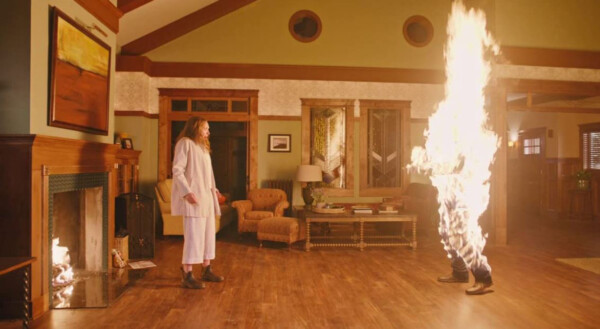
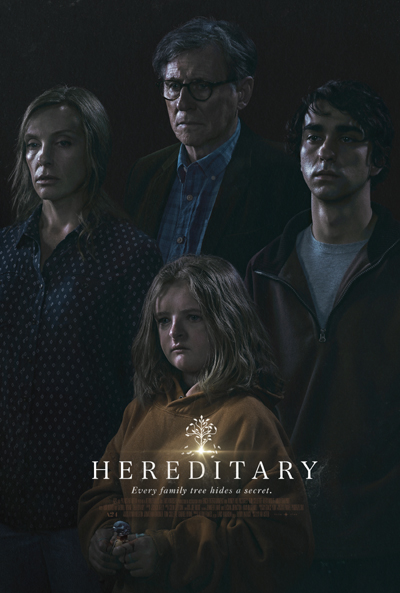
Image courtesy of A24.
“Hereditary” Starring Toni Collette, Gabriel Byrne, Alex Wolf and Milly Shapiro. Directed by Ari Aster. 127 minutes. Rated R.
Del’s take
“Kinda boring, isn’t it?” said the woman in the hallway as I headed for the men’s room. She had seen me coming out of the theater where “Hereditary” was about halfway through its 4:20 showing.
“It’s so very slow,” she continued as she headed back to the theater. Seems she was on her own bathroom break. But she was only partly right.
Said to be the “scariest movie of the year so far,” “Hereditary” is not just “kinda” boring. It’s VERY boring. The first two acts are thuddingly dull, and they’re followed by a third act mashup of horror movie clichés and a reveal that will have you asking yourself, “You mean, that’s it?”
The story begins with a funeral. Annie (Collette) is burying her mom, a miserable old bitch who made Annie’s life a living hell. In fact, Annie comes from a family of whackjobs – schizoids, paranoids and suicides – and now the last one has died. But with a title like “Hereditary” you know Annie’s life will never settle down to that pleasant myth of Americana depicted in every Norman Rockwell painting.
In fact, her current family is downright weird. Husband Steve is passive to a fault, letting every member of the family use him as a doormat. Big brother Peter is a pot-smoking cipher who has no purpose in life except that of professional victim. Little Sister Charlie is a strangely sociopathic oddball with no friends, no interests and no apparent redeeming qualities.
Annie herself is not exactly Mom of the Year material. She sleepwalks, at least once dousing the kids with paint thinner and trying to set them on fire. She re-creates various tragedies in her life as miniature models, an artform that has brought her a measure of acclaim, at least in the part of the world that appreciates depictions of headless children hanging out of the window of a Volvo stationwagon.
And there you have the first two acts of the movie – a slow infodump of all this boring background. The woman in the hallway almost got it right. Very boring.
I won’t tell you what happens in the third act because that would spoil it for you, God forbid you actually see this movie. But I will say this: Little girls crawling across the ceiling isn’t scary anymore. Candles suddenly spouting gouts of flame isn’t scary. Séances, furniture tipping over, flies in the attic – these things aren’t scary anymore because they’ve been done to death.
Collette is super as the besieged Annie. One scene, in which she’s having it out with her son over the dinner table, is Oscar-worthy in my opinion. And young Shapiro is nicely weird as the bird head-snipping Charlie. But Byrne and Wolff are less impressive, not through any fault of their own. Their characters are simply less impressive.
“Hereditary” isn’t scary. It lacks the tension of a good scary movie. And nothing is left to the imagination. You take a movie like “The Haunting,” “The Innocents” or even “Alien” – now THOSE are scary movies. They build their tension slowly and carefully, and they show you only hints of the Bad Thing, allowing your imagination to fill in the awful details.
If you’re in the mood for “Rosemary’s Baby” meets “The Exorcist,” by all means catch “Hereditary.” But prepare yourself for a long slog with a meager payoff. I’m pretty sure you’ll be disappointed.
I grade this movie a C.
Del Stone Jr. is a former journalist and author.
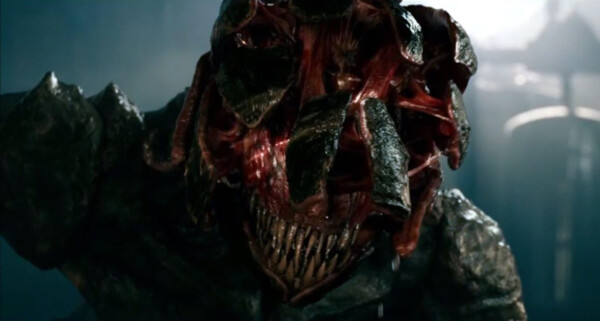
Image courtesy of Paramount.
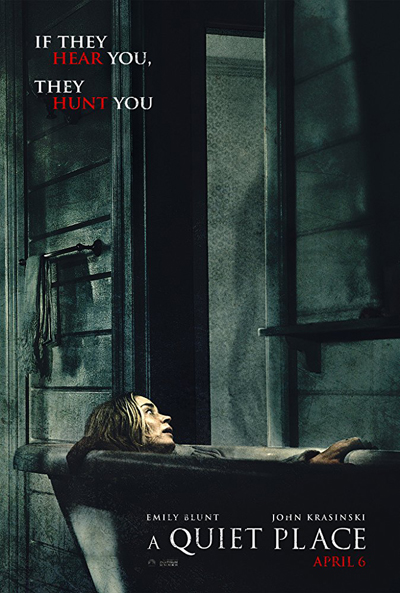
“A Quiet Place” Starring Emily Blunt, John Krasinski, Millicent Simmonds and Noah Jupe. Directed by John Krasinski. 90 minutes. Rated PG-13.
Del’s take
“A Quiet Place” is relentlessly tense. To be honest, I was relieved when the movie ended because throughout, my stomach was cinched into a knot. It has a couple of problems, but overall it’s a good value for your entertainment dollar and I recommend it.
It’s directed by John Krasinski of “The Office” fame, but Emily Blunt, who plays his wife both on and offscreen, has been getting top billing. Krasinski also directed the film. I’ve always wondered how that works. If you screw up a scene, do you get mad and yell at yourself?
The story is about a family trying to survive the emergence of a blind super predator that hunts by sound. I was a little unclear as to where the predators came from. Are they extraterrestrials? Demons? Genetic mutations? I don’t think the movie made that clear, but reviewers are calling them aliens so I’ll go with that.
The Abbott family lives on an abandoned farm in the countryside, never speaking, never wearing shoes, never doing anything that might reveal their presence to the monsters. They communicate through sign language and scatter sand along their footpaths to muffle the sound of their tread.
The first anecdote of the movie ratchets up the tension to an unbearable level. The family is scavenging for supplies in a nearby town. Their youngest, a little boy named Beau, finds a battery-operated space shuttle toy and wants to play with it, but Krasinski takes it away from him and removes the batteries, explaining the toy is too loud. Later, Beau’s big sister Regan (Simmonds) gives him the toy, and as they’re leaving Beau grabs the batteries.
As they’re walking back to the farmhouse the boy falls behind – because he’s loading the batteries into the toy. When he turns it on it begins to emit loud sounds, and what you fear might happen … well … it actually happens.
Cut to a year later. Blunt is pregnant. Otherwise, nothing has changed. Well, not quite. Regan blames herself for her little brother’s death. She thinks her father hates her. She doesn’t feel welcome in the family, even after her dad tries to invent a turbocharged hearing aid that might repair her deafness. The Abbotts’ other son, Marcus (Jupe), is more terrified of the monsters than the rest of the family and doesn’t think his father will keep them safe. Turns out he should be afraid.
I won’t say anything more about the plot. I don’t want to spoil it for you. Suffice it to say everything that follows cranks up the tension to the point you will be breaking for the bathroom or snack bar just to get your heart back in sync, like I did during a certain scene involving a nail.
But yes, in my opinion the movie had a few problems. The story supposedly takes place between one and two years after the creatures arrive, yet the town the Abbotts raid for supplies looks like it’s been abandoned for many years. By the same token, the farm where they hide is surrounded by lovingly cultivated fields of corn, which could not have been accomplished without the use of heavy – and loud – machinery.
And what’s with this baby thing? Why would they bring a baby into this world? And aren’t babies loud? I mean, really, really loud?
If the monsters are attracted to sound, why couldn’t Krasinsky set up some speakers in the middle of that corn field, crank up the Iggy Pop and blast the monsters to smithereens when they show up?
Details, details.
Apart from those gripes, “A Quiet Place” is a super tense, super scary movie that should appeal to both fans and non-fans of horror. See it in a movie theater. Don’t wait for it to show up on Netflix or Prime.
While I’m at it, let me recommend the smartphone app MoviePass. You pay $7 a month for one theatrical release – per day. Thirty-one movies for $7? I don’t know how they make money at it, but somehow they must.
That’s how we got to see “A Quiet Place.”
I give it a B+.
Del Stone Jr. is a former journalist and author.
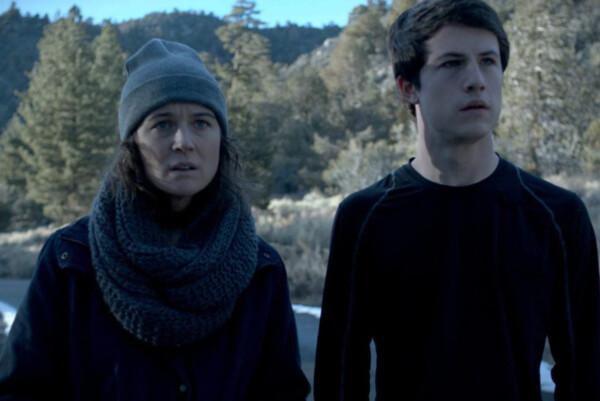
Image courtesy of Netflix.
“The Open House” Starring Dylan Minnette, Piercey Dalton and Sharif Atkins. Directed by Matt Angel and Suzanne Coote. 94 minutes. Rating not listed.
Del’s take
“The Open House” was pitched as a horror movie and I watched it because Netflix has been streaming decent non-theatrical programming lately (“Mindhunter” for instance).
Unfortunately, that isn’t the case here. While “The Open House” initially holds promise as a lite version of “The Shining,” it undergoes a slow collapse as it slides toward its dire conclusion, leaving the viewer to wonder what the point of all that was.
It’s hard to discuss the movie without spoiling it, so beware.
Suffice it to say young Logan Wallace (Minnette) is a promising track star living in what I presume to be the foothills of the Rocky Mountains – Colorado perhaps? – with his mom (Dalton) and dad (Aaron Abrams). All is not well in the Wallace household. Dad’s unemployment has stretched the family budget to the limit, and mom has tried, without success, to find a job herself. The rent is due and there’s no money to pay the bills. Meanwhile, Logan hopes to make the Olympics in track and field, something that may become possible if he continues to improve his times.
Logan and his dad venture to a convenience store for a carton of eggs and quart of milk. While Logan waits in the van, dad is mowed down in the parking lot by a driver suffering a medical event. It is all very sudden and heartbreaking, as Logan’s relationship with his father is one of the movie’s sparse warm spots. With the death, a bad situation has been rendered into a horrible situation.
After the funeral, Logan’s aunt offers to let them stay at her and her husband’s remote mountain house while they figure out what to do with their lives. Logan’s mother, aware of their dire financial straits, accepts the offer, much to Logan’s predictably selfish despair. In fact, he spends the rest of the movie pouting and blaming his mother for their sad turn of fortune.
The house is a McMansion with a spooky old basement that seems impervious to illumination. In fact, not once do Logan or his mother attempt to locate and replace a burned-out light bulb, meaning several trips into the crypt-like basement with a flashlight (and you know who temperamental flashlights are in horror movies) will be necessary after scary things start happening.
The townfolk comprise the usual suspects – the crazy, nosy neighbor; and the noble store clerk who might just have an interest in Logan’s mother (much to Logan’s irritation) and otherwise manages to show up at any number of weird, beyond-coincidental occasions, conjuring visions of stalkers.
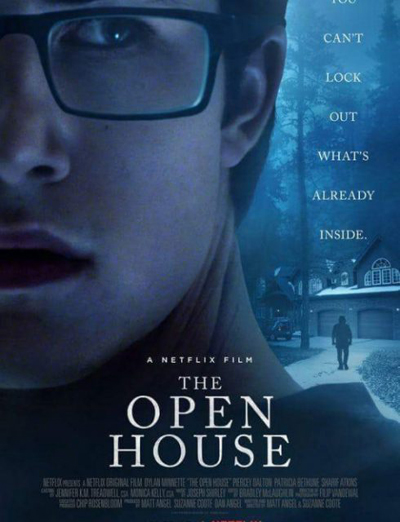
Meanwhile, weirdness escalates. The water heater keeps getting turned off. Logan’s glasses disappear, then reappear. Loud noises interrupt everybody’s sleep. Strange vehicles pull into the driveway, their headlights blinding, then abruptly leave. And nobody is looking for a job.
The house is for sale. Every Sunday between the hours of 11 a.m. and 5 p.m., Logan and his mother must leave for open house. The movie suggests that somebody, or something, arrived for one of these open houses and decided to stay.
Which is a shame, because the movie’s other tensions provide much more interesting potential – Logan having to set aside his dreams of the Olympics, the resentment he feels for his mother, and his mother’s resentment of her husband’s failure to provide for them. These are barely explored in favor of, well, dead-ends, red herrings, and an antagonist who seems to arrive from somewhere beyond the movie’s logical reach.
“The Open House” wraps with an absurd and pointlessly nihilistic series of events that remind me of films I saw in the 1970s, movies that sought to achieve emotional resonance by clubbing the viewer with cruelty and shock. That didn’t work then and it doesn’t work now.
Minnette is wooden and unsympathetic in his role as Logan, while Dalton manages to imbue her saddened wife and mother character with moments of real pathos. Both are saddled with a screenplay that, in the end, doesn’t make much sense.
It’s a nice-looking movie but I can’t recommend “The Open House.” If you subscribe to Netflix streaming and want to watch it, by all means do so. It will cost you only 94 minutes of your life.
I would grade this movie a generous C-, maybe a D+.
Del Stone Jr. is a former journalist and author.
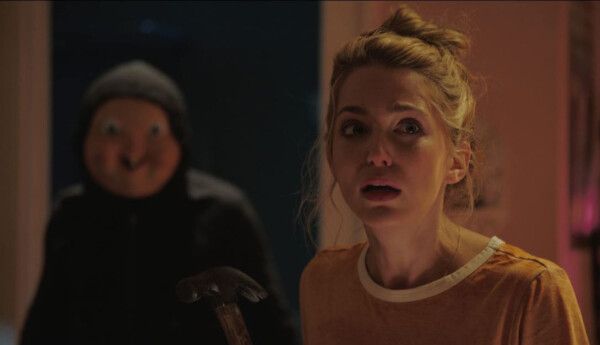
Image courtesy of Universal Pictures.
“Happy Death Day” Starring Jessica Rothe, Israel Broussard, Ruby Modine, Charles Aitken and Laura Clifton. Directed by Christopher Landon. 96 minutes. Rated PG-13.
Del’s take
I’m not going to say it … I’m not going to say it. …
Oh hell, who am I kidding? Of course I’m going to say “Groundhog Day” with a killer.
That’s the conceit of “Happy Death Day,” an entertaining trifle of a horror slash comedy (Yes!) that has come to a theater near you. Just in time for trick-or-treat, “Death Day” neither scares, edifies, nor elevates the spirit. What it does do is entertain with humor, mild romance and a who-dunnit that will defy your attempts to finger the killer.
The story goes like this: It’s Tree Gelbman’s (Rothe) birthday, but even Tree isn’t celebrating. She’s a beta beeyotch sorority snob who treats people as if they were disposable, except for her yummy college professor, Dr. Gregory Butler (Aitken), with whom she’s having an affair. She awakens in a dorm room (to her shame) with a ferocious hangover and finds she cannot remember what she did last night, especially as per young Carter Davis (Broussard) whose bed she currently inhabits. Carter is below her station in the college caste and she hustles out of his dorm lest one of her sorority sisters tumbles onto her indiscretion.
That night, on her way to a party, Tree encounters the killer, an individual wearing a pig baby mask who chases her across the campus and eventually stabs her to death. Tree jolts awake in Carter’s bed, as she did that morning, and the day begins to anew, unspooling exactly as it did before, perhaps with a change of viewpoints for the audience’s sake.
As the movie goes on we learn Tree will continue to relive the day, over and over, until the killer is dispatched. Problem is, her every attempt to kill the killer ends with her own death – by gunshot, baseball bat, hanging, bus collision, even fire. Does the obnoxious Tree deserve to live? Will she figure out a way to destroy her nemesis before dying herself?
Interestingly, each iteration of her life gives Tree a chance to see what a terrible person she has become. As the callow but earnest young Carter observes, it’s never too late to change. And change is what Tree does, so that by movie’s end you may actually like her, assuming she lives long enough for that to happen.
At roughly an hour and a half, “Death Day” is shorter than a lot of current movies such as “Blade Runner 2049,” which clocks in at almost double the length. The movie moves along at a brisk pace and you’ll be kept awake by the snappy dialogue, daily variations in Tree’s manifestations, and the puzzle over the killer’s identity (Hint: Tree is an equal opportunity snob. It could be anybody on campus.). You won’t be put off by blood because there is hardly a drop.
I was unfamiliar with the cast, but everybody turns in a creditable performance, including director Landon. “Death Day” was written by Scott Lobdell, who is primarily a comic book writer.
Somebody at Blumhouse must be licking his chops. Costing a mere $4.8 million to produce, “Death Day” has earned $40 million plus as of week 2. It will likely top out at over $50 million earning a tidy profit for the Blumhouse horror meisters. Expect it to appear on DVD and streaming in the not too distant future, joining a fraternity – or in this case sorority – of young adult-themed slasher movies that provide a forgettable hour and a half of entertainment value then recede into the cinema background.
Go see it at the movie theater, because all movies deserve to be seen on the big screen.
I give it a score of B+.
Del Stone Jr. is a former journalist and author.
[ Primary image courtesy of Free SVG ]
From Amazon:
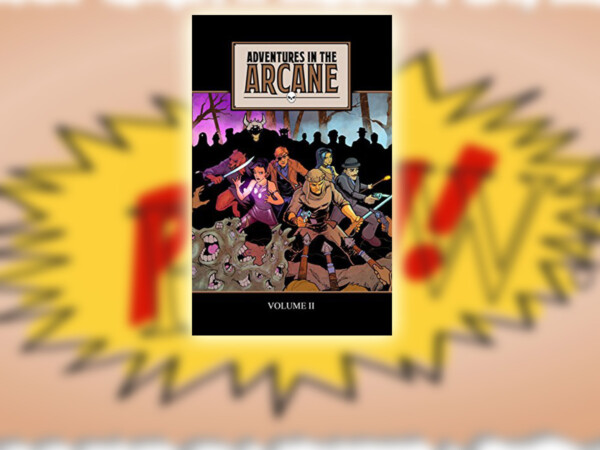
Adventures in the Arcane is back! And we’ve expanded to eight thrilling stories. The characters you love from Volume I return, including Captain Argo, Dominic Ashwood, Waylon and Jester, Dempsey and Drood.
Our guest authors, including pulp legend Ron Goulart, bring you four terrific tales guaranteed to set your heart racing. Inside you’ll find femme fatales, vengeful ghosts, mysterious islands, and deadly dream worlds.
Lock your door, brew some coffee, and light a candle. Then open this book and prepare to be thrilled!
A Syndicate Production featuring the work of Mark Boss, S. Brady Calhoun, Ruth Corley, Mark Douglas Jr., Ron Goulart, Jayson Kretzer, Tony Simmons, and Del Stone Jr.
If you would like to order a copy of “Adventures in the Arcane, Volume II,” following this link.
About the author:
Del Stone Jr. is a professional fiction writer. He is known primarily for his work in the contemporary dark fiction field, but has also published science fiction and contemporary fantasy. Stone’s stories, poetry and scripts have appeared in publications such as Amazing Stories, Eldritch Tales, and Bantam-Spectra’s Full Spectrum. His short fiction has been published in The Year’s Best Horror Stories XXII; Alfred Hitchcock’s Mystery Magazine; the Pocket Books anthology More Phobias; the Barnes & Noble anthologies 100 Wicked Little Witch Stories, Horrors! 365 Scary Stories, and 100 Astounding Little Alien Stories; the HWA anthology Psychos; and other short fiction venues, like Blood Muse, Live Without a Net, Zombiesque and Sex Macabre. Stone’s comic book debut was in the Clive Barker series of books, Hellraiser, published by Marvel/Epic and reprinted in The Best of Hellraiser anthology. He has also published stories in Penthouse Comix, and worked with artist Dave Dorman on many projects, including the illustrated novella “Roadkill,” a short story for the Andrew Vachss anthology Underground from Dark Horse, an ashcan titled “December” for Hero Illustrated, and several of Dorman’s Wasted Lands novellas and comics, such as Rail from Image and “The Uninvited.” Stone’s novel, Dead Heat, won the 1996 International Horror Guild’s award for best first novel and was a runner-up for the Bram Stoker Award. Stone has also been a finalist for the IHG award for short fiction, the British Fantasy Award for best novella, and a semifinalist for the Nebula and Writers of the Future awards. His stories have appeared in anthologies that have won the Bram Stoker Award and the World Fantasy Award. Two of his works were optioned for film, the novella “Black Tide” and short story “Crisis Line.”
Stone recently retired after a 41-year career in journalism. He won numerous awards for his work, and in 1986 was named Florida’s best columnist in his circulation division by the Florida Society of Newspaper Editors. In 2001 he received an honorable mention from the National Lesbian and Gay Journalists Association for his essay “When Freedom of Speech Ends” and in 2003 he was voted Best of the Best in the category of columnists by Emerald Coast Magazine. He participated in book signings and awareness campaigns, and was a guest on local television and radio programs.
As an addendum, Stone is single, kills tomatoes and morning glories with ruthless efficiency, once tied the stem of a cocktail cherry in a knot with his tongue, and carries a permanent scar on his chest after having been shot with a paintball gun. He’s in his 60s as of this writing but doesn’t look a day over 94.
Contact Del at [email protected]. He is also on Facebook, twitter, Pinterest, tumblr, TikTok, Ello and Instagram. Visit his website at delstonejr.com .
[ Cover image by Eugene Kim. ]
This is a short story, and it is short even for that. I say up front because I don’t want you to think you’ve been tricked out of your money (pardon the seasonal pun). At 99 cents, “Trick-or-Treat” is priced the lowest Amazon allows. If you don’t think a story of that length is worth a buck, please don’t buy this book.
Now, about “Trick-or-Treat”: I wrote the story back in the ’80s, and you’ll notice dated references to corded telephones and so forth. True story: The first cordless phone I ever saw was in the film “Terms of Endearment.” I remember thinking it was a trendy piece of technology I would never be able to afford, but a few years later I would own, and cherish, a Sony cordless phone.
I present to you the story as I wrote it, warts and all. I have not rewritten it or revised it in any way except to correct typos and misspellings.
Of the story I remember it was my first Halloween away from my parents. I had bought an old house across town and was a little nervous about being a homeowner. Suddenly I was responsible for a monster debt – $45,000 – and a huge obligation of repairs and maintenance. It meant I could not quit my job, nor could I suddenly up and leave for a job in another state. I was home “bound.”
The genesis of the story itself, I’m unsure of. The protagonist, Clifton, bears no resemblance to anyone I know either physically or spiritually. I have never experienced his kind of anger – I wouldn’t want to.
The story is set in the living room of that old house, and when I envision the activities taking place, they are framed by that house and neighborhood. I can see the yellowish door with the diamond-shaped window. I can see the tan shag carpeting, the sloped driveway, the buggy carport and the paint peeling from the frame.
I can even see Clifton standing in the living room during the climax that, to this day, shocks me and makes me wonder what the heck is wrong with a person who could think of a resolution so diabolical.
If you gave me your 99 cents (of which I get to keep 35; Amazon collects the rest), then I thank you and hope you enjoy “Trick-or-Treat.”
Think of it this coming Halloween.
Order a copy of “Trick-or-Treat” by following this link:
[ Cover image by Eugene Kim. ]
From Amazon
“While short enough to be called flash fiction, this story delivers the impact of a good horror story. Concise with no wasted words. Excellent read for Halloween.”
– Richard A. Bamberg, author of “The Hunters: Monster Hunting 101”
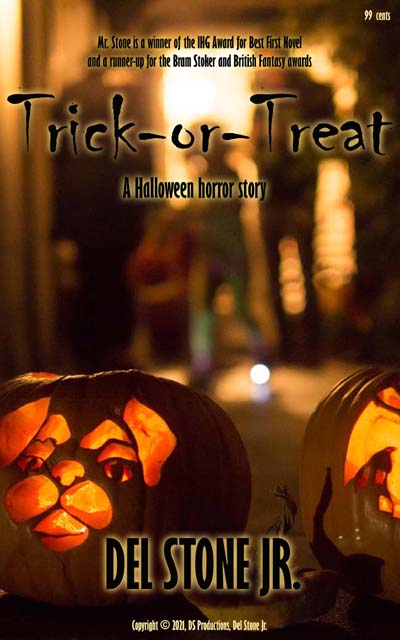
Trick-or-Treat: Revised, updated and enhanced with additional content, this micro-story punches far above its weight.
Clifton’s girlfriend Lisa has told him goodbye and he is not happy about it.
Not happy at all.
She said she needed space, and time. Clifton has no need of space or time, and now that Halloween is here, with all those happy kids ringing his doorbell and demanding candy, Clifton is ever reminded of his girlfriend, and her class of fourth-graders, and her young daughter, all of them gone now … or maybe not.
Because this Halloween, Clifton has a surprise for Lisa, and all the children in her life.
About the author:
Del Stone Jr. is a professional fiction writer. He is known primarily for his work in the contemporary dark fiction field, but has also published science fiction and contemporary fantasy. Stone’s stories, poetry and scripts have appeared in publications such as Amazing Stories, Eldritch Tales, and Bantam-Spectra’s Full Spectrum. His short fiction has been published in The Year’s Best Horror Stories XXII; Alfred Hitchcock’s Mystery Magazine; the Pocket Books anthology More Phobias; the Barnes & Noble anthologies 100 Wicked Little Witch Stories, Horrors! 365 Scary Stories, and 100 Astounding Little Alien Stories; the HWA anthology Psychos; and other short fiction venues, like Blood Muse, Live Without a Net, Zombiesque and Sex Macabre. Stone’s comic book debut was in the Clive Barker series of books, Hellraiser, published by Marvel/Epic and reprinted in The Best of Hellraiser anthology. He has also published stories in Penthouse Comix, and worked with artist Dave Dorman on many projects, including the illustrated novella “Roadkill,” a short story for the Andrew Vachss anthology Underground from Dark Horse, an ashcan titled “December” for Hero Illustrated, and several of Dorman’s Wasted Lands novellas and comics, such as Rail from Image and “The Uninvited.” Stone’s novel, Dead Heat, won the 1996 International Horror Guild’s award for best first novel and was a runner-up for the Bram Stoker Award. Stone has also been a finalist for the IHG award for short fiction, the British Fantasy Award for best novella, and a semifinalist for the Nebula and Writers of the Future awards. His stories have appeared in anthologies that have won the Bram Stoker Award and the World Fantasy Award. Two of his works were optioned for film, the novella “Black Tide” and short story “Crisis Line.”
Stone recently retired after a 41-year career in journalism. He won numerous awards for his work, and in 1986 was named Florida’s best columnist in his circulation division by the Florida Society of Newspaper Editors. In 2001 he received an honorable mention from the National Lesbian and Gay Journalists Association for his essay “When Freedom of Speech Ends” and in 2003 he was voted Best of the Best in the category of columnists by Emerald Coast Magazine. He participated in book signings and awareness campaigns, and was a guest on local television and radio programs.
As an addendum, Stone is single, kills tomatoes and morning glories with ruthless efficiency, once tied the stem of a cocktail cherry in a knot with his tongue, and carries a permanent scar on his chest after having been shot with a paintball gun. He’s in his 60s as of this writing but doesn’t look a day over 94.
Contact Del at [email protected]. He is also on Facebook, twitter, Pinterest, tumblr, TikTok, Ello and Instagram. Visit his website at delstonejr.com .
About this book:
“Trick-or-Treat” is a 756-word short story. It has never been published before.
The book’s total length is 3,516 words.
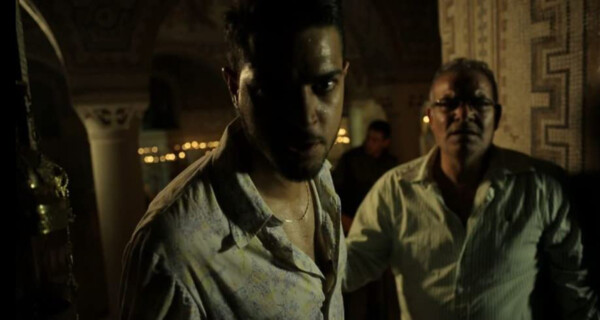
Image courtesy of Epic Pictures Releasing.
“JeruZalem” Starring Yael Grobglas, Yon Tumarkin, Danielle Jadelyn and Tom Graziani. Directed by Doran and Yoav Paz as The PAZ Brothers. 94 minutes. Rated R. Netflix.
Del’s take
The found-footage film has found a home in the horror genre, resulting in classics like “REC,” “V/H/S,” “Troll Hunter” and the grandwitchy of ’em all, “The Blair Witch Project.” It also has produced some amazing clunkers. “Paranormal Entity,” “Area 407” and “Apollo 18” come to mind.
Falling somewhere in between is “JeruZalem,” an unlikely pairing of the weighty and the frothy (Judgment Day from the point of view of a teen girl’s spring break getaway). How far it leans toward “Blair Witch” or “Apollo 18” depends on the moviegoer’s charity. While some people loath found footage as a lazy director’s approach to storytelling, others appreciate its clarity of viewpoint.
I find myself bouncing between those two worldviews. I think movies like “Troll Hunter” and “Cloverfield” are masterpieces of the genre. I even liked “Apollo 18” for what it was – a space-based horror flick with limited ambitions. But some movies don’t benefit from the found-footage viewpoint and “JeruZalem” may be one of them. Third person probably would have been a perfectly acceptable storytelling vantage point, and I would not have been distracted by irrelevant technical details such as how the lead character kept her device charged throughout the apocalypse.
I’ll probably be asking myself the same question about my phone after this Korea thing blows up.
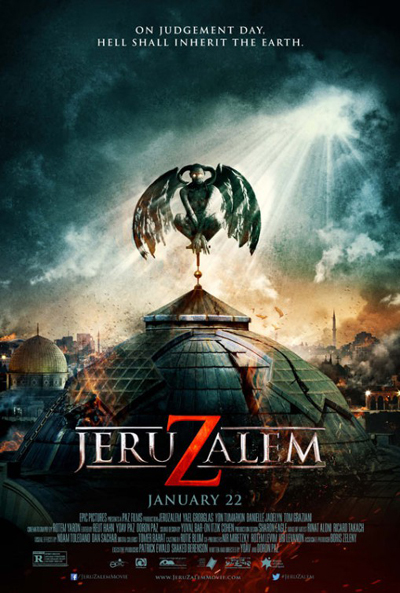
In “JeruZalem,” young Sarah Pullman (Jadelyn) is whisked away from her overprotective and Skype-stalking father (Howard Ripp) for a whirlwind tour of the old city of Jerusalem during Yom Kippur. At the Tel Aviv airport they meet good-looking Kevin Reed (Tumarkin), an antiquities student who promises to hook them up with a hostel in the old city and show them the best clubs and sights.
There, they hook up with Omar, the young hostel owner, who takes them out for a night on the old town and stakes his claim to Rachel (Kevin has already targeted Sarah). They dance the night away as dear old dad vainly tries to Skype his daughter because he has been watching the news and hears that something weird is going on in Jerusalem.
The quartet discover the city has been quarantined and Israeli troops are battling – something. They hear gunfire, explosions and screams in the distance, not to mention an unearthly growling and screeching reminiscent of the time you accidentally shut the door on the cat’s tail.
From that point “JeruZalem” becomes an escape caper with the two American girls and their vacation boyfriends struggling to get out of the old city while monstrous events unfold around them.
The story is displayed from a pair of Google Glass-like eyeglasses that belong to Sarah, and yes, I would really like to know how she kept the damn things charged through her ordeal. My new phone will maintain a charge over a couple of days’ heavy usage, but then my phone has a battery the size of a Pop Tart. Sarah’s Glass didn’t – unless the Pop Tart was hidden in her blouse pocket.
The actors carried their parts effectively and there were no gaping holes in the plot, at least none I would try to drive a truck through. Special effects were acceptable and pacing matched the plot well enough. The found-footage viewpoint was not overly distracting, although at times the integration of technologies struck me as too seamless to be believed.
If I had a substantial criticism it would be that the storytelling mechanism trivializes the subject material. Mysterious stars in the sky over Jerusalem portending a religious disaster, sinister film footage smuggled from the Vatican showing the alleged execution of a demon, and air raid sirens that warn of something far worse than incoming Palestinian rockets are all gamely revealed through the lens of a silly pair of internet-capable glasses that display a frowny face and flash “fatal error” when dropped.
It’s all in the name of fun, however, and I confess I enjoyed “JeruZalem” despite its limited flaws.
I would give the movie a B- grade for its interesting premise, decent plot and pacing, and occasional (although sparse) flashes of genuine weirdness. I mark it down for its found-footage viewpoint, which did not serve the story effectively.
I watched it on Netflix.
Del Stone Jr. is a former journalist and author.
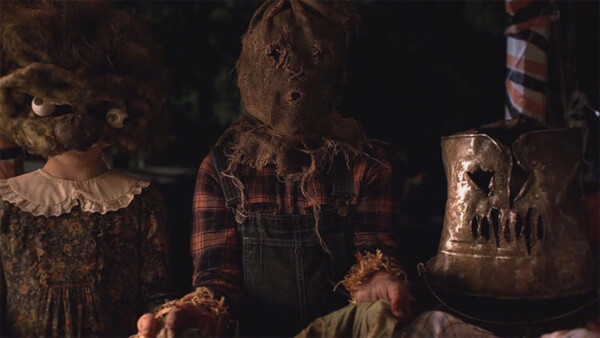
Image courtesy of IFC Midnight.
“Hellions” Starring Chloe Rose, Robert Patrick, Rossif Sutherland. Directed by Bruce McDonald. 80 minutes. Unrated.
Del’s take
My ever-present quest for those hidden gems of cinema, the obscure horror movie, recently carried me to “Hellions,” a new offering on Netflix. “Hellions” is hidden for a reason, although sadly I had to sit through it to find out why.
The movie begins promisingly enough. Seventeen-year-old Dora is planning a Halloween night liaison with boyfriend Jace at a Halloween party, but first she must drop by that pesky health clinic to see why she’s been summoned. Probably just want her to pick up a prescription or something.
Too bad it wasn’t BCPs because the doctor has news for Dora – she’s knocked up. That’ll sure take the fun out of a night of canoodling with your dope-smoking teen boy.
Dora decides to kick back at the house while her mom and little brother head out for a children’s Halloween party. But later, Jace calls and Dora changes her mind, partly because she wants Daddy Dearest to hear the news ASAP. As she waits for Jace to pick her up, the doorbell rings and a devilishly dressed moppet holds out a trick-or-treat bag.
That’s where the trouble begins, in terms of plot and the movie itself.
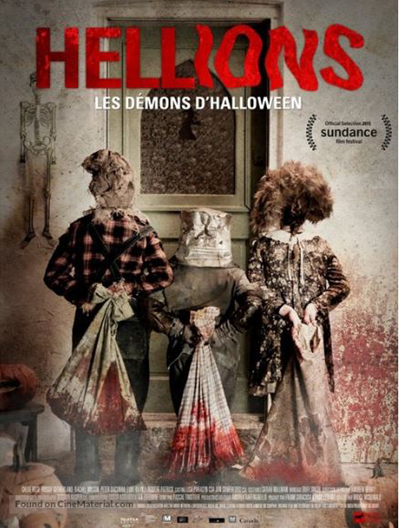
What follows is a near incomprehensible descent into … something. I’m not sure what to call it. A fever dream? Madness? An alternate universe?
Suffice it to say Dora and her unborn child, which is rapidly maturing within her belly into some kind of monster, become the targets of a cadre of demon children who want the baby whatever-it-is for something. I never quite figured that out.
I also never figured out the movie’s odd color palette – a kind of faux infrared – and it’s weird soundtrack. Oh, and I almost forgot the exploding pumpkins. Musn’t forget the exploding pumpkins.
“Hellions” is skillfully assembled in technical terms, and it shows flashes of originality and brilliance. But McDonald loses me, and what I predict will be most viewers, about 15 minutes into the movie when events become inexplicably strange, and not really very interesting.
I don’t want to discourage McDonald because I think if he reins in these excursions into visual excess, he should make some decent movies. But “Hellions” isn’t one of them.
I would give it a D+, and the plus is for the inventive costumes.
Del Stone Jr. is a former journalist and author.