Del and Mladen review ‘Disclosure Day’

Universal Studios
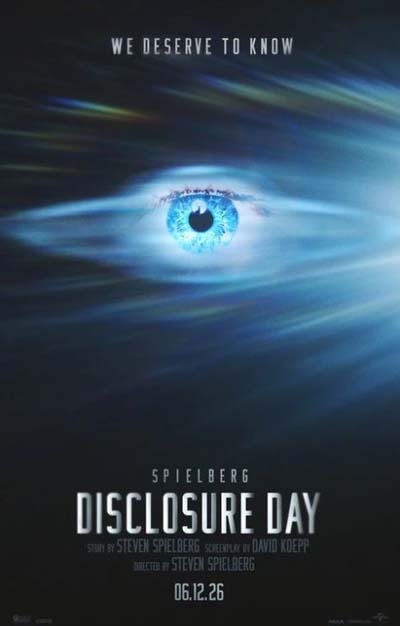
“Disclosure Day” Starring Emily Blunt as Margaret Fairchild, Josh O’Connor as Dr. Daniel Kellner, Colin Firth as Noah Scanlon, and others. Directed by Steven Spielberg. Two hours, 25 minutes. Rated PG-13. Theatrical release.
Plot summary: Dr. Daniel Kellner is being pursued by agents of the Wardex corporation because he stole information the company has been hiding for decades. He intends to release that information in hopes of changing the world. He’s abetted by weathergirl Margaret Fairchild, who has mysteriously developed the ability to read minds and speak foreign languages.
Spoilers: Does the UFO make crop circles in the wheat field?
Del’s take
I would probably have liked “Disclosure Day” a lot better had anyone but Steven Spielberg directed it. But because my expectations of Spielberg are higher than mere mortal directors, I was not overwhelmed. Don’t get me wrong. “Disclosure Day” is a decent movie. But I don’t think it’s one of his better efforts.
“Disclosure Day” marks a return to familiar grounds for Spielberg, those of the misunderstood alien who arrives on Earth and strikes up an alliance with sympathetic humans to survive. We saw it in “E.T. the Extraterrestrial” and “Close Encounters of the Third Kind.” “Disclosure Day” is, in terms of structure, very similar to “Close Encounters” and tonally it resembles the glittery sentimentality of “A.I. Artificial Intelligence.”
That’s one of the problems with “Disclosure Day.” We’ve seen it all before.
The movie features two-track storytelling duties divided between Dr. Daniel Kellner (Josh O’Connor) and Margaret Fairchild (Emily Blunt). Kellner, a former employee of the Wardex corporation, has stolen secrets that, if revealed to the general public, could momentarily distract people from an impending showdown between Russia and the United States. At the same time Fairchild has mysteriously acquired the ability to speak Russian and Korean, and can read people’s minds. She begins to sense the presence of Kellner and feels a compulsion to help him, despite not knowing who he is or what he’s trying to do.
From there the movie becomes an extended chase scene as Kellner and Fairchild careen from one life-threatening situation to another in a desperate quest to release Kellner’s pilfered data to the world.
“Disclosure Day” is a fast-paced, entertaining movie that does not feel as long as its 2½-hour run time. The actors are well cast and do an excellent job – Blunt in particular stands out as the funny, disheveled and thoroughly baffled TV weathergirl-turned potential savior of mankind. And Wyatt Russell, son of Kurt Russell and Goldie Hawn, steps away from his duties at “Monarch, Legacy of Monsters” to provide a convincing performance as Fairchild’s confused boyfriend, Jackson. Colin Firth and Josh O’Connor are also excellent.
Everything else about the movie reflects Spielberg’s meticulous attention to detail, and the score, another stellar John Williams composition, is rousing but, in my opinion, forgettable. All in all it’s a well-assembled product from the most talented movie director of our time.
But as I said, “Disclosure Day” is not one of Spielberg’s better movies. Apart from it being a pastiche – if not thematically then tonally – of “E.T.,” “Close Encounters” and “A.I.,” it asks the audience to accept an idea I found impossible to embrace – that people would freak out and stop believing in God if they discovered aliens exist. The material Kellner and Fairchild are working so hard to “disclose,” alien autopsies and crashed UFO video clips, are presented by Spielberg as mind-altering bits of information that would leave the world spellbound.
No, they wouldn’t.
You can search on YouTube right now and find any number of alien autopsy videos and crashed flying saucer clips. Not just YouTube – they’re all over the internet. They’re as good or better than the fictional Wardex videos. People would see the Wardex clips as nothing more than AI-generated slop, like the crap that’s already online. And after 70 years of “Star Trek,” “Star Wars,” “Close Encounters,” “The Day the Earth Stood Still” and tens of thousands of other movies and TV shows about alien civilizations, people are no longer awed by the idea of E.T. They expect E.T. to be out there. What “Disclosure Day” demonstrates more than anything else is that Spielberg, as a 70-something year old dude, is a little bit out of touch with the times.
The movie asks us to be more empathetic, an appropriate message for a time when the least empathetic among us are calling the shots, and it is yet another effort by Spielberg, with themes of innocence and wonder, to articulate and celebrate his and our youth.
But because I expect more from a Spielberg movie, and because it strikes so many familiar Spielbergian notes, and because it asks us to believe something I can’t and won’t believe, I’m giving it a grade of B.
“Disclosure Day” is a well assembled, entertaining movie, but in the end, we’ve seen it all before.
Mladen’s take
In 2025, it was “Sinners.” In 2026, it’s “Disclosure Day.” What’s the common thread? Both films were hyper‑hyped and both failed to deliver.
See the Movie Faceoff review of “Sinners,” if you want to know why that movie misfires. See below to get a bead on “Disclosure Day” faults.
“Disclosure Day” is an almost compelling movie driven by a shitload of sentimentality and some historical fiction a la the Bible.
Hell, I’m surprised Del didn’t mention the Adam and Eve thingy that unfolded as the movie careened toward an annoying ending. Toss in some mysticism, telekinesis, at least two poor decisions by Kellner, corporate mercenaries rampaging through cities and the countryside, an annoying scene in a train car, and you have yourself a story that left me, ah, a touch miffed rather than a whole lot hopeful.
Oh, almost forgot to mention this scene. To contain the film to a simple, two-sided good v. evil donnybrook, Spielberg inserted a 20-second scene that showed a corporate whack job convince a couple of gung‑ho U.S. military generals that the Department of Defense should NOT be getting involved in resolving a situation of, literally, cosmic significance. No way that would happen. Persuading DoD to NOT get directly involved in the chase to secure other-than-earthly information and stuff would be like trying to persuade Trump NOT to be stupid – futile.
Look, Blunt as Fairchild did everything Spielberg asked. And she did it credibly and with panache. No question. Blunt is one of the Top Five actors working today. O’Connor’s Kellner also helped Spielberg accomplish his “Disclosure Day” vision. The trouble? The vision is incorrect.
I start with a minor quibble. Again and again, I hear that mathematics is a universal language. No, it’s not. Mathematics, like the flushing toilet or the NASA Space Launch System, is just technology. Because math is a technology, there’s a nearly 0 percent chance that Earthmen could understand non-Earthmen through symbology because their symbologies would be incompatible. I say that with an assurance rate of 99.9 percent with a line over the top of the “9” to the right of the decimal point. For a more realistic take on talking science with an alien, see “Project Hail Mary.” The human and the animate rock in that story had to learn each other’s language, including the babble of science.
Now, the bigger woe. “Disclosure Day” is propelled by the notion of “empathy.” If only humans were more empathetic to (with?) each other, we’d be happier, kinder, and un‑violent. Wrong. I cannot ever understand what another person feels because I have not led that person’s life. Neither can you. What I, and you, can be is sympathetic. Sympathy is sufficient because it requires that we only understand each other’s basic needs. I need not ever have gone hungry to know that starving sucks. I need not have ever injured myself, gone to the emergency room, and then been asked to pay $5,000 for three stitches because I had no health insurance. That, too, would suck. I also know that living in a house is better than living on the street, though, so far, anyway, I have not been houseless.
One other point about “empathy,” at least the way it was portrayed in the film. One of our two protagonists wielded the capacity to empathize. The “emphatizer” targeted the “empathizee” by using names, dates, and events that mattered most to the latter. Essentially, the empathizer manipulated the brains of empathizees to achieve the Disclosure Day mission. Humanity was lucky because the empathizer was channeling a do‑gooder. But could not empathy also be used to achieve evil? Yes, commander of the submarine, sorry you weren’t nominated for promotion to Rear Admiral. Yes, you deserved it. You worked hard. You endured much. Sorry about that backstabber. Everything will be alright if you just give me the launch codes for nuclear warhead‑tipped, sea‑launched ballistic missiles 2, 3, 7, and 9. Promise, I’ll set their yields to a mere 250 kilotons each because 500 would be too much.
“Disclosure Day” has its heart in the right place. But it didn’t move me and I’m a pretty sensitive guy. I sympathize with the lesson it tries to teach. We do need to be nicer to each other. But that has been the case since Homo sapiens started clumping into villages of more than 500 people thousands of years ago. Why didn’t Spielberg show me something I didn’t already now?
“Disclosure Day” is a B- largely because Blunt pulled the movie along despite its silliness.
Mladen Rudman is a former journalist and technical writer. Del Stone Jr. is a former journalist and writer.

Leave a Reply