Post Office ( a short horror story )
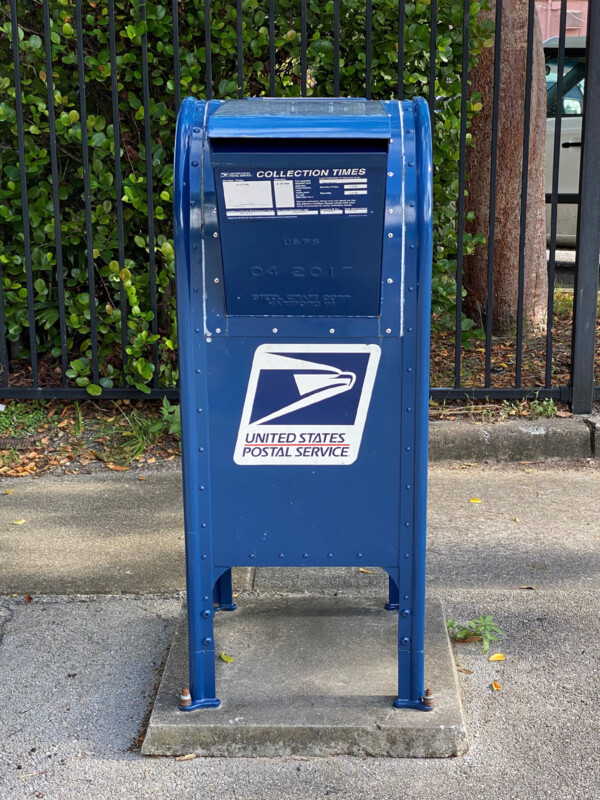
Image courtesy of Phillip Pessar by way of a Creative Commons license. https://www.flickr.com/people/25955895@N03
INTRODUCTION
I hate writing.
I really do.
I think my attitude toward writing is similar to that of my friend, Ray Aldridge, who once said (and I think he was quoting yet another writer), “I enjoy having written.”
That suits me. If I could forgo the teeth clenching, hair pulling, sick-in-the-gut stomach-wrenching AGONY of writing, and skip to the part where I look upon the finished work, knowing it is as good as I could make it, and feel the satisfaction that any new parent feels … well, life would be grand.
But life isn’t grand, at least so far as writing is concerned, and I try to avoid the painful bits as much as I can. Some people like to “talk about writing.” Not me. I hate talking about writing. Some people enjoy belonging to writers’ groups. Not me. Apart from the social aspect I think they’re a waste of time. And some people like writing about writing. Not me.
I take that back – mostly not about me.
This story is one of two exceptions.
The first, titled “Artist,” is also available as a Kindle e-book (minor sales pitch) and you can get yourself a copy here. Please buy it. I’m poor.
This is the second.
It’s a story about writing – more precisely, a story about submitting what you write.
That’s a neglected aspect of the writing conversation. You never hear people talk about the process of submitting their manuscripts for publication – it’s always about the artistic, as if they don’t want to acknowledge that a big part – maybe the biggest part – of writing is the business part. You know, the ugly, brass tacks part with editors and agents and lawyers and contracts, royalties and earn-back expenses and all the other crap that has absolutely nothing to do with lying in the clover and studying the clouds for inspiration but is absolutely essential for anyone who hopes to become a published writer.
When I finally stopped talking about writing and began actually writing and submitting my work for publication, the world was a different place. The earth’s mantle had just cooled and there were dinosaurs that stood between me and the mailbox, ferocious man-eaters who discouraged me from venturing into that bloody neighborhood. When I finally worked up the courage to go forth, a whole new subset of monsters emerged.
Those would be the monsters of impatience, and paranoia.
Back in those days there was no such thing as e-mail. You typed your manuscript on paper, inserted it into a large manila envelope, included a second manila envelope – self-addressed and with the return postage contained in a wax envelope of its own – and dispatched this package into the postal ethers. Hey, that’s what they told us to do.
I soon learned the error of their ways.
For instance, those little wax paper envelopes containing the return postage? They often did not find their way onto my self-addressed envelope. Instead, the envelope would arrive postage due. Ha ha, how could it be that the noble editor had somehow misplaced my valuable return postage, ha ha?
And those manuscripts I had laboriously typed? Sometimes they arrived folded in half. Sometimes stained with spaghetti sauce. Sometimes with sarcastic notations on the manuscript itself.
I soon learned to not submit the actual typed manuscript, but a photocopy. I explained to the editor that this was not a simultaneous submission, that I merely photocopied the original to protect the manuscript from damage incurred in the mail (ahem, yes … in the mail … right).
One part of this process I could not control was the length of time between the moment I mailed the manuscript and the moment the editor’s response appeared in my mailbox. I think every freelance writer is familiar with that part of the writing – the Vigil at the Mailbox.
That might be the most painful obstacle to becoming a freelance writer – waiting for the editor to get back to you. You want your story to sell, and you want to hear the good news as soon as possible. Wouldn’t two weeks be sufficient time to hear a response?
Well, no. Turns out two weeks is the length of time it takes for an editor to receive your submission, instantly reject it, and drop it back in the mail. Two months is the more likely norm. Meanwhile, as this invisible drama is playing out, you, the writer, stand at your mailbox every day, eyeing the bundle of letters and parcels the mailman is carrying to your box. Any large manila envelopes in there?
Yes, the Vigil at the Mailbox.
“Post Office” was inspired by such a vigil. One stretch in the 1980s – I don’t remember the exact dates – most if not all of my manuscripts were suspiciously late getting back to me. I was accustomed to the longer-than-expected waiting period, but this was ridiculous. It seemed like eons since I’d last gotten a yea or nay (almost always nay). What the heck was going on?
The longer this drought continued, the more paranoid I became, until it occurred to me that maybe, just maybe, something that did not meet the eye was going on. Something malevolent. I am, after all, a horror writer. It was not too much of a stretch to suspect an evil entity at the post office was holding my manuscripts hostage.
Batshit crazy, right? Of course it is, in the blessed light of hindsight. But before you go off thinking Uncle Del has wandered from the rose garden at the asylum, let me reiterate – I’m a horror writer, and horror writers experience these kinds of weird departures from rational thinking. That’s how we come up with story ideas. In fact, that’s how I came up with the idea for “Post Office.”
I passed off the story as a lighthearted confection, a joke, something not to be taken with the same weighty gravitas of a real horror story. I think that’s why Kris Rusch and Dean Wesley Smith accepted it for Pulphouse. They seemed to recognize it was written with the tongue firmly implanted within cheek.
I don’t remember what happened to all those stories. Maybe they came back. Maybe I queried the editors, received no response, and withdrew them from consideration.
But I do remember this:
I really did wonder if somebody at the post office was stealing my manuscripts.
Ha ha … you laugh. Try slipping a gift card into a your niece’s next birthday card and drop it in the mail.
See what happens.
—
POST OFFICE
David reached into the metal throat of the mailbox and pulled out a clutch of white envelopes. His face was already pinched into a scowl, and as he scanned the return addresses and dealt envelopes onto the sidewalk, the scowl tightened. When the last had fluttered from his fingers, he uttered a single, derisive snort.
A Visa bill. Two solicitations: one from Greenpeace (printed on the envelope in screaming blue characters was “This is the year of Antarctica!”) and the other an invitation to buy National Wildlife Federation Christmas cards … in August. An inquiry from J.C. Penney asking if he were satisfied with his recent purchase of an MCS stereo receiver. A letter from a cousin who would probably be wanting money.
No letters from editors today. And certainly no checks. No large manila envelopes, his address typed neatly on an adhesive label and taped to the envelope for good measure.
Seven months now, and no manuscripts. Not a single one had come back in the mail.
—
David studied his log sheets, as if the titles listed there would affirm he had ever written any stories.
The one about the two buddies arguing over the existence of monsters – that one had disappeared a couple of months ago. The lesbian magazine never answered his query about the love-murder story. Likewise with the cube-that-ate-personalities piece he’d submitted to that men’s magazine.
He flipped through the log sheets.
The monster-in-the-closet story was missing.
The walk-in-the-dark story was missing.
The insect-revolt story was missing.
The end-of-the-world story was missing.
The killer playground story. The ghost story. The zombies. Amok computers.
All of them.
Missing.
—
David was a horror writer. He wrote about monsters, both real and imagined. He wrote about things that go bump in the night.
But mostly he wrote about evil. Not evil with a capital E, the evil that is pronounced with the inflection on the second syllable, as it is pronounced in those Vincent Price movies. Not an ecclesiastical evil.
David had important theories about evil, theories he could express and test only within the confines of fiction. He had decided long ago that evil was not conscious or calculated.
Evil was not the rotted face of The Beast.
To the contrary, evil was simply a random breakdown in order. Evil chose its victims for no reason, inflicted undeserved torment on them, then inscrutably departed. Evil was a sort of anti-entropy.
To test his theories, he would take protagonists, everyday working Joes, and deposit them in execrable circumstances – for no reason at all – then have them try to wriggle their way out within the constraints of the story’s logic. Many – most – did not succeed, and that was fine with David. It validated his theories. If evil were random then there was no such thing as justice. And in a literary context, if justice were the hero riding off into the sunset, then David would have his heroes ride off into the sunset … in a hearse.
David had 15 horror stories “making the rounds” at publications as diverse as Playboy and one of those self-important literary magazines at the university upstate. Fifteen stories was a good body of work for a new writer hungry for his first sale, he thought. Fifteen stories. The time he had first picked up a pen, he hadn’t dreamed he would write 15 stories.
Fifteen stories about evil. And now they were gone.
—
If he could have believed each story was lying on an editor’s desk awaiting final approval for publication, he would have been patient … patient and goddamned jumped-out-of-his-socks ecstatic. Wasn’t it the editor of that back-to-nature magazine in California who told him having a story accepted was only a matter of it crossing the editor’s desk on the right day? Sure. She’d said that. She’d written it on a rejection slip.
But all 15 stories in seven months? Christ. Some of those losers had been “making the rounds” for two years. Editors didn’t like unhappy endings. Even if they validate important theories about evil. The possibility that all 15 stories had been accepted simultaneously was as improbable as all 15 being simultaneously swallowed up by the behemoth that is the United States Postal Service.
No. They were not lying on any editor’s desk.
—
Somebody was stealing his manuscripts.
Somebody who worked at the post office.
He was certain of it, as certain as he had ever been of anything. He deposited his manila envelopes in the same “out of town” slot used by other post office patrons, and he collected the mail as soon as the delivery man dropped it off. He wasn’t misboxing the manuscripts and they weren’t being filched from his mailbox. He had gone over the problem like an old woman worrying at a knot in her apron string, and the only unknown quantity that consistently emerged from his deliberations was the post office.
—
But why?
Why would somebody at the post office steal his manuscripts? Mail tampering was a federal crime; what kind of person would jeopardize an enviably secure civil service position to torment a two-bit horror writer, even if the two-bit horror writer had important theories about evil?
To David, the question began to assume a familiar and unsettling quality.
—
The problem, as David saw it, could be approached two ways.
There was the direct method. Make an appointment with the postmaster, explain to him what was happening and ask for his help. This had its advantages and disadvantages, the disadvantages seeming to outweigh the benefits. The postmaster would not take kindly to the suggestion that mail was being stolen from his office. And if, indeed, the manuscripts had simply been lost in the mail, David would not be able to show his face in the post office without feeling like a fool. That would be a disaster. What writer could practice his craft without using the post office?
There was the indirect approach. A threat, directed to the culprit himself. Through the mail. Very discreet, and no risk of exposure. And if it didn’t produce results, he still could meet with the postmaster, though God forbid it should come to that.
He feed a sheet of paper into his typewriter and began to type.
—
DEAR SIR OR MA’AM:
HAVE YOU ENJOYED YOURSELF? I IMAGINE YOU HAVE. WHAT BETTER WAY TO TORMENT A WRITER THAN TO STEAL HIS WORK. YES, I SUPPOSE YOU HAVE HAD A GOOD LAUGH OVER THIS. IT HAS TAKEN ME SEVEN MONTHS, BUT I AM FINALLY ONTO YOU. AND I INTEND TO DO SOMETHING ABOUT IT.
IF THIS NONSENSE DOESN’T STOP, I WILL CONTACT YOUR SUPERIORS. I WILL PRESS CHARGES. I WILL DO EVERYTHING IN MY ABILITY TO SEE THAT YOU DO NOT HAVE ANOTHER OPPORTUNITY TO HARASS ME.
I WILL GIVE YOU THIS CHANCE TO SQUARE THINGS WITH ME. DO NOT EVEN THINK ABOUT TAKING ANOTHER MANUSCRIPT, AND RETURN THE ONES YOU HAVE STOLEN. DO THIS AND WE’LL CALL IT EVEN. WE’LL LEAVE IT AT THAT.
SINCERELY,
DAVE
—
He hoped the thief was actually reading his manuscripts. It didn’t seem likely somebody would go to the trouble of stealing an envelope without at least taking a peek at what was inside.
And if the thief did read his note: Would he respond? David thought not. It was a bluff, plain and simple. What could David really do? Both of them knew the answer to that.
But threats seemed so much more forceful from the print aspect. Perhaps it would frighten the thief into returning his work. Perhaps he would leave David alone. And David would not have to make a fool of himself at the post office.
—
David paperclipped the note to a stack of blank pages to give it the feel of a “manuscript.” He inserted these into a manilla envelope. He included a rigid sheet of carboard, as he always did, so the “manuscript” would not be mutilated as it made its way through the mail. He even included a self-addressed, stamped envelope for the “manuscript’s” return.
He addressed it to himself.
There.
That afternoon, he drove to the post office. As he entered the foyer, he studied the faces of the postal employees ensconced behind their work stations. He watched to see if they watched him as he deposited the envelope in the “out-of-town” slot.
None did. But he knew that did not mean they hadn’t seen him.
—
He went over it again.
If the envelope did not return, somebody had stolen it. That was the agreed-upon conclusion.
If the envelope returned, either the thief had taken the day off, or David had beaten fantastic odds – either to his detriment or benefit.
He almost hoped it would not return.
—
Two days after mailing the “manuscript,” David opened his box to find a large manila envelope. His heart literally skipped a beat. It was addressed to him, the way he had typed it. The cancellation mark bore yesterday’s date. Everything was in order.
David stared at it, his emotions frozen somewhere between embarrassment and relief. The post office, it seemed, was blameless, which left no easy explanation for the disappearance of his manuscripts. Either they were lying in dead-letter files at 15 post offices scattered across the United States, or 15 editors were still weighing their decisions or simply hadn’t gotten around to breaking the good news to him. His breath hitched at that prospect, and he quickly corrected himself. You know that isn’t the answer. He would have heard something by now. A letter. A phone call … something. It didn’t take seven months for an editor to decide if a story was worth publishing.
Then what?
He considered it all that afternoon and into the night, and the more he denied the possibility that all 15 stories had sold, the more quickly his imagination seized on the idea. Could lightning strike 15 times? He thought it could be done, though it wasn’t likely. Poker players sometimes drew to a royal flush more than once in a night. Bowlers sometimes rolled 300 games twice in a row. Couldn’t a writer with important theories about evil enjoy a once-in-a-lifetime hammerstroke of good fortune? As the hours crawled by, that possibility evolved into a probability, and David began to feel better about himself.
Fifteen sales in a year. Christ! If it had happened – God, he hoped it had happened – he would burst upon the fiction field like no beginning writer before him. The synergy of those sales would lead to others, a novel, movie screenplays, a career as a full-time editor. …
Success. He spoke the word, tasting the syllables, and thought nothing had ever felt so good in his mouth in all his life.
The manila envelope was lying on the floor next to the file cabinet where he kept his log sheets. His gaze fell on it, and a tremor of guilt ran through him. Guilt, and embarrassment. The envelope seemed to eclipse everything else in the room, testimony to a faint heart, a small, suspicious mind, somebody who thought small and worked small and was small in shameful ways. Like believing their manuscripts had been stolen … and wrote threatening letters. He frowned and picked it up, not believing, for an instant, that he had done this shameful thing. He opened it. He would destroy the note. He would tear it into confetti, maybe burn the pieces when he was done, and nobody would ever know how bush league he had sunk.
He yanked out the contents, and in that moment, time stopped. It just stopped. His heart stopped. The tides of his blood ebbed, all at once. His surroundings, the room, the house, the world, ceased to exist. Everything but the note.
Scribbled beneath his typewritten text was: YOU WANT YOUR STORIES? COME DOWN TO THE POST OFFICE AND GET THEM.
He dropped the paper. It see-sawed through the air and tapped against the carpet. A glacier of breath was locked at the back of his throat, but he did not think to let it out.
He thought, How did he … and his mind frantically replayed the moment he had first opened the envelope. Had he noticed that it was already open? No. The flap had been glued to the envelope. The way it should have been. The way he’d done it.
It was impossible.
He looked up and in his mind’s eye he saw the image of a huge “out-of-town” slot floating dreamily. It seemed to be smiling; it seemed to be leering at him.
It seemed to whisper his name.
—
At 9:45 the morning after, David got into his car and drove to the post office. He took with the manila envelope. The note was still inside.
Impossible or not, he intended to have his questions answered.
—
A neat stack of manila envelopes was deposited in David’s mailbox the next day. If any had bothered to count them, they would have gotten to 15 before stopping.
But nobody counted them. Not the mailman, because the envelopes were heavy and he only wanted to be rid of the damn things.
And not David. Because for all his important theories about evil, he had not come back from the post office.
About the author:
Del Stone Jr. is a professional fiction writer. He is known primarily for his work in the contemporary dark fiction field, but has also published science fiction and contemporary fantasy. Stone’s stories, poetry and scripts have appeared in publications such as Amazing Stories, Eldritch Tales, and Bantam-Spectra’s Full Spectrum. His short fiction has been published in The Year’s Best Horror Stories XXII; Alfred Hitchcock’s Mystery Magazine; the Pocket Books anthology More Phobias; the Barnes & Noble anthologies 100 Wicked Little Witch Stories, Horrors! 365 Scary Stories, and 100 Astounding Little Alien Stories; the HWA anthology Psychos; and other short fiction venues, like Blood Muse, Live Without a Net, Zombiesque and Sex Macabre. Stone’s comic book debut was in the Clive Barker series of books, Hellraiser, published by Marvel/Epic and reprinted in The Best of Hellraiser anthology. He has also published stories in Penthouse Comix, and worked with artist Dave Dorman on many projects, including the illustrated novella “Roadkill,” a short story for the Andrew Vachss anthology Underground from Dark Horse, an ashcan titled “December” for Hero Illustrated, and several of Dorman’s Wasted Lands novellas and comics, such as Rail from Image and “The Uninvited.” Stone’s novel, Dead Heat, won the 1996 International Horror Guild’s award for best first novel and was a runner-up for the Bram Stoker Award. Stone has also been a finalist for the IHG award for short fiction, the British Fantasy Award for best novella, and a semifinalist for the Nebula and Writers of the Future awards. His stories have appeared in anthologies that have won the Bram Stoker Award and the World Fantasy Award. Two of his works were optioned for film, the novella “Black Tide” and short story “Crisis Line.”
Stone recently retired after a 41-year career in journalism. He won numerous awards for his work, and in 1986 was named Florida’s best columnist in his circulation division by the Florida Society of Newspaper Editors. In 2001 he received an honorable mention from the National Lesbian and Gay Journalists Association for his essay “When Freedom of Speech Ends” and in 2003 he was voted Best of the Best in the category of columnists by Emerald Coast Magazine. He participated in book signings and awareness campaigns, and was a guest on local television and radio programs.
As an addendum, Stone is single, kills tomatoes and morning glories with ruthless efficiency, once tied the stem of a cocktail cherry in a knot with his tongue, and carries a permanent scar on his chest after having been shot with a paintball gun. He’s in his 60s as of this writing but doesn’t look a day over 94.
Contact Del at [email protected]. He is also on Facebook, twitter, Pinterest, tumblr, TikTok, and Instagram. Visit his website at delstonejr.com .

Leave a Reply