Mladen and Del review ‘The Dog Stars’
20th Century Studios
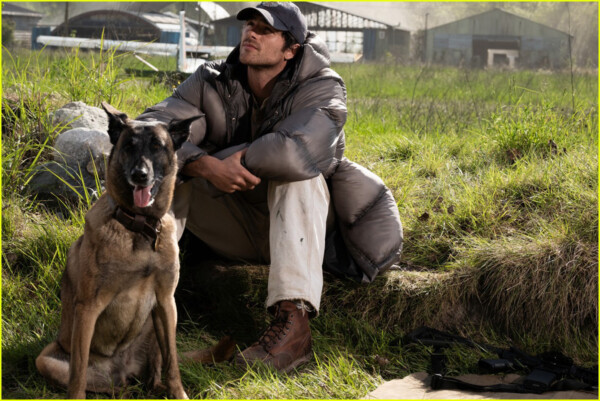
“The Dog Stars” starring Jacob Elordi as the boy next door Hig, Margaret Qualley as the girl next door Cima, Josh Brolin as no‑mercy Bangley, Guy Pearce as goodly hearted gruff Pops, Allison Janney as perfect religionist Darlene, and others. Directed by Ridley Scott. Written by Peter Heller, Mark L. Smith, and Christopher Wilkinson. Score composed by Harry Gregson‑Williams. 1 hour, 58 minutes. Rated R. Theatrical release.
Plot summary: The world has ended. Correction, civilization has ended but the Earth is doing just fine, thank you. A virus has drop-kicked most of humankind between the uprights of the goalpost called Oblivion. Of course, there are survivors. Some are good folk and the rest MAGA. Who prevails? Can either type of Homo sapiens find Shangri La amid the urban, suburban, and rural desolation and bursts of savagery?
Spoilers: Yeah, but, hell, we don’t tell you how the movie ends.
Mladen’s take
Ever watch an anti‑insomnia screen saver playing gently falling rain or wind blowing through tree tops or fish swimming in an aquarium? Well, that’s “The Dog Stars” in a nutshell, mostly.
The film is a mellow take on the end of the world with bits of violence thrown in to add noise. And, this surprises the shit out of me, I could’ve done without the bloodshed. Sure, bullets have to cackle, grenades have to explode, and watchtowers must topple, but it all could’ve happened off-screen or in low light.
What I enjoyed consistently about “The Dog Stars” was the sweeping cinematography, all of it accompanied by a barely noticeable, though hypnotic, score. The panoramic moments when the little Cessna is flying below mountain tops or turning to track a river were soothing. Then, before you know it, some Hellraiser is launching an RPG at one of our heroes or there’s a bunch of horseback‑riding hooligans shooting at the above mentioned Cessna at close range without knocking the Little Airplane That Could out of the sky. Remarkable luck for Cima, Hig, and Pops, no?
As for what you’re about to read, all I can say is this. It’s not my fault. The languorous flow of the story, the loveliness of the land outside cities, forced me to put this to paper. I liked watching the relationship between Cima and Hig unfold. The kids were wounded. The kids adored each other. But the kids never succumbed to lust. Cima was patient with Hig as he tried to shed the past. Hig knew all along that Cima was beyond great. Dang, I’m almost teary eyed.
The best part of the film, by far, however, was the 10 minutes of screentime by Janney as Darlene. I could’ve used a whole lot more of Darlene’s menacing and maniacal presence as a lethal Holy Roller. Man, it was reminiscent of the role played by Marcia Gay Harden as Mrs. Carmody in “The Mist” (2007). Harden should’ve earned the Best Supporting Actress Oscar for that superb bit of acting. Still pissed, I am, that she didn’t. The way Harden escalated the religion‑fired fanaticism in the grocery store was brilliant. The way Janney sprinted from welcoming air traffic controller Darlene to getting set on fire was terrific. Somehow, in the short span that Janney was on the screen, the Grand Junction airport terminal scene went from suspiciously friendly to grotesquely inhumane without faltering into the absurd. Well done and it was all her.
I’m giving “The Dog Stars” an A- because of its narcotic effect on me. It made me feel that the end of civilization won’t be so bad after all. And, thank goodness, the dog died. Take it away, Del.
Del’s take
I didn’t actively hate this movie but I DID actively hate the damn dog.
Talk about annoying. Man, I HATED that damn dog. He was overeager. He was into everything. He was constantly yipping or whining. At one point I thought he was going to fly the fucking airplane. His attitude could have been improved with Adderall but I guess Ridley Scott didn’t think that far into it.
Annoying pooches notwithstanding, what about “The Dog Stars” itself? Well, to be blunt, I never knew the end of the world could be so boring. This movie somnambulates between threatless and dare I say racist action scenes to maudlin periods of introspection and hyperglycemic pastoral myths, all told through a drab, bluish color palette and mumbling dialogue that does little to advance the plot, shed light on the characters or build tension.
Hig (Jacob Elordi) is a former mechanic who survived a world-ending viral pandemic and is hiding out at a remote Colorado airstrip with Bangley (Josh Brolin), a cynical and coldly realistic survivalist who shoots anybody who approaches their redoubt. Hig spends his time delivering supplies to a nearby Mennonite community and visiting his old home in Denver, where he grieves the death of his pregnant wife. The appropriately named Bangley passes his days scanning the treeline for intruders, his trusty high-powered rifle at the ready.
During a flight, Hig hears a radio transmission from a sender in Grand Junction and decides he should investigate. This decision underlines the essential difference between Hig and Bangley: Hig craves community and togetherness. Bangley is content with the isolated safety of their status quo. After an attack by intruders claims the life of his beloved pooch, Jasper (damned irritating dog), Hig’s mind is made up: He’s going to Grand Junction.
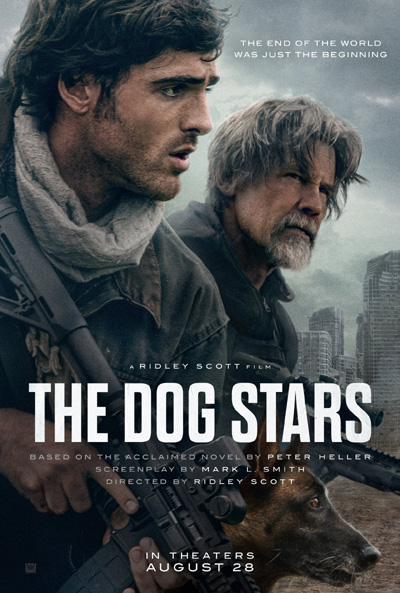
Along the way his plane develops engine trouble and he lands near a ranch, where he meets Cima (Margaret Qualley) and her father, Pops (Guy Pearce). Over time the inevitable romance blooms between Hig and Cima, hobbled by mutual guilt: They’re both reluctant to abandon the memories of their spouses, who died as a result of the virus. But an attack by savages forces their hand and all three flee in Hig’s newly-repaired plane. They fly to Grand Junction, where they encounter a large enclave of people living pretty much as they did before the pandemic. Except they aren’t. I’ll let that part be a surprise.
Mladen correctly points out the cinematography is superb. The sight of Hig’s yellow Cessna sailing between the craggy peaks of the Rocky Mountains is breathtaking. And there’s a pleasing note of nostalgia to one of the movie’s core themes, that maybe we could actually shed the technological impositions of the 21st century – smart phones, artificial intelligence and social media – and return to our simpler, agrarian roots. Who knows? Maybe we’d find happiness there. We sure as hell ain’t finding it here.
But “The Dog Star”’s liabilities outweigh its virtues.
Almost no explanation is given for the existence of the ferals, who bear an uncanny resemblance to similar characters in the Mad Max movies and “The Walking Dead.” And there were moments during one of the attack sequences when I could swear I was watching a scene from a 1950s-vintage cowboy vs. injuns movie. I could even hear war whoops in the background.
The segment involving Grand Junction, a critical plot element, comes and goes with such rapidity that one wonders why it was even included in the story, unless it was to buttress Bangley’s assertion that risking happiness is stupid and will get you killed. That message won’t resonate with modern audiences. It didn’t resonate with me and I’m an old fart! Also, Elordi plays Hig with a kind of fumbling earnestness I assume is meant to be endearing, but honestly, I found it to be suggestive of somebody who’s on the spectrum. Bangley is a stereotype who we know, by movie’s end, will emerge from his chrysalis of cynicism. Won’t any movie director challenge us with a character we haven’t met a thousand times before?
Overall, I thought “The Dog Stars” was an expenditure of pointless energy. I’m not sure what I was supposed to get out of it – that change is bad? Be satisfied with what you have? Never risk happiness? Beats the hell out of me.
Mladen was far too generous in his score. He’d been to a birthday party in the hours before the movie and I think that slice of birthday cake must have screwed up his blood sugar. There is no way in hell “The Dog Stars” is worth an A-. I’d give it a C, and that’s being generous.
Mladen Rudman is a technical writer and former journalist. Del Stone Jr. is a writer and former journalist.

I’m still leaking.
I’ve been leaking since July 31, when they took out my catheter.
That’s OK. It’s only been a month since my radical prostatectomy. My understanding is it could be two to three months at the earliest, or two to three years at the latest, before I regain control of my bladder.
I’m prepared to live with that. My new life is not so bad. I wear adult pull-ups, and I line them with a folded paper towel. I change the paper towel 10 or so times a day. It works for me.
I keep telling myself: I don’t have cancer. That’s my consolation. But that assurance was put to the test recently when I received a lab order for a follow-up PSA test.
If you’re not familiar, PSA stands for prostate-specific antigen. When you have tissue in your prostate that’s cancerous, your body forms antigens to attack that specific tissue. Doctors can measure the level of antigens in your body to determine your cancer risk.
It never occurred to me that my PSA could be anything other than zero after a radical prostatectomy. But apparently it can. If any cancer-producing tissue remains, the body continues to respond with antigens, hence a PSA number that’s higher than zero.
I had my PSA follow-up on Aug. 21. Then, I made the mistake of looking online.
According to the data, I should have waited two to three months after my surgery to have my PSA levels checked. That gives the body time to expel any lingering antigens. I had scheduled my PSA test for just shy of a month after my procedure.
Which meant my number was likely to be higher than zero.
I know. Just get another PSA, right?
Yes, of course. But it was the terror of seeing that number on the results sheet, of having to explain to my doctors I’d jumped the gun on my PSA, of having a new PSA scheduled and sweating out the wait before I got the results. I wanted to be DONE with this thing, once and for all.
Just today, Aug. 25, I was cleaning out my email when I got a notice from the lab. My results were in. A void appeared in my stomach. I could feel it sucking in my body, molecule by molecule. I did not want to log into my account. I did not want to open that file.
I did not want to see that number.
But I made myself do it because not looking wouldn’t change a thing. I didn’t want to live in terror until the next time I met with my urologist.
I logged in. I found the “test results” tab and clicked on it. I found the file containing my PSA test result. I clicked on it. The number I wanted to see was <0.1 – undetectable.
The number was <0.1 – undetectable.
I was so relieved I almost experienced a different kind of incontinence, which is to say I almost shit myself. No sweeter word ever existed at that moment than “undetectable.”
I quickly logged out before the number could change or the computer could say, “Ha, ha, just kidding” or anything that could make me believe my PSA levels were anything less than “undetectable.”
Wow, I can breathe again.
So now, it’s just a matter of doing my exercises, changing out my paper towels and hoping I can make it through a round of weed-pulling or lawn-mowing or park-walking without weeing myself. I can live with that.
Because I’m going to live.
About the author:
Del Stone Jr. is a professional fiction writer. He is known primarily for his work in the contemporary dark fiction field, but has also published science fiction and contemporary fantasy. Stone’s stories, poetry and scripts have appeared in publications such as Amazing Stories, Eldritch Tales, and Bantam-Spectra’s Full Spectrum. His short fiction has been published in The Year’s Best Horror Stories XXII; Alfred Hitchcock’s Mystery Magazine; the Pocket Books anthology More Phobias; the Barnes & Noble anthologies 100 Wicked Little Witch Stories, Horrors! 365 Scary Stories, and 100 Astounding Little Alien Stories; the HWA anthology Psychos; and other short fiction venues, like Blood Muse, Live Without a Net, Zombiesque and Sex Macabre. Stone’s comic book debut was in the Clive Barker series of books, Hellraiser, published by Marvel/Epic and reprinted in The Best of Hellraiser anthology. He has also published stories in Penthouse Comix, and worked with artist Dave Dorman on many projects, including the illustrated novella “Roadkill,” a short story for the Andrew Vachss anthology Underground from Dark Horse, an ashcan titled “December” for Hero Illustrated, and several of Dorman’s Wasted Lands novellas and comics, such as Rail from Image and “The Uninvited.” Stone’s novel, Dead Heat, won the 1996 International Horror Guild’s award for best first novel and was a runner-up for the Bram Stoker Award. Stone has also been a finalist for the IHG award for short fiction, the British Fantasy Award for best novella, and a semifinalist for the Nebula and Writers of the Future awards. His stories have appeared in anthologies that have won the Bram Stoker Award and the World Fantasy Award. Two of his works were optioned for film, the novella “Black Tide” and short story “Crisis Line.”
Stone recently retired after a 41-year career in journalism. He won numerous awards for his work, and in 1986 was named Florida’s best columnist in his circulation division by the Florida Society of Newspaper Editors. In 2001 he received an honorable mention from the National Lesbian and Gay Journalists Association for his essay “When Freedom of Speech Ends” and in 2003 he was voted Best of the Best in the category of columnists by Emerald Coast Magazine. He participated in book signings and awareness campaigns, and was a guest on local television and radio programs.
As an addendum, Stone is single, kills tomatoes and morning glories with ruthless efficiency, once tied the stem of a cocktail cherry in a knot with his tongue, and carries a permanent scar on his chest after having been shot with a paintball gun. He’s in his 60s as of this writing but doesn’t look a day over 94.
Contact Del at [email protected]. He is also on Facebook, twitter, Pinterest, tumblr, TikTok, and Instagram. Visit his website at delstonejr.com .
ChatGPT
INTRODUCTION
I’ve made no secret of the fact Stephen King greatly influenced my work, but there was another writer who played an equally important role in my evolution as a writer:
Dennis Etchison.
In the mid-’80s my friend and coworker Jim Shoffner gave me a copy of Etchison’s collection “The Dark Country” and I was instantly blown away. I loved Etchison’s practical writing style and the “modernity” of his stories (I don’t know if that’s a real word, but if not, it should be). Etchison didn’t write about vampires, werewolves and reanimated corpses. He wrote about ordinary people doing extraordinarily nasty things to other people – the kinds of monsters you and I might run into during our daily walk through life.
“The Dark Country’s” lead-off story, “It Only Comes Out at Night,” reduced my brain to fried jelly.
I was sitting in my parents’ living room. It was very late, going on midnight. The house was dark and I was already listening with half an ear to the odd pops and groans all old houses make when they are shrugging off the day’s heat and settling in for the night. I read “It Only Comes Out at Night” and when I finished, I could feel the hair on the back of my neck standing on end. I had to put down the book and breathe for a moment. I remember thinking I had just been dragged across a threshold of storytelling I hadn’t known existed. “It Only Comes Out at Night” was breathtaking in its … well … its strangeness. It conveyed its horror by saying less, not more. I would call it one of the finest short stories ever written, up there with Shirley Jackson’s “The Witch” and Stephen King’s “The Woman in the Room.”
That’s when I became a lifelong Etchison fan.
The story you’re about to read, “Mister Dark” is my attempt to write a story Etchison would have liked. Later, it came to pass Etchison did like it, though not enough to publish it.
The story came to me after my first trip to Etchison’s stomping grounds in Los Angeles. The year was 1986 and I was working for a newspaper as the design editor. My boss at the time decided to jump-start a redesign project I was working on by sending me to the Orange County Register for a week, where I would tap the creative genius of design guru Nannette Bisher. I flew out on a Sunday so I could be there first thing Monday morning.
For most folks such a venture would amount to nothing more than a work trip, but for me it was a huge, scary undertaking. I had never traveled for the job, I was terrified of flying, and the thought of driving in Los Angeles scared the shit out of me.
I landed at LAX late that afternoon and somehow found the rental car kiosk and got my car, a bland Oldsmobile or Buick, I don’t remember which. LAX was a labyrinth and I couldn’t figure out how to get out of there and onto the freeway. Somehow I managed, but after half an hour’s driving at 80 mph on a 12-lane superhighway I realized I was heading in the wrong direction. I pulled off and stopped at a gas station, where I asked a surly Latino man for directions. He gave me an angry look and pointed to the front of the building, where I spotted a map vending machine. I paid $2 for a map of LA, got back in the car, locked the doors, and tried to figure out where I was and where I needed to go.
I did that, finally, then got back on the freeway and headed in the correct direction, arriving an hour later at my destination, The Saddleback Inn in Santa Ana. As I was getting out of the car, a woman parked next to me, threw open her door and struck my car with such force it rocked on its suspension. She acted as if nothing had happened. I knew, then, that I was a stranger in a strange land, at least one with different values about car care.
My room was dark and depressing. The door frame showed signs of having been broken down. You couldn’t walk anywhere – you had to drive, even if it was across the street. Helicopters and jetliners flew overhead constantly. At night, searchlights from police choppers filled the sky. And everywhere there was a constant din of noise – cars, cars and more cars. The traffic never stopped, on the ground or above.
I couldn’t wait to get out of there. Come Saturday morning I was glad to get back on the plane.
My overall impression of LA is that it was so big, and so indifferent to the plight of its residents, that anybody who lived there was choosing to subordinate themselves to the vast, hungry and all-devouring machine that was Los Angeles. And that, to me, represented a kind of evil – the casual evil of indifference. The kind of evil that becomes so commonplace that some people can no longer distinguish it from good.
I submitted “Mister Dark” to Etchison for an anthology he was editing. He kept it for a long time but eventually returned it, saying he had almost bought it but in the end decided to pass. I forget the reason. For me, it was a thrill to have him say something nice about my story. And to get his autograph.
Sadly, Dennis Etchison passed away in 2019. He was one of the great writers of American horror.
If you get a chance, read “It Only Comes Out at Night.” If it doesn’t scare the bejesus out of you, check your pulse.
You may not have one.
—
MISTER DARK
Swells of darkness rolled in like the tide as Faye shivered in the rental car. It was a warm night. She angled the folded newspaper into a dim bar of fluorescent light that slanted through the window, while the crazy lady by the dumpster raved and raved and raved.
A billboard across the road, opposite the parking lot, declared: The Staples Center – A Happening Place.
A half-eaten cherry turnover, wrapped in torn cellophane that was dotted with drops of condensation, lay congealing on the dashboard. A Diet Coke cup filled with sweating ice lay on the floorboards. The ice melted and settled with a hollow, rattling sound that scared a twitch out of Faye.
She jerked her head up. She looked out the dusty windshield. A group of teen-aged boys squeezed through the convenience store door. One burst into barking laughter in response to a whispered comment, and dropped his Slurpee. Slush sprayed out over the grease-smeared parking lot.
“Oh, shit,” he said disgustedly. “Look what you made me do.”
“Just go get another one and quit your bitching,” the whisperer said. “We’ll wait.” While the boy went back inside, the others clambered into a brown Mercedes that looked green in the stark light. The crazy lady by the dumpster cawed hoarsely. She had a dented cardboard box in a shopping cart. She was carrying a golf club, which she used alternately to prop herself up and attack the box. “Prince of earwigs!” she shrieked and aimed a wobbling broadside at the box. The boys in the Mercedes laughed.
God. I hate this place. I already hate it. Faye squeezed her eyes shut and forced herself to breath deeply. The city throbbed around her, so much unlike the place she had come from. She wished the sun would rise. She glanced at her watch. It read only 10:43, and worse, that was central time. She couldn’t bring herself to set it back. She sighed. I made a big mistake coming here. The dark pressed closer, barely kept at bay by the light from the convenience store. She decided if the crazy woman came near her, she’d drive away. Back into that Christ-awful traffic on the Santa Ana Freeway, which was an entirely different but no less terrifying form of insanity. She would have to leave soon anyway. She’d stopped only to get a newspaper, but had ended up buying the turnover and Diet Coke with the hope that something to eat and drink would make her feel better. They hadn’t. And now she would have to leave, because the motel had a 10 p.m. check-in time – Pacific time. It was 10 miles down the freeway, if she could trust the map she’d gotten. That might as well be 10 million miles.
“Crawling like an earwig!” the crazy lady snarled, “but where will you crawl now, Mister Dark? No closets to slither from! No beds to make your damned coffin! You’re here with me, and I’m not going to let you out!” She thumped the box with the club and broke into harsh, gargling laughter.
“No. Don’t,” Faye heard one of the boys in the Mercedes whisper. “Just leave the old bitch alone for God’s sake.”
Faye let her gaze drop to the newspaper. A copy of the Orange County Register. A headline on the local front page read: Man convicted of wife’s murder. “A Tustin man was found guilty Thursday in a bizarre murder case in which he allegedly strangled his wife, beheaded the corpse and left the head in a local movie theater aisle. …” Faye felt the little bit of turnover she’d eaten slide queasily into some deeper recess of her stomach. She’d bought the newspaper to check the apartments-for-rent listings in the classifieds, but something on the front page had caught her eye – 12-year-old among eight arrested in gang shooting – and then she’d gone through the other pages. The stories reminded her that she’d left her home in Northwest Florida for this teaching position because it offered an opportunity, a real step forward in terms of pay. But now that she was here, she felt as if she’d bargained away some essential part of herself, and she wondered which master she served, the voice of her own peace of mind, or some other compelling influence that demanded she do what was expected of anyone in her position.
“Oh, Jesus! I don’t believe you,” one of the boys in the Mercedes sniggered as another boy opened the passenger door and climbed out. The crazy lady was whacking the box and babbling. “Never again! Never again, Mister Dark!” Faye shivered.
The day had gone badly. Her flight was late getting out of Memphis. She hated flying and was hoping they’d put her on a jumbo jet, something big to smooth out those terrifying bumps and sudden dips that caused her heart to lodge in her throat. But the plane was a three-engine model, a 727 or something, that bounced across the sky like a cork in white water. The flight became worse as the plane carried her closer and closer to Los Angeles. Somewhere over New Mexico the oven broke. No lunch – not that she could have eaten anything. The steward offered her an exchange, and she took the trade in vodka collins.
A dry, hot gust of wind swept across the parking lot, stirring clouds of dust. The empty Slurpee cup rattled across the asphalt in imprecise semicircles. A BMW pulled up to the gas pumps in the middle of the lot. The boy from the Mercedes was approaching the crazy lady. She was cackling, “Never again, Mister Dark! You’ll never scare anyone again!”
The boy said slyly, “What’cha got in the box, lady?”
Faye flipped the newspaper over and scanned the headlines. A sewer board was meeting. Then: Teen charged in rape of teacher. She was seized by an involuntary shudder, and the car seemed to grow uncomfortably cold. Darkness pooled in the floorboards and filled the back seat. The rape had taken place at a school across town, far from where she would be teaching, but somehow that failed to comfort her. The feeling of dread that had stayed with her throughout the day reasserted itself, worse now than when she arrived at the airport.
LAX had been an incomprehensible maze of corridors and walkways and faceless people who rushed about as if they knew exactly where they were going. By some miracle of providence she recovered her luggage and found the rental car booth, which apparently had closed.
“Where is everybody,” Faye asked the girl at the adjacent Hertz kiosk.
“They’re gone,” the girl answered in a rigor-mortic monotone.
Faye felt as if she were back on the airplane and it had just flown into an air pocket, dropping a thousand feet. “But I had reservations for a car.”
“I can rent you a car.”
So she’d taken the Hertz car, an Alero. A minivan carried her at breakneck speed through the LAX warrens and out to the lot. She got her papers squared away and climbed into the car. An Oriental woman was getting into the car next to hers. The woman’s door flew open and struck Faye’s car with enough force to rock it on its springs. The woman never looked at her.
“C’mon. Tell me what you got in the box,” the boy was saying. Faye looked up. The crazy lady’s gaze darted into and then away from the boy’s eyes, as if she feared being mesmerized by him. He shrugged, started to turn and walk away, when she shrieked, “I got Mister Dark in there! Yes sir! That’s what I got!”
The boys in the Mercedes chortled. The boy in the store finally came out, but he wasn’t carrying a Slurpee. He had a six-pack of Budweiser. The boy near the crazy lady looked back at his friends, rolled his eyes, then said, “Who’s Mister Dark?”
“The prince of earwigs!” the crazy lady blurted, then clutched her chest in a spasm of wracking coughs.
“Earwigs, huh?” the kid commented. The crazy lady spat and nodded vigorously. “In there. In the box.”
“C’mon! Let’s roll!” the boy behind the wheel of the Mercedes shouted. “We got beer!”
Faye watched the string of headlights hurtling down the freeway. She’d taken the San Diego Freeway south, through Signal Hill and past Los Alamitos, and then she had cut east through Garden Grove to the Santa Ana Freeway, where she was supposed to turn south again. Right. Just bear to the right. Half an hour later, with the traffic growing heavier and carrying her along faster and faster, she discovered she was driving north, back into Los Angeles.
So she veered into an exit and stopped at the first gas station she came to, a dark, dirty place that was staffed by a lone Hispanic man.
“Do you have any maps?” she asked him, and he gave her a look of pure malevolence, an expression that chilled her blood to slush, and hooked a thumb at the office.
A map vending machine. She paid $2 for an LA map, hurried back to the Alero and locked the doors. The man watched her from the gas pumps. His face was hidden in shadow, as was the surrounding city as the sun slipped below a bank of clouds and smoke. She tried to study the map, and eventually guessed which way she had to go. As she drove away, she saw the man’s hobgoblin silhouette at the pumps, his head turning to follow her as she crossed the street and fled back into the torrent of cars.
“ – how’d you get … Mister Dark,” the boy snickered, “locked up inside a cardboard box?”
“I charmed the bastard in there,” the crazy woman hissed. “You got to use a charm to catch Mister Dark! The best kind of a charm! Mister Dark likes to hide in closets and under beds. You know why?” she whispered.
“Surprise me,” the boy said.
“So he can scare you!” she screamed.
The boy took an uncertain step back. His friends laughed loud and hard. The boy said, “Well, maybe when I was 2 years old.”
Faye shook her head. She really needed to be going. The motel was 10 miles south of here, and tomorrow she faced a long day of apartment hunting, and work started next Monday. She tried to make herself put down the newspaper and clean up her mess and leave, but she felt drugged and cold and exhausted, as if her brief time in Los Angeles had drained her of vitality. The boy and the crazy lady and the boys in the Mercedes were arguing in a raucous babble. The BMW roared away from the gas pumps, its radio braying punk rock music. Nobody had ever gotten out. The Slurpee cup skittered across the asphalt into a lake of shadow trying to flood inside the building.
“I wanna see what’s inside,” the boy shouted.
“No! You’ll let him out!”
Faye leaned back against the headrest. This was a mistake. A helicopter clattered overhead, its searchlight spearing the ground like a UFO from a Steven Spielberg movie. She wondered who, or what, it was looking for.
“You smack me with that and I’ll bust your goddamned head open, you stupid bitch,” the boy threatened. The crazy lady raised the club to do just that and the boy lunged and snatched it from her grasp. He pitched it aside. It thonked against the dumpster.
The crazy lady threw her arms protectively over the box and cried, “No! No! You’ll let him out! The prince of earwigs! Mister Dark!”
“C’mon, Andy,” a boy yelled from the Mercedes.
I want to go home. Ice melted in the cup lying on the floorboards. It rattled like bones in a cigar box.
The boy wrenched the box from under the crazy lady. The shopping cart tipped over, dumping the box onto the parking lot. The flaps flew open, and shadows seemed to spill out – shadows, and something else.
A gust of wind blew through the car window, catching the newspaper like a sail, turning the pages. Faye looked down and read: 2nd toddler found bludgeoned to death. Across the street, a man stood in the shadows. She hadn’t seen him there before. A hitchhiker. He was holding a sign, and she could barely read it. It said: Anywhere.
The boy began to laugh. “You crazy old bitch.”
“No!” the crazy lady moaned. “You’ve let him out! You’ve set him loose! He’s in the city! He’s everywhere! Can’t you see him? He’s everywhere – “
Faye looked up at the dashboard. Something was leaking from the turnover, something dark and viscous that smelled vaguely of chemicals. It left a slimy trail down the dashboard, around the air-conditioning vent, and to the carpet. Her gaze traveled from the carpet, to the windshield, her depth of focus centering on the hitchhiker. He seemed to be staring at her, the way everybody in L.A. had stared at her since she’d arrived: a thoughtless look that somehow seemed filled with malevolent intent.
The boy nudged whatever had fallen out of the box with the toe of his shoe. A doll-like hand flipped over. His expression congealed into bafflement, then intense scrutiny, and he yelled, “Oooh, gross! You guys! C’mere!” The crazy lady staggered off into the shadows, her voice fluttering bat-like out of the gloom, “I can see him! I can see him!”
The newspaper slid from Faye’s grasp and the pages rustled as they settled to the floorboards. A breaker of dark reared before her, and it seemed composed of millions of faces, uniform and anonymous in their multitudes, and they were lost for something that no drug, no secret kiss, no act of violence could give them. Anonymity. A car on the freeway. A girl at an airport kiosk. A man at a gas station. A hitchhiker. A crazy lady.
A woman sitting in a rental car outside a convenience store.
Faye stared in nerveless fascination at the lights above the gas pumps, and no insects circled there. Only dust blew through the cones of harsh brilliance, borne on a hot, dry wind, and overhead there were no stars in the sky, only helicopters and incoming jets, and she could hear nothing but the distant thunder of traffic, the city’s asthmatic respiration all around her, the shadows circling and closing, a faceless, bleak tide that lapped at the edges of her thoughts.
Mister Dark.
The hitchhiker was crossing the street, coming toward her. She tried to start the car, but the solenoid clicked uselessly. The boys had gathered in a reverential circle around whatever lay on the asphalt.
The hitchhiker was tapping on the driver’s side window, saying, “Lady? Lady, can I catch a lift?” Her blood had turned to frost. She fumbled for the electric door lock but he had the door open. The dome light didn’t come on. He climbed in and she felt herself sliding across the seat, furtively reaching for the door handle on the passenger side. The locks ratcheted into place.
He said, “You’re not from here. Let me drive; I know my way around this place. I can get you where you want to go. I’m sure it’s on my way.”
In her mind’s eye, Faye saw newspaper headlines about murders and gang shootings and rapes. The muscles around her throat were like pythons. She wanted to cry, but nothing would come out. She pictured herself riding onto the freeway with this man and never leaving, driving without end.
“Well? Where to?” he asked. He’d tossed his sign on the floorboards. Faye saw it from the corner of her eye. She’d been wrong. It read: Everywhere.
The hitchhiker shrugged and started the car. The engine turned over on the first try. He shifted it into gear and eased out of the parking lot.
And then the dark folded over them.
—
About the author:
Del Stone Jr. is a professional fiction writer. He is known primarily for his work in the contemporary dark fiction field, but has also published science fiction and contemporary fantasy. Stone’s stories, poetry and scripts have appeared in publications such as Amazing Stories, Eldritch Tales, and Bantam-Spectra’s Full Spectrum. His short fiction has been published in The Year’s Best Horror Stories XXII; Alfred Hitchcock’s Mystery Magazine; the Pocket Books anthology More Phobias; the Barnes & Noble anthologies 100 Wicked Little Witch Stories, Horrors! 365 Scary Stories, and 100 Astounding Little Alien Stories; the HWA anthology Psychos; and other short fiction venues, like Blood Muse, Live Without a Net, Zombiesque and Sex Macabre. Stone’s comic book debut was in the Clive Barker series of books, Hellraiser, published by Marvel/Epic and reprinted in The Best of Hellraiser anthology. He has also published stories in Penthouse Comix, and worked with artist Dave Dorman on many projects, including the illustrated novella “Roadkill,” a short story for the Andrew Vachss anthology Underground from Dark Horse, an ashcan titled “December” for Hero Illustrated, and several of Dorman’s Wasted Lands novellas and comics, such as Rail from Image and “The Uninvited.” Stone’s novel, Dead Heat, won the 1996 International Horror Guild’s award for best first novel and was a runner-up for the Bram Stoker Award. Stone has also been a finalist for the IHG award for short fiction, the British Fantasy Award for best novella, and a semifinalist for the Nebula and Writers of the Future awards. His stories have appeared in anthologies that have won the Bram Stoker Award and the World Fantasy Award. Two of his works were optioned for film, the novella “Black Tide” and short story “Crisis Line.”
Stone recently retired after a 41-year career in journalism. He won numerous awards for his work, and in 1986 was named Florida’s best columnist in his circulation division by the Florida Society of Newspaper Editors. In 2001 he received an honorable mention from the National Lesbian and Gay Journalists Association for his essay “When Freedom of Speech Ends” and in 2003 he was voted Best of the Best in the category of columnists by Emerald Coast Magazine. He participated in book signings and awareness campaigns, and was a guest on local television and radio programs.
As an addendum, Stone is single, kills tomatoes and morning glories with ruthless efficiency, once tied the stem of a cocktail cherry in a knot with his tongue, and carries a permanent scar on his chest after having been shot with a paintball gun. He’s in his 60s as of this writing but doesn’t look a day over 94.
Contact Del at [email protected]. He is also on Facebook, twitter, Pinterest, tumblr, TikTok, and Instagram. Visit his website at delstonejr.com .
Lionsgate
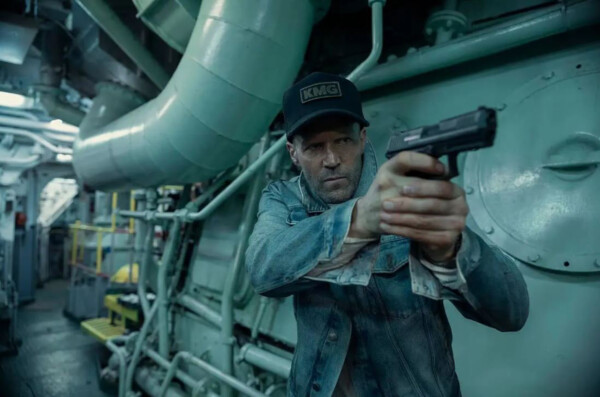
“Mutiny” Starring Jason Statham as Cole Reed, Annabelle Wallis as Angie Ellis, Chaneil Kular as Kameron Campallo, Ramon Tikaram as Tibu Campallo, and others. Directed by Jean-Francois Richet. Written by Lindsay Michel and J.P. Davis. 1 hour, 35 minutes. Rated R. Theatrical release.
Plot summary: Cole Reed is framed for the murder of his boss, but he didn’t do it. He follows the real killers to a container ship owned by his late boss’s company and sneaks aboard as it sets sail from Bangkok, only to discover the ship is being used in a human trafficking operation. Reed must free the victims and clear his name, all in about an hour and a half.
Spoilers: Are there ever NOT spoilers?
Del’s take
“Mutiny” is “Die Hard” on a container ship – not that there’s anything wrong with “Die Hard” on a container ship. But one wonders where the line is drawn between homage and rip-off, because it sure looks like a lot more was borrowed from “Die Hard” than just the concept.
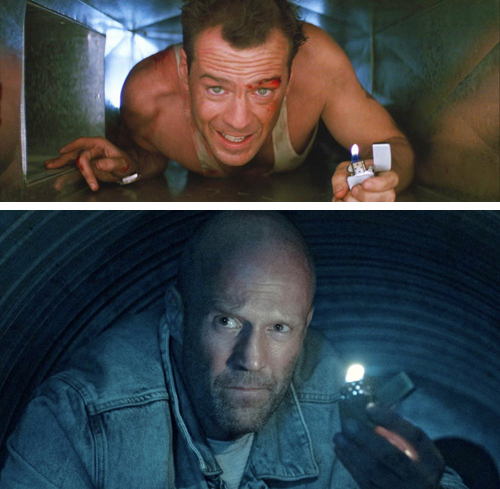
Both movies take place in an isolated setting – in “Die Hard” it was Nakatomi Plaza on the night before Christmas; in “Mutiny” it’s the plodding container ship Artemis. Both leads are tough law-enforcement types who take on an army of bad guys. Both are, for the benefit of you claustrophobes, required to crawl through extremely dark, extremely tight places, like air ducts, ventilator shafts, or various pipe-like structures, while being shot at. There’s even a scene in “Mutiny” where Jason Statham, slithering through an air duct, fires up a Zippo to shed some light on his predicament, just like Bruce Willis in “Die Hard.”
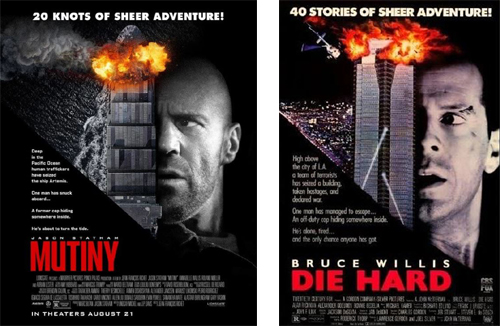
But nowhere are the similarities more obvious – that would be flagrant – than in the movie posters. “Mutiny” is identical to “Die Hard,” and I say this as a guy who was once paid to design publications. The visual elements are the same. The typography is similar in size and positioned the same. The color palette is the same. Even the taglines – “40 stories of sheer adventure!” vs. “20 knots of sheer adventure!” are the same. What’s missing from “Mutiny” is a “Yipee-Ki-Yay, motherfucker,” catch phrase, but then it wouldn’t sound the same coming out of Jason Statham’s mouth.
And that’s the big difference between “Mutiny” and “Die Hard.” While Bruce Willis was a hapless and relatable everyman who just happened to be good at taking out bad guys, Jason Statham is a humorless berserker who grinds up everything in his path. But even that isn’t a fatal flaw because people do not watch a Jason Statham movie for the laughs. They watch a Jason Statham movie for the Three B’s – Bullets, Blood, and Body Count – and “Mutiny” provides all three in very generous helpings.
Statham plays the part of Cole Reed, a bodyguard for shipping magnate Ramon Tikaram (Tibu Campallo), who has put up his company for sale. But Tikaram is killed in an ambush and the local police, who have been compromised by Tikaram’s killers, blame Reed for the murder. Reed tracks the killers to one of the company’s container ships, the Artemis, which is about to depart the port of Bangkok. He sneaks aboard and discovers it’s being used to transport human trafficking victims. Without much preamble, Reed becomes a one-man wrecking crew as he tries to free the trafficking victims and gain vengeance for his beloved boss, who is a kind of surrogate father to him.
“Mutiny” is rife with subplots and motivations. Reed’s father was a cop who got himself killed trying to rescue Reed from a dangerous situation. Plagued by guilt, Reed now seeks to avenge the death of Tikaram. Meanwhile, the ship’s third officer, Angie Ellis (Annabelle Wallis), a last-minute replacement for a sick co-worker, is trying to get home to her daughter in Los Angeles when she also discovers the human trafficking scheme. She and Reed become partners of circumstance in their battle against the crew. Then come questions about Tikaram’s son, Kameron, who may or may not be cooperating with the traffickers, and there’s also a band of Danish thugs who meet the Artemis on the high seas to take possession of their human cargo, presumably before the arrival of a U.S. Navy ship which received a distress call from Ellis before she was captured by the bad guys.
It sounds complicated but “Mutiny” is a stripped-down, high-tension iteration of the usual Statham fare, with lots of clever kills, including an almost hilarious exchange of knives between Reed and the movie’s primary antagonist, the Artemis’ creepy captain, Marko Madsen (Roland Møller). Semi-autos, machine guns, fire axes, spear guns and even a meat hook come into play, reminiscent of a John Wick slaughterfest.
Problems include the plot’s dependency on at least one too-good-to-be-true coincidence; some cheesy motivational elements; and the aforementioned borrowing of plot, scene and design elements from “Die Hard.” Much of this you’ve seen before – if not in a Statham movie then in a Willis movie, a Schwarzenegger movie or a Stallone movie. But none of that really matters because at a lean hour and 35 minutes, the story cranks along briskly and it’s over before you know it.
I’m giving “Mutiny” a B. I like the fact it was a lean, mean killing machine. I did not like the fact it borrowed so much from “Die Hard.” But in the end, how can I complain? A 95-minute respite from this broiling summer heat, and some-over-the-top mayhem, is just what the doctor ordered.
Yipee ki yay and anchors away, motherfucker.
Mladen’s take
Del must’ve slipped cocaine into his mid‑afternoon dose of Geritol before we saw “Mutiny.” Two hours, maybe two‑and‑a‑half, certainly no more than three, after the movie he texts to tell me to look at my email. The old timer had already written his take of this decent lil ole film of contained violence. A record. That’s a record for sure. Well done, Del.
I start by disagreeing with Del on the grade for this movie but it’s not much of a disagreement. B+. “Mutiny” is a B+ because, well, the violence in this movie is believable. Compared to the Wicks, and the two Sisu movies, the two Nobody misadventures, the Extractions or, for that matter, older films such as “Wanted” (2008), “Mutiny” is somewhat subdued.
All we have here is a bit of gun and blade play, though, I must concede, the use of the unlocked padlock to maim an opponent was fabulous. Oh, mustn’t forgot the harpoon gun.
It must be noted that Del and I use different scales for measuring movie violence. Del asserts that there’s plenty of the Three B’s in “Mutiny.” No, there’s not. There’s just enough to carry the movie forward. None of it overstays its welcome.
“Mutiny” features plenty of hide‑n‑seek as the Good Guy and Good Gal walk, run, crawl, and climb to avoid the Bad Guys. There’s some cool cinematography, dark spaces and tight spaces and machinery spaces. The cat‑and‑mouse schtick and the look and feel of life aboard an ocean‑going container ship felt authentic. The film is less blood fest and a bit more like something trying to tell a story.
Also, human endurance in “Mutiny” isn’t pushed too far past the realistic. No single round of hand‑to‑hand is prolonged, leaving the room to move to the next burst of chaos without me thinking something like this: “Only the perfect 6‑foot‑3, 230-pound Donald J. Trump, a known titan of combat and not a five-time draft dodger who wears diapers, could fight for so long.” By the way, if you want to see a thriller that seems to portray the frailty of humans in a face‑to‑face, life‑or‑death fight, give 2017’s “Atomic Blonde” a see.
The “Mutiny” plot pushes through as swiftly as Statham/Cool brings a submachinegun to bear. That the events letting that happen are much less realistic than the gun and knife and cargo‑grab hook violence is easy for me to overlook. Whatever it takes to get to the next battle is fine by me.
Finally, I liked Wallis/Angie. She was naïve at first (which bugged the hell out of me) but came around right quick. By the end of the film, she was thinking fast and had killed. Atta girl.
I don’t know, maybe I’m being too easy on “Mutiny.” I like Statham. He’s cool. From “The Transporter” (2002) to “Crank” (2006) to last year’s “Working Man” and with the couple of sci‑fi‑ish Megs thrown in, Statham leaves me with the impression that he’s doing exactly what he wants to do and enjoying it.
Mladen Rudman is a former journalist and technical writer. Del Stone Jr. is a former journalist and writer.
I don’t have any real expectation of ever being published again.
I don’t know if it’s because my writing is that bad or if it’s the woeful state of reading, writing and publishing in this country today. I continue to submit my work, but I can’t get a publisher to even email me a rejection.
I do know many of the publications I used to sell to have disappeared. The entire magazine industry appears to be failing. Mass market paperbacks are vanishing. A recent survey showed only 16 percent of Americans read a book for pleasure in 2023.
Saddest of all, I saw a video of a middle school teacher practically crying about the illiteracy of her students. Not only were they illiterate, but they didn’t care that they were illiterate, she said.
The solution, of course, would be to ban smart phones and unplug the internet, but that’s about as likely to happen as me selling my most recent novel.
About the author:
Del Stone Jr. is a professional fiction writer. He is known primarily for his work in the contemporary dark fiction field, but has also published science fiction and contemporary fantasy. Stone’s stories, poetry and scripts have appeared in publications such as Amazing Stories, Eldritch Tales, and Bantam-Spectra’s Full Spectrum. His short fiction has been published in The Year’s Best Horror Stories XXII; Alfred Hitchcock’s Mystery Magazine; the Pocket Books anthology More Phobias; the Barnes & Noble anthologies 100 Wicked Little Witch Stories, Horrors! 365 Scary Stories, and 100 Astounding Little Alien Stories; the HWA anthology Psychos; and other short fiction venues, like Blood Muse, Live Without a Net, Zombiesque and Sex Macabre. Stone’s comic book debut was in the Clive Barker series of books, Hellraiser, published by Marvel/Epic and reprinted in The Best of Hellraiser anthology. He has also published stories in Penthouse Comix, and worked with artist Dave Dorman on many projects, including the illustrated novella “Roadkill,” a short story for the Andrew Vachss anthology Underground from Dark Horse, an ashcan titled “December” for Hero Illustrated, and several of Dorman’s Wasted Lands novellas and comics, such as Rail from Image and “The Uninvited.” Stone’s novel, Dead Heat, won the 1996 International Horror Guild’s award for best first novel and was a runner-up for the Bram Stoker Award. Stone has also been a finalist for the IHG award for short fiction, the British Fantasy Award for best novella, and a semifinalist for the Nebula and Writers of the Future awards. His stories have appeared in anthologies that have won the Bram Stoker Award and the World Fantasy Award. Two of his works were optioned for film, the novella “Black Tide” and short story “Crisis Line.”
Stone recently retired after a 41-year career in journalism. He won numerous awards for his work, and in 1986 was named Florida’s best columnist in his circulation division by the Florida Society of Newspaper Editors. In 2001 he received an honorable mention from the National Lesbian and Gay Journalists Association for his essay “When Freedom of Speech Ends” and in 2003 he was voted Best of the Best in the category of columnists by Emerald Coast Magazine. He participated in book signings and awareness campaigns, and was a guest on local television and radio programs.
As an addendum, Stone is single, kills tomatoes and morning glories with ruthless efficiency, once tied the stem of a cocktail cherry in a knot with his tongue, and carries a permanent scar on his chest after having been shot with a paintball gun. He’s in his 60s as of this writing but doesn’t look a day over 94.
Contact Del at [email protected]. He is also on Facebook, twitter, Pinterest, tumblr, TikTok, and Instagram. Visit his website at delstonejr.com .
Warner Bros.
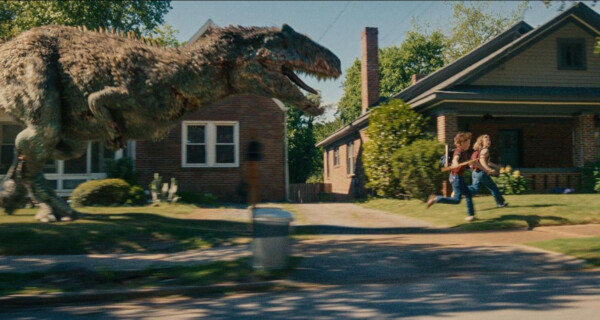
“The End of Oak Street” starring Anne Hathaway as disgruntled mom Denise Platt, Ewan McGregor as Pollyanna dad Greg Platt, Maisy Stella as mildly interesting daughter Audrey Platt, and Christian Convery as sissy son Brian Platt, and others. Directed by David Robert Mitchell. Score Composer Michael Giacchino. Script writer the same guy as who directed. One hour, 39 minutes. Rated PG-13. Theatrical release.
Plot summary: A time warp blasts a 2-mile diameter of early-1980s suburbia to the Mesozoic era. That’s between 66 and 201.4 million years ago. Feathery dinosaurs, crocodiles, and an amphibian‑like, snake‑y, maggot‑esque beast haunt and hunt each other and people as the Platt family struggles to stay alive while quibbling with each other at regular intervals. There’s a happy ending.
Spoilers: How else are we going to orient you to the movie so that you understand our review? Huh?
Mladen’s take
Not even Anne Hathaway, who I adore only 0.027 percent less than Mary Elizabeth Winstead, could save “The End of Oak Street.” The poor script writing, hollow family dynamics, and bland depictions of dinosaurs wrecked the movie for me. Also, why did the dog have to live?
“The End of Oak Street” had potential. The potential never turned into anything kinetic.
The director is known for directing a gem of a movie called “It Follows” (2014). I write this with a caveat. I have not seen “It Follows” but Del told me it was a good movie. Yeah, I know.
Hathaway is an Oscar recipient, best supporting actress for “Les Misérables.” She earned a best actress nomination for “Rachel Getting Married.” Most recently, she did good in “The Devil Wears Prada 2.”
Obi-Wan … ah, Gregor has an outstanding lead actor Emmy and a Golden Globe for best actor.
JJ Abrams (“Cloverfield,” Star Trek, Star Wars, etc.) is among the film’s producers and Michael Giacchino wrote the score.
So, why is “The End of Oak Street” so uninspired and uninspiring?
More than anything, the film made the time warp, and the critters that it dropped into Middle America, a thing of complete horror. No. No. No. The movie should’ve moderated the horror of dinosaurs eating people with the mind‑boggling wonder of theropods and sauropods living among us. That – the danger and risks of mankind facing undeniably stunning and clever dinosaurs – is what makes “Jurassic Park” such a top-notch film to this day. Instead, we get to see two diplodocuses, or whatever, copulating with the roof of a house as their perch. Come on.
“The End of Oak Street” has a fallible micro‑focus. Trying to blend the story of a family falling part while the family is trying to avoid becoming dinosaur kibble didn’t work. Want family drama that fits well inside a monster story? Give “Evil Dead Burn” (2026) a seeing. Or, try 2023’s “Godzilla Minus One.”
“The End of Oak Street” relies on one very stupid choice to carry the story. The stupid choice is made by, of course, the male Platt teenager. Sure, chasing after your dog at night while everything from gangs of pint‑size dinos to a two‑story allosaurus are now your new neighbors is a good idea. And, yes, Lassie comes home just in time to save dumb‑ass Brian later in the movie.
At the end of “The End of Oak Street,” I was nonplussed. The movie had a couple of good scenes, including one that was surprising, if not entirely shocking. All the principal actors played their rolls with sincerity, though at least one of them was unlikeable. The visual effects were mediocre and the soundtrack not a whole lot better. But it’s the script that weakened a good idea for a movie. “The End of Oak Street” squeaks by with a B-.
Del’s take
And I thought I was the one who needed to use the bathroom!
Next time I ask Mladen to see a movie with me I’m going to make sure he has a heapin’ helpin’ of bran flakes for breakfast that morning. What a stuffy take on what was nothing more than a fun summer romp. “The End of Oak Street” isn’t “Anna Karenina,” but it’s not “Melania” either. It’s “Back to the Future” meets “Jurassic Park,” and I’m surprised by how much I liked it.
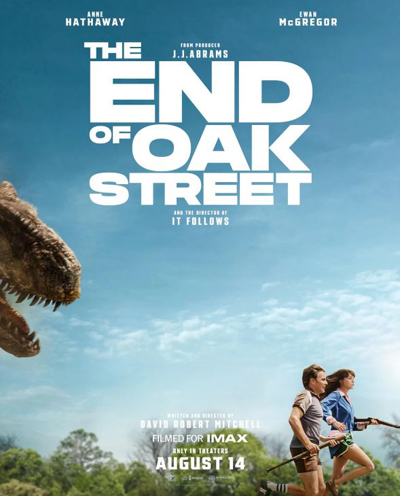
I agree with Old Grouchy Pants that the domestic squabbling between Denise and Greg Platt seemed unreal and downright uncalled for, especially as the neighborhood pets – and the neighbors, for that matter – are being reduced to dinosaur kibble. I also agree the dialogue just doesn’t snap, and the characters – more importantly, their motivations – were hastily sketched, leaving moviegoers grasping for reasons to care about the Platt family.
But the movie redeemed itself with humor and a mostly nostalgic glance at the recent (for me) past. One gripe: The sound track was lame. In a decade fat with truly iconic, classic tunes, the best they could come up with was Pat Benatar’s “Hit Me with Your Best Shot” and Steve Winwood’s “Valerie”? No Thompson Twins? Flock of Seagulls? Madonna? Tears for Fears? Howard Jones? Not even a Name-That-Tune snippet of Billy Idol or John Cougar Mellencamp?
“The End of Oak Street” isn’t a treatise on anything except maybe how important it is that Mom and Dad not argue in front of the kids. It’s a snapshot of a somewhat fractured and dysfunctional family coming together to cope with a surreal threat, and the fun is in watching them meet that meager expectation while unknowingly rediscovering the bond that made them a family to begin with. It has all the thrills and chills of “Jurassic Park” but the wistful sweetness of “Back to the Future.”
I enjoyed it for what it was – an hour and a half of summer escapism. I heard members of the audience talking to the characters on the screen, saying things like, “Look behind you!” or “Don’t do that!” and that’s when I realized “The End of Oak Street” had accomplished its mission – to entertain.
I’m giving it a B+. It has its flaws, but overall it’s a very entertaining movie. Apart from one shocking scene it should be great for the kids.
Oh, and Mladen … “It Follows” is a masterpiece of modern horror, so no arguments from you, Mr. I-Haven’t-Seen-It Guy.
Image courtesy of Pexels user Portrenk. https://www.pexels.com/@portrenk/
INTRODUCTION
According to my-not-very good publication notes, I wrote “Nightwalk” in 1983. I wonder if that’s true.
My recordkeeping back then was spotty. I never thought it necessary to keep track of production dates or publication credits.
Now, as you might expect, I’m scrambling to backtrack and figure it all out. If I could return to my youth, among the many things I would do differently – among them getting a job in my teens, or taking steps in high school to prepare for college – would be to keep track of the dates I wrote stories and make a list of where (or if) they were published, and when.
I remember sitting on bleachers at the local tennis courts, shaded by oaks, planning the details of “Nightwalk.” I remember the scene – the two boys walking along the road in the dark, and the menacing shape stalking them. I remember thinking a really good writer could make this look scary.
A friend and I had spent the day in Pensacola, about 45 miles away, shopping, eating and going to movies. On the way home I began telling him the details of “Nightwalk.” When I got to the part where the boy trips over the surveyor’s wire, Steve said, “Ah, don’t do that. They always do that in horror movies – trip over something so the monster can catch up.”
Silly Steve. He didn’t understand the monster was going to catch them, tripping or not. Besides, tripping added an interesting moral dilemma – should the other boy stop and help his friend, or leave him as an offering to the monster?
In retrospect Steve was right. They always trip in horror movies. I should have taken that out.
I don’t remember much else about the story – what prompted me to write it, or how long it took to write. Back then I didn’t have the same concept of storytelling I have today.
According to my spotty records “Nightwalk” was published in the magazine After Hours in 1987. I’ll have to dig through my copies to see if I can find it. Unfortunately, they are hidden in a plastic Sterilite box at my storage unit, beneath teetering towers of other Sterilite boxes. One day, when I am rich and have money to burn, I will build a house with lots and lots of bookshelves, and all my back copies – even the copy of my high school newspaper with my letter to the editor complaining about 43-cent-per-gallon gas – will go up on those shelves, including the edition of After Hours featuring the story “Nightwalk.”
Tripping and all.
NIGHTWALK
The screen door banged open and there was the wet slapping sound of Nikes beating frantically against the porch floorboards. Then the boys were leaping – arms pinwheeling – as they cleared the cement-block steps and thudded heavily against the grass which was already damp with the night. They were off, then, drawn pell-mell into the smoky twilight like two madly scrambling shadows; one, tall and lanky; the other shorter, the motions of his body more pronounced as he struggled to keep pace with his stronger companion. They ran until they had put the honeysuckle hedge that bordered the front yard between them and the house lights. They ran until every house on the block was behind them and only an interminable asphalt road flanked by dark woods lay ahead. That, and The House. Then the taller boy slowed, allowing the shorter one to overtake him, ad they walked with the rubber-legged gait peculiar to exhausted marathoners, speaking ragged whispers. Their hearts continued to race.
“You think this is far enough?” Demmy asked. He was trying very hard not to look tired. He sounded worn out.
Todd made no pretense that he hadn’t been winded by the sprint – but he had his size for an excuse. The air, it seemed, had grown cooler and more rarified since sundown. It burned his lungs.
“Far – far enough for what?”
Demmy snorted, sucked air. “Far enough so that if she changes her mind and comes stomping out the front door hollering like a goddamned cow about to split its udder for me to haul my ass back, I can say I didn’t hear her.” He sniffed, spat, and let out a long, pent-up exhalation of relief. Todd continued to wheeze.
“It doesn’t – doesn’t matter. As soon as we get to my house she’s gonna call your ass and make you walk all the way back – in the dark – by yourself. Past. The House.”
“Oh, eat me. She is not.”
Todd paused to collect a breath. “Fuckin’ A. She told me herself. Gave me a buck to keep my mouth shut. But since you’re my cool bud, I wouldn’t want to see you get screwed. So I guess you ought to be heading back. See ya around.”
“She really did that?” Demmy asked, incredulous. “Gimme that goddamned dollar, fuckhead!”
Todd shook his head wearily. “Oh, Christ. Don’t pout. I hate it when you can’t take a joke. OK. I was bullshitting you.”
He saw the tension ease out of Demmy’s expression. Then Demmy mumbled, “Pretty shitty joke.”
From some remote corner of the night, a dog barked. Night time is the best time for hearing, Todd thought. Sometimes, when it’s cool and dark and the wind isn’t blowing, it seems you can tune in the whole world – at least as far as The House. His mind seized on that, and he wondered what it would be like to walk past The House at night, if it would be different somehow. If Demmy would do it despite the things they had heard (and Demmy had been hearing them a lot longer), especially after summer before last, those two kids, what happened to those two kids.
“– don’t see why spending the night with a friend is such a big deal.” Demmy was gesticulating with his hands, flipping them about like spastic marionettes. “She acts like it’s the goddamned worst thing that could happen – Christ, she never lets me do anything!”
Todd took a deep breath. The fire in his chest had cooled to embers; he felt his mind clearing, his thoughts slowly beginning to congeal. Demmy made some crack about his mother and Todd bit down on a sneer. He said, “I like your mom – ”
“Yeah, but – ”
“Yeah, but nothing. Your mom’s OK so lay off.” He looked up at Demmy, hoping find some indication that Demmy knew he was lying. But the other boy’s face was framed in shadow and unreadable.
Demmy grabbed his shoulder, stopped him (Todd’s heart fluttered and he thought, Oh shit! This big, brawny moron is gonna flatten me), and hissed, “But she smothers me, man!” and he went off on an agitated tirade.
Capillaries of a breeze snaked their way through the firs that walled-in the road, tussling Todd’s hair, twining his thoughts and leading them back through time. Demmy’s voice receded into a toneless blur, and Todd remembered Washington, where his father had carved out a niche at the Smithsonian. The city, with its color, its movement, its energy – all the important things in life. Things that had given his mother a nervous condition and had sent them packing to this godforsaken, two-horse western Massachusetts town where his father had bought a hardware store to squander their collective future.
Todd chewed over all the old arguments. Washington was it; Jesus, everything that mattered – everything important – was in Washington: the institute, the colleges, the arcades, the rinks, the malls … the people. What did this place have going for it? Frigging hardware store and wormy-ass friends like Demmy.
Demmy! Todd wondered why they still called him that. The kid was a year older and three inches taller than Todd. Todd had always been called Todd. Never Todd-O or any of those other dumb kid names. Just Todd. And his parents. They were cool. Always letting him do just about anything he wanted – almost anything. Like staying in Washington. No, they wouldn’t – couldn’t – let him do that. Sure, he was only 14. But they could’ve stayed at least until he was old enough to start college instead of dragging his ass out to this – this hole, where time ground down on rusty sprockets and old clock springs, where a stickup at the 7-Eleven made headlines on the front page of the county weekly. Christ.
“ – and then I’m gonna ask her if she’ll let me go swimmin’ – by myself – in Jefferson Hole. You think that’ll shake her up? Hey, Todd, you listenin’?”
Todd blinked away cobwebs and said uneasily, Yeah, uh, I think that would probably, uh, do it.”
The trees shook themselves and sighed as the breeze freshened. A bird twittered and then quieted. The night was alive with furtive noises, and this was the only part of Olianth Todd could abide. Nighttime in the country, with its mysteries, its secrets. There were times, like tonight, when the stars seemed so impossibly large that he thought they might come crashing down out of the sky to smash against the ground. Huge stars, hone to flawless, brilliant clarity in the smoke-free sky of the backwoods. And the quiet – God, it was oh-so quiet.
Except for little noises.
Demmy snapped his fingers. “Hey, wanna cig?”
Todd shook his head. “Hell no, I don’t want a cigarette – not unless you got some gum – and I know you don’t ’cause you never do. And what would your old lady do if she knew you smoked?”
“Fuck her,” Demmy said automatically. “And you’re right. I ain’t got no gum.”
“Well, fuck you then.” Todd’s voice slipped into a grainy falsetto, and he began speaking in clipped-off syllables. “Now Demson, I will not permit you to use that sort of language in this classroom. Is that clear?”
“Wait a second.” Demmy stopped, dug deeply into his pocket and withdrew a pack of Kools. He hooked one from the pack, inserted it into his mouth like the Marlboro Man, and let it dangle there while he opened a book of matches. He struck one and cupped it in his hands. His face flared into ethereal brilliance, framed against twilight. He drew heavily on the cigarette and a thick cloud of smoke swept about his face and vanished into the darkness. He coughed, nearly spat the cigarette, then took another drag and inhaled deeply.
Again, the falsetto. “Demson, my boy. Are you listening?”
Demmy put away the matches and said, “Lemme guess: Miss Lothario. Fourth period.”
Todd clapped his hands. “Correct, my man. You win the Samsonite luggage.”
Demmy grimaced. “I hate that bitch. Always calling me Demson. If I’ve asked her once I’ve asked her a thousand times not to call me Demson. I’m Demmy. That’s who I am.”
You sure are.
“Yeah, I know,” Todd said. “But she does have one thing going for her. She’s the sexiest goddamned teacher in school.” He growled playfully. “She’s a regular Twentieth-Century Fox. God! I could do the horizontal bop with her any time, any place, Bub.”
They were walking along the road shoulder. Chunks of asphalt crumbled beneath their feet. Ahead, the orderly line of fir trees was broken by a blank gash in the night. Hunched at the inner reaches of the pit, they could make out the vague, shadowy outline of a house. It was a massive, brooding structure that had since fallen victim to the years and passed into senility. Patches of shingles had slipped from the roof. Window panes were cracked or missing altogether. The front door had been torn free from its hinges, leaving a gaping socket of blackness in its middle. The house had been given up.
Todd elbowed Demmy in the ribs and nodded. “Why, I’d even be willing to spend the night in that old place, so long as she came along.”
Demmy wrinkled his nose. “That place gives me the creeps. The House. Wish somebody’d tear it down or something.”
“Tear it down?” Todd spoke with mock incredulity. “Nobody’s gonna tear it down. Nobody’s gonna go near that place.” Then, in a whisper, “They say something still lives there.”
“Awww, that’s bullshit.”
“Yeah. You know it’s bullshit, and I know it’s bullshit, but that’s what they say.” He wondered if Demmy would run. He almost felt like giggling..
But Demmy only snorted. Without a trace of humor. “Look, I’ve been living in Olianth a lot longer than you, and there ain’t nothing to any of that bullshit, not even what happened. …” His voice trailed away. Then he said, “So just shuddup, OK?”
“What’s the matter?” Todd leered. “Scared?”
“No, I ain’t scared – ”
“Afraid a monster’s gonna come slithering out of the dark, like OVER THERE!” Todd pointed frantically at the house. Demmy stiffened and Todd heard a tiny gasp squeak past his lips.
“Goddammit!” Demmy hissed. Todd laughed – out loud this time.
“Awww c’mon, you gutless pud. Just a joke. A little joke, that’s all.”
“Yeah. Ha ha,” Demmy answered, still whispering. “Real funny.”
Todd kicked a fractured chunk of asphalt, sent it tumbling along the road shoulder ahead of them. “Seriously though. You know Mr. Aikens?”
Yeah, Demmy knew him.
“He was in the store the other day, shootin’ the shit with my old man, and my old man mentioned something about maybe buying that place – ” Now they were directly across the road from the house “– fixing it u so he could rent it out to somebody one of those bed-and-breakfast places. As soon as he said that, Mr. Aikens starts in on that writer who used to live there – you’ve heard about him, I’d imagine.”
“Yeah,” Demmy mumbled uncertainly.
“That real famous writer way back in the late twenties or early thirties. I’m not sure; what’s his name?”
“I dunno.”
Todd scratched his chin. “He used to write all those weird stories about devils and monsters and old ruins. He wrote ‘Nightwalk’ – his novel that’s really famous – while he lived in that house. It was about this huge flying thing that only comes out after dark; I saw the movie on Creature Feature.”
“Sounds like a mental to me,” Demmy remarked gloomily.
“His name … what was it?”
“Strangelove?”
Todd sniggered. “No, dummy. That was a movie with Peter Sellers. And I know who you’re thinking about. Lovecraft. It wasn’t him.”
“Poe?”
Todd rolled his eyes. “No, not Poe for God’s sake. Somebody else – Jakes! Jakes! That’s who. Jakes. He lived in that house, way back when. At least that’s what Mr. Aikens told my dad.”
Demmy murmured in a low voice, “Yes, I think I remember somebody saying something about a famous writer staying in that house for awhile, but that was a long time ago. Didn’t he take off?”
In the distance Todd could see a patch of wan light. The porch light at his house. They were almost there. Mom had probably left it on for him before she and Dad left for Sebring.
“I dunno. Anyway, Aikens. …” and the night grew hushed, as if it too would stoop closer, bend an ear and hear the story. Todd found himself whispering, “… said that this writer guy moved into the house and for awhile, everybody here was real excited – you know – having somebody really famous living right here in town and all. People used to walk down this road just to catch a glimpse of him.”
The night pressed closer. Todd lowered his voice still further.
“But it was no dice. The guy never came out. A recluse. Spent all his time cooped up in that old place. Used to send his housekeeper into town for groceries, and she was a tight-lipped old battle ax.”
Demmy sniffed, poked his hands into his pockets.
“Anyway, after awhile, people began to think something weird was going on in there, and they started staying away. Eventually they were pretty much able to forget about him – that is until the night he left.
“Aikens said that the ‘writer fella’ had up and left without so much as a goodbye or a kiss my ass. Forgot about all his stuff and just blew right out of town like he was runnin’ scared or something. Damnedest thing he’d ever seen. One of those storage firms brought a truck in about two, three weeks later and gathered up all his stuff. And that was it. Never saw him again. And the guy never wrote another book. Strange.”
Todd cleared his throat. “Then Aikens took a long suck off his Nehi Grape and said the house had been rented out at least a dozen times since and the longest anyone had managed to stick it out was three months, and how the general consensus – that’s polite for gossip – was that maybe this writer guy, during his stay at the house, had stirred up a bunch of ‘spooks,’ seeing as how he was a horror writer.”
“I don’t think I wanna hear anymore,” Demmy whispered. The House was now to their right and behind them as they continued toward the point of light in the distance. Every few seconds, Demmy would snatch a furtive glance over his shoulder.
“What do you mean you don’t want to hear anymore?” Todd mocked. “I’m not finished.” You’ve got to hear more. I haven’t gotten to the good parts yet, the parts about why they call it “The House,” the parts about those kids, summer before last, how they were mutilated so badly that nobody could look at them without puking, how the cops thought they might have been partially eaten .. there. In front of The House. “You scared? Afraid something might reach out and grab you? Huh?”
“Shuddup!” Demmy hissed pleadingly. “I don’t give a flying fuck about no monster. But haven’t you noticed how weird it feels out here all of the sudden? It’s too quiet. Even the crickets have stopped – ”
https://www.pexels.com/@portrenk/
“That’s because the monster is around somewhere,” Todd answered in a sibilant whisper. He smiled. “The monster from the writer’s novel. The one that lives in The House. The one that killed those kids.”
“It was a pree-vert who killed those kids,” Demmy snapped. But he looked genuinely alarmed.
“That’s what the cops told everyone. But that isn’t what they think,” Todd answered ominously. He jerked his head to the right. “The monster – ”
“Shuddup! Shuddup! Listen!” Demmy squealed.
“ – tore them limb from limb, chewed them up and spit them out in little pieces all over the front drive – ”
Demmy grabbed Todd’s arm, squeezed it so tightly that Todd winced and had to grit his teeth to keep from shouting. He tried to jerk away; Demmy’s grip was unyielding.
“What’s your problem anyway?”
Demmy had stopped. His eyes had gone wide and were shot with fear. “Can’t you hear it? Can’t you feel it?”
Todd paused. What was Demmy talking about? Could Demmy hear things that he couldn’t, or see things he couldn’t see? Did he have some unexplained sensitivity, some jungle instinct that had been dulled in Todd by years of city living?
“Something is out there …” Demmy said thickly. Todd snorted, laughed uneasily.
“Awww, c’mon. Bullshit. There isn’t anything out there. …” His voice trailed away when he realized how dumb that had sounded. Demmy’s grip on his arm tightened.
“Something’s out there. I can tell.”
Todd hesitated. Demmy was right. Something had changed. It was unusually quiet. Where were the night sounds, the little whisperings and rustlings that let you know the sun had gone down? Shadows slithered and roiled in the inky turbulence. The woods on either side of the road had become impenetrable black walls – walls that could hide things from anyone – two boys, for instance, walking along a deserted road at night.
“Bear … or something, maybe,” Todd whispered. The air had become supercharged with panic that had a burnt, ozone smell.
Demmy moaned, “Ohhh, Todd, let’s get outta here,” and then behind them – behind the wall of firs – Demmy gasped and whirled. A part of the night grew darker, and then tree limbs were being sheared from their trunks to the sound of bones snapping as something big moved toward them out of the darkness like a black thunderstorm.
Todd’s heart crawled into his throat. Suddenly – miraculously – the pressure on his arm was gone. He turned and watched as Demmy began running – running for the pinprick of light that now seemed impossibly far away. Panic prodded at him; his feet began to move with dreamy slowness, as if this were a nightmare where nothing moved with any urgency. From the cavern of night came a low, rumbling growl that cut a swath of chills along his spine. He felt himself staggering – then running. As he moved his mind seemed to clear so that everything came into sharper focus, and he knew suddenly that if he did not run he die here on this dark road, he would die –
Ahead, Demmy’s misty form bobbed against the light. Todd heard talons clawing at asphalt behind him. From some hidden reservoir of terror came the strength for him to scream, “DEMMY – DEMMY – WAIT! PLEEEEZE!”
Claw clicks on the pavement, drawing nearer.
“DEMMY! DEMEEEEE!”
Demmy’s form suddenly winked out of eclipse and Todd heard a whimper and a thud. In a second he was on top of the other boy, saw him lying in the wet grass on the road shoulder, his face screwed into a rictus of surprised horror. A surveyor’s wire was wrapped around his ankle.
“Todd? Todd – ”
Todd raced past him without breaking stride. Serves him right.
He reached the front yard. God, the light looks like heaven.
He took the porch steps in a single, exaggerated leap that sent him careening against the screen door. For a panicky moment he couldn’t get the damn knob in his hand. From out of the night he heard his name called. He got the door open, but hesitated before stepping inside to look. Demmy was at the corner of the yard, running stiffly, and behind him … oh, behind him, the darkness bearing down.
Todd stepped inside and slammed the door shut.
The house was black; it seemed unnaturally large in the murky twilight. Everything was hidden in sooty shadows and ear-ringing quiet. All he could hear was his thundering heart, his ragged breathing, and from outside –
“Todd! Todd!”
– distant and muffled by wood, plaster, but drawing closer now. Much closer. Pretty soon. …
“Todd! Open the d – ”
The sentence was left unfinished. The silence that followed came down like a question mark. Todd turned, pressed his cheek against the cool door facing and whispered, “Demmy?”
Nothing.
“Demmy? Then, louder, “Demmy?”
Todd frowned. “Demmy? What’re you doing? What the fuck are you doing, dammit! Demmy!”
The bones in his leg seemed to so soft. His stomach roiled queasily.
“Demmy!”
Panic was edging back into his voice – God – none of this was happening. That line he’d fed Demmy on the road back there – pure bullshit. Fiction. There couldn’t be anything out there. There couldn’t.”
“Demmy?”
It could have been a dog, or something. Couldn’t it? A bear. Did they have bears in Massachusetts? Todd didn’t think so. Probably a big dog from the sound of things – somebody’s lost pooch out roaming the woods, maybe a wild dog that wouldn’t come near the house, the light. Maybe Demmy already knew that and was hiding in the cedars by the porch, playing some stupid-shit joke, getting him back for all the shitting things he had done.
“Demmy.” Todd’s temples had begun to throb angrily. “Demmy, I know you’re out there. Goddammit! If you don’t want to spend the night in the front yard you’d better hoist your ass up here pronto!”
He was out there, hiding, playing some dumb game. Having a good laugh at the city boy’s expense. That’s what he was doing – that’s what he had to be doing. Making Todd look like an idiot so he could go around school Monday and tell everybody how he’s pulled a fast one on Mr. Bigshot City Slicker, and what a pussy Todd had been, afraid of the dark, of noises and shadows in the dark.
Todd gritted his teeth and whipped open the door. That frigging dumbass –
The porch was slicked down with something that looked oily and scorched in the porchlight’s yellow glare. And at the welcome mat lay a shredded bundle of – a –
Jesus.
Then the porch light was swatted out, and the night reached out to Todd to gather him in.
About the author:
Del Stone Jr. is a professional fiction writer. He is known primarily for his work in the contemporary dark fiction field, but has also published science fiction and contemporary fantasy. Stone’s stories, poetry and scripts have appeared in publications such as Amazing Stories, Eldritch Tales, and Bantam-Spectra’s Full Spectrum. His short fiction has been published in The Year’s Best Horror Stories XXII; Alfred Hitchcock’s Mystery Magazine; the Pocket Books anthology More Phobias; the Barnes & Noble anthologies 100 Wicked Little Witch Stories, Horrors! 365 Scary Stories, and 100 Astounding Little Alien Stories; the HWA anthology Psychos; and other short fiction venues, like Blood Muse, Live Without a Net, Zombiesque and Sex Macabre. Stone’s comic book debut was in the Clive Barker series of books, Hellraiser, published by Marvel/Epic and reprinted in The Best of Hellraiser anthology. He has also published stories in Penthouse Comix, and worked with artist Dave Dorman on many projects, including the illustrated novella “Roadkill,” a short story for the Andrew Vachss anthology Underground from Dark Horse, an ashcan titled “December” for Hero Illustrated, and several of Dorman’s Wasted Lands novellas and comics, such as Rail from Image and “The Uninvited.” Stone’s novel, Dead Heat, won the 1996 International Horror Guild’s award for best first novel and was a runner-up for the Bram Stoker Award. Stone has also been a finalist for the IHG award for short fiction, the British Fantasy Award for best novella, and a semifinalist for the Nebula and Writers of the Future awards. His stories have appeared in anthologies that have won the Bram Stoker Award and the World Fantasy Award. Two of his works were optioned for film, the novella “Black Tide” and short story “Crisis Line.”
Stone recently retired after a 41-year career in journalism. He won numerous awards for his work, and in 1986 was named Florida’s best columnist in his circulation division by the Florida Society of Newspaper Editors. In 2001 he received an honorable mention from the National Lesbian and Gay Journalists Association for his essay “When Freedom of Speech Ends” and in 2003 he was voted Best of the Best in the category of columnists by Emerald Coast Magazine. He participated in book signings and awareness campaigns, and was a guest on local television and radio programs.
As an addendum, Stone is single, kills tomatoes and morning glories with ruthless efficiency, once tied the stem of a cocktail cherry in a knot with his tongue, and carries a permanent scar on his chest after having been shot with a paintball gun. He’s in his 60s as of this writing but doesn’t look a day over 94.
Contact Del at [email protected]. He is also on Facebook, twitter, Pinterest, tumblr, TikTok, and Instagram. Visit his website at delstonejr.com .

After the hell I’ve been through the past month, I decided to reward myself with a treat: a subscription to NFL Sunday Ticket.
But I’m consumed with guilt.
Why?
I’ve earned it, I tell myself. I drove 700 miles to a strange city where I knew nobody, had a major portion of my anatomy removed, drove back with a catheter and no pain meds, and now I’m teaching myself not to piss my britches – again, if you count the time when I was 1 year old.
I deserve a little treat, especially since I’m not supposed to exert myself or pick up anything heavier than 10 pounds until sometime in September.
I didn’t take any of the oxycodone they gave me, I canceled my subscription to Apple TV, and I’m making extra money ranting on social media, I remind myself. Surely those things count for something.
But it costs $240 a year, the miser in me whispers slyly. Next year that cost goes up to $480.
I signed up anyway. You know why?
Because I have spent my entire life pinching pennies, counting dollars and saving money for that fabled day when “I would need it.” Well, guess what?
Today is that day.
NFL Ticket is a luxury, yes. In four years the government will start cutting my Social Security income by damn near 20 percent unless Congress gets off its lying, thieving ass and does something to fix the problem, so I’ll be less able to afford it.
But I never, EVER do anything for myself.
So I signed up for it. If I don’t get the use out of it I expect, I’ll cancel at the end of the season. I refuse to feel guilty anymore.
Oh, and the damn Dolphins better learn how to win. I ain’t paying $480 a year to watch those bastards lose.
About the author:
Del Stone Jr. is a professional fiction writer. He is known primarily for his work in the contemporary dark fiction field, but has also published science fiction and contemporary fantasy. Stone’s stories, poetry and scripts have appeared in publications such as Amazing Stories, Eldritch Tales, and Bantam-Spectra’s Full Spectrum. His short fiction has been published in The Year’s Best Horror Stories XXII; Alfred Hitchcock’s Mystery Magazine; the Pocket Books anthology More Phobias; the Barnes & Noble anthologies 100 Wicked Little Witch Stories, Horrors! 365 Scary Stories, and 100 Astounding Little Alien Stories; the HWA anthology Psychos; and other short fiction venues, like Blood Muse, Live Without a Net, Zombiesque and Sex Macabre. Stone’s comic book debut was in the Clive Barker series of books, Hellraiser, published by Marvel/Epic and reprinted in The Best of Hellraiser anthology. He has also published stories in Penthouse Comix, and worked with artist Dave Dorman on many projects, including the illustrated novella “Roadkill,” a short story for the Andrew Vachss anthology Underground from Dark Horse, an ashcan titled “December” for Hero Illustrated, and several of Dorman’s Wasted Lands novellas and comics, such as Rail from Image and “The Uninvited.” Stone’s novel, Dead Heat, won the 1996 International Horror Guild’s award for best first novel and was a runner-up for the Bram Stoker Award. Stone has also been a finalist for the IHG award for short fiction, the British Fantasy Award for best novella, and a semifinalist for the Nebula and Writers of the Future awards. His stories have appeared in anthologies that have won the Bram Stoker Award and the World Fantasy Award. Two of his works were optioned for film, the novella “Black Tide” and short story “Crisis Line.”
Stone recently retired after a 41-year career in journalism. He won numerous awards for his work, and in 1986 was named Florida’s best columnist in his circulation division by the Florida Society of Newspaper Editors. In 2001 he received an honorable mention from the National Lesbian and Gay Journalists Association for his essay “When Freedom of Speech Ends” and in 2003 he was voted Best of the Best in the category of columnists by Emerald Coast Magazine. He participated in book signings and awareness campaigns, and was a guest on local television and radio programs.
As an addendum, Stone is single, kills tomatoes and morning glories with ruthless efficiency, once tied the stem of a cocktail cherry in a knot with his tongue, and carries a permanent scar on his chest after having been shot with a paintball gun. He’s in his 60s as of this writing but doesn’t look a day over 94.
Contact Del at [email protected]. He is also on Facebook, twitter, Pinterest, tumblr, TikTok, and Instagram. Visit his website at delstonejr.com .
Nano Banana
INTRODUCTION
“Object d’Art” breaks all the rules.
It’s the story of a man who takes his press releases too seriously. And it’s the story of a woman who is just as serious about her revenge.
Finally, it’s a story about an industry that eats its own.
Not a single, likeable character in the bunch. Not one. They’re all assholes. You’re not supposed to do that in fiction. You’re supposed to write at least one character to which the reader can relate.
Oh well.
Luckily for you, dear person who paid 99 cents for this cynical morceau savoureux, it’s so short you’ll finish it before you can hate it.
Besides, there are industries out there, artistic industries, populated with assholes who would do just about anything to get in that last little dig, that final poke in the ribs, no matter the cost. Not that I would know anything about that.
Ahem.
There’s a line in this story I love. I rarely love what I write – my inner critic doesn’t allow such luxuries – but this line is just perfect, according to my writerly eye:
He was older, his Tuscanny suit hanging on him like a flag wrapped around a flagpole, his silk tie squeezing his head into a marsupial funnel of angular gristle and teeth.
I adore that line. It perfectly illustrates the character I was trying to describe – a thin, avaricious little man who can’t wait to get his hands on the cash. I was thinking opossum at the time. That’s what I was shooting for, a human opossum. That line succeeds better than I could have hoped.
Speaking of which, I hope you enjoy “Object d’Art” as much as I enjoyed writing it.
OBJECT D’ART
“He must not know,” Pamela told the gentleman, who slipped her an avaricious smile, then smoothed it into something more practiced and civilized.
“I assure Madame, he will not,” the gentleman answered. He was older, his Tuscanny suit hanging on him like a flag wrapped around a flagpole, his silk tie squeezing his head into a marsupial funnel of angular gristle and teeth.
But Pamela didn’t care. All that mattered was that she acquire the painting.
The last Brookenstein original.
“Our transactions are conducted in complete discretion,” the gentleman told her. “Mr. Brookenstein will not know it was you.” He fidgeted a moment, then asked, “And how will Madame be making the arrangements – ”
“Cash,” Pamela told him, opening her handbag. She withdrew a sheath of $1,000 bills and counted out 10. She folded and inserted them, as she might a business card, in the gentleman’s breast pocket. “Have it taken downstairs,” she said, turning and crossing the room. “It should fit in the trunk of the Ferrari.”
And she was gone.
—
Brookenstein had not visited Pamela’s flat in years. He will be astonished at the changes, she thought, as her assistant, Miss Deppler, showed the artist into the gathering room.
“Ah, Pammie,” Brookenstein said munificently as he spotted her, spreading his arms as if to gather her in. When she did not rise from the wingback, he lowered his arms and said, “Good to see you again.”
Pamela nodded. Brookenstein had not changed – oh, the cheeks pooched a bit and the gut spread to his waist, but other than that he hadn’t changed, she remembered with a shudder.
“Your invitation caught me off guard,” he said. “I thought I was persona non grata hereabouts.”
She offered him a thin smile. “After you abandoned me?”
Brookenstein effected shock. “After I taught you the exigencies of business?” he gasped. “Which I had heard, and now see, that you’ve put to good effect? What’s your net worth, Pammie? Ten mil? Twenty?”
“I loved you,” she said evenly.
“As I loved you,” he answered. “But I also loved art, and what better lesson could I teach you than the suffering any real artist must bear in pursuit of his vocation?”
Pamela motioned to Miss Deppler, who twisted a rheostat. The lights revealed framed paintings affixed to the walls … and a five-gallon can of gasoline.
Brookenstein’s eyes traveled the walls. “My paintings – ” He touched a finger to his lips. “All of my paintings. The extent of my creative output since I began selling professionally. Touching.” His gaze settled on the can, and his eyes brightened. “I understand now. You bought my work, then brought me here to witness its destruction. A flair for irony.”
Pamela arched an eyebrow.
“But it won’t work,” he said casually. “You own it; do with it what you wish. I am a creator. I will create.”
“You are a creator,” Pamela whispered slyly. “And I am a businesswoman. A wealthy businesswoman. No, Brookenstein, I don’t plan to destroy your creations. I plan to sell them.”
Brookenstein paused, a frown beginning to congeal.
“I plan to sell them as labels on products my company produces, Brookenstein – cans of baked beans, and disposable diapers, and children’s toys – ”
“What—” His face had gone the color of overdone sausage.
“And no matter what you ‘create,’ I will be there to purchase it,” Pamela went on smoothly, “and bring it to the art-starved masses, plastered across a can of spray deodorant – ”
“I am an artist!” Brookenstein screamed at her. “You bourgeois, impercipient capitalist! I am an ARTIST, NOT a day laborer in some graphics art factory!”
“Yes,” Pamela told him, “and as an artist, you must suffer.”
Brookenstein’s eyes darted rat-like about the room. He sprinted for the can and snatched it up, and splashed gasoline on the paintings lining the walls. When he was done, he held the can aloft, turning it upside down. Gasoline cascaded across his head and down his shoulders, plastering his blouse to his flabby paunch. He squinted at her with a look of pure malice.
“You’ll never get your hands on another piece of my work,” he seethed, and with that, he fished a Zippo from his jacket pocket.
He struck it.
“I am a piece of your work,” Pamela said, as her first work of art whooped into flames.
About the author:
Del Stone Jr. is a professional fiction writer. He is known primarily for his work in the contemporary dark fiction field, but has also published science fiction and contemporary fantasy. Stone’s stories, poetry and scripts have appeared in publications such as Amazing Stories, Eldritch Tales, and Bantam-Spectra’s Full Spectrum. His short fiction has been published in The Year’s Best Horror Stories XXII; Alfred Hitchcock’s Mystery Magazine; the Pocket Books anthology More Phobias; the Barnes & Noble anthologies 100 Wicked Little Witch Stories, Horrors! 365 Scary Stories, and 100 Astounding Little Alien Stories; the HWA anthology Psychos; and other short fiction venues, like Blood Muse, Live Without a Net, Zombiesque and Sex Macabre. Stone’s comic book debut was in the Clive Barker series of books, Hellraiser, published by Marvel/Epic and reprinted in The Best of Hellraiser anthology. He has also published stories in Penthouse Comix, and worked with artist Dave Dorman on many projects, including the illustrated novella “Roadkill,” a short story for the Andrew Vachss anthology Underground from Dark Horse, an ashcan titled “December” for Hero Illustrated, and several of Dorman’s Wasted Lands novellas and comics, such as Rail from Image and “The Uninvited.” Stone’s novel, Dead Heat, won the 1996 International Horror Guild’s award for best first novel and was a runner-up for the Bram Stoker Award. Stone has also been a finalist for the IHG award for short fiction, the British Fantasy Award for best novella, and a semifinalist for the Nebula and Writers of the Future awards. His stories have appeared in anthologies that have won the Bram Stoker Award and the World Fantasy Award. Two of his works were optioned for film, the novella “Black Tide” and short story “Crisis Line.”
Stone recently retired after a 41-year career in journalism. He won numerous awards for his work, and in 1986 was named Florida’s best columnist in his circulation division by the Florida Society of Newspaper Editors. In 2001 he received an honorable mention from the National Lesbian and Gay Journalists Association for his essay “When Freedom of Speech Ends” and in 2003 he was voted Best of the Best in the category of columnists by Emerald Coast Magazine. He participated in book signings and awareness campaigns, and was a guest on local television and radio programs.
As an addendum, Stone is single, kills tomatoes and morning glories with ruthless efficiency, once tied the stem of a cocktail cherry in a knot with his tongue, and carries a permanent scar on his chest after having been shot with a paintball gun. He’s in his 60s as of this writing but doesn’t look a day over 94.
Contact Del at [email protected]. He is also on Facebook, twitter, Pinterest, tumblr, TikTok, and Instagram. Visit his website at delstonejr.com .

ChatGPT
A maniac tried to kill me on the interstate.
I admit, that’s a slight exaggeration. A maniac tried to scare the hell out of me on the interstate – and succeeded. That’s a more accurate reflection of events.
I woke up at 3:30 in the morning in Jacksonville. My back was killing me from all the sitting around I had done after my radical prostatectomy. I was planning to leave for home that morning anyway, so the thought occurred to me that I left then I could avoid the heat and traffic of the day.
So that’s what I did – I finished packing the car, checked out of the hotel and hit the road.
I had to find the Jacksonville outer belt – I-295. That would take me to I-10 west. From there it would be a straight shot back to Okaloosa County.
I was on a road called the 202, looking for the exit to I-295. Traffic was almost non-existent. The speed limit was 65. I was in the center of three or four lanes, doing about 60. I thought it would be OK to drive a little slower, seeing as how there was no significant traffic, so I could look for my exit.
Within a couple of minutes, the tire pressure warning light clicked on. Great, I thought. Just great. It had done that in Fort Walton Beach the week before I left for Jacksonville. I checked the tires and found no nails, and I checked the pressure in all four tires. None were low. I had just put four new Michelin Defenders on the car and I know that sometimes, when you change out tires, it can cause the pressure sensors to malfunction. Just to be safe I took the car back to the dealer that installed the new tires and had them check everything. They didn’t find anything wrong so I assumed it was a sensor malfunction.
Then, I glanced in my rear-view mirror.
Headlights were hurtling toward me at a high rate of speed. I mashed down on the gas pedal to try to cushion the blow. At the last second the other driver slammed on his brakes. By the grace of God he didn’t rear-end me. He pulled up next to me, paused a moment, then raced ahead of me. He swerved into my lane.
Then he slammed on his brakes.
All I could think was: Hit the brakes. I did – hard.
The car started skidding. It started to turn sideways, but I corrected.
He let off his brakes and accelerated, careening across three lanes to take an exit.
Inside the car, with nobody other than myself to hear me, I shouted. “Goddamn motherfucker! You goddamn motherfucker!”
My heart was pounding wildly. I heard a dull ringing in my ears. My pits were soaked with sweat. Every loose thing in the car was now forward of its previous location, and lying in a chaotic jumble.
I couldn’t believe what had just happened. The guy must’ve been out of his mind, or drunk. I realized I was frightened – badly. I was completely helpless. I had an abdomen full of stitches and I was wearing a catheter. What would I have done if we’d wrecked?
I was running out of road. Obviously, I had missed my turn. I found a place to turn around and went back in the opposite direction. Eventually I did find I-295, and then I-10 west.
But I couldn’t stop thinking about that nut in the car, that drunk, that asshole. He must’ve been out of his mind, I told myself. Totally irrational. A death wish. It reminded me of every horror movie I’d ever seen, where a person on a road trip is suddenly targeted by a lunatic, totally at random.
The sun came up as I drove home. I stopped at every interstate rest stop along the way. I took my time.
Later that morning, as I pulled into my driveway, I uttered a prayer of thanks.
Home never looked so good.
About the author:
Del Stone Jr. is a professional fiction writer. He is known primarily for his work in the contemporary dark fiction field, but has also published science fiction and contemporary fantasy. Stone’s stories, poetry and scripts have appeared in publications such as Amazing Stories, Eldritch Tales, and Bantam-Spectra’s Full Spectrum. His short fiction has been published in The Year’s Best Horror Stories XXII; Alfred Hitchcock’s Mystery Magazine; the Pocket Books anthology More Phobias; the Barnes & Noble anthologies 100 Wicked Little Witch Stories, Horrors! 365 Scary Stories, and 100 Astounding Little Alien Stories; the HWA anthology Psychos; and other short fiction venues, like Blood Muse, Live Without a Net, Zombiesque and Sex Macabre. Stone’s comic book debut was in the Clive Barker series of books, Hellraiser, published by Marvel/Epic and reprinted in The Best of Hellraiser anthology. He has also published stories in Penthouse Comix, and worked with artist Dave Dorman on many projects, including the illustrated novella “Roadkill,” a short story for the Andrew Vachss anthology Underground from Dark Horse, an ashcan titled “December” for Hero Illustrated, and several of Dorman’s Wasted Lands novellas and comics, such as Rail from Image and “The Uninvited.” Stone’s novel, Dead Heat, won the 1996 International Horror Guild’s award for best first novel and was a runner-up for the Bram Stoker Award. Stone has also been a finalist for the IHG award for short fiction, the British Fantasy Award for best novella, and a semifinalist for the Nebula and Writers of the Future awards. His stories have appeared in anthologies that have won the Bram Stoker Award and the World Fantasy Award. Two of his works were optioned for film, the novella “Black Tide” and short story “Crisis Line.”
Stone recently retired after a 41-year career in journalism. He won numerous awards for his work, and in 1986 was named Florida’s best columnist in his circulation division by the Florida Society of Newspaper Editors. In 2001 he received an honorable mention from the National Lesbian and Gay Journalists Association for his essay “When Freedom of Speech Ends” and in 2003 he was voted Best of the Best in the category of columnists by Emerald Coast Magazine. He participated in book signings and awareness campaigns, and was a guest on local television and radio programs.
As an addendum, Stone is single, kills tomatoes and morning glories with ruthless efficiency, once tied the stem of a cocktail cherry in a knot with his tongue, and carries a permanent scar on his chest after having been shot with a paintball gun. He’s in his 60s as of this writing but doesn’t look a day over 94.
Contact Del at [email protected]. He is also on Facebook, twitter, Pinterest, tumblr, TikTok, and Instagram. Visit his website at delstonejr.com .