Del and Mladen review ‘Mutiny’
Lionsgate
“Mutiny” Starring Jason Statham as Cole Reed, Annabelle Wallis as Angie Ellis, Chaneil Kular as Kameron Campallo, Ramon Tikaram as Tibu Campallo, and others. Directed by Jean-Francois Richet. Written by Lindsay Michel and J.P. Davis. 1 hour, 35 minutes. Rated R. Theatrical release.
Plot summary: Cole Reed is framed for the murder of his boss, but he didn’t do it. He follows the real killers to a container ship owned by his late boss’s company and sneaks aboard as it sets sail from Bangkok, only to discover the ship is being used in a human trafficking operation. Reed must free the victims and clear his name, all in about an hour and a half.
Spoilers: Are there ever NOT spoilers?
Del’s take
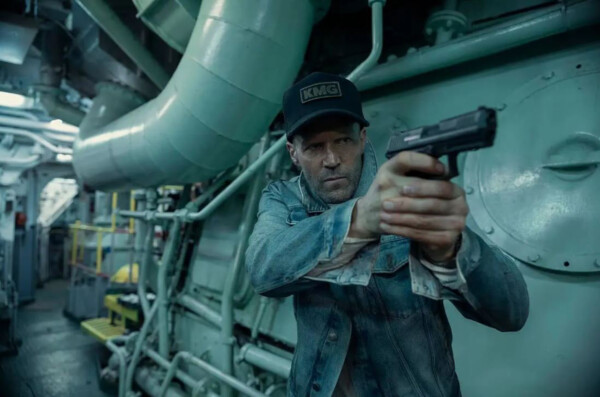
“Mutiny” is “Die Hard” on a container ship – not that there’s anything wrong with “Die Hard” on a container ship. But one wonders where the line is drawn between homage and rip-off, because it sure looks like a lot more was borrowed from “Die Hard” than just the concept.
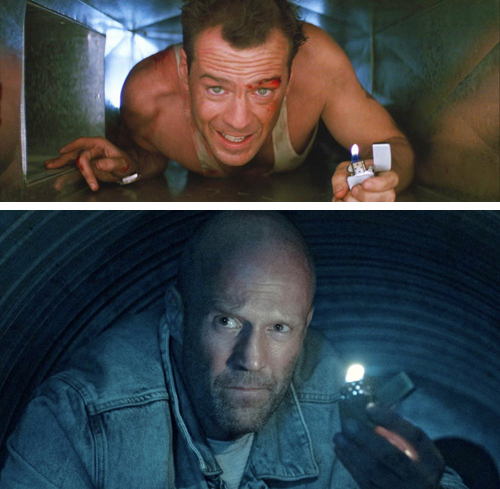
Both movies take place in an isolated setting – in “Die Hard” it was Nakatomi Plaza on the night before Christmas; in “Mutiny” it’s the plodding container ship Artemis. Both leads are tough law-enforcement types who take on an army of bad guys. Both are, for the benefit of you claustrophobes, required to crawl through extremely dark, extremely tight places, like air ducts, ventilator shafts, or various pipe-like structures, while being shot at. There’s even a scene in “Mutiny” where Jason Statham, slithering through an air duct, fires up a Zippo to shed some light on his predicament, just like Bruce Willis in “Die Hard.”
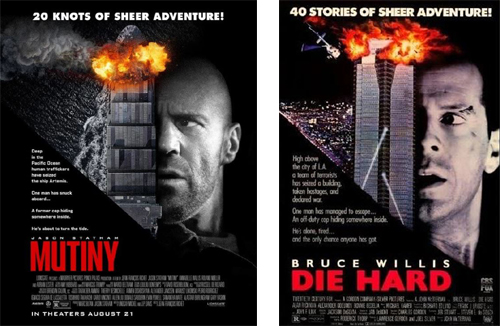
But nowhere are the similarities more obvious – that would be flagrant – than in the movie posters. “Mutiny” is identical to “Die Hard,” and I say this as a guy who was once paid to design publications. The visual elements are the same. The typography is similar in size and positioned the same. The color palette is the same. Even the taglines – “40 stories of sheer adventure!” vs. “20 knots of sheer adventure!” are the same. What’s missing from “Mutiny” is a “Yipee-Ki-Yay, motherfucker,” catch phrase, but then it wouldn’t sound the same coming out of Jason Statham’s mouth.
And that’s the big difference between “Mutiny” and “Die Hard.” While Bruce Willis was a hapless and relatable everyman who just happened to be good at taking out bad guys, Jason Statham is a humorless berserker who grinds up everything in his path. But even that isn’t a fatal flaw because people do not watch a Jason Statham movie for the laughs. They watch a Jason Statham movie for the Three B’s – Bullets, Blood, and Body Count – and “Mutiny” provides all three in very generous helpings.
Statham plays the part of Cole Reed, a bodyguard for shipping magnate Ramon Tikaram (Tibu Campallo), who has put up his company for sale. But Tikaram is killed in an ambush and the local police, who have been compromised by Tikaram’s killers, blame Reed for the murder. Reed tracks the killers to one of the company’s container ships, the Artemis, which is about to depart the port of Bangkok. He sneaks aboard and discovers it’s being used to transport human trafficking victims. Without much preamble, Reed becomes a one-man wrecking crew as he tries to free the trafficking victims and gain vengeance for his beloved boss, who is a kind of surrogate father to him.
“Mutiny” is rife with subplots and motivations. Reed’s father was a cop who got himself killed trying to rescue Reed from a dangerous situation. Plagued by guilt, Reed now seeks to avenge the death of Tikaram. Meanwhile, the ship’s third officer, Angie Ellis (Annabelle Wallis), a last-minute replacement for a sick co-worker, is trying to get home to her daughter in Los Angeles when she also discovers the human trafficking scheme. She and Reed become partners of circumstance in their battle against the crew. Then come questions about Tikaram’s son, Kameron, who may or may not be cooperating with the traffickers, and there’s also a band of Danish thugs who meet the Artemis on the high seas to take possession of their human cargo, presumably before the arrival of a U.S. Navy ship which received a distress call from Ellis before she was captured by the bad guys.
It sounds complicated but “Mutiny” is a stripped-down, high-tension iteration of the usual Statham fare, with lots of clever kills, including an almost hilarious exchange of knives between Reed and the movie’s primary antagonist, the Artemis’ creepy captain, Marko Madsen (Roland Møller). Semi-autos, machine guns, fire axes, spear guns and even a meat hook come into play, reminiscent of a John Wick slaughterfest.
Problems include the plot’s dependency on at least one too-good-to-be-true coincidence; some cheesy motivational elements; and the aforementioned borrowing of plot, scene and design elements from “Die Hard.” Much of this you’ve seen before – if not in a Statham movie then in a Willis movie, a Schwarzenegger movie or a Stallone movie. But none of that really matters because at a lean hour and 35 minutes, the story cranks along briskly and it’s over before you know it.
I’m giving “Mutiny” a B. I like the fact it was a lean, mean killing machine. I did not like the fact it borrowed so much from “Die Hard.” But in the end, how can I complain? A 95-minute respite from this broiling summer heat, and some-over-the-top mayhem, is just what the doctor ordered.
Yipee ki yay and anchors away, motherfucker.
Mladen’s take
Del must’ve slipped cocaine into his mid‑afternoon dose of Geritol before we saw “Mutiny.” Two hours, maybe two‑and‑a‑half, certainly no more than three, after the movie he texts to tell me to look at my email. The old timer had already written his take of this decent lil ole film of contained violence. A record. That’s a record for sure. Well done, Del.
I start by disagreeing with Del on the grade for this movie but it’s not much of a disagreement. B+. “Mutiny” is a B+ because, well, the violence in this movie is believable. Compared to the Wicks, and the two Sisu movies, the two Nobody misadventures, the Extractions or, for that matter, older films such as “Wanted” (2008), “Mutiny” is somewhat subdued.
All we have here is a bit of gun and blade play, though, I must concede, the use of the unlocked padlock to maim an opponent was fabulous. Oh, mustn’t forgot the harpoon gun.
It must be noted that Del and I use different scales for measuring movie violence. Del asserts that there’s plenty of the Three B’s in “Mutiny.” No, there’s not. There’s just enough to carry the movie forward. None of it overstays its welcome.
“Mutiny” features plenty of hide‑n‑seek as the Good Guy and Good Gal walk, run, crawl, and climb to avoid the Bad Guys. There’s some cool cinematography, dark spaces and tight spaces and machinery spaces. The cat‑and‑mouse schtick and the look and feel of life aboard an ocean‑going container ship felt authentic. The film is less blood fest and a bit more like something trying to tell a story.
Also, human endurance in “Mutiny” isn’t pushed too far past the realistic. No single round of hand‑to‑hand is prolonged, leaving the room to move to the next burst of chaos without me thinking something like this: “Only the perfect 6‑foot‑3, 230-pound Donald J. Trump, a known titan of combat and not a five-time draft dodger who wears diapers, could fight for so long.” By the way, if you want to see a thriller that seems to portray the frailty of humans in a face‑to‑face, life‑or‑death fight, give 2017’s “Atomic Blonde” a see.
The “Mutiny” plot pushes through as swiftly as Statham/Cool brings a submachinegun to bear. That the events letting that happen are much less realistic than the gun and knife and cargo‑grab hook violence is easy for me to overlook. Whatever it takes to get to the next battle is fine by me.
Finally, I liked Wallis/Angie. She was naïve at first (which bugged the hell out of me) but came around right quick. By the end of the film, she was thinking fast and had killed. Atta girl.
I don’t know, maybe I’m being too easy on “Mutiny.” I like Statham. He’s cool. From “The Transporter” (2002) to “Crank” (2006) to last year’s “Working Man” and with the couple of sci‑fi‑ish Megs thrown in, Statham leaves me with the impression that he’s doing exactly what he wants to do and enjoying it.
Mladen Rudman is a former journalist and technical writer. Del Stone Jr. is a former journalist and writer.
I don’t have any real expectation of ever being published again.
I don’t know if it’s because my writing is that bad or if it’s the woeful state of reading, writing and publishing in this country today. I continue to submit my work, but I can’t get a publisher to even email me a rejection.
I do know many of the publications I used to sell to have disappeared. The entire magazine industry appears to be failing. Mass market paperbacks are vanishing. A recent survey showed only 16 percent of Americans read a book for pleasure in 2023.
Saddest of all, I saw a video of a middle school teacher practically crying about the illiteracy of her students. Not only were they illiterate, but they didn’t care that they were illiterate, she said.
The solution, of course, would be to ban smart phones and unplug the internet, but that’s about as likely to happen as me selling my most recent novel.
About the author:
Del Stone Jr. is a professional fiction writer. He is known primarily for his work in the contemporary dark fiction field, but has also published science fiction and contemporary fantasy. Stone’s stories, poetry and scripts have appeared in publications such as Amazing Stories, Eldritch Tales, and Bantam-Spectra’s Full Spectrum. His short fiction has been published in The Year’s Best Horror Stories XXII; Alfred Hitchcock’s Mystery Magazine; the Pocket Books anthology More Phobias; the Barnes & Noble anthologies 100 Wicked Little Witch Stories, Horrors! 365 Scary Stories, and 100 Astounding Little Alien Stories; the HWA anthology Psychos; and other short fiction venues, like Blood Muse, Live Without a Net, Zombiesque and Sex Macabre. Stone’s comic book debut was in the Clive Barker series of books, Hellraiser, published by Marvel/Epic and reprinted in The Best of Hellraiser anthology. He has also published stories in Penthouse Comix, and worked with artist Dave Dorman on many projects, including the illustrated novella “Roadkill,” a short story for the Andrew Vachss anthology Underground from Dark Horse, an ashcan titled “December” for Hero Illustrated, and several of Dorman’s Wasted Lands novellas and comics, such as Rail from Image and “The Uninvited.” Stone’s novel, Dead Heat, won the 1996 International Horror Guild’s award for best first novel and was a runner-up for the Bram Stoker Award. Stone has also been a finalist for the IHG award for short fiction, the British Fantasy Award for best novella, and a semifinalist for the Nebula and Writers of the Future awards. His stories have appeared in anthologies that have won the Bram Stoker Award and the World Fantasy Award. Two of his works were optioned for film, the novella “Black Tide” and short story “Crisis Line.”
Stone recently retired after a 41-year career in journalism. He won numerous awards for his work, and in 1986 was named Florida’s best columnist in his circulation division by the Florida Society of Newspaper Editors. In 2001 he received an honorable mention from the National Lesbian and Gay Journalists Association for his essay “When Freedom of Speech Ends” and in 2003 he was voted Best of the Best in the category of columnists by Emerald Coast Magazine. He participated in book signings and awareness campaigns, and was a guest on local television and radio programs.
As an addendum, Stone is single, kills tomatoes and morning glories with ruthless efficiency, once tied the stem of a cocktail cherry in a knot with his tongue, and carries a permanent scar on his chest after having been shot with a paintball gun. He’s in his 60s as of this writing but doesn’t look a day over 94.
Contact Del at [email protected]. He is also on Facebook, twitter, Pinterest, tumblr, TikTok, and Instagram. Visit his website at delstonejr.com .
Warner Bros.
“The End of Oak Street” starring Anne Hathaway as disgruntled mom Denise Platt, Ewan McGregor as Pollyanna dad Greg Platt, Maisy Stella as mildly interesting daughter Audrey Platt, and Christian Convery as sissy son Brian Platt, and others. Directed by David Robert Mitchell. Score Composer Michael Giacchino. Script writer the same guy as who directed. One hour, 39 minutes. Rated PG-13. Theatrical release.
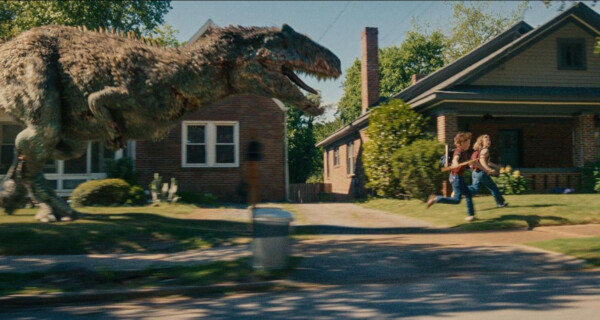
Plot summary: A time warp blasts a 2-mile diameter of early-1980s suburbia to the Mesozoic era. That’s between 66 and 201.4 million years ago. Feathery dinosaurs, crocodiles, and an amphibian‑like, snake‑y, maggot‑esque beast haunt and hunt each other and people as the Platt family struggles to stay alive while quibbling with each other at regular intervals. There’s a happy ending.
Spoilers: How else are we going to orient you to the movie so that you understand our review? Huh?
Mladen’s take
Not even Anne Hathaway, who I adore only 0.027 percent less than Mary Elizabeth Winstead, could save “The End of Oak Street.” The poor script writing, hollow family dynamics, and bland depictions of dinosaurs wrecked the movie for me. Also, why did the dog have to live?
“The End of Oak Street” had potential. The potential never turned into anything kinetic.
The director is known for directing a gem of a movie called “It Follows” (2014). I write this with a caveat. I have not seen “It Follows” but Del told me it was a good movie. Yeah, I know.
Hathaway is an Oscar recipient, best supporting actress for “Les Misérables.” She earned a best actress nomination for “Rachel Getting Married.” Most recently, she did good in “The Devil Wears Prada 2.”
Obi-Wan … ah, Gregor has an outstanding lead actor Emmy and a Golden Globe for best actor.
JJ Abrams (“Cloverfield,” Star Trek, Star Wars, etc.) is among the film’s producers and Michael Giacchino wrote the score.
So, why is “The End of Oak Street” so uninspired and uninspiring?
More than anything, the film made the time warp, and the critters that it dropped into Middle America, a thing of complete horror. No. No. No. The movie should’ve moderated the horror of dinosaurs eating people with the mind‑boggling wonder of theropods and sauropods living among us. That – the danger and risks of mankind facing undeniably stunning and clever dinosaurs – is what makes “Jurassic Park” such a top-notch film to this day. Instead, we get to see two diplodocuses, or whatever, copulating with the roof of a house as their perch. Come on.
“The End of Oak Street” has a fallible micro‑focus. Trying to blend the story of a family falling part while the family is trying to avoid becoming dinosaur kibble didn’t work. Want family drama that fits well inside a monster story? Give “Evil Dead Burn” (2026) a seeing. Or, try 2023’s “Godzilla Minus One.”
“The End of Oak Street” relies on one very stupid choice to carry the story. The stupid choice is made by, of course, the male Platt teenager. Sure, chasing after your dog at night while everything from gangs of pint‑size dinos to a two‑story allosaurus are now your new neighbors is a good idea. And, yes, Lassie comes home just in time to save dumb‑ass Brian later in the movie.
At the end of “The End of Oak Street,” I was nonplussed. The movie had a couple of good scenes, including one that was surprising, if not entirely shocking. All the principal actors played their rolls with sincerity, though at least one of them was unlikeable. The visual effects were mediocre and the soundtrack not a whole lot better. But it’s the script that weakened a good idea for a movie. “The End of Oak Street” squeaks by with a B-.
Del’s take
And I thought I was the one who needed to use the bathroom!
Next time I ask Mladen to see a movie with me I’m going to make sure he has a heapin’ helpin’ of bran flakes for breakfast that morning. What a stuffy take on what was nothing more than a fun summer romp. “The End of Oak Street” isn’t “Anna Karenina,” but it’s not “Melania” either. It’s “Back to the Future” meets “Jurassic Park,” and I’m surprised by how much I liked it.
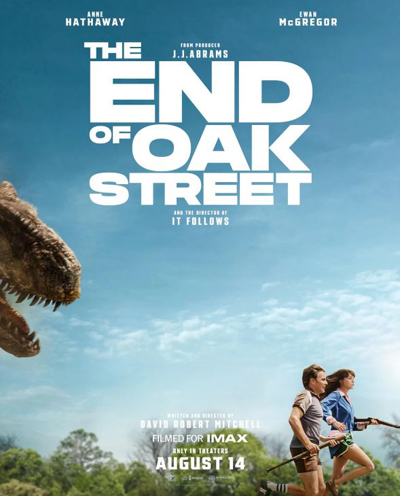
I agree with Old Grouchy Pants that the domestic squabbling between Denise and Greg Platt seemed unreal and downright uncalled for, especially as the neighborhood pets – and the neighbors, for that matter – are being reduced to dinosaur kibble. I also agree the dialogue just doesn’t snap, and the characters – more importantly, their motivations – were hastily sketched, leaving moviegoers grasping for reasons to care about the Platt family.
But the movie redeemed itself with humor and a mostly nostalgic glance at the recent (for me) past. One gripe: The sound track was lame. In a decade fat with truly iconic, classic tunes, the best they could come up with was Pat Benatar’s “Hit Me with Your Best Shot” and Steve Winwood’s “Valerie”? No Thompson Twins? Flock of Seagulls? Madonna? Tears for Fears? Howard Jones? Not even a Name-That-Tune snippet of Billy Idol or John Cougar Mellencamp?
“The End of Oak Street” isn’t a treatise on anything except maybe how important it is that Mom and Dad not argue in front of the kids. It’s a snapshot of a somewhat fractured and dysfunctional family coming together to cope with a surreal threat, and the fun is in watching them meet that meager expectation while unknowingly rediscovering the bond that made them a family to begin with. It has all the thrills and chills of “Jurassic Park” but the wistful sweetness of “Back to the Future.”
I enjoyed it for what it was – an hour and a half of summer escapism. I heard members of the audience talking to the characters on the screen, saying things like, “Look behind you!” or “Don’t do that!” and that’s when I realized “The End of Oak Street” had accomplished its mission – to entertain.
I’m giving it a B+. It has its flaws, but overall it’s a very entertaining movie. Apart from one shocking scene it should be great for the kids.
Oh, and Mladen … “It Follows” is a masterpiece of modern horror, so no arguments from you, Mr. I-Haven’t-Seen-It Guy.

Image courtesy of Pexels user Portrenk. https://www.pexels.com/@portrenk/
INTRODUCTION
According to my-not-very good publication notes, I wrote “Nightwalk” in 1983. I wonder if that’s true.
My recordkeeping back then was spotty. I never thought it necessary to keep track of production dates or publication credits.
Now, as you might expect, I’m scrambling to backtrack and figure it all out. If I could return to my youth, among the many things I would do differently – among them getting a job in my teens, or taking steps in high school to prepare for college – would be to keep track of the dates I wrote stories and make a list of where (or if) they were published, and when.
I remember sitting on bleachers at the local tennis courts, shaded by oaks, planning the details of “Nightwalk.” I remember the scene – the two boys walking along the road in the dark, and the menacing shape stalking them. I remember thinking a really good writer could make this look scary.
A friend and I had spent the day in Pensacola, about 45 miles away, shopping, eating and going to movies. On the way home I began telling him the details of “Nightwalk.” When I got to the part where the boy trips over the surveyor’s wire, Steve said, “Ah, don’t do that. They always do that in horror movies – trip over something so the monster can catch up.”
Silly Steve. He didn’t understand the monster was going to catch them, tripping or not. Besides, tripping added an interesting moral dilemma – should the other boy stop and help his friend, or leave him as an offering to the monster?
In retrospect Steve was right. They always trip in horror movies. I should have taken that out.
I don’t remember much else about the story – what prompted me to write it, or how long it took to write. Back then I didn’t have the same concept of storytelling I have today.
According to my spotty records “Nightwalk” was published in the magazine After Hours in 1987. I’ll have to dig through my copies to see if I can find it. Unfortunately, they are hidden in a plastic Sterilite box at my storage unit, beneath teetering towers of other Sterilite boxes. One day, when I am rich and have money to burn, I will build a house with lots and lots of bookshelves, and all my back copies – even the copy of my high school newspaper with my letter to the editor complaining about 43-cent-per-gallon gas – will go up on those shelves, including the edition of After Hours featuring the story “Nightwalk.”
Tripping and all.
NIGHTWALK
The screen door banged open and there was the wet slapping sound of Nikes beating frantically against the porch floorboards. Then the boys were leaping – arms pinwheeling – as they cleared the cement-block steps and thudded heavily against the grass which was already damp with the night. They were off, then, drawn pell-mell into the smoky twilight like two madly scrambling shadows; one, tall and lanky; the other shorter, the motions of his body more pronounced as he struggled to keep pace with his stronger companion. They ran until they had put the honeysuckle hedge that bordered the front yard between them and the house lights. They ran until every house on the block was behind them and only an interminable asphalt road flanked by dark woods lay ahead. That, and The House. Then the taller boy slowed, allowing the shorter one to overtake him, ad they walked with the rubber-legged gait peculiar to exhausted marathoners, speaking ragged whispers. Their hearts continued to race.
“You think this is far enough?” Demmy asked. He was trying very hard not to look tired. He sounded worn out.
Todd made no pretense that he hadn’t been winded by the sprint – but he had his size for an excuse. The air, it seemed, had grown cooler and more rarified since sundown. It burned his lungs.
“Far – far enough for what?”
Demmy snorted, sucked air. “Far enough so that if she changes her mind and comes stomping out the front door hollering like a goddamned cow about to split its udder for me to haul my ass back, I can say I didn’t hear her.” He sniffed, spat, and let out a long, pent-up exhalation of relief. Todd continued to wheeze.
“It doesn’t – doesn’t matter. As soon as we get to my house she’s gonna call your ass and make you walk all the way back – in the dark – by yourself. Past. The House.”
“Oh, eat me. She is not.”
Todd paused to collect a breath. “Fuckin’ A. She told me herself. Gave me a buck to keep my mouth shut. But since you’re my cool bud, I wouldn’t want to see you get screwed. So I guess you ought to be heading back. See ya around.”
“She really did that?” Demmy asked, incredulous. “Gimme that goddamned dollar, fuckhead!”
Todd shook his head wearily. “Oh, Christ. Don’t pout. I hate it when you can’t take a joke. OK. I was bullshitting you.”
He saw the tension ease out of Demmy’s expression. Then Demmy mumbled, “Pretty shitty joke.”
From some remote corner of the night, a dog barked. Night time is the best time for hearing, Todd thought. Sometimes, when it’s cool and dark and the wind isn’t blowing, it seems you can tune in the whole world – at least as far as The House. His mind seized on that, and he wondered what it would be like to walk past The House at night, if it would be different somehow. If Demmy would do it despite the things they had heard (and Demmy had been hearing them a lot longer), especially after summer before last, those two kids, what happened to those two kids.
“– don’t see why spending the night with a friend is such a big deal.” Demmy was gesticulating with his hands, flipping them about like spastic marionettes. “She acts like it’s the goddamned worst thing that could happen – Christ, she never lets me do anything!”
Todd took a deep breath. The fire in his chest had cooled to embers; he felt his mind clearing, his thoughts slowly beginning to congeal. Demmy made some crack about his mother and Todd bit down on a sneer. He said, “I like your mom – ”
“Yeah, but – ”
“Yeah, but nothing. Your mom’s OK so lay off.” He looked up at Demmy, hoping find some indication that Demmy knew he was lying. But the other boy’s face was framed in shadow and unreadable.
Demmy grabbed his shoulder, stopped him (Todd’s heart fluttered and he thought, Oh shit! This big, brawny moron is gonna flatten me), and hissed, “But she smothers me, man!” and he went off on an agitated tirade.
Capillaries of a breeze snaked their way through the firs that walled-in the road, tussling Todd’s hair, twining his thoughts and leading them back through time. Demmy’s voice receded into a toneless blur, and Todd remembered Washington, where his father had carved out a niche at the Smithsonian. The city, with its color, its movement, its energy – all the important things in life. Things that had given his mother a nervous condition and had sent them packing to this godforsaken, two-horse western Massachusetts town where his father had bought a hardware store to squander their collective future.
Todd chewed over all the old arguments. Washington was it; Jesus, everything that mattered – everything important – was in Washington: the institute, the colleges, the arcades, the rinks, the malls … the people. What did this place have going for it? Frigging hardware store and wormy-ass friends like Demmy.
Demmy! Todd wondered why they still called him that. The kid was a year older and three inches taller than Todd. Todd had always been called Todd. Never Todd-O or any of those other dumb kid names. Just Todd. And his parents. They were cool. Always letting him do just about anything he wanted – almost anything. Like staying in Washington. No, they wouldn’t – couldn’t – let him do that. Sure, he was only 14. But they could’ve stayed at least until he was old enough to start college instead of dragging his ass out to this – this hole, where time ground down on rusty sprockets and old clock springs, where a stickup at the 7-Eleven made headlines on the front page of the county weekly. Christ.
“ – and then I’m gonna ask her if she’ll let me go swimmin’ – by myself – in Jefferson Hole. You think that’ll shake her up? Hey, Todd, you listenin’?”
Todd blinked away cobwebs and said uneasily, Yeah, uh, I think that would probably, uh, do it.”
The trees shook themselves and sighed as the breeze freshened. A bird twittered and then quieted. The night was alive with furtive noises, and this was the only part of Olianth Todd could abide. Nighttime in the country, with its mysteries, its secrets. There were times, like tonight, when the stars seemed so impossibly large that he thought they might come crashing down out of the sky to smash against the ground. Huge stars, hone to flawless, brilliant clarity in the smoke-free sky of the backwoods. And the quiet – God, it was oh-so quiet.
Except for little noises.
Demmy snapped his fingers. “Hey, wanna cig?”
Todd shook his head. “Hell no, I don’t want a cigarette – not unless you got some gum – and I know you don’t ’cause you never do. And what would your old lady do if she knew you smoked?”
“Fuck her,” Demmy said automatically. “And you’re right. I ain’t got no gum.”
“Well, fuck you then.” Todd’s voice slipped into a grainy falsetto, and he began speaking in clipped-off syllables. “Now Demson, I will not permit you to use that sort of language in this classroom. Is that clear?”
“Wait a second.” Demmy stopped, dug deeply into his pocket and withdrew a pack of Kools. He hooked one from the pack, inserted it into his mouth like the Marlboro Man, and let it dangle there while he opened a book of matches. He struck one and cupped it in his hands. His face flared into ethereal brilliance, framed against twilight. He drew heavily on the cigarette and a thick cloud of smoke swept about his face and vanished into the darkness. He coughed, nearly spat the cigarette, then took another drag and inhaled deeply.
Again, the falsetto. “Demson, my boy. Are you listening?”
Demmy put away the matches and said, “Lemme guess: Miss Lothario. Fourth period.”
Todd clapped his hands. “Correct, my man. You win the Samsonite luggage.”
Demmy grimaced. “I hate that bitch. Always calling me Demson. If I’ve asked her once I’ve asked her a thousand times not to call me Demson. I’m Demmy. That’s who I am.”
You sure are.
“Yeah, I know,” Todd said. “But she does have one thing going for her. She’s the sexiest goddamned teacher in school.” He growled playfully. “She’s a regular Twentieth-Century Fox. God! I could do the horizontal bop with her any time, any place, Bub.”
They were walking along the road shoulder. Chunks of asphalt crumbled beneath their feet. Ahead, the orderly line of fir trees was broken by a blank gash in the night. Hunched at the inner reaches of the pit, they could make out the vague, shadowy outline of a house. It was a massive, brooding structure that had since fallen victim to the years and passed into senility. Patches of shingles had slipped from the roof. Window panes were cracked or missing altogether. The front door had been torn free from its hinges, leaving a gaping socket of blackness in its middle. The house had been given up.
Todd elbowed Demmy in the ribs and nodded. “Why, I’d even be willing to spend the night in that old place, so long as she came along.”
Demmy wrinkled his nose. “That place gives me the creeps. The House. Wish somebody’d tear it down or something.”
“Tear it down?” Todd spoke with mock incredulity. “Nobody’s gonna tear it down. Nobody’s gonna go near that place.” Then, in a whisper, “They say something still lives there.”
“Awww, that’s bullshit.”
“Yeah. You know it’s bullshit, and I know it’s bullshit, but that’s what they say.” He wondered if Demmy would run. He almost felt like giggling..
But Demmy only snorted. Without a trace of humor. “Look, I’ve been living in Olianth a lot longer than you, and there ain’t nothing to any of that bullshit, not even what happened. …” His voice trailed away. Then he said, “So just shuddup, OK?”
“What’s the matter?” Todd leered. “Scared?”
“No, I ain’t scared – ”
“Afraid a monster’s gonna come slithering out of the dark, like OVER THERE!” Todd pointed frantically at the house. Demmy stiffened and Todd heard a tiny gasp squeak past his lips.
“Goddammit!” Demmy hissed. Todd laughed – out loud this time.
“Awww c’mon, you gutless pud. Just a joke. A little joke, that’s all.”
“Yeah. Ha ha,” Demmy answered, still whispering. “Real funny.”
Todd kicked a fractured chunk of asphalt, sent it tumbling along the road shoulder ahead of them. “Seriously though. You know Mr. Aikens?”
Yeah, Demmy knew him.
“He was in the store the other day, shootin’ the shit with my old man, and my old man mentioned something about maybe buying that place – ” Now they were directly across the road from the house “– fixing it u so he could rent it out to somebody one of those bed-and-breakfast places. As soon as he said that, Mr. Aikens starts in on that writer who used to live there – you’ve heard about him, I’d imagine.”
“Yeah,” Demmy mumbled uncertainly.
“That real famous writer way back in the late twenties or early thirties. I’m not sure; what’s his name?”
“I dunno.”
Todd scratched his chin. “He used to write all those weird stories about devils and monsters and old ruins. He wrote ‘Nightwalk’ – his novel that’s really famous – while he lived in that house. It was about this huge flying thing that only comes out after dark; I saw the movie on Creature Feature.”
“Sounds like a mental to me,” Demmy remarked gloomily.
“His name … what was it?”
“Strangelove?”
Todd sniggered. “No, dummy. That was a movie with Peter Sellers. And I know who you’re thinking about. Lovecraft. It wasn’t him.”
“Poe?”
Todd rolled his eyes. “No, not Poe for God’s sake. Somebody else – Jakes! Jakes! That’s who. Jakes. He lived in that house, way back when. At least that’s what Mr. Aikens told my dad.”
Demmy murmured in a low voice, “Yes, I think I remember somebody saying something about a famous writer staying in that house for awhile, but that was a long time ago. Didn’t he take off?”
In the distance Todd could see a patch of wan light. The porch light at his house. They were almost there. Mom had probably left it on for him before she and Dad left for Sebring.
“I dunno. Anyway, Aikens. …” and the night grew hushed, as if it too would stoop closer, bend an ear and hear the story. Todd found himself whispering, “… said that this writer guy moved into the house and for awhile, everybody here was real excited – you know – having somebody really famous living right here in town and all. People used to walk down this road just to catch a glimpse of him.”
The night pressed closer. Todd lowered his voice still further.
“But it was no dice. The guy never came out. A recluse. Spent all his time cooped up in that old place. Used to send his housekeeper into town for groceries, and she was a tight-lipped old battle ax.”
Demmy sniffed, poked his hands into his pockets.
“Anyway, after awhile, people began to think something weird was going on in there, and they started staying away. Eventually they were pretty much able to forget about him – that is until the night he left.
“Aikens said that the ‘writer fella’ had up and left without so much as a goodbye or a kiss my ass. Forgot about all his stuff and just blew right out of town like he was runnin’ scared or something. Damnedest thing he’d ever seen. One of those storage firms brought a truck in about two, three weeks later and gathered up all his stuff. And that was it. Never saw him again. And the guy never wrote another book. Strange.”
Todd cleared his throat. “Then Aikens took a long suck off his Nehi Grape and said the house had been rented out at least a dozen times since and the longest anyone had managed to stick it out was three months, and how the general consensus – that’s polite for gossip – was that maybe this writer guy, during his stay at the house, had stirred up a bunch of ‘spooks,’ seeing as how he was a horror writer.”
“I don’t think I wanna hear anymore,” Demmy whispered. The House was now to their right and behind them as they continued toward the point of light in the distance. Every few seconds, Demmy would snatch a furtive glance over his shoulder.
“What do you mean you don’t want to hear anymore?” Todd mocked. “I’m not finished.” You’ve got to hear more. I haven’t gotten to the good parts yet, the parts about why they call it “The House,” the parts about those kids, summer before last, how they were mutilated so badly that nobody could look at them without puking, how the cops thought they might have been partially eaten .. there. In front of The House. “You scared? Afraid something might reach out and grab you? Huh?”
“Shuddup!” Demmy hissed pleadingly. “I don’t give a flying fuck about no monster. But haven’t you noticed how weird it feels out here all of the sudden? It’s too quiet. Even the crickets have stopped – ”
https://www.pexels.com/@portrenk/
“That’s because the monster is around somewhere,” Todd answered in a sibilant whisper. He smiled. “The monster from the writer’s novel. The one that lives in The House. The one that killed those kids.”
“It was a pree-vert who killed those kids,” Demmy snapped. But he looked genuinely alarmed.
“That’s what the cops told everyone. But that isn’t what they think,” Todd answered ominously. He jerked his head to the right. “The monster – ”
“Shuddup! Shuddup! Listen!” Demmy squealed.
“ – tore them limb from limb, chewed them up and spit them out in little pieces all over the front drive – ”
Demmy grabbed Todd’s arm, squeezed it so tightly that Todd winced and had to grit his teeth to keep from shouting. He tried to jerk away; Demmy’s grip was unyielding.
“What’s your problem anyway?”
Demmy had stopped. His eyes had gone wide and were shot with fear. “Can’t you hear it? Can’t you feel it?”
Todd paused. What was Demmy talking about? Could Demmy hear things that he couldn’t, or see things he couldn’t see? Did he have some unexplained sensitivity, some jungle instinct that had been dulled in Todd by years of city living?
“Something is out there …” Demmy said thickly. Todd snorted, laughed uneasily.
“Awww, c’mon. Bullshit. There isn’t anything out there. …” His voice trailed away when he realized how dumb that had sounded. Demmy’s grip on his arm tightened.
“Something’s out there. I can tell.”
Todd hesitated. Demmy was right. Something had changed. It was unusually quiet. Where were the night sounds, the little whisperings and rustlings that let you know the sun had gone down? Shadows slithered and roiled in the inky turbulence. The woods on either side of the road had become impenetrable black walls – walls that could hide things from anyone – two boys, for instance, walking along a deserted road at night.
“Bear … or something, maybe,” Todd whispered. The air had become supercharged with panic that had a burnt, ozone smell.
Demmy moaned, “Ohhh, Todd, let’s get outta here,” and then behind them – behind the wall of firs – Demmy gasped and whirled. A part of the night grew darker, and then tree limbs were being sheared from their trunks to the sound of bones snapping as something big moved toward them out of the darkness like a black thunderstorm.
Todd’s heart crawled into his throat. Suddenly – miraculously – the pressure on his arm was gone. He turned and watched as Demmy began running – running for the pinprick of light that now seemed impossibly far away. Panic prodded at him; his feet began to move with dreamy slowness, as if this were a nightmare where nothing moved with any urgency. From the cavern of night came a low, rumbling growl that cut a swath of chills along his spine. He felt himself staggering – then running. As he moved his mind seemed to clear so that everything came into sharper focus, and he knew suddenly that if he did not run he die here on this dark road, he would die –
Ahead, Demmy’s misty form bobbed against the light. Todd heard talons clawing at asphalt behind him. From some hidden reservoir of terror came the strength for him to scream, “DEMMY – DEMMY – WAIT! PLEEEEZE!”
Claw clicks on the pavement, drawing nearer.
“DEMMY! DEMEEEEE!”
Demmy’s form suddenly winked out of eclipse and Todd heard a whimper and a thud. In a second he was on top of the other boy, saw him lying in the wet grass on the road shoulder, his face screwed into a rictus of surprised horror. A surveyor’s wire was wrapped around his ankle.
“Todd? Todd – ”
Todd raced past him without breaking stride. Serves him right.
He reached the front yard. God, the light looks like heaven.
He took the porch steps in a single, exaggerated leap that sent him careening against the screen door. For a panicky moment he couldn’t get the damn knob in his hand. From out of the night he heard his name called. He got the door open, but hesitated before stepping inside to look. Demmy was at the corner of the yard, running stiffly, and behind him … oh, behind him, the darkness bearing down.
Todd stepped inside and slammed the door shut.
The house was black; it seemed unnaturally large in the murky twilight. Everything was hidden in sooty shadows and ear-ringing quiet. All he could hear was his thundering heart, his ragged breathing, and from outside –
“Todd! Todd!”
– distant and muffled by wood, plaster, but drawing closer now. Much closer. Pretty soon. …
“Todd! Open the d – ”
The sentence was left unfinished. The silence that followed came down like a question mark. Todd turned, pressed his cheek against the cool door facing and whispered, “Demmy?”
Nothing.
“Demmy? Then, louder, “Demmy?”
Todd frowned. “Demmy? What’re you doing? What the fuck are you doing, dammit! Demmy!”
The bones in his leg seemed to so soft. His stomach roiled queasily.
“Demmy!”
Panic was edging back into his voice – God – none of this was happening. That line he’d fed Demmy on the road back there – pure bullshit. Fiction. There couldn’t be anything out there. There couldn’t.”
“Demmy?”
It could have been a dog, or something. Couldn’t it? A bear. Did they have bears in Massachusetts? Todd didn’t think so. Probably a big dog from the sound of things – somebody’s lost pooch out roaming the woods, maybe a wild dog that wouldn’t come near the house, the light. Maybe Demmy already knew that and was hiding in the cedars by the porch, playing some stupid-shit joke, getting him back for all the shitting things he had done.
“Demmy.” Todd’s temples had begun to throb angrily. “Demmy, I know you’re out there. Goddammit! If you don’t want to spend the night in the front yard you’d better hoist your ass up here pronto!”
He was out there, hiding, playing some dumb game. Having a good laugh at the city boy’s expense. That’s what he was doing – that’s what he had to be doing. Making Todd look like an idiot so he could go around school Monday and tell everybody how he’s pulled a fast one on Mr. Bigshot City Slicker, and what a pussy Todd had been, afraid of the dark, of noises and shadows in the dark.
Todd gritted his teeth and whipped open the door. That frigging dumbass –
The porch was slicked down with something that looked oily and scorched in the porchlight’s yellow glare. And at the welcome mat lay a shredded bundle of – a –
Jesus.
Then the porch light was swatted out, and the night reached out to Todd to gather him in.
About the author:
Del Stone Jr. is a professional fiction writer. He is known primarily for his work in the contemporary dark fiction field, but has also published science fiction and contemporary fantasy. Stone’s stories, poetry and scripts have appeared in publications such as Amazing Stories, Eldritch Tales, and Bantam-Spectra’s Full Spectrum. His short fiction has been published in The Year’s Best Horror Stories XXII; Alfred Hitchcock’s Mystery Magazine; the Pocket Books anthology More Phobias; the Barnes & Noble anthologies 100 Wicked Little Witch Stories, Horrors! 365 Scary Stories, and 100 Astounding Little Alien Stories; the HWA anthology Psychos; and other short fiction venues, like Blood Muse, Live Without a Net, Zombiesque and Sex Macabre. Stone’s comic book debut was in the Clive Barker series of books, Hellraiser, published by Marvel/Epic and reprinted in The Best of Hellraiser anthology. He has also published stories in Penthouse Comix, and worked with artist Dave Dorman on many projects, including the illustrated novella “Roadkill,” a short story for the Andrew Vachss anthology Underground from Dark Horse, an ashcan titled “December” for Hero Illustrated, and several of Dorman’s Wasted Lands novellas and comics, such as Rail from Image and “The Uninvited.” Stone’s novel, Dead Heat, won the 1996 International Horror Guild’s award for best first novel and was a runner-up for the Bram Stoker Award. Stone has also been a finalist for the IHG award for short fiction, the British Fantasy Award for best novella, and a semifinalist for the Nebula and Writers of the Future awards. His stories have appeared in anthologies that have won the Bram Stoker Award and the World Fantasy Award. Two of his works were optioned for film, the novella “Black Tide” and short story “Crisis Line.”
Stone recently retired after a 41-year career in journalism. He won numerous awards for his work, and in 1986 was named Florida’s best columnist in his circulation division by the Florida Society of Newspaper Editors. In 2001 he received an honorable mention from the National Lesbian and Gay Journalists Association for his essay “When Freedom of Speech Ends” and in 2003 he was voted Best of the Best in the category of columnists by Emerald Coast Magazine. He participated in book signings and awareness campaigns, and was a guest on local television and radio programs.
As an addendum, Stone is single, kills tomatoes and morning glories with ruthless efficiency, once tied the stem of a cocktail cherry in a knot with his tongue, and carries a permanent scar on his chest after having been shot with a paintball gun. He’s in his 60s as of this writing but doesn’t look a day over 94.
Contact Del at [email protected]. He is also on Facebook, twitter, Pinterest, tumblr, TikTok, and Instagram. Visit his website at delstonejr.com .

After the hell I’ve been through the past month, I decided to reward myself with a treat: a subscription to NFL Sunday Ticket.
But I’m consumed with guilt.
Why?
I’ve earned it, I tell myself. I drove 700 miles to a strange city where I knew nobody, had a major portion of my anatomy removed, drove back with a catheter and no pain meds, and now I’m teaching myself not to piss my britches – again, if you count the time when I was 1 year old.
I deserve a little treat, especially since I’m not supposed to exert myself or pick up anything heavier than 10 pounds until sometime in September.
I didn’t take any of the oxycodone they gave me, I canceled my subscription to Apple TV, and I’m making extra money ranting on social media, I remind myself. Surely those things count for something.
But it costs $240 a year, the miser in me whispers slyly. Next year that cost goes up to $480.
I signed up anyway. You know why?
Because I have spent my entire life pinching pennies, counting dollars and saving money for that fabled day when “I would need it.” Well, guess what?
Today is that day.
NFL Ticket is a luxury, yes. In four years the government will start cutting my Social Security income by damn near 20 percent unless Congress gets off its lying, thieving ass and does something to fix the problem, so I’ll be less able to afford it.
But I never, EVER do anything for myself.
So I signed up for it. If I don’t get the use out of it I expect, I’ll cancel at the end of the season. I refuse to feel guilty anymore.
Oh, and the damn Dolphins better learn how to win. I ain’t paying $480 a year to watch those bastards lose.
About the author:
Del Stone Jr. is a professional fiction writer. He is known primarily for his work in the contemporary dark fiction field, but has also published science fiction and contemporary fantasy. Stone’s stories, poetry and scripts have appeared in publications such as Amazing Stories, Eldritch Tales, and Bantam-Spectra’s Full Spectrum. His short fiction has been published in The Year’s Best Horror Stories XXII; Alfred Hitchcock’s Mystery Magazine; the Pocket Books anthology More Phobias; the Barnes & Noble anthologies 100 Wicked Little Witch Stories, Horrors! 365 Scary Stories, and 100 Astounding Little Alien Stories; the HWA anthology Psychos; and other short fiction venues, like Blood Muse, Live Without a Net, Zombiesque and Sex Macabre. Stone’s comic book debut was in the Clive Barker series of books, Hellraiser, published by Marvel/Epic and reprinted in The Best of Hellraiser anthology. He has also published stories in Penthouse Comix, and worked with artist Dave Dorman on many projects, including the illustrated novella “Roadkill,” a short story for the Andrew Vachss anthology Underground from Dark Horse, an ashcan titled “December” for Hero Illustrated, and several of Dorman’s Wasted Lands novellas and comics, such as Rail from Image and “The Uninvited.” Stone’s novel, Dead Heat, won the 1996 International Horror Guild’s award for best first novel and was a runner-up for the Bram Stoker Award. Stone has also been a finalist for the IHG award for short fiction, the British Fantasy Award for best novella, and a semifinalist for the Nebula and Writers of the Future awards. His stories have appeared in anthologies that have won the Bram Stoker Award and the World Fantasy Award. Two of his works were optioned for film, the novella “Black Tide” and short story “Crisis Line.”
Stone recently retired after a 41-year career in journalism. He won numerous awards for his work, and in 1986 was named Florida’s best columnist in his circulation division by the Florida Society of Newspaper Editors. In 2001 he received an honorable mention from the National Lesbian and Gay Journalists Association for his essay “When Freedom of Speech Ends” and in 2003 he was voted Best of the Best in the category of columnists by Emerald Coast Magazine. He participated in book signings and awareness campaigns, and was a guest on local television and radio programs.
As an addendum, Stone is single, kills tomatoes and morning glories with ruthless efficiency, once tied the stem of a cocktail cherry in a knot with his tongue, and carries a permanent scar on his chest after having been shot with a paintball gun. He’s in his 60s as of this writing but doesn’t look a day over 94.
Contact Del at [email protected]. He is also on Facebook, twitter, Pinterest, tumblr, TikTok, and Instagram. Visit his website at delstonejr.com .
Nano Banana
INTRODUCTION
“Object d’Art” breaks all the rules.
It’s the story of a man who takes his press releases too seriously. And it’s the story of a woman who is just as serious about her revenge.
Finally, it’s a story about an industry that eats its own.
Not a single, likeable character in the bunch. Not one. They’re all assholes. You’re not supposed to do that in fiction. You’re supposed to write at least one character to which the reader can relate.
Oh well.
Luckily for you, dear person who paid 99 cents for this cynical morceau savoureux, it’s so short you’ll finish it before you can hate it.
Besides, there are industries out there, artistic industries, populated with assholes who would do just about anything to get in that last little dig, that final poke in the ribs, no matter the cost. Not that I would know anything about that.
Ahem.
There’s a line in this story I love. I rarely love what I write – my inner critic doesn’t allow such luxuries – but this line is just perfect, according to my writerly eye:
He was older, his Tuscanny suit hanging on him like a flag wrapped around a flagpole, his silk tie squeezing his head into a marsupial funnel of angular gristle and teeth.
I adore that line. It perfectly illustrates the character I was trying to describe – a thin, avaricious little man who can’t wait to get his hands on the cash. I was thinking opossum at the time. That’s what I was shooting for, a human opossum. That line succeeds better than I could have hoped.
Speaking of which, I hope you enjoy “Object d’Art” as much as I enjoyed writing it.
OBJECT D’ART
“He must not know,” Pamela told the gentleman, who slipped her an avaricious smile, then smoothed it into something more practiced and civilized.
“I assure Madame, he will not,” the gentleman answered. He was older, his Tuscanny suit hanging on him like a flag wrapped around a flagpole, his silk tie squeezing his head into a marsupial funnel of angular gristle and teeth.
But Pamela didn’t care. All that mattered was that she acquire the painting.
The last Brookenstein original.
“Our transactions are conducted in complete discretion,” the gentleman told her. “Mr. Brookenstein will not know it was you.” He fidgeted a moment, then asked, “And how will Madame be making the arrangements – ”
“Cash,” Pamela told him, opening her handbag. She withdrew a sheath of $1,000 bills and counted out 10. She folded and inserted them, as she might a business card, in the gentleman’s breast pocket. “Have it taken downstairs,” she said, turning and crossing the room. “It should fit in the trunk of the Ferrari.”
And she was gone.
—
Brookenstein had not visited Pamela’s flat in years. He will be astonished at the changes, she thought, as her assistant, Miss Deppler, showed the artist into the gathering room.
“Ah, Pammie,” Brookenstein said munificently as he spotted her, spreading his arms as if to gather her in. When she did not rise from the wingback, he lowered his arms and said, “Good to see you again.”
Pamela nodded. Brookenstein had not changed – oh, the cheeks pooched a bit and the gut spread to his waist, but other than that he hadn’t changed, she remembered with a shudder.
“Your invitation caught me off guard,” he said. “I thought I was persona non grata hereabouts.”
She offered him a thin smile. “After you abandoned me?”
Brookenstein effected shock. “After I taught you the exigencies of business?” he gasped. “Which I had heard, and now see, that you’ve put to good effect? What’s your net worth, Pammie? Ten mil? Twenty?”
“I loved you,” she said evenly.
“As I loved you,” he answered. “But I also loved art, and what better lesson could I teach you than the suffering any real artist must bear in pursuit of his vocation?”
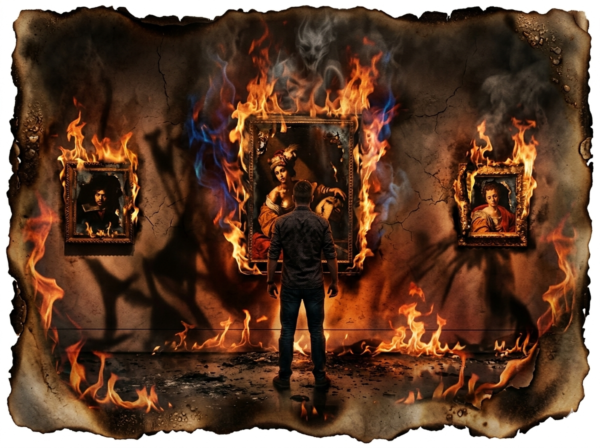
Pamela motioned to Miss Deppler, who twisted a rheostat. The lights revealed framed paintings affixed to the walls … and a five-gallon can of gasoline.
Brookenstein’s eyes traveled the walls. “My paintings – ” He touched a finger to his lips. “All of my paintings. The extent of my creative output since I began selling professionally. Touching.” His gaze settled on the can, and his eyes brightened. “I understand now. You bought my work, then brought me here to witness its destruction. A flair for irony.”
Pamela arched an eyebrow.
“But it won’t work,” he said casually. “You own it; do with it what you wish. I am a creator. I will create.”
“You are a creator,” Pamela whispered slyly. “And I am a businesswoman. A wealthy businesswoman. No, Brookenstein, I don’t plan to destroy your creations. I plan to sell them.”
Brookenstein paused, a frown beginning to congeal.
“I plan to sell them as labels on products my company produces, Brookenstein – cans of baked beans, and disposable diapers, and children’s toys – ”
“What—” His face had gone the color of overdone sausage.
“And no matter what you ‘create,’ I will be there to purchase it,” Pamela went on smoothly, “and bring it to the art-starved masses, plastered across a can of spray deodorant – ”
“I am an artist!” Brookenstein screamed at her. “You bourgeois, impercipient capitalist! I am an ARTIST, NOT a day laborer in some graphics art factory!”
“Yes,” Pamela told him, “and as an artist, you must suffer.”
Brookenstein’s eyes darted rat-like about the room. He sprinted for the can and snatched it up, and splashed gasoline on the paintings lining the walls. When he was done, he held the can aloft, turning it upside down. Gasoline cascaded across his head and down his shoulders, plastering his blouse to his flabby paunch. He squinted at her with a look of pure malice.
“You’ll never get your hands on another piece of my work,” he seethed, and with that, he fished a Zippo from his jacket pocket.
He struck it.
“I am a piece of your work,” Pamela said, as her first work of art whooped into flames.
About the author:
Del Stone Jr. is a professional fiction writer. He is known primarily for his work in the contemporary dark fiction field, but has also published science fiction and contemporary fantasy. Stone’s stories, poetry and scripts have appeared in publications such as Amazing Stories, Eldritch Tales, and Bantam-Spectra’s Full Spectrum. His short fiction has been published in The Year’s Best Horror Stories XXII; Alfred Hitchcock’s Mystery Magazine; the Pocket Books anthology More Phobias; the Barnes & Noble anthologies 100 Wicked Little Witch Stories, Horrors! 365 Scary Stories, and 100 Astounding Little Alien Stories; the HWA anthology Psychos; and other short fiction venues, like Blood Muse, Live Without a Net, Zombiesque and Sex Macabre. Stone’s comic book debut was in the Clive Barker series of books, Hellraiser, published by Marvel/Epic and reprinted in The Best of Hellraiser anthology. He has also published stories in Penthouse Comix, and worked with artist Dave Dorman on many projects, including the illustrated novella “Roadkill,” a short story for the Andrew Vachss anthology Underground from Dark Horse, an ashcan titled “December” for Hero Illustrated, and several of Dorman’s Wasted Lands novellas and comics, such as Rail from Image and “The Uninvited.” Stone’s novel, Dead Heat, won the 1996 International Horror Guild’s award for best first novel and was a runner-up for the Bram Stoker Award. Stone has also been a finalist for the IHG award for short fiction, the British Fantasy Award for best novella, and a semifinalist for the Nebula and Writers of the Future awards. His stories have appeared in anthologies that have won the Bram Stoker Award and the World Fantasy Award. Two of his works were optioned for film, the novella “Black Tide” and short story “Crisis Line.”
Stone recently retired after a 41-year career in journalism. He won numerous awards for his work, and in 1986 was named Florida’s best columnist in his circulation division by the Florida Society of Newspaper Editors. In 2001 he received an honorable mention from the National Lesbian and Gay Journalists Association for his essay “When Freedom of Speech Ends” and in 2003 he was voted Best of the Best in the category of columnists by Emerald Coast Magazine. He participated in book signings and awareness campaigns, and was a guest on local television and radio programs.
As an addendum, Stone is single, kills tomatoes and morning glories with ruthless efficiency, once tied the stem of a cocktail cherry in a knot with his tongue, and carries a permanent scar on his chest after having been shot with a paintball gun. He’s in his 60s as of this writing but doesn’t look a day over 94.
Contact Del at [email protected]. He is also on Facebook, twitter, Pinterest, tumblr, TikTok, and Instagram. Visit his website at delstonejr.com .

ChatGPT
A maniac tried to kill me on the interstate.
I admit, that’s a slight exaggeration. A maniac tried to scare the hell out of me on the interstate – and succeeded. That’s a more accurate reflection of events.
I woke up at 3:30 in the morning in Jacksonville. My back was killing me from all the sitting around I had done after my radical prostatectomy. I was planning to leave for home that morning anyway, so the thought occurred to me that I left then I could avoid the heat and traffic of the day.
So that’s what I did – I finished packing the car, checked out of the hotel and hit the road.
I had to find the Jacksonville outer belt – I-295. That would take me to I-10 west. From there it would be a straight shot back to Okaloosa County.
I was on a road called the 202, looking for the exit to I-295. Traffic was almost non-existent. The speed limit was 65. I was in the center of three or four lanes, doing about 60. I thought it would be OK to drive a little slower, seeing as how there was no significant traffic, so I could look for my exit.
Within a couple of minutes, the tire pressure warning light clicked on. Great, I thought. Just great. It had done that in Fort Walton Beach the week before I left for Jacksonville. I checked the tires and found no nails, and I checked the pressure in all four tires. None were low. I had just put four new Michelin Defenders on the car and I know that sometimes, when you change out tires, it can cause the pressure sensors to malfunction. Just to be safe I took the car back to the dealer that installed the new tires and had them check everything. They didn’t find anything wrong so I assumed it was a sensor malfunction.
Then, I glanced in my rear-view mirror.
Headlights were hurtling toward me at a high rate of speed. I mashed down on the gas pedal to try to cushion the blow. At the last second the other driver slammed on his brakes. By the grace of God he didn’t rear-end me. He pulled up next to me, paused a moment, then raced ahead of me. He swerved into my lane.
Then he slammed on his brakes.
All I could think was: Hit the brakes. I did – hard.
The car started skidding. It started to turn sideways, but I corrected.
He let off his brakes and accelerated, careening across three lanes to take an exit.
Inside the car, with nobody other than myself to hear me, I shouted. “Goddamn motherfucker! You goddamn motherfucker!”
My heart was pounding wildly. I heard a dull ringing in my ears. My pits were soaked with sweat. Every loose thing in the car was now forward of its previous location, and lying in a chaotic jumble.
I couldn’t believe what had just happened. The guy must’ve been out of his mind, or drunk. I realized I was frightened – badly. I was completely helpless. I had an abdomen full of stitches and I was wearing a catheter. What would I have done if we’d wrecked?
I was running out of road. Obviously, I had missed my turn. I found a place to turn around and went back in the opposite direction. Eventually I did find I-295, and then I-10 west.
But I couldn’t stop thinking about that nut in the car, that drunk, that asshole. He must’ve been out of his mind, I told myself. Totally irrational. A death wish. It reminded me of every horror movie I’d ever seen, where a person on a road trip is suddenly targeted by a lunatic, totally at random.
The sun came up as I drove home. I stopped at every interstate rest stop along the way. I took my time.
Later that morning, as I pulled into my driveway, I uttered a prayer of thanks.
Home never looked so good.
About the author:
Del Stone Jr. is a professional fiction writer. He is known primarily for his work in the contemporary dark fiction field, but has also published science fiction and contemporary fantasy. Stone’s stories, poetry and scripts have appeared in publications such as Amazing Stories, Eldritch Tales, and Bantam-Spectra’s Full Spectrum. His short fiction has been published in The Year’s Best Horror Stories XXII; Alfred Hitchcock’s Mystery Magazine; the Pocket Books anthology More Phobias; the Barnes & Noble anthologies 100 Wicked Little Witch Stories, Horrors! 365 Scary Stories, and 100 Astounding Little Alien Stories; the HWA anthology Psychos; and other short fiction venues, like Blood Muse, Live Without a Net, Zombiesque and Sex Macabre. Stone’s comic book debut was in the Clive Barker series of books, Hellraiser, published by Marvel/Epic and reprinted in The Best of Hellraiser anthology. He has also published stories in Penthouse Comix, and worked with artist Dave Dorman on many projects, including the illustrated novella “Roadkill,” a short story for the Andrew Vachss anthology Underground from Dark Horse, an ashcan titled “December” for Hero Illustrated, and several of Dorman’s Wasted Lands novellas and comics, such as Rail from Image and “The Uninvited.” Stone’s novel, Dead Heat, won the 1996 International Horror Guild’s award for best first novel and was a runner-up for the Bram Stoker Award. Stone has also been a finalist for the IHG award for short fiction, the British Fantasy Award for best novella, and a semifinalist for the Nebula and Writers of the Future awards. His stories have appeared in anthologies that have won the Bram Stoker Award and the World Fantasy Award. Two of his works were optioned for film, the novella “Black Tide” and short story “Crisis Line.”
Stone recently retired after a 41-year career in journalism. He won numerous awards for his work, and in 1986 was named Florida’s best columnist in his circulation division by the Florida Society of Newspaper Editors. In 2001 he received an honorable mention from the National Lesbian and Gay Journalists Association for his essay “When Freedom of Speech Ends” and in 2003 he was voted Best of the Best in the category of columnists by Emerald Coast Magazine. He participated in book signings and awareness campaigns, and was a guest on local television and radio programs.
As an addendum, Stone is single, kills tomatoes and morning glories with ruthless efficiency, once tied the stem of a cocktail cherry in a knot with his tongue, and carries a permanent scar on his chest after having been shot with a paintball gun. He’s in his 60s as of this writing but doesn’t look a day over 94.
Contact Del at [email protected]. He is also on Facebook, twitter, Pinterest, tumblr, TikTok, and Instagram. Visit his website at delstonejr.com .

The air carried the faintest whiff of fall this morning, and that gives me hope.
I love this time of year. Yes, it’s hotter than the devil’s left nut. You could literally fry an egg on an asphalt road, and you practically need gills to breathe because the humidity is right up there with the temperature.
BUT … and this is an all-caps “but” as you’ve noticed … the end is nigh. The days are growing shorter. I expect any morning to see a yellow leaf on the fig tree, which is my canary in the coal mine for autumn. The fig tree is always the first to shed its leaves. There’s talk of football in the air. I’m already itching to deploy the Halloween decorations.
One more reason to celebrate this time of year. I don’t have cancer.
Two weeks ago I was at the Mayo Clinic in Jacksonville having my prostate removed. It has been an experience. But, the good news is, they got it all. Now I face the long haul of regaining my continence – small price to pay for remaining on this side of the dirt.
It’s still dark when I leave for my morning walk. I love that. When winter sinks its fangs into the Florida Panhandle I’ll be griping about the cold and wishing it was warm again. Oh well. I’ve been doing that the past 50 years.
It’s good to know I’ll be doing it for a few more.
Oh, and by the way … yes, that is an AI-generated image associated with this blog entry. I know. I’ll roast in hell for using AI to illustrate my blogs. It’s just not financially realistic for me to hire an artist and pay them $300 per image for what could be a daily blog entry.
Sorry.
About the author:
Del Stone Jr. is a professional fiction writer. He is known primarily for his work in the contemporary dark fiction field, but has also published science fiction and contemporary fantasy. Stone’s stories, poetry and scripts have appeared in publications such as Amazing Stories, Eldritch Tales, and Bantam-Spectra’s Full Spectrum. His short fiction has been published in The Year’s Best Horror Stories XXII; Alfred Hitchcock’s Mystery Magazine; the Pocket Books anthology More Phobias; the Barnes & Noble anthologies 100 Wicked Little Witch Stories, Horrors! 365 Scary Stories, and 100 Astounding Little Alien Stories; the HWA anthology Psychos; and other short fiction venues, like Blood Muse, Live Without a Net, Zombiesque and Sex Macabre. Stone’s comic book debut was in the Clive Barker series of books, Hellraiser, published by Marvel/Epic and reprinted in The Best of Hellraiser anthology. He has also published stories in Penthouse Comix, and worked with artist Dave Dorman on many projects, including the illustrated novella “Roadkill,” a short story for the Andrew Vachss anthology Underground from Dark Horse, an ashcan titled “December” for Hero Illustrated, and several of Dorman’s Wasted Lands novellas and comics, such as Rail from Image and “The Uninvited.” Stone’s novel, Dead Heat, won the 1996 International Horror Guild’s award for best first novel and was a runner-up for the Bram Stoker Award. Stone has also been a finalist for the IHG award for short fiction, the British Fantasy Award for best novella, and a semifinalist for the Nebula and Writers of the Future awards. His stories have appeared in anthologies that have won the Bram Stoker Award and the World Fantasy Award. Two of his works were optioned for film, the novella “Black Tide” and short story “Crisis Line.”
Stone recently retired after a 41-year career in journalism. He won numerous awards for his work, and in 1986 was named Florida’s best columnist in his circulation division by the Florida Society of Newspaper Editors. In 2001 he received an honorable mention from the National Lesbian and Gay Journalists Association for his essay “When Freedom of Speech Ends” and in 2003 he was voted Best of the Best in the category of columnists by Emerald Coast Magazine. He participated in book signings and awareness campaigns, and was a guest on local television and radio programs.
As an addendum, Stone is single, kills tomatoes and morning glories with ruthless efficiency, once tied the stem of a cocktail cherry in a knot with his tongue, and carries a permanent scar on his chest after having been shot with a paintball gun. He’s in his 60s as of this writing but doesn’t look a day over 94.
Contact Del at [email protected]. He is also on Facebook, twitter, Pinterest, tumblr, TikTok, and Instagram. Visit his website at delstonejr.com .
INTRODUCTION
Obviously I wrote this story a looong time ago. I mean, c’mon. A Falcon? The last Falcon rolled off the Ford assembly line in 1970, according to Dr. Google.
But that’s OK because the central conceit of “Paradise Café” – criminal regret – is timeless.
Seriously. Haven’t you ever done something you regretted – I mean really regretted, so much that it ate your lunch for weeks and weeks until you finally came to some kind of internal accommodation with it? I have. There are things I’ve done, things I’ve said, that make me so ashamed my brain reflexively flinches from the memory. I wish I could go back to that moment and not do the thing I did.
In “Paradise Café,” Rochester Allston did something so horrible that it has consumed his life. And now IT is about to consume him. Actually, it already has.
I wrote “Paradise Café” in the early 1980s. I’m guessing it was 1981 but truth be told I did a pretty terrible job of keeping track of things like story conception dates, so I can’t say with absolute certainty that was the year. Hell, it could have been in the late ’70s.
At that time I was mesmerized by Stephen King and was trying to write like him. I think you can see King’s influence in this story – brand names, colloquial dialogue, and a species of horror that treads somewhere between reality and fantasy. Of course it’s nowhere near King’s level of writing, but it tries.
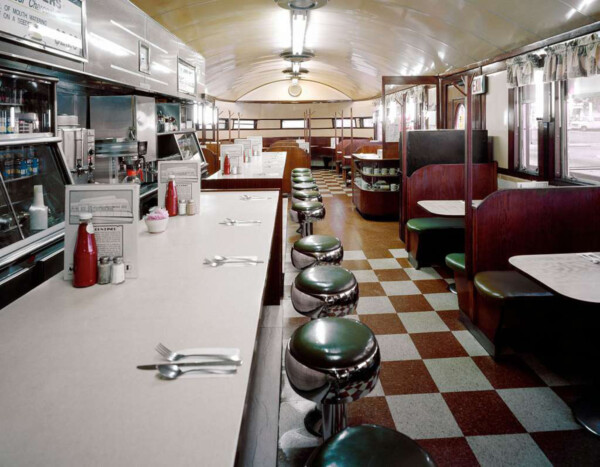
I remember “Paradise Café” being based on an actual place. Was that actual place named “Paradise Café” or something else? I can’t remember. Nor do I recall where it was located. We ate lunch a few times at a little seafood shack in Freeport, Florida, that bears a resemblance to the diner in this story. But there was also a joint called The Red Bar in Grayton Beach, Florida, that looks like the actual “Paradise Café” building. Maybe it’s an amalgam of the two.
What counts is that Rochester Allston, as do the protagonists in many horror stories of that era, meets his comeuppance. The reward for doing bad things, even for burned out, hopeless, shopworn old Bible salesmen, is often terrible and eternal.
And it is always couched in irony.
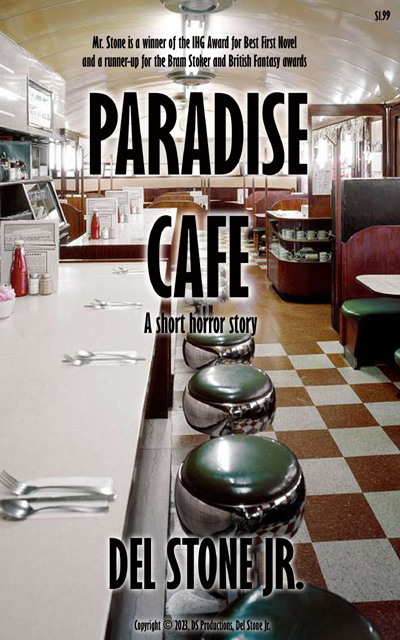
So take a seat in the Paradise Café. Wash your hands after handling the menu. They won’t have beer, but you can order an ice-cold Coke, and maybe a BLT.
Just be careful leaving.
You never know what will follow you out of a place like that.
—
PARADISE CAFE
The sign read “Paradise Cafe,” Rochester Allston saw. It was written in florid cursives that were dirt-smeared and eaten at the edges. The painted letters seemed to run in the oppressive heat of the Mississippi afternoon.
And he thought, Oh. Lord.
He slid the straw hat from his brow; it came off like it had been greased. He waited for dust to settle, then rolled down the Falcon’s window a little farther and tested a smothering breath.
This heat … playing hard on the old man. And then he almost remembered … a distant screech of tires, or was that only the echo of a memory? He still couldn’t deny it, just as he could not deny the dream that had followed, the dream that was so repugnant his mind kept all but its presence concealed from him by day, the particulars lurking in his subconscious to emerge at night as he slept, so that he awakened slicked in cold sweat, and remembered only that he had screamed.
Forget it.
He breathed more deeply and the sign still read “Paradise Cafe” and he remained hot, hotter than he’d ever remembered, soaked to the bone with sweat, his back and his armpits pools of damp, spots of perspiration little crawling things loose inside his clothes. The Falcon was sweltering with the windows down, as he’d driven the Mississippi backroads, and now that he’d found what passed for paradise the heat was everywhere at once, a drowsy presence slithering beneath a patina of road dust and grime and endless afternoons on the road, talking – talking – talking –
He’d have traded his soul for a frozen mug of Wiedemann Bohemian Special. Or just a Coke – anything cold.
He snapped shut the sample case to his right. It’s the heat. That’s what’s got me whipped, he told himself, the thought slurred and indistinct as the afternoon took hold of him. Heat. And no sleep.
He opened the car door and grabbed the case, his shirt peeling from the vinyl seat like a clammy second skin. The case was heavier than he expected; it contained a depressing burden of unsold plastic Jesus dashboard ornaments, clasped-hands-in-prayer bookmarks, and most worthy of all, the Living Waters Bible, the word of God made comprehensible to the feeble minds that populated these sweaty backwood towns through large type and lots of pictures, which at the sacrifice price of only $9.95 plus tax was reasonable beyond the expectations of any God-fearing Southern Baptist … or the legions of pretended faithful.
Well, that’s what you’d think, anyway.
He got a better grip on the case, shut the car door with his hip. He walked toward the door, half expecting hound dogs to rush out, sniffing at his heels and urinating on the car tires. The case was an anchor, dragging at his body, and as he took the steps to the door he thought of cool afternoons spent beneath ancient oaks, wrapped in the slow swoon of a hammock and the easy slumber peculiar to Saturdays when nothing needed doing anytime soon. Once, life had been like that. But it seemed things would never go that way again.
Sleep.
He pried open the screen door, stepped into the grainy twilight inside the restaurant, and found the ubiquitous heat in here, too. The screen door banged shut.
He looked across dusty floorboards and chipped, formica tabletops – each chair squared neatly against the table, each table fastidious with a glass ashtray, a napkin dispenser, a lunch menu laminated in transparent plastic, salt and pepper shakers – rice grains in the salt to keep it from crystalizing. A thermometer on the back wall said “Royal Crown Cola – the fresher refresher!” The temperature read 78, and he knew that couldn’t be right.
“Hullo.”
He searched for the voice, scanning the counter, rows of padded stools, and saw a shape through the window in the door that opened onto the kitchen, a suggestion of pink sliding in shadow.
The waitress appeared and moved along the counter, wielding a half-composed frown and looking flustered at the prospect of work. She swept a slick tendril of hair behind her crimped, white hat and said, “Hullo” again. The scowl deepened.
“How do you do, Ma’am,” Allston answered. He ran a shirtsleeve over his forehead, then moved to the table in the back, away from the window. It looked cooler there. The waitress followed.
When Allston had sat down, the waitress pulled out a notepad and Bic pen from her apron pocket. The name “Angie” was embroidered on the pink lapel of her blouse. Her gaze flitted, lizardlike, from the packing case at his foot to his face.
“What can I get for you?”
Allston leaned forward, propped his elbows on the table. He took the menu and scanned it quickly, looking but not really seeing what was printed there. At the top of the sandwiches column was a photo of a bacon, lettuce and tomato sandwich and a sweating Coke. He said, “I’ll have a BLT – says here you got BLTs.”
She nodded, scribbled words, seemed to stare through the pad at him. “Whatcha want to drink?”
“Beer. Wiedemann – ”
She shook her head. “Dry county.”
Allston closed his eyes. “Coke. A Coke. With lots of ice.”
She was gone in a whorl that set the dust astir. Allston yanked a napkin from the dispenser, pulled the neck of his shirt loose and took a long, slow swipe with the napkin. The glare coming through the window seemed unbearably bright, a hot ingot of freshly poured steel still glowing from the furnace. He tried to think of air conditioners and hammocks slung beneath oaks and Wiedemann beer. And sleep.
He pulled out his wallet and thumbed the bills. Two ones, a ten, and another one. Thirteen bucks. Never had he experienced such a run of sorry luck. No sales. No nothing. And then … that goddamned wreck – he couldn’t believe he’d said the words to himself. He wanted to forget – he really needed to forget about all that.
And he didn’t want to think about the dream.
“You’re a salesman, ain’t you?”
The waitress seemed to appear from the thin, superheated air. She set down a glass of water. Allston snapped the wallet shut, leaned and slid it into his trousers pocket.
“Whatcha got in your case?” She tapped it with her foot. He stooped and hefted it to the table and undid the clasps. Was she interested in buying something, or would this be another dry well?
“Oh. You’re a Bible salesman.”
“And other spiritual necessities.”
She glanced at him, then began picking and prodding at the case’s contents. He almost considered trying her out on the wonderments of the Living Waters Bible, but she’d found something else, a porcelain figurine of a young girl kneeling in solemn prayer. She clasped it like something precious, raised it to her eye and attempted a smile. She turned it to the light.
Allston said, “That’s hand-painted porcelain, ma’am. Made right here in Mississippi. It’s a beauty.”
The lines in her face hardened. She stared back at him and murmured, “I can see that.”
She set it back in the case. “You want your Coke now or with the sandwich?”
He exhaled wearily. Another dry well. He said, “Now, please.” She whirled and marched back to the kitchen.
He stared and stared, eyes away from the bright window, looking at nothing and thinking of nothing except relief, of sleep, of earlier times. It had been less complicated then, compared to now. Getting by – nothing flamboyant, but work that put bread on the table and beer in the fridge and made for lazy afternoons enveloped in dizzy lethargy. He shifted in the chair and felt his body move in a boneless rearrangement of lumps and dull aches. It was difficult to keep his eyes open. These last few weeks … he turned those events over in his mind and couldn’t touch them –
– the little girl was staring at him –
He jerked from a slouch, startled at the depths of his thoughts.
The little girl was staring.
He hadn’t noticed them come in. They’d taken the table by the window and, squinting against the brilliance, he could barely make out the blurred contours of a man – a big man, big as a diesel engine, made to look all the bigger by the sleeveless T-shirt he was wearing. His wife sat across from him and was rendered anonymous by the light. An older child sat at the woman’s left; Allston couldn’t guess its sex because of the overalls … and the little girl. The girl watched Allston with an intent that disturbed him. The little girl … she reminded him of something.
Allston pulled another napkin from the dispenser and mopped his forehead and neck. He drank from the water, frowned at its strange taste. The ice was almost melted, and it didn’t feel cool at all. Somebody had boiled a glass of water and put ice in it; that’s what he thought.
The little girl watched. She knew something about him, Allston felt. And now, he saw, her older brother/sister was staring too. Sister, he guessed. The hair. It was long; loose strands seemed to float, suspended on thermals snaking across the tabletop.
The waitress brought his Coke. He sipped and it was thick as syrup.
The family was watching him. All of them. Watching – not a word spoken among them, as if he were intruding on some space reserved exclusively for them. The room seemed 10 degrees hotter now. He breathed in gusts and glanced at the R.C. Cola thermometer. He looked over the menu again. He looked at his nails – anywhere but the window where the family baked in the sunlight and watched – where the child watched and knew.
The waitress appeared again with his sandwich, mercifully intruding on the moment. She stood between him and the window, eclipsing the square of sun. He watched her set down the plate. The toast was scorched around the edges and the sandwich had the look of something that would raise blisters on the roof of his mouth. He waited as she scribbled the check; she slid it between the ashtray and napkin dispenser, and without a word, walked away.
The girl was standing behind her.
Allston blinked and caught his breath, surprised and frightened in a single lash of tingling heat. The girl did not move; her eyes did not move, but held him immobile. Allston stared at her. He struggled and composed a slow, nervous smile. He opened the case.
“You know, I got something that might suit a pretty little girl like you.”
He withdrew the porcelain girl-in-prayer. He held it out to her. “Here. Take it.”
The child didn’t move.
“It’s yours. No charge.”
The girl reached and grasped the figurine. She did not look at it, but drew it behind her head, held it there a moment, then pitched it at him. Viciously. He was so surprised that he didn’t try to dodge or even hold up his hand, and it struck him in the forehead, landing with a thump that seemed to set every nerve in his body to thrumming. He stared in stunned amazement at her, his jaw unhinged and a cry suspended there. Her expression didn’t change. He clapped a hand over his forehead, felt oily liquid, couldn’t tell if it were sweat or blood until he looked down and saw red spatterings on his plate. Then he was overcome with nausea and thought he might puke. He grabbed a handful of napkins and held them to his forehead, a flare of pain arching behind his skull. A tear of blood ran along the ridge of his nose. The figurine rolled off his lap and clonked to the floor.
He opened one eye and looked balefully at the girl from behind a triangle of napkin. He hissed, “Get! Get outta here, you!” then closed his eyes, dropped back and let the sweaty dark come over him. His head throbbed to a cacophony of bell sounds. He felt a headache coming on, a bad one. It was hot and he’d made a mistake – a big mistake – in stopping at the Paradise Cafe and, suddenly, all eh wanted was to be away from here, this part of the country where the people seemed filled with meanness and no respect for a man trying to make an honest buck.
He folded the napkins and reached for his case, all before he saw that the other members of the family had joined the girl and were standing at the edge of his table, their faces unmoving and sinister. He gazed up at them, holding his breath. They watched. He thought he felt flickers of communication going between them. He thought if he moved something terrible would happen. Something awful. Like in the dream. That sickening twist of the gut right before the car wraps around the telephone pole, out of his – anybody’s – control. That thought again. The car. Tires.
For a half-minute he waited, his thoughts paralyzed. He moved his right hand slowly for his rear pocket, pulled out his wallet, removed three dollars and slid them between the ashtray and napkin holder, next to the check. He put his wallet back in his pocket.
They watched.
He rose, slowly. He turned his back to them …
… and shambled out the door.
The sun stung his exposed flesh like hot needles. He shimmied between his car and a big Ford wagon – it belonged to the family, he guessed – tossed in the case and then squeezed into the front seat. He could still feel the weight of their stares as he started the car and backed out of the dusty parking lot.
The sign still said “Paradise Cafe,” and he thought, Oh. God.
The car jounced over ruts, his head thumping in rhythm to the movement, and then he was on clean, smooth asphalt. A breath of wind snaked its way into the car.
That little girl … why?
Flickering light played across his rear-view mirror …
… a windshield, heliographing sunshine.
It was the stationwagon, bearing down on him at an impossible speed, rushing up from behind like some horrible predator, the jaws of its grill showing chrome-plated teeth.
Allston felt the blood drain from his head. He could clearly see them, the burly man, the woman next to him, two distinct silhouettes in the back seat.
Without thinking, he stood on the gas pedal. The Falcon seemed to groan as it accelerated. The tires began to howl. He didn’t care. The stationwagon was keeping up with him – it surged up to his bumper and then dropped back, surging forward again as if to exhort Allston to go faster, faster.
Allston had the steering wheel in a death grip. His gaze darted from the road to the mirror to the speedometer; when the stationwagon swung alongside his car, the speedometer needled had just nicked the 80 mark.
He snatched a glance at them. They were watching him with a kind of subdued glee. The little girl had her face pressed against the window, her nose a spatula of flesh on the glass, her eyes wide and piercing.
The stationwagon edged closer to his Falcon, seemed to brush it, to kiss it, so that the steering wheel lurched in Allston’s grip and he had to fight to keep the car on the road. The stationwagon veered in again, this time smacking soundly against the Falcon.
And suddenly, Allston knew what they wanted. His heart crawled into his throat. He tried to shake his head, his thoughts cramping into recollection. He heard tires. Rubber, grabbing asphalt. The memory of the accident began to replay in his mind, and he could not stop it, could only watch in silent horror. … He had been low, closer to zero than ever. Desperately low, ready to panhandle, to beg, God so low. And only if he could keep things going another week, Lord, just a week – that’s all he was asking – he could turn it around. Somehow. But he was low and the only antidote he knew for that was the road, the road and a couple of six-packs of Wiedemann Bohemian Special, to exorcise those inner voices that never relented, always reminding him that he had no chance for anything but scraping by, that somehow he had missed his calling. But on the road he was moving, and movement always held the possibility for a lucky turn of fortune, the one ingredient absent from his life at the moment. And so he’d bid good riddance to Tupelo and had taken to the road, a clutch of Wiedemann empties clanking around on the floorboards, half a dozen others scattered along the baking fringes of some Mississippi state road. Night had come with his hangover, the electric glare of the headlights an icepick boring into his skull. It was impossible to keep the car on the road; the center line was wandering over the asphalt in loose, serpentine undulations, and he could only think of the next gas station and another six-pack of Wiedemann to take the bite out of this thundering, skull-cruncher of a headache. Tires screamed, and it was a sound like mortal agony. A great big battleship of a stationwagon was hurtling past, slewing sideways, and for a stuttered second he had seen the little girl’s face, illuminated in the pools of his headlights, frozen in his subconscious for all time. The little girl. Her mother and father. An older sister. The stationwagon swept by his Falcon, shrugging into the soft road shoulder and flipping to smash full-on into an embankment. And then it had exploded, the fire sucking out his breath and the light from his eyes, the sound from his ears, giving it all back in a sudden, terrific CARUMP that had jarred him clear to the bone.
The car had burned. Oh God, it had burned.
He didn’t stop. He didn’t stop. He couldn’t stop, Oh Jesus, not with the empties rolling around in the floorboards and he didn’t stop, he didn’t and instead he’d run, just put the pedal to the firewall and run, all night and into the next scorching afternoon, just run anywhere, and he had to forget, he had to wipe it from memory because …
… now they came to him. In the flytrap motel rooms where he stayed when he could scrape up the bucks. In the roadside taverns where he drank to forget. In the rest areas … all the places he dared to sleep.
And that was what he could never remember, the rational part of his mind fending off recognition until the last possible moment and then purging it just as quickly. The little girl. Her family. That was the dream. Stalking him as he slept. Sending him to his death until he came away clutching a mattress or the leg of a barstool or the steering wheel, unable to remember exactly what he had dreamed but feeling an ugly presence slithering back into the inaccessible regions of his brain, waiting … waiting for him to sleep again.
He needed to forget. What had happened. What he’d done. So he would be rid of them.
That stationwagon smashed into his car. Dimly, he heard glass shattering. The steering wheel spun crazily and there was a breathtaking moment of weightlessness as the Falcon skidded off the road and somersaulted once, twice, a sickening cacophony of metal concussions drowning out any other thought but terror. The roof came down on him and he felt bones snapping. Detonations of pain erupted across his body. Something speared him in the ribs. He couldn’t breath.
The car settled with a final, jolting shudder, and Allston knew what would happen next. What always happened next. The delicate cough of spilled gasoline igniting. Flames racing through the car. He would burn, Oh God, he would burn. Scream and burn. He told himself he was dreaming this, that he’d fallen asleep at the Paradise Cafe and soon the frowning waitress would be tapping him on the shoulder to tell him his sandwich was ready and he’d awaken and know he had dreamed the awful dream again, that if he were to preserve his sanity he must erase the past from memory. He must forget.
Fire began to eat at the upholstery. He wondered if the dream always seemed this real.
—
The waitress knelt and picked up the porcelain girl-who-prayed. She remembered what the deputy said.
Heat stroke. Had t’be heat stroke, though Jesus knows I never seen a case worse’n this.
Blisters. Flesh like a slug that had been dipped in rock salt. Christ, what the hell had happened?
She crossed the dining room and stood for a moment in front of the air conditioner grate. Red ribbons waggled on the chilly draught of air and tickled her face. It felt good, and it offered a temporary refugee from the stink of burned hair.
Then she disappeared behind the door to the kitchen, where dishes needed washing, and hot thunderclouds of steam curled darkly at the heart of paradise.
About the author:
Del Stone Jr. is a professional fiction writer. He is known primarily for his work in the contemporary dark fiction field, but has also published science fiction and contemporary fantasy. Stone’s stories, poetry and scripts have appeared in publications such as Amazing Stories, Eldritch Tales, and Bantam-Spectra’s Full Spectrum. His short fiction has been published in The Year’s Best Horror Stories XXII; Alfred Hitchcock’s Mystery Magazine; the Pocket Books anthology More Phobias; the Barnes & Noble anthologies 100 Wicked Little Witch Stories, Horrors! 365 Scary Stories, and 100 Astounding Little Alien Stories; the HWA anthology Psychos; and other short fiction venues, like Blood Muse, Live Without a Net, Zombiesque and Sex Macabre. Stone’s comic book debut was in the Clive Barker series of books, Hellraiser, published by Marvel/Epic and reprinted in The Best of Hellraiser anthology. He has also published stories in Penthouse Comix, and worked with artist Dave Dorman on many projects, including the illustrated novella “Roadkill,” a short story for the Andrew Vachss anthology Underground from Dark Horse, an ashcan titled “December” for Hero Illustrated, and several of Dorman’s Wasted Lands novellas and comics, such as Rail from Image and “The Uninvited.” Stone’s novel, Dead Heat, won the 1996 International Horror Guild’s award for best first novel and was a runner-up for the Bram Stoker Award. Stone has also been a finalist for the IHG award for short fiction, the British Fantasy Award for best novella, and a semifinalist for the Nebula and Writers of the Future awards. His stories have appeared in anthologies that have won the Bram Stoker Award and the World Fantasy Award. Two of his works were optioned for film, the novella “Black Tide” and short story “Crisis Line.”
Stone recently retired after a 41-year career in journalism. He won numerous awards for his work, and in 1986 was named Florida’s best columnist in his circulation division by the Florida Society of Newspaper Editors. In 2001 he received an honorable mention from the National Lesbian and Gay Journalists Association for his essay “When Freedom of Speech Ends” and in 2003 he was voted Best of the Best in the category of columnists by Emerald Coast Magazine. He participated in book signings and awareness campaigns, and was a guest on local television and radio programs.
As an addendum, Stone is single, kills tomatoes and morning glories with ruthless efficiency, once tied the stem of a cocktail cherry in a knot with his tongue, and carries a permanent scar on his chest after having been shot with a paintball gun. He’s in his 60s as of this writing but doesn’t look a day over 94.
Contact Del at [email protected]. He is also on Facebook, twitter, Pinterest, tumblr, TikTok, and Instagram. Visit his website at delstonejr.com .

Warner Bros.
“Evil Dead Burn” starring Souheila Yacoub as I’ve‑Had‑Enough Alice; Hunter Doohan as weakling and coward Joseph; Luciane Buchanan as Up‑Yours Thya; Erroll Shand as bitter, mean, angry, and resentful Edgar; Tandi Wright as Gotta‑Keep‑Everything‑Together Susan; Maude Davey as funny, Alzheimer’s-addled grandma Polly; and others. Directed by Sébastien Vanicek. Score Composer Double Danger (Xavier Caux and Douglas Cavanna). Script Writers Florent Bernard, Sam Raimi, and Sébastien Vanicek. One hour, 50 minutes. Rated R. Theatrical release.
Plot summary: What happens when members of a dysfunctional family get possessed, one by one, by demons trying to keep themselves from getting kicked back to Hell? The family’s dysfunctions get amplified to 11 as they corral, at times, the demons to settle long festering, or newly minted, grudges to even the score.
Spoilers: Ah, yeah.
Mladen’s take
The Horror is all around me in real life.
The high-end apartment complex going up across from my office that only military personnel will be able to afford because they’re BAH‑ed. I can no longer access my favorite fishing spots on the beach because the Air Force has made them No Trespass land. Northwest Florida has become one giant parking lot, day or night. Oh, poser Florida Gov. De‑Insane‑tis paid tens of millions of dollars to a campaign contributor to buy worthless Norriego Point in Destin. It’ll blow away when the next hurricane hits the area and so will the tax dollars, your tax dollars, that Fahrenheit 451 Ron used to pay off one of his besties for the spit of sand. The Gulf Stream is starting to not stream as much. The Great Pacific Garbage Patch is getting greater by the minute. The Sixth Mass Extinction is well on its way to playing out. The Fabulous Five Fascists – Xi, Putin, Erdogan, Netanyahu, and Trump – still have tens of millions of supplicants enabling their “Animal Farm” ways. The Horror.
So, I groaned when Del invited me to see pretend horror in the form of “Evil Dead Burn.”
What can I say about that except this, thank you, Del, the on‑screen horror was pretty darned good. And less grotesque than what’s actually going on around us.
“Evil Dead Burn” gets a B+ from me and that’s just because of the dropped dagger thing.
Know that “Evil Dead Burn” is only mildly scary. What drives this mature bit of horror filmmaking is a solid script, good acting, and its sincere commitment to old‑style graphic violence. It’s “The Exorcist” melded with “The Omen” (the original films) with tints of “Hellraiser.” Don’t get me wrong. “Evil Dead Burn” is not as good as those classics but, tell you what, it ain’t bad.
The movie cuts to the chase really fast. First couple of minutes set up the story, so, no, you need not watch the preceding five Evil Deads to understand what’s about to happen.
Also, “Evil Dead Burn” does a good job of weaving a plot – family dynamics gone awry – with a lot, and I mean a lot, of top‑notch, true-blue and red and purple and mushy and stringy and oozing and spraying and pulpy body mutilation. Heck, a couple of scenes meandered into disgusting. Wait ’til you see how Thya infects Polly with demon seed. Yuck. Times 1,000. Can’t decide, though, which was more bonkers gross, the Polly‑Thya moment or the Susan‑Edgar make out scene. Wait, I’ve decided. It’s Thya mercilessly infecting the demented grandmother.
More than anything, though, I give “Evil Dead Burn” a nod for recognizing that events happening in the background are critical to good storytelling on the Big Screen. Pay attention toward the middle of the movie to what’s erupting behind and around our lovely and unpossessed Alice as she tries to escape the demons. Loved it. The Alice moment was a beautiful reminder of the best slaughter ever captured on cellulose. The film is “Let the Right One In” (Swedish, 2008). The set is a pool and the bloodletting distant as Oskar, being held under water, is getting bullied.
Visually, “Evil Dead Burn” sets the mood with dreary weather, a dreary landscape, and a dilapidating house. Aurally, the soundtrack does the film a solid by propelling the story without overwhelming it as happened, for example, with 2025’s “Tron: Ares.”
“Evil Dead Burn” is worth seeing in a theater. Drop the change to help make it a success. I’d like to see what comes out of the two teasers that come at the end of the movie.
Del’s take
Is an Evil Dead movie really an Evil Dead movie without the presence of Bruce Campbell? Take comfort, Deadheads. Campbell is an executive producer of this sixth installment of Sam Raimi’s low-budget horror series that began at a remote cabin in the woods way back in 1981. All the Evil Dead tropes have been lovingly preserved – the goopy, nausea-inducing gore; the cackling, maniacal demons; and the weird, leaf blower-level POV of approaching evil. What “Evil Dead Burn” offers that the first two films didn’t – “Evil Dead” and 1987’s “Evil Dead 2” – is an actual plot, and an interesting plot at that, though not wholly realistic.
The movie begins innocently enough, with a birthday celebration for Joseph Price (Hunter Doohan) at his brother Will’s club (George Pullar). Joseph’s girlfriend Thya (Luciane Buchanan) is present, along with Will’s wife, Alice (Yacoub). Will and Alice argue – it’s suggested a history of domestic violence exists between the two – and Will storms off in a drunken huff. Joseph tries to keep him from driving but Will, the older of the two, asserts himself and leaves, after which he promptly runs over a demon-possessed Jessica (Greta Van Den Brink), who causes Will to crash, and then passes the demon to him as he burns to death in the wreckage of his car.
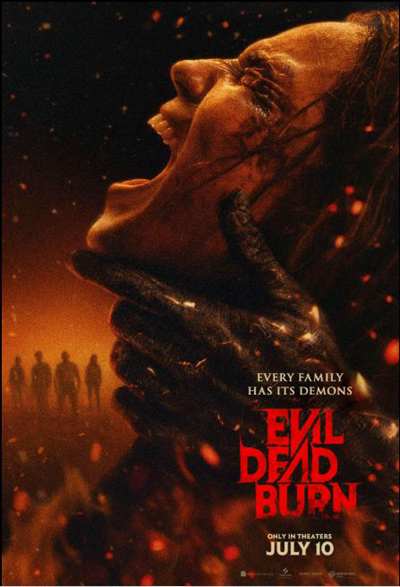
Later, the family gathers at a crematorium for Will’s service, and in a nice bit of claustrophobic horror Will’s father, Edgar (Erroll Shand) is attacked by a reanimated Will who is pounding on the casket about to be fed to the flames. Edgar now becomes the carrier and proceeds to infect the others as they gather at the old family house, now crumbling into ruin under Joseph’s neglect, for a tense, miserable wake. Will’s mother, Susan (Tandi Wright) and Edgar blame Alice for Will’s death. And they resent that it was Joseph who lived and not Will because Will was making something of himself while Joseph seemed weak and directionless.
As each family member is infected by the demon, all pretenses of civilized behavior go out the window as the possession victims find new and inventive ways to attack, and those defending themselves find new and inventive ways to fend off those attacks. There are knives involved, plus guns, plus shards of glass, plus toilet bowls, plus gasoline-powered edgers, plus chainsaws, plus a collection of pointy-tipped utensils – sharp side up, of course – arranged in a dishwasher basket. The havoc and ruin these instruments produce is displayed as graphically as current camera and computer technology allows. That bucket of popcorn you bought before entering the theater will sit untouched, and if it didn’t, the bucket will serve as a handy barf bag.
For a possible B-level horror movie, the actors in “Evil Dead Burn” do a remarkably good job. Will’s mother Susan is given a brittle grip on sanity by Wright that I found totally relatable, while Shand’s depiction of father Edgar and his seething, demon-exacerbated dementia seemed entirely appropriate to the moment. Van Den Brink is terrifying as Jessica, who kicks off the massacre mayhem by murdering two friends out for an innocent day of fishing and beer-drinking. I wasn’t as impressed with Yacoub’s Alice, who inexplicably stuck around despite having her ass kicked by her husband, and then his parents treating her like a mudroom throw-rug. The one character I actively disliked was Doohan’s Joseph, who was weak, indecisive, and failed spectacular in a moment where he might have redeemed himself.
Another aspect of the movie I found remarkable was the cinematography, which was often spectacular. As Will’s car is rolling down an embankment we’re given a look at the chaos taking place inside the car – debris hovers in midair as if gravity had been suspended. And the fight scene that takes place inside the car was the best I’ve ever seen. At one point a fire extinguisher explodes, filling the car with a cloud of white chemicals that momentarily masks the horror of who is doing what to whom.
What I think most folks won’t appreciate is the jaw-dropping violence and gore, which are on par with that notorious butcher scene from “Bone Tomahawk.” It might be the most gratuitously violent movie I’ve ever seen. “Evil Dead” and “Evil Dead 2” were both violent films, but the violence was leavened by comedy. While “Burn” has its comedic moments, the tone of the violence is deadly serious. I haven’t seen 2013’s “Evil Dead” or the 2023 “Evil Dead Rise” so I can’t compare.
I’m giving “Evil Dead Burn” a B. In ways it’s better than its predecessors, but the blood and guts were too much for me.
Mladen Rudman is a former journalist and technical writer. Del Stone Jr. is a former journalist and writer.