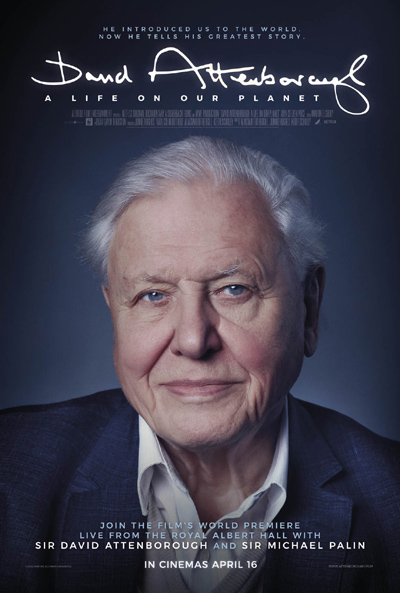
Del and Mladen review ‘A Life on Our Planet’

Image courtesy of Silverback Films.
“David Attenborough: A Life on Our Planet” Starring David Attenborough. Directed by Alastair Fothergill, Jonathan Hughes, Keith Scholey. Rated PG. 83 minutes. Netflix.
Del’s take
The most heartbreaking moment in David Attenborough’s profound “A Life on Our Planet” takes place at about the halfway mark when we see an orangutan clinging to the shredded branch of a tree – one tree – remaining in a field of clear-cut Borneo rain forest. Surrounding this pitiful creature lies destruction – jagged stumps, mangled limbs, the earth scarred by monster bulldozers.
Gut-wrenching.
That brief snippet of video perfectly encapsulates the message of Attenborough’s documentary film about the downfall of the natural world and serves as a metaphor for the future of mankind as we greedily attack the systems that make life on Earth possible.
Attenborough has a unique perspective on this tragedy. His role as broadcast journalist and naturalist for the BBC has allowed him to see firsthand the rapid decline in animal species, the fouling of the earth and the collapse of ecosystems. As a result, “A Life on Our Planet” is “my witness statement and my vision for the future,” he says.
The first two thirds of the documentary are devoted to Attenborough’s career as a journalist-naturalist and the chilling litany of ruin and destruction he has witnessed since he began covering the “nature beat” in the 1950s. Then, the plains of Africa were covered with migrating herds of wildebeest and zebras, Antarctica was a deep-freeze of glaciers and penguins, and the oceans of the world were home to thriving coral reefs.
Compare that with today: The great herds of Africa are diminished to a trickle, with some species, like the white rhino, becoming extinct. Glacier coverage around the world has shrunk, contributing to sea level rise and the possible extinction of animals like the emperor penguin. Coral reefs are dying as the oceans heat and become more acidic.
Attenborough tries to describe the relationship that exists between mankind and nature, and how the former must be preserved if latter is to survive, then devotes the remaining third of “A Life on Our Planet” to the steps we must take to save ourselves.
In the end, “We need to learn how to work with nature, not against it,” he says.
The film is a showcase of lush visuals, both beautiful and horrific, the yin and the yang of how beautiful our world once was and could be again, and what it is increasingly becoming.
I expect his “witness statement” will fall on deaf ears.
Forgive my cynicism, but I don’t hold much hope for the years ahead. People are disconnected from nature and cannot understand the gravity of Attenborough’s message. They conflate science with some kind of political philosophy. Any attempt to educate them only hardens their disbelief. Throw in market incentives to maintain the status quo, an unswerving refusal to limit population growth, and a rampant, voracious consumerism stoked by soulless corporate entities and you reach a future that resembles a science fiction novel where masses of uneducated savages are baking in the slums of a dead world, awaiting a final war to finish off the species.
I hope that doesn’t happen. I hope “A Life on Our Planet” creates a groundswell of support for those who are trying to solve the riddles of climate change, population growth and destruction of the natural systems that give us clean water, air to breath and food to eat. I hope to see the weather return to normal, to hear a bobwhite quail calling in the morning, to see moths orbiting the porch light.
In the time it takes you to read this review, 60 average homes’ worth of rain forest will have been cut down. That’s an area roughly the size of your neighborhood, gone forever.
Better hurry.
“A Life on Our Planet” gets an A+.
Mladen’s take
Shit, Del’s correct. By that I mean he correctly assessed the quality and importance of “David Attenborough: A Life on Our Planet” and the documentary’s likely impact on mankind’s environment-ruining behavior, as well as that I hate to admit Del is right about anything.
Attenborough is 93 years old. He walks with a slight hunch and his steps seem tentative, but the sparkle in his eyes, the pleasantness of his voice, and the lucidness of what he observes and says are unchanged. The Old Timer, who narrated such break-through documentaries as “Life on Earth,” “The Living Planet,” and “The Blue Planet,” should be heeded because he knows his stuff. His advice should be taken – reduce poverty to reduce deforestation, destruction of fisheries, obliteration of species; render one-third of the ocean’s littoral off limits to mankind; stopping buying so much crap.
It ain’t gonna happen, of course, as Del notes.
“A Life” makes the argument that mankind will go the way of the wild places it destroys, extinct, unless it starts preserving the atmosphere, the biosphere, and the geosphere. Attenborough’s storytelling is punctuated periodically with a counter that ticks off numbers such as the world population of humans and the percentage of wild places still left from the 1950s to today. Sobering. As the population of people grew, guess what happened to the extent of wild places? I’ll give you a clue. It’s what mathematicians call an inverse relationship.
One striking feature of the documentary might go unnoticed unless you’re paying attention. Attenborough never casts blame for the demise of nature at specific countries or leaders. Bollsanaro in Brazil, the feckless muther-f-er encouraging destruction of the Amazon, is not named. China and brutal, soulless Xi aren’t named for obliterating the country’s rivers. America and beyond-stupid Trump are not named for loosening environment preservation regulations and opening national parks and monuments to “mineral extraction.” Attenborough does use examples of sustainable activity such as agriculture in the Netherlands, if I recall accurately, to make the point mankind can have less impact on the air, land, and water while still enjoying a lofty lifestyle. To Attenborough, the environmental catastrophe facing Earth is caused by “us.” It is “our” problem. The problem can be stemmed only through global action requiring that “we” cooperate with each other.
“A Life” ends where it started, in Pripyat, Ukraine. This “atomgrad” of the former Soviet Union was the place where the people who operated the Chernobyl nuclear power plant lived. When Reactor Number 4 exploded in April 1986, all 50,000 of those people had to be evacuated. The city remains uninhabitable decades later. The radionuclides ejected into the air poisoned some of the world’s most productive land and water, crossing national borders all the way up to parts of North Europe. I assume that Attenborough chose to disregard the March 2011 Fukushima Daiichi three-reactor meltdown in Japan because that disaster is still in the early stages of unfolding.
Attenborough warns us that Earth will become Chernobyl writ planetary scale —uninhabitable for mankind — unless Homo sapiens initiates remediation now. The naturalist considers pollution and climate change significant contributing factors to the destruction of the outdoors, but not its root causes. Industrial agriculture, mining, and fishing; wanton consumerism; and human disconnection from land and sea are the culprits. He asserts we have stepped from nature and into a delusion: that the supply of Earth’s resources is infinite and that are always technologic solutions to problems caused by technology.
To illustrate there’s hope, Attenborough moves from talking about the Chernobyl catastrophe by walking through room after room filled with abandoned furniture, books, and toys to the outdoors. Large fauna (e.g., wolves, deer, and rare wild horses), the kinds of animals that end up dead or displaced when mankind moves in, are reclaiming Pripyat and so are flora. Trees are present in what were once courtyards. They compete for height with the desolate and deteriorating multi-story buildings that once housed tens of thousands of humans. It might be that vines growing up the walls of those buildings are helping them stay intact a little be longer. In Pripyat, it’s as though Nature had forgiven mankind and has started the hard task of re-nourishing the air, land, and water.
So, there it is in a visual nutshell. Attenborough shows that given enough time and space, the outdoors, and, as a consequence, mankind can recover.
“David Attenborough: A Life on Our Planet” gets an A+. Watch this documentary and then go plant a tree in your yard, somewhere, anywhere. Seriously.
Mladen Rudman is a former journalist and technical writer. Del Stone Jr. is a former journalist and author.

Image courtesy of Vertical Entertainment.
“Ava” Starring Jessica Chastain, John Malkovich, Common and others. Directed by Tate Taylor. 96 minutes. Rated R. Netflix.
Mladen’s take
“Ava,” starring Jessica Chastain as a hitwoman, gets good about halfway through the 96-minute movie. What’s the halfway grade on the scale from A to F? Correct. C. That’s the grade the movie gets from me.
Chastain is a very good actress, but what’s with very good actresses heading toward middle-middle to late-middle age and the urge to do action thrillers? We have Angelina Jolie as “Salt.” We have Charlize Theron as the matriarch of “The Old Guard.” Jennifer Garner is “Peppermint.” I imagine you can name others. Are Harrison Ford or Bruce Willis or Liam Neeson convincing as kick-your-ass man killers when they look their skins have turned to leather and their muscles are rippled rather than ripped? I loved the “The Expendables” trilogy, but only Antonio Banderas in TE3 looked somewhat like he was nimble enough to dodge bullets.
Ava is a former drunkard and Army super-soldier recruited by one of her then-commanders – played convincingly by John Malkovich as Duke until he fights and nearly kicks the shit out of much younger Simon (Colin Farrell) – to be the assassinator of guys who’ve done serious wrongs but avoided prison time. Simon is the head of the organization that arranges the hits. Duke and Ava, who are friends, too, are employees of said company.
We are led to believe that in most instances Ava moves in, takes out her target, and moves out with barely a ripple in the Force. But, of late, she’s started asking her marks what they had done that warranted the application of her skills before she applied them. For some reason, Simon is disturbed by Ava’s curiosity.
Between offing prominent baddies, Ava struggles with staying sober, tries to bed her sister’s fiancé (who was once Ava’s lover), and works hard and long to mend relations with her ailing mother, played nicely by Geena Davis. OK, so far so somewhat good, but, like pretty much every action thriller, it seems that very few, if any, other soldiers or mercenaries can shoot as good as our likeable but troubled protagonist. Or fight as good as Ava. Or take body blows like Ava, etc.
But, the real problem with the first half of the film is that it’s somewhat uninteresting because A. I could give a shit about her family woes and B. what’s wrong with knocking off a corrupt IMF economist? It’s when the movie gets personal, Ava moving to avenge Duke’s murder, that I started to enjoy the pretty redhead’s acumen and ability to focus.
“Ava” is a C, but that could be a rating that’s the result of my defective preference for straight-up violence. John Wick started puncturing Russian mobsters with knives and bullets because one of them killed his dog (which his wife gifted after her death) and stole his Mustang. I sympathize with both, though much more with the missing muscle car than a puppy. After that, the dead dog and the stolen hot rod were used by the mobsters to express disbelief about Wick’s motivation to kill them moments before he did so. Wick wanted to be left alone, but people kept interfering with his new life as a non-assassin. Ava, well, she’s portrayed as human. She wants to booze. She wants to copulate. She’s troubled by her mother’s, what, callousness and wants to repair their relationship or obtain her affirmation or whatever. Who cares? Not me, until Ava goes vengeful.
If you want to watch a movie about an assassin and the assassin’s detailed backstory, “Ava” is for you. I prefer my killers to be meticulous, stone-cold sociopaths with contempt for humanity, rather than inclination to become part of it.

Del’s take
Much as it pains me I agree with the drift of Mladen’s review. I wasn’t a fan of “Ava.” Ironically, one of the movie’s co-stars appeared as the lead in a superior action flick many years ago. Oh, if “Ava” had only been half as good.
My problem with “Ava” is that it wants to be two movies – the story of Ava the recovering drunk and the story of Ava the badass lady assassin. For an action movie viewpoint character to have flaws is perfectly fine by me, but when half the movie is spent exploring family dynamics and attending 12-step meetings, the distraction of naval-gazing amounts to more than the focus and pacing can bear.
The movie seemed populated with clichéd characters – John Malkovich as the eccentric yet deadly handler, Colin Farrell as the ruthless higher up and Chastain herself as the out-of-control rogue operative who must be exterminated for the sake of the company’s reputation. All this strikes me as VERY familiar. Maybe if they had changed Ava’s name to “Jason.”
Acting was only so-so. Malkovich is good in everything he does but he typically plays one type of character – the kind of guy who, when you walked into your junior year situational ethics class, could be standing at the podium or slouched in the desk next to you. I’ve never understood the draw of Colin Farrell, who strikes me as a tabula rosa kinda guy, and Common was simply awful. I honestly think Shaquille O’Neal could have done a better job reciting those lines.
And then Chastain … what can I say? She was totally wrong for the part. Most of the time she seemed lost and confused, her face an expressionless slate, her eyes wide with … I don’t know, introspection? Valium? Beats me, but the effect was the same. Plus, and this is a biggie, she totally lacked the physicality to play the role. During many of her fight scenes she struck me as slow, uncoordinated and dare I say weak? I wasn’t convinced.
The one redeeming performance came from Geena Davis as Ava’s bitchy, judgmental mom who’s nevertheless happy to have her kid back home, toxic secrets and all. Davis is an actor’s actor and she seemed born into that role, just as she seemed born into all her roles. She was also the star of a much better action flick that some of you old farts may remember, 1996’s “The Long Kiss Goodnight.” Samantha Caine was the romp ’em, stomp ’em action hero that Ava should have been. If only they had handed Geena a gun.
“Ava” is mostly competent in the details but not so much in the view from 20,000 feet. With a better lead actor and a tightly focused plot it could have been a better movie. From me it gets a C-.
Mladen Rudman is a former journalist and technical writer. Del Stone Jr. is a former journalist and author.
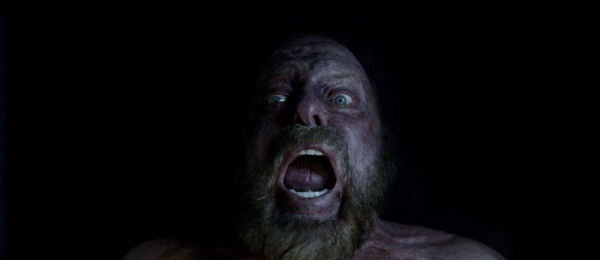
Image courtesy of Netflix.
“The Block Island Sound” Starring Chris Sheffield, Michaela McManus, Matilda Lawler, Neville Archambault, and others. Directed by Kevin McManus and Matthew McManus. 99 minutes. Unrated. Netflix.
Mladen’s take
Del warned me to avoid spoilers when I recapitulate the plot of “The Block Island Sound” because the film relies on keeping the source of the troubles endured by our protagonists secret.
So, here are a couple of sayings to help you meander through this review while I try to explain what the sci-fi-like, horror-ish “The Block Island Sound” is about without giving away the neat ending. To appreciate the ending, by the way, be sure to pay attention to the beginning of the movie. It’s the scene between mother and daughter talking about studying animals.
I’m borrowing the first indirect explanation of “The Block Island Sound” storyline from a couple of Star Trek movies: “The needs of the many outweigh the needs of the few.” I believe that’s a Spockism.
Then there’s “What’s good for the goose is good for the gander.” I have no idea where that saying originated.
The movie also portrays and warns about doing onto others, in this case marine fish, what you wouldn’t want done unto you. That truism is derived from the Bible or some other piece of historical fiction.
“The Block Island Sound” is a slo-mo film that constantly has the viewer wondering what the hell is going on. By slo-mo I mean action is limited and the story unfolds through the tension of a family that doesn’t get along. There are a couple of drunkards, the father and the son; a smart and altruistic sister and her cute daughter; an unempathetic and punitive sister; and a dead mother.
Other characters in the film are the gossip and law enforcement attitudes of a small, somewhat isolated community. A kook expounding all sorts of conspiracies about the Government, parasites, and I can’t recall what else is in the movie, too.
Semi-mass dyings of fish and birds and an apparition are also parts of the story.
“The Block Island Sound” takes place in the American Northeast, somewhere in the vicinity of Nantucket. The sea is blue-gray, as is the sky. The movie’s moodiness is similar to “The Vast of Night” or “Cosmos.”
The acting is good, even if the smart sister seems to be dumb occasionally though she’s a scientist. Chris Sheffield, playing emotionally tortured Harry, executes again and again some one of the finest examples of walking catatonia, the vacant stare and slackened face, the blank expression, a hypnotic state, describe it as you wish, I’ve seen in a movie.
Be patient watching “The Block Island Sound.” Everything is tied together at the end in pretty cool fashion. Disregard, to some degree, the family dysfunction that’s regurgitated throughout the film. It annoyed me, but I hung on until the credits rolled to see what caused the strangeness on the island and its local waters.
“The Block Island Sound” earns a B, just scraping past a B-, from me.

Del’s take
I won’t be as charitable as Mladen in grading “The Block Island Sound.” The movie was a tad schizophrenic for my tastes.
To amplify Mladen’s plot summary, the story is about a man caring for his Alzheimer’s-stricken father at the ancestral home on an island somewhere in the Northeast. His sister, who works for the Environmental Protection Agency, returns to the island with her daughter to study a series of bird and fish kills. When the father turns up missing and then deceased, another daughter, the bitchier of the two sisters, joins her siblings for the funeral. The brother resents his sisters for abandoning him to the care of their father. And now he’s seeing things. He’s drinking heavily. He’s falling apart.
For the most part the movie is competently made, and casting and script are fine (faint praise). My gripe is with the metastory. There are two stories at work here, and the McManus brothers do a much better job of telling one. The second story is not original in content or presentation.
Most interesting is the interaction between the siblings, all finely drawn by the actors. Sheffield does a good job as Harry, the suffering son who has remained behind to take care of his dementia-addled father while his two sisters pursue their lives unencumbered by familial obligations. McManus and Heidi Niedermeyer are equally effective as the two sisters who have left their ailing father in the hands of their brother, then snottily fault him for crumbling under the pressure of caregiving. The interplay between these three is sufficiently interesting to compel a watch, despite the fact that none of them is very likeable.
And the second story? It emerges slowly over the course of the action, until sometime in the second act when the climax is telegraphed, resulting in an anti-climax to wrap that branch of the narrative and the movie itself.
As many character studies go, the pacing of “The Block Island Sound” is slow, abetted by a depressing color palette of grays and steely blues, always cloudy skies, and a choppy Atlantic Ocean that does not give up its secrets. Likewise the tone is dark and funereal. You are watching the dissolution of a family as much as a mystery about dying fish and crows flying into windshields.
My sense is the overarching thematic imperative is one of loss – loss of soul due to the escalating infirmity of cognitive decline, loss of life on the part of those in the caregiver role, loss of empathy for those who have shirked their responsibilities and in the end, loss of humanity.
That’s a lot to digest in a movie that’s pitched in its trailer as being about something more congruent with a horror movie. Who wants to be entertained by grim reality when there’s a fun universe of exploding heads to be explored?
If the McManus brothers had left out the fish kills, bird kills and all the nonsense that followed, “The Block Island Sound” would have earned a B+ from me. As it is, the movie gets a C.
Mladen Rudman is a former journalist and technical writer. Del Stone Jr. is a former journalist and author.
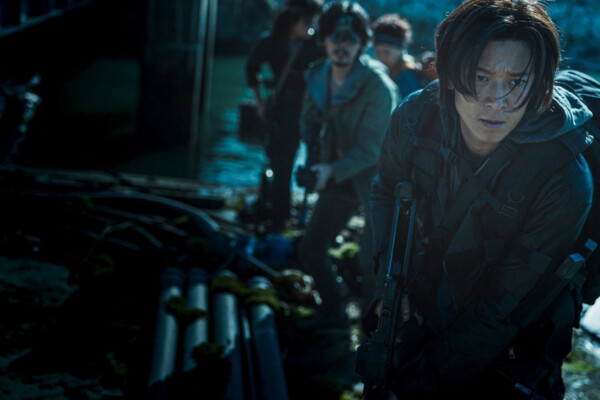
Image courtesy of Next Entertainment World.
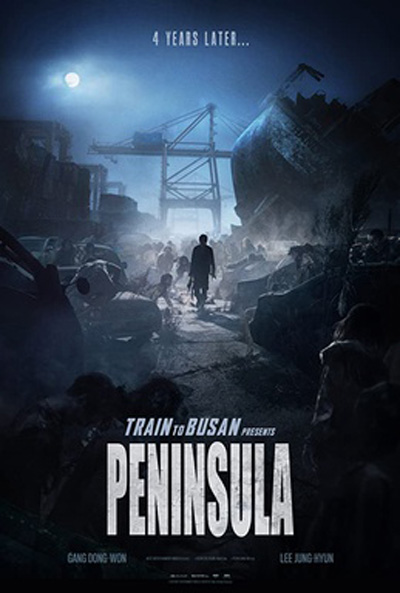
“Train to Busan Presents: Peninsula.” Starring Lee Jung-hyun, Dong-won Gang, Re Lee, Ye-won Lee, Hae-hyo Kwon, Kyo-hwan Koo, and others. Directed by Sang-ho Yeon. 115 minutes. Rated PG-13. Amazon pay-to-stream
Mladen’s take
There I sat, wavering. It was about three-fifths of the way through the South Korean movie “Train to Busan Presents: Peninsula.” My qualms included a meditation on the film’s weird title, which was clearly an example of success exploitation marketing. Was this semi-sequel to the excellent film “Train to Busan” worthy of a good grade or does it deserve a bad grade? And, then, came the straight-faced line: “Let’s get Mom.” Poof, I dropped into the “Better than Average” column, but only just.
Before I sum the plot, you’re owed a warning. Del the zombie-phile will praise this movie, maybe even slip it an A-. He’ll be wrong. The movie is one full grade lower, but worth watching. It cost me 55 cents to lease a 48-hour viewing window on Amazon.
Recall that “Train to Busan” introduced us to some very good action horror with an unremarkable plot very well executed. A bioengineering laboratory accidentally releases a contagion that transforms people into something akin to the rampaging quasi-dead hungry we first met in 2010’s “28 Hours Later.” In “T to B,” the story was driven by a father trying to keep his daughter alive, if I recall accurately, as the infected multiply and the state rapidly loses control of law and order. “T to B” possessed stunning special effects. The locomotive slowly motoring along while zombies clinging to the back of the machine pile on each other to make a squirming, yet flowing tail of organic debris was something else.
That “something else” was missing in “Peninsula.” The computer-generated special effects lacked believable physics of motion. The vehicles bulldozing through zombies, jumping roads, or smashing into each other seemed like Matchbox cars running the gauntlet of a plastic race course. Also, at times, “Peninsula” seemed very “Casshern”-like or “Alita: Battle Angel”-ish. The difference is that “Casshern,” a 2004 Japanese movie, and “Alita” of 2019 intentionally deployed the tinge of anime as part of the storytelling. “Peninsula,” which imagined quarantined South Korea four years after the “T to B” virus was unleashed, often portrayed dilapidated urban terrain or action scenes with the patina of a video game that had mated with anime to create an almost-cartoon. In short, the visual effects in “Peninsula” were surprisingly crappy.
Oh, the plot. A South Korean soldier loses his sister and nephew to zombie-itis, but manages to save his brother-in-law. A few years later, the pair gets sucked into returning to South Korea to retrieve a truck load of American dollars for an American gangster based in Hong Kong. If they and a couple of others succeed, they get half of $20 mil. That’s money that would get them out of the political limbo of being microbe-induced refugees. Naturally, the return to the Peninsula, get it, goes astray. Dong-won Gang, playing South Korea Army Capt. Jung Seok, gets pulled off a zombie dinner plate by feisty, hard-driving teenager Jooni, played by Re Lee, and her younger sister Ye-won Lee as Yu Jin. They flee to their hideout, where Jung meets resourceful, determined, and very pretty Min Jung. Min is played by Lee Jung-hyun. She’s the mom in “Let’s get Mom.” While Jung, Min, and the girls are good and likeable characters in the film, most of the bad guys are all pretty much clichés and fail to be unlikeable. The exception was Captain Seo, nicely portrayed by Kyo-hwan Koo as desperate and scheming to the end. He has no trouble shooting the old man and Mom to get the hell off the Peninsula.
The soundtrack in the film is good enough. There was a moment when I thought I heard a few stanzas, verses, whatever you call pieces of music, that sounded like an adventure tune in the video game “Halo.”
OK, Del, take it away with your take. Please don’t let the blubbery family scenes in “Peninsula” color your judgment as they did when you watched the last film we reviewed. We owe it to our growing readership to assess correctly the merits of a film.
Del’s take
It was I who recommended to Mladen that we review “Peninsula.” It was not I who recommended that he tap the cooking sherry before writing his review.
He’s correct when he describes the putative prequel to “Peninsula,” “Train to Busan” as excellent. I remember foraging through Netflix one night, searching for something to watch, when I stumbled across “T to B.” Another hokey foreign zombie flick, I warned myself, before clicking the “play” button. Imagine my surprise when I discovered a modern classic in science fiction-horror, one I’ve added to my DVD collection. “T to B” is that good. I would rate it up there with the Zack Snyder remake of “Dawn of the Dead.”
So it was with great expectations that I forked over my 99 cents to watch “Peninsula.” (I’d like to know how Mladen managed to do that for 55 cents. Did he get the cooking sherry discount?)
To put it succinctly, I was not impressed. For these reasons:
1. It’s derivative. Take the premise of “28 Weeks Later,” throw in some “Escape from New York” and using crude, Frankensteined stitches graft on any road chase sequence from the “Mad Max” movies and you’ve got “Peninsula.”
2. Mladen was right about another aspect of the film – the special effects. They weren’t just bad. They were cartoonish, on par with “Speed Racer.” They completely ruined the movie for me because I’ve seen car chases and motorized mayhem done right – all that metal-crunching comprises a story of its own. You want a car chase? Consult George Miller. You don’t hand it to the CGI folks, and that’s what the creators did with “Peninsula.” Those scenes screamed “Fake!” and threw me out of the zombie-infested universe Sang-ho Yeon sought to create.
3. Many of the major characters were unlikable. As Mladen explained, the point of this group’s return to zombie-infested South Korea is to recover a truckload of American dollars. The deal is a small group will find the truck and drive it back to an Inchon dock, where it will be loaded aboard a ferry. The group gets half the $20 million and the crooks get the other half. Ahem. Of course. The crooks will most definitely abide by their end of the deal. Have you never heard of honor among thieves?
The movie is really about Gang Dong-won’s character attempting to redeem himself after refusing to help a family in need during the initial, hyper-frantic days of the zombie outbreak. As subtexts go it’s about as subtle as a Mar-a-Lago powder room and Jung-seok is such a weak and altruistic tormented-soul type that by mid-movie you’re hoping one of his putrid antagonists makes a snack of him.
4. Nitpicks. Why does a director spend a considerable chunk of screen time building tension and setting a deadline, and when that deadline arrives the director allows his characters to engage in long, deadline-busting soliloquies and dénouements?
How is it that a car will start after sitting idle four years?
Why are children always precocious and infallible?
Why are the elderly characters always expendable?
Why does a highway choked with wrecked and abandoned vehicles always have a lane open?
Why was South Korea simply abandoned? Is its net worth beneath the scope of recovery?
5. The version I saw was not subtitled. It was dubbed. Have I ever told you how much I hate dubbing? When you can see the character’s mouth moving while the dialogue track stopped three seconds ago?
Enough fussing. Bottom line: I was hoping for a movie that matched the off-the-rail entertainment punch of “Train to Busan” and what I got for my 99 cents (Really, Mladen? Fifty-five cents?) was something altogether different and, dare I say, less everything. I could wax all movie-review poetic and talk about the film’s emotional core or its resonance to the genre template but this is not a thirst trap for pretty words. Suffice it to say “Peninsula” was a disappointment.
For much better fare about the undead try “Cargo” or the unbelievably good series “Black Summer,” both on Netflix at no extra charge. For an even weirder take on the zombie genre try Arnold Schwarzenegger in “Maggie,” which you can find in some DVD bargain bins.
“Peninsula” gets a grade of C from me.
Mladen Rudman is a former journalist and technical writer. Del Stone Jr. is a former journalist and author.
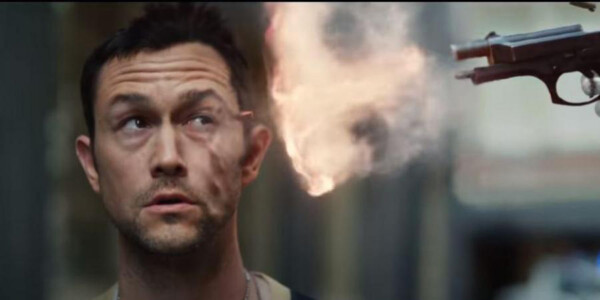
Image courtesy of Netflix.
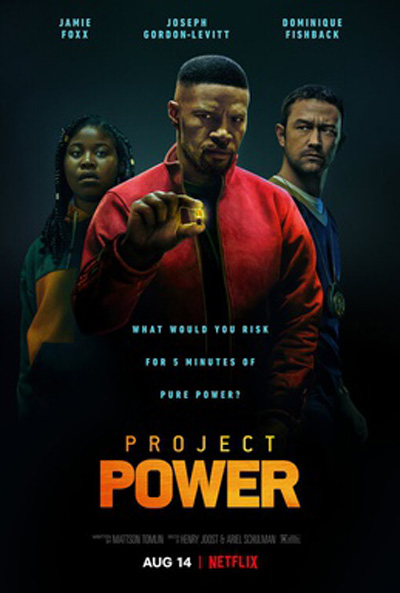
“Project Power” Starring Jamie Foxx, Joseph Gordon-Levitt, Dominique Fishback, and others. Directed by Henry Joost and Ariel Schulman, 113 minutes. Rated R. Netflix.
Mladen’s take
I watched “Project Power” a couple of weeks ago and, because the film isn’t worth re-watching, I’m writing this review from memory. Don’t misunderstand, cantankerous Del. “Project Power” is fine for a one-time seeing. Its plot is decent. The acting is good. Visual effects are good. I appreciate the effort the directors made to convey some of the movie from an artsy perspective like the basement room brawl and shootout. Hell, there was one scene toward the end of the film that made me chuckle, though it was a take on the old, “No, your other left.” And, I don’t care that one of our protagonists melodramatized the strength of the strike of a mantis shrimp. Or, was it the pistol shrimp? Or, are they the same species of Odontodactylus?
In “Project Power,” a rogue defense contractor/pharmaceuticals company disallowed to trials test a powerful physiology-altering drug that either kills you or infuses you with a unique power starts selling it as street smack. To gather lessons learned, collect proof of its discovery’s potential to the rich and connected assholes of the world, and elude mainstream press coverage, the pharma moves from city to city using pre-screened drug dealers to push its wares. Where pharma’s potion draws coverage, it’s snippets reported by the local media. One such unbelievable story was the claim that a suspect outran a police car on foot. Toss in a father’s (portrayed by Jamie Foxx) search for his kidnapped daughter, a smart young woman’s (portrayed by Dominique Fishback) need to raise money to help her mother with medical bills, and a New Orleans cop’s (portrayed by Joseph Gordon-Levitt) urge to protect his city and “Project Power” becomes a movie with too many anecdotal, though tolerable, moments.
The principal trouble with “Project Power” is its blunt-force-trauma wokeness. Blending so forcibly and pedantically the prejudices faced by blacks into a sci-fi thriller, paradoxically, weakened the message all of us non-Trumpers, anti-McConnells, and Baby Gaetz-Jerkoff Jordan-Supplicant Nunnes haters want reinforced. Racism and lack of economic opportunity for blacks is disgraceful, immoral, and illegal, but you have to be careful about whining because it’ll trigger those among us who’ll happily respond to Black Lives Matter by flippantly saying all lives matter as though there’s no history of, oh, slavery and Jim Crow in this country. In “Project Power,” unfortunately, the wokeness takes the tone of a dry, set-piece lecture.
One of the film’s strongest points is the clever and authentic way it melded the story of “Henrietta” into its script. From the ACLU website: “In 1951, doctors harvested cells from Henrietta Lacks while she was receiving treatment for cervical cancer and discovered that her cells had an amazing capacity to reproduce. ‘The Immortal Life of Henrietta Lacks,’ which aired … on HBO and is based on the book of the same name, tells the dramatic story of how scientists used the ‘HeLa’ cells in research for decades without the knowledge of her family.” As it turns out, Foxx’s character in “Project Power” is chasing pharma because it kidnapped his daughter to study and weaponize her superpower to heal. Neat.
Fishback, who plays Robin in the film, is very good. She does a wonderful job creating her character, a spunky and smart high schooler caught in an untenable dilemma. To help her mother buy health care, Robin pushes pharma’s power pill to drug users. Foxx as Art goes smoothly from appearing to be a bad guy to showing himself as the good guy, after all. Frank, Gordon-Levitt’s role, is a smart-aleck cop who pops a power pill to don his special attribute, very tough skin and/or bones that can absorb a 9-mm round to the temple from pointblank range with only bruising. He just wants to save New Orleans from itself and grifters with links, if I recall correctly, to the federal government. That subplot got a little blurry for my aging brain. Wonder if there’s a pill for lapsing mental acuity?
“Project Power” is sprayed with violence, car chases, and such. All of it good. The CGI approached to top-notch, barring the flaming dude at the beginning of the movie. He looked like he was engulfed by flaming paper streamers or one of those eerie two-story-tall inflatable marketing tubes that bop and wave at you as you drive by. I can’t remember the score, suggesting it was unnoteworthy.
Shit, I don’t know. Maybe “Project Power” is worth a second viewing. I’ll think about it. You, meanwhile, feel free to enjoy this solid B of a movie for its fairly common sequences of good moviemaking. Del, how about you getting off your ass to see this film, so that we can satisfy our loving readers with yet another good review by me and whatever it is that you slap together?
Del’s take
Yes, Mladen, there is a pill for lapsing mental acuity. It’s called Prevagen and I gave you a bulk gift basket from Sam’s Club for Christmas last year. Or have you forgotten?
I watched “Project Power” because Netflix flogged it as “No. 1 in America,” the trailer had cool special effects and it starred Joseph Gordon-Levitt, of whom I am a big fan. I know. Those are judgments based on the book cover principle. But let’s not be coy: We all judge books by their covers, regardless of aphorisms and scolding admonitions. The “Project Power” looked cool.
I thought it was an OK movie. Not great; not terrible. An acceptable use of almost two hours of my entertainment ration. Gordon-Levitt and Foxx are excellent. Dominique Fishback is exceptional. The special effects were terrific and the script was airtight. Plus it was nice to see New Orleans as the setting; I’ve been there many times and it is a unique city, unlike any other in the country. In some ways it reminds me of Spain (a tactic urban planners could adopt for future American developments – cultural design).
I didn’t have as much a problem with the “wokeness” as Mladen put it, though I would agree the delivery of that important message was clumsy and heavy-handed. It leaned more toward telling, not showing, a cardinal sin for all storytellers.
My big problem with “Project Power” was this: They took a big idea and married it to a small story.
Imagine being able to take a pill that would give you a superpower for five minutes. Imagine the potential, not just for warfare but crime, sports, law enforcement, even entertainment? Imagine such a capability in the hands of a rogue player – North Korea, or a school shooter? With this technology you have the ability to completely revolutionize society, and in the process tell a big, world-spanning story. Instead, “Project Wastes” it on drug deals and a man trying to find his daughter. It’s like discovering a cure for cancer and using it to clear up those unsightly liver spots on your hands.
Also, was I mistaken or did the movie suggest taking this drug exacted a physical toll from the user? Because some of the folks looked a little worse for wear following their excursions into the world of superpowers. I don’t believe that aspect of the story was explored to any depth.
Believe it or not, Mladen, I agree with your grade of B for “Project Power.” It has big ambitions but wastes them on a small story that, in the end, doesn’t really change anything.
If you’re looking to invest two hours of movie-watching time in a gritty, science-fictiony universe, catch “Project Power” on Netflix. But unlike its magic pill, your mind will not have been expanded after the experience.
Mladen Rudman is a former journalist and technical writer. Del Stone Jr. is a former journalist and author.
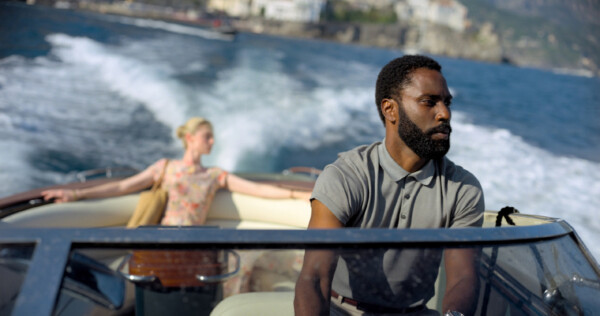
Image courtesy of Warner Bros.
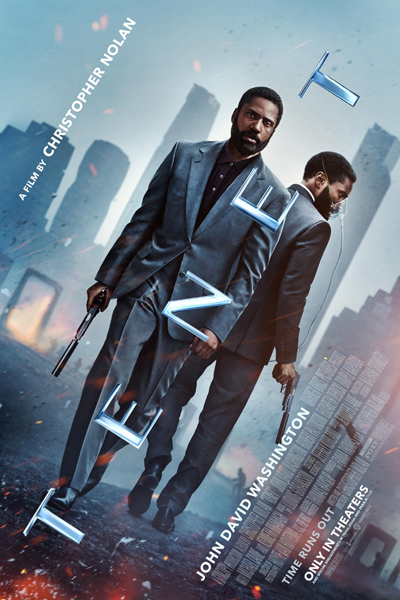
“Tenet” Starring John David Washington, Robert Pattinson, Elizabeth Debicki, Aaron Taylor-Johnson, Kenneth Branagh, and others. Directed by Christopher Nolan. 150 minutes. PG-13. Pay-per-view on YouTube, Google Play, Amazon Prime, Vudu, DVD.
Del’s take
In my dodderage I’ve become less enamored of puzzle boxes, Russian dolls, hidden meanings, subtext within subtext, Rubik’s cubes and other gimmicks, tricks, deflections and distractions – anything capable of making me believe something that isn’t true. We live in an age Qanon, ignorance on an industrial scale, conspiracy theories, corporate subterfuge and red hat-wearing politicians who not only lie shamelessly but revel in their malevolent deceit. Is it asking too much of a movie to just be a freaking movie and entertain me for a couple of hours instead of making me do a bunch of work?
I spent $15.99 on the “Tenet” DVD and I really, really wish I could get that money back. “Tenet” is well made and several of the performances are excellent, but it’s unwatchably dense and about as warm as a guest at the county morgue.
I can’t effectively summarize the plot because I’m still not sure I understand it. John David Washington is a CIA agent who, after an attack at a Russian opera performance, is recruited into an effort called “Tenet.” (Did I mention none of the characters have names?) Tenet is a war between us and the future. We have doomed the future with climate change, and the future is not happy about it. Future scientists have invented a way to “invert” the entropy of people and objects, allowing them to travel backward in time. Instead of using this inversion nonsense to head off climate change, the future would track down a cache of plutonium pilfered from a Russian ICBM … for what purpose? We don’t know. Is plutonium what they’re really looking for? We don’t know. What’s this about “The Algorithm” – has Facebook also pissed off the future, or is The Algorithm some kind of world-ending secret weapon invented by a future scientist and hidden in the past? Well, we don’t know, but since they bring it up. …
It’s a migraine-inducing onion of riddles hidden within paradoxes layered with feints and false flags, and to be honest I found it exhausting and unrewarding.
What’s good about “Tenet” is the cinematography, the locations, costumes, and some of the performances. Washington is excellent as the CIA agent and in my book would make a fine replacement for Daniel Craig when all those catalogs for Medicare start showing up in his mailbox. Also excellent were Robert Pattinson as Washington’s sort-of partner and Elizabeth Debicki as the suffering wife of a wicked Russian oligarch who may or may not be trying to acquire The Algorithm for his own demented death-bed purpose.
What I did NOT like about “Tenet” was the blink-your-eyes-and-miss-critical-plot-points narrative, the mumbled and often indecipherable dialogue, the lack of any pathos (which is typical of Christopher Nolan’s fare) and the unfathomable density of the plot. It seems Nolan is making movies for himself, not his audience.
After everything that has happened the past four years, my brain is only capable of processing movies like “Hobo with a Shotgun” or “The Man Who Killed Hitler and then the Bigfoot.” I would need a few less pandemics, insurrections and climate catastrophes before I could enjoy “Tenet.”
If acting and cinematography were the only criteria I could give “Tenet” an A-. But its hard-to-hear dialogue, lack of an emotional heart and black-hole density bring that grade down to a B. If you’re up for doing the work Nolan seems to ask of his fans, knock yourself out. I wasn’t.
Mladen’s take
Alas, I share Del’s frustration with “Tenet.” Despite his dodderage and, believe me, it’s advanced, he’s correct about the film. “Tenet” is a mess in execution.
Actually, I’m more frustrated than Del because I disliked the suffering wife/doting mother character played by Elizabeth Debicki. She damn near caused the destruction of 7 billion people in our time because she didn’t want her one son to be traumatized by, oh, hell, I forgot the reason.
“Tenet” is based on a neat concept. In this nicely shot film, people are able to move backward or forward in the same space. The spacetime of “Tenet” (the word reads the same backward or forward) can be separated into space and time by scientists from the future, which, as Del notes, are waging war against the present by allying with, and supporting the martyrdom of, a Russian oligarch portrayed beautifully by Kenneth Branagh.
Demonstrating the usefulness of the capability to manipulate time – again, a neat concept – is badly mangled in “Tenet.” Particularly difficult to understand are the “temporal pincer movements” unfolding on the screen as opponents move along the time continuum in which every direction they thought would produce tactical advantage. So, for example, you have cars moving forward and backward in the same lanes. Or, you have one unit of troops starting, executing, and completing a mission and another completing, executing, and starting the same mission on the same battleground. Hell, in this film, a man can fight himself, one version of him being from the present and the other “inverted” or from where, the future? Now that I think about it, there might not be a present, past, and future in “Tenet.” In this film, time is jumbled and coils around itself, like a ball of yarn, rather than being a point-to-point, straight line event. Maybe.
The most annoying part of “Tenet” to me, for some reason, was the film insisting that an “inverted” bullet – that is, a bullet exiting your body in the same direction it had entered (I think) – would cause more damage than a bullet entering your body from the same direction it would exit. Wouldn’t a bullet reversing course and leaving your body return your body to its pre-bullet state? If the phenomenon is someone shooting you who’s inverted – while you’re what, verted? – why would there be damage at all?
I’m tempted to give “Tenet” some slack. The idea of time travelers moving in opposite directions while sharing the same space in a way that affects the outcome of the present and the future simultaneously is far out and wonderful. “Tenet” still has me thinking about time inversion, which is different, apparently, than merely time travel. “Tenet” also has some very good acting. And, I enjoyed the score. It was propulsive. My surround-sound AVR has a separate volume control for the center channel speaker, which broadcasts the dialogue in a film. I was able to listen to the words because I was able to turn-up their volume without also increasing the volume of the many explosions and much gunfire in “Tenet.” Del, I did hear the dialogue but it didn’t help me understand the movie any better.
Finally, “Tenet” was ripe for R-rated action. Yes, not showing graphically a man getting beaten to death with blows to the head using a gold bar is a terrific way of capturing violence. More is left to the imagination. But, much of the movie is loads of people shooting at each other or getting their asses mortar-ed. That would have benefitted from vivid blood splatter, heads disintegrating, and limb amputations. Making “Tenet” PG-13 was an error. This movie is not for teenagers nor will teenagers watch it. “Tenet” pushes toward cerebral. Teens ain’t interested in cerebral on the big screen. They want crude, sexual, and narcissistic, the kind of film one-term, poser president, loser Donald Trump would watch.
“Tenet” is a C because it promises top-notch sci-fi adventure and then fails to deliver.
Mladen Rudman is a former journalist and technical writer. Del Stone Jr. is a former journalist and author.
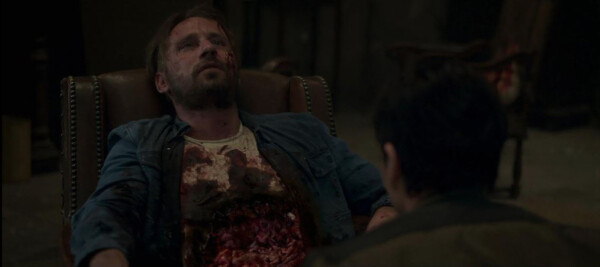
Image courtesy of Netflix.
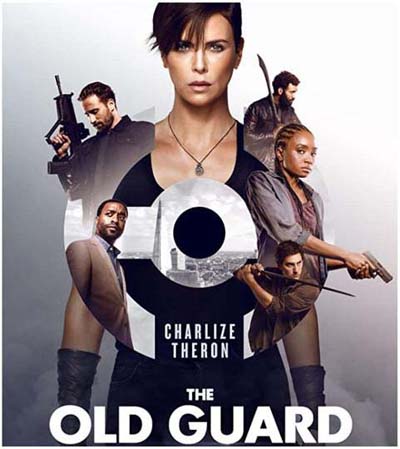
“The Old Guard” Starring Charlize Theron, KiKi Layne, Matthais Schoenaerts, Marwan Kenzari, Luca Marinelli and Chiwetel Ejiofor. Directed by Gina Prince-Bythewood. Netflix. 125 minutes. Rated R.
Del’s take
I predict Mladen will love this movie.
He’ll give it 17 stars, an A to the nth power and at least one second watch, maybe two.
He’ll rhapsodize about the gore, the “Matrix”-esque firepower, the jaw-dislocating fight scenes, the insurance-adjusting destruction, and the fact that it stars Charlize Theron, who is developing quite the reputation as a badass rock ’em sock ’em fighter chick who can hang with The Road Warrior and now the semi-immortal do-gooders of “The Old Guard.”
And for once he won’t be wrong, for the most part, though I am going to skip the rant where he goes into the Dolby SurroundSound decibel whatevers.
“The Old Guard” is a Euro-sleek production that gives off more of a socially glib James Bond vibe than any “Atomic Blonde” or “Salt.” These globe-trotting polyglot martial artists who can strangle a mercenary wearing body armor while parsing a slab of baklava with their taste buds might just be the new thing, if Netflix plays its cards right, and clearly it intends to try – the movie is set up as Entry No. 1 of a franchise.
The story is based on the Greg Rucka-Leandro Fernandez comic book from Image: Some people, like Rob Lowe, are born with an inability to die. Shoot ’em, stab ’em, toss ’em in front of a Freightliner and a minute later they pick themselves up, dust off the tire tracks and carry on, their hair slightly out of place. The band of immortals in “The Old Guard” has taken crime-fighting as its joie de vivre. At least they’re not running for office.
After thousands of years the immortals have, shall we say, developed a fighting skills set second to none. Even if they weren’t immune to your bullets, they could stomp your ass with ease. And that’s what this movie is about – stomping ass, in this case an evil big pharma company (is “evil” redundant when coupled with “big pharma”?) that wants the secret to their longevity.
It all works, and it works well. I had no problem with suspension of belief, and that’s something I struggle with every single time I watch a superhero movie. Acting was spot-on, although Harry Melling’s Merrick, the big pharma chieftain, drifted into the fringes of self-caricature. Pacing was brisk with the occasional infodump that lowered the octane of carnage, and the characters were well-developed, spoke intelligent (sometimes funny) lines and otherwise provided a level of empathy that rendered them as human beings, not comic book cannon fodder.
The quality of Netflix movies is improving to the point the streaming service is as legitimate a moviemaker as any brick-and-mortar studio. “Bird Box,” “Extraction” and now “The Old Guard” are entertaining movies available to anybody with a subscription. You must, however, provide your own buttered popcorn.
The movie is rated R, which should salve Mladen’s fragile, French soap-scented movie-watching ego, and it comes with enough shell casings to earn you a profitable trip to a dopamine addiction treatment facility.
I give it an A-.
Mladen’s take
I’d disagree with Del’s prediction about me “loving” this film, but I don’t want to hurt his fragile feelings.
“The Old Guard” is solid action fare based on the principle that immortality has an expiration date. An A-, though? I think not. Let’s go with a straight-up B and the recommendation that you see this film. And, as an aside, Del’s description of Charlize Theron should’ve included “really good-looking,” maybe before “badass.”
The justification for the B is that there are moments when the movie slides toward morose. It’s Theron’s fault. She portrays the character Andy. Old Guard leader Andy is wracked by the obvious, which should’ve been even more obvious to her because she’s, like, hundreds of years old. You see, Andy, now a 21st century denizen has started asking the question, “Is mankind worth saving?” Sheesh, Mankind has been unworthy of existing since we descended from the trees and started walking the plains.
So, the strategic problem with “The Old Guard” is that it needed justification for the mercenary ways of the troop of semi-immortals, recently joined by KiKi Layne’s Nile. That justification, alluded to above, is banal: the Guard sprays limited-spectrum helpfulness adjuvanted with the hope that humanity deserves salvation despite the overwhelming fratricide it practices day in, day out. The Guard exists to fumigate dickheads modeled on assholes such as Bashar al-Assad and Donald Moron Trump, but is sidetracked by the amoral Big Pharma nerd mentioned by Del. The nerd reminded me of real-life “Pharma Bro.” Remember Martin Shkreli? He raised the price of an antiparasite drug 5,000 percent. Who tends to suffer from parasitic infections, say, malaria? Uh huh, the poor. Did upping the price of Daraprim make it more affordable for them or the nonprofits helping them? No. But, would have whacking Shkreli made a difference for mankind? No, because along came another Big Pharma executive, this one female, to hyperinflate the price of antihistamine auto injectors, i.e., the life-saving product known generically as an “epi-pen.”
I agree with my fellow co-reviewer. The characters in The Old Guard are nicely developed. They have on-air chemistry. They’re the socially acceptable mix of female and male, heterosexual and homosexual, and race. There’s a neat ambiguous betrayal, too. At the end of the movie in preparation for The Old Guard Chapter Two, an important-to-be partial-immortal of Asian ethnicity is introduced. Her entrance is laced with portent.
Also pluses are the film’s allusions to real-world grotesqueness: the use of chemical weapons on luckless people, the kidnapping of children by fundamentalists, and the aforementioned Big Pharma sleaziness. The movie’s locales are stark such as desert or claustrophobic such as heavy urbanization. The Guard moves about by bartering deals with lower-level scumbags. Hey, you gotta do what you gotta do to get to the higher-level scumbags.
And, yes, there’s the violence. It’s a nice mix of hand-to-hand, blade, and bullet peppered with an occasional explosion. The more speakers you’re AVR is driving during the film, the better.
From a production standpoint, “The Old Guard” clearly demonstrates the way streaming has changed moviemaking. Films have become a global enterprise. One wonders who’s financing them. I hope that by enjoying “The Old Guard” I didn’t indirectly make Putin, Xi, or the petty tyrants running places like Singapore or East Europe richer. Who knows? Maybe Putin or Xi knockoffs are on the list of muthers who are eradicated by our band of benevolent PMCs in the next film of the now nicely rooted franchise.
Mladen Rudman is a former journalist and technical writer. Del Stone Jr. is a former journalist and author.

Image courtesy of Netflix.
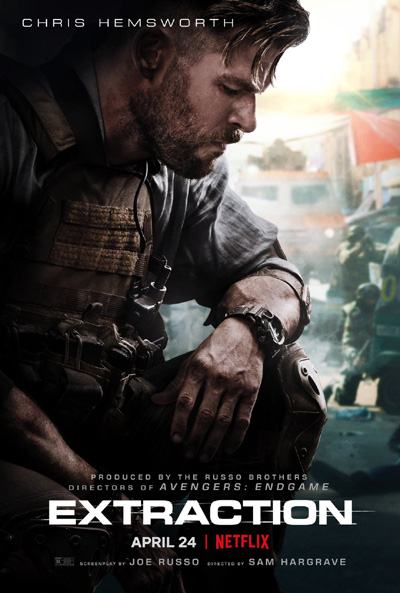
“Extraction” Starring Chris Hemsworth, Bryon Lerum, Ryder Lerum, Rudhraksh Jaiswal, Shivam Vichare, Randeep Hooda, David Harbour, and others. Directed by Sam Hargrave. 116 minutes. Rated R. Netflix.
Mladen’s take
Think of “Extraction” as a John Wick movie with two John Wicks. The film is as good as “John Wick Chapter 3,” which was less good than “John Wick Chapter 2,” which was less good than “John Wick Chapter 1,” a delightful action blockbuster and the Gold Standard for depicting personal violence on the big screen. “Extraction” is worth seeing. It’s closer to a B+ than an A-. And, don’t confuse this “Extraction” with the “Extraction” starring Bruce Willis. Apparently, the Willis film is the opposite of good.
Hemsworth’s character Tyler is a PMC with a guilty conscience. It’s the guilt that yields some banal chatter between him and his teenaged ward and even, get this, tears. The emotional putridness is what pushes this hostage rescue movie into the upper B range. Hell, I expect touchy feely Del to condemn me for my dislike of the effort to introduce warmth to the movie. So, Del, let me be clear. I find it more endearing that Wick whacked a bunch of people for killing his dog and stealing his classic Ford Mustang than Tyler’s decision to save a privileged youth who lives in a society built on unimaginable inequities. The income gap, houselessness, and medical insurancelessness in America ain’t nothing juxtaposed to what upper caste Indians do to lower caste Indians.
The action, violence, and tension in “Extraction” are a whole ’nother story. Give that subset of the film a sparkling A.
On this side, we have Tyler and his Australian army commando good looks and pumped body and, on the other, Saju, portrayed wonderfully by Randeep Hooda. Tyler and Saju, a former Indian army commando with flowing long, dark hair and chiseled jaw, are initially foes and ally later in the movie to execute the good deed. They are the muscular playthings of a feud between an Indian drug boss and a Bangladeshi drug boss. Much of the action takes place in Dhakka.
The fight sequences of the two Wick mimickers against each other and corrupt Bangladeshi army troops are top-notch choreography. There’s hand-to-hand. There are close-in pistol shots to heads and thoraxes. Thoraxi? Thoraxae? There are assault rifle gun-downs at medium range. And, there are exploding heads via snipers at long distances. Damn fine Wick-y-ness. But, though I hate to admit this, there is one prolonged gun battle toward the middle of the movie that ran too long. It was reminiscent of a battle sequence in “Battle LA” that also held children in peril for an interminable period.
Tyler and Saju absorb wicked abuse. It’s the sort of abuse that none of the other shooters in the movie could take. The PMCs recover faster from lacerations, contusions, and blood loss than Donald Moron Trump and William Stay Puft Barr violate the U.S. Constitution. The good part? There’s no effort to explain Tyler’s and Saju’s resilience by pointing out that they are forces of pure will. The two are well-conditioned dudes with a single goal driven, ultimately, by self‑interest. Plausible.
It would be a mistake to ignore the potent character played by David Harbour, as brief as his appearance in “Extraction” is. Harbour portrays another PMC and is Tyler’s long-time buddy. Slimmed down from his days as the sheriff in “Stranger Things” and imposing, Harbour is terrific as the merciless, though he argued otherwise, mercenary. He almost persuaded me to back doing what he wanted to do. Remarkable. Ten million dollars is a lot of money, after all.
“Extraction” also benefits from a very good original score by Henry Jackman. Its tone fits the film. The score’s moodiness, modernity, despair, and a touch of “everything-will-be-all-right” move the movie by helping pace it and adding atmosphere. Maybe this also means that streaming services are now starting to attract capable composers. What would “Jaws” or “Star Wars” be without John Williams? “The Good, The Bad, and The Ugly” or “The Thing” without Ennio Morricone? Almost nothing, I argue. To me, the sound in a movie, including its score, is more important than the visuals. That means what? Yep, to enjoy “Extraction” correctly you need an AVR pushing as many speakers as possible at decibels that will annoy your neighbors up and down the block.
Finally, yes, the ending of “Extraction” set up a sequel. Who was that stranger standing poolside?
Del’s take
I expect to visit Mladen one day and find him sunning on a rock with the lizards that make up his band of cold-blooded brothers. He might flick his tongue to catch a fly, then bask in exothermic bliss as he digests his snack, untroubled by emotion or feelings, a Mr. Spock among iguanas.
But enough hissing.
I thought “Extraction” was a much better movie than Mladen’s fussy take and I’m surprised he went in that direction. The movie is a bloodbath that by comparison reduces John Wick to a milquetoast Mr. Rogers guest starring on a Richard Simmons workout video. I was black and blue from just watching it. Sure, Hemsworth gets choked up when remembering the death of his little boy. Who wouldn’t? It was 30 seconds of characterization that lifted Hemsworth from the realm of Van Dammit and Rambot into the arms of relatable human beings. I don’t mind seeing my heroes bleed.
The story is simple: The 14-year-old son of a jailed drug lord is kidnapped by a rival cartel chieftain. The boy’s father is understandably pissed and tells the boy’s chagrined guardian to get him back, or else. You’ve probably watched enough episodes of “Narcos” to know what “or else” means in drug lord-speak. Problem is, the government has frozen the drug lord’s assets, so there’s no money to hire the army necessary to free the boy.
The solution? Hire Thor.
And that’s it. Get the kid back. A hammerless Chris Hemsworth swings into bloody action, laying waste to corrupt Bangladeshi soldiers, hired triggermen, a band of rotten brats sprung from the imagination of a methed-out Charles Dickens, and even a former pal who wants to retire but lacks the necessary funds … until now.
The mayhem is fast and very, very furious with lots of shooting, beatings, car chases, stabbings, and even one scene where Hemsworth pummels a guy into a senseless stupor with a stove pot. It makes a delightful clonky sound and I couldn’t tell if it was coming from the pot or the guy’s head.
Hemsworth’s character, Tyler, is motivated to go above and beyond by the memory of his child. When the boy was diagnosed with a terminal illness, Tyler chose another tour of duty in Afghanistan over remaining stateside to preside over the boy’s decline and eventual death. His wife left him over that – deservedly so. And now he must atone for that sin of abandonment by not abandoning another child in need. Yes, his teenaged ward is the son of a drug lord, as Mladen pointed out. But he’s 14, for Christ’s sake. He hasn’t made any of his life’s choices, except which PornHub channel to bookmark. You can’t blame him for his father’s poor choices.
The movie was well-done in many ways, from the setting to the script and even Hemsworth’s performance, which was not overbaked and in some ways contained surprising and, dare I say it, heartwarming subtleties.
So the movie worked for me and I’m rating it a solid A. The only thing that could top it would be a movie that paired Hemsworth with immortal Charlize Theron to kick Godzilla’s ass. Take THAT, Mladen!
You want action without caricature? You want “Extraction.”
Mladen Rudman is a former journalist and technical writer. Del Stone Jr. is a former journalist and writer.

Image courtesy of Sony Pictures.
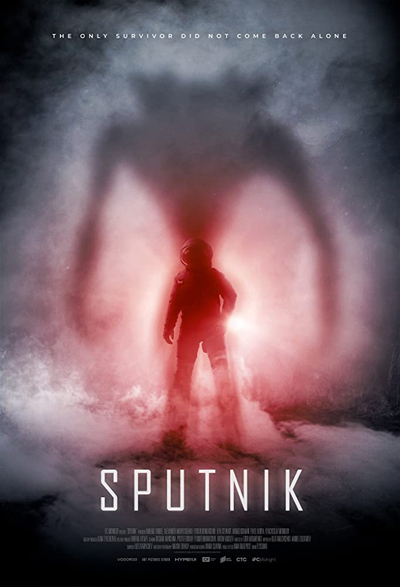
“Sputnik” Starring Oksana Akinshina, Fyodor Bondarchuk, Pyotr Fyodorov, Anton Vasiliev and others. Directed by Egor Abramenko. Music by Oleg Karpachev. 113 minutes. Amazon Prime. Should be rated R for at least gore.
Mladen’s take
If the commie pinko fascist reds of the Putin regime savaging Russia today ever build an economy and arsenal like a few of that luckless nation’s citizens built the film “Sputnik,” the U.S. is in trouble. “Sputnik” is Grade A sci-fi horror nicely balanced with the correct doses of well acted storytelling, a world class score, and sophisticated, non-overbearing CGI. The movie is in Russian, so it’s captioned. Inevitably, something must’ve been lost in translation to English, but don’t let that discourage you from seeing the film. The captioning is good enough to convey its neat ideas and the character of the characters.
The Soviet Union is only seven years from disintegrating when this movie takes place. It’s 1983. It’s still the first Cold War. And, the Politburo needs a nationalistic win to boost the country’s sagging morale. The U.S.S.R. war in Afghanistan ain’t going well. Consumer goods are in short supply, unless you’re privileged. The Communist Party is going through leaders like Donald Moron Trump goes through unqualified cabinet secretaries. So, the addled Soviet Union turns to one of its few semi successes, space travel, for a taste of accomplishment. Two of its cosmonauts go into low-earth orbit, but three passengers return.
What unfolds next will have movie reviewers inevitably drawing comparisons between “Sputnik” and one of the two greatest sci-fi horror films ever, “Alien.” Labeling “Sputnik” an “Alien” derivative would be a false equivalency, however. It’d be like bashing “Alien” for mimicking “Invasion of the Body Snatchers.” There’s nothing new in moviedom about films creature featuring critters living inside us. “Invasion” with Donald Sutherland is a terrific movie, as is “Alien” with Sigourney Weaver. In “Sputnik,” Oksana Akinshina is top notch as her character, neuropsychiatrist Tatyana Klimova. Amiably menacing Fyodor Bondarchuk as Colonel Semiradov, charming survivor cosmonaut Konstantin Veshnyakov played by Pyotr Fyodorov, and Anton Vasiliev donning the role of ambitious but riven Dr. Yan Rigel are excellent, too. Even the movie’s title is well executed. “Sputnik” means “fellow traveler” or “companion,” but, generally, in a friendly way. That’s not what we get here.
“Sputnik” is one of the finest sci-fi movies I’ve seen in years. It’s better than “Life,” “Annihilation,” “High Life” or “Ad Astra.” It approaches “Europa Report” and “Arrival” in quality in terms of applying science to decipher what’s occurring, as well as acting and atmosphere. As with “Arrival,” for example, there’s a strong and intelligent female as the principal player in “Sputnik.” There’s tension and a twist or two as the characters develop. There’s realism. In “Arrival” the militaries of the world take the lead in trying to understand the aliens that have parked ships above certain spots on Earth. In “Sputnik,” the Soviet army’s Semiradov is trying to weaponize the trilling, cute-ish, slimy symbiont emerging nightly from the esophagus of Veshnyakov to feed. Pay attention to that part, the feeding. The food the alien needs is produced by a human’s endocrine subsystem. The way the creature ensures that happens is one of the movie’s provocative and original ideas. Loved it.
Come to think of it, there’s one other parallel between “Arrival” and “Sputnik.” This one falls into the category of irritating with a caveat. Both films have annoying time spanning flashes that involve children. Where that was needed to tell the story in “Arrival,” it was not needed to tell the story in “Sputnik.” But, that’s a minor quibble.
Disregard Del’s take, if he even suggests in his introduction that the film stinks. To dislike “Sputnik” is to demonstrate short-circuited sensory response, poor reasoning, a flawed recollection of movie history, moral turpitude and full-on soullessness. Watch “Sputnik.” It’s so good that I’m hoping to buy the film on Blu-ray. This way, when some National Security Agency trained, white hat hacker blows up the internet in anger after losing his Luke Skywalker figurine still in the original package that he put up as collateral to speculate on cryptocurrency futures, I’ll be able to watch this film again and again without worrying about access to a streaming service.
Del’s take
Man, what a stinker!
(I am picturing Mladen frothing at the mouth, his eyes goggling out like one of those squishy rubber chickens.)
On second thought, mark your calendars, folks, because today is one of those rare occasions – snow falling on Labor Day, the Florida unemployment compensation site actually working – when Mladen and I agree on something. “Sputnik” is a splendid film, the kind once made in America before the MBAs took over Hollywood.
“Sputnik” is a period piece, set in that happy time frame – for the United States, anyway – of the 1980s when MTV played music videos, imported beer became all the rage and many of us had waistline measurements that did not begin with the number 4. Except in “Sputnik” we are mired in the drab, run-down Soviet Union where people seem drab and run-down themselves, perhaps wearied by the relentless and dispiriting reality of communism. Neuropsychiatrist Tatyana Klimova, who has lost her job because of her unorthodox methods, has been summoned to a remote military facility to examine one of two recently returned cosmonauts – the other is deceased – who is experiencing amnesia. Except there’s a complication and I like the way Mladen put it: “Two of its cosmonauts go into low-earth orbit, but three passengers return.”
That’s a creepy premise and the movie delivers on creep, offering start-to-finish tension that lets up only briefly to set the stage of an original and surprising finish, one I’m surprised Mladen didn’t crab about seeing as how it’s laden with sentimentality.
Mladen is right. “Sputnik” has drawn comparisons to “Alien,” but the world of fiction, be it print or moving picture, provides a surfeit of tales about small groups confined to small spaces facing a singular threat – the Agatha Christie novel “And Then There Were None,” the lighthouse couple in “Day of the Triffids,” and even the happy gang of “The Walking Dead” to name a few. “Sputnik” may tread familiar ground but it strikes its own path.
It is no coincidence a movie about a man afflicted with a destructive internal force and the woman determined to save him takes place in a creaky totalitarian regime that is rotting from the inside, and Americans should pay heed to the cautionary aspects of the movie, which equally reflect the intellectual and moral rot eating the heart out of this country. That comment may not sit well with the Sieg Heil crowd that seems to be running Washington these days, but you know what? They’ll get over it.
The Russians and Chinese are improving their movie-making skills – “Winter of the Dead” and “The Wandering Earth” are two examples – and “Sputnik” continues that trend. I don’t draw any political conclusions from this fact – I think the improvements have come in spite of their no-fun, no-inspiration political and economic systems. Like Klimova of “Sputnik,” some moviemakers in those repressed states have risen above their hopeless surroundings to find some measure of success. Let’s hope that trend is just the beginning.
I give “Sputnik” an A.
There, Comrade Mladen. Are you happy now?
Mladen Rudman is a former journalist and technical writer. Del Stone Jr. is a former journalist and author.

Recently I posted a link to a story about former Republican Congressman Aaron Schock, who finally admitted he is gay. Schock was known for opposing gay rights measures while in office.
In my post I said something to the effect that from now on, I would assume any Republican opposing gay rights is secretly closeted.
The post received a number of responses, some of them depressingly predictable in their defense of the GOP. So to clarify:
Do I believe each and every Republican lawmaker who opposes gay rights is secretly closeted?
Of course not!
That was a literary device, written for dramatic effect. Not every Republican lawmaker who opposes gay rights is secretly closeted, but some are, and they are being caught in homosexual trysts, which makes them liars and hypocrites.
I became curious about some of the examples and compiled this list. Bear in mind it’s only a PARTIAL list. I could have added more names:
Republican Bob Allen: Opposed LGBTQ rights, caught offering a male undercover officer $20 to perform oral sex on him.
New Progressive (derived from the Republican Party) Robert Arango: Opposed LGBTQ rights, caught posing shirtless on the gay sex solicitation app Grindr, resigned in shame.
Republican Roy Ashburn: Opposed LGBTQ rights (and blamed that on his constituents), arrested for DUI after partying at a gay nightclub. Admitted later he is gay.
Republican Bruce Barclay: Opposed LGBTQ rights, caught hiring gay prostitutes and shooting videos of the sexual encounters.
Republican Robert Bauman: Opposed LGBTQ rights, caught soliciting sex from a 16-year-old male prostitute.
Republican Randy Boehning: Opposed LGBTQ rights (and blamed that on his constituents), caught sending racy photos to a 21-year-old male on the gay sex solicitation app Grindr.
Republican Larry Craig: Opposed LGBTQ rights, caught asking a male undercover agent for sex in a Minnesota airport men’s room.
Republican Richard Curtis: Opposed LGBTQ rights, caught paying a young man for sex and dressing in women’s clothes.
Republican David Dreier: Opposed LGBTQ rights, discovered to be living with his “partner,” another man.
Republican Mark Foley: Caught soliciting teenage congressional pages, disgraced.
Republican Phil Hinkle: Opposed LGBTQ rights, caught offering an 18-year-old male $140 for “a really good time.”
Republican Jon Hinson: Denied he was gay, married, caught performing oral sex on a man in a Washington, D.C. men’s room.
Republican Troy King: Opposed LGBTQ rights, caught by his wife in bed with another man.
Republican Jim McRery: Opposed LGBTQ rights, accused of using his college fraternity as a front for gay activity.
Republican Glen Murphy Jr.: Opposed LGBTQ rights, caught performing oral sex on a 22-year-old sleeping man.
Republican Aaron Schock: Opposed LGBTQ rights, caught taking a shower with another man, admits on social media he is gay.
Republican Edward L. Schrock: Opposed LGBTQ rights, caught leaving messages on a gay sex line, did not seek re-election.
About the author:
Del Stone Jr. is a professional fiction writer. He is known primarily for his work in the contemporary dark fiction field, but has also published science fiction and contemporary fantasy. Stone’s stories, poetry and scripts have appeared in publications such as Amazing Stories, Eldritch Tales, and Bantam-Spectra’s Full Spectrum. His short fiction has been published in The Year’s Best Horror Stories XXII; Alfred Hitchcock’s Mystery Magazine; the Pocket Books anthology More Phobias; the Barnes & Noble anthologies 100 Wicked Little Witch Stories, Horrors! 365 Scary Stories, and 100 Astounding Little Alien Stories; the HWA anthology Psychos; and other short fiction venues, like Blood Muse, Live Without a Net, Zombiesque and Sex Macabre. Stone’s comic book debut was in the Clive Barker series of books, Hellraiser, published by Marvel/Epic and reprinted in The Best of Hellraiser anthology. He has also published stories in Penthouse Comix, and worked with artist Dave Dorman on many projects, including the illustrated novella “Roadkill,” a short story for the Andrew Vachss anthology Underground from Dark Horse, an ashcan titled “December” for Hero Illustrated, and several of Dorman’s Wasted Lands novellas and comics, such as Rail from Image and “The Uninvited.” Stone’s novel, Dead Heat, won the 1996 International Horror Guild’s award for best first novel and was a runner-up for the Bram Stoker Award. Stone has also been a finalist for the IHG award for short fiction, the British Fantasy Award for best novella, and a semifinalist for the Nebula and Writers of the Future awards. His stories have appeared in anthologies that have won the Bram Stoker Award and the World Fantasy Award. Two of his works were optioned for film, the novella “Black Tide” and short story “Crisis Line.”
Stone recently retired after a 41-year career in journalism. He won numerous awards for his work, and in 1986 was named Florida’s best columnist in his circulation division by the Florida Society of Newspaper Editors. In 2001 he received an honorable mention from the National Lesbian and Gay Journalists Association for his essay “When Freedom of Speech Ends” and in 2003 he was voted Best of the Best in the category of columnists by Emerald Coast Magazine. He participated in book signings and awareness campaigns, and was a guest on local television and radio programs.
As an addendum, Stone is single, kills tomatoes and morning glories with ruthless efficiency, once tied the stem of a cocktail cherry in a knot with his tongue, and carries a permanent scar on his chest after having been shot with a paintball gun. He’s in his 60s as of this writing but doesn’t look a day over 94.
Contact Del at [email protected]. He is also on Facebook, twitter, Pinterest, tumblr, TikTok, Ello and Instagram. Visit his website at delstonejr.com .