Del and Mladen review ‘Prospect’

Image courtesy of Dust.
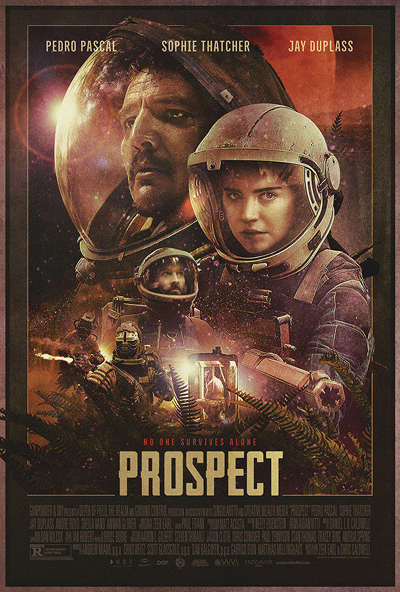
“Prospect” Starring Sophie Thatcher, Jay Duplass, Pedro Pascal and others. Directed by Christopher Caldwell and Zeek Earl. 100 minutes. Rated R. Netflix.
Del’s take
I’m always a little nervous when Mladen chooses the movie to be reviewed. There’s no telling what he’ll come up with – some giant thing crawling out of the muck to wreak havoc on mankind, most likely. But this time Mladen resisted his misanthropic tendencies to recommend a fine little science fiction movie called “Prospect,” and it’s one I think some of you will enjoy.
The plot is simple: A down on his luck prospector and his teenage daughter travel to an alien moon where a cache of valuable gemstone-like objects awaits. Recover those objects and they’ll be able to pay off their debts and lift themselves from the wretchedness of their current existence. But along the way they encounter a couple of rogues who want to jump their claim. And there’s a ticking clock – the freighter they arrived on will depart in a few days and this will be its final trip to the alien moon with its poisonous forests.
The viewpoint character is Cee (Sophie Thatcher), who loves her father but has grown weary of his ne’er-do-well ways and yearns for the life of a normal teenager. Her father Damon (Jay Duplass) is one quick get-rich scheme away from having to chase every other quick get-rich scheme that comes along. On the moon’s surface they encounter Ezra (Pedro Pascal), who in my opinion steals the show as the murderous but ultimately human claim-jumper, he of a dubious but malleable moral code.
What fascinates me about “Prospect” is the world Caldwell and Earl created to frame their story. Gone is the usual sleek, antiseptic science fictiony setting with its focus on technology, gleaming metal and blinking telltales. The world of “Prospect” is littered with garbage, tchotchkes, an alien alphabet and people who are as trashy and disposable as everything around them – in other words, a world very much like the one we live in.
The plot itself is thin, but it works. More money and bigger talent might have cluttered the story with unnecessary and distracting plot subordinates and crappy special effects, but “Prospect” plods along with relative efficiency, focusing on a single imperative: getting off this infernal moon. I say “plod” because at times the action does seem to wallow in needless internal conflict and naval-gazing. It isn’t a plot suitable for an action movie anyway, but the directors could have slain at least a few of their little darlings and moved things along more briskly, with no harm to the pacing and tone.
Another anachronistic artifact – Ezra’s peculiar diction, a strangely stilted form of speech, almost as if he were quoting from 19th century literature – struck me as distracting and superfluous. It reminded me of the dialogue in “Bone Tomahawk” and I still can’t figure out what purpose it served in supporting the character or story. In “Bone Tomahawk” it lent a weird, offbeat humor to the proceedings, but I doubt that was the intent here. Perhaps it was intended to boost the gain of the vaguely western theme? I dunno.
I loved the look and feel of “Prospect.” It was unique and different, and I have not encountered unique and different in a long, long time. The directors eschewed many of the special effects you might expect of a sci-fi flick and that works to the movie’s advantage, enhancing its grungy look and amplifying the dirt-track poverty of its three primary characters.
I think sci-fi fans will appreciate “Prospect’s” virtues but I’m not sure a general audience will feel the same. It enjoyed a brief theatrical release but from there went to video-on-demand.
I’m giving it a B+. Caldwell and Earl did a lot of things right in making this movie and I look forward to their future efforts.
But Mladen gets only a C+ for choosing it. He should have been choosing movies like this all along and not clinkers like “Ice Spiders.”
Mladen’s take
Del, though praising “Prospect,” has failed to adore this terrific piece of sci-fi sufficiently. B+ my ass. The sleeper film is an A top to bottom, left to right, and diagonally. “Prospect” is intimate sci-fi such as “Sputnik,” “Arrival,” or “Children of Men,” albeit less provocative intellectually.
There are nothing but exemplary performances in “Prospect.” Where Del chooses Pascal portraying Ezra as the show stealer, I give Thatcher’s Cee equal billing and praise.
Ezra is cunning, but abides the thief’s code of right and wrong as a “fringeling” prospecting and “digging” for gems created by living organisms. I wonder if the beasties, which eat limbs if improperly neutralized because accessing their “aurelac” requires sticking arms into their mouths, were modeled on oysters. Like oysters produce pearls from grains of ingested sand that irritate them, the whatevers on Green seem to create fist-sized aurelac the same way. Neat idea.
Ezra is a well-spoken rogue with boundaries. He has a chance to shoot Cee during a tumultuous encounter, but doesn’t. The way he demonstrates aversion to killing a child is wonderful. Nor did he sell her to god-fearing, convoluted-thinking, brazenly hypocritical religionists for a case full of neatly packed aurelac.
Cee’s reaction, measured in facial expression, when the religionists offer Ezra gems for the “girl” is compelling and authentic. It’s as though the youngster was able to imagine herself actually getting sold like property. Thatcher as Cee demonstrates uncanny acting again and again. From getting high chewing laced gum to a subtle hint of calculation and greed when Ezra offers her the prospect of collecting a fortune in aurelac to the way she urges him to keep moving with the wave of the rail gun in her hand, Thatcher is perfectly comfortable with her role as a resourceful teenager with still girlish interests. Why hasn’t she appeared in more movies? Give me more Pascal, while we’re at it. Caldwell and Earl get your asses in gear and make another movie as excellent as “Prospect.” Feel free to use Thatcher and Pascal again. They were a charismatic de facto father and daughter in “Prospect.” I imagine they could be, say, an effective mercenary duo on Earth or beyond fighting for Mankind’s survival. Maybe giving Thatcher the role of a queen reclaiming her kingdom from an alien race known as the Grist. Pascal could be a cyborg playing both sides until he witnesses the horror of Grist assimilating people.
Directors Caldwell and Earl understand that the guts of a movie is the story as captured by a good script. Visual effects can augment, never replace, solid writing and acting. In “Prospect,” the VFX are spot-on. A worn-down hi-tech world is assumed. The sound effects – the thunk of lander latches releasing, the rumble of thrusters, materials vibrating during re-entry, the clanking of “thrower” projectiles sent into hypervelocity motion – are very good, too. A soon-to-be-discontinued commuter line runs to the aurelac moon. Why discontinued? Probably because it’s no longer profitable now that the gem rush has come and gone. Who gives a shit about flora and fauna on Green, or studying it, when there ain’t no more money to be made? As the major points out in the less good, though still worth watching “Ad Astra,” humans are world eaters. Always will be.
“Prospect” is the whole works wrapped into a precise and efficient plot. The whole works includes the score. I paid attention to the soundtrack watching the movie and I listened to the soundtrack as its own medium. It’s very, very good. Have to hand it to composer Daniel L.K. Caldwell. He chose the correct orchestra and boys choir to immerse me in the moodiness of the story.
Yup, this film will be added to my Blu-ray collection. It’s that good.
Mladen Rudman is a former journalist and technical writer. Del Stone Jr. is a former journalist and author.

Image courtesy of eOne.
“Your Son” (“Tu Hijo”) starring Jose Coronado, Ana Wagener, Asia Ortego. Directed by Miguel Angel Vivas. 103 minutes. Rated TV-MA.
Del’s take
It isn’t often a movie pisses me off. I hated “Natural Born Killers” so intensely I wrote a newspaper column about it. Unfortunately, “Your Son” falls into that category.
The movie is well made but I’m not going to give it a favorable review. I thought it was a useless piece of shit, not only unworthy of the time I spent watching it but a detriment to the human experience.
The story takes place in the Canary Islands where a successful surgeon (Jaime Jimenez, played by Jose Coronado) has just saved the life of a young boy. The surgeon, who is married with two kids, receives the desperate gratitude of the boy’s parents with the understated (and possibly condescending) humility of a man who’s often sanctified by overjoyed relatives when the prognosis results in the patient remaining on this side of the dirt.
That comes screeching to a halt when his own son Marcos (Pol Monen) appears in the ER. Marcos has had the living shit beat out of him, and floating around out there is a video record of the crime. In an instant Surgeon Jaime Jimenez is deprived of his calm, confident control over events and must trust his son’s fate to other surgeons and the cops investigating the assault.
Or must he?

Thus begins Dr.Jimenez’s odyssey for revenge. Suffice it to say things are not as they seem. Both Dr. Jimenez and the audience will receive a brutal instruction in the shortcomings of human moral anatomy.
I’ve seen movies like this, and some of them can be entertaining as hell. “No Country for Old Men” comes to mind. But something about “Your Son” triggered my anger reflex. Maybe it was the horribly sexist male-centric point of view, or the “What if it were YOUR son?” question the movie seems to ask.
Speaking to that point, I would answer that if it were MY son, I wouldn’t have done ANY of the things Dr. Jimenez did. Not one. His actions seem born of a monstrous selfishness I can’t wrap my brain around. Worse, the movie, by not exploring anything beyond Dr. Jimenez’s immoral choices, seems to approve of them, as if no reasonable person could have reacted otherwise. Seriously, what would you have done if it was YOUR son?
What a crock.
I think my overall objection has something to do with the fact that in every movie about man’s capacity to be a shit to his fellow man, the story always proceeds from the assumption that, hey, these things are wrong, so don’t do them. I don’t think “Your Son” does. I think its moral center is agnostic, which sounds fine for a psychiatry thesis but sucks for entertainment.
As I said, the movie is well made, albeit slow to the point of boring throughout much of its running time. The actors do a fine job. The script is well-written. The tone is consistent with the theme.
But “Your Son” is a piece of shit. I hated it, and I won’t recommend it.
I’ll give it a C-, because despite its vile message, it’s a well-made film.
Del Stone Jr. is a former journalist and author.

Image courtesy of Benaroya Pictures.
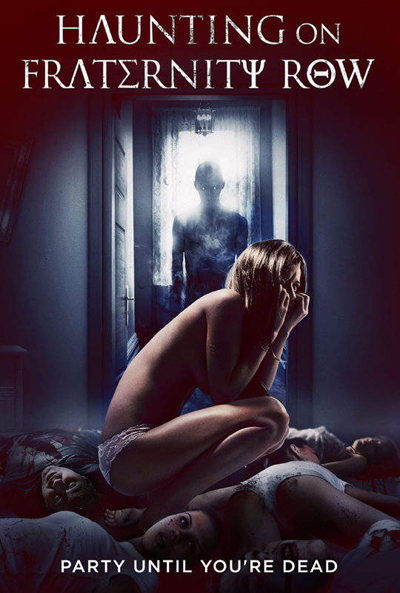
“Haunting on Fraternity Row” starring Jacob Artist, Jayson Blair and Shanley Caswell. Directed by Brant Sersen. 99 minutes. Rated TV-MA.
Del’s take
There’s no explaining my Netflix whims, but they have introduced me to surprisingly good films (“Troll Hunter, “Birdbox”) and some real stinkers ( “Open House,” “IO”).
Then there’s that gray area between, where movies that are neither good nor awful fall. “Haunting on Fraternity Row” fits that realm. You can’t expect much from a movie with the word “fraternity” in its title and “Haunting” doesn’t provide much. It’s a frat party punch bowl of clichéd characters and their predicaments that you have seen a thousand times before minus these silly details.
The story is about a group of frathouse seniors on the day of their last big bash before graduation, the annual Luau Party. They want this to be a party for the ages because although it’s never said, they seem to collectively understand their time together is soon to end and they don’t want these days to be forgotten (although they will). So the boys are busy abusing pledges, stocking the shelves with booze and kegs, setting up Hawaiian-themed decorations and flirting with sorority cleaning girls.
Speaking of kegs, the hapless pledges drop one down the basement stairs and it punches a hole through a wall, revealing a tunnel that opens into a scary room with scores of light fixtures. One of the boys refers to it as a place where “you can’t see your shadow.” Oooh-weeee-ooooh.
The room is quickly forgotten as party time approaches. Tiki torches are lit. Sand is poured for the “beach.” A slaughtered pig makes its way to the roaster. And did I mention booze? Oceans of booze – the entire output of a brewery and a distillery – is laid out in astonishing plentitude. It’s like Golden Corral buffet for alcoholics.
Frat brother Dougie (Ashton Moio), meanwhile, has been researching the house’s past and learns that a terrible event took place here decades ago – the owner at that time invited a group of people to dinner and slaughtered them. Dougie thinks the creepy room may have some larger significance than a room where a person can’t see his shadow.
The party commences, with all the alcohol-fueled, sex-starved antics you know to expect from countless movies about frat boys and the sorority girls who love them – until all hell breaks loose, and I mean literally breaks loose. Objects move, mysterious growls emanate from the shadows, and people start dying, their eyes seemingly burned from the sockets.
I won’t tell you what happens afterwards should you decide to throw away an hour and a half of your life on this movie. Suffice it to say “Haunting” has more vices than virtues. It is sometimes amusing (but not often enough), sometimes spooky, and it might just remind you of a college experience or two (not me – I commuted).
Notice that damning with faint praise? That’s because “Haunting” is mostly a hastily assembled mashup of hackneyed characters doing what hackneyed characters do – except they’re doing it in a horror movie. That might work with sufficient camp (“Happy Death Day”), but the laughs are about as unlikely as any of these dimwits getting a job after graduation.
You’ve got the rich asshole and his catty sorority girlfriend, the hunk who’s dumb as a brick, the fat pledge, the nerd pledge, the smart frat who uses his powers for, well, neither good nor evil, but nothing productive either. Then you’ve got the earnest, soulful frat, Jason (Jacob Artist), and the girl he’s crushing on, Claire (Shanley Caswell). Jason is too shy to make his move but Claire is patient and awaits his stiffened courage (not what you think) while the other boys rollick in the receding tide of hormonal sex addiction (they are about to graduate from college, after all). Will Jason and Claire hook up? Will Dougie get to the bottom of the frathouse murder mystery?
And who’s going to clean up this mess?
I didn’t much care for “Haunting.” Characters are thinly sketched. The house’s backstory is barely touched. A motivation for the “haunting” is absent. Director Sersen seems to care more about scenes of college debauchery and raunchy dialogue than telling a decent ghost story.
It’s all very cursory and sketchy. I wasn’t scared because I didn’t care about anybody. You won’t either.
For a sparse moment of fun check out “Haunting on Fraternity Row.” I caught it on Netflix, where all it cost me was 99 minutes of boredom.
Grade D+.
Del Stone Jr. is a former journalist and author.
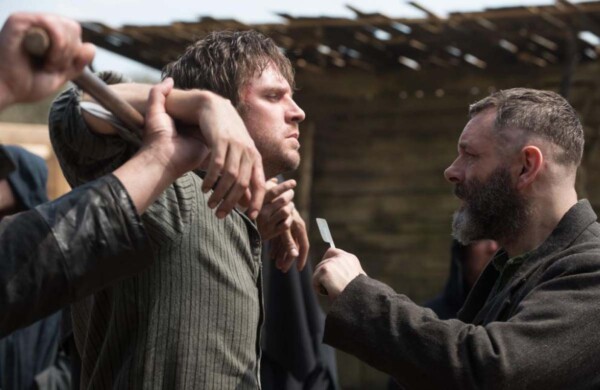
Image courtesy of Severn Screen.
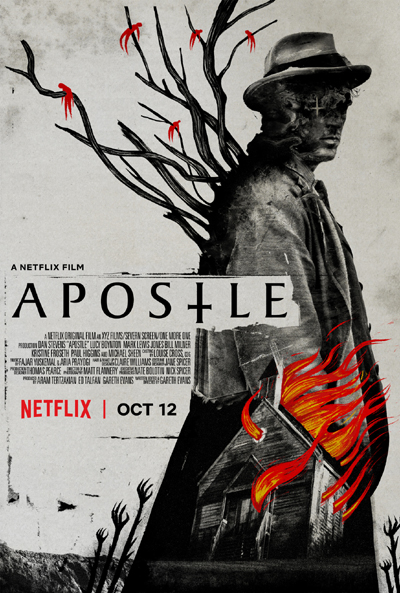
“Apostle” Starring Dan Stevens as Thomas Richardson, Michael Sheen as Malcolm, Richard Elfyn as Charles, Paul Higgins as Frank, Bill Milner as Jeremy, Catrin Aaron as Elaine, Lucy Boynton as Andrea Howe, and others. Directed by Gareth Evans. 2 hours, 10 minutes. Rated TV-MA. Streaming on Netflix.
Plot summary: A man goes undercover to rescue his sister from the clutches of a religious cult that has taken up residence on a secluded island. During his attempt to free his sister he discovers a horrifying secret being kept by cult leaders.
Are there spoilers in this review: Yes. Read at your peril.
Del’s take
“Apostle” is two movies in one.
On the surface it’s a high-tension thriller about a man trying to rescue his sister from the clutches of a religious cult. But it’s also about a uniquely weird and horrifying supernatural secret being kept within the bleak, windswept hills of a deserted island.
I should have saved this review for Halloween because “Apostle” would fit that bill perfectly – as scarefests go it departs from the usual Spooky Season fare. You’ll find no unkillable slashers, shrieking ghosts or giant reptiles here. Instead, it’s a tense period piece from the debut of the previous century with a quietly anarchic feel, more reminiscent of “Midsommer” and “Wicker Man” than “Friday the 13th.”
I’m not familiar with Evans’ work but I am becoming a fan as “Apostle” is the rare movie that undergoes a tectonic shift in pacing and tone at about the halfway point, and somehow it all works. From quietly tense to madness, “Apostle” asserts the power of suggestion can be a dangerous weapon, but what lies behind that power could be even worse.
“Apostle” is also one of those movies where the setting abets the theme. It was shot mostly in Wales along the coastline and embodies the harsh, threadbare and downright mucky quality of life such locales had to offer in the early 20th century. Rocky coastlines flanked by fields of wiry grass giving way to dark, dank forests, operate as a kind of additional character in the story, similar to the way the cold and snow worked in the original “Let the Right One In.”
But it’s what lurks beneath those hills and forests that really drives the story, and while its presence is hinted at in the first half of the film, the second half becomes a quest to bring everything into the rational light of day while defeating the antagonists and acquitting the victims. At this point “Apostle” goes from slow burn to a furious boil of gore, blood, and horror layered upon horror, much like events leading up to the climatic scene in “Texas Chainsaw Massacre.”
All the actors were terrific in this film, but Dan Stevens’ desperate Thomas Richardson stands above the others. Also notable were Lucy Boynton as skeptical Andrea Howe and Bill Milner as the callow Jeremy. If I had to criticize the movie for anything, it would be the relative unlikability of Thomas, who seemed to hover somewhere between devoted rescuer and drug-addicted looney.
Mladen is already crabbing about it not having lots of foul language or sex. There are sex scenes, but I’d describe them as demur. As for the cussing, well, what can I say? This was turn-of-the-century England, not MAGA America.
I’ve watched movies that in one small way or another remind me of parts of “Apostle,” but I think it’s safe to say you’ve never seen anything like it. Evans tells a fascinating and entertaining story, one that’s worth your 2-hour, 10-minute commitment to watch it.
You won’t be disappointed.
Del’s score: B+
Mladen’s take
Speaking of MAGA. When I read Del’s summary of “Apostle,” I assumed the movie was about the Republican Party under Trump. I was mistaken. “Apostle” is tame compared to the back-stabbing, power-hoarding, hyper-erratic, yellow-bellied, proudly racist, and gullible males and females classifying themselves as GOP-ers these days.
Also mistaken is Del’s review of “Apostle.” It’s crappy and just barely more tolerable than torture movies such as “Saw” or “Hostel.” Only smart and beautiful redhead Andrea kept me watching because she bridged the gap between the film’s decent portrayal of cultism and its grotesque, nearly gratuitous descent into body horror starting with the brain drill.
The film’s most interesting character is religious sect prophet Malcolm (portrayed by Micheal Sheen). As the cult’s top religionist, Malcolm balances charisma, desperation, and dislike for needed violence, as he defines it, pretty darn well. His sole goal is keeping his colony functioning by eluding an impending doom even if that means shedding the Almighty for paganism. Now that I think about it, that’s interesting. The libertarian god of Malcolm’s beliefs most share space with the nature witch who control the island’s plant life.
“Apostle” costumes and bleak environment, mostly grays and blacks, suit the plot nicely as Del noted but other elements are askew.
First, there’s no way that turn-of-the-19th century Englanders, not to say self-exiled cultists living on the edge of poverty, had such perfect teeth.
Second, our protagonist Thomas is accidently the scariest person in the film. It wasn’t his opium addiction. It wasn’t that Thomas got a man murdered by doing a ticket switch to get on a guarded boat to the unholy island warren of Erisden. It was the persistent expression on his face, particularly the eyes. He looked evil with eyes always darting never blinking and, I don’t know, glowing preternaturally.
Third, where Del sees a wonderful transition from the film’s first half of seething, albeit, discreet menace and hypocrisy to a father murdering his teenaged daughter with a knife, then her teenaged lover with the hand-powered brain drill, then shooting Malcolm with a sawed-off shotgun, and then threatening sexy Andrea and Thomas’s sister, I see a movie running out of ideas to convey the dangers of cults and the rhetoric that inspires regular folk to dive into the deep end of an empty pool.
And, finally, I have no idea why the beast-man with his reed-wrapped head was needed. Yes, the soiled being, apparently, protected and fed the nature witch with blood and flesh from animals and then humans but from where did he come? Who or what was he? Why did Malcolm trust the beast man to care for the increasingly apathetic, or was it disillusioned, pagan who ran the island’s environment. I believe the beast man was inserted into the movie for on scene alone, the one where he tries to grind Thomas into food pellets and strips for the witch. Yuck and a repulsive yuck at that.
I agree with Del. Y’all probably never saw anything like “Apostle” and you may not want to.
Mladen’s score: A generous C because the first half of the movie isn’t bad.
Mladen Rudman is a former journalist and technical writer. Del Stone Jr. is a former journalist and writer.

Image courtesy of STX Films.
“Peppermint” Starring Jennifer Garner, John Ortiz, John Gallagher Jr., and others. Directed by Pierre Morel. 101 minutes. Rated R. Netflix.
Mladen’s take
Badass beauty Charlize Theron, a.k.a. Aeon Flux, Imperator Furiosa, Lorraine Broughton, etc., has serious competition. Who? Badass Beauty Jennifer Garner as Riley North in the pretty good Netflix flick “Peppermint.”
“Peppermint” has its weaknesses. Among those are its cliché good-guy/gal-seeks-rightful-revenge plot, a bit of maudlin nostalgia, the not infrequent appearances of the apparition of a murdered daughter, woke commentary on poverty, and the origin of the movie’s title. I’m sure even curmudgeonly Del, who, paradoxically, wants humanity in his movies, will agree with me on that. However, none of the above comes close to diminishing Garner’s exquisite performance as a mother pursuing justice very, very violently and the neat double-cross about two-thirds into the exactly correct runtime for this film.
I urge patience when you start watching this movie. The first third or so of the movie is dedicated to establishing the bad guys, a corrupt justice system, and the power and allure of money. The really good stuff starts with North’s takedown of a drunkard father in a convenience store. Loved it and the moral. It’s here that we get our first glimpse of the glib, witty, and rage-infused North. Garner delivers her lines convincingly. She metes righteousness in correct proportions. The shitty daddy is merely threatened with a 9 mm pistol stuck in his mouth. The drug-dealing gangbangers get the opportunity to meet bullets and shotgun pellets up close and personal. In between, North manages to avenge the slight of coquettish rich lady. The insult was delivered when North’s husband and daughter were still alive. North has a good memory, along with a body and temperament to take and deliver punishment.
Yes, “Peppermint” has its doses of bodies absorbing stunning injuries and the obligatory self-repairs of deep lacerations or punctures. I understand and sympathize with the troupe. I don’t know. Maybe from here on I should just rationalize moviedom abuse of the body and moviedom’s interpretation of how much abuse a body can absorb as the consequence of surging adrenaline. If you’re running with a dozen bullet holes through you or fighting with your guts spilling onto the sidewalk, it’s simply a matter of fact that your body hasn’t yet recognized that it’s dying. Hell, I don’t know why people are making such a fuss about legalizing recreational use of marijuana or other drugs countrywide. Give me synthetic adrenaline, damn it.
So, forget about Garner as “Elektra.” That’s polluted water, caused by the imbecile Trump and his administration of fools, under the bridge. “Peppermint” is Garner’s re-introduction as an action star. And, it works.
I was happy to see John Gallagher Jr. as Detective Stan Carmichael in “Peppermint.” You may remember Gallagher for his excellent portrayal of Emmet in the very good “10 Cloverfield Lane.” Gallagher’s Carmichael is a bit dopey, somewhat a slob, but likeable. He serves nicely as part of the narrative that explains Riley’s metamorphosis, while playing an important role in the story, as well.
Finally, there’s nothing special about the score for “Peppermint.” I interpret it as techno-poppy and raucous, but it failed to make an impression. Fortunately, neither did the score distract or diminish the film.
“Peppermint” gets a B. Garner gets a strident A. That would’ve been an A+ had she not balked. See the movie and you’ll know what I mean. There’s no way you or Del will disagree.

Del’s take
As of this writing “Peppermint” is “No. 9 in the U.S.,” according to Netflix. I tip my hat to the streaming giant. Americans do love their lists, and a list of who’s watching what on Netflix is sure to fire up page views for the lesser lights among its offerings.
Except it’s not really a “top 10 on Netflix” list. It’s a “top 10 on Netflix that are relevant to you” list, which means it’s pointless as a barometer of popularity. Yup. The algogremlin strikes again.
And here I was thinking “Peppermint” was a top 10 movie in the whole U.S. of A. despite its paltry $53 million box office take and 12 percent Rotten Tomatoes score. Why? Why is a 2-year-old movie suddenly popular on Netflix?
Turns out it isn’t.
I think Mladen has damaged his brain with all the “Ice Spiders” and “Snow Sharks” garbage he watches. On the luminosity scale “Peppermint” ranks somewhere between a searchlight and a miniature Christmas bulb. I lean toward the latter because truth be told, it’s little more than “Death Wish” retold without a trace of charm. No way should this movie be anything more than a time-killer when a body is waiting to be called into the doctor’s office for a hemorrhoidectomy.
Mladen also neglected to summarize the plot, which is this: Riley North sees her hubby and daughter gunned down by drug dealers because hubby (Jeff Hephner) refused to participate in a drug deal. The bad guys are caught, but the corrupt justice system lets them skate. North decides to take matters into her own hands.
Sound familiar?
Garner delivers a kickass performance, and for that I’m grateful. It made the movie for me. I do enjoy watching women like Charlize Theron and Rooney Mara mete justice to those who deserve a swift bust in the chops.
Also, there were some excellent visuals and fight sequences, particular the one in which the roles are reversed and it is the drug dealers’ bodies swinging from a bridge. I’d like to note Garner’s character was not one of those indestructible super-creatures who never gets stabbed, shot or beaten up. She suffers her share of damage, though her recovery time is a lot quicker than mine would be.
But everything else about “Peppermint” you’ve seen before – in my case over and over again. That’s not necessarily a bad thing. I can watch the same movie, or iterations of such, many times as long as they’re well done. In this case the plot relied too heavily on suspension of disbelief and hand-of-God intervention to leave me with a favorable impression.
I referred Mladen to “Peppermint” because I know he likes brain splatter and infrastructure destruction, although I don’t recall seeing either in “Christmas Chronicles 2.” But should you watch “Peppermint”?
My answer would be a qualified “maybe.”
It’s a simple-minded yet decent action movie with a hero who does not dodge all the bullets. But the plot is hackneyed and everything works out a little too adroitly to be taken seriously. I would look at it as a cartoonish rendition of “Skyfall” or “The French Connection.”
Going into “Peppermint” with that attitude will make it a more entertaining film.
Garner’s performance is a solid B+, but overall the movie gets a C from me.
Mladen Rudman is a former journalist and technical writer. Del Stone Jr. is a former journalist and author.
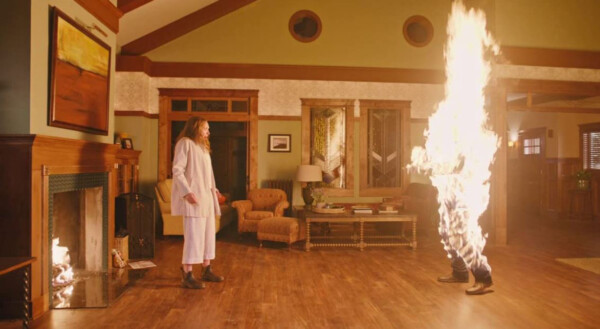
Image courtesy of A24.
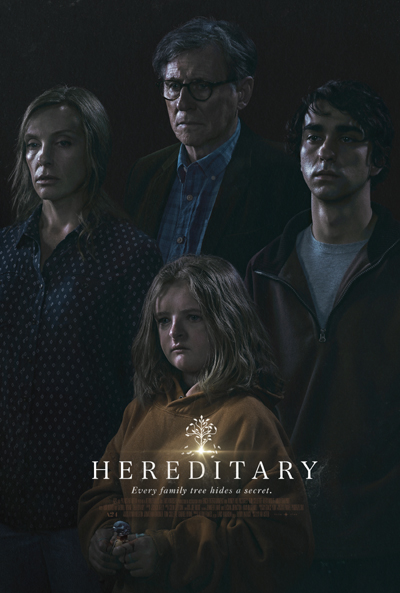
“Hereditary” Starring Toni Collette, Gabriel Byrne, Alex Wolf and Milly Shapiro. Directed by Ari Aster. 127 minutes. Rated R.
Del’s take
“Kinda boring, isn’t it?” said the woman in the hallway as I headed for the men’s room. She had seen me coming out of the theater where “Hereditary” was about halfway through its 4:20 showing.
“It’s so very slow,” she continued as she headed back to the theater. Seems she was on her own bathroom break. But she was only partly right.
Said to be the “scariest movie of the year so far,” “Hereditary” is not just “kinda” boring. It’s VERY boring. The first two acts are thuddingly dull, and they’re followed by a third act mashup of horror movie clichés and a reveal that will have you asking yourself, “You mean, that’s it?”
The story begins with a funeral. Annie (Collette) is burying her mom, a miserable old bitch who made Annie’s life a living hell. In fact, Annie comes from a family of whackjobs – schizoids, paranoids and suicides – and now the last one has died. But with a title like “Hereditary” you know Annie’s life will never settle down to that pleasant myth of Americana depicted in every Norman Rockwell painting.
In fact, her current family is downright weird. Husband Steve is passive to a fault, letting every member of the family use him as a doormat. Big brother Peter is a pot-smoking cipher who has no purpose in life except that of professional victim. Little Sister Charlie is a strangely sociopathic oddball with no friends, no interests and no apparent redeeming qualities.
Annie herself is not exactly Mom of the Year material. She sleepwalks, at least once dousing the kids with paint thinner and trying to set them on fire. She re-creates various tragedies in her life as miniature models, an artform that has brought her a measure of acclaim, at least in the part of the world that appreciates depictions of headless children hanging out of the window of a Volvo stationwagon.
And there you have the first two acts of the movie – a slow infodump of all this boring background. The woman in the hallway almost got it right. Very boring.
I won’t tell you what happens in the third act because that would spoil it for you, God forbid you actually see this movie. But I will say this: Little girls crawling across the ceiling isn’t scary anymore. Candles suddenly spouting gouts of flame isn’t scary. Séances, furniture tipping over, flies in the attic – these things aren’t scary anymore because they’ve been done to death.
Collette is super as the besieged Annie. One scene, in which she’s having it out with her son over the dinner table, is Oscar-worthy in my opinion. And young Shapiro is nicely weird as the bird head-snipping Charlie. But Byrne and Wolff are less impressive, not through any fault of their own. Their characters are simply less impressive.
“Hereditary” isn’t scary. It lacks the tension of a good scary movie. And nothing is left to the imagination. You take a movie like “The Haunting,” “The Innocents” or even “Alien” – now THOSE are scary movies. They build their tension slowly and carefully, and they show you only hints of the Bad Thing, allowing your imagination to fill in the awful details.
If you’re in the mood for “Rosemary’s Baby” meets “The Exorcist,” by all means catch “Hereditary.” But prepare yourself for a long slog with a meager payoff. I’m pretty sure you’ll be disappointed.
I grade this movie a C.
Del Stone Jr. is a former journalist and author.

Brandon Jasper of Flickr via CC licnese
Photo courtesy of Brandon Jasper of Flickr via Creative Commons license
—
Another mass shooting.
Ten people dead this time in what has become a depressing affront to human decency.
We will react the way we always react – with declarations of “thoughts and prayers,” angry remonstrations over gun control or mental health funding, vows to vote out the politicians who don’t act on behalf of our beliefs … and do nothing.
And you know what? Nothing will change. It will happen again. We will react the same way, and again, nothing will change.
Change involves risk. As a culture, we’ve become risk-averse in everything from fighting wars to having dinner at a locally owned restaurant. We don’t like risk because it’s … risky.
Meanwhile, some of us will become a little more afraid. When we go out in public we’ll look for places to take cover. We’ll make sure we know where the exits are.
Some of us will become more cynical. We’ll throw up our hands in defeat, ask a rhetorical question about the fundamental nature of society, then move along.
Many of us – far, far too many of us – will become more hardened and extreme in our political beliefs until any kind of action, for better or worse, becomes impossible.
All of us will be asking: Why?
What compels a young man – and many of these mass shooters are young men – to pick up a gun, go to a public place and open fire on innocent people?
It’s trite and dismissive to brand them as “mentally ill” and let it go at that, as if no further explanation is necessary. Of course they’re mentally ill. It could be argued that anybody who commits premeditated murder is mentally ill, and these horrible acts are premeditated. They are not impulse killings or spree killings. They are planned and prepared for, a process that occurs only when a person’s grasp of reality has been seized by infection and rots and dies.
But what caused them to become mentally ill?
Some might say their home environment. Others blame video games and violent movies, while others say we have too many guns floating around out there.
I’ve been thinking about this question for a long time.
I’m afraid I don’t have an answer.
But I do have suspicions.
When I was a kid, most households consisted of two parents. Typically it was the mother who kept the family running and the father who went off to earn a paycheck. These days, far too many households consist of only a single parent, somebody who must work to support the family and is therefore absent a good deal of the time. Many children are raising themselves or worse, they are being raised by television and the internet. While I have known single parents who did a good job bringing up their kids, I suspect having one parent at home results in a more stable family environment. It allows children time to be children, not miniature adults with adult responsibilities. Childhood is an essential ingredient of a well balanced individual, I would say. I make no judgments about the gender, race, politics or religious persuasions of the parents. And I acknowledge that even in two-parent households, the cost of living often requires both parents to work outside the house.
Marriage, it seems, is treated as a disposable commodity. I suspect that’s a symptom of our overall attitude toward the concept of disposability. Whether you agree or not, here in the United States we live in a throw-away world. We throw away everything – small appliances, food packaging, furniture, and yes, even people. We perceive something that’s broken as replaceable, and we throw it away, because it’s cheaper than trying to fix the original.
That was not the case when I was a kid. We fixed things. If the electric can-opener broke we took it to a repairman. If a clock broke we took it to a clock shop. Soft drink bottles carried deposits, and with a bicycle basket full of Coke, Pepsi and RC Cola bottles you could earn enough money to buy a box of frozen shrimp to use as fish bait. Fixing things took time and cost money, yes. But often, the thing that was fixed was better than the original. And guess what? All those clock fixers and can opener surgeons had jobs.
Back then, couples who were having problems with their relationships tended to stay together and try to fix them. They didn’t always succeed but they seemed more likely to try. Your mother was right – marriage is hard work. Not all times are good times. But in today’s throw-away culture we treat marriage and relationships as disposable, just like that clock you bought at Big Lots that stopped working three days after you hung it on the living room wall. We place less value on marriage and relationships because we know if they are not instantly gratifying, we can simply throw them away and find another one.
Gratification. That’s another ingredient in this toxic stew of cultural rot. Our technology has given us the ability to be instantly gratified in just about everything we do. Want something right now? Buy it online and have it delivered. Don’t have the money to pay for it? Put it on credit. Want attention right now? Find it online. Want to be distracted or entertained right now? Lose yourself in a mobile phone screen.
Once, anything worth having was worth working and sacrificing for. A person did without, delayed gratification and scrimped on time or money to eventually acquire that magical thing. Once they had it, they worked like hell to keep it in great shape, which is why Dad spent Saturday morning washing and waxing the car, and Mom spent so much time cleaning the house and yelling at kids who didn’t wipe their feet before they came inside. A certain pride of ownership came with every new and great thing, and that was partly because it represented, to borrow a cliché, all the blood, sweat and yes, even a few tears, to get it in the first place.
The work it took to get those things – not just material possessions but marriages, relationships and children – was instructional in and of itself. It taught us the value of hard work, gave us patience, and made us appreciative for what we had.
I guess what I’m talking about are old-fashioned values.
Life was more difficult. Everything from washing clothes to fixing the car, cooking dinner and making sure the kids toed the line, took more effort. People didn’t have time to feel sorry for themselves, spread poison on the internet or immerse themselves in screed and demented jingoism. They were too busy trying to get by.
People tended to communicate by actually talking to other people. That was partly due to necessity – there were few alternatives – and partly because it was pleasurable. People invented reasons to socialize with other people, from parties to bridge club meetings, social work, scouting or just hanging out at local restaurants. When you speak to somebody in the flesh, a magical thing happens. You engage in not only verbal communication but interpersonal communication. You see the arch of their eyebrows; you hear the tone of their voice. You know instantly when they are joking, being sarcastic, or feeling grief.
You develop empathy.
That’s a quality sadly lacking in today’s environment of text messages, email, online comments and social media posts. We communicate, yes. More than at any previous time in human history. But the quality of our communication is lacking. It is disposable, just like everything else in our culture. We treat others online in ways we would never do in person – as a person who grew up before the arrival of the internet, I would say we rarely treated people as savagely as we do now in comments and social media posts. The lack of immediate physical presence has exerted a profound influence on not only what we say to others but how we say it. The dearth of empathy has turned many of us into sociopaths.
The internet has been a boon to mankind. Commerce, communication, the availability of knowledge – all of these activities have been revolutionized by the invention of the world wide web. Just today, for instance, I went online to search for a way to replace the batteries in an LED lantern. When I found the instructions in a PDF, I had to search for a way to mirror an image in Photoshop because the text was backwards. It would have taken me weeks to get those answers 50 years ago, and the Photoshop question would have been moot, because it didn’t exist 50 years ago.
I spend a great deal of my time online, from posting my ramblings on social media to checking weather models for hurricane development, watching movies, and offering my fiction for sale to readers directly.
But the digital world is a double-edged sword. I have an advantage over younger people in that I grew up with and learned a tradition of study and contemplation. I read quite a few books per year – some by excellent writers, others throw-away trash designed to entertain, not inform (I do not throw them away! I donate them to the SOCKS thrift shop to support their mission of saving and finding homes for abandoned cats and kittens in the Fort Walton Beach area.)
But for every online opportunity to learn, share information or spread kindness, there are a thousand ways to waste time, indulge in trash or even poison, and be cruel to other people. Pornography is rampant, for instance. While I personally don’t have a problem with porn, its easy availability means children are seeing it, and it is shaping their views about sex, romance, and relationships. Jingoism, political dogma and the echo chambers of extremism are also only a few clicks away. Nazis, racists, left- and right-wing extremists and others who never, ever would have received much of an audience in the past now make their voices as loud or louder than the mainstream.
The result is a skewed perception of reality. Marshall McLuhan told us that the medium is the message. If that’s the case, the message is that the United States is awash in rage, from angry comments to political extremism and violence. A kind of cultural lawlessness is at work in the absence of everything that leavened our behavior – hard work, struggle, delay of gratification, studiousness, and the consideration of others. These days it seems even acts of kindness we hear about are freighted with an expectation of reward other than the mere satisfaction of having done something nice.
It must sound as if I’m demonizing the present and deifying the past. I suppose I am, to an extent. I acknowledge life today, in many ways, is vastly superior to what it was 50 years ago. I can communicate instantly with people halfway around the world; in the past that would have required a costly telephone call. I take a pill that keeps my blood pressure down; in the past I would probably be dead of a stroke already. I underwent a laser iridotomy to treat my acute-angle glaucoma. It was an office procedure and I drove myself home. In the past it would have required major surgery. And it’s not just things – attitudes have changed. Although we are still struggling, we are making progress in eliminating racial discrimination. It is no longer an automatic death sentence for a man to admit he loves another man. We care about the environment (except for President Imbecile). We can build a device and send it out of the solar system to capture fantastic photos of objects we will not, in our lifetime, see for ourselves.
Life is so much better in so many ways.
But in other ways it is worse.
Families are fractured and kids are left to fend for themselves. People communicate vicariously, and much is lost in translation. Technology is a dehumanizing wall that is transforming us into misanthropes and sociopaths. Our obsession with disposability has extended to our relationships and how we treat others. Our technology has created a vast laziness that affects not only what we think but how we think it, corrupting both the medium and the message.
The medium and the message.
I would say many of these mass shootings represent a reservoir of anger generated by the way we live, coupled with a cry for attention from a generation of kids who desperately need some stability and love in their lives.
In the balance of things, our efforts to make life easier have not done us many favors.
Calls for additional gun controls, or more guns carried by more people, or more mental health funding, or any of the knee-jerk solutions offered by angry and frightened people in the wake of a mass shooting, are probably not going to work. Simple solutions to complex problems never do. The problem is a hydra, with many, many faces. One answer does not fit all.
So how do we fix this? I have some ideas, but because my analysis of the problem is made up of suspicions, so is my answer. Bear that in mind as you read this, if you are still with me.
I think the only answer is to re-establish certain values. People need to put down their phones and spend time with their kids. They need to get involved in their communities on a face-to-face basis and meet their neighbors. They need to make time for the important things in life – family and community – and stop throwing it away on self-indulgence and comfort. They need to make time for contemplation, thoughtfulness, and at least a small measure of scholarship. Sacrifice. Work hard. Delay gratification. Be nice.
And again, for God’s sake, spend time with your kids.
Those things won’t happen, but if they did, mass shootings might become a thing of the past.
—
Author’s note: Contact me at [email protected]. To read more of my opinion and humor pieces, visit delstonejr.com . In addition to my humor columns and opinion pieces, I write fiction – horror, science fiction and contemporary fantasy. If you’re a fan of such genres please check out my Amazon author’s page. Print and e-books are both available, and remember: You don’t need a Kindle device to read a Kindle e-book. Simply download the free Kindle app for your smart phone or tablet.

Image courtesy of IFC Midnight.
“The 12th Man” Starring Thomas Gullestad, Jonathan Rhys Meyers, Marie Blokhus and others. Directed by Harald Zwart. 135 minutes. Unrated. Hulu.
Del’s take
To describe a movie as “interesting” is to suggest it is not inspiring or intriguing or epic in its sweep. I think that’s a fair assessment of “The 12th Man,” an interesting movie that somehow falls short of the real events it seeks to depict.
Based on the 2001 book “Jan Baalsrud and Those Who Saved Him,” by Tore Haug and Astrid Karlsen, “The 12th Man” chronicles the action of a band of saboteurs who are captured trying to infiltrate German-occupied Norway during World War II. One man is shot on site, 10 are later executed, but a 12th man, Jan Baalsrud (Gullestad), escapes into the snowy wilderness. What follows is a harrowing tale of survival and near-misses as Baalsrud makes his way toward neutral Sweden while being pursued by obsessive Sturmbannführer Kurt Stage (Rhys Meyers).
“The 12th Man” is a testament to human strength and endurance. Baalsrud experiences gruesome deprivations during his months-long odyssey across the frozen landscape – he is shot, suffers hypothermia and frostbite, and starves while hiding from the relentless Stage. You wonder how a body could survive such abuse. For his pursuer, the stakes are equally painful. If Baalsrud succeeds in reaching Sweden, Stage’s failure will be noted in Berlin … with legendary Nazi displeasure.
The movie does a credible job of replaying the events of Baalsrud’s trek, which we are assured actually happened, with the exception of Stage’s pursuit. According to my research Stage did not pursue Baalsrud across frozen Norway. In fact, the Nazis believed Baalsrud drowned trying to swim across a fjord. Still, the major points of Baalsrud’s escape and the suffering he experienced remain intact and are, as I said, harrowing if not grotesque.
The movie is beautifully shot and makes effective use of the ice and snow as a kind of character unto itself, much the way snow and cold figured into the telling of “Let the Right One In.” I felt a sympathetic shiver as Baalsrud plunged into the chilly Arctic waters of a fjord as German soldiers and their dogs approached, or hid for days in the snow-covered swale of an icy boulder.
The stars of “The 12th Man” are not Baalsrud but the Norwegian people along the way who sacrificed all to facilitate his escape. It is they who risked everything to help a man they didn’t know, a patriot but a stranger who could not improve their lives under Nazi rule but could make things a hell of a lot worse if it became known they were harboring a fugitive.
The movie also reminds us the Nazis were evil, horrible men and women who did evil, horrible things to millions of innocent people. Given that fascism is on the ascendency and some of the former president’s more ardent and colorful admirers are fond of culling the Nazi playbook for political tips and strategies, maybe a stomach-turning dose of “The 12th Man” is just the tonic for this generation hell bent on re-discovering that tragic wheel of human misery.
My gripes with “The 12th Man” are, for starters, that it’s way too long. Two hours and 15 minutes of unrelenting tension is too much for an audience to endure. The movie also dwells to lurid excess on the details of Baalsrud’s suffering – I wanted to fast-forward through the scenes of blackened toes falling off or Baalsrud chipping his teeth through another bout of fjord-induced hypothermia.
My biggest complaint is that while the camera mostly focuses on Baalsrud, perhaps it should have been focused on the ordinary Norwegians who made his escape possible. Baalsrud does not do much except stay alive – no small thing, I admit. But it is the fishermen and trappers and villagers, the real stars of the movie I alluded to earlier, who take the action and pay the price for getting Baalsrud to Sweden. They will not have any movies made about them, but maybe they should.
Overall “The 12th Man” is a decent enough war movie about a real event. But it is too long, relishes a little too much the suffering of its protagonist and maybe doesn’t spend enough time detailing the heroics of its real heroes. Watch it on Hulu but gird yourself for a sometimes graphic marathon of pain and suffering.
Oh, and yes, it uses subtitles, if that’s an impediment for you.
I would grade it a B-.

Mladen’s take
Del and his people-are-wonderful-under-duress approach to reviewing a movie. Sheesh. Hey, Del, it was a stoolpigeon Norwegian who fingered the Norwegian commandos to the Germans. The indigenous stoolie was responsible for the deaths of the 11 saboteurs and our beloved Baalsrud’s prolonged exposure to the elements at high latitude as he fled east.
No, no. Let’s put the “The 12th Man” in context.
The film, though decent enough, is what I label “history revenge” cinematography. In Europe, the ongoing object of history revenge is Germany. Please, no misunderstandings. The Third Reich and its Hitler-driven National Socialism is among mankind’s most soulless societies. Tactically, however, the Wehrmacht right to the end of Word War II was one helluva fighting force and the Gestapo one helluva counter-spy and internal intelligence directorate. That’s what the “The 12th Man” is about. It tries to make the fact that one surviving Norwegian, who was a member of a raiding party that utterly failed to execute its mission and itself was executed, equaled a great victory for Norway against a country that occupied it from 1940 to 1945. What nonsense.
Europe today is far from the savage bundle of countries that colonized the globe and annihilated or oppressed cultures, ethnicities, languages, or sustainable economic systems from Africa to Asia to both Americas. The EU, the euro zone, and NATO have rendered Europe less blindingly feudal, fascistic, or mercantilist. But, all those countries that had their asses kicked by Germany between 1938 and 1945 still hold grudges.
“The 12th Man” is a manifestation of the history revenge grudge from the Norwegian perspective like 2013’s very good “Battle of Westerplatte” reflects Polish and Lithuanian history revenge. What would happen to you if you started taking about the history of Vichy France in Paris today? Your escargot would come laced with arsenic. Hell, the Russians, who obliterated Hitler’s Germany, still talk, write, sing, and make TV series and movies about the Great Patriotic War as though it happened yesterday.
We must never forget World War II, but we have to be careful of believing the way it’s portrayed in films, documentaries, fiction literature, and partisan interpretations of events. There were good guys and bad guys on the Allied and Axis sides, though some were worse than others. Norway had its share of Nazi sympathizers and straight-up fascist politicians. The continuum of World War II injustices must be understood and illuminated to withstand the diabolical revision of history that is easily spread through the internet and entertainment media.
Kicking aside my infallible law of history revenge as it applies to nationalistic re-interpretation of events long ago to look at the merits of “The 12th Man” without context, I give the film a C+.
It shouldn’t take you long to see that the movie’s producers and director (as well as the book on which the movie is based) tried to transform a lemon of a commando raid into lemonade even if you’re unaware of the geopolitics of World War II. Twelve men were sent to help the allies and one lived, an 8 percent rate of survival. What would have happened if only 8 percent of the Yanks, Tommys, and whatever the nickname for Canadian soldiers storming five beaches in 1944 Normandy lived? Uh huh. Also, most of the “The 12th Man” depicts Baalsrud trying to stay alive while running and hiding and hiding and running from Germans. He made no effort to continue the mission, explode Luftwaffe aerodromes, or stick around to use his training to help Norwegian resistance fighters.
Look, the saboteurs had balls, but in the movie as in real life, they had their balls shot off. One of them surviving with his balls intact, though a few of his toes on the right foot did not, was not a victory for Norway. It was a moment of triumph of the will for a very, very limited number of individuals. “The 12th Man” would have served better as a microcosm of a story showing us the determination and grit by the people we saw in the movie and got to know, rather than trying to convince me that their effort helped all of Norway and its millions of people endure occupation. A more disciplined, less holistic “The 12th Man” might have also allowed some 25 minutes to 30 minutes of the film to be cut.
“The 12th Man” is worth watching. The austere beauty of fjords, mountains, and snow near the Arctic circle is captured nicely in the film. There’s good acting. The women are all lookers. But, I’m no chump. There’s no way that one soldier surviving a busted mission improved life in a country overrun by a conquering army.
Mladen Rudman is a former journalist and technical writer. Del Stone Jr. is a former journalist and author.

Image courtesy of Paramount.
“A Quiet Place” Starring Emily Blunt, John Krasinski, Millicent Simmonds and Noah Jupe. Directed by John Krasinski. 90 minutes. Rated PG-13.
Del’s take
“A Quiet Place” is relentlessly tense. To be honest, I was relieved when the movie ended because throughout, my stomach was cinched into a knot. It has a couple of problems, but overall it’s a good value for your entertainment dollar and I recommend it.
It’s directed by John Krasinski of “The Office” fame, but Emily Blunt, who plays his wife both on and offscreen, has been getting top billing. Krasinski also directed the film. I’ve always wondered how that works. If you screw up a scene, do you get mad and yell at yourself?
The story is about a family trying to survive the emergence of a blind super predator that hunts by sound. I was a little unclear as to where the predators came from. Are they extraterrestrials? Demons? Genetic mutations? I don’t think the movie made that clear, but reviewers are calling them aliens so I’ll go with that.
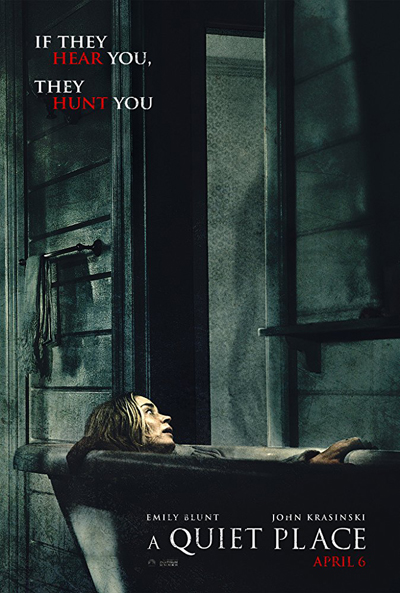
The Abbott family lives on an abandoned farm in the countryside, never speaking, never wearing shoes, never doing anything that might reveal their presence to the monsters. They communicate through sign language and scatter sand along their footpaths to muffle the sound of their tread.
The first anecdote of the movie ratchets up the tension to an unbearable level. The family is scavenging for supplies in a nearby town. Their youngest, a little boy named Beau, finds a battery-operated space shuttle toy and wants to play with it, but Krasinski takes it away from him and removes the batteries, explaining the toy is too loud. Later, Beau’s big sister Regan (Simmonds) gives him the toy, and as they’re leaving Beau grabs the batteries.
As they’re walking back to the farmhouse the boy falls behind – because he’s loading the batteries into the toy. When he turns it on it begins to emit loud sounds, and what you fear might happen … well … it actually happens.
Cut to a year later. Blunt is pregnant. Otherwise, nothing has changed. Well, not quite. Regan blames herself for her little brother’s death. She thinks her father hates her. She doesn’t feel welcome in the family, even after her dad tries to invent a turbocharged hearing aid that might repair her deafness. The Abbotts’ other son, Marcus (Jupe), is more terrified of the monsters than the rest of the family and doesn’t think his father will keep them safe. Turns out he should be afraid.
I won’t say anything more about the plot. I don’t want to spoil it for you. Suffice it to say everything that follows cranks up the tension to the point you will be breaking for the bathroom or snack bar just to get your heart back in sync, like I did during a certain scene involving a nail.
But yes, in my opinion the movie had a few problems. The story supposedly takes place between one and two years after the creatures arrive, yet the town the Abbotts raid for supplies looks like it’s been abandoned for many years. By the same token, the farm where they hide is surrounded by lovingly cultivated fields of corn, which could not have been accomplished without the use of heavy – and loud – machinery.
And what’s with this baby thing? Why would they bring a baby into this world? And aren’t babies loud? I mean, really, really loud?
If the monsters are attracted to sound, why couldn’t Krasinsky set up some speakers in the middle of that corn field, crank up the Iggy Pop and blast the monsters to smithereens when they show up?
Details, details.
Apart from those gripes, “A Quiet Place” is a super tense, super scary movie that should appeal to both fans and non-fans of horror. See it in a movie theater. Don’t wait for it to show up on Netflix or Prime.
While I’m at it, let me recommend the smartphone app MoviePass. You pay $7 a month for one theatrical release – per day. Thirty-one movies for $7? I don’t know how they make money at it, but somehow they must.
That’s how we got to see “A Quiet Place.”
I give it a B+.
Del Stone Jr. is a former journalist and author.

Image courtesy of Universal Pictures.
“Pacific Rim: Uprising” Starring John Boyega, Scott Eastwood and Cailee Spaeny. Directed by Steven S. DeKnight. 111 minutes. Rated PG-13.
Del’s take
I had great hopes for the original “Pacific Rim” and came away greatly disappointed, so my expectations of “Pacific Rim: Uprising” were minimal. But what the hell. It was a rainy Sunday afternoon and while I had a crap-ton of stuff that needed doing, I didn’t feel like doing any of it. “Uprising” it was.
And hey, guess what? It didn’t suck as bad as I thought it would. Let’s face it: You don’t go to a “Transformers” or “Pacific Rim” movie for the social commentary or existential angst. You go to see giant monsters and robots beat the shit out of each other, destroying cities in the process. In that meager capacity “Uprising” did not disappoint.
The movie stars John Boyega as Jake Pentecost, son of Idris Elba’s Stacker Pentecost from the original movie. Stacker was the marshal of the Jaeger corps, giant robots built to defend humanity from the Kaiju, equally giant monsters from another dimension that entered this world through a breach in the Pacific Ocean floor. Stacker is revered for his role in sealing the breach and saving the world.

Jake, once a promising Jaeger pilot himself, has given up his career to become a petty criminal. During a theft gone wrong he meets young Amara Namani (Spaeny), who has built her own Jaeger called Scrapper. Because it is against the law to own unregistered Jaegers, Amara and Jake are hauled in by the authorities. Instead of being jailed they’re sent to the Jaeger corps, where Jake is to resume his old job and Amara becomes a cadet.
The Shao Corporation has a plan to replace Jaegers with huge, robotic drones, and I won’t say any more about that because it would spoil the movie for you. Suffice it to say “Uprising” becomes more action-oriented with the second act and continues through the third.
John Boyega does a good job with his role and shows he can act outside of “Star Wars.” He manages to bring a little more oomph to his role, which is saddled with clichés. I last saw Scott Eastwood in “The Fate of the Furious” and he was about as wooden as a ventriloquist’s dummy. His acting has improved and at times he seems almost human, so there’s hope. Spaeny is a natural for the screen. I think we’ll be seeing a lot of her in the future.
I think this movie was better written than the original. The dialogue was an improvement. It didn’t strike me as silly and fanboyish as del Torro’s script.
The flaws? I’m sure there were plenty. The premise itself is the biggest flaw of all. But I turned off that part of my brain before I walked into the theater. Again, you don’t watch a “Transformers” or “Pacific Rim” to appreciate the logic or scientific accuracy. The movie panders to a Chinese audience so if you have a problem with that, be prepared.
“Uprising” sets up a sequel, and I initially thought that wouldn’t happen until I checked the overseas grosses. Domestically it has earned just south of $60 million, with a budget of $150 million. But worldwide? A whopping $275 million for a $333 million cume, so I guess we can expect a “Pacific Rim: Domination.” Way to go, Chinese audience.
Don’t get me wrong: “Uprising” is an entertaining and even fun movie if your expectations aren’t too high. But don’t expect much in the way of depth.
I give it a B-.
Del Stone Jr. is a former journalist and author.