An emphatic ‘No’ to tech for the sake of tech

In this photo the author (right) explains to visitors how the newspaper is assembled during an open house. Photo courtesy of the Daily News.
Very soon, the Daily News will abandon its old, proprietary computer system for a brand new, PC-based computer system.
With this change, we will move up a notch in the high-technology race that seemingly shifted into high gear during the 1980s and has yet to slow down. Every week, we hear about a new gadget or application that offers to make our lives better.
In some cases, these gadgets actually do make life better. I can’t imagine a world without CAT scanners, or even cordless telephones.
But it also seems increasingly true that these gadgets have evolved to such absurd levels of complexity that they no longer serve the people they were intended to help. In fact, they’ve become an end unto themselves.
This fact was driven home to me last week as we began to learn about our new computers and software.
They are amazing machines. They do most anything, and they do it three or four different ways: They check your spelling, check your grammar, play your CDs, fax your files, surf the web and answer your questions.
Therein lies the problem: They are a little too amazing.
They do too much.
It’s normal to feel a little overwhelmed when learning an unfamiliar and complicated new skill. But I’m not unfamiliar with these machines, and I’m not a computer Luddite. Yet I am most definitely swooning over the sheer volume of … “stuff” on these machines … and the intricacy of its use.
The computer industry is especially guilty of overcomplicating what should be simple procedures. This overcomplication exists on every level of the computer experience, from the insane number of ways any one command can be executed, down to even the muddy syntax of the “documentation” (computerese for “instruction manual”).
But this overcomplication extends to much of the high technology we are told we need: telephones with so many features that they cannot be deciphered; kitchen appliances that require so much programming to do something that it would be easier to do it by hand; VCRs all across America that blink 12:00; the endless parade of digital cell phones, analog cell phones, pagers, check-writers, electronic games, CD players, DVD, HDTV, LD and DCS. …
I feel like one of the robotic workers in Fritz Lang’s science fiction classics “Metropolis.”
Our purpose is no longer to use these machines to accomplish a task, but to make the machines do everything they are capable of doing.
People are starting to rebel.
The “nesting” phenomenon of the early to mid-’90s was an opening shot in our War of Rejection against this insane spiral of technology. The stress of attempting to cope became too much for some people, who chose to hide out and decompress rather than hurl themselves into the clicking, beeping fray.
These days, the move to lead simple lives manifests our desire for the serenity we enjoyed when people, not machines, were more important.
When our computers are installed, I will try to learn the fastest, easiest and most direct ways to do my work. The rest will stay in the “documentation” – there if I need it, I suppose, but out of sight and, with any luck, out of mind.
This column was originally published in the Wednesday, May 27, 1998 edition of the Northwest Florida Daily News and is used with permission.
About the author:
Del Stone Jr. is a professional fiction writer. He is known primarily for his work in the contemporary dark fiction field, but has also published science fiction and contemporary fantasy. Stone’s stories, poetry and scripts have appeared in publications such as Amazing Stories, Eldritch Tales, and Bantam-Spectra’s Full Spectrum. His short fiction has been published in The Year’s Best Horror Stories XXII; Alfred Hitchcock’s Mystery Magazine; the Pocket Books anthology More Phobias; the Barnes & Noble anthologies 100 Wicked Little Witch Stories, Horrors! 365 Scary Stories, and 100 Astounding Little Alien Stories; the HWA anthology Psychos; and other short fiction venues, like Blood Muse, Live Without a Net, Zombiesque and Sex Macabre. Stone’s comic book debut was in the Clive Barker series of books, Hellraiser, published by Marvel/Epic and reprinted in The Best of Hellraiser anthology. He has also published stories in Penthouse Comix, and worked with artist Dave Dorman on many projects, including the illustrated novella “Roadkill,” a short story for the Andrew Vachss anthology Underground from Dark Horse, an ashcan titled “December” for Hero Illustrated, and several of Dorman’s Wasted Lands novellas and comics, such as Rail from Image and “The Uninvited.” Stone’s novel, Dead Heat, won the 1996 International Horror Guild’s award for best first novel and was a runner-up for the Bram Stoker Award. Stone has also been a finalist for the IHG award for short fiction, the British Fantasy Award for best novella, and a semifinalist for the Nebula and Writers of the Future awards. His stories have appeared in anthologies that have won the Bram Stoker Award and the World Fantasy Award. Two of his works were optioned for film, the novella “Black Tide” and short story “Crisis Line.”
Stone recently retired after a 41-year career in journalism. He won numerous awards for his work, and in 1986 was named Florida’s best columnist in his circulation division by the Florida Society of Newspaper Editors. In 2001 he received an honorable mention from the National Lesbian and Gay Journalists Association for his essay “When Freedom of Speech Ends” and in 2003 he was voted Best of the Best in the category of columnists by Emerald Coast Magazine. He participated in book signings and awareness campaigns, and was a guest on local television and radio programs.
As an addendum, Stone is single, kills tomatoes and morning glories with ruthless efficiency, once tied the stem of a cocktail cherry in a knot with his tongue, and carries a permanent scar on his chest after having been shot with a paintball gun. He’s in his 60s as of this writing but doesn’t look a day over 94.
Contact Del at [email protected]. He is also on Facebook, twitter, Pinterest, tumblr, TikTok, and Instagram. Visit his website at delstonejr.com .

Image courtesy of Flickr user Frank by way of a Creative Commons license. https://www.flickr.com/photos/frankonyc/
The other day, as I paid for a tank of gas, the lady behind the cash register offered to give me her son.
“Take him. He’s yours,” she said exasperatedly.
I felt my eyes darting, minnow-like. Where was this son? I half expected to see him crying under the counter, trussed in shrink wrap and bar-coded and ready for delivery. But no child lay in sight. I began to breathe easier.
Why, I asked, would she want to give away her son?
“I can’t do a thing with him,” she declared, throwing up her hands. “Twelve years old and he’s back-talking the teacher, so he gets suspended from school.”
At least he didn’t blow the teacher’s head off.
“You can’t discipline kids anymore,” she went on. “They’re not afraid of you because they know if you lift a finger against them the state will have you arrested for abuse.”
A germ of truth in that. I thought back to a relation who told me her 10-year-old threatened to call their state’s division of social services if she gave him a whipping.
(She wouldn’t really have given him a whipping. There comes a point when the whipper suffers more physical harm than the whippee, and I think this person had traveled well across that line.)
But she and the clerk raise an interesting point, one that has been debated since the invention of children. Does it do any good to spank a kid?
I made the mistake one time of saying I thought spankings were all right, which brought an immediate and venomous rejoinder from some of the mothers on the newsroom staff, who snidely reminded me that as a single, childless man, I was probably unfit to state an opinion on the subject.
Au contraire. I am uniquely qualified to state an opinion on the subject, having suffered innumerable screaming children in movie theaters, temper tantrums at restaurants, and other assorted conniptions and spazzolopolisms. And while it is true that once – how horrid – I believed such behavior should be greeted with a swat on the behind, I have since modified my beliefs.
It is the parents who need the spanking.
Really.
That little incomplete person who is screaming and pounding the table and squeezing his cheeks into various shades of purple can hardly be held responsible for his behavior. He’s just trying to elicit a desirable response – the parent buys him the toy, or gives him the ketchup bottle to spray his fellow diners. Can the little nipper be faulted? Heck, no. I’d say it makes him pretty smart.
But the parent who teaches him to act that way by giving him what he wants – now, that’s a different story. Maybe a swat on the fanny would remind Mom or Dad that the quick and easy solution to these outbursts is not the best solution. I think as a culture we’ve grown accustomed to ease and convenience, and it permeates everything we do, right down to our child-rearing.
As for my clerk, well, good luck, ma’am. The kid is 12, and the die may be cast. At 12, parental oversight takes a back seat to the possibly corrupting influence of the world at large.
But I see a bunch of wailing little fit-pitchers out there. …
This column was published in the May 20, 1998 edition of the Northwest Florida Daily News and is used with permission.
About the author:
Del Stone Jr. is a professional fiction writer. He is known primarily for his work in the contemporary dark fiction field, but has also published science fiction and contemporary fantasy. Stone’s stories, poetry and scripts have appeared in publications such as Amazing Stories, Eldritch Tales, and Bantam-Spectra’s Full Spectrum. His short fiction has been published in The Year’s Best Horror Stories XXII; Alfred Hitchcock’s Mystery Magazine; the Pocket Books anthology More Phobias; the Barnes & Noble anthologies 100 Wicked Little Witch Stories, Horrors! 365 Scary Stories, and 100 Astounding Little Alien Stories; the HWA anthology Psychos; and other short fiction venues, like Blood Muse, Live Without a Net, Zombiesque and Sex Macabre. Stone’s comic book debut was in the Clive Barker series of books, Hellraiser, published by Marvel/Epic and reprinted in The Best of Hellraiser anthology. He has also published stories in Penthouse Comix, and worked with artist Dave Dorman on many projects, including the illustrated novella “Roadkill,” a short story for the Andrew Vachss anthology Underground from Dark Horse, an ashcan titled “December” for Hero Illustrated, and several of Dorman’s Wasted Lands novellas and comics, such as Rail from Image and “The Uninvited.” Stone’s novel, Dead Heat, won the 1996 International Horror Guild’s award for best first novel and was a runner-up for the Bram Stoker Award. Stone has also been a finalist for the IHG award for short fiction, the British Fantasy Award for best novella, and a semifinalist for the Nebula and Writers of the Future awards. His stories have appeared in anthologies that have won the Bram Stoker Award and the World Fantasy Award. Two of his works were optioned for film, the novella “Black Tide” and short story “Crisis Line.”
Stone recently retired after a 41-year career in journalism. He won numerous awards for his work, and in 1986 was named Florida’s best columnist in his circulation division by the Florida Society of Newspaper Editors. In 2001 he received an honorable mention from the National Lesbian and Gay Journalists Association for his essay “When Freedom of Speech Ends” and in 2003 he was voted Best of the Best in the category of columnists by Emerald Coast Magazine. He participated in book signings and awareness campaigns, and was a guest on local television and radio programs.
As an addendum, Stone is single, kills tomatoes and morning glories with ruthless efficiency, once tied the stem of a cocktail cherry in a knot with his tongue, and carries a permanent scar on his chest after having been shot with a paintball gun. He’s in his 60s as of this writing but doesn’t look a day over 94.
Contact Del at [email protected]. He is also on Facebook, twitter, Pinterest, tumblr, TikTok, Ello and Instagram. Visit his website at delstonejr.com .

Image courtesy of Wikimedia Commons user Phoebe. https://commons.wikimedia.org/wiki/User:Phoebe
“Olestra may cause abdominal cramping and loose stools. Olestra inhibits the absorption of some vitamins and other nutrients.”
So says the label on a package of Ruffles WOW! ripple-cut potato chips.
Perhaps you remember the story behind this label, which surfaced last year when the Food and Drug Administration gave its permission for Procter & Gamble to use the artificial fat olestra in snack products like potato chips and nacho chips.
Critics of olestra claimed the substance, a synthetic fat molecule which, because of its size, passes undigested through the abdominal tract, causes all manner of stomach upsets.
Suddenly, public discourse was flooded with terms like “abdominal cramping,” “anal leakage,” and “loose stools.”
(Gag.)
Procter & Gamble test-marketed these snacks in certain parts of the country. Having apparently settled the issue of gastrointestinal side effects, the company has begun circulating the snacks nationwide. They recently appeared on shelves at Northwest Florida stores as Frito-Lay’s WOW! brand of chips.
Have you tried them?
Being an intrepid columnist, I decided to risk my peace of digestion and taste-test these WOW! chips. I rarely eat potato chips, sniff (but we won’t talk about those boxes of Captain Crunch cereal that disappear once they enter my house.) but I was prepared to make the sacrifice so that you, dear reader, would be better informed.
I bought three bags of chips:
A bag of regular potato chips, like Lay’s.
A bag of ripple-cut chips, like Ruffles.
A bag of Doritos-style nacho chips.
I first tried the Lays-like chip. Crunch crunch crunch. Hmmm. These were not bad. In fact, they were quite tasty. I’d rate them superior to the regular chip.
Next, I tried the Ruffles-like chip. They tasted dry, and too salty. They were better than baked chips, or other low-fat chips, but not as good as the regular WOW! chips.
I then ate some of the nacho chips. They were a tad overspiced but otherwise acceptable.
But I felt cheered. A serving of these chips contains only 75 calories and 0 grams of fat – good news for people like me who snarf junk food by the bagful. Perhaps I truly could have my chip and eat it, too.
Later that night, as I lay in bed, I heard my stomach grumbling. More than grumbling, actually. It was thundering.
I’ll spare you the unpleasant details, but suffice it to say the next morning it became obvious I’d eaten something that disagreed with me. I was miserable all day.
To be fair to Procter &* Gamble, I did try the chips on three other occasions and I experienced no GI unpleasantness, except for one mildly upset stomach. I can’t blame these episodes on olestra.
I would even buy the chips again.
But I think P&G still has a perception problem on its hands. I left a huge bag of Ruffles WOW! chips on a table in the Daily News break room, and later that day, they were still there.
That is even more incredible than the concept of a low-fat, good-tasting potato chip.
This column was originally published in the Wednesday, April 29, 1998 edition of the Northwest Florida Daily News and is used with permission.
About the author:
Del Stone Jr. is a professional fiction writer. He is known primarily for his work in the contemporary dark fiction field, but has also published science fiction and contemporary fantasy. Stone’s stories, poetry and scripts have appeared in publications such as Amazing Stories, Eldritch Tales, and Bantam-Spectra’s Full Spectrum. His short fiction has been published in The Year’s Best Horror Stories XXII; Alfred Hitchcock’s Mystery Magazine; the Pocket Books anthology More Phobias; the Barnes & Noble anthologies 100 Wicked Little Witch Stories, Horrors! 365 Scary Stories, and 100 Astounding Little Alien Stories; the HWA anthology Psychos; and other short fiction venues, like Blood Muse, Live Without a Net, Zombiesque and Sex Macabre. Stone’s comic book debut was in the Clive Barker series of books, Hellraiser, published by Marvel/Epic and reprinted in The Best of Hellraiser anthology. He has also published stories in Penthouse Comix, and worked with artist Dave Dorman on many projects, including the illustrated novella “Roadkill,” a short story for the Andrew Vachss anthology Underground from Dark Horse, an ashcan titled “December” for Hero Illustrated, and several of Dorman’s Wasted Lands novellas and comics, such as Rail from Image and “The Uninvited.” Stone’s novel, Dead Heat, won the 1996 International Horror Guild’s award for best first novel and was a runner-up for the Bram Stoker Award. Stone has also been a finalist for the IHG award for short fiction, the British Fantasy Award for best novella, and a semifinalist for the Nebula and Writers of the Future awards. His stories have appeared in anthologies that have won the Bram Stoker Award and the World Fantasy Award. Two of his works were optioned for film, the novella “Black Tide” and short story “Crisis Line.”
Stone recently retired after a 41-year career in journalism. He won numerous awards for his work, and in 1986 was named Florida’s best columnist in his circulation division by the Florida Society of Newspaper Editors. In 2001 he received an honorable mention from the National Lesbian and Gay Journalists Association for his essay “When Freedom of Speech Ends” and in 2003 he was voted Best of the Best in the category of columnists by Emerald Coast Magazine. He participated in book signings and awareness campaigns, and was a guest on local television and radio programs.
As an addendum, Stone is single, kills tomatoes and morning glories with ruthless efficiency, once tied the stem of a cocktail cherry in a knot with his tongue, and carries a permanent scar on his chest after having been shot with a paintball gun. He’s in his 60s as of this writing but doesn’t look a day over 94.
Contact Del at [email protected]. He is also on Facebook, twitter, Pinterest, tumblr, TikTok, and Instagram. Visit his website at delstonejr.com .

Image courtesy of Alessandro Avilés of Pexels.
Confession is good for the soul. So is ranting. Here is this week’s rant.
YOU STUPID IDIOT DRIVERS!
Not you. But you other morons who tricked the DMV into giving you a license to kill.
YOU DRIVE ME CRAZY!
After years of careful consideration, I’ve decided you drive badly because: You’re stupid.
How do you know if you’re stupid? Fortunately, I found this screening test. Take it and see how you do:
If you stop when you’re supposed to go, get out of the gene pool. I drove from Ohio to Fort Walton Beach in one day, through snow, ice, urban traffic, blah blah blah. My only risk with death occurred at the intersection of state roads 123 and 85, when the woman ahead of me STOPPED her car in the acceleration lane to check for oncoming traffic. I ran off the road to avoid hitting her. If my car had been equipped with half-inch-thick steel brush bars, the back of her Caddy would’ve looked like a Hibachi grill and the brain trust behind the wheel would be showing off a neck brace.
If you change lanes while driving through an intersection or where a smaller road joins a major road, you need to discover the wonderful world of pedestrianism. I’m waiting to turn right onto Lewis Turner. The woman behind me is riding my tail – her car is practically shoving mine into the road. The right lane is clear, but a blue car is approaching in the left lane. I start to turn. Suddenly, the man in the blue car whips into my lane. I jam the brakes, the woman behind me goes into advanced Type A defibrillation, and the man in the blue car drives blithely onward, a death wish floating in his wake.
If you pull into traffic and instead of staying in the right lane you swing out into the left lane, you really need to move to England.
If you drive slowly in the left lane, you need an anti-lobotomy. Driving in Germany was a gratifying experience. Traffic flowed smoothly – the speedier cars flashed by on the left, and the slowpokes did their thing in the right lane. Returning to the States was an exercise in frustration. Big, fat, cellulite Buicks and Mercurys plodding along in the left lane, their owners oblivious to anything but their own pleasure and convenience, traffic backed up for miles behind them, everyone hoping that one day these buffet mavens would evolve into a higher life form and hoist that big land yacht into the right lane.
If you pull out in front of oncoming traffic and accelerate to 12 mph, you deserve whatever horrible fate the karmic waves mete out to you. Once, I saw justice served. A little smart aleck in a Chevette – in total defiance of courtesy or traffic laws or the laws of physics – darted in front of a truck and stopped at a red light. I believe you can still find individual Chevette molecules at that intersection.
If you pull into a median turn-around and leave the rear end of your car hanging out in traffic, we all hope you like driving a compact.
That’s the screening test. The trick is to check yourself AFTER you’ve read this. If you’re still driving like this, do us all a favor.
Take a taxi.
This column was published in the April 22, 1998 Northwest Florida Daily News and is used with permission.
About the author:
Del Stone Jr. is a professional fiction writer. He is known primarily for his work in the contemporary dark fiction field, but has also published science fiction and contemporary fantasy. Stone’s stories, poetry and scripts have appeared in publications such as Amazing Stories, Eldritch Tales, and Bantam-Spectra’s Full Spectrum. His short fiction has been published in The Year’s Best Horror Stories XXII; Alfred Hitchcock’s Mystery Magazine; the Pocket Books anthology More Phobias; the Barnes & Noble anthologies 100 Wicked Little Witch Stories, Horrors! 365 Scary Stories, and 100 Astounding Little Alien Stories; the HWA anthology Psychos; and other short fiction venues, like Blood Muse, Live Without a Net, Zombiesque and Sex Macabre. Stone’s comic book debut was in the Clive Barker series of books, Hellraiser, published by Marvel/Epic and reprinted in The Best of Hellraiser anthology. He has also published stories in Penthouse Comix, and worked with artist Dave Dorman on many projects, including the illustrated novella “Roadkill,” a short story for the Andrew Vachss anthology Underground from Dark Horse, an ashcan titled “December” for Hero Illustrated, and several of Dorman’s Wasted Lands novellas and comics, such as Rail from Image and “The Uninvited.” Stone’s novel, Dead Heat, won the 1996 International Horror Guild’s award for best first novel and was a runner-up for the Bram Stoker Award. Stone has also been a finalist for the IHG award for short fiction, the British Fantasy Award for best novella, and a semifinalist for the Nebula and Writers of the Future awards. His stories have appeared in anthologies that have won the Bram Stoker Award and the World Fantasy Award. Two of his works were optioned for film, the novella “Black Tide” and short story “Crisis Line.”
Stone recently retired after a 41-year career in journalism. He won numerous awards for his work, and in 1986 was named Florida’s best columnist in his circulation division by the Florida Society of Newspaper Editors. In 2001 he received an honorable mention from the National Lesbian and Gay Journalists Association for his essay “When Freedom of Speech Ends” and in 2003 he was voted Best of the Best in the category of columnists by Emerald Coast Magazine. He participated in book signings and awareness campaigns, and was a guest on local television and radio programs.
As an addendum, Stone is single, kills tomatoes and morning glories with ruthless efficiency, once tied the stem of a cocktail cherry in a knot with his tongue, and carries a permanent scar on his chest after having been shot with a paintball gun. He’s in his 60s as of this writing but doesn’t look a day over 94.
Contact Del at [email protected]. He is also on Facebook, twitter, Pinterest, tumblr, TikTok, Ello and Instagram. Visit his website at delstonejr.com .

Once upon a time the beautiful beaches of Northwest Florida were freely accessible by the public. They're still beautiful - if you can get to them. Image courtesy of Del Stone Jr.
In the shadow of Pride Week and Earth Day, you too could have spent your Saturday creeping bumper-to-bumper through Destin on your way to an oil-stained beach lined with murky brown water.
Ah, the rewards of growth. Praise the Lord and pass the asphalt.
When we speak of growth, we speak of rights – the right to live where we choose, to own our land, to procreate as we please.
Procreation might be the ultimate right, observed and respected by virtually every culture, with the exception of China.
You’ve got to give the Chinese credit. They understand that resources are limited and that uncontrolled growth threatens not only the snail darters of the world, but the imperious privileged who fan their wattles on the veranda of the bistro as they suck down those little umbrella-festooned cocktails.
Sorry to tell you this, Chaz, but the more people you got, the fewer “rights” you got. It can’t work any other way.
If people are so all-fired concerned about “rights,” maybe they’d agree to forego just one right – the right to reproduce the human race into extinction.
Imagine, for instance, how better life might be if 180 million fewer peopled lived between the shores of the United States.
Unemployment would be lower than it is already. Work would be plentiful, and everybody who wanted one could have a job.
Children would receive personalized education because classrooms would be less crowded. These better-educated children would grow up to become better parents, better workers and better members of society.
The pressure and pace of life would diminish. Kick back and enjoy the quiet, the fresh air, and the serenity that happens when society’s manic pace is shut away.
We’d have to bulldoze many of the existing structures. Bye bye, convenience stores on every corner. Bye bye, strip shopping centers. Bye bye, gross wings stores. How sad.
Once those structures were gone, we could set about restoring the land to what it was. We’d plant native trees, shrubs and grasses. Nature would do the rest. The small animals would move in first, then the larger ones. There’d be deer, and yes, there’d be bears. We’d have to be careful.
But the benefits would outweigh the disadvantages. The weather would return to normal. No more freakish El Nino winters, and freakish hurricane summers.
With the watershed restored, Choctawhatchee Bay would clear up. Grass beds would regrow. Fish would become more plentiful.
The gulf would become emerald again. The sand would glisten whitely. Those awful seaweed blooms would become a thing of the past.
Our energy sources would go further, as would our natural resources.
Most importantly, we would become human beings again, not the frustrated, angry, self-destructive rats in a case that we’ve become.
We can go on as we are, giving up more and more of our rights and living at a lower and lower standard. Or maybe we could relinquish a single right and enjoy the future benefits of moderation.
It’s something to think about as you’re trapped in gridlock, staring at the murky brown waters.
This column was originally published in the April 15, 1998 edition of the Northwest Florida Daily News and is used with permission.
About the author:
Del Stone Jr. is a professional fiction writer. He is known primarily for his work in the contemporary dark fiction field, but has also published science fiction and contemporary fantasy. Stone’s stories, poetry and scripts have appeared in publications such as Amazing Stories, Eldritch Tales, and Bantam-Spectra’s Full Spectrum. His short fiction has been published in The Year’s Best Horror Stories XXII; Alfred Hitchcock’s Mystery Magazine; the Pocket Books anthology More Phobias; the Barnes & Noble anthologies 100 Wicked Little Witch Stories, Horrors! 365 Scary Stories, and 100 Astounding Little Alien Stories; the HWA anthology Psychos; and other short fiction venues, like Blood Muse, Live Without a Net, Zombiesque and Sex Macabre. Stone’s comic book debut was in the Clive Barker series of books, Hellraiser, published by Marvel/Epic and reprinted in The Best of Hellraiser anthology. He has also published stories in Penthouse Comix, and worked with artist Dave Dorman on many projects, including the illustrated novella “Roadkill,” a short story for the Andrew Vachss anthology Underground from Dark Horse, an ashcan titled “December” for Hero Illustrated, and several of Dorman’s Wasted Lands novellas and comics, such as Rail from Image and “The Uninvited.” Stone’s novel, Dead Heat, won the 1996 International Horror Guild’s award for best first novel and was a runner-up for the Bram Stoker Award. Stone has also been a finalist for the IHG award for short fiction, the British Fantasy Award for best novella, and a semifinalist for the Nebula and Writers of the Future awards. His stories have appeared in anthologies that have won the Bram Stoker Award and the World Fantasy Award. Two of his works were optioned for film, the novella “Black Tide” and short story “Crisis Line.”
Stone recently retired after a 41-year career in journalism. He won numerous awards for his work, and in 1986 was named Florida’s best columnist in his circulation division by the Florida Society of Newspaper Editors. In 2001 he received an honorable mention from the National Lesbian and Gay Journalists Association for his essay “When Freedom of Speech Ends” and in 2003 he was voted Best of the Best in the category of columnists by Emerald Coast Magazine. He participated in book signings and awareness campaigns, and was a guest on local television and radio programs.
As an addendum, Stone is single, kills tomatoes and morning glories with ruthless efficiency, once tied the stem of a cocktail cherry in a knot with his tongue, and carries a permanent scar on his chest after having been shot with a paintball gun. He’s in his 60s as of this writing but doesn’t look a day over 94.
Contact Del at [email protected]. He is also on Facebook, twitter, Pinterest, tumblr, TikTok, and Instagram. Visit his website at delstonejr.com .

Image courtesy of Wallpaper Flare.
—
On Feb. 26 the Daily News published a letter to the editor from a Mary White of Eglin Air Force Base, who wrote to lament that her daughter is a lesbian.
In her letter, Ms. White emphasized that her daughter had chosen this sexual orientation, and that the Bible proscribes homosexuality as a sin. If she were to condone this sin, Ms. White wondered, who would pray for her daughter?
Other writers supported Ms. White’s position in subsequent letters to the editor.
I do not.
While I’d rather not embarrass Ms. White and the others, I cannot agree with this nonsense that people choose their sexuality, or that homosexuality is a “sin.” That kind of backward thinking has produced more suffering than any other human shortcoming, and I must speak against it.
A traditional explanation for homosexuality centers on the idea that circumstances of a child’s very early years influence her sexual orientation, although recently doctors have uncovered intriguing physical differences between homosexuals and heterosexuals that suggest a gene, or brain chemistry, might produced changes in sexual orientation.
But nobody – I emphasize the word nobody – who is in a position to even express a hypothesis about this question believes choice is a factor. A person can no more choose her sexual orientation than she can choose the color of her skin.
And the notion that a person’s sexual orientation amounts to a moral failing is downright barbaric. How can a person be held morally responsible for something over which she has no choice?
Such ideas fall into that category of outmoded beliefs we are struggling to discard, beliefs that have resulted in a long, sad history of injustices: racial discrimination, religious intolerance, slavery, even genocide.
The “debate’ would be comical were it not that real people are suffering real pain. The sorry truth is that homosexuals are the last minority group it is still OK to discriminate against, and one day people will look back on these days with shame. They ought to.
Meanwhile, speculations about cause and morality aren’t important here. If I were the parent of a lesbian, I’d be asking these questions:
Is my daughter a functioning, contributing member of society?
Does she do an honest day’s work for an honest day’s wages?
Does she pay her taxes and abide by the law?
Does she tell the truth, respect her elders, pay her debts and occasionally give something back to the world?
Does she love?
Is she happy?
If the answer to most of those questions were an enthusiastic “Yes!” I’d feel the pride due a parent has done a pretty good job of raising his kid.
My only regret would be that my child might suffer at the hands of people who still do not understand that life, and love, are more wondrous than any of us can imagine.
And that maybe the good Lord knew what he was doing after all.
About the author:
Del Stone Jr. is a professional fiction writer. He is known primarily for his work in the contemporary dark fiction field, but has also published science fiction and contemporary fantasy. Stone’s stories, poetry and scripts have appeared in publications such as Amazing Stories, Eldritch Tales, and Bantam-Spectra’s Full Spectrum. His short fiction has been published in The Year’s Best Horror Stories XXII; Alfred Hitchcock’s Mystery Magazine; the Pocket Books anthology More Phobias; the Barnes & Noble anthologies 100 Wicked Little Witch Stories, Horrors! 365 Scary Stories, and 100 Astounding Little Alien Stories; the HWA anthology Psychos; and other short fiction venues, like Blood Muse, Live Without a Net, Zombiesque and Sex Macabre. Stone’s comic book debut was in the Clive Barker series of books, Hellraiser, published by Marvel/Epic and reprinted in The Best of Hellraiser anthology. He has also published stories in Penthouse Comix, and worked with artist Dave Dorman on many projects, including the illustrated novella “Roadkill,” a short story for the Andrew Vachss anthology Underground from Dark Horse, an ashcan titled “December” for Hero Illustrated, and several of Dorman’s Wasted Lands novellas and comics, such as Rail from Image and “The Uninvited.” Stone’s novel, Dead Heat, won the 1996 International Horror Guild’s award for best first novel and was a runner-up for the Bram Stoker Award. Stone has also been a finalist for the IHG award for short fiction, the British Fantasy Award for best novella, and a semifinalist for the Nebula and Writers of the Future awards. His stories have appeared in anthologies that have won the Bram Stoker Award and the World Fantasy Award. Two of his works were optioned for film, the novella “Black Tide” and short story “Crisis Line.”
Stone recently retired after a 41-year career in journalism. He won numerous awards for his work, and in 1986 was named Florida’s best columnist in his circulation division by the Florida Society of Newspaper Editors. In 2001 he received an honorable mention from the National Lesbian and Gay Journalists Association for his essay “When Freedom of Speech Ends” and in 2003 he was voted Best of the Best in the category of columnists by Emerald Coast Magazine. He participated in book signings and awareness campaigns, and was a guest on local television and radio programs.
As an addendum, Stone is single, kills tomatoes and morning glories with ruthless efficiency, once tied the stem of a cocktail cherry in a knot with his tongue, and carries a permanent scar on his chest after having been shot with a paintball gun. He’s in his 60s as of this writing but doesn’t look a day over 94.
Contact Del at [email protected]. He is also on Facebook, twitter, Pinterest, tumblr, TikTok, Ello and Instagram. Visit his website at delstonejr.com .
Walmart is America’s store, isn’t that right?
At any Small Town, USA, you are likely to see a VGW hall, a Sunoco station, and a Walmart. Inside, you’ll find lots of red, white and blue amongst the $3.58 cases of Sam’s Club sodas. Walmart has staked its claim to the values embodied by rural America: community, fairness, and hard work.
At the soon-to-be-vacant Walmart on Mary Esther Cut-Off, you can see these values articulated on mission statements that hang above the shopping cart stall just inside the entrance.
Incredibly, you can also read about Walmart’s commitment to the environment. Walmart, the statement boasts, likes “to leave each community a little greener than we found it.”
(In fact, Walmart will hold a “town meeting” on April 22, Earth Day, to choose an environmental project its workers can perform for the following year.)
Now, I am as guilty as the next person of saving money at Walmart. Just the other night, I bought a battery for my car’s keyless entry system. The young fellow behind the camera counter dismantled my unit and replaced the battery for me. Walmart has always employed courteous workers.
So it is with a certain sense of misgiving that I hold my nose and gag when talk turns to Walmart’s commitment to the environment. “Walmart” and “green” do not leap to mind in any word-association test.
To be honest, when I think of Walmart, at least in an environmental context, I think of that ugly scar on Beal Parkway in Wright that was once a wooded lot and will soon become another warehouse-style hulk while its predecessor sits empty on Mary Esther Cut-Off.
I think of a huge gash bulldozed out of a unique and irreplaceable scrub forest east of Destin, and then a short time later, the building abandoned as a new and even bigger gash is taken out of the woodlands right next door for a Walmart Supercenter.
I also think of a Walmart building in DeFuniak Springs going unoccupied for two years as a new super store is built in the same town. (Walton County has agreed, in principle, to buy the building for office space.)
And I think of Walmart’s neighbors in anta Rosa County pleading with the store to tone down its garden center and parking lot lighting, and the store doing nothing – for months – until the County Commission threatened to withhold its certificate of occupancy, which they granted only minutes before the grand opening in January.
When I think of Walmart, I think of low prices and courteous employees.
But I also think of acres and acres of asphalt.
I think of a company that roars into town, plows down the woodlands, constructs its buildings, and shuts them down to build new and bigger buildings.
This strikes me as unconscionable waste and consumption.
But at least you can buy a case of house brand sodas for under $4. I suppose that’s what counts.
I have a suggestion for Walmart’s environmental project: Rewrite your company’s mission statement to say, “When we arrive in a community, we will build our store and STAY THERE. Amen.”
Unless it’s a different kind of “green” Walmart is talking about.
This column was originally published in the March 18, 1998 edition of the Northwest Florida Daily News and is used with permission.
About the author:
Del Stone Jr. is a professional fiction writer. He is known primarily for his work in the contemporary dark fiction field, but has also published science fiction and contemporary fantasy. Stone’s stories, poetry and scripts have appeared in publications such as Amazing Stories, Eldritch Tales, and Bantam-Spectra’s Full Spectrum. His short fiction has been published in The Year’s Best Horror Stories XXII; Alfred Hitchcock’s Mystery Magazine; the Pocket Books anthology More Phobias; the Barnes & Noble anthologies 100 Wicked Little Witch Stories, Horrors! 365 Scary Stories, and 100 Astounding Little Alien Stories; the HWA anthology Psychos; and other short fiction venues, like Blood Muse, Live Without a Net, Zombiesque and Sex Macabre. Stone’s comic book debut was in the Clive Barker series of books, Hellraiser, published by Marvel/Epic and reprinted in The Best of Hellraiser anthology. He has also published stories in Penthouse Comix, and worked with artist Dave Dorman on many projects, including the illustrated novella “Roadkill,” a short story for the Andrew Vachss anthology Underground from Dark Horse, an ashcan titled “December” for Hero Illustrated, and several of Dorman’s Wasted Lands novellas and comics, such as Rail from Image and “The Uninvited.” Stone’s novel, Dead Heat, won the 1996 International Horror Guild’s award for best first novel and was a runner-up for the Bram Stoker Award. Stone has also been a finalist for the IHG award for short fiction, the British Fantasy Award for best novella, and a semifinalist for the Nebula and Writers of the Future awards. His stories have appeared in anthologies that have won the Bram Stoker Award and the World Fantasy Award. Two of his works were optioned for film, the novella “Black Tide” and short story “Crisis Line.”
Stone recently retired after a 41-year career in journalism. He won numerous awards for his work, and in 1986 was named Florida’s best columnist in his circulation division by the Florida Society of Newspaper Editors. In 2001 he received an honorable mention from the National Lesbian and Gay Journalists Association for his essay “When Freedom of Speech Ends” and in 2003 he was voted Best of the Best in the category of columnists by Emerald Coast Magazine. He participated in book signings and awareness campaigns, and was a guest on local television and radio programs.
As an addendum, Stone is single, kills tomatoes and morning glories with ruthless efficiency, once tied the stem of a cocktail cherry in a knot with his tongue, and carries a permanent scar on his chest after having been shot with a paintball gun. He’s in his 60s as of this writing but doesn’t look a day over 94.
Contact Del at [email protected]. He is also on Facebook, twitter, Pinterest, tumblr, TikTok, and Instagram. Visit his website at delstonejr.com .

Despite the name "Golden Girl" appearing near the nose of this B-24, it's real name is "All American" and was operated by the Collings Foundation of Massachusetts. The author flew aboard the "All American" on a hop from Panama City to Crestview in March 1998. Image courtesy of Del Stone Jr.
On March 4 it was my honor to fly aboard the “All American,” the world’s only operational B-24 Liberator. This World War II-era bomber, restored and operated by the Collings Foundation of Stowe, Mass., flew from Panama City Airport to Bob Sikes Airport in Crestview along with the “Nine-O-Nine,” a similarly restored B-17.
This is what our flight was like:
As you stand in the prop wash of those big Pratt & Whitney engines, memories that aren’t even yours blow over you: strains of Benny Goodman and images of skinny 19-year-olds in flak vests and a fervent wish that no matter what happens, the old girl is good for one more ride.
You crawl through a hatch on the bottom of the fuselage. Your first impression is that this is not your father’s Oldsmobile – it’s your grandfather’s.
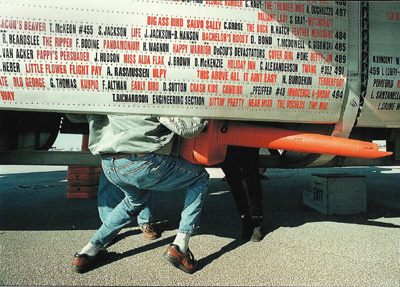
Virtually everything that is covered up, carpeted or padded in a commercial airliner is laid out for all the world to see – steel ribs, control cables, ammo boxes, oxygen tanks, rotating gun turrets – everything.
They fire up the engines and clouds of white exhaust sweep into the wash, something called “churn and burn,” according to a former tail gunner who’d come out to see her take off. It’s oil that seeped into the cylinders. It burns off.
Once all four engines are running cleanly you taxi out to the runway. The engine noise is deafening – you have to shout at the guy sitting next to you to make yourself heard.
When they throttle up to take off, she sprints down the runway with amazing power. The landscape rushes by with increasing velocity, the sound of the wind grows louder, and the old girl bounds into the air.
This is flying like you’ve never experienced. The waist gun ports, about the size of your refrigerator door, are totally open. Stick your head out there and see what 300 mph feels like.
You have to be careful where you step. The bomb bay doors, for instance, are designed to tear away if something heavy – like you – falls on them. Slip off the narrow catwalk and there’s nothing between you and the ground but 2,000 feet of Northwest Florida afternoon.
Wind howls through the aft part of the airplane. The cold is amazing. You think of those kids in their fleece-lined jackets, aiming .50-calibers at incoming fighters, and you wonder how in the name of God they did it.
The trip takes an hour. When you get to Crestview, you come in at treetop level and buzz the airport. The world spins crazily as you climb and simultaneously bank for the go-around to land.
You get out and pat her on the fuselage and tell her, “Good airplane,” and two important changes have taken place over the afternoon.
Now that you’ve had a taste of what it was like to fly in these airplanes, you have a new awe and respect for the men who flew them into war.
And maybe you’re a little said that never, not in your entire life, will you ever do anything as fine as what those men did.
But you have done something that not many people will get to do anymore. You flew aboard a B-24 Liberator.
The old girl was good for one more ride.
This column was originally published in the Wednesday, March 11, 1998 edition of the Northwest Florida Daily News and is used with permission.
About the author:
Del Stone Jr. is a professional fiction writer. He is known primarily for his work in the contemporary dark fiction field, but has also published science fiction and contemporary fantasy. Stone’s stories, poetry and scripts have appeared in publications such as Amazing Stories, Eldritch Tales, and Bantam-Spectra’s Full Spectrum. His short fiction has been published in The Year’s Best Horror Stories XXII; Alfred Hitchcock’s Mystery Magazine; the Pocket Books anthology More Phobias; the Barnes & Noble anthologies 100 Wicked Little Witch Stories, Horrors! 365 Scary Stories, and 100 Astounding Little Alien Stories; the HWA anthology Psychos; and other short fiction venues, like Blood Muse, Live Without a Net, Zombiesque and Sex Macabre. Stone’s comic book debut was in the Clive Barker series of books, Hellraiser, published by Marvel/Epic and reprinted in The Best of Hellraiser anthology. He has also published stories in Penthouse Comix, and worked with artist Dave Dorman on many projects, including the illustrated novella “Roadkill,” a short story for the Andrew Vachss anthology Underground from Dark Horse, an ashcan titled “December” for Hero Illustrated, and several of Dorman’s Wasted Lands novellas and comics, such as Rail from Image and “The Uninvited.” Stone’s novel, Dead Heat, won the 1996 International Horror Guild’s award for best first novel and was a runner-up for the Bram Stoker Award. Stone has also been a finalist for the IHG award for short fiction, the British Fantasy Award for best novella, and a semifinalist for the Nebula and Writers of the Future awards. His stories have appeared in anthologies that have won the Bram Stoker Award and the World Fantasy Award. Two of his works were optioned for film, the novella “Black Tide” and short story “Crisis Line.”
Stone recently retired after a 41-year career in journalism. He won numerous awards for his work, and in 1986 was named Florida’s best columnist in his circulation division by the Florida Society of Newspaper Editors. In 2001 he received an honorable mention from the National Lesbian and Gay Journalists Association for his essay “When Freedom of Speech Ends” and in 2003 he was voted Best of the Best in the category of columnists by Emerald Coast Magazine. He participated in book signings and awareness campaigns, and was a guest on local television and radio programs.
As an addendum, Stone is single, kills tomatoes and morning glories with ruthless efficiency, once tied the stem of a cocktail cherry in a knot with his tongue, and carries a permanent scar on his chest after having been shot with a paintball gun. He’s in his 60s as of this writing but doesn’t look a day over 94.
Contact Del at [email protected]. He is also on Facebook, twitter, Pinterest, tumblr, TikTok, and Instagram. Visit his website at delstonejr.com .
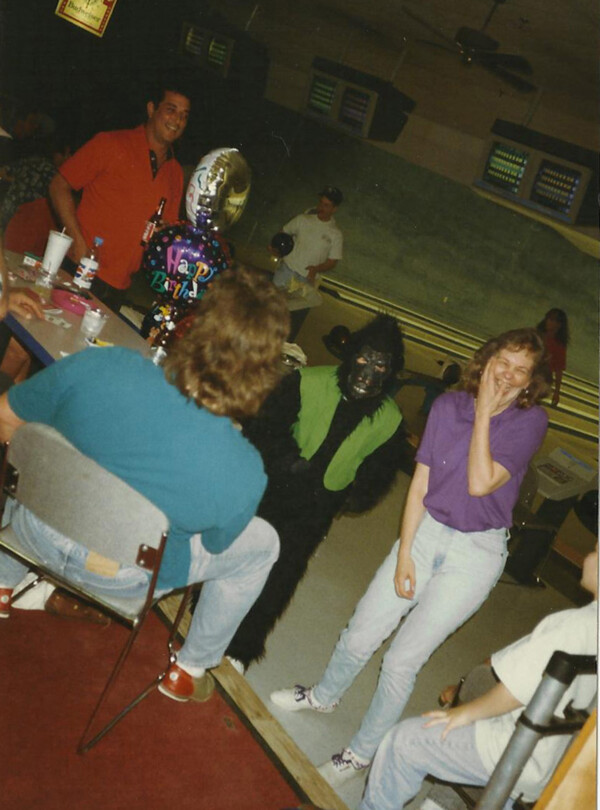
Julie Coble (in purple shirt) is serenaded by a gorilla during a birthday celebration at Lucky Strike Lanes in 1996. Image by Del Stone Jr.
In September 1991, I joined the Friday Nite Early Mixers, a bowling league headquartered at Lucky Strike Lanes in Fort Walton Beach.
That first night was a lesson in humility for me. My brand-new ball wouldn’t hit the big side of a barn, I couldn’t keep score fast enough. And there was this woman who kept laughing. …
She laughed all night long – a trail of unconstrained mirth that caused everyone around her to laugh, too. I went home with the certainty that whoever she was, she was having a darned good time.
Later, I would learn her name.
Julie Coble.
Later still we’d bowl on the same team. We’d bowl in tournaments. We’d hang out, talk on the phone, and do all the tings good friends do.
I’m one of hundreds of people who can say that about Julie. She was everybody’s friend, and that’s why she laughed. Her heart held that much.
She was a terrific bowler. She threw a backup ball that would slide into the 1-2 pocket and produce a lethal scattering of pins. But you wouldn’t ask her to pick up the 7 pin. Her ball would either drop into the gutter or slide to the right.
The pin she made sure to get was the 5 pin, the one right in the middle. The “sex” pin. Pick up the 5 pin, and romance was in your immediate future. Miss it, and you’d be sleeping on the couch. She rarely missed it.
We teased her about that, a subject that elicited embarrassed peals of laughter and a blushing, unspoken acknowledgement that there were some things she wouldn’t share, not even with her very good friends. And being her very good friends, we teased her even more.
But Julie was more than our bowling friend.
She was a wife and a mother. She was an award-winning newspaper carrier. She had an uncanny knack for winning games of chance, like bingo, raffles and cards.
She could pick up at 4-10 split, or take on a lame tournament partner and roll a 600 series.
Best of all, give her a bowling alley full of grouchy people, and she’d have ’em laughing till they cried. She knew, and loved, everybody. And everybody knew, and loved, her.
About two years ago, Julie discovered she had inoperable cancer. The news cast a pall over the bowling alley.
But Julie simply carried on. This would not stop her, and indeed, it did not. Until a short while ago, she appeared at the bowling alley every Friday night, laughing and bowling. When the chemo took her hair, she got a wig and kept right on going. When she could no longer heft her 14-pound ball, she bought a lighter ball.
Through the worst of everything, she laughed. It was a humbling thing to see. Her heart was larger than any of us could imagine.
Julie died Saturday night. She would have been 46 on March 18.
It is impossible to remember Julie without remembering how much she loved this world and her life. We are all sad, but somehow, as I think about her, I find myself trying to smile.
Whenever Julie told somebody goodbye, she’d sign off with, “See ya, Sweetie.”
So for all of us, I say:
We’ll see ya.
Sweetie.
About the author:
Del Stone Jr. is a professional fiction writer. He is known primarily for his work in the contemporary dark fiction field, but has also published science fiction and contemporary fantasy. Stone’s stories, poetry and scripts have appeared in publications such as Amazing Stories, Eldritch Tales, and Bantam-Spectra’s Full Spectrum. His short fiction has been published in The Year’s Best Horror Stories XXII; Alfred Hitchcock’s Mystery Magazine; the Pocket Books anthology More Phobias; the Barnes & Noble anthologies 100 Wicked Little Witch Stories, Horrors! 365 Scary Stories, and 100 Astounding Little Alien Stories; the HWA anthology Psychos; and other short fiction venues, like Blood Muse, Live Without a Net, Zombiesque and Sex Macabre. Stone’s comic book debut was in the Clive Barker series of books, Hellraiser, published by Marvel/Epic and reprinted in The Best of Hellraiser anthology. He has also published stories in Penthouse Comix, and worked with artist Dave Dorman on many projects, including the illustrated novella “Roadkill,” a short story for the Andrew Vachss anthology Underground from Dark Horse, an ashcan titled “December” for Hero Illustrated, and several of Dorman’s Wasted Lands novellas and comics, such as Rail from Image and “The Uninvited.” Stone’s novel, Dead Heat, won the 1996 International Horror Guild’s award for best first novel and was a runner-up for the Bram Stoker Award. Stone has also been a finalist for the IHG award for short fiction, the British Fantasy Award for best novella, and a semifinalist for the Nebula and Writers of the Future awards. His stories have appeared in anthologies that have won the Bram Stoker Award and the World Fantasy Award. Two of his works were optioned for film, the novella “Black Tide” and short story “Crisis Line.”
Stone recently retired after a 41-year career in journalism. He won numerous awards for his work, and in 1986 was named Florida’s best columnist in his circulation division by the Florida Society of Newspaper Editors. In 2001 he received an honorable mention from the National Lesbian and Gay Journalists Association for his essay “When Freedom of Speech Ends” and in 2003 he was voted Best of the Best in the category of columnists by Emerald Coast Magazine. He participated in book signings and awareness campaigns, and was a guest on local television and radio programs.
As an addendum, Stone is single, kills tomatoes and morning glories with ruthless efficiency, once tied the stem of a cocktail cherry in a knot with his tongue, and carries a permanent scar on his chest after having been shot with a paintball gun. He’s in his 60s as of this writing but doesn’t look a day over 94.
Contact Del at [email protected]. He is also on Facebook, twitter, Pinterest, tumblr, TikTok, and Instagram. Visit his website at delstonejr.com .
Image courtesy of Picryl under a Creative Commons license.
Greetings from Stockholm, where I am receiving the Nobel Prize for chemistry. I thought invite you, but only people with IQs above 185 are allowed.
I have been very busy the past year. I not only conquered my fear of flying but obtained my commercial airline pilot’s license, which enabled me to ferry the president and his concubine aboard the Concorde on a fact-finding tour of Bali.
And that little weight problem I grappled with last year? Not only did I get back into shape, I recently posed for the Mr. November foldout of the Undergear catalog. Good thing my washboard abs were honed to a glistening edge by my personal trainer, Arnold Schwarzenegger.
My goal for the coming year is to occupy the top 10 positions on the New York Times best seller list – simultaneously.
My wife, Carolyn Murphy, the supermodel, finished that shoot in Milan and came home to complete her doctorate’s – magna cum laude, of course – in quantum mechanics. She will complete her Grand Unification Theory aboard the International Space Station, once she’s finished carving that sculpture of the president into Mount Rushmore.
Our daughter, Zelda, recently won the best actress Academy Award for her portrayal of Juliet Capulet in James Cameron’s new movie, “Shakespeare vs. The Terminator,” which grossed over $2 billion in worldwide ticket receipts. Now it’s back to Oxford – assuming they grant her tenure. If not, she’s been asked to serve a term as prime minister of Japan.
Meanwhile, our son Abercrombie defeated the Russian Federation representative for the world chess crown and recently established radio contact with the Antareans, a race of superbeings who inhabit a distant planet and have promised to share their secrets of immortality and galactic peace with humanity. He’s a clever scamp. Now if I could only get him to make his bed!
Even the family dog, Clytemnestra, has news. She received a presidential citation for leading the passengers and crew of a grounded cruise liner to safety, and recently disarmed a gang of thugs trying to make off with the Spode. If you see her story on “60 Minutes” pay close attention to the tile in the entryway – it’s Tuscany, and I quarried, cut, polished laid it myself (with a little help from Bob Vila).
Lastly, our house has been declared a national sanctuary by federal wildlife officials after a rare orchid, thought to have been extinct 100 million years ago, was discovered growing in our back yard amidst the kiwi grove.
Well, enough about me and my family. How was your tawdry, hollow shell of an existence for the year?
This column was originally published in the Dec. 3, 1997 edition of the Northwest Florida Daily News and is used with permission.
About the author:
Del Stone Jr. is a professional fiction writer. He is known primarily for his work in the contemporary dark fiction field, but has also published science fiction and contemporary fantasy. Stone’s stories, poetry and scripts have appeared in publications such as Amazing Stories, Eldritch Tales, and Bantam-Spectra’s Full Spectrum. His short fiction has been published in The Year’s Best Horror Stories XXII; Alfred Hitchcock’s Mystery Magazine; the Pocket Books anthology More Phobias; the Barnes & Noble anthologies 100 Wicked Little Witch Stories, Horrors! 365 Scary Stories, and 100 Astounding Little Alien Stories; the HWA anthology Psychos; and other short fiction venues, like Blood Muse, Live Without a Net, Zombiesque and Sex Macabre. Stone’s comic book debut was in the Clive Barker series of books, Hellraiser, published by Marvel/Epic and reprinted in The Best of Hellraiser anthology. He has also published stories in Penthouse Comix, and worked with artist Dave Dorman on many projects, including the illustrated novella “Roadkill,” a short story for the Andrew Vachss anthology Underground from Dark Horse, an ashcan titled “December” for Hero Illustrated, and several of Dorman’s Wasted Lands novellas and comics, such as Rail from Image and “The Uninvited.” Stone’s novel, Dead Heat, won the 1996 International Horror Guild’s award for best first novel and was a runner-up for the Bram Stoker Award. Stone has also been a finalist for the IHG award for short fiction, the British Fantasy Award for best novella, and a semifinalist for the Nebula and Writers of the Future awards. His stories have appeared in anthologies that have won the Bram Stoker Award and the World Fantasy Award. Two of his works were optioned for film, the novella “Black Tide” and short story “Crisis Line.”
Stone recently retired after a 41-year career in journalism. He won numerous awards for his work, and in 1986 was named Florida’s best columnist in his circulation division by the Florida Society of Newspaper Editors. In 2001 he received an honorable mention from the National Lesbian and Gay Journalists Association for his essay “When Freedom of Speech Ends” and in 2003 he was voted Best of the Best in the category of columnists by Emerald Coast Magazine. He participated in book signings and awareness campaigns, and was a guest on local television and radio programs.
As an addendum, Stone is single, kills tomatoes and morning glories with ruthless efficiency, once tied the stem of a cocktail cherry in a knot with his tongue, and carries a permanent scar on his chest after having been shot with a paintball gun. He’s in his 60s as of this writing but doesn’t look a day over 94.
Contact Del at [email protected]. He is also on Facebook, twitter, Pinterest, tumblr, TikTok, Ello and Instagram. Visit his website at delstonejr.com .