Del and Mladen review ‘Gravity’
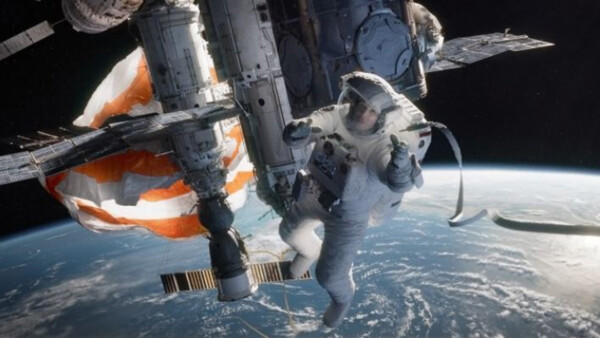
Image courtesy of Warner Brothers.
—
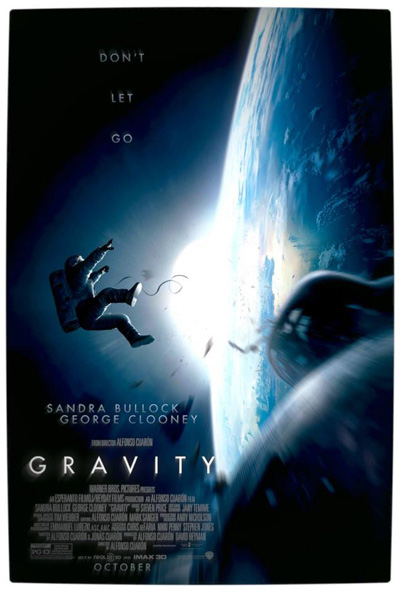
“Gravity” Starring Sandra Bullock and George Clooney. Directed by Alfonso Cuaron. 91 minutes. Rated PG-13.
Del’s take
“Gravity” is a stunning spectacle of special effects and a riveting depiction of the human will to survive. But its characters are thinly sketched and their motivations contrived, which pulls the movie from the lofty realm of a classic to the merely good, despite the “buzz” and Oscar talk.
In “Gravity,” Sandra Bullock plays Dr. Ryan Stone, a mission specialist, on her first space shuttle flight. She and old hand astronaut Matt Kowalski (George Clooney) are part of a Hubble Space Telescope repair team which falls afoul of a Russian anti-satellite test gone wrong. The ensuing cloud of orbiting debris, traveling at thousands of miles per hour, destroys their shuttle and leaves Stone and Kowalski in orbit – alone.
They must make their way to the International Space Station, and from there a Chinese space station, all the while dodging a killer cloud of orbiting junk and racing against the clock before their oxygen is depleted. At every turn their efforts are thwarted by the expected and unexpected perils presented by spaceflight.
The star of “Gravity” is not Bullock but the special effects. We did not see the 3-D version but I expect it is spectacular. Even in 2-D you feel as though you’re floating above the earth with nothing between you and the ground but 150 miles of vacuum and 50 miles of air. For sufferers of acrophobia (like yours truly) the view was sometimes sweaty palm-inducing. Never in a movie did I feel as though I were actually there, and the claustrophobia of being confined to a spacesuit with no option to pop the helmet and take a breath of fresh air was so pervasive it almost became a third character.
And “Gravity” is an edge-of-your-seat thriller to be sure. Pauses in tension are few, and you’ll come out of the theater with aching muscles as you tried to help Bullock push this way and pull that. In that respect “Gravity” strikes me as more of an “Armageddon” and less of an “Apollo 13.”
As I said, the characters are thinly sketched, which may have been a necessity given “Gravity’s” narrative structure. Still, we get to know Dr. Stone somewhat but nobody else, including astronaut Kowalski. As you might expect under the circumstances Stone has a fatalistic view of her outcome and it is amplified by the loss of a child, requiring that she be coached and encouraged by Kowalski. That struck me as contrived and unnecessary. No matter how highly educated and motivated astronauts can be, and no matter what their burdens, when the issue at hand is survival every individual will behave predictably, and try to live. Bullock’s character does evolve during the movie, and that’s what all good characters do: They change as a result of their experiences. But in Bullock’s case the change seemed forced.
I found it puzzling Cuaron chose to abide by some scientific principles and ignore others. After reading astronomer Neil Degrasse Tyson’s enumeration of the scientific errors in “Gravity,” I came prepared to ignore them for the benefit of watching a great story. But during the movie I found myself distracted by the implausibilities.
Is “Gravity” the best movie of the year? Is Bullock’s performance worthy of an Oscar? I would say no on both counts. While “Gravity” is entertaining, and Bullock’s performance commendable, I didn’t come out of the theater with any lasting impression of either.
Still, it’s nice to see a film that isn’t a sequel and isn’t based on some “blockbuster” premise make its way to theaters and do well at the box office. Maybe Hollywood can take a lesson from “Gravity” and return to making films from original stories.
Mladen’s take
(Spoiler alert)
“Gravity” is one of my worst movie-going fears realized, a film promising action but delivering little more than maudlin introspection.
The movie betrayed me. It also betrayed Del, though he doesn’t fully accept it.
Del summed the plot nicely. A series of improbable events sires both the prospect of our heroine dying alone in space or surviving despite implacable odds.
Had “Gravity” fulfilled its promise, what I would’ve seen was an intelligent, nicely configured middle-aged woman give fate the middle finger as she demonstrated what training, technical prowess, and a will to live can accomplish.
In response, fate would’ve contributed not only dumb-ass Russians inopportunely blowing up one of their own satellites to create a hypervelocity constellation of space debris holing everything in its path, but also micrometeorites, sun flares, gravitons, an atmosphere salient jutting far into space that threatened incineration if entered, and an interesting sidekick for Stone rather than the quasi-cowboy-like character portrayed by Clooney.
Instead, the film yields sequences of free-floating, spin-induced disorientation and bodies slamming into solid objects such as space modules. Each bit of extra-atmospheric action is followed by moments of a person talking to herself about staying hopeful and alive. Hell, Stone even references Heaven at one point, though earlier she had said to herself that she never prays. This “no-one-in-a-foxhole-is-an-atheist” triteness only added to the movie’s superfluous feel.
Efforts to convey the spiritual impact of what Stone and Kowalski, and then Stone alone, faced were as empty as the vacuum of space. Kowalski’s seemingly unselfish and chivalrous suicide was nothing of the sort because it was unnecessary.
Suicide comes along again when Stone, ensconced in a Russian – there they are again – Soyuz vehicle, decides there’s no chance of surviving. She turns off the capsule’s oxygen supply and begins to pass out when there’s a knock on the capsule’s door. It’s handsome Kowalski waving to her through the door’s portal. The silliness of it just about exploded my head.
Kowalski, of course, is a figment of Stone’s oxygen-starved imagination. The apparition, after he takes a swig of vodka craftily hidden aboard the capsule by one of Kowalski’s cosmonaut friends, tells Stone how to make the best of a very, very, very, very, very bad situation. Yes, the capsule’s main engine is out of fuel, but its soft-landing thrusters have the juice to get her to the Chinese space station, which has a fully functioning return-to-Earth capsule.
A fiery atmospheric reentry scene and near-drowning later, Stone swims to the shore of a pristine lake surrounded by an idyllic land, not a single artifact of humanity in sight. Stone is going to get a fresh start was the message of the film’s last scene.
Who cares?
Not me.
Mladen Rudman is a former journalist and technical editor. Del Stone Jr. is a journalist and author.

Image courtesy of Roger Brown at Pexels. https://www.pexels.com/@roger-brown-3435524/
I got up this morning about 3:30 to use the bathroom. When I turned on the light I saw something move.
There, on the bathroom floor, stood a cockroach – not one of the cute TV commercial cartoon roaches that checks into the roach hotel but doesn’t check out. This was a bull, so big it didn’t care about its surroundings or the fact that I’d turned on the light.
I was paralyzed by fear. What to do? If I sprayed it the thing would go crazy, probably start flying around, crawl into a hidden nook then emerge once the lights were off to crawl into my mouth.
But I couldn’t squash it. When squashed roaches release a chemical marker that attracts other roaches – I read that somewhere. Besides, I didn’t want to get close enough to the infernal thing to squash it. And I no longer had a cat I could sic on it.
I decided to take my chances with the spray.
I went downstairs to fetch a can of Raid. When I came back, the roach was gone. I searched for it – from a distance – when suddenly it scuttled between my feet. I did the Crazy Dance; the roach did the Crazy Dance and scurried under my bed. Great. Now I’d never find it.
I circled the bed a few times, hoping it would come out, but when it didn’t I mustered the courage to get on my hands and knees and peer under the bed. There it was, nonchalantly marching across the carpet. I gave it a shot of insecticide and the thing went berserk. It headed for the other side and I jumped up and ran around the corner of the mattress to intercept.
When it came out I hosed it. The thing went bonkers and started running everywhere. I kept up my attack and its wings began to flutter. I took off for the door, ready to bail out of the second floor if that thing launched itself into the air.
I lost track of it for a moment, then BAM! There it was, skittering past my feet. I gave it another blast of Raid and it finally rolled over on its back and started doing one-legged backstrokes in circles.
God, what a nightmare. I soaked it again and it finally lay still.
Then I was faced with the problem of getting rid of it. No way was I going to touch it, not even with a wadded up paper towel. Roaches have a habit of springing back to life when disturbed from their death knells.
I went downstairs and got the vacuum cleaner. Plugged it in, detached the hose, turned it on and sucked that disgusting creature into the dust bin. Except I couldn’t see it in the dust bun.
Later that morning, I took the vacuum cleaner outside and dumped the dust bin in the trash can. No roach. And it wasn’t trapped in the filter, either.
That means it’s somewhere inside the vacuum cleaner and one day in the near future it’ll come tumbling out, giving me another fright.
With luck it won’t came scrambling out!
About the author:
Del Stone Jr. is a professional fiction writer. He is known primarily for his work in the contemporary dark fiction field, but has also published science fiction and contemporary fantasy. Stone’s stories, poetry and scripts have appeared in publications such as Amazing Stories, Eldritch Tales, and Bantam-Spectra’s Full Spectrum. His short fiction has been published in The Year’s Best Horror Stories XXII; Alfred Hitchcock’s Mystery Magazine; the Pocket Books anthology More Phobias; the Barnes & Noble anthologies 100 Wicked Little Witch Stories, Horrors! 365 Scary Stories, and 100 Astounding Little Alien Stories; the HWA anthology Psychos; and other short fiction venues, like Blood Muse, Live Without a Net, Zombiesque and Sex Macabre. Stone’s comic book debut was in the Clive Barker series of books, Hellraiser, published by Marvel/Epic and reprinted in The Best of Hellraiser anthology. He has also published stories in Penthouse Comix, and worked with artist Dave Dorman on many projects, including the illustrated novella “Roadkill,” a short story for the Andrew Vachss anthology Underground from Dark Horse, an ashcan titled “December” for Hero Illustrated, and several of Dorman’s Wasted Lands novellas and comics, such as Rail from Image and “The Uninvited.” Stone’s novel, Dead Heat, won the 1996 International Horror Guild’s award for best first novel and was a runner-up for the Bram Stoker Award. Stone has also been a finalist for the IHG award for short fiction, the British Fantasy Award for best novella, and a semifinalist for the Nebula and Writers of the Future awards. His stories have appeared in anthologies that have won the Bram Stoker Award and the World Fantasy Award. Two of his works were optioned for film, the novella “Black Tide” and short story “Crisis Line.”
Stone recently retired after a 41-year career in journalism. He won numerous awards for his work, and in 1986 was named Florida’s best columnist in his circulation division by the Florida Society of Newspaper Editors. In 2001 he received an honorable mention from the National Lesbian and Gay Journalists Association for his essay “When Freedom of Speech Ends” and in 2003 he was voted Best of the Best in the category of columnists by Emerald Coast Magazine. He participated in book signings and awareness campaigns, and was a guest on local television and radio programs.
As an addendum, Stone is single, kills tomatoes and morning glories with ruthless efficiency, once tied the stem of a cocktail cherry in a knot with his tongue, and carries a permanent scar on his chest after having been shot with a paintball gun. He’s in his 60s as of this writing but doesn’t look a day over 94.
Contact Del at [email protected]. He is also on Facebook, twitter, Pinterest, tumblr, TikTok, Ello and Instagram. Visit his website at delstonejr.com .
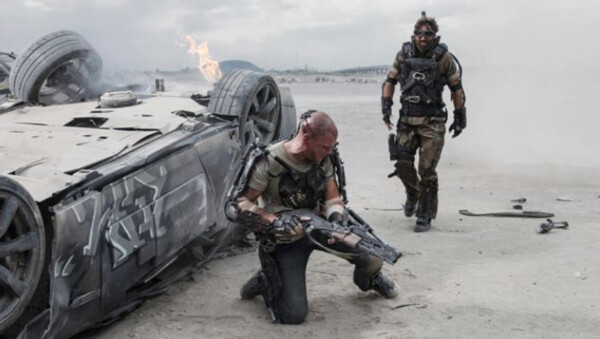
Image courtesy of Sony Pictures.
—
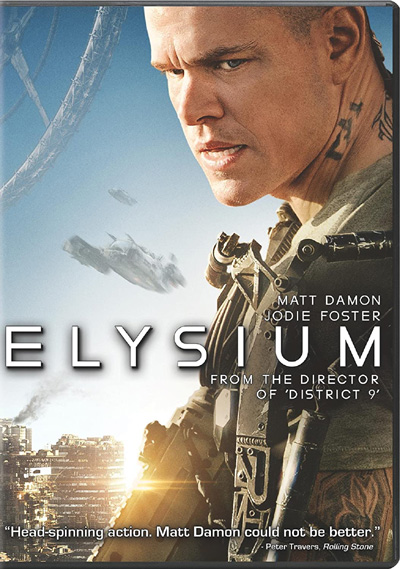
“Elysium” Starring Matt Damon, Alice Braga, Jodie Foster and Sharlto Copley. Directed by Neill Blomkamp. 1 hour, 49 minutes. Rated R.
Mladen’s take
It’s tough to criticize a movie where the poor and luckless prevail, because that’s the way the sentimental slugfest “Elysium” ends.
Elysium, derived from the Greek phrase for ideal happiness, is a space station orbiting squalid Earth. The planet in 2154 is a vast slum teeming with poverty, crime and illness. Elysium is a skyborne paradise for wealthies and their “med bays.”
Medical treatment is at the core of this film by the director of nearly perfect “District 9,” which was nominated for a Best Picture Oscar a few years ago. The med bays are scanners that detect bodily maladies and then heal them.
And it’s a med bay that our not always heroic hero Max, played by Matt Damon, has to reach. He can’t buy access to the off-planet treatment, so he becomes part of a grand scheme.
Max, a reformed car thief, has been exposed to a lethal dose of radiation at an Earth-located police android factor where he works. A med bay is the only way to repair his cells. From internally fried body to death is only five days, the extraction droid that pulled Max from the spot he was nuked tells him.
“Elysium” is a movie that requires that you pay attention because there are at least three subplots. The film also asks that you accept at least one far-fetched coincidence.
There’s a villainess, Elysium’s defense secretary Delacourt, played by Jodie Foster.
There’s her Earth-planted, off-the-books paramilitary spook and sadist Kruger, who develops an ambition of his own.
And there’s the other reason Max has to reach Elysium, the daughter of a not-quite love interest, Frey, portrayed by Alice Braga. Frey’s daughter, actress Emma Tremblay, has leukemia and needs access to a med bay, too.
Add a computer hacktivist, machine-to-brain data storage, exoskeletons fused to bodies, solid cussing and graphic violence, much of it the result of miniaturized smart munitions designed to take out individuals, and the result is a sci-fi fairy tale of a selfish man becoming selfless, of the masses finding what the wealthy had been enjoying for some time, eternal life.
In a med bay, not even the blown off lower part of a man’s head is immune from repair. As long as the brain is ticking and the body sufficiently intact, tissue can be repaired.
As with “District 9,” Blomkamp maintains control of CGI. It exists to enhance the story, not supplant it. And, as with District 9, the South African director likes to blow apart bodies.
“Elysium” tries to, and at the end, succeeds in tugging your heart. Its plot pulls you through the sometimes choppy story-telling.
But, the film’s real strength is the vivid portrayal of lives differentiated by access to money, health care included.
When the most recent United Kingdom royal was having a baby, she had it at an exclusive hospital with, no doubt, the best doctors and technology at her side.
The frenzied attention television and Internet paid attention to the birth in pristine conditions was appalling.
So, while the globe was fed imagery of a hospital in a fashionable neighborhood of London, I was wondering what it was like to give birth in a Syrian refugee camp on the border with Lebanon or Turkey or Jordan.
The precursors to med bays are here, now. Welcome to Elysium 2013, if you can afford it.
Del’s take
Mladen was right about one thing: “It’s tough to criticize a movie where the poor and luckless prevail,” … But that’s precisely what I intend to do. I found “Elysium” to be a simple-minded polemic about class warfare, a story that has been told more skillfully and entertainingly many times since the dawn of storytelling.
“Elysium” is a contrast in extremes. Reality as we know it is black, white, and all the shades in between. That quality is missing from Blomkamp’s stark vision of the future. What’s good is deliriously utopian, and what’s bad is worse than awful. As a result, it’s hard to take any of it very seriously.
Mladen has given you the basics of the setting, but I’ll elaborate: Earth has indeed been overrun by poverty, crime and illness, but it’s worse than that. Los Angeles is a slum built on a garbage dump, a Third World shantytown where even the basics of infrastructure don’t exist. People are subjugated by a violent police force of androids who arbitrarily beat and arrest people for minor infractions. Even Matt Damon’s parole officer, a robot, threatens him with arrest for being sarcastic (one of the film’s sparse light moments).
Then you have Elysium, the orbiting torus where the grass is green, every home is a mansion, and the citizens possess a gentility conveyed by wealth, status, and comfortable living, abetted by their medical bays that can cure every disease by simply “re-atomizing” the person’s cell structure. I’ll bet the folks behind Obamacare would like to get their hands on that one.
The price for admission is money, something the unwashed masses don’t possess. So in a crude parable of illegal immigration, people pay smugglers to get them aboard Elysium.
Except it isn’t a better life these people are seeking. It isn’t freedom from tyranny, clean water, fresh air, and opportunities to improve themselves that drive these people to Elysium. It is: health care.
Don’t get me wrong. Health care is important, especially when you’re terminally ill, as is Damon and the daughter of his former love interest. But in the sweep of human motivation, where empires hang in the balance, isn’t health care a tad farther down the list behind freedom and hope?
I’m not buying it. I’m not buying that rich people are evil, as the film seems to suggest. For every snooty scion who was born with a silver spoon in his mouth, there’s another fellow who earned his wealth by coming up with a better idea and working his backside off to make it happen. For every rich snob who looks down his nose at folks in the lower tax brackets, there’s a Warren Buffet or Bill Gates who uses his wealth to better mankind.
Nor am I buying that people less financially endowed are hapless victims, doomed to suffer the whims of the wealthy. In fact, I find it insulting Blomkamp thinks so little of us. In “Elysium,” people who try to better their lives are beaten into submission, which serves neither the rich nor the poor. It doesn’t make any sense.
My biggest gripe with “Elysium” is it ignores the real problem. The film asks, “Wouldn’t life be better if the poor had access to the same level of health care as the wealthy?” I ask, “What about overpopulation?” “What about violence?” “What about pollution?” “What about all the awful oversights and neglected problems that caused the earth to become a foul wasteland?” All the health care in the world amounts to nothing if humanity is starving, living in a toxic environment, and deprived of hope.
In “Elysium,” the answers are simple. In the world I inhabit, they are far more complex. I could wish for a utopian fantasy, but that’s all it would be: a fantasy.
I’d rather my stories offer hope in a way that’s believable and realistic. “Elysium” offers neither.
Mladen Rudman is a former journalist and technical editor. Del Stone Jr. is a former journalist and author.
Last night I was talking to Mom about my visit today with Dr. Norman Friedman, a local dermatologist. I had several objects on my face I wanted removed, plus my family doctor recommended I have him look at a mole on my cheek.
Mom said if I had procedures done and needed a ride home to give her a call. “Don’t worry, Mom,” I told her. “He’s not going to do anything (today) except look at everything and schedule an appointment for me to come in and have things cut off.”
Well.
As I sat in his examination room he began looking me over. He paid close attention to an object on my lower back, something I hadn’t known was there. He said he was certain it was a skin cancer, but the good news was that in removing it for a biopsy, it would be gone and no follow-up treatment necessary. Then he asked why I’d come to see him. I told him about the objects on my face. He checked them and said, “We’ll remove those just for fun, though I warn you, the procedure is painful.” Great.
First, he took off the offender on my lower back. Then he used some kind of cauterizing device to burn the area. “Phew, that stinks!” I told him. “That’s the aroma of roasted Del,” he answered.
Then he laid me on the examination table to go after the facial objects. He warned me again it was painful and said he’d do one just to test my pain threshold. I’m already a big baby when it comes to doctors, and a bigger baby when it comes to pain, so I was expecting something akin to a root canal. He took a stylus-like object and began tracing it over one of the areas. It was painful, yes, but not so painful I couldn’t stand it. I’m thinking it applied an electric current to the area, scorching the flesh – heck, I don’t know. He did the rest of the areas plus a couple of others for good measure.
As his nurse explained to me how to care for the area on my back, she noticed another area that looked suspicious. She thought about it for a minute, then went to fetch Dr. Friedman for another look. He debated removing it, then finally decided it was better to be safe than sorry. Another Novocain shot, more scraping, more burning. All the while we chatted about the joys of kidney stones.
My face feels like I’ve got a sunburn, but I’m very happy to be rid of these things. I’m even happier to be rid of the one I didn’t know about, the one that was likely cancerous.
So I encourage you to visit your local dermatologist if you haven’t been in awhile. I hadn’t seen Dr. Friedman since 2006 and that was clearly too long to wait. I plan to make it an annual affair.
About the author:
Del Stone Jr. is a professional fiction writer. He is known primarily for his work in the contemporary dark fiction field, but has also published science fiction and contemporary fantasy. Stone’s stories, poetry and scripts have appeared in publications such as Amazing Stories, Eldritch Tales, and Bantam-Spectra’s Full Spectrum. His short fiction has been published in The Year’s Best Horror Stories XXII; Alfred Hitchcock’s Mystery Magazine; the Pocket Books anthology More Phobias; the Barnes & Noble anthologies 100 Wicked Little Witch Stories, Horrors! 365 Scary Stories, and 100 Astounding Little Alien Stories; the HWA anthology Psychos; and other short fiction venues, like Blood Muse, Live Without a Net, Zombiesque and Sex Macabre. Stone’s comic book debut was in the Clive Barker series of books, Hellraiser, published by Marvel/Epic and reprinted in The Best of Hellraiser anthology. He has also published stories in Penthouse Comix, and worked with artist Dave Dorman on many projects, including the illustrated novella “Roadkill,” a short story for the Andrew Vachss anthology Underground from Dark Horse, an ashcan titled “December” for Hero Illustrated, and several of Dorman’s Wasted Lands novellas and comics, such as Rail from Image and “The Uninvited.” Stone’s novel, Dead Heat, won the 1996 International Horror Guild’s award for best first novel and was a runner-up for the Bram Stoker Award. Stone has also been a finalist for the IHG award for short fiction, the British Fantasy Award for best novella, and a semifinalist for the Nebula and Writers of the Future awards. His stories have appeared in anthologies that have won the Bram Stoker Award and the World Fantasy Award. Two of his works were optioned for film, the novella “Black Tide” and short story “Crisis Line.”
Stone recently retired after a 41-year career in journalism. He won numerous awards for his work, and in 1986 was named Florida’s best columnist in his circulation division by the Florida Society of Newspaper Editors. In 2001 he received an honorable mention from the National Lesbian and Gay Journalists Association for his essay “When Freedom of Speech Ends” and in 2003 he was voted Best of the Best in the category of columnists by Emerald Coast Magazine. He participated in book signings and awareness campaigns, and was a guest on local television and radio programs.
As an addendum, Stone is single, kills tomatoes and morning glories with ruthless efficiency, once tied the stem of a cocktail cherry in a knot with his tongue, and carries a permanent scar on his chest after having been shot with a paintball gun. He’s in his 60s as of this writing but doesn’t look a day over 94.
Contact Del at [email protected]. He is also on Facebook, twitter, Pinterest, tumblr, TikTok, and Instagram. Visit his website at delstonejr.com .
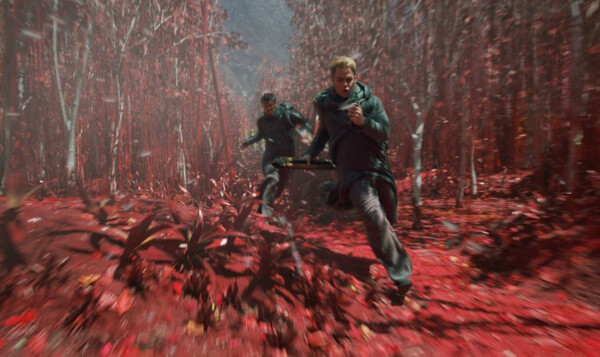
Image courtesy of Paramount Studios.
—
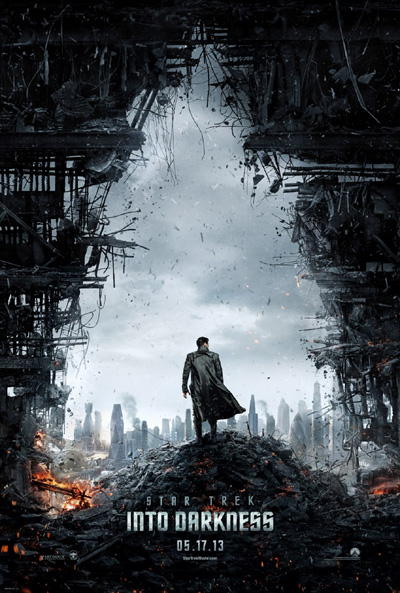
“Star Trek Into Darkness” Starring Chris Pine, Benedict Cumberbatch, Zachary Quinto, Zoe Saldana, Peter Weller. Directed by JJ Abrams. 132 minutes. Rated PG.
Mladen’s take
After watching “Star Trek Into Darkness,” I decided to produce and direct my own movie. It’ll be titled: “Mladen Rudman Into Frustration.”
The most recent version of Star Trek left me feeling unsatisfied, as though I had ordered a steak but gotten cotton candy.
A few parts of the film were good; most others stank. The circumstance that allowed Scotty to stay alive to open the door of an air lock that permitted a commando raid on the bigger and badder version of the U.S.S. Enterprise was all stinkiness.
The scene was all the more stinky because it was crucial. Had Scotty not stayed alive, the film would have had no place to go. The End. An implausible scene that keeps a story going wrecks a movie’s authenticity.
And, there’s too much crying in the movie.
Here’s a rule all producers and directors should follow when building a science fiction adventure film.
A man cries only when he’s enduring extreme physical pain. Your large intestine twisted into a half-hitch knot being chewed by a pit bull is an example of extreme pain. Tears are warranted in that case. Everything else – a friend dying from exposure to radiation – is a prompt for murderous revenge without tears intervening.
“Into Darkness” suffers from the Great Malaise of Hollywood, which Del addresses indirectly. He wonders if “Into Darkness” would appeal to everyone but Trekkies, which is precisely the point.
The studio should have stayed focused.
The studio should have made it a movie that would be liked only by Trekkies and guys like me who appreciate a good sci-fi film though mostly unfamiliar with the lore of Star Trek.
Look, all I need to know is that the crew of the Enterprise has been tasked with boldly going where no one has gone before and, when necessary, blowing the hell out of nasty indigenous life forms.
That friendships exist can be established by the way an away team dodges death rays and demolishes starships. Or by the fact that a crew stuck on an interstellar vessel for months at a time hasn’t torn itself apart.
We all know that humans like to couple and endure the emotional ravages of relationships going awry. Who cares about Spock’s and Uhura’s dating woes when you’re at the edge of the Neutral Zone violating the Klingon empire’s sovereignty? If I want a dose of the touchy feelies, I’ll see a “Twilight” movie.
In fact, I resent their squabbling and I’ll tell you why. It happened aboard a shuttle approaching a Klingon planet. The shuttle scene should have been replaced by something “Into Darkness” sorely lacked – open space battles among ships floating in a vacuum. What I wanted to see was a cloaked Klingon warbird suddenly materialize to fire on the Enterprise.
Remember the Romulan starship Narada in the very good 2009 “Star Trek”?
Narada was massive, looked like a multi-bladed serrated knife and fired missiles that fired smart submunitions targeting an enemy’s most sensitive systems. Watching U.S.S. Kelvin wither under its fire, the scenes of obliteration outside the spacecraft were silent, was impressive and accurate.
Abrams tried to make “Into Darkness” a movie that pleases everyone – women, men, teenagers, dogs, sea cucumbers – and will likely end up pleasing almost no one.
Del’s take
What I would say about “Star Trek Into Darkness” is: Yet another movie ruined by writer Damon Lindelof.
How long will it be until studios bar their pitch room doors to this person? If M. Night Shyamalan is any indication, I guess we can expect a long and dismal tradition of “Prometheuses” springing from the keyboard of the overrated Lindelof, who seems to understand nothing about story structure, character interaction and pathos.
It’s a shame, really, because “Into Darkness” could have been a fine summer movie. Instead, it is a collage of spangly images held together by a thin gossamer of story, a web so insubstantial that very little gets caught and the audience leaves hungry.
Its saving grace is a script that allows for a little self-deprecating fun, and command performances by at least three cast members: Chris Pine, Benedict Cumberbatch and Peter Weller. Others praised Zachary Quinto’s turn as Mr. Spock (though he and Leonard Nimoy assemble a much better performance in an Audi commercial) or the ensemble Star Trek “family” members (Saldana, Anton Yelchin and John Cho).
I’ve never thought much of Pine as an actor but I admit, he seems to capture my notion of a younger, friskier James Tiberius Kirk, whose disregard for protocol and willingness to indulge in gut instinct chafes the collective neck of the powers that be.
Peter Weller walks a highwire between bad and good, what I call “reasonable evil” – a person who’s able to convince others of the righteousness of his cause without sounding like a lunatic. For me he evoked a memory of Sterling Hayden in “Doctor Strangelove,” a man who, when you stand back and look at the cold truth of his worldview, is obviously insane, but sounds somewhat reasonable – his words make a kind of sense that doesn’t bear close inspection.
Better, “Into Darkness” isn’t just dominated but overwhelmed by Benedict Cumberbatch, the mysterious trenchcoated figure in the posters and trailers. Had Cumberbatch been given room to move he might have become the most insidious movie villain since Hans Gruber of “Die Hard” infamy. Unfortunately, his screen time is limited, to the movie’s detriment.
The movie ties together some loose threads from “Star Treks” that preceded it, and I won’t discuss them here for fear of spoiling the surprises. Suffice it to say you should brush up on your Trek lore before venturing into the darkness.
Weaknesses? The real plot of “Into Darkness” orbits Weller and Cumberbatch, who are given the short shrift in favor of the unconvincing bromance between Kirk and Spock, the wildly unconvincing romance between Spock and Uhura, and the silly notion Kirk should be allowed to run amok and do as he pleases, disregarding the accumulated wisdom of the human race. It’s a wonder we ever got into space without him.
Special effects are first rate. London and San Francisco get a 23rd century dressing up, and Enterprise interiors look less like a deep space-going craft than a 21st century corporate high-rise – that is until you venture into “Engineering,” which resembles nothing more than a glue factory.
Overall, however, I couldn’t escape the feeling I was watching a fleshed-out TV episode of a show based loosely on the original “Star Trek.” Gone is the wonder of discovery, the “new worlds” and “new civilizations” that made the original series such a unique experience, replaced by an irritating Millennial approach to work and life: To hell with your rules and institutions; I’ll do what I want, when I want.
Trekkies will probably be disappointed, which is OK if you can deliver a product that pleases everybody else. It’s the everybody else I wonder about. Is there enough meat on the bones of “Into Darkness” to please the larger movie-going audience?
At this point I can’t say there is. Its skimpy storyline, which I place squarely on the shoulders of writers like Lindelof, doom it to mediocrity.
As Hollywood struggles to woo fans into theaters and away from Netflix, it does not need a $190 million tentpole that underperforms at the box office. “Into Darkness” may not do as well as the 2009 rendering of “Star Trek,” which would be bad news for hosting studio Paramount and JJ Abrams.
Let’s hope he keeps Lindelhof in a galaxy far, far away from “Star Wars.”
Mladen Rudman is a former journalist and public information officer. Del Stone Jr. is a former journalist and author.
Life has changed dramatically since I was a boy, so dramatically I sometimes must remind myself I’m the same person who got up to change the TV channel, then tune the correct color balance. The world of my childhood was much different than today, in some ways better but in many ways not.
When I was a boy, American cars ruled the road – not just Chevys, Fords and Chryslers, but Nashes, Ramblers and other makes from companies that no longer exist. “Foreign” cars consisted of Volkswagen Bugs, MGs and the occasional Triumph. There were no Japanese cars. Also, people tend to think of extended cab pickup trucks as a recent development, but Dodge made extended cabs back in the ’60s for the U.S. Air Force. And Ford produced a large van called the Falcon (not the car) that rivaled anything built by Chrysler these days.
TV sets were giant boxes that sat in the corner of the living room. They were furniture, not cute little devices that could be put anywhere, and they were filled with tubes that often burned out. When a tube burned out you had to take off the back of the TV, find the offending tube, take it to a hardware store and plug it in to a machine called a tube tester. Once the tube tester confirmed it had burned out, you bought a new tube and plugged it into the TV. If you were lucky, the TV would start working. If not, you had to find the other tube that burned out.
There were no remotes. You had to get up, cross the living room and manually switch the channel with a knob. Sometimes the contacts on the knob would wear out and the TV wouldn’t tune the channel. If you had a color TV – and we didn’t get one until 1966 – you had to manually adjust the color between each network, which at the time consisted of ABC, NBC and CBS. ABC tended to produce “hot” colors, lots of reds and oranges. CBS was in the middle and NBC produced “cold” colors, bland flesh tones that always needed warming up. My sister Sandie was the champion of color balancing the picture.
Telephones were hunks of metal sitting on their own table in a strategic location. Later, we graduated to Bakelite phones mounted on the wall. Rich people had extensions in their bedrooms. It was not unusual to share a “party line” with other houses in your neighborhood. You would pick up the phone and hear other people talking. Sometimes, you had to tell them to get off the phone so you could use it.
We didn’t have icemakers. We had ice cube trays – and not the bendable plastic trays where the ice cubes pop out. These were metal contraptions with a lift arm that bent the dividers, creating fractures in the ice. You dumped the cubes into the bucket and filled the tray with water and put it back in the freezer. It was a rule the last person to use all the ice was responsible for filling the trays. This produced violent arguments about which miscreant hadn’t filled the trays.
Only the better-off families could afford a dishwasher. We washed and dried dishes by hand. Again, whose turn it was to wash dishes became a source of friction in the household.
There were no video games but plenty of board games – Monolopy, Life, Yahtzee, CandyLand, and card games.
Microwave ovens came out in 1966 and we thought they were magical. Still, we wondered if they weren’t irradiating our food. In the early ’80s, cordless phones arrived. Again, we thought they were magical. I used to brag about being able to talk on the phone and do housework at the same time. We got cable TV in the mid-’60s and it was a gift from the rabbit-eared god – until the cable went out. I remember waiting all summer for a critical scene in the afternoon soap opera “Dark Shadows,” only to have the darned TV cable crap out just before it happened. VCRs and 8-track tapes came out in the late ’70s and early ’80s. You could buy a blank VCR tape for $20, while a pre-recorded movie cost between $80 and $90. Our first home computer was a “Trash 80” that you hooked up to your TV so you could have a “monitor.” Digital calculators emerged in the early ’70s but cost anywhere from $50 to over $200. I worked for Texas Instruments building calculators in the summer of ’74 – one of the best jobs I’ve ever had.
I got my first home computer in 1991, an IBM PS1, and you could access AOL or another online “community” whose name I’ve forgotten. Problem was internet usage cost by the minute, so going online was a costly affair. I sent my first e-mail in 1990 and was amazed when I got a response. It was to a friend who worked at Eglin Air Force Base. I thought it was the stuff of science fiction. In 1995 I purchased my first cellphone, a Motorola flip phone. The thing barely worked because the network of cellphone towers didn’t exist.
And that’s the way it went. Eventually ATM cards, satellite TV, smart phones, terrabyte hard drives, fuel injection and HDTV replaced the world I once knew. I confess it’s been a struggle trying to keep up with everything. Bulletin boards, Usenet and Gopher Space have been supplanted by Facebook and other social media networks. Frozen food tastes as good or better than fresh, despite my beloved “TV dinners” of Salisbury steak, peas and carrots, and mashed potatoes and gravy. On twitter I communicate directly with scientists, whereas in the past I would’ve mailed a typewritten letter and hoped for a response.
The new world has better technology. What I liked about the old was its innocence and focus.
But I feel lucky to have lived in both.
About the author:
Del Stone Jr. is a professional fiction writer. He is known primarily for his work in the contemporary dark fiction field, but has also published science fiction and contemporary fantasy. Stone’s stories, poetry and scripts have appeared in publications such as Amazing Stories, Eldritch Tales, and Bantam-Spectra’s Full Spectrum. His short fiction has been published in The Year’s Best Horror Stories XXII; Alfred Hitchcock’s Mystery Magazine; the Pocket Books anthology More Phobias; the Barnes & Noble anthologies 100 Wicked Little Witch Stories, Horrors! 365 Scary Stories, and 100 Astounding Little Alien Stories; the HWA anthology Psychos; and other short fiction venues, like Blood Muse, Live Without a Net, Zombiesque and Sex Macabre. Stone’s comic book debut was in the Clive Barker series of books, Hellraiser, published by Marvel/Epic and reprinted in The Best of Hellraiser anthology. He has also published stories in Penthouse Comix, and worked with artist Dave Dorman on many projects, including the illustrated novella “Roadkill,” a short story for the Andrew Vachss anthology Underground from Dark Horse, an ashcan titled “December” for Hero Illustrated, and several of Dorman’s Wasted Lands novellas and comics, such as Rail from Image and “The Uninvited.” Stone’s novel, Dead Heat, won the 1996 International Horror Guild’s award for best first novel and was a runner-up for the Bram Stoker Award. Stone has also been a finalist for the IHG award for short fiction, the British Fantasy Award for best novella, and a semifinalist for the Nebula and Writers of the Future awards. His stories have appeared in anthologies that have won the Bram Stoker Award and the World Fantasy Award. Two of his works were optioned for film, the novella “Black Tide” and short story “Crisis Line.”
Stone recently retired after a 41-year career in journalism. He won numerous awards for his work, and in 1986 was named Florida’s best columnist in his circulation division by the Florida Society of Newspaper Editors. In 2001 he received an honorable mention from the National Lesbian and Gay Journalists Association for his essay “When Freedom of Speech Ends” and in 2003 he was voted Best of the Best in the category of columnists by Emerald Coast Magazine. He participated in book signings and awareness campaigns, and was a guest on local television and radio programs.
As an addendum, Stone is single, kills tomatoes and morning glories with ruthless efficiency, once tied the stem of a cocktail cherry in a knot with his tongue, and carries a permanent scar on his chest after having been shot with a paintball gun. He’s in his 60s as of this writing but doesn’t look a day over 94.
Contact Del at [email protected]. He is also on Facebook, twitter, Pinterest, tumblr, TikTok, and Instagram. Visit his website at delstonejr.com .
“Attention grocery store shoppers: Mr. Stone has found the one item he intends to purchase and is heading to the front of the store. Drop what you are doing and RUN for the cash registers, NOW! Stampede if you must, but get there before he reaches the checkout aisle. There must be at least six people at every register. If you want to pay in rubles, that’s fine. A debit card with insufficient funds and no ID is also good. Or, our manager will be happy to approve your application for a personal check-cashing account, as soon as he gets back from his potty break. But under no terms must Mr. Stone be allowed to walk into the store, select an item, then proceed to the checkout and pay for it in a timely manner. That is all.”
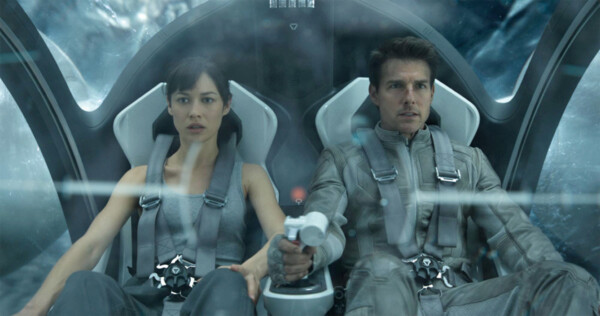
Image courtesy of Universal Pictures.
—
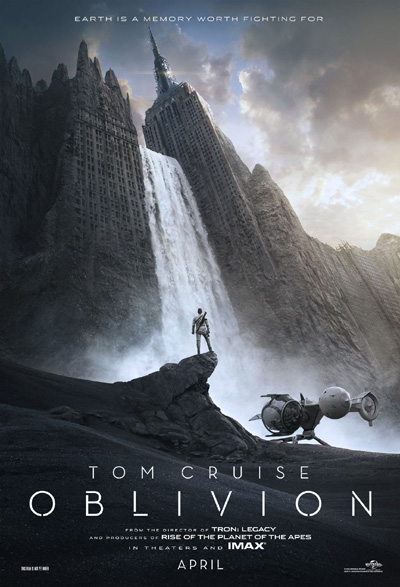
“Oblivion” Starring Tom Cruise, Morgan Freeman, Olga Kurylenko, Andrea Riseborough, Melissa Leo. Directed by Joseph Kosinski. 124 minutes. Rated PG.
Del’s take
And why did they choose the title “Oblivion”?
Because that’s how long the movie is.
It’s nice to look at, though. And the cast does a credible job. Critics dismiss Tom Cruise as an actor but he’s good – if you saw “Collateral” you’ll know what I’m talking about. Olga Kurylenko, Andrea Riseborough and Melisso Leo carry their weight, with Leo’s part trending toward Clicheland at the end. Morgan Freeman stars as Morgan Freeman.
“Oblivion’s” problem, however, lies in its veneer of a story. Casual science fiction fans will appreciate its sleek look and original ideas. Everybody else will look at those ideas, recognize they’ve been done time and again, and wonder what the fuss was about.
Here’s the story: Mankind has fought and won a war with alien invaders, but in the process they’ve rendered Earth uninhabitable. Everyone has fled to a sanctuary on Saturn’s moon Titan. Left behind are Jack (Cruise) and Victoria (Riseborough) who must oversee a fleet of drones that protects giant energy harvesters from scattered remnants of the alien invasion force. In two weeks’ time the harvesters will have collected enough energy to ensure mankind’s future on Titan. But a spacecraft crash lands on Earth and disgorges a crew of preserved human beings, including a woman Jack seems to remember from a former life. He begins to question everything he knows, including his current mission.
“Oblivion” relies on a couple of plot twists to deliver impact and I will not reveal them here. Suffice it to say the first act – no doubt intended as a character-building session by director Kosinski – is excruciatingly long and, dare I say, boring. Things pick up in the second act, and it was here I figured out what was really going on in the movie. The third act was mostly action-packed, though a word of warning: If trailers created the impression “Oblivion” is a grand-scale science fiction epic with sprawling CGI battles, think again. It’s mostly character-driven. Movie fans will recognize influences from “2001,” “Minority Report” and “Gattaca.”
Cruise is effective as the memory-wiped Jack struggling for rapprochement with the images he sees of a wife in a former life. Riseborough, his teammate, successfully evokes a slavish dedication to corporate dictates, at one point reminding Jack it’s their job not to remember. And Kurylenko brings to her role a sweetly devoted innocence that makes her worthy of Jack’s attentions.
Leo’s role, as the administrator of an orbiting station that monitors the drones, is constrained, but she nonetheless brings personality to her exchanges with the Earth-side crew until the very end of the movie, when she devolves into a caricature. Freeman has limited screen time and seems to channel Denzel Washington in “The Book of Eli.”
All of this is not to say “Oblivion” is a bad movie. But it’s not very original, it features long stretches of not much happening, and despite its beauty and the skill of its cast, it won’t create a lasting impression.
Mladen’s take
Walking from the theater, I asked Del, “What was the last good movie we saw?” We had just watched “Oblivion.”
“Cloverfield,” was the response after a few moments of thought.
Yet, Del has written a merciful review of “Oblivion.”
To be honest, I sympathize to some degree with his reaction. The actors sincerely and skillful portrayed their characters but were unable to subdue the movie’s weak script, clichéd ideas and too many subplots.
“Oblivion” is a sci-fi dystopian chick-flick fairy tale with some action.
Let’s start with the good.
The cinematography was lush and, somehow, sparing at the same time.
The special effects were very good.
Jack’s bubble engine-powered, high-performing V/STOL aircraft with a goldfish bowl cockpit was neat.
The autonomous spherical drones that protected gigantic water vaporizers were menacing despite their shape. Fast, heavily armed and assessing threats through HAL 9000-like sensor eyes, the unmanned combat aerial vehicles intimidated me not because of their role in the movie. They’re what the real mankind-induced future has in store for us.
Finally, there’s what the orbiting space station administrator would say when she finished giving Jack and Victoria their orders: “Are we an effective team?”
It’s exactly what many of us encounter during the course of a workday. A type of corporate cheerleading that’s all enthusiasm and smiles on the surface and brain-washing dogma beneath that reminds workers they better toe the line if they want to keep their jobs. Are you with us or against us?
Now, a few of the weaknesses of “Oblivion.”
Del mentioned that “Oblivion” has similarities with movies that came before it, “2001: A Space Odyssey,” “Minority Report,” and “Gattaca.” I add “The Matrix,” “Independence Day” and even “Battle: LA” to the list.
Maybe it’s impossible to devise a novel reason that aliens would invade earth. Maybe it’s impossible to end the invasion with other than nuking the mothership from the inside after gaining access to it through implausible deception. But, can’t someone, somewhere try?
“Oblivion” is a complex story. It weaves Jack’s nightmares with suspicions about the truth of his situation. For good measure, there are the battles that he has to fight with “scavs” whenever he has to repair a drone that has crash landed. And, another principal character is fully introduced about half-way into the movie.
Complexity doesn’t have to be bad. The problem is that it can be very tricky to develop as a screenplay. And, in the case of “Oblivion,” it took a long, long time to tie everything together. The effort including introducing a backstory to establish true identities.
As “Oblivion” dragged on, I became bored. Not even the questions that it raised periodically were enough to pull me back from the urge to look at my wristwatch.
I didn’t feel much sympathy for the characters when the movie ended.
And, I was thoroughly irritated by the arrogant dopiness of the lone, star-travelling alien that met its demise by ingesting a human-planted, uncontrolled nuclear chain reaction device. All the being needed was a couple of cloned TSA screeners and an X-ray machine to detect the nuke and it would have been on its way to destroy another planet in just a couple of weeks.
Mladen Rudman is a former journalist and public information officer. Del Stone Jr. is a former journalist and author.
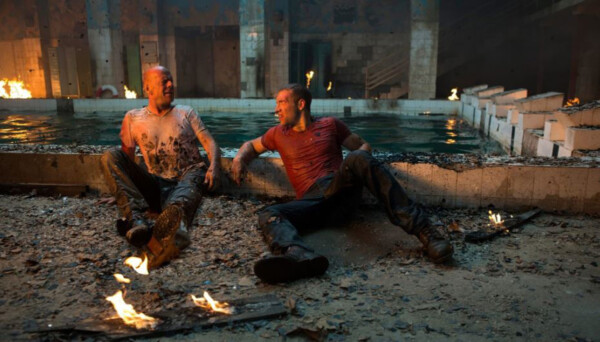
Image courtesy of 20th Century Studios.
—
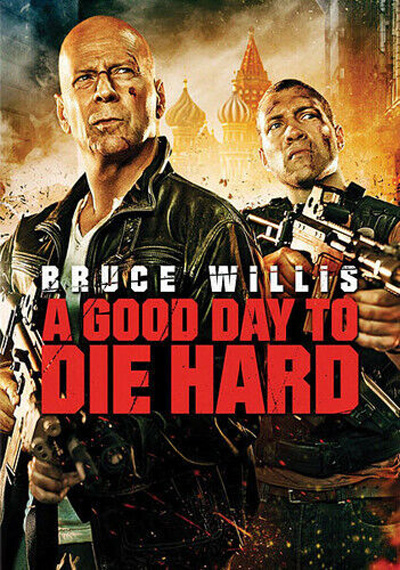
“A Good Day to Die Hard” Starring Bruce Willis, Jai Courtney, Sebastian Koch. Directed by John Moore. 97 minutes. Rated R.
Mladen’s take
Let’s do the numbers. The numbers of objects destroyed in recently released “A Good Day to Die Hard,” starring Bruce Willis as berserk New York cop John McClane.
I estimate 3,000 acres of windows, 83 cars and trucks, and at least three dozen people were smashed or blown to bits. And that’s just in the first 15 minutes of this film, the fifth in the “Die Hard” franchise.
Mayhem is what I expect when Bruce Willis reprises his McClane character but the action must be sensible. The first four “Die Hards” possessed useful violence. “A Good Day,” which has McClane and his CIA agent son administering punishment to Russians in Moscow and Chernobyl, was a blur of destruction.
Between flying cars and discovery of a stash of weapons-grade uranium, the McClanes move toward repairing their broken relationship. Apparently, there’s nothing like blood, brain splatter and radioactivity to bring a father and son closer.
R-rated “A Good Day” is almost completely flawed. Its counter double-cross is as predictable as my son’s reaction when I tell him to do a chore.
McClane’s son, Jack, is played by Jai Courtney. His biceps are bigger than my head but Courtney’s physique and good looks can’t compensate for his uninspired performance. Jack the CIA man has no charisma. Jack isn’t particularly likeable. Jack is a dolt whose aged father has to rescue him again and again.
The movie’s weakness could be attributed to poor screenwriting or the director’s over-reliance on action, but I fault Willis.
I was bored by the movie because Willis was bored by the movie. His one-liners were delivered without flourish or joy or that subtle exclamation that Willis always managed in past “Die Hards” when he survived the unsurvivable.
Recall the momentous and frenetic scene near the end of the fourth installment, “Live Free or Die Hard.”
McClane is driving a tractor-trailer on an elevated interstate. His nemesis, a computer hacking nut job, sics a Marine Corps F-35 on poor McClane.
The Lightning II targets McClane with missiles, blowing away pilings that collapse part of the interstate.
Next comes the cannon.
Shells blow holes in the tractor-trailer. It’s almost tipped on its side but McClane presses on.
He ends up on a piece of inclined interstate as the truck burns. More cannon fire. McClane rolls out of the truck and falls onto the tail section of the F-35.
Then, a piece of debris is swallowed by the fighter’s hover fan and it explodes. Out of control, the F-35 begins to rotate, flinging McClane onto another piece of battle-damaged, slanting highway.
The battered cop slides down the gritty road to land on his feet. As McClane limps from the wreckage – truck, aircraft and roadway all smoking – he looks back, grins and says, “Whew.”
Perfect. Absolutely perfect. Perfectly executed. Perfectly understated. Perfectly unbelievable and perfectly plausible simultaneously.
None of that happens in “A Good Day.” It’s droll and the movie’s special effects come nowhere near to rescuing it. After this “Die Hard,” the franchise should have no trouble dying easily.
Del’s take
One night in 1988 I visited a local movie theater to catch a movie called “Die Hard.” I had few expectations – the movie starred a television actor whose work seemed incompatible with the badass requirements of an action hero.
I came away with my mind officially blown. “Die Hard” was a classic. Every aspect – acting, script, pacing, even the score – was first rate. I saw it again and when the video came out, I happily sprang $25 for the VHS tape.
What a difference 25 years makes.
“A Good Day to Die Hard” is a ridiculous farce – not so much an action movie as a disaster flick, and the disaster is the movie itself. Fans of the original movie and its scrappy protagonist, John McClane, will be shaking their heads and declaring the franchise dead. Another dud like “A Good Day” will cement that demise.
The shark has definitely jumped Nakatomi Plaza.
Mladen has already filled you in with the plot details. I’ll add the first 10 minutes of the movie are boring beyond description, and make little sense. When the action commences it is a pointless destructionfest with every car east of the former Iron Curtain smashed beyond comprehension, and no attempt made to elaborate on the overall direction of the movie. I found myself wondering if I were watching a POV rendition of a video game player’s chapter of “Grand Theft Auto.”
Worse, Bruce Willis’ character, John McClane, is reduced from a hapless but insurmountable everyman whom trouble seems to find, into a mumbling accessory whose inane and humorless pronouncements contradict the film’s subtext that while he is old, McClane still has much to offer the world of crime-fighting.
Next come the awful cliches – McClane is estranged from his son yet flies halfway across the world to rescue him from a Russian jail where he is being held on suspicion of attempted murder. The two meet amidst a chaotic situation and spend the next hour snipping at one another, the son constantly reminding the dad of how his absence ruined the son’s life until finally, near the film’s climax, the two reach a kind of rapprochement that you just know will have them walking off into the smoky, debris-filled sunset shoulder to shoulder, if not arm in arm, as the movie limps to its closing curtain.
Missing is the sharp-witted detective with the snappy comebacks whom every bad guy underestimates, replaced by a grumpy pensioner who ceaselessly complains his vacation has been spoiled by a thankless child. “A Good Day” lacks the single most important ingredient of a “Die Hard” film – fun.
Ironically, on the same day I saw “A Good Day” I also watched “Skyfall,” the latest James Bond installment. It deals with a similar theme, that of an aging crime fighter who may have lived beyond his usefulness. But “Skyfall” is Mozart beside “A Good Day’s” bubblegum pop. Smartly written and skillfully directed, “Skyfall” proves there’s hope for the “Die Hard” franchise.
If Sam Mendes decides to take on another failing action hero property, I can only expect John McClane to gleefully declare, “Yippy kay yay, …”
Mladen Rudman is a former journalist and public information officer. Del Stone Jr. is a former journalist and author.

Two TWA 707s sit on the tarmac at the Torejon flightline in Madrid, Spain in 1963. One of these planes would take me and my family back to the United States. Image by Del Stone Sr.
My flying days are behind me.
I remember the exact moment I discovered my fear of flying – it was on a trip to visit my sister and her husband in Dearborn, Mich. I was 14 and traveling alone for the first time.
Which is odd. When I was 5 we flew to Spain in a lumbering C-124 Globemaster, a flight that lasted, oh, I don’t know. Seemed like 24 hours. We took off in the afternoon, flew through the night, stopped at the Azores for fuel, then flew into the next day, landing in Madrid late that morning. An hour into the flight I threw up all over Dad, but otherwise I was fine. I insisted on a window seat and spent the hours staring at the cold Atlantic below.
On our return to the U.S. we boarded a shiny new Boeing 707. It was like climbing into science fiction. We think nothing of jet travel today but in 1963 it was a miracle. We hurtled into the sky and a mere seven hours later touched down at McGuire AFB.
I didn’t fly again until that fateful day in 1970 when I boarded a Southern Airways DC-9 for a flight to Atlanta and a connecting flight to Dearborn. The plane built up thrust, I was pressed back in my seat, and the nose came up. When I looked out the window and saw the ground receding below me, I was seized by an instantaneous convulsion of panic. My first thought was I had to get off that plane. I forced myself to remain under control and stared straight ahead, at the foreward bulkhead, my palms sheeted with cold sweat. It was the longest hour of my life.
The flight to Dearborn was no better. This time the plane was a DC-8 which had seen better days. The seats were threadbare, the cabin ceiling was stained and everything squeaked and rattled.
I’ve flown a few times since then and every flight was a trial by terror. Later in life I asked my doctor for tranquilizers, but even those magical little pills didn’t quell my fear. I would spend the flight leaned back in my seat, my eyes closed, hoping by force of will I could keep the plane in the air. I barely remember my flight to Germany and back. I was so tranked up with drugs if you had asked me my name I couldn’t have told you.
My last flight was roundtrip from Pensacola to LAX. I sat next to a video game designer and made the mistake of telling him I was afraid to fly. From Pensacola to Houston he terrorized me, suddenly gripping the armrests and whispering, “What was that *noise*?” On the trip back I sat next to a kindred soul he snapped rubber bands against her wrist.
I knew, then, I had fulfilled this life’s quote of airplanes.
It’s irrational, yes. I’ve seen all the stats. I know flying is the safest form of travel.
But you won’t get me back on an airplane. I’ve written stories about planes crashing. I have nightmares about planes crashing. At my advanced age, the prospect of a plane ride would probably kill me.
I wonder if John Madden has room on his bus?
About the author:
Del Stone Jr. is a professional fiction writer. He is known primarily for his work in the contemporary dark fiction field, but has also published science fiction and contemporary fantasy. Stone’s stories, poetry and scripts have appeared in publications such as Amazing Stories, Eldritch Tales, and Bantam-Spectra’s Full Spectrum. His short fiction has been published in The Year’s Best Horror Stories XXII; Alfred Hitchcock’s Mystery Magazine; the Pocket Books anthology More Phobias; the Barnes & Noble anthologies 100 Wicked Little Witch Stories, Horrors! 365 Scary Stories, and 100 Astounding Little Alien Stories; the HWA anthology Psychos; and other short fiction venues, like Blood Muse, Live Without a Net, Zombiesque and Sex Macabre. Stone’s comic book debut was in the Clive Barker series of books, Hellraiser, published by Marvel/Epic and reprinted in The Best of Hellraiser anthology. He has also published stories in Penthouse Comix, and worked with artist Dave Dorman on many projects, including the illustrated novella “Roadkill,” a short story for the Andrew Vachss anthology Underground from Dark Horse, an ashcan titled “December” for Hero Illustrated, and several of Dorman’s Wasted Lands novellas and comics, such as Rail from Image and “The Uninvited.” Stone’s novel, Dead Heat, won the 1996 International Horror Guild’s award for best first novel and was a runner-up for the Bram Stoker Award. Stone has also been a finalist for the IHG award for short fiction, the British Fantasy Award for best novella, and a semifinalist for the Nebula and Writers of the Future awards. His stories have appeared in anthologies that have won the Bram Stoker Award and the World Fantasy Award. Two of his works were optioned for film, the novella “Black Tide” and short story “Crisis Line.”
Stone recently retired after a 41-year career in journalism. He won numerous awards for his work, and in 1986 was named Florida’s best columnist in his circulation division by the Florida Society of Newspaper Editors. In 2001 he received an honorable mention from the National Lesbian and Gay Journalists Association for his essay “When Freedom of Speech Ends” and in 2003 he was voted Best of the Best in the category of columnists by Emerald Coast Magazine. He participated in book signings and awareness campaigns, and was a guest on local television and radio programs.
As an addendum, Stone is single, kills tomatoes and morning glories with ruthless efficiency, once tied the stem of a cocktail cherry in a knot with his tongue, and carries a permanent scar on his chest after having been shot with a paintball gun. He’s in his 60s as of this writing but doesn’t look a day over 94.
Contact Del at [email protected]. He is also on Facebook, twitter, Pinterest, tumblr, TikTok, and Instagram. Visit his website at delstonejr.com .