Skepticism now has an ultra-atmospheric spin

Image courtesy of Flickr user Lance H. Bates under the auspices of a Creative Commons license. https://www.flickr.com/photos/7977365@N08/5709021472/
A number of people called, e-mailed, faxed, or contacted me via the Intergalactic Council to let me know what a rube I am for suggesting flying saucers are a figment of the collective unconscious.
One person even admonished me to put away my Bible (I nearly choked with laughter over that!) and asserted people like me actually hinder the exploration of space by dissing poor little E.T.
I’m not sure what to think about all this. It’s a comfort knowing that skepticism lives in this day of McDonaldized Mass Mind thinking. But at the same time, how spooky to see that this skepticism is fueled by utter nonsense.
Tell you what: I’ll eat my words if somebody can produce a real, live flying saucer, demonstrably from outer space. Until then, you guys keep shaking your hoodoo sticks and baying at the moon.
I’ll wait for the real scientists to give us our answers.
Look for their names on the silver screen! It was bad enough that I nearly sprained my back and gave myself leg cramps trying to help Harrison Ford crawl back into the airplane in “Air Force One.” But then I had to wait in agony until the end of the credits to see the acknowledgments for Eglin and Hurlburt.
But it was time well spent for about 20 of us who remained in the theater as the movie ended Sunday afternoon. When the names of our local bases rolled across the screen, everybody clapped and cheered.
“Air Force One” is one darned exciting movie – probably the best of the action-movie crop this summer. Check it out – and watch those credits roll.
Let it rain: Saturday’s deluge prompted a very strange reaction among some of us around town.
It was such a thunderous downpour – typical for Florida – that people I talked to didn’t even try to go out and about. They stayed at home and watched NASCAR, the Brickyard 400.
I’m not a big NASCAR fan, but like those other people, I was glued to the TV, rooting for all the old-timers, drivers like Bill Elliot (who is the husband of former Daily News photographer Cindy Poole) and casting hexes on young showoffs like Jeff Gordon.
Next thing you know we’ll be packing up the Winnebago and caravanning to Talladega.
Who won the race?
Somebody named Tide.
This week’s wire weirdness: DAKAR, Senegal (AP) – Vigilante mobs convinced that foreign sorcerers can shrink a man’s genitals with a mere handshake have killed eight people in Senegal in the past week.
Attackers killed five people at Ziguinghor in southern Senegal after a man accused one of them of making his penis shrink, newspapers reported Friday. At least three other people were killed in the West African nation’s capital, Dakar.
Headlines that didn’t work: Miners Refuse to Work after Death.
Strange but true: A man in Johannesburg, South Africa, shot his 49-year-old friend in the face, seriously wounding him, while the two practiced shooting beer cans off each other’s heads.
About the author:
Del Stone Jr. is a professional fiction writer. He is known primarily for his work in the contemporary dark fiction field, but has also published science fiction and contemporary fantasy. Stone’s stories, poetry and scripts have appeared in publications such as Amazing Stories, Eldritch Tales, and Bantam-Spectra’s Full Spectrum. His short fiction has been published in The Year’s Best Horror Stories XXII; Alfred Hitchcock’s Mystery Magazine; the Pocket Books anthology More Phobias; the Barnes & Noble anthologies 100 Wicked Little Witch Stories, Horrors! 365 Scary Stories, and 100 Astounding Little Alien Stories; the HWA anthology Psychos; and other short fiction venues, like Blood Muse, Live Without a Net, Zombiesque and Sex Macabre. Stone’s comic book debut was in the Clive Barker series of books, Hellraiser, published by Marvel/Epic and reprinted in The Best of Hellraiser anthology. He has also published stories in Penthouse Comix, and worked with artist Dave Dorman on many projects, including the illustrated novella “Roadkill,” a short story for the Andrew Vachss anthology Underground from Dark Horse, an ashcan titled “December” for Hero Illustrated, and several of Dorman’s Wasted Lands novellas and comics, such as Rail from Image and “The Uninvited.” Stone’s novel, Dead Heat, won the 1996 International Horror Guild’s award for best first novel and was a runner-up for the Bram Stoker Award. Stone has also been a finalist for the IHG award for short fiction, the British Fantasy Award for best novella, and a semifinalist for the Nebula and Writers of the Future awards. His stories have appeared in anthologies that have won the Bram Stoker Award and the World Fantasy Award. Two of his works were optioned for film, the novella “Black Tide” and short story “Crisis Line.”
Stone recently retired after a 41-year career in journalism. He won numerous awards for his work, and in 1986 was named Florida’s best columnist in his circulation division by the Florida Society of Newspaper Editors. In 2001 he received an honorable mention from the National Lesbian and Gay Journalists Association for his essay “When Freedom of Speech Ends” and in 2003 he was voted Best of the Best in the category of columnists by Emerald Coast Magazine. He participated in book signings and awareness campaigns, and was a guest on local television and radio programs.
As an addendum, Stone is single, kills tomatoes and morning glories with ruthless efficiency, once tied the stem of a cocktail cherry in a knot with his tongue, and carries a permanent scar on his chest after having been shot with a paintball gun. He’s in his 60s as of this writing but doesn’t look a day over 94.
Contact Del at [email protected]. He is also on Facebook, twitter, Pinterest, tumblr, TikTok, Ello and Instagram. Visit his website at delstonejr.com .
Feel no evil: Have you heard the medical expression “target organ”?
I’m told it refers to the organ that becomes the target of all your health fears, sometimes to the point you actually feel pain in said organ.
Worried about your heart? Feeling a little tight in the chest? Maybe a stab of pain shooting under your ribs? Could be your heart, but maybe you’ve found your target organ.
Another alarming medical condition you need to worry about: Tight Pants Syndrome.
Can you guess who this affects most often?
Can you guess what age group the afflicted belong to?
If you answered “40-something men” to both you’d be less clairvoyant than observant about human nature, because Tight Pants Syndrome is one of those unwelcome rites of passage into middle-age that keeps the hair dye factories churning well into the night.
The story goes that when men hit their 40s they continue to buy the same old waist sizes for their pants, which is absurd because that flat stomach of 32 inches’ circumference has gone a little soft after yeas of fudging on dessert and cheating on yardwork and letting natural senescence creep in, and that 32 inches has swelled to 38 inches minimum.
When you squeeze 36 inches of flab into a 32-inch sack, all kinds of bad things happen. In a nutshell, everything touched by your waistband becomes a target organ.
Why don’t men buy pants that fit? Partly out of vanity. Who wants to wear a pair of Levis with a 36-32 on the label, when you’re used to 32-32?
But a big reason is that men are creatures of habit. They buy 32s because “That’s what they’ve always worn.”
So all you guys with stomach cramps, pinched nerves and light-headedness: Before running to the doctor, check your waist size. Could be time for a “gentlemen’s fit.”
This week’s wire weirdness: HARRISONBURG, Va. (AP) – Bettie Phillips thought the zircon-studded earrings she put on a baby deer were fashionable.
Police said it was criminal.
Mrs. Phillips, 54, of Hiddenite, N.C., was charged with animal cruelty and illegally possessing a wild animal after officers found the fawn in the back of her four-wheel-drive with cross-shaped earrings in its pierced ears.
She said she rescued the fawn from a busy road on July 3 as she drove to Harrisonburg to visit her daughter. Later that day, she said, she pierced its ears by hand, pushing the posts of the two earrings through the flesh.
The 2-month-old deer was seized and taken to a wildlife center, its ears inflamed and infected. Antibiotics were used to treat the mild infection.
“I thought it would be pretty,” Mrs. Phillips said. “You can get a little kid’s ears pierced. What’s the different between a person’s and a baby deer’s?”
The housewife could get up to a year in jail and $3,000 in fines.
Headlines that didn’t work: Drunk Gets Nine Months in Violens Case.
Redneck computer terms: “Digital control,” as in what your finders do on the TV remote.
Words that should be words: “Inclimate,” as in, “That weather out there sure is inclimate – that’s where it’s not inclement.” (Courtesy of my South Walton grammar checker.)
This column was originally published in the July 16, 1997 edition of the Northwest Florida Daily News and is used with permission.
About the author:
Del Stone Jr. is a professional fiction writer. He is known primarily for his work in the contemporary dark fiction field, but has also published science fiction and contemporary fantasy. Stone’s stories, poetry and scripts have appeared in publications such as Amazing Stories, Eldritch Tales, and Bantam-Spectra’s Full Spectrum. His short fiction has been published in The Year’s Best Horror Stories XXII; Alfred Hitchcock’s Mystery Magazine; the Pocket Books anthology More Phobias; the Barnes & Noble anthologies 100 Wicked Little Witch Stories, Horrors! 365 Scary Stories, and 100 Astounding Little Alien Stories; the HWA anthology Psychos; and other short fiction venues, like Blood Muse, Live Without a Net, Zombiesque and Sex Macabre. Stone’s comic book debut was in the Clive Barker series of books, Hellraiser, published by Marvel/Epic and reprinted in The Best of Hellraiser anthology. He has also published stories in Penthouse Comix, and worked with artist Dave Dorman on many projects, including the illustrated novella “Roadkill,” a short story for the Andrew Vachss anthology Underground from Dark Horse, an ashcan titled “December” for Hero Illustrated, and several of Dorman’s Wasted Lands novellas and comics, such as Rail from Image and “The Uninvited.” Stone’s novel, Dead Heat, won the 1996 International Horror Guild’s award for best first novel and was a runner-up for the Bram Stoker Award. Stone has also been a finalist for the IHG award for short fiction, the British Fantasy Award for best novella, and a semifinalist for the Nebula and Writers of the Future awards. His stories have appeared in anthologies that have won the Bram Stoker Award and the World Fantasy Award. Two of his works were optioned for film, the novella “Black Tide” and short story “Crisis Line.”
Stone recently retired after a 41-year career in journalism. He won numerous awards for his work, and in 1986 was named Florida’s best columnist in his circulation division by the Florida Society of Newspaper Editors. In 2001 he received an honorable mention from the National Lesbian and Gay Journalists Association for his essay “When Freedom of Speech Ends” and in 2003 he was voted Best of the Best in the category of columnists by Emerald Coast Magazine. He participated in book signings and awareness campaigns, and was a guest on local television and radio programs.
As an addendum, Stone is single, kills tomatoes and morning glories with ruthless efficiency, once tied the stem of a cocktail cherry in a knot with his tongue, and carries a permanent scar on his chest after having been shot with a paintball gun. He’s in his 60s as of this writing but doesn’t look a day over 94.
Contact Del at [email protected]. He is also on Facebook, twitter, Pinterest, tumblr, TikTok, and Instagram. Visit his website at delstonejr.com .

This image mosaic of asteroid 253 Mathilde is constructed from four images acquired by the Near Earth Asteroid Rendezvous (NEAR) spacecraft on June 27, 1997. NASA/JPL
“May you live in interesting times” was more blessing than curse last week as information poured in from an armada of spacecraft whipping across the vastness of our tiny solar system, threatening to make us more intelligent citizens of our planet whether we wanted to or not.
While cosmonauts and astronauts worked in low Earth orbit, a couple of NASA darts scored consecutive bulls-eyes millions of miles from home, and another veteran space probe continued a mission that may lead t the biggest discovery of all time.
First on deck was the Near Earth Asteroid Rendezvous spacecraft, which on June 27 waltzed past a cosmic flyspeck called Mathilde.
As asteroid go Mathilde is not that special, a 33-mile-wide lump of rock that reflects only 3 percent of the sunlight it receives. But since it was along the way to NEAR’s ultimate destination, the asteroid Eros in 1999, planetologists decided to stop by for a visit.
NEAR photographed a dark, heavily cratered surface, almost uniform in color. Scientists believe these features show that Mathilde is an artifact of the original building blocks of the solar system, unchanged for billions of years.
As NEAR rocketed by Mathilde, the space probe Galileo was busy with its exploration of the giant planet Jupiter and its mini-solar system of moons. Most fascinating of these moons are Ganymede and Europa, both of which likely possess oceans of water.
The case for an ocean on Europa is much stronger, and therein lies the potential for a discovery immense proportions, because where there is water, and heat, there may be life. Exobiologists are already wondering about suspicious dark spots around crack in the ice of Europa’s surface. Those dark spots may be stains of organic material.
Think about it: an extraterrestrial ecosystem, right here in our own solar system! The suspense of not knowing is unbearable!
Then there was Pathfinder, and its tiny robot Sojourner.
Both Pathfinder and NEAR are products of NASA’s “faster, cheaper, better” philosophy of space exploration on a shoestring, best exemplified by Pathfinder, which used a number of unique technologies to get to the surface of Mars.
For instance, Pathfinder didn’t orbit Mars. It dove right in, using the planet’s atmosphere to slow it down in a maneuver called aerobraking. After its parachute unfurled, the main body of Pathfinder unreeled down a cable to escape retrorockets that would fire from above. About 60 feet above the surface, Pathfinder disconnected itself and fell to the ground, bouncing on a cocoon of air bags, which later deflated as the machine unfolded like a cornflower.
The fact that everything worked was miracle enough. The pictures and information will keep scientists drooling for decades.
What these and future space missions will accomplish for mankind is incalculable. The advances in knowledge will revolutionize our understanding of the universe, and the technology spinoffs will change the way we live and work.
But most important is this: Over the July Fourth weekend, the Pathfinder web page recorded 100 million hits. That proves the public is hungry for knowledge and adventure.
Indeed, we live in interesting times.
This column was published in the July 9, 1997 edition of the Northwest Florida Daily News and is used with permission.
About the author:
Del Stone Jr. is a professional fiction writer. He is known primarily for his work in the contemporary dark fiction field, but has also published science fiction and contemporary fantasy. Stone’s stories, poetry and scripts have appeared in publications such as Amazing Stories, Eldritch Tales, and Bantam-Spectra’s Full Spectrum. His short fiction has been published in The Year’s Best Horror Stories XXII; Alfred Hitchcock’s Mystery Magazine; the Pocket Books anthology More Phobias; the Barnes & Noble anthologies 100 Wicked Little Witch Stories, Horrors! 365 Scary Stories, and 100 Astounding Little Alien Stories; the HWA anthology Psychos; and other short fiction venues, like Blood Muse, Live Without a Net, Zombiesque and Sex Macabre. Stone’s comic book debut was in the Clive Barker series of books, Hellraiser, published by Marvel/Epic and reprinted in The Best of Hellraiser anthology. He has also published stories in Penthouse Comix, and worked with artist Dave Dorman on many projects, including the illustrated novella “Roadkill,” a short story for the Andrew Vachss anthology Underground from Dark Horse, an ashcan titled “December” for Hero Illustrated, and several of Dorman’s Wasted Lands novellas and comics, such as Rail from Image and “The Uninvited.” Stone’s novel, Dead Heat, won the 1996 International Horror Guild’s award for best first novel and was a runner-up for the Bram Stoker Award. Stone has also been a finalist for the IHG award for short fiction, the British Fantasy Award for best novella, and a semifinalist for the Nebula and Writers of the Future awards. His stories have appeared in anthologies that have won the Bram Stoker Award and the World Fantasy Award. Two of his works were optioned for film, the novella “Black Tide” and short story “Crisis Line.”
Stone recently retired after a 41-year career in journalism. He won numerous awards for his work, and in 1986 was named Florida’s best columnist in his circulation division by the Florida Society of Newspaper Editors. In 2001 he received an honorable mention from the National Lesbian and Gay Journalists Association for his essay “When Freedom of Speech Ends” and in 2003 he was voted Best of the Best in the category of columnists by Emerald Coast Magazine. He participated in book signings and awareness campaigns, and was a guest on local television and radio programs.
As an addendum, Stone is single, kills tomatoes and morning glories with ruthless efficiency, once tied the stem of a cocktail cherry in a knot with his tongue, and carries a permanent scar on his chest after having been shot with a paintball gun. He’s in his 60s as of this writing but doesn’t look a day over 94.
Contact Del at [email protected]. He is also on Facebook, twitter, Pinterest, tumblr, TikTok, and Instagram. Visit his website at delstonejr.com .
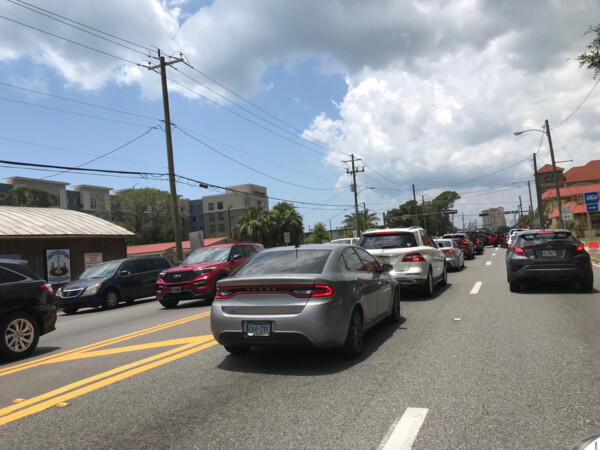
Image courtesy of Del Stone Jr.
Glad to be gone: I had friends down from up north last weekend.
They used to live here, but now they live in a town with one traffic light, a McDonald’s, two video-rental joints and a couple of gas stations.
Saturday night, I thought I’d treat them to a gulf-front dinner at a South Walton restaurant.
As we sat in gridlock near The Shores Shopping Center in Destin, my friends remarked about how terrible the traffic had become. It was bumper-to-bumper in both directions, off to the horizon.
Then, as we headed farther east, they declared, “How many Wings do you need?” They’d started counting on Okaloosa Island.
We took Old 98 east. They were dismayed by the construction. They said, “You had something beautiful here and you built over it.”
Were these old-timers who’d lived here back in the ’60s?
Nope. They moved away three years ago.
It’s funny. We place restrictions on movie theater occupancy, restaurant occupancy – even dog-kennel occupancy, but not city occupancy or county occupancy. Just pack ’em in, lay everything to waste and ruin what’s good about a place.
“You need to get out of here, Del,” they said as they left.
They’re right.
This week’s wire weirdness: JACKSON, Mich. (AP) – Mr. Chicken died with his artificial legs on, defending his hens to the end, and that’s the way he’ll be buried.
Veterinarian Tim England said his plucky rooster was mauled to death, probably by a raccoon, as he tried to protect the chickens who shared his pen.
Mr. Chicken was rescued last December, his feet were frozen beyond repair. England adopted the bird and had a physical therapist make Mr. Chicken a new pair of legs.
The plastic legs fit snugly over the stumps, with squarish “feet” that curved up at the toe like skis. As with most prosthetics, Mr. Chicken’s were removed at night to prevent pressure sores.
Mr. Chicken was featured in national magazines including Newsweek and in newspapers from South Africa to Hawaii.
“It’s a glum day,” England said. “We will bury him in the flower garden with his legs on.”
Redneck computer terms: “Bit,” a wager as in, “I bit you can’t spit that piece a ear across the porch longways.”
At the great Bowlerama: The pins didn’t fall, but onlookers did – with laughter – as they watched folks like Kelly Humphrey, Brenda Shoffner and yours truly bowl for the Red Cross at Destin Lanes on June 21. Kelly got more strikes than I, but at least I won the poker, which earned me a fast 75 cents (I immediately lost it to Kelly’s son Joey in the air hockey machine).
We had a good time and raised a few hundred bucks for the flood-sodden folks of North Dakota.
Later that night – much later – it was SRO at Frankly Scarlett for the Performance Against AIDS fundraiser. What a blast. Melissa Welch can belt out a tune, let me tell you. Can’t wait till next year’s show.
Headlines that didn’t work: “Clinton Wins on Budget, but More Lies Ahead.”
Words that should be words: (This one is courtesy of Julie Nichols), “epressed,” as in the depression of not receiving any e-mail.
The column was published in the Wednesday, July 2, 1997 Northwest Florida Daily News and is used with permission.
About the author:
Del Stone Jr. is a professional fiction writer. He is known primarily for his work in the contemporary dark fiction field, but has also published science fiction and contemporary fantasy. Stone’s stories, poetry and scripts have appeared in publications such as Amazing Stories, Eldritch Tales, and Bantam-Spectra’s Full Spectrum. His short fiction has been published in The Year’s Best Horror Stories XXII; Alfred Hitchcock’s Mystery Magazine; the Pocket Books anthology More Phobias; the Barnes & Noble anthologies 100 Wicked Little Witch Stories, Horrors! 365 Scary Stories, and 100 Astounding Little Alien Stories; the HWA anthology Psychos; and other short fiction venues, like Blood Muse, Live Without a Net, Zombiesque and Sex Macabre. Stone’s comic book debut was in the Clive Barker series of books, Hellraiser, published by Marvel/Epic and reprinted in The Best of Hellraiser anthology. He has also published stories in Penthouse Comix, and worked with artist Dave Dorman on many projects, including the illustrated novella “Roadkill,” a short story for the Andrew Vachss anthology Underground from Dark Horse, an ashcan titled “December” for Hero Illustrated, and several of Dorman’s Wasted Lands novellas and comics, such as Rail from Image and “The Uninvited.” Stone’s novel, Dead Heat, won the 1996 International Horror Guild’s award for best first novel and was a runner-up for the Bram Stoker Award. Stone has also been a finalist for the IHG award for short fiction, the British Fantasy Award for best novella, and a semifinalist for the Nebula and Writers of the Future awards. His stories have appeared in anthologies that have won the Bram Stoker Award and the World Fantasy Award. Two of his works were optioned for film, the novella “Black Tide” and short story “Crisis Line.”
Stone recently retired after a 41-year career in journalism. He won numerous awards for his work, and in 1986 was named Florida’s best columnist in his circulation division by the Florida Society of Newspaper Editors. In 2001 he received an honorable mention from the National Lesbian and Gay Journalists Association for his essay “When Freedom of Speech Ends” and in 2003 he was voted Best of the Best in the category of columnists by Emerald Coast Magazine. He participated in book signings and awareness campaigns, and was a guest on local television and radio programs.
As an addendum, Stone is single, kills tomatoes and morning glories with ruthless efficiency, once tied the stem of a cocktail cherry in a knot with his tongue, and carries a permanent scar on his chest after having been shot with a paintball gun. He’s in his 60s as of this writing but doesn’t look a day over 94.
Contact Del at [email protected]. He is also on Facebook, twitter, Pinterest, tumblr, TikTok, and Instagram. Visit his website at delstonejr.com .
Lord, help us: Why should there be any question about religion in school up at Niceville?
The issue was settled 221 years ago by people who, having experienced religious persecutions and selectivism, wisely decided that our government, and every endeavor it supports, would not favor one faith over another.
That means strict neutrality. Any other way is unconstitutional.
I met Chip Woolwine years ago and I know he’s not a bad man. But if he’s breaking the rules, he must be stopped. It’s as simple as that.
Also, some of you have treated our reporter rudely, and have attacked her for shedding light on this situation. Let me remind you it was reporters who revealed the past two meningitis outbreaks, and it was reporters who gave you information to help you cop with the aftermath of Hurricane Opal.
Do not slay the messenger, folks.
Nice in Niceville: Just to show I’m not picking on Niceville, here’s a plug for the fine folks of NHS who are trying to organize a reunion for the Class of ’72.
Seventy-two? Even I graduated later than that!
(OK, it was by one year.)
Enough with the “old” jokes. The Class of ’72 is seeking to reunite, and Tina Slown Faulkner, at 678-3506, is the lady to call. Get off your duffs, if you’re able, and give her a call.
Conspiracy theory: Is downtown Fort Walton Beach a conspiracy by no-growth fanatics to drive away the tourists? That’s the theory of one Destin caller, who lamented the passing of Caffe Italia, and the fact that it has been replaced with a cash-for-car-title loan joint. I dunno … even we no-growthers like to get our fast bucks behind the scenes. It’s probably just somebody’s idea of prosperity.
Headlines that did not work: Teacher Strikes Idle Kids.
This week’s wire weirdness: CLEARWATER (AP) – A pair of state detectives took a break from hunting people to follow a car apparently driven by an iguana.
John Halliday and Tom Colbert had to take a second look Thursday morning when they saw the 3-foot, scaly, green and orange beast at the wheel of a car on a busy road.
The car drove south on the congested highway a couple of miles before it pulled into a service station. There, the plainclothes detectives arrested John Ruppell on a drunken driving charge.
“(Ruppell) was slouched down in the seat, but he could obviously see what was going on,” said Larry Sams of the FDLE, adding that Finley the iguana seemed to keep the car in the lane as well or better than Ruppell.
Finley was taken to the Society for the Prevention of Cruelty to Animals in Largo. Ruppell was taken to jail.
Words that should be words: This week’s installment is “telecrastination,” as in: The act of always letting the phone ring at least twice before you pick it up, even when you’re only 6 inches away.
Redneck computer terms: “Cursor,” or what some guys do when they are mad at their wife or girlfriend.
This column was originally published in the Wednesday, June 25, 1997 edition of the Northwest Florida Daily News and is used with permission.
About the author:
Del Stone Jr. is a professional fiction writer. He is known primarily for his work in the contemporary dark fiction field, but has also published science fiction and contemporary fantasy. Stone’s stories, poetry and scripts have appeared in publications such as Amazing Stories, Eldritch Tales, and Bantam-Spectra’s Full Spectrum. His short fiction has been published in The Year’s Best Horror Stories XXII; Alfred Hitchcock’s Mystery Magazine; the Pocket Books anthology More Phobias; the Barnes & Noble anthologies 100 Wicked Little Witch Stories, Horrors! 365 Scary Stories, and 100 Astounding Little Alien Stories; the HWA anthology Psychos; and other short fiction venues, like Blood Muse, Live Without a Net, Zombiesque and Sex Macabre. Stone’s comic book debut was in the Clive Barker series of books, Hellraiser, published by Marvel/Epic and reprinted in The Best of Hellraiser anthology. He has also published stories in Penthouse Comix, and worked with artist Dave Dorman on many projects, including the illustrated novella “Roadkill,” a short story for the Andrew Vachss anthology Underground from Dark Horse, an ashcan titled “December” for Hero Illustrated, and several of Dorman’s Wasted Lands novellas and comics, such as Rail from Image and “The Uninvited.” Stone’s novel, Dead Heat, won the 1996 International Horror Guild’s award for best first novel and was a runner-up for the Bram Stoker Award. Stone has also been a finalist for the IHG award for short fiction, the British Fantasy Award for best novella, and a semifinalist for the Nebula and Writers of the Future awards. His stories have appeared in anthologies that have won the Bram Stoker Award and the World Fantasy Award. Two of his works were optioned for film, the novella “Black Tide” and short story “Crisis Line.”
Stone recently retired after a 41-year career in journalism. He won numerous awards for his work, and in 1986 was named Florida’s best columnist in his circulation division by the Florida Society of Newspaper Editors. In 2001 he received an honorable mention from the National Lesbian and Gay Journalists Association for his essay “When Freedom of Speech Ends” and in 2003 he was voted Best of the Best in the category of columnists by Emerald Coast Magazine. He participated in book signings and awareness campaigns, and was a guest on local television and radio programs.
As an addendum, Stone is single, kills tomatoes and morning glories with ruthless efficiency, once tied the stem of a cocktail cherry in a knot with his tongue, and carries a permanent scar on his chest after having been shot with a paintball gun. He’s in his 60s as of this writing but doesn’t look a day over 94.
Contact Del at [email protected]. He is also on Facebook, twitter, Pinterest, tumblr, TikTok, and Instagram. Visit his website at delstonejr.com .
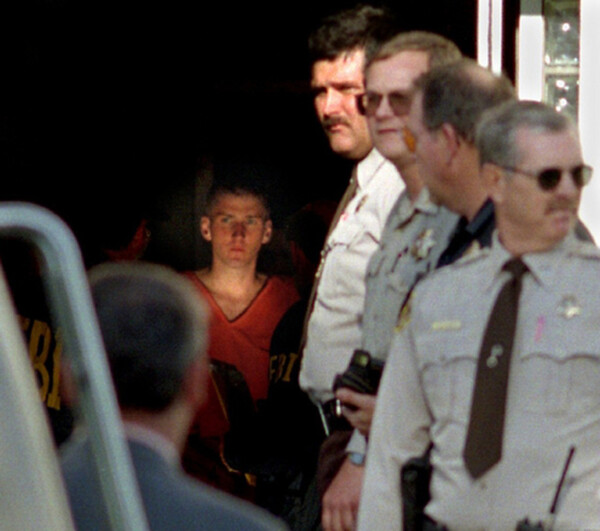
Image courtesy of Olaf Growald, Wikimedia Commons.
The death penalty? The righteously wrathful were rubbing their palms last week as jurors in the penalty phase of the Timothy McVeigh murder and conspiracy trial decided he should die for his crime.
His crime – the April 19, 1995 bombing of the Alfred P. Murrah Building in Oklahoma City that killed 168 people – was undeniably horrible.
But while death penalty advocates declared their satisfaction and pundits hailed the trail as proof the U.S. legal system “works,” some of us held our noses and waited for the stench of sanctimony to pass on by.
Timothy McVeigh’s trail was many things, but it was not a test for the workability of American justice – not when they’re letting convicted felons run free after serving mere fractions of their sentences, and certainly not after O.J.
Also, I’d wonder about a government that could execute Timothy McVeigh while granting diplomatic recognition to a butcher like Yasser Arafat, or proffering most-favored nation trading status to a genocidal autocracy like the People’s Republic of China.
I believe the operative word here is “hypocrisy.”
For a system to “work,” it must work for all.
Charity bowl: Daily News columnist Kelly Humphrey has organized the Bowl for Red Cross fund-raiser, and now that she’s done all the work, we can do the fun part:
Bowl!
The Bowl for Red Cross happens Saturday at Destin Lanes from 10 a.m. to 3 p.m. The owners will donate 25 percent of the proceeds to the Red Cross, which is helping the flooded folks of Fargo, N.D. mop up after the Red River jumped its banks earlier this year and did an Opal-like number on the while town. What makes this worse for our northern cousins is their unenviable lack of WARM TEMPERATURES and a MOSQUITO-FREE EXISTENCE while cleaning up the mess.
We had ICE in our Cokes, not our debris.
Come out Saturday and bowl a few lines. I’ll need somebody to show me how to use the scoring computers, so bring the kids. It’ll be a good time – you betcha!
This week’s wire weirdness: MIAMI (AP) – The U.S. government has rejected Raul Blanco’s to become a citizen five times. But the 53-year-old Cuban immigrant hasn’t given up.
Ten fingerprints are required from applicants and Blanco only put down seven.
But that’s all he has – seven whole fingers.
The clerks who read Blanco’s application failed to see the explanation: “amputated.”
Years ago, he lost the ring finger and the tips of the index and middle fingers of his right hand after an accident at a Cuban sugar mill.
James Minton, deputy chief of the Immigration and Naturalization Service’s Miami office, acknowledged the agency goofed.
“Our office is going to call him,” Minton said.
Words that should be words: “Pupkus,” as in: The moist residue left on a window after a dog presses its nose to it.
Headlines that did not work: “Lung Cancer in Women Mushrooms.”
Redneck computer terms: “LAN”: To borrow, as in: “Hey Billy Joe, LAN me yore truck.”
This column was previously published in the June 18, 1997 Northwest Florida Daily News and is used with permission.
About the author:
Del Stone Jr. is a professional fiction writer. He is known primarily for his work in the contemporary dark fiction field, but has also published science fiction and contemporary fantasy. Stone’s stories, poetry and scripts have appeared in publications such as Amazing Stories, Eldritch Tales, and Bantam-Spectra’s Full Spectrum. His short fiction has been published in The Year’s Best Horror Stories XXII; Alfred Hitchcock’s Mystery Magazine; the Pocket Books anthology More Phobias; the Barnes & Noble anthologies 100 Wicked Little Witch Stories, Horrors! 365 Scary Stories, and 100 Astounding Little Alien Stories; the HWA anthology Psychos; and other short fiction venues, like Blood Muse, Live Without a Net, Zombiesque and Sex Macabre. Stone’s comic book debut was in the Clive Barker series of books, Hellraiser, published by Marvel/Epic and reprinted in The Best of Hellraiser anthology. He has also published stories in Penthouse Comix, and worked with artist Dave Dorman on many projects, including the illustrated novella “Roadkill,” a short story for the Andrew Vachss anthology Underground from Dark Horse, an ashcan titled “December” for Hero Illustrated, and several of Dorman’s Wasted Lands novellas and comics, such as Rail from Image and “The Uninvited.” Stone’s novel, Dead Heat, won the 1996 International Horror Guild’s award for best first novel and was a runner-up for the Bram Stoker Award. Stone has also been a finalist for the IHG award for short fiction, the British Fantasy Award for best novella, and a semifinalist for the Nebula and Writers of the Future awards. His stories have appeared in anthologies that have won the Bram Stoker Award and the World Fantasy Award. Two of his works were optioned for film, the novella “Black Tide” and short story “Crisis Line.”
Stone recently retired after a 41-year career in journalism. He won numerous awards for his work, and in 1986 was named Florida’s best columnist in his circulation division by the Florida Society of Newspaper Editors. In 2001 he received an honorable mention from the National Lesbian and Gay Journalists Association for his essay “When Freedom of Speech Ends” and in 2003 he was voted Best of the Best in the category of columnists by Emerald Coast Magazine. He participated in book signings and awareness campaigns, and was a guest on local television and radio programs.
As an addendum, Stone is single, kills tomatoes and morning glories with ruthless efficiency, once tied the stem of a cocktail cherry in a knot with his tongue, and carries a permanent scar on his chest after having been shot with a paintball gun. He’s in his 60s as of this writing but doesn’t look a day over 94.
Contact Del at [email protected]. He is also on Facebook, twitter, Pinterest, tumblr, TikTok, Ello and Instagram. Visit his website at delstonejr.com .

Image courtesy of Flickr user lilbluelola.
—
Performance Against AIDS: Frankly Scarlett in downtown Fort Walton Beach will again be the venue for Performance Against AIDS V, a fund-raiser for OASIS and its efforts to improve the quality of life for local folks who are living with AIDS.
Expect a variety show, also starring local folks, on June21 at 10 p.m. Ticket prices are $8, with limited VIP tickets going for $50. That’ll get you a reserved seat at the show and two complimentary drinks, but more importantly it’ll sponsor a second ticket for a person living with AIDS or who is HIV-positive and wants to attend the show.
There’ll be hors d’oeuvres, door prizes, and no-show tickets that people who can’t attend but want to help can buy.
It’s all for OASIS, which provides financial assistance and support services to people in Okaloosa and Walton counties affected by HIV and AIDS.
For more info, give Melissa Welch a call at 314-0950, or fax her at 314-0952. Frankly Scarlett is at 217 S.E. Miracle Strip Parkway.
Bay Day in May: Camp Timpoochee was the site for the first Bay Day – a fascinating celebration of science and environmentalism that organizers hope to make a yearly event.
The flora and fauna that make up the bay and its watershed were on display, and Steve Rider of the Department of Environmental Protection even brought his Okaloosa darters, the endangered fish that in the past has stirred up more than just sediment around these parts.
An afternoon thunderstorm swept away brochures and knocked over planters, but everybody crowded under the camp enclosure and waited for Mom Nature to get her act together. It was all part of the scene.
The Choctawhatchee Basin Alliance did a good job with its first festival and they’ve got a year’s preparation time to make the second an even bigger and more elaborate event. Plan on it for ’98.
That coveted Bowlegs loot: The Bowlegs treasure hunt winners are promised $500 in gift certificates from downtown businesses.
That’ll buy a lot of skull tattoos.
And a whole FLOCK of partridges in a pear tree!
Words that should be words: “Phonesia,” as in the affliction of dialing a phone number and forgetting whom you were calling just as they answer.
This week’s wire weirdness: ASSEN, Netherlands (AP) – A pilot dubbed Capt. Flinstone because he insisted pm singing the theme to the popular cartoon series over his small plane’s radio has been sentenced to four months in jail.
Authorities jailed pilot Wim de Nijs because his March 1996 prank tied up a radio frequency used by air traffic controllers at the airport in the northern Dutch city of Groningen.
By bellowing out “Flintstones, meet the Flintsones, they’re a modern stone-age family” for 20 minutes, de Nijs drowned out controllers’ contacts with other aircraft, prosecutors said.
Redneck computer terms: “Mouse,” as in a fuzzy, softy thing you stuff in your beer bottle in order to get a free case.
Headlines that did not work: “British Left Waffles on Falkland Islands.”
This column was originally published in the Wednesday, June 11, 1997 edition of the Northwest Florida Daily News.
About the author:
Del Stone Jr. is a professional fiction writer. He is known primarily for his work in the contemporary dark fiction field, but has also published science fiction and contemporary fantasy. Stone’s stories, poetry and scripts have appeared in publications such as Amazing Stories, Eldritch Tales, and Bantam-Spectra’s Full Spectrum. His short fiction has been published in The Year’s Best Horror Stories XXII; Alfred Hitchcock’s Mystery Magazine; the Pocket Books anthology More Phobias; the Barnes & Noble anthologies 100 Wicked Little Witch Stories, Horrors! 365 Scary Stories, and 100 Astounding Little Alien Stories; the HWA anthology Psychos; and other short fiction venues, like Blood Muse, Live Without a Net, Zombiesque and Sex Macabre. Stone’s comic book debut was in the Clive Barker series of books, Hellraiser, published by Marvel/Epic and reprinted in The Best of Hellraiser anthology. He has also published stories in Penthouse Comix, and worked with artist Dave Dorman on many projects, including the illustrated novella “Roadkill,” a short story for the Andrew Vachss anthology Underground from Dark Horse, an ashcan titled “December” for Hero Illustrated, and several of Dorman’s Wasted Lands novellas and comics, such as Rail from Image and “The Uninvited.” Stone’s novel, Dead Heat, won the 1996 International Horror Guild’s award for best first novel and was a runner-up for the Bram Stoker Award. Stone has also been a finalist for the IHG award for short fiction, the British Fantasy Award for best novella, and a semifinalist for the Nebula and Writers of the Future awards. His stories have appeared in anthologies that have won the Bram Stoker Award and the World Fantasy Award. Two of his works were optioned for film, the novella “Black Tide” and short story “Crisis Line.”
Stone recently retired after a 41-year career in journalism. He won numerous awards for his work, and in 1986 was named Florida’s best columnist in his circulation division by the Florida Society of Newspaper Editors. In 2001 he received an honorable mention from the National Lesbian and Gay Journalists Association for his essay “When Freedom of Speech Ends” and in 2003 he was voted Best of the Best in the category of columnists by Emerald Coast Magazine. He participated in book signings and awareness campaigns, and was a guest on local television and radio programs.
As an addendum, Stone is single, kills tomatoes and morning glories with ruthless efficiency, once tied the stem of a cocktail cherry in a knot with his tongue, and carries a permanent scar on his chest after having been shot with a paintball gun. He’s in his 60s as of this writing but doesn’t look a day over 94.
Contact Del at [email protected]. He is also on Facebook, twitter, Pinterest, tumblr, TikTok, Ello and Instagram. Visit his website at delstonejr.com .

Image courtesy of Pikist by way of a Creative Commons license.
Let the good times roll: Skinny teenagers capered across the stage at Fort Walton Landing as I stood astride my bike, trying to ignite matches by rubbing them between my flab rolls.
It was Saturday night’s Battle of the Bands. I loved the music but I hated the fact that these kids didn’t need sawhorses to hold up their love handles.
Meanwhile, a mother of a friend of a band member tried to help me see the bright side.
“Embrace your flab,” Sally said as she simultaneously demonstrated various crunches and other flab-reducing maneuvers. The contradiction did not escape me.
Another thought that didn’t escape me was my memory of the movie “The Blob,” in which a giant, loogie-type mass of protoplasm devours every single living thing it encounters, including trim, smart-alecky teen-agers. That’d learn ’em. I’m reminded of that movie every time I try on a pair of pants with a 33-inch waistline.
“Be proud of your flab,” Sally declared, striking a New Deal pose with her appraised fist, a firm set to her jaw, and immense spasms of hysterical laughter quivering just beneath the surface of her expression.
OK, Sally. Go ahead and almost laugh. When you see me on David Letterman, shooting fireballs out of the cracks of my flab rolls, you’re gonna say, “To think: I knew him when he almost burned down the judge’s tent at Battle of the Bands.”
Meanwhile, Tracey and her beau, 99 Rock’s Jason, who you almost saw wearing a bikini in this very column, came up with the most logical solution to the entire problem: “Let’s go eat!”
And I really wanted to. Really. The only thing standing between me and a fried oyster sandwich was the absence of Andrew Jackson – that and the fact that the only element missing from my fashion statement was a hockey mask and I’d be tossed out of any restaurant that didn’t have the suffix “cide” in its name.
So me and my flubber rolls pedaled away, but not before holding a visitation with The Mustangs, who serenaded the dark outside The Last Saloon. Those guys were no flat-bellies either, but you could hear the wisdom in their music, and after a moment I didn’t feel so bad.
Headlines that didn’t work: Panda Mating Fails; Veterinarian Takes Over.
Redneck computer terms: “Network,” as in activity meant to provide bait for your trot line.
This week’s wire weirdness: GAINESVILLE, Fla. (AP) – Throat cancer patient Abraham Mosley couldn’t scream when his pajamas caught fire as he tried to light a cigar.
The silent seconds until the smoke alarm sounded may have cost Mosley his life. Family and friends rescued him from the fire, but the 64-year-old died later … at a hospital.
Mosley, confined to a hospital bed in his kitchen, ignited strips of paper on a stove burner in an attempt to light the cigar because the cancer had degraded his manual coordination. But the paper lit first the gauze bandages around his neck, then his pajamas.
Words that should be words: This week’s offering is: “Petrophobic,” as in, one who is embarrassed to undress in front of a household pet.
This column was originally published in the June 4, 1997 Northwest Florida Daily News and is used with permission.
About the author:
Del Stone Jr. is a professional fiction writer. He is known primarily for his work in the contemporary dark fiction field, but has also published science fiction and contemporary fantasy. Stone’s stories, poetry and scripts have appeared in publications such as Amazing Stories, Eldritch Tales, and Bantam-Spectra’s Full Spectrum. His short fiction has been published in The Year’s Best Horror Stories XXII; Alfred Hitchcock’s Mystery Magazine; the Pocket Books anthology More Phobias; the Barnes & Noble anthologies 100 Wicked Little Witch Stories, Horrors! 365 Scary Stories, and 100 Astounding Little Alien Stories; the HWA anthology Psychos; and other short fiction venues, like Blood Muse, Live Without a Net, Zombiesque and Sex Macabre. Stone’s comic book debut was in the Clive Barker series of books, Hellraiser, published by Marvel/Epic and reprinted in The Best of Hellraiser anthology. He has also published stories in Penthouse Comix, and worked with artist Dave Dorman on many projects, including the illustrated novella “Roadkill,” a short story for the Andrew Vachss anthology Underground from Dark Horse, an ashcan titled “December” for Hero Illustrated, and several of Dorman’s Wasted Lands novellas and comics, such as Rail from Image and “The Uninvited.” Stone’s novel, Dead Heat, won the 1996 International Horror Guild’s award for best first novel and was a runner-up for the Bram Stoker Award. Stone has also been a finalist for the IHG award for short fiction, the British Fantasy Award for best novella, and a semifinalist for the Nebula and Writers of the Future awards. His stories have appeared in anthologies that have won the Bram Stoker Award and the World Fantasy Award. Two of his works were optioned for film, the novella “Black Tide” and short story “Crisis Line.”
Stone recently retired after a 41-year career in journalism. He won numerous awards for his work, and in 1986 was named Florida’s best columnist in his circulation division by the Florida Society of Newspaper Editors. In 2001 he received an honorable mention from the National Lesbian and Gay Journalists Association for his essay “When Freedom of Speech Ends” and in 2003 he was voted Best of the Best in the category of columnists by Emerald Coast Magazine. He participated in book signings and awareness campaigns, and was a guest on local television and radio programs.
As an addendum, Stone is single, kills tomatoes and morning glories with ruthless efficiency, once tied the stem of a cocktail cherry in a knot with his tongue, and carries a permanent scar on his chest after having been shot with a paintball gun. He’s in his 60s as of this writing but doesn’t look a day over 94.
Contact Del at [email protected]. He is also on Facebook, twitter, Pinterest, tumblr, TikTok, Ello and Instagram. Visit his website at delstonejr.com .

Image courtesy of Flickr user Bryan McDonald by way of a Creative Commons license. https://www.flickr.com/people/28155182@N06
Gator growl: One of my long-held suspicions has been confirmed by researchers at the University of Florida.
This will come as good news for Steve Spurrier, and maybe not such good news for the unborn children of Gator fans – who will remain unborn, it seems, if the University of Florida remains in national championship contention.
Here’s a quote from a press release from the UF public affairs department:
“Some would say that for diehard Gator fans, seeing their favorite team in action is better than sex. Now, University of Florida researchers have scientific evidence supporting it.
“Researchers examining how people react to their emotions sowed subjects a variety of photographs while recording their physiological and subjective responses. People categorized as extreme Gator fans showed stronger positive reactions to pictures of Gator sporting events than to erotic pictures.”
Whoa!
Is that not a mouthful or what?
No wonder the stands at Ben Hill Griffith Stadium are always so packed. No wonder the seething, sweaty masses who pack those stands are cheering – and it’s a LUSTY cheering, I might add.
No wonder the seats are so. …
NO! I won’t do that. But NOW I understand why Florida fans chant, “It’s great to be a Florida Gator!” as they leave the stadium, not to mention why so many of them are smoking cigarettes. It IS great to be a Florida Gator.
The news that Florida football is better than sex will force headline writers the land over to rethink their verbs.
BTW, the researcher who made this landmark discovery is a University of Miami grad, a school where football is better than murder.
This brew’s for you: For years I’ve been amassing a collection of American beer cans and bottles. I must have a couple of hundred. Now, I want to get rid of them.
But I know nothing about the collectability of beer cans. Do you? Give me a call at 864-0433, or e-mail me at [email protected].
I’m not looking to make money. In fact, if any charity or kids’ group would to clean up the collection and sell it, they can have whatever money it brings.
Redneck computer terms: “Reboot,” as in: what you do when the first pair gets covered with barnyard stuff.
Say what? Recently a letter arrived from the National Safety Council stamped “Air Enhanced.” Does that mean the letter was almost sent “air mail”? Did the mailman stand behind the airplane, waving the letter as the jet exhaust swooshed over him? Did anybody arrest this man?
I threw it in a receptacle that was “garbage enhanced.”
Headlines that didn’t work: “Prostitutes Appeal to Pope.”
Words that should be words: “Peppier,” as in” The waiter at a fancy restaurant whose sole purpose seems to be walking around asking diners if they want ground pepper.
This column was originally published in the May 28, 1997 Northwest Florida Daily News and is used with permission.
About the author:
Del Stone Jr. is a professional fiction writer. He is known primarily for his work in the contemporary dark fiction field, but has also published science fiction and contemporary fantasy. Stone’s stories, poetry and scripts have appeared in publications such as Amazing Stories, Eldritch Tales, and Bantam-Spectra’s Full Spectrum. His short fiction has been published in The Year’s Best Horror Stories XXII; Alfred Hitchcock’s Mystery Magazine; the Pocket Books anthology More Phobias; the Barnes & Noble anthologies 100 Wicked Little Witch Stories, Horrors! 365 Scary Stories, and 100 Astounding Little Alien Stories; the HWA anthology Psychos; and other short fiction venues, like Blood Muse, Live Without a Net, Zombiesque and Sex Macabre. Stone’s comic book debut was in the Clive Barker series of books, Hellraiser, published by Marvel/Epic and reprinted in The Best of Hellraiser anthology. He has also published stories in Penthouse Comix, and worked with artist Dave Dorman on many projects, including the illustrated novella “Roadkill,” a short story for the Andrew Vachss anthology Underground from Dark Horse, an ashcan titled “December” for Hero Illustrated, and several of Dorman’s Wasted Lands novellas and comics, such as Rail from Image and “The Uninvited.” Stone’s novel, Dead Heat, won the 1996 International Horror Guild’s award for best first novel and was a runner-up for the Bram Stoker Award. Stone has also been a finalist for the IHG award for short fiction, the British Fantasy Award for best novella, and a semifinalist for the Nebula and Writers of the Future awards. His stories have appeared in anthologies that have won the Bram Stoker Award and the World Fantasy Award. Two of his works were optioned for film, the novella “Black Tide” and short story “Crisis Line.”
Stone recently retired after a 41-year career in journalism. He won numerous awards for his work, and in 1986 was named Florida’s best columnist in his circulation division by the Florida Society of Newspaper Editors. In 2001 he received an honorable mention from the National Lesbian and Gay Journalists Association for his essay “When Freedom of Speech Ends” and in 2003 he was voted Best of the Best in the category of columnists by Emerald Coast Magazine. He participated in book signings and awareness campaigns, and was a guest on local television and radio programs.
As an addendum, Stone is single, kills tomatoes and morning glories with ruthless efficiency, once tied the stem of a cocktail cherry in a knot with his tongue, and carries a permanent scar on his chest after having been shot with a paintball gun. He’s in his 60s as of this writing but doesn’t look a day over 94.
Contact Del at [email protected]. He is also on Facebook, twitter, Pinterest, tumblr, TikTok, Ello and Instagram. Visit his website at delstonejr.com .
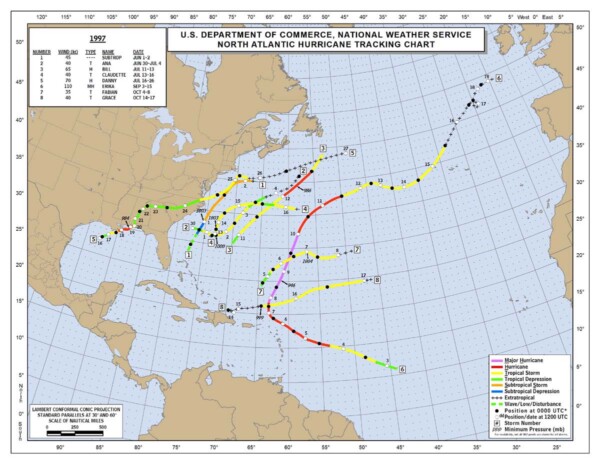
Image courtesy of the National Hurricane Center.
The list of hurricane names for 1997 is out, and what a sorry list of names it is.
The A storm will be called Ana. I have a friend whose name is Anna, so I will not say anything bad about this name. But just between you, me and the fence post, I would never trust a storm named Ana, which is no reflection on the real Anna, who is entirely trustworthy. Well. Almost.
The B storm will be Bill. It will arrive collect-on-delivery. Ha ha. That’s my only “Bill” joke.
Next we have Claudette. Claudette is too exotic a name. I see French madams prowling the gas lit back alleys of the New Orleans French Quarter – a fearful image of you worry about diseases, not hurricanes.
Then there’s Danny. How could anybody run away from a Hurricane Danny? When I think of Danny, I think of a “Far Side” Irish setter, its tongue lolling, its eyes slightly crossed. Danny is too friendly a name for a hurricane.
For the E storm we have Erika. I like this name. I see a rigid Nordic disciplinarian, one who would deal a devastating blow to a city filled with Bills and Claudettes. Erika would teach them a thing or two.
The F storm will be named Fabian.
You’ve got to be kidding.
Fabian? Do you expect me to take a storm named Fabian seriously? Why not Frankie? Annette? Or, the Hurricane Formerly Known as Fabian?
The G name is excellent. Grace. It embodies an ironic contrast between the naturally violent nature of a tropical cyclone and the gentle, moral forthrightness of forgiveness. Or something like that.
Next we have Henri, pronounced ahn-REE, like the waiter who brings you a platter of snails and sneers at your non-gold Visa card and then slinks away for a rendezvous with Claudette. You can imagine this storm muttering, “I SPIT on your waterfront property” in a French accent.
The I storm will be Isabel, as in the queen of Spain who dispatched Columbus on his journey westward. Not a bad choice, especially if Isabel is a Cape Verde hurricane.
The next two storms are familiar refrains from 1985, Juan and Kate. Juan struck Pensacola. Kate struck Panama City. Hmmm. If there were a letter between J and K, we’d be in big trouble.
The L hurricane will be Larry. I sit in front of a Larry. As I write this, I can feel his eyes boring into the back of my neck, like laser beams. He edits this column, which is why you haven’t been seeing my curse words lately.
I think Larry is a great name.
Forgive me for chortling, but the M storm will be called Mindy. We have a Mindy who works here, but I think I could take her two falls out of three. Therefore, it’s only with a little trepidation that I say Mindy is a terrible name for a hurricane. Na-noo, Na-noo.
The N and O storms have names I don’t really care about, Nicholas and Odette. I think the hurricane center must be growing desperate. Odette? Sorry all you Odettes. I think this name is a 0.
The last name on the list is Peter. I don’t think Hurricane Peter is a good idea. To put it bluntly, I fear the pun potential is too enormous, and every scatologist in the nation will be jeering.
Who would want to be struck by Peter?
This column was published in the Wednesday, May 21, 1997 edition of the Northwest Florida Daily News and is used with permission.
About the author:
Del Stone Jr. is a professional fiction writer. He is known primarily for his work in the contemporary dark fiction field, but has also published science fiction and contemporary fantasy. Stone’s stories, poetry and scripts have appeared in publications such as Amazing Stories, Eldritch Tales, and Bantam-Spectra’s Full Spectrum. His short fiction has been published in The Year’s Best Horror Stories XXII; Alfred Hitchcock’s Mystery Magazine; the Pocket Books anthology More Phobias; the Barnes & Noble anthologies 100 Wicked Little Witch Stories, Horrors! 365 Scary Stories, and 100 Astounding Little Alien Stories; the HWA anthology Psychos; and other short fiction venues, like Blood Muse, Live Without a Net, Zombiesque and Sex Macabre. Stone’s comic book debut was in the Clive Barker series of books, Hellraiser, published by Marvel/Epic and reprinted in The Best of Hellraiser anthology. He has also published stories in Penthouse Comix, and worked with artist Dave Dorman on many projects, including the illustrated novella “Roadkill,” a short story for the Andrew Vachss anthology Underground from Dark Horse, an ashcan titled “December” for Hero Illustrated, and several of Dorman’s Wasted Lands novellas and comics, such as Rail from Image and “The Uninvited.” Stone’s novel, Dead Heat, won the 1996 International Horror Guild’s award for best first novel and was a runner-up for the Bram Stoker Award. Stone has also been a finalist for the IHG award for short fiction, the British Fantasy Award for best novella, and a semifinalist for the Nebula and Writers of the Future awards. His stories have appeared in anthologies that have won the Bram Stoker Award and the World Fantasy Award. Two of his works were optioned for film, the novella “Black Tide” and short story “Crisis Line.”
Stone recently retired after a 41-year career in journalism. He won numerous awards for his work, and in 1986 was named Florida’s best columnist in his circulation division by the Florida Society of Newspaper Editors. In 2001 he received an honorable mention from the National Lesbian and Gay Journalists Association for his essay “When Freedom of Speech Ends” and in 2003 he was voted Best of the Best in the category of columnists by Emerald Coast Magazine. He participated in book signings and awareness campaigns, and was a guest on local television and radio programs.
As an addendum, Stone is single, kills tomatoes and morning glories with ruthless efficiency, once tied the stem of a cocktail cherry in a knot with his tongue, and carries a permanent scar on his chest after having been shot with a paintball gun. He’s in his 60s as of this writing but doesn’t look a day over 94.
Contact Del at [email protected]. He is also on Facebook, twitter, Pinterest, tumblr, TikTok, Ello and Instagram. Visit his website at delstonejr.com .