Florida could be home to the national Mustang museum
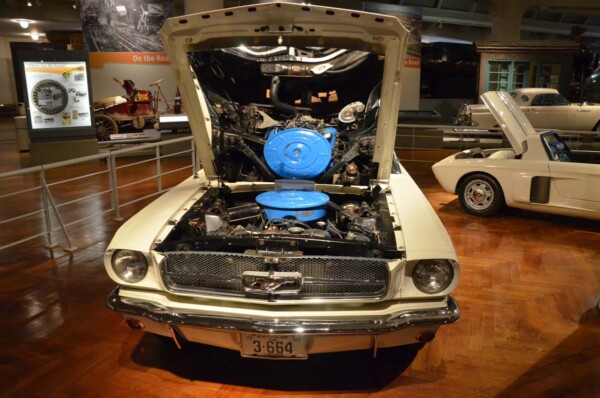
Image courtesy of Flickr user Joe Ross. https://www.flickr.com/photos/joeross/
Have you visited a Ford lately? Did you know Florida has two cities in the running to become the permanent home of the Mustang Museum?
We’re talking cars, not horses or airplanes.
I spoke to Chris Hoverman, chairman of the museum site selection committee, who told me Orlando and Daytona Beach have made it to a short list of 10 candidate cities after the committee, which met the weekend of April 19-20, whittled down a preliminary list of 25 potential sites.
The committee will meet with representatives from the remaining candidates in early June at a gathering at the Henry Ford Museum in Dearborn, Mich. By late August, the 10 cities will be narrowed to those four that offer the best combination of features sought by museum supporters. A final decision will be made in the first quarter of 1998.
And what kind of features is the museum looking for?
Hoverman answered that question without hesitation: “We need land.”
About 30 acres to be exact – make that 30 affordable acres. “I’ve got cities that’ll sell me land at a million dollars an acre,” Hoverman said sardonically. Obviously a better deal is one of the goals.
But they’re also looking for location location location – with sufficient nearby attractions to draw about 300,000 visitors per year to the museum.
Would a 30-acre parcel in attraction-rich Orlando be a good draw? Hoverman answered with an unqualified maybe. It would depend on where in Orlando that parcel lay, he said. A site that was inaccessible or located in an undesirable area wouldn’t do the museum or Mustang fans any good. Hoverman also expressed a little bit of concern over the fact that Orlando is already glutted with attractions. But the weather in the Southeast is a factor in its favor, he added. And so is Florida’s existing tourist machinery, which brings in tens of thousands of visitors every year.
A deciding factor could be enthusiastic support from Orlando or Daytona Beach – either the cities themselves or local businesses.
Neither Orlando nor Daytona Beach is very close to Okaloosa County, so having the Mustang Museum in one of those cities might not make a huge difference to local folks. But if the museum goes to a California site, not many of the people who would put in a day’s drive could see it either.
Besides, it’s kind of a matter of pride that the museum be located in Florida.
I don’t know what you could do to help, unless you’ve got connections on the Orlando or Daytona Beach economic development councils or chambers of commerce. But we’ll hope for the best. The Corvette museum is out in the middle of nowhere (Kentucky). We’ll hope the Mustang doesn’t suffer the same fate.
Headlines that didn’t work: Police Begin Campaign to Run Down Jaywalkers
Redneck computer terms: “Modem,” as in how you got rid of your dandelions.
Words that should be words: This week’s installment is “Frust,” as in the small line of debris that refuses to be swept onto the dust pan and keeps backing a person across the room until he finally decides to give up and sweep it under the rug.
This column was originally published in the April 30, 1997 Northwest Florida Daily News and is used with permission.
About the author:
Del Stone Jr. is a professional fiction writer. He is known primarily for his work in the contemporary dark fiction field, but has also published science fiction and contemporary fantasy. Stone’s stories, poetry and scripts have appeared in publications such as Amazing Stories, Eldritch Tales, and Bantam-Spectra’s Full Spectrum. His short fiction has been published in The Year’s Best Horror Stories XXII; Alfred Hitchcock’s Mystery Magazine; the Pocket Books anthology More Phobias; the Barnes & Noble anthologies 100 Wicked Little Witch Stories, Horrors! 365 Scary Stories, and 100 Astounding Little Alien Stories; the HWA anthology Psychos; and other short fiction venues, like Blood Muse, Live Without a Net, Zombiesque and Sex Macabre. Stone’s comic book debut was in the Clive Barker series of books, Hellraiser, published by Marvel/Epic and reprinted in The Best of Hellraiser anthology. He has also published stories in Penthouse Comix, and worked with artist Dave Dorman on many projects, including the illustrated novella “Roadkill,” a short story for the Andrew Vachss anthology Underground from Dark Horse, an ashcan titled “December” for Hero Illustrated, and several of Dorman’s Wasted Lands novellas and comics, such as Rail from Image and “The Uninvited.” Stone’s novel, Dead Heat, won the 1996 International Horror Guild’s award for best first novel and was a runner-up for the Bram Stoker Award. Stone has also been a finalist for the IHG award for short fiction, the British Fantasy Award for best novella, and a semifinalist for the Nebula and Writers of the Future awards. His stories have appeared in anthologies that have won the Bram Stoker Award and the World Fantasy Award. Two of his works were optioned for film, the novella “Black Tide” and short story “Crisis Line.”
Stone recently retired after a 41-year career in journalism. He won numerous awards for his work, and in 1986 was named Florida’s best columnist in his circulation division by the Florida Society of Newspaper Editors. In 2001 he received an honorable mention from the National Lesbian and Gay Journalists Association for his essay “When Freedom of Speech Ends” and in 2003 he was voted Best of the Best in the category of columnists by Emerald Coast Magazine. He participated in book signings and awareness campaigns, and was a guest on local television and radio programs.
As an addendum, Stone is single, kills tomatoes and morning glories with ruthless efficiency, once tied the stem of a cocktail cherry in a knot with his tongue, and carries a permanent scar on his chest after having been shot with a paintball gun. He’s in his 60s as of this writing but doesn’t look a day over 94.
Contact Del at [email protected]. He is also on Facebook, twitter, Pinterest, tumblr, TikTok, Ello and Instagram. Visit his website at delstonejr.com .
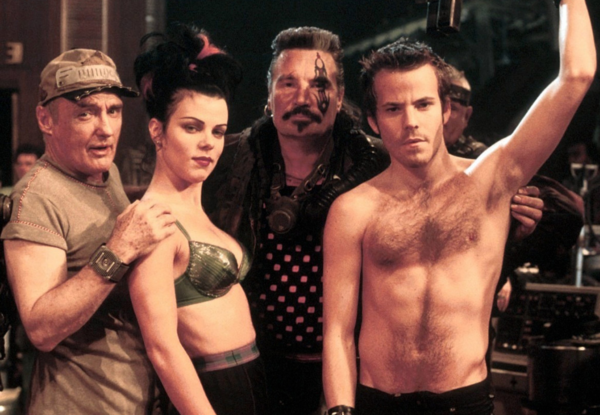
“Space Truckers” Starring Dennis Hopper, Debi Mazar, Stephen Dorff, Charles Dance, George Wendt and others. Directed by Stuart Gordon. 1 hour, 35 minutes. Rated PG-13. Amazon Prime.
Del’s take
“Space Truckers” is Mladen’s revenge for “A Recipe for Seduction.”
He’s been stewing for months about being forced to watch that dreck, and plotting ways to make me pay. Well, he came up with a doozy. “Space Truckers” has a cult following – of kooks with bad taste. Trust me, it’s boring schlock.
Director Stuart Gordon, who captained some pretty good movies like “Reanimator,” intended this to be a lowbrow sci-fi comedy. He succeeded with lowbrow but the comedy part fails, and it fails miserably. I can’t think of a single funny moment in this movie.
It features some real talent – Dennis Hopper, a young Stephen Dorff, Charles Dance and George Wendt – but the problem with “Space Truckers” is the script. It falls flat and I doubt defibrillator paddles could shock some life into this toe-tag of a screenplay.
The story goes like this: Hopper is the last of the independent “space truckers” driving goods and whatnot from one planet to the next. After a late delivery of square pigs and only partial payment, he takes on a sketchy consignment from a shady group headquartered at the Neptunian moon Triton for rapid delivery to Earth. As you might expect, “rapid delivery” becomes anything but after an encounter with space pirates, and then the load itself becomes problematic when it turns out to be a swarm of Terminator-like robots bent on killing all humans.
In theory this kind of movie should work. Ironically, a day or two after I finished “Space Truckers” another comedy – this one very funny – was playing on cable: “Airplane.” I was struck by the differences in the two movies – “Airplane” has a similarly thin plot but that’s OK – the movie is nothing but one rapid-fire joke delivery after another. In “Airplane” some jokes are visual, some physical, and some are embedded in dialogue. “Space Truckers” exhibited none of those qualities. It was an hour and a half of Dennis Hopper glaring and leering at the camera Quint-style with Debi Mazar almost flashing her boobies and Stephen Dorf showing off a not-bad stack of abs.
Comedy relies to a great extent on timing and “Space Truckers,” like its bumbling space truck-driving Hopper, misses delivery time and time again. He could never get a job with intergalactic Fed-Ex. Couple that with nonsensical special effects – I mean you can see the wirework in the scenes of weightlessness – and you get a movie that’s not quite “Plan 9 from Outer Space” but darned close, maybe “Plan 8.”
I expect some folks love this movie and will sniff at my dismissal as the grumpy curmudgeoning of a foul-tempered old man. Maybe Mladen will be one of them. I’m good with that.
I didn’t like “Space Truckers” and I don’t mind saying so. It rates a solid D on my grade scale.
And that’s a 10-4 good buddy.
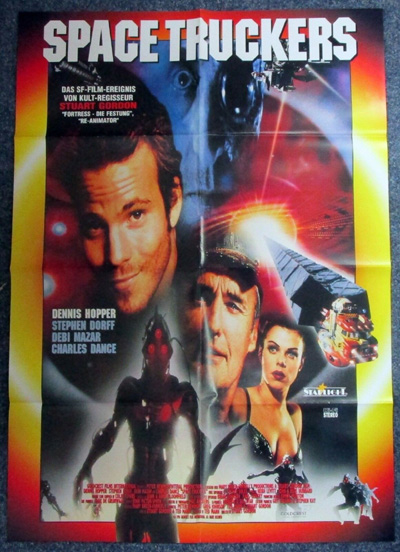
Mladen’s take
There is absolutely zero wrong with Debi Mazar almost flashing her boobies in “Space Truckers.” If there is a problem, Del, it’s that the “almost” does not become an actual.
“Space Truckers,” despite the way bona fide critics and Del have characterized the movie, is not a comedy.
Yes, it has elements of farce which, I suppose, can be construed as a form of comedy. The space truck space lane approach to Triton is lined with ugly billboards like a U.S. highway. The message? Leave it to mankind to fuck up even deep and beautiful outer space with its garish drive to sell shit.
Yes, cyborg Macanudo (Charles Dance) trying to start his mechanical penis’ erection by pulling a cord as you would do to start an uncooperative chainsaw is clearly intended to be humor and it works.
But this 1996 film – let me say that again – this 1996 film – that’s three years before “The Matrix” hits the big screen – gives it its all to take advantage of emerging computer-generated visual effects and provide an action-adventure joy ride.
To enjoy “Space Truckers” requires a pinch of mercy, a dollop of appreciation for effort and two tablespoons of understanding. Del lacks all three.
Mercy because “Space Truckers” is imbalanced. Set design and costumes are good, as is most of the acting. The special effects – models and electronic visuals – ain’t bad either. The movie is tainted, as Del noted, by the often-visible suspension wires used to make it look like people are floating or tumbling in low gravity. I have no idea why that significant flaw wasn’t disguised in film post‑production.
Appreciation because other movies of that era, “Escape from LA,” for example, directed by the great John Carpenter had crappier computer-driven animation. You have to appreciate “Space Truckers” for what it is: A movie made as the landscape of moviemaking was changing with the introduction of the microchip and graphic arts software to a director’s pallet.
Understanding because … see Mercy and Appreciation above.
I didn’t know that “Space Truckers” had a cult following until Del mentioned it in his review. And, though I’m not a cultist except as it regards Godzilla movies, I can understand why the movie would draw a particular kind of audience. “Space Truckers” is campy, studded with absurd characters, hampered by not infrequent special effects malfunctions, and, if your tolerant of imperfections, fun.
I give “Space Truckers” a B for effort and the likelihood it’ll appeal to 1 out of 7 viewers despite its flaws.
Mladen Rudman is a former journalist and technical writer. Del Stone Jr. is a former journalist and author.
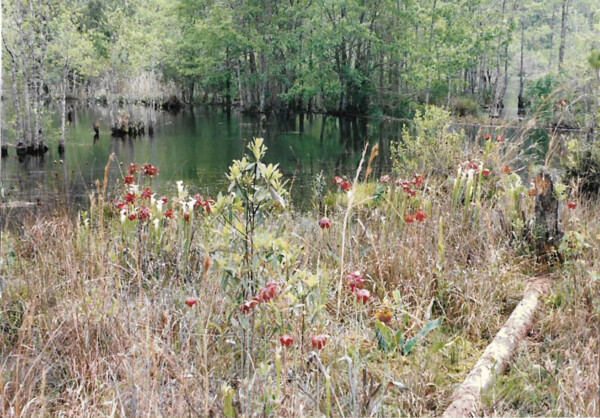
Pitcher plants grow along the grassy shoreline of a slough along the hiking trail that surrounds Bear Lake northwest of Baker, Florida. Image by Del Stone Jr
Unpaved paradise: Just an hour north of here, along State Road 4 between Baker and Munson, lies Bear Lake. It’s smack in the middle of the Blackwater River State Park.
You gotta see this place.
We took the hiking tour of the lake, a four-mile trek that leads you through primeval sloughs and climax pine forest and bogs of flesh-eating plants.
I kid you not. A highlight of the hike is the pitcher plant bog, where thousands of bug-devouring Tubes of Death sprout from the muck to how down on flies and mosquitoes.
The trail is busy with benches for the bushed, bat boxes for our leathery buddies, bridges over the boggy parts – but no bathrooms for the bladder-burdened (that’s what all those woods are for).
Get ready for some serious beauty. We tiptoed through a grotto of overhanging trees that shaded a trickling creek. Within were stunning growths of moss, ferns and an outcropping of lavender, orchid-like flowers.
The hike will take some time, especially if you’re a camera nut who’s trying to learn about f-stops and shutter speeds. But it puts you back in touch with what’s real.
No American Express: We were at a “Destin eatery” and that’s all I’ll say about where it happened.
My friend had the eggs Benedict. I munched a monstrous salad.
When we finished I whipped out my Visa card. The lady shook her head. “We don’t take ANY credit cards.”
A cold chill ran up my spine. I had a fiver. My friend had $5. The bill was $13. How many dishes could we wash to make up the shortfall?
Then I remembered my Emergency Stash in the glove box of the truck. Got it. Paid the bill and had enough change to leave a tip.
No credit cards?
Better have the defibrillators handy.
One of the perks of this job is I get to hang out with cool people. Last week, one of those people was Daily News columnist Julie Nichols, who accompanied me to Cracker Barrel, where we lamented our expanding waistlines – she as she munched, bird-like, at a salad, and I as I pounded down the Brownie Piet and Ice Cream.
It was a great evening. Julie is smart and engaging and funny, and she’s a writer’s writer. If you’re not reading her column, you should be.
But have the salad.
More coolness: Last week brought Tavel Bell nee Cowan and her navigator husband, Major Tom, back to the Emerald Coast for a visit. Tavel was a Daily News copy editor from whom I sponged travel adventures about the slopes at Lake Tahoe.
The recently relocated Wolf Woman and I joined them at the Donut Hole in Destin – Major Tom and I weaseled them into a monster cookie apiece, and they capitulated with barely a mumble about diets. I think Major Tom came back solely for those huge cookies.
Redneck computer terms: “Window,” as in a place in the truck to hang your guns.
Words that should be words: This week’s installment is “Elbonics,” as in: The actions of two people maneuvering for one armrest in a movie theater.
This column was published in the Wednesday, April 16, 1997 edition of the Northwest Florida Daily News and is used with permission.
About the author:
Del Stone Jr. is a professional fiction writer. He is known primarily for his work in the contemporary dark fiction field, but has also published science fiction and contemporary fantasy. Stone’s stories, poetry and scripts have appeared in publications such as Amazing Stories, Eldritch Tales, and Bantam-Spectra’s Full Spectrum. His short fiction has been published in The Year’s Best Horror Stories XXII; Alfred Hitchcock’s Mystery Magazine; the Pocket Books anthology More Phobias; the Barnes & Noble anthologies 100 Wicked Little Witch Stories, Horrors! 365 Scary Stories, and 100 Astounding Little Alien Stories; the HWA anthology Psychos; and other short fiction venues, like Blood Muse, Live Without a Net, Zombiesque and Sex Macabre. Stone’s comic book debut was in the Clive Barker series of books, Hellraiser, published by Marvel/Epic and reprinted in The Best of Hellraiser anthology. He has also published stories in Penthouse Comix, and worked with artist Dave Dorman on many projects, including the illustrated novella “Roadkill,” a short story for the Andrew Vachss anthology Underground from Dark Horse, an ashcan titled “December” for Hero Illustrated, and several of Dorman’s Wasted Lands novellas and comics, such as Rail from Image and “The Uninvited.” Stone’s novel, Dead Heat, won the 1996 International Horror Guild’s award for best first novel and was a runner-up for the Bram Stoker Award. Stone has also been a finalist for the IHG award for short fiction, the British Fantasy Award for best novella, and a semifinalist for the Nebula and Writers of the Future awards. His stories have appeared in anthologies that have won the Bram Stoker Award and the World Fantasy Award. Two of his works were optioned for film, the novella “Black Tide” and short story “Crisis Line.”
Stone recently retired after a 41-year career in journalism. He won numerous awards for his work, and in 1986 was named Florida’s best columnist in his circulation division by the Florida Society of Newspaper Editors. In 2001 he received an honorable mention from the National Lesbian and Gay Journalists Association for his essay “When Freedom of Speech Ends” and in 2003 he was voted Best of the Best in the category of columnists by Emerald Coast Magazine. He participated in book signings and awareness campaigns, and was a guest on local television and radio programs.
As an addendum, Stone is single, kills tomatoes and morning glories with ruthless efficiency, once tied the stem of a cocktail cherry in a knot with his tongue, and carries a permanent scar on his chest after having been shot with a paintball gun. He’s in his 60s as of this writing but doesn’t look a day over 94.
Contact Del at [email protected]. He is also on Facebook, twitter, Pinterest, tumblr, TikTok, and Instagram. Visit his website at delstonejr.com .
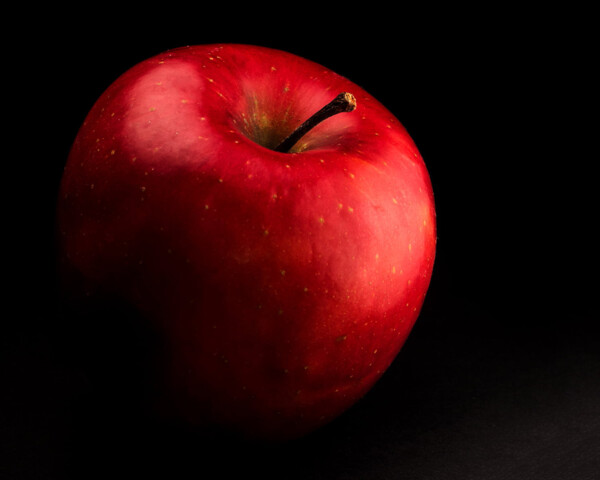
Image courtesy of Wallpaper Flare.
—
One a day: Few foods surpass the simple virtues of the apple.
For instance, the shape is sculpted to fit the human hand. It is not round but oval, with a top that is wider than the bottom, which allows it to fit the concavity of the palm, with a largeness above to accommodate the longer fingers and a tapering at the bottom to support the thumb and pinky.
An apple’s shape is a good indicator of the flavor and its texture. What you want is a slight tartness that underlines a moist sweetness. When you bite into an apple, the meat should glisten with an off-white color, leaning to pale yellow. It should be firm, producing a distinctive chomp sound.
Those characteristics are most often found in red delicious apples, which are oval-shaped and have lobes that provide leverage for biting. For those reasons, and others, the red delicious is the apple of choice.
I wouldn’t trust a round apple. The rounder the apple, the more bitter the taste, which hits you at the back of your jaw, just below your ears. Also, round apples can be very hard, which makes biting them a test. Will I or will I not chip that front tooth? Better to avoid round apples.
Another important apple characteristic is color. The best tasting apples have skins that are deeply red and streaked with shallow threads of yellow.
The red delicious apples we get at local grocery stores have sometimes passed the red stage to become a plum-like purple. While this color makes for a fine-looking specimen to display in a produce case, the applies inside may be soft and dry.
Since you cannot wander the grocery aisle taking bites to choose apples that have reached the correct stage of ripeness, you must use your best judgment. Go with the apple that appears not to have reached a reddish-purple hue.
I have found a supply of apples that are consistently sized and ripened to perfection. I won’t tell you where they are, because you will take them away from me. But know that I’m enjoying them greatly.
When it comes to apples, I’m a selfish, possessive man.
Redneck computer terms: “Keyboard,” as in: a place to hang your truck keys.
This week’s word that should be a word: “Eiffelites,” as in: gangly people sitting in front of you at the movies who, no matter what direction you lean in, follow suit.
This week’s weirdness from the wires: BANGKOK, Thailand (AP) – A pet peacock mauled his master, killing him in a freak attack, hospital officials and relatives say.
Vichai Thongto, 30, was feeding his family’s four caged peacocks in the western province of Ratchaburi on Sunday when a male bird hurled itself at him, clawing his head.
Vichai soon began suffering headaches and fell into a coma by the time relatives got him to a hospital.
A nurse at Ratchaburi Hospital’s neurological department said doctors found a tiny puncture wound above Vichai’s left ear, and that a CAT scan revealed a blood clot in his brain.
About the author:
Del Stone Jr. is a professional fiction writer. He is known primarily for his work in the contemporary dark fiction field, but has also published science fiction and contemporary fantasy. Stone’s stories, poetry and scripts have appeared in publications such as Amazing Stories, Eldritch Tales, and Bantam-Spectra’s Full Spectrum. His short fiction has been published in The Year’s Best Horror Stories XXII; Alfred Hitchcock’s Mystery Magazine; the Pocket Books anthology More Phobias; the Barnes & Noble anthologies 100 Wicked Little Witch Stories, Horrors! 365 Scary Stories, and 100 Astounding Little Alien Stories; the HWA anthology Psychos; and other short fiction venues, like Blood Muse, Live Without a Net, Zombiesque and Sex Macabre. Stone’s comic book debut was in the Clive Barker series of books, Hellraiser, published by Marvel/Epic and reprinted in The Best of Hellraiser anthology. He has also published stories in Penthouse Comix, and worked with artist Dave Dorman on many projects, including the illustrated novella “Roadkill,” a short story for the Andrew Vachss anthology Underground from Dark Horse, an ashcan titled “December” for Hero Illustrated, and several of Dorman’s Wasted Lands novellas and comics, such as Rail from Image and “The Uninvited.” Stone’s novel, Dead Heat, won the 1996 International Horror Guild’s award for best first novel and was a runner-up for the Bram Stoker Award. Stone has also been a finalist for the IHG award for short fiction, the British Fantasy Award for best novella, and a semifinalist for the Nebula and Writers of the Future awards. His stories have appeared in anthologies that have won the Bram Stoker Award and the World Fantasy Award. Two of his works were optioned for film, the novella “Black Tide” and short story “Crisis Line.”
Stone recently retired after a 41-year career in journalism. He won numerous awards for his work, and in 1986 was named Florida’s best columnist in his circulation division by the Florida Society of Newspaper Editors. In 2001 he received an honorable mention from the National Lesbian and Gay Journalists Association for his essay “When Freedom of Speech Ends” and in 2003 he was voted Best of the Best in the category of columnists by Emerald Coast Magazine. He participated in book signings and awareness campaigns, and was a guest on local television and radio programs.
As an addendum, Stone is single, kills tomatoes and morning glories with ruthless efficiency, once tied the stem of a cocktail cherry in a knot with his tongue, and carries a permanent scar on his chest after having been shot with a paintball gun. He’s in his 60s as of this writing but doesn’t look a day over 94.
Contact Del at [email protected]. He is also on Facebook, twitter, Pinterest, tumblr, TikTok, Ello and Instagram. Visit his website at delstonejr.com .

Image by Mathias Krumbholz by way of a Creative Commons license. https://commons.wikimedia.org/wiki/User:Leviathan1983
Lately I have been thinking about heaven.
In heaven, I am 10 years old again. I live in a small town, surrounded by farms and forests.
It is summer.
I burst from my house at sunup. I cut across Mrs. Disten’s yard , careful to dodge her beds of hollyhock and zinnia and marigold because the last time I didn’t and she yelled at me and Mom gave me a lickin’ when I snuck in that afternoon.
I wear cutoff shorts and a pair of ratty old sneakers that fit my feet perfectly and nothing else.
The streets are lined with shade trees tall as monuments. Within their dark canopies, birds and squirrels and the Hampton Street Boogeyman create tiny rustling sounds.
I have two best friends, one slightly better than the other. Which one is which depends on who will do what with me when. One celebrates dreams, while the other celebrates the here-and-now. Usually it’s all three of us, our allegiances shifting with the pull of the earth.
We take off down a two-lane road that leads to the fields and woods. Behind us, the town awakens slowly.
The gas station opens first, Old Man Tucker wheeling out his whitewalls and cans of Sinclair motor oil. Then, in rapid succession, it is the post office, the drug store and Mr. Hendree’s barber shop. Not until nighttime will the VFW post, the grange hall and the movie theater throw back their doors.
We cut across fields of waist-high weeds. Before us, grasshoppers go tearing into the gathering heat. Ladybugs hover near clusters of Queen Ann’s Lace. Butterflies jitterbug from black-eyed Susan to thistle to dandelion.
We make for a row of trees that shelters a creek we call Oper’s. That’s “old person’s” because the creek flows very slowly. A rock fall as created a silent pool. It is home to a monster trout seen by many and hooked by none. We fish with our calves rubbing smooth stones furred by moss.
As morning gives way to afternoon, the heat becomes liquid, fueling big thunderheads that purple the horizon. We see faces billowing out of the stacks – presidents and movie actresses and that damned Sunday school teacher who makes us sing “Sometimes I Feel Like a Motherless Child.”
By late afternoon it is time to go home. We pass the wrecked crop duster, the elm struck by lightning because a witch is buried there, the copse of trees where the Privettes squeeze their ’shine. We go three ways with a promise to reunite after supper.
The shadows grow long. The air cools. The trees along Hampton Street come alive with noises as the Boogeyman awakens from his day-long slumber.
Then it is night and we are out again, chasing the spectral fireflies that float amongst the branches. Folks are lining up at the theater, and the VFW is jumping with badly played clarinets and trumpets.
Out in the fields, away from the trees, the sky unfolds before us. The ghostly tails of comets blend with clouds of stars that stretch into forever.
It is there, staring into God’s cool, infinite eye, that I recognize heaven for what it is: an innocence and purity and truth.
But more than that it is an acknowledgement that the world and our lives form a wonderful mystery we will never solve.
The night is strange and immense and beautiful.
I am in heaven.
This column was originally published in the April 2, 1997 edition of the Northwest Florida Daily News and is used with permission.
About the author:
Del Stone Jr. is a professional fiction writer. He is known primarily for his work in the contemporary dark fiction field, but has also published science fiction and contemporary fantasy. Stone’s stories, poetry and scripts have appeared in publications such as Amazing Stories, Eldritch Tales, and Bantam-Spectra’s Full Spectrum. His short fiction has been published in The Year’s Best Horror Stories XXII; Alfred Hitchcock’s Mystery Magazine; the Pocket Books anthology More Phobias; the Barnes & Noble anthologies 100 Wicked Little Witch Stories, Horrors! 365 Scary Stories, and 100 Astounding Little Alien Stories; the HWA anthology Psychos; and other short fiction venues, like Blood Muse, Live Without a Net, Zombiesque and Sex Macabre. Stone’s comic book debut was in the Clive Barker series of books, Hellraiser, published by Marvel/Epic and reprinted in The Best of Hellraiser anthology. He has also published stories in Penthouse Comix, and worked with artist Dave Dorman on many projects, including the illustrated novella “Roadkill,” a short story for the Andrew Vachss anthology Underground from Dark Horse, an ashcan titled “December” for Hero Illustrated, and several of Dorman’s Wasted Lands novellas and comics, such as Rail from Image and “The Uninvited.” Stone’s novel, Dead Heat, won the 1996 International Horror Guild’s award for best first novel and was a runner-up for the Bram Stoker Award. Stone has also been a finalist for the IHG award for short fiction, the British Fantasy Award for best novella, and a semifinalist for the Nebula and Writers of the Future awards. His stories have appeared in anthologies that have won the Bram Stoker Award and the World Fantasy Award. Two of his works were optioned for film, the novella “Black Tide” and short story “Crisis Line.”
Stone recently retired after a 41-year career in journalism. He won numerous awards for his work, and in 1986 was named Florida’s best columnist in his circulation division by the Florida Society of Newspaper Editors. In 2001 he received an honorable mention from the National Lesbian and Gay Journalists Association for his essay “When Freedom of Speech Ends” and in 2003 he was voted Best of the Best in the category of columnists by Emerald Coast Magazine. He participated in book signings and awareness campaigns, and was a guest on local television and radio programs.
As an addendum, Stone is single, kills tomatoes and morning glories with ruthless efficiency, once tied the stem of a cocktail cherry in a knot with his tongue, and carries a permanent scar on his chest after having been shot with a paintball gun. He’s in his 60s as of this writing but doesn’t look a day over 94.
Contact Del at [email protected]. He is also on Facebook, twitter, Pinterest, tumblr, TikTok, and Instagram. Visit his website at delstonejr.com .

Image courtesy of flickr user Cweyant by way of a Creative Commons license. https://www.flickr.com/people/80267980@N00
The power of pennies: Squirreled away inside Aunt Wendy’s recent gift of chocolate chip cookies was a container of pennies.
I think everyone must have a container of pennies sitting around the house. Mine is in the kitchen, next to the microwave.
Now, Aunt Wendy’s was too.
Typically I let the penny jar fill until it’s overflowing. With the addition of Aunt Wendy’s donation, which I’d estimate to be $10 to $15, the jar was approaching that point. Still, I did not want to start rolling pennies. It’s so much work for so little return.
Or so I thought.
One day recently, my wallet turned up devoid of money. Not an unusual occurrence. But this time, instead of raiding the ATM machine, I had another option.
I rolled up $5 in pennies to buy gas. Then, I needed to mail a book to a store owner. I rolled up $2 in pennies for the postage. I needed $10 to pay my bowling league fees for the week. I started rolling.
Get this: I needed $3 to buy more penny rolls. Guess how I paid for them?
In the process of rolling all those pennies, I discovered $10 in quarters, $8 in dimes and $2 in nickels which had also found their way into the penny jar. Wow! That paid for dinner at Cuco’s in Pensacola, soft drinks for the ride to the Bush concert and a fab cookie at Books-A-Million.
I guess the moral of this story is: Good things come in one-cent packages.
Cool movie of the week: Tonight, AMC will broadcast the cinematic rendition of Edward Albee’s drama, “Who’s Afraid of Virginia Woolf?”
I remember watching this movie as a young teen. While my tastes in cinema leaned to monster movies, science fiction, war stores and shoot-’em ups, I was mesmerized by the powerful interplay of emotions between Richard Burton, Elizabeth Taylor, George Segal and Sandy Dennis.
Don’t miss this landmark film, at 7:30 tonight on Channel 33.
A lunch bunch in need: The folks at OASIS are looking for a few good individuals, church groups and/or service organizations to provide and prepare a regular Thursday luncheon.
These luncheons benefit OASIS clients, caregivers, volunteers and board members who are able to attend, and they help maintain the support network that keeps OASIS clients and helpers going.
Donations are welcome. Meantime, if you’ve got questions, give Carol Boughton a call at 897-2687.
Redneck computer terms: “Hard drive,” as in trying to climb a steep, muddy hill with three flat tires and pulling a trailer load of fertilizer.
This week’s wire weirdness: BANGKOK, Thailand (AP) – A spooked elephant killed an Australian man at a tourist show in northern Thailand a day after two villagers were stomped to death elsewhere by rogue elephants.
Words that should be words: This week’s word is “lysdexic,” for people who hear it one way and repeat it backward. This word is courtesy of Daily News Staff Writer Jeff Newell, an admitted lysdexic.
This column was originally published in the Northwest Florida Daily News on March 26, 1997 and is used with permission.
About the author:
Del Stone Jr. is a professional fiction writer. He is known primarily for his work in the contemporary dark fiction field, but has also published science fiction and contemporary fantasy. Stone’s stories, poetry and scripts have appeared in publications such as Amazing Stories, Eldritch Tales, and Bantam-Spectra’s Full Spectrum. His short fiction has been published in The Year’s Best Horror Stories XXII; Alfred Hitchcock’s Mystery Magazine; the Pocket Books anthology More Phobias; the Barnes & Noble anthologies 100 Wicked Little Witch Stories, Horrors! 365 Scary Stories, and 100 Astounding Little Alien Stories; the HWA anthology Psychos; and other short fiction venues, like Blood Muse, Live Without a Net, Zombiesque and Sex Macabre. Stone’s comic book debut was in the Clive Barker series of books, Hellraiser, published by Marvel/Epic and reprinted in The Best of Hellraiser anthology. He has also published stories in Penthouse Comix, and worked with artist Dave Dorman on many projects, including the illustrated novella “Roadkill,” a short story for the Andrew Vachss anthology Underground from Dark Horse, an ashcan titled “December” for Hero Illustrated, and several of Dorman’s Wasted Lands novellas and comics, such as Rail from Image and “The Uninvited.” Stone’s novel, Dead Heat, won the 1996 International Horror Guild’s award for best first novel and was a runner-up for the Bram Stoker Award. Stone has also been a finalist for the IHG award for short fiction, the British Fantasy Award for best novella, and a semifinalist for the Nebula and Writers of the Future awards. His stories have appeared in anthologies that have won the Bram Stoker Award and the World Fantasy Award. Two of his works were optioned for film, the novella “Black Tide” and short story “Crisis Line.”
Stone recently retired after a 41-year career in journalism. He won numerous awards for his work, and in 1986 was named Florida’s best columnist in his circulation division by the Florida Society of Newspaper Editors. In 2001 he received an honorable mention from the National Lesbian and Gay Journalists Association for his essay “When Freedom of Speech Ends” and in 2003 he was voted Best of the Best in the category of columnists by Emerald Coast Magazine. He participated in book signings and awareness campaigns, and was a guest on local television and radio programs.
As an addendum, Stone is single, kills tomatoes and morning glories with ruthless efficiency, once tied the stem of a cocktail cherry in a knot with his tongue, and carries a permanent scar on his chest after having been shot with a paintball gun. He’s in his 60s as of this writing but doesn’t look a day over 94.
Contact Del at [email protected]. He is also on Facebook, twitter, Pinterest, tumblr, TikTok, Ello and Instagram. Visit his website at delstonejr.com .

Image courtesy of Flickr user Gloria Manna by way of a Creative Commons license. https://www.flickr.com/photos/gloriamanna/
It’s a question of quality: The Hap-Hap-Happy News at the top of Friday’s Daily News left me with a lump in my throat.
“Economist: Emerald Coast to grow for next 15 years.”
I managed not to throw up as I read this epitaph.
It was delivered by Orlando-based economist Henry Fishkind, who predicted the Northwest Florida area would experience continued development well into the next century.
Oh joy, oh rapture.
Judging by what passes for “development” in this area, we can expect a plethora of strip shopping centers, gas/convenience stores, and fast food outlets.
This is good news – if you’re a developer, a construction worker or a taco/burger/pizza flipper. Life here along the Asphalt Coast will be splendid. The rich will get richer, and the poor will get trucked in like galley slaves to do the scutwork. Sound familiar, Destin and South Walton?
While the tiny minority that profits from this rapacious consumption clinks cocktail glasses behind the walls of “gated communities” (another word for “fortress”) the rest of us will be living in an ugly, polluted and congested hog swill that we once called “paradise.”
Somebody will surely say tome, “You got yours, and now you want to slam the door on anybody else coming here.”
Absolutely right. Truth is, you can’t put 100 people in a room that only holds 50. The 50 who got there first have every right to complain when the door isn’t shut.
The destruction of the Emerald Coast and the rise of the Asphalt Coast is a refrain heard all over this country, yet we refuse to learn that prosperity need not be a function of “growth.” Many cultures prospered without laying waste to everything around them.
What is the point of life without loveliness?
Heaven or hell? It would be nice if somebody with a sense of humor responded to our heaven-and-hell write-in being sponsored by the Lifestyle department. So far, we’ve gotten mostly Old Testament pronouncements of doom, and a couple of really bizarre letters from some nutcase in Andalusia.
C’mon, folks. We want this to be fun!
A tragedy that should have been averted: Recently four girls in New York were killed when a tree fell on their school bus.
Soon after, the Daily News received a press release from the National Arborist Association, which read:
“The recent tragedy in Laurelton, Queens, N.Y., where four girls died when a tree fell on their school bus was an accident that could have been averted had the tree received the professional care of an arborist.” The press release went on to describe all the marvelous things arborists do for people with trees.
Excuse me, but does anybody else find this press release to be a ghoulish and tasteless exploitation of an accident? Sort of like a tire manufacturer videotaping fatal accidents and saying, “They should’ve been using OUR steel-belted radials.”
Words that should be words: “Disconfect,” as in: To sterilize the piece of candy you dropped on the floor by blowing on it, assuming this will somehow “remove” all the germs.
This column was originally published in the March 19, 1997 edition of the Northwest Florida Daily News and is used with permission.
About the author:
Del Stone Jr. is a professional fiction writer. He is known primarily for his work in the contemporary dark fiction field, but has also published science fiction and contemporary fantasy. Stone’s stories, poetry and scripts have appeared in publications such as Amazing Stories, Eldritch Tales, and Bantam-Spectra’s Full Spectrum. His short fiction has been published in The Year’s Best Horror Stories XXII; Alfred Hitchcock’s Mystery Magazine; the Pocket Books anthology More Phobias; the Barnes & Noble anthologies 100 Wicked Little Witch Stories, Horrors! 365 Scary Stories, and 100 Astounding Little Alien Stories; the HWA anthology Psychos; and other short fiction venues, like Blood Muse, Live Without a Net, Zombiesque and Sex Macabre. Stone’s comic book debut was in the Clive Barker series of books, Hellraiser, published by Marvel/Epic and reprinted in The Best of Hellraiser anthology. He has also published stories in Penthouse Comix, and worked with artist Dave Dorman on many projects, including the illustrated novella “Roadkill,” a short story for the Andrew Vachss anthology Underground from Dark Horse, an ashcan titled “December” for Hero Illustrated, and several of Dorman’s Wasted Lands novellas and comics, such as Rail from Image and “The Uninvited.” Stone’s novel, Dead Heat, won the 1996 International Horror Guild’s award for best first novel and was a runner-up for the Bram Stoker Award. Stone has also been a finalist for the IHG award for short fiction, the British Fantasy Award for best novella, and a semifinalist for the Nebula and Writers of the Future awards. His stories have appeared in anthologies that have won the Bram Stoker Award and the World Fantasy Award. Two of his works were optioned for film, the novella “Black Tide” and short story “Crisis Line.”
Stone recently retired after a 41-year career in journalism. He won numerous awards for his work, and in 1986 was named Florida’s best columnist in his circulation division by the Florida Society of Newspaper Editors. In 2001 he received an honorable mention from the National Lesbian and Gay Journalists Association for his essay “When Freedom of Speech Ends” and in 2003 he was voted Best of the Best in the category of columnists by Emerald Coast Magazine. He participated in book signings and awareness campaigns, and was a guest on local television and radio programs.
As an addendum, Stone is single, kills tomatoes and morning glories with ruthless efficiency, once tied the stem of a cocktail cherry in a knot with his tongue, and carries a permanent scar on his chest after having been shot with a paintball gun. He’s in his 60s as of this writing but doesn’t look a day over 94.
Contact Del at [email protected]. He is also on Facebook, twitter, Pinterest, tumblr, TikTok, Ello and Instagram. Visit his website at delstonejr.com .

Props spin on the "Nine-O-Nine," a World War II-era bomber operated by the Collings Foundation, during a stopover at the Crestview, Florida airport. Image by Del Stone Jr.
12 O’Clock High: There she sat, the “Nine-O-Nine,” perched on the apron at the Crestview Airport, looking like a thousand B-17 Flying Fortresses I’d seen in a thousand movies about Eighth Air Force raids into Hitler’s Germany.
Except this was no movie.
She was smaller than I expected, and in this age of missiles and lasers she looked forlornly vulnerable with a few .50-calibers drooping from her fuselage.
I climbed inside. It was a claustrophobe’s horror, dark and full of sharp, metal corners. A narrow catwalk divided the bomb bay into two parts. I could barely make it through. The kids had no problem.
I stepped around the ball turret and thought of the Randall Jarrel poem. The dreams of black flak. What they did with the hose.
How did those kids tiptoe through these narrow bays filled with bombs? I thought. How did they fly and fight in these tiny, freezing machines? How did they lean out open hatches at 12,000 feet and aim machine guns at fighters that were filling their slender bombers with holes?
My dad flew in one of these. It was during the filming of the movie “12 O’Clock High,” starring Gregory Peck. I have the black-and-white photos Dad took and printed himself. I don’t know why he was there. Dad wasn’t a bomber pilot. He flew Mustangs and Lightnings.
As I walked around the “Nine-O-Nine,” I was filled with melancholy. This was an artifact from an era that was gone now, an era that seemed more honest and heroic than our own. These men defined their worth through deeds, not cell phones, fancy clothes and cocktail parties.
I snapped photo after photo of the old bomber. I didn’t know if I’d ever see one again. Especially one that could fly.
Maybe the folks who inherit my photographs will marvel that they knew someone who had seen firsthand the spinning propellers of a B-17. Maybe their children will marvel that their parents knew somebody who had witnessed that sight.
Perhaps the memory will be passed along, a little diminished each time but never gone entirely, so that in our way we live forever.
This week’s wire weirdness: From The Associated Press: Two women are publicly quarreling about whose bare breasts graced the pages of a Norwegian magazine. Aud Sto of Flekkefjord is angry about the alleged exposure, which was snapped in the Canary Islands, and is suing the magazine Se og Hoer for $22,000. The other woman, Inger Marie Maylam of Kristiansand, sees things differently: “The breasts are mine and they are for free,” she declared recently in a newspaper interview. The sit has been frozen pending resolution of the claims.
This week’s good read: “Acts of Conscience” by William Barton, a trade paperback from Warner Books. A high-flying science fiction adventure about a man who goes to an alien planet and discovers more about mankind, and himself, than he could ever know.
Words that should be words: This week’s selection is “Ecnalubma,” as in a rescue vehicle that can only be seen in the rearview mirror.
This column was originally published in the Wednesday, March 12, 1997 edition of the Northwest Florida Daily News and is used with permission.
About the author:
Del Stone Jr. is a professional fiction writer. He is known primarily for his work in the contemporary dark fiction field, but has also published science fiction and contemporary fantasy. Stone’s stories, poetry and scripts have appeared in publications such as Amazing Stories, Eldritch Tales, and Bantam-Spectra’s Full Spectrum. His short fiction has been published in The Year’s Best Horror Stories XXII; Alfred Hitchcock’s Mystery Magazine; the Pocket Books anthology More Phobias; the Barnes & Noble anthologies 100 Wicked Little Witch Stories, Horrors! 365 Scary Stories, and 100 Astounding Little Alien Stories; the HWA anthology Psychos; and other short fiction venues, like Blood Muse, Live Without a Net, Zombiesque and Sex Macabre. Stone’s comic book debut was in the Clive Barker series of books, Hellraiser, published by Marvel/Epic and reprinted in The Best of Hellraiser anthology. He has also published stories in Penthouse Comix, and worked with artist Dave Dorman on many projects, including the illustrated novella “Roadkill,” a short story for the Andrew Vachss anthology Underground from Dark Horse, an ashcan titled “December” for Hero Illustrated, and several of Dorman’s Wasted Lands novellas and comics, such as Rail from Image and “The Uninvited.” Stone’s novel, Dead Heat, won the 1996 International Horror Guild’s award for best first novel and was a runner-up for the Bram Stoker Award. Stone has also been a finalist for the IHG award for short fiction, the British Fantasy Award for best novella, and a semifinalist for the Nebula and Writers of the Future awards. His stories have appeared in anthologies that have won the Bram Stoker Award and the World Fantasy Award. Two of his works were optioned for film, the novella “Black Tide” and short story “Crisis Line.”
Stone recently retired after a 41-year career in journalism. He won numerous awards for his work, and in 1986 was named Florida’s best columnist in his circulation division by the Florida Society of Newspaper Editors. In 2001 he received an honorable mention from the National Lesbian and Gay Journalists Association for his essay “When Freedom of Speech Ends” and in 2003 he was voted Best of the Best in the category of columnists by Emerald Coast Magazine. He participated in book signings and awareness campaigns, and was a guest on local television and radio programs.
As an addendum, Stone is single, kills tomatoes and morning glories with ruthless efficiency, once tied the stem of a cocktail cherry in a knot with his tongue, and carries a permanent scar on his chest after having been shot with a paintball gun. He’s in his 60s as of this writing but doesn’t look a day over 94.
Contact Del at [email protected]. He is also on Facebook, twitter, Pinterest, tumblr, TikTok, and Instagram. Visit his website at delstonejr.com .

Image courtesy of Wikimedia Commons user Kroelleboelle.
We were talking about memorable commercials when I began quoting all the jingles I could remember. Problem was, they were all from the ’60s and ’70s.
In 1965, for instance, when the Ford Mustang first appeared, there was a radio ad that went: “Margie, Margie, Margie got a Mustang!”
If memory serves me correctly, the Sonny and Cher song “The Beat Goes On” was originally a jingle for a Pontiac TV commercial.
Coca-Cola commercials always featured catchy songs or slogans: “I’d Like to Teach the World to Sing” was one; “Things go better with Coke,” was another, as was “Have a Coke and a smile.”
It seems inconceivable now, but cigarettes were heavily advertised on TV. I remember one that went, “A silly millimeter longer, 101!” for a brand of cigarettes that were 101 millimeters in length.
Most notorious was a Winston commercial that went: “Winston tastes good, like a cigarette should.” Grammarians howled over that one, asserting the slogan should have been, “Winston tastes good, AS a cigarette should.” We kids finished the verse thusly: “No filter, no flavor, just cotton-picking paper.”
Then there was The Swinger, an inexpensive Polaroid instant camera. Its jingle went something like this: “It’s the Swinger, Polaroid Swinger. It’s only a camera. It’s almost alive; it’s only nineteen dollars, and ninety-five. Pick it up. It says ‘yes.’ Take the shot. Pull it out. Peel it off.” The Swinger was a huge improvement over my Kodak box camera.
In North Dakota we frequently saw TV commercials for Hamms beer, with a jingle sung by cartoon Indians that would flunk today’s PC tests: “From the land of sky blue water. Hamms (is) the beer, the refreshingest.”
Most laughable by today’s standards were the coffee commercials. They followed a script as predictable as a soap opera: Husband tastes wife’s coffee and scowls. Then husband makes snarky remark. Wife feels deep shame, humiliation. Wife switches to a new brand of coffee. Husband tries new coffee, smiles. Wife basks in husband’s approval. A variation was that the husband would taste some OTHER woman’s coffee and prefer it over his wife’s, who would then beat feet to the grocery store to buy the same brand lest she lose her husband.
The latest wire weirdness: From the Associated Press: A heifer got loose at the Houston Livestock Show and Rodeo and ran kicking into a group of schoolchildren on a field trip Friday, injuring 10 youngsters and an adult.
Can you say “Detroit Iron”? This Saturday will find my camera and me at the American Business Women’s Association’s Coastal Classic Car Show at Manufacturer’s Outlet Center at the foot of Brooks Bridge. Do these old battle cruisers bring back memories: Mom and Dad’s ’59 Mercury that was vandalized by trick-or-treaters, and the ’65 Mustang with “four on the floor.” Come see what horsepower was all about.
Words that should be words: This week’s suggestion is “buzzacks,” as in: People in phone marts who walk around picking up display phones and listening to dial tones even when the know the phones are not connected.
This column was originally published in the Feb. 26, 1997 edition of the Northwest Florida Daily News and is used with permission.
About the author:
Del Stone Jr. is a professional fiction writer. He is known primarily for his work in the contemporary dark fiction field, but has also published science fiction and contemporary fantasy. Stone’s stories, poetry and scripts have appeared in publications such as Amazing Stories, Eldritch Tales, and Bantam-Spectra’s Full Spectrum. His short fiction has been published in The Year’s Best Horror Stories XXII; Alfred Hitchcock’s Mystery Magazine; the Pocket Books anthology More Phobias; the Barnes & Noble anthologies 100 Wicked Little Witch Stories, Horrors! 365 Scary Stories, and 100 Astounding Little Alien Stories; the HWA anthology Psychos; and other short fiction venues, like Blood Muse, Live Without a Net, Zombiesque and Sex Macabre. Stone’s comic book debut was in the Clive Barker series of books, Hellraiser, published by Marvel/Epic and reprinted in The Best of Hellraiser anthology. He has also published stories in Penthouse Comix, and worked with artist Dave Dorman on many projects, including the illustrated novella “Roadkill,” a short story for the Andrew Vachss anthology Underground from Dark Horse, an ashcan titled “December” for Hero Illustrated, and several of Dorman’s Wasted Lands novellas and comics, such as Rail from Image and “The Uninvited.” Stone’s novel, Dead Heat, won the 1996 International Horror Guild’s award for best first novel and was a runner-up for the Bram Stoker Award. Stone has also been a finalist for the IHG award for short fiction, the British Fantasy Award for best novella, and a semifinalist for the Nebula and Writers of the Future awards. His stories have appeared in anthologies that have won the Bram Stoker Award and the World Fantasy Award. Two of his works were optioned for film, the novella “Black Tide” and short story “Crisis Line.”
Stone recently retired after a 41-year career in journalism. He won numerous awards for his work, and in 1986 was named Florida’s best columnist in his circulation division by the Florida Society of Newspaper Editors. In 2001 he received an honorable mention from the National Lesbian and Gay Journalists Association for his essay “When Freedom of Speech Ends” and in 2003 he was voted Best of the Best in the category of columnists by Emerald Coast Magazine. He participated in book signings and awareness campaigns, and was a guest on local television and radio programs.
As an addendum, Stone is single, kills tomatoes and morning glories with ruthless efficiency, once tied the stem of a cocktail cherry in a knot with his tongue, and carries a permanent scar on his chest after having been shot with a paintball gun. He’s in his 60s as of this writing but doesn’t look a day over 94.
Contact Del at [email protected]. He is also on Facebook, twitter, Pinterest, tumblr, TikTok, Ello and Instagram. Visit his website at delstonejr.com .

Image courtesy of Raw Pixel.
When I walk into my living room these days, I no longer see the Big Empty. I see a proper home.
I own the same cat-ripped furniture, the same TV from the Permian, the same Salvation Army coffee table.
But there, swirling lazily from the ceiling is a spanking new Hunter fan.
Ah, what a miracle it is to own a ceiling fan. How did I live all these years without one? I’ll tell you: I didn’t. A ceiling fan is the line that separates life from mere existence.
It took the guys only a few minutes to do the installation, a job that would have dragged on for years had I tried it – plus I would have blown up the entire townhouse complex, or hooked up the fan to the garbage disposal, or had it flying around south Fort Walton Beach like a prop from a Japanese UFO movie.
Now, with the flick of a switch, I have “Casablanca.”
Another advantage: It scares the hell out of the cats.
They think it’s a pterodactyl about to scoop them up for dinner. They slink around the edges of the room, staring balefully at those big, walnut-colored paddles, growling low in the throat, with malevolent Dr. Ceiling Fan’s Inviso Electro Rays standing their fur on end. It’s pretty hilarious.
But I expect my true appreciation of the fan will bloom this spring, when I delay the annual christening of the AC – and those three-figure power bills. How shall I spend the saving? Probably on cat psychiatry bills.
For now, the fan is a welcome interruption in the Big Empty of the living room ceiling, and a sanctuary from cloying and clawing kitties.
Come to think of it, that upstairs bedroom can get pretty stuffy in the afternoon. …
Happy belated Valentine’s Day: In addition to my “hard-copy” Valentines, I received my first batch of Virtual Valentines off the Internet, which were very cool. More cool than very, they forced me to go looking for, download, and install software that would allow the computer to PLAY MUSIC. The Valentines crooned and we all swooned.
The cyberknowledge curve is lower than dirt around here, but we have our moments.
Even more wire weirdness: This from the Associated Press: “Toymakers at Lego are upset that a Polish artist used their donated building blocks to make model concentration camps, complete with gas chambers and chimneys. Zhignew Libera’s exhibit at a Copenhagen gallery consists of seven box sets bearing the Lego logo and photos of what the famed plastic bricks can build: not model planes or skyscrapers this time, but detention barracks with helmeted guards and skeletons.”
S.O.C.K.S., a no-kill cat shelter headquartered on Racetrack Road, is sponsoring a craft show March 15 at the Niceville Recreation Center from 9 a.m. to 4 p.m. All you crafters who want to enter a table should call either Vana Gilliland at 862-4213, or Sara DeMonbrum at 863-1432.
This week’s word that should be a word: “burgacide,” as in: When a hamburger can’t take any more torture and hurls itself through the grill into the coals.
About the author:
Del Stone Jr. is a professional fiction writer. He is known primarily for his work in the contemporary dark fiction field, but has also published science fiction and contemporary fantasy. Stone’s stories, poetry and scripts have appeared in publications such as Amazing Stories, Eldritch Tales, and Bantam-Spectra’s Full Spectrum. His short fiction has been published in The Year’s Best Horror Stories XXII; Alfred Hitchcock’s Mystery Magazine; the Pocket Books anthology More Phobias; the Barnes & Noble anthologies 100 Wicked Little Witch Stories, Horrors! 365 Scary Stories, and 100 Astounding Little Alien Stories; the HWA anthology Psychos; and other short fiction venues, like Blood Muse, Live Without a Net, Zombiesque and Sex Macabre. Stone’s comic book debut was in the Clive Barker series of books, Hellraiser, published by Marvel/Epic and reprinted in The Best of Hellraiser anthology. He has also published stories in Penthouse Comix, and worked with artist Dave Dorman on many projects, including the illustrated novella “Roadkill,” a short story for the Andrew Vachss anthology Underground from Dark Horse, an ashcan titled “December” for Hero Illustrated, and several of Dorman’s Wasted Lands novellas and comics, such as Rail from Image and “The Uninvited.” Stone’s novel, Dead Heat, won the 1996 International Horror Guild’s award for best first novel and was a runner-up for the Bram Stoker Award. Stone has also been a finalist for the IHG award for short fiction, the British Fantasy Award for best novella, and a semifinalist for the Nebula and Writers of the Future awards. His stories have appeared in anthologies that have won the Bram Stoker Award and the World Fantasy Award. Two of his works were optioned for film, the novella “Black Tide” and short story “Crisis Line.”
Stone recently retired after a 41-year career in journalism. He won numerous awards for his work, and in 1986 was named Florida’s best columnist in his circulation division by the Florida Society of Newspaper Editors. In 2001 he received an honorable mention from the National Lesbian and Gay Journalists Association for his essay “When Freedom of Speech Ends” and in 2003 he was voted Best of the Best in the category of columnists by Emerald Coast Magazine. He participated in book signings and awareness campaigns, and was a guest on local television and radio programs.
As an addendum, Stone is single, kills tomatoes and morning glories with ruthless efficiency, once tied the stem of a cocktail cherry in a knot with his tongue, and carries a permanent scar on his chest after having been shot with a paintball gun. He’s in his 60s as of this writing but doesn’t look a day over 94.
Contact Del at [email protected]. He is also on Facebook, twitter, Pinterest, tumblr, TikTok, Ello and Instagram. Visit his website at delstonejr.com .