I had just cracked open a 20-ounce Diet Coke after finishing a steaming-hot Styrofoam cup of coffee when I pulled onto the Interstate 294 toll road in Chicago.
The day was freezing. An icy northwest wind cut across the eight lanes of traffic, buffeting the truck. It seeped inside. I couldn’t get my internal thermostat set; one minute I needed coffee, the next, something cold.
I was only half an hour from my destination, the Hyatt Regency in Lombard, Ill., after having driven that morning from northern Kentucky. I had visions of getting out of these clothes and taking a long, extremely hot shower once I reached the hotel.
The toll was only 40 cents. Fortunately, I had a fistful of change in the console between the two front seats. I hurled a quarter, a dime and a nickel into the basket at the toll booth and raced under the bar as it rose, rolling up the window to shut out the cold.
Traffic was heavy with wall-to-wall trucks, and big cars like Pontiacs, Chevy Impalas, and Lincolns. They were all driving 80 mph. As the lanes went from eight to four, I felt squeezed in.
Then I realized it. That squeezed feeling wasn’t coming from highway claustrophobia.
It was coming from my bladder.
I’d almost stopped before driving into Chicago proper, but by map reckoning the hotel didn’t look far away, so I’d gone on. “You can make it,” I’d told myself. “In half an hour you’ll be there.”
I drove and drove. The pressure increased. I really had to go. I thought back to the moment I’d opened the Diet Coke and wished I’d thrown it back in the cooler. Idiot. And I was getting cold, too. I had the heater on, but I was cold. Maybe it wasn’t the temperature. Maybe I was going into some kind of shock, from renal failure.
I started looking for an exit, a gas station, a blessed bathroom. That’s when I knew I’d died and gone to hell.
There were no exits.
I drove until I swear my ears were leaking, and there were no exits. Chicagoans must have cast-iron bladders, I told myself.
I needed to take the Eisenhower west off the toll road. I got the exit, and what did I see? A traffic jam – endless tanker trucks, panel trucks and salt-eaten Buicks.
“This can’t be right,” I told myself in a urine-induced delirium. “The road is supposed to go north, not west.” I peeled out of line and took the northern spur. It led me right back onto the damned toll road.
“Oh nooo,” I cried mournfully, seeing the endless stretch of crazed drivers and bathroom-less highway before me. “You FOOL! You IDIOT! You TOOK A WRONG TURN! AND NOW YOU MUST DIE!”
I’d begun to hallucinate. I imagined my bladder had taken on a life of its own and was laughing maniacally. It was a terrorist, holding the rest of the body hostage. Unless its demands where met, it would explode.
I went through the tollbooths like a madman, flinging coins at the automated baskets in a fever of pressure-filled desperation.
And then I saw it.
A toll road oasis.
A gas station, a Wendys, and – and – YES! A bathroom!
I won’t tell you what happened next, but that night they reported flooding along the lakefront in downtown Chicago.
I’d say they got their 40 cents’ worth.
This column was originally published in the Wednesday, November 27, 1996 edition of the Northwest Florida Daily News and is used with permission.
About the author:
Del Stone Jr. is a professional fiction writer. He is known primarily for his work in the contemporary dark fiction field, but has also published science fiction and contemporary fantasy. Stone's stories, poetry and scripts have appeared in publications such as Amazing Stories, Eldritch Tales, and Bantam-Spectra's Full Spectrum. His short fiction has been published in The Year's Best Horror Stories XXII; Alfred Hitchcock's Mystery Magazine; the Pocket Books anthology More Phobias; the Barnes & Noble anthologies 100 Wicked Little Witch Stories, Horrors! 365 Scary Stories, and 100 Astounding Little Alien Stories; the HWA anthology Psychos; and other short fiction venues, like Blood Muse, Live Without a Net, Zombiesque and Sex Macabre. Stone's comic book debut was in the Clive Barker series of books, Hellraiser, published by Marvel/Epic and reprinted in The Best of Hellraiser anthology. He has also published stories in Penthouse Comix, and worked with artist Dave Dorman on many projects, including the illustrated novella “Roadkill,” a short story for the Andrew Vachss anthology Underground from Dark Horse, an ashcan titled "December" for Hero Illustrated, and several of Dorman's Wasted Lands novellas and comics, such as Rail from Image and “The Uninvited.” Stone's novel, Dead Heat, won the 1996 International Horror Guild's award for best first novel and was a runner-up for the Bram Stoker Award. Stone has also been a finalist for the IHG award for short fiction, the British Fantasy Award for best novella, and a semifinalist for the Nebula and Writers of the Future awards. His stories have appeared in anthologies that have won the Bram Stoker Award and the World Fantasy Award. Two of his works were optioned for film, the novella “Black Tide” and short story “Crisis Line.”
Stone recently retired after a 41-year career in journalism. He won numerous awards for his work, and in 1986 was named Florida's best columnist in his circulation division by the Florida Society of Newspaper Editors. In 2001 he received an honorable mention from the National Lesbian and Gay Journalists Association for his essay “When Freedom of Speech Ends” and in 2003 he was voted Best of the Best in the category of columnists by Emerald Coast Magazine. He participated in book signings and awareness campaigns, and was a guest on local television and radio programs.
As an addendum, Stone is single, kills tomatoes and morning glories with ruthless efficiency, once tied the stem of a cocktail cherry in a knot with his tongue, and carries a permanent scar on his chest after having been shot with a paintball gun. He’s in his 60s as of this writing but doesn't look a day over 94.
I had just cracked open a 20-ounce Diet Coke after finishing a steaming-hot Styrofoam cup of coffee when I pulled onto the Interstate 294 toll road in Chicago. The day was freezing. An icy northwest wind cut across the eight… READ MORE
8 a.m.? Time to vomit in the big guy’s shoe
Pavlov, about to get up to no good. Image by Del Stone Jr.
Today’s cat itinerary: 5 a.m. – Sit outside the big guy’s door and meow frantically, as if to shout, “The house is on fire!” When he’s standing in front of you, wild-eyed and hair sticking out at crazy angles and… READ MORE
The cat nearly gutted me, and all I did was smile
This is a stock photo from Flickr user Tambako the Jaguar, but it roughly equates to the cat Mao, who nearly took off my arm as we sat after dinner and chatted in the living room. https://www.flickr.com/photos/tambako/
Got a call from a lady in Navarre who wanted to point out the traffic lights in front of the Target store in Mary Esther are hard to see, and drivers are NOT seeing them, and they’re blowing through red… READ MORE
Cyberspace could have a dark side
If you could be the star of a movie, would you?
Soon, you’ll have that choice because technology is becoming available that will allow you to create the world of your dreams.
Think about it: If you could “the world of your dreams,” what would it be? I world inhabited by people of your own design and desires – people who are exquisitely witty, or sexually dynamic (I’ve sold you already), or heroic, or dark-hearted, or beautiful?
Would your world be inhabited by lions and tigers and bears, oh my? Griffins, unicorns and dragons? Allosaurs, triceratops and raptors? Godzilla, King Kong, Gidra?
Would this world exist on Earth, or Mars, or far Neptune? Would rings traverse the sky, twin suns rise above the horizon, or bright nebulae illuminate the night?
Would this world exist in three dimensions? Would death shadow life? Would gravity keep things nailed down the way it’s supposed to be?
The point of all this is to get you thinking about the options that will be available to you in a few short years, courtesy of the stunning advances being rendered unto the computer industry. These advances will make today’s computers look primitive, as steam engines laboring noisily in a world powered by silent and efficient reactors.
This bewildering leap forward will be facilitated by dramatic improvements in the way information is exchanged – modems, and either coaxial or fiber-optic cables, that will transmit gigabytes of data in the amount of time (or less) that mere kilobytes are transmitted now.
The operating speeds and computational abilities of computers will be tens of thousands of times higher, making real-time video the norm for screen environments.
Advances in software will permit the creation of character-designing programs, plot-designing programs and other programs that address every aspect of storytelling.
Combine these advances with a recent evolution in Net-interfacing techniques, the “agent,” an electronic proxy that goes onto the Net and does what you want it to do, and you acquire all the ingredients for a fantasy world that you may create.
Farfetched? I saw John Wayne selling beer on TV the other day.
And what will you do with this imaginary world? Allow others to enter? Make little stories, like movies, and sell them on the Net? Go looking for other people’s stories to interface? Or will you kept it for yourself, self-consciously hiding the drama of you and John Lennon playing a canticle for Michelangelo on the 100th level of the revised Dante’s Inferno?
Unlike television, radio, books or other media forms, cyberspace will allow you to create these things, and worse (or better, as the Net advocates assert), you will have a measure of control over every process. Therein lies the allure – and it is a powerful allure. Hence the danger.
Think about it: a highly addictive media form where “truth” and “fantasy” mix freely; an unreal world controlled by a few entities chosen by profit.
This is not a development we should embrace. The Net is a fine library, and a handy way to keep in touch. But as it continues to evolve from its current incarnation, it will become a more attractive, more influential, and ultimately, an evil influence on us as a people.
This column was originally published in the Wednesday, November 6, 1996 and is used with permission.
About the author:
Del Stone Jr. is a professional fiction writer. He is known primarily for his work in the contemporary dark fiction field, but has also published science fiction and contemporary fantasy. Stone's stories, poetry and scripts have appeared in publications such as Amazing Stories, Eldritch Tales, and Bantam-Spectra's Full Spectrum. His short fiction has been published in The Year's Best Horror Stories XXII; Alfred Hitchcock's Mystery Magazine; the Pocket Books anthology More Phobias; the Barnes & Noble anthologies 100 Wicked Little Witch Stories, Horrors! 365 Scary Stories, and 100 Astounding Little Alien Stories; the HWA anthology Psychos; and other short fiction venues, like Blood Muse, Live Without a Net, Zombiesque and Sex Macabre. Stone's comic book debut was in the Clive Barker series of books, Hellraiser, published by Marvel/Epic and reprinted in The Best of Hellraiser anthology. He has also published stories in Penthouse Comix, and worked with artist Dave Dorman on many projects, including the illustrated novella “Roadkill,” a short story for the Andrew Vachss anthology Underground from Dark Horse, an ashcan titled "December" for Hero Illustrated, and several of Dorman's Wasted Lands novellas and comics, such as Rail from Image and “The Uninvited.” Stone's novel, Dead Heat, won the 1996 International Horror Guild's award for best first novel and was a runner-up for the Bram Stoker Award. Stone has also been a finalist for the IHG award for short fiction, the British Fantasy Award for best novella, and a semifinalist for the Nebula and Writers of the Future awards. His stories have appeared in anthologies that have won the Bram Stoker Award and the World Fantasy Award. Two of his works were optioned for film, the novella “Black Tide” and short story “Crisis Line.”
Stone recently retired after a 41-year career in journalism. He won numerous awards for his work, and in 1986 was named Florida's best columnist in his circulation division by the Florida Society of Newspaper Editors. In 2001 he received an honorable mention from the National Lesbian and Gay Journalists Association for his essay “When Freedom of Speech Ends” and in 2003 he was voted Best of the Best in the category of columnists by Emerald Coast Magazine. He participated in book signings and awareness campaigns, and was a guest on local television and radio programs.
As an addendum, Stone is single, kills tomatoes and morning glories with ruthless efficiency, once tied the stem of a cocktail cherry in a knot with his tongue, and carries a permanent scar on his chest after having been shot with a paintball gun. He’s in his 60s as of this writing but doesn't look a day over 94.
If you could be the star of a movie, would you? Soon, you’ll have that choice because technology is becoming available that will allow you to create the world of your dreams. Think about it: If you could “the world… READ MORE
Technology is doing more than just alienating us from one another
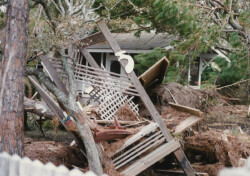
Damage in the Fort Walton Beach, Florida area caused by Hurricane Opal, which struck on Oct. 3, 1995. Image by Del Stone Jr.
On Aug. 5, 1995, and again on Oct. 3, 1995, something strange and wonderful happened in Fort Walton Beach. Hurricanes Erin and Opal had roared through the days before. The town was in a shambles – trees down, boats sunk,… READ MORE
Once, we lived and breathed in color. Now, thanks to the web, we live and breath in black and white
Image by Wikimedia Commons user Rock1997.
In “The Lost World” author Michael Crichton takes us on another hair-raising journey through The Land That Time Forgot Then Suddenly Remembered, a revisiting of “Jurassic Park.” Almost worth the price of admission by itself, however, is Crichton’s indictment of… READ MORE
Controlling urban sprawl should be everyone’s mission
My greenlining correspondent, Gayle Melich, sends a copy of a recent Washington Post editorial that provides more fodder for the notion of restricting urban sprawl.
The editorial points out that local and state officials in Maryland are feeling the sting of conflicting interests – “… it’s called sprawl, and it’s killing treasuries, urban areas, forests and farmlands at an alarming pace,” opposed to policies that control “living patterns.”
Reaction was predictably political. “… the governor told a gathering of municipal officials that his intention is not to dictate prescriptions for halting sprawl but to lay some political groundwork for debate, recommendations and action over the coming months.”
What a load.
But the editorial continues along a more heartening path. The governor of Maryland wants money for encouraging development in communities that already exist, which would save those municipalities huge development and upkeep costs for infrastructure.
The editorial ends with this directive: “… the answers should not lie in exhausting the remaining spaces as well as public funds with open invitations to clear and build at will.”
If folks inside the Beltway can understand this common-sense frugality, why can’t the paragons of conservative virtue who rule the roost in Northwest Florida do the same?
Movies, movies, movies! This unwavering summer heat has driven me indoors, where I’ve seen more movies in the past month than I usually see in a year. Here’s my report.
“Independence Day”: A shameless parade of clichés, but who cares? This movie is more fun than cinematic pedantry allows. See the White House get obliterated! Watch Los Angeles disappear in a well-earned lake of fire! There’s much much more! Terror (the laboratory scene is about as spooky as they come); humor (did you catch the homage to “2001: A Space Odyssey?”), and action – on a scale that will even leave Arnold What’s-His-Name out of breath. A “Star Wars” kind of classic.
“Eraser”: Speaking of Arnold What’s-His-Name, here he is with Vanessa Williams, and they’re on the run from … and the bad guys are trying to … and the government wants to … does it really matter? “Eraser” has got bullets and explosions and Arnold. What else does a growing baby need with this formula?
“Phenomenon”: This movie was a test. Could I or could I not stay awake to watch John Travolta mumble and shuffle, like Jimmy Stewart on muscle relaxers, through this stultifying tribute to celluloid boredom? I didn’t fall asleep, but I wish I had.
“The Cable Guy”: I don’t like Jim Carrey. He’s more annoying that funny. But in “The Cable Guy” he has his moments, which I attribute to the streaky genius of the script, not Carrey’s manic comedy. I don’t know what to make of this movie; it was hysterical in parts, dark in others, and largely entertaining.
“The Frighteners”: Creepy special effects and the occasional witty line are no substitute for story, and that’s the big problem with this movie. It gives you no sense of place, no sense of character, no sense of story. It is to movies what malls are to shopping: You see one, you’ve seen ’em all.
This column was originally published in the July 24, 1996 edition of the Northwest Florida Daily News and is used with permission.
About the author:
Del Stone Jr. is a professional fiction writer. He is known primarily for his work in the contemporary dark fiction field, but has also published science fiction and contemporary fantasy. Stone's stories, poetry and scripts have appeared in publications such as Amazing Stories, Eldritch Tales, and Bantam-Spectra's Full Spectrum. His short fiction has been published in The Year's Best Horror Stories XXII; Alfred Hitchcock's Mystery Magazine; the Pocket Books anthology More Phobias; the Barnes & Noble anthologies 100 Wicked Little Witch Stories, Horrors! 365 Scary Stories, and 100 Astounding Little Alien Stories; the HWA anthology Psychos; and other short fiction venues, like Blood Muse, Live Without a Net, Zombiesque and Sex Macabre. Stone's comic book debut was in the Clive Barker series of books, Hellraiser, published by Marvel/Epic and reprinted in The Best of Hellraiser anthology. He has also published stories in Penthouse Comix, and worked with artist Dave Dorman on many projects, including the illustrated novella “Roadkill,” a short story for the Andrew Vachss anthology Underground from Dark Horse, an ashcan titled "December" for Hero Illustrated, and several of Dorman's Wasted Lands novellas and comics, such as Rail from Image and “The Uninvited.” Stone's novel, Dead Heat, won the 1996 International Horror Guild's award for best first novel and was a runner-up for the Bram Stoker Award. Stone has also been a finalist for the IHG award for short fiction, the British Fantasy Award for best novella, and a semifinalist for the Nebula and Writers of the Future awards. His stories have appeared in anthologies that have won the Bram Stoker Award and the World Fantasy Award. Two of his works were optioned for film, the novella “Black Tide” and short story “Crisis Line.”
Stone recently retired after a 41-year career in journalism. He won numerous awards for his work, and in 1986 was named Florida's best columnist in his circulation division by the Florida Society of Newspaper Editors. In 2001 he received an honorable mention from the National Lesbian and Gay Journalists Association for his essay “When Freedom of Speech Ends” and in 2003 he was voted Best of the Best in the category of columnists by Emerald Coast Magazine. He participated in book signings and awareness campaigns, and was a guest on local television and radio programs.
As an addendum, Stone is single, kills tomatoes and morning glories with ruthless efficiency, once tied the stem of a cocktail cherry in a knot with his tongue, and carries a permanent scar on his chest after having been shot with a paintball gun. He’s in his 60s as of this writing but doesn't look a day over 94.
My greenlining correspondent, Gayle Melich, sends a copy of a recent Washington Post editorial that provides more fodder for the notion of restricting urban sprawl. The editorial points out that local and state officials in Maryland are feeling the sting… READ MORE
It’s those cats!
Image by Del Stone Jr.
Note: This was an essay I wrote that later became the basis of a short story, “Aunt Edna’s Cats,” which was published in the Barnes & Noble anthology “101 Crafty Cat Capers.” — As I stand in my kitchen, hands… READ MORE
My memories of the near-apocalypse of Hurricane Opal
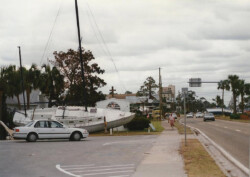
Photo by Del Stone Jr.
On Tuesday, Oct. 4, 1995, I was sitting in a staff meeting listening to the disaster plan should Hurricane Opal come our way. I remember that day for two reasons. O.J. Simpson had just been found innocent of murder and… READ MORE
Eye of newt, hair of bat, and ‘100 Wicked Little Witch Stories’
[ Main image courtesy of SplitShire at Pexels by way of a Creative Commons license ]
The genesis of my story, “I Feel My Body Grow,” in “100 Wicked Little Witch Stories” was simple: I wanted to sell a story to “100 Wicked Little Witch Stories.” During the ‘90s writer and editor Stefan Dziemianowicz edited a… READ MORE