Mladen and Del review ‘Unnatural’

Image courtesy of Twentieth Century Fox.
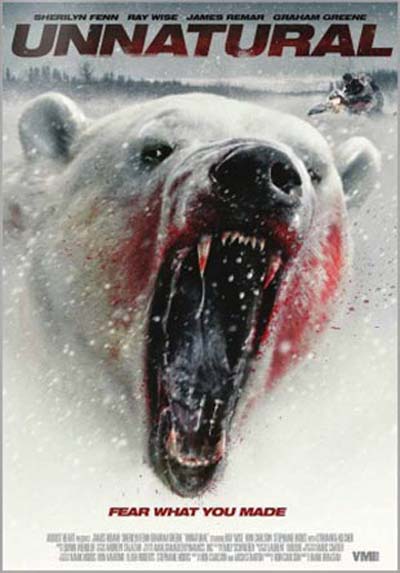
“Unnatural” Starring James Remar as Martin, Sherilyn Fenn (one of Mladen’s favorite B-movie actors) as Hanna, Ron Carlson as Brooking, Ivana Korab as Ella, Q’orianka Kilcher as Lily, Allegra Carpenter as Quincy, Gregory Cruz as Nate, Graham Greene as Buffalo, and others. Directed by Hank Braxtan. 1 hour, 29 minutes. Rated R. Streaming on Amazon Prime.
Plot summary: A mutant beast escapes from a secret corporate laboratory in Alaska to hunt humans. A stranded group comprising Alaskans and a handful white bourgie from the lower 48 fight to survive the rampaging Ursus maritimus and Canis lupus DNA‑mixed hyper predator.
Does this review contain spoilers: A few, yes.
Mladen’s take
The guttural groan you hear right now is not from the bio-fabricated monster in 2015’s “Unnatural.”
It’s my beloved Del hating the hell out of the film, which I picked to review.
“Unnatural” is stylish B schlock in that it has pretty good production value and not-altogether shitty acting. The schlock part is its in-your-face, never subtle exploitation of corporate greed, corporate immorality, and corporate PR strategies that mimic what Big Tobacco, Big Agriculture, Big Oil, Big Pharma, Big Tech, and little Trump and his looney band of misfits have done and continue doing – gaslighting dumb fucks vulnerable to gaslighting – to tell its story. Oh, the bad person wins in the end, her life saved by a good person. Love it.
My affection for “Unnatural” stems from its “American Werewolf in London” vibe. The creature featured in “Unnatural” is a real-world practical effect. It’s big. It’s white. It’s bulky sleek. And, it makes quick-hit appearances, barring a damn cool panoramic shot of the animal casually approaching an injured human across a patch of open snow after it emerges from the woods.
I confess. That scene alone provoked the anti-Del grade I give the film. It reminded me of the greatest moment in AWiL (aside from seeing Jenny Agutter nude). You remember it. The werewolf is loose. Its haunt includes the U.K. subway where a lone dude gets off the train, hears a growl, and starts running. He makes it about halfway up the stairs but stumbles. He looks down the stairwell and the camera flashes to a wide shot of the werewolf. The aberration of nature is casually approaching the stairs while its next victim stares in immobilized horror at the mangy mass of fur, teeth, and ’tude heading for his throat.
“Unnatural” doesn’t consider itself a farce as do so many low-budget films that rip off better movies. Yes, it’s melodramatic and in-your-face about everything from the culture clash between backwoods folks and urban sophisticates to the danger of manipulating genes to save (allegedly) wildlife from global warming. Sure, there’s some corny dialogue, particularly our hero’s dying hope that Mankind, here incarnate as Clobirch Corporation, leaves natural nature untouched. And, yes, the humans are always going out by themselves to search for someone or chase the beast. But, the way Martin dispatches the wolf bear, or is it bear wolf, is pretty neat. Also neat is the way some of the folk die as the mendacious animal hunts them for the shear joy of killing something.
I can’t recall the soundtrack. That means it’s unremarkable. The costumes are fine and the way the soon-to-be-victims interact with each other and the situation they’re facing is good enough.
“Unnatural” is fine as horror film entertainment. There are a couple of jump-from-your-seat moments, the women are attractive, and the animal nicely done considering it cost $20.05 to make. See the movie and post a comment below if you agree with me and disagree with Del. You’re allowed to call him names but be nice to me because my feelings get hurt easily.
Mladen’s grade: A-
Del’s take
Mladen must be out of his ever-lovin’ mind. I can’t believe he gave this crappy movie such a high score.
Within 2 minutes of watching “Unnatural” I knew the bitchy blonde supermodel would end up bear kibble and I was not wrong.
Movies like “Unnatural” have a standard formula, which goes something like this:
1. Obnoxious lowlanders venture into the countryside to shit on their noble savage rural folk cousins and disrespect their beliefs and traditions.
2. MEANWHILE, a secret lab / government facility / hidden pool / abandoned mine shaft gives forth a MONSTER with a ravenous taste for human flesh.
3. Lowlanders go about their lowlander business while ignoring and / or disrespecting the sage advice of the noble savage rural folk.
4. MONSTER starts picking off lowlanders with the occasional noble savage rural folk (just to add variety to its diet).
5. Siege sets in. Plot wrinkle introduced (father “wasn’t there” for kids, husband “wasn’t there” for wife, etc.) and mysteries of secret lab / government facility / hidden pool / abandoned mine shaft are revealed, sometimes pitting noble savage rural folk who knew against those who didn’t, but more often noble savage rural folk against lowlanders.
6. Slaughter ensues. Lots of jiggling breasts.
7. MONSTER is slain. Noble savage rural folk prevail. Everyone relaxes.
8. Hey, wait a minute! MONSTER ISN’T DEAD!
What sets apart “Unnatural” from other B movies is its unique awfulness. Take the acting … please. I wouldn’t call it “method.” More like “methadone.” These actors are about as animated as a box of chalk. It’s not totally their fault – the script barely rises above the level of random words on paper.
Characterization is equally dull-edged. The characters in “Unnatural” are themselves unnatural – caricatures of stereotypes, from the racist and judgmental fashion photographer to the taciturn native guide who speaks only to put forth bromides of local wisdom, which are promptly mocked by the lowlanders.
The story advocates for the natural world, but that preaching is limited to the very beginning and very end, and mostly abandoned in the middle three-quarters, which means its message is inconsistent and not well supported by the action. Instead, it’s put out there as an enabling excuse to give us an hour’s worth of growling and blood spray.
I’ll give the creators of “Unnatural” credit – they filmed the movie on location so we weren’t inflicted with “snow” that looked like spray starch. Nor were they shy about killing people. Don’t become attached to too many of these characters, if such a thing is possible. They won’t be around long.
Look, I’m all for movies that bash large corporations. I think corporate America is an amalgam of soul-less scumbags who are soaking ordinary Americans by way of price-gouging and profiteering. All they care about is money – morality be damned. And like all mindless machines that can do great harm, they must be regulated.
But “Unnatural” isn’t that kind of statement, despite Mladen’s halfhearted attempts to make it so to justify his lust for boobies and blood. It’s just a perfunctory exercise in virtue signaling so we can get on with the business of sexploitation and gore. I thought it was stupid and dull.
You want a good bear-out-of-control movie? Try the Clint Walker classic “Night of the Grizzly,” which will scare the hell out of you, or the 1979 flick “Prophecy,” which does a much better job of defending the natural world and bashing corporate America’s money machines.
“Unnatural” will insult your intelligence.
Del’s grade: D
Mladen Rudman is a former journalist and technical writer. Del Stone Jr. is a former journalist and writer.
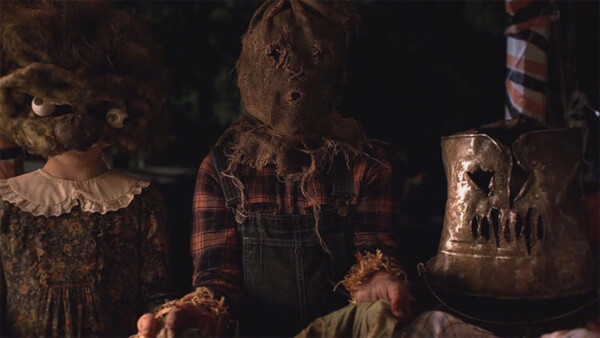
Image courtesy of IFC Midnight.
“Hellions” Starring Chloe Rose, Robert Patrick, Rossif Sutherland. Directed by Bruce McDonald. 80 minutes. Unrated.
Del’s take
My ever-present quest for those hidden gems of cinema, the obscure horror movie, recently carried me to “Hellions,” a new offering on Netflix. “Hellions” is hidden for a reason, although sadly I had to sit through it to find out why.
The movie begins promisingly enough. Seventeen-year-old Dora is planning a Halloween night liaison with boyfriend Jace at a Halloween party, but first she must drop by that pesky health clinic to see why she’s been summoned. Probably just want her to pick up a prescription or something.
Too bad it wasn’t BCPs because the doctor has news for Dora – she’s knocked up. That’ll sure take the fun out of a night of canoodling with your dope-smoking teen boy.
Dora decides to kick back at the house while her mom and little brother head out for a children’s Halloween party. But later, Jace calls and Dora changes her mind, partly because she wants Daddy Dearest to hear the news ASAP. As she waits for Jace to pick her up, the doorbell rings and a devilishly dressed moppet holds out a trick-or-treat bag.
That’s where the trouble begins, in terms of plot and the movie itself.
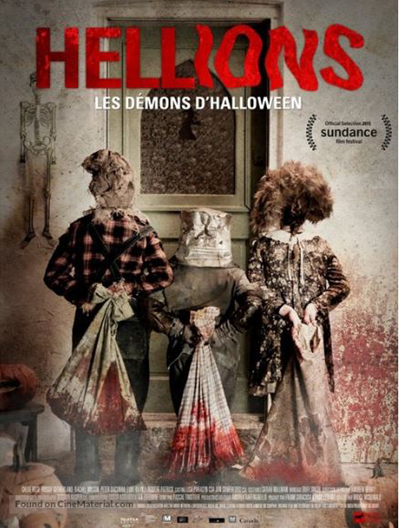
What follows is a near incomprehensible descent into … something. I’m not sure what to call it. A fever dream? Madness? An alternate universe?
Suffice it to say Dora and her unborn child, which is rapidly maturing within her belly into some kind of monster, become the targets of a cadre of demon children who want the baby whatever-it-is for something. I never quite figured that out.
I also never figured out the movie’s odd color palette – a kind of faux infrared – and it’s weird soundtrack. Oh, and I almost forgot the exploding pumpkins. Musn’t forget the exploding pumpkins.
“Hellions” is skillfully assembled in technical terms, and it shows flashes of originality and brilliance. But McDonald loses me, and what I predict will be most viewers, about 15 minutes into the movie when events become inexplicably strange, and not really very interesting.
I don’t want to discourage McDonald because I think if he reins in these excursions into visual excess, he should make some decent movies. But “Hellions” isn’t one of them.
I would give it a D+, and the plus is for the inventive costumes.
Del Stone Jr. is a former journalist and author.

Workers begin the process of tearing down the Docie Bass Recreation Center at Ferry Park. Image courtesy of Del Stone Jr.
The gym at Ferry Park is going away and I’m a little sad about that.
I don’t fault the city for tearing it down. The building was old and lacked air conditioning. It cost a fortune to operate.
Still, there’s something to be said for neighborhood touchstones like gyms, taverns, grocery stores and restaurants. I think it has something to do with Ray Oldenburg’s “The Great Good Place.” Those “third places,” as Oldenburg put it — the first two being the home and the workplace — allow for public interaction on a more intimate level, thereby preserving democracy and fostering community involvement. America wouldn’t be the same without third places and they’re vanishing before our eyes, swallowed up by a sea of packaged, templated, franchised uniformity.
Once we went to Docie Bass where I threw a basketball at the basket and hoped I didn’t cold-cock somebody in the bleachers. I could not bounce a ball and run at the same time. To this day I don’t know how they do it. But it was a comfort seeing Docie Bass across the canal from the tennis courts, hearing the rubbery thump of basketballs and echoey shouts of kids sinking baskets.
Docie Bass was the first place I worked for money that didn’t involve a rake or a lawn mower. A neighbor who was involved in the city’s rec program needed help with the scoreboard and asked if I wanted the job. He would pay me 85 cents per game.
Knowing nothing about the rules of basketball, I foolishly agreed to this proposition.
What followed was a very steep learning curve in which I not only became schooled to a referee’s knowledge level but in the intricacies of the scoreboard itself. The scoreboard was a tricky proposition. You had to be very quick on the clock kill switch, especially as time was running out. If you didn’t stop the clock within a nanosecond of the ref’s whistle, you had a mob of angry guys in your face accusing you of rigging the game for the other team.
I enjoyed the youth leagues better. There weren’t many 12-year-olds who could take me down —well, maybe a couple. There wasn’t a lot of scoring in those games, so my scoring finger didn’t see much duty.
Confession: Over time, my objectivity as scorekeeper began to crack as I developed favorites. That’s not to say I did anything to help those teams, but I definitely enjoyed watching them.
One such team was the Chiefs. They were the underdog almost every time they played, but they had one standout who sometimes put them in a position to win – Ray Sansom.
Ray was a good athlete and I’ll wager he excelled at other sports, too. What stood out for me was that no matter how lopsided the score and how improbable the Chiefs’ prospects of winning, Ray always tried. You could see his determination. That quality served him well. I expect it still does.
I worked that job only one season and missed it the following year. I didn’t know it would be 36 years before I would set foot in that gym again.
The occasion was a roller derby match involving the Beach Brawl Sk8r Dolls and a visiting team. That Saturday night, crowds of us jammed into a stuffy, sweaty Docie Bass to cheer the Sk8r Dolls and our workmate, Robbyn Brooks. Those ladies had more collisions and pileups than NASCAR, but it was great fun and I walked out with a Sk8r Dolls T-shirt designed especially for me — it read “Old Man” on the back and my number was 100.
The gym seems forlorn now. Its doors are locked and electrical power is disconnected, the lines hanging impotently from the side of the building. Items that had been stored at the gym are stacked in the back. A spray-painted sign on the side indicates a sewer connection.
As of this writing it has not been demolished, but perhaps by the time you read this, it will be gone. It’ll be replaced by a park dedicated to the memory of Bud and Dorie Day.
For now, if you hold your head a certain way, you can almost hear the thumping bounce of a basketball and the excited shouts of neighborhood kids having the time of their lives.
Docie Bass was a third place for me and a lot of other people.
This column was published in the Wednesday, September 2, 2015 edition of the Northwest Florida Daily News and is used with permission.
About the author:
Del Stone Jr. is a professional fiction writer. He is known primarily for his work in the contemporary dark fiction field, but has also published science fiction and contemporary fantasy. Stone’s stories, poetry and scripts have appeared in publications such as Amazing Stories, Eldritch Tales, and Bantam-Spectra’s Full Spectrum. His short fiction has been published in The Year’s Best Horror Stories XXII; Alfred Hitchcock’s Mystery Magazine; the Pocket Books anthology More Phobias; the Barnes & Noble anthologies 100 Wicked Little Witch Stories, Horrors! 365 Scary Stories, and 100 Astounding Little Alien Stories; the HWA anthology Psychos; and other short fiction venues, like Blood Muse, Live Without a Net, Zombiesque and Sex Macabre. Stone’s comic book debut was in the Clive Barker series of books, Hellraiser, published by Marvel/Epic and reprinted in The Best of Hellraiser anthology. He has also published stories in Penthouse Comix, and worked with artist Dave Dorman on many projects, including the illustrated novella “Roadkill,” a short story for the Andrew Vachss anthology Underground from Dark Horse, an ashcan titled “December” for Hero Illustrated, and several of Dorman’s Wasted Lands novellas and comics, such as Rail from Image and “The Uninvited.” Stone’s novel, Dead Heat, won the 1996 International Horror Guild’s award for best first novel and was a runner-up for the Bram Stoker Award. Stone has also been a finalist for the IHG award for short fiction, the British Fantasy Award for best novella, and a semifinalist for the Nebula and Writers of the Future awards. His stories have appeared in anthologies that have won the Bram Stoker Award and the World Fantasy Award. Two of his works were optioned for film, the novella “Black Tide” and short story “Crisis Line.”
Stone recently retired after a 41-year career in journalism. He won numerous awards for his work, and in 1986 was named Florida’s best columnist in his circulation division by the Florida Society of Newspaper Editors. In 2001 he received an honorable mention from the National Lesbian and Gay Journalists Association for his essay “When Freedom of Speech Ends” and in 2003 he was voted Best of the Best in the category of columnists by Emerald Coast Magazine. He participated in book signings and awareness campaigns, and was a guest on local television and radio programs.
As an addendum, Stone is single, kills tomatoes and morning glories with ruthless efficiency, once tied the stem of a cocktail cherry in a knot with his tongue, and carries a permanent scar on his chest after having been shot with a paintball gun. He’s in his 60s as of this writing but doesn’t look a day over 94.
Contact Del at [email protected]. He is also on Facebook, twitter, Pinterest, tumblr, TikTok, and Instagram. Visit his website at delstonejr.com .

Image courtesy of Marvista Entertainment.
“Most Likely to Die” Starring Chad Addison, Jake Busey, Tess Christiansen, Heather Morris, Perez Hilton. Directed by Anthony DiBlasi. 90 minutes. Unrated.
Del’s take
Hollywood has exhausted its trove of mask themes for slashers these days.
Leatherface, Michael Myers, Jason Voorheis, Ghostface – they all have distinctive face coverings to make them scarier than what they really are – close-to-middle-age white dudes with mommy issues. A close-to-middle-age white dude is scary only when he shows up as your Tindr date, so if you’re John Carpenter or Tobe Hooper, you put your killer in a mask.
Hoping to join that cadre of baddies is The Graduate of “Most Likely to Die,” a room-temperature horror flick that never receives its diploma. Our Graduate wears an overbaked pot roast of a mask, which bears no resemblance to the conflict or subtext. To complete his ensemble he’s wrapped in a graduation gown, with a cap so sharp and deadly that if it were a human being, it could trade barbs with Bill Maher.
Too bad the script and acting aren’t equally cutting edge. The only thing they’re cutting is the cheese because this is one stinker of a scary movie. Don’t waste your time.
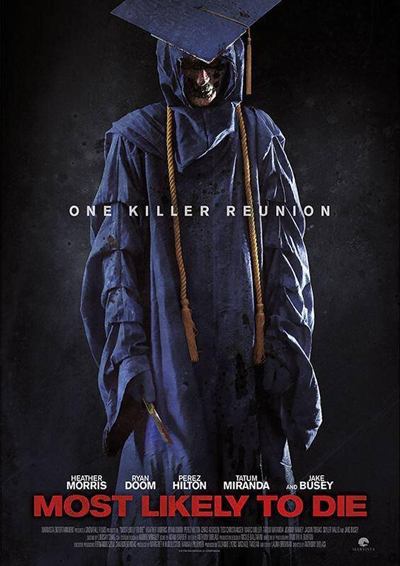
“Most Likely” features an ensemble cast starring Gaby (Heather Morris), a world poker wannabe who attends a reunion of her old high school clique at buddy Ray’s (Jason Tobias) remote hillside pad. She’s joined by eight others as they await their host, who’s mysteriously AWOL.
It takes no time for this Band of Mother******s to fall back into its high school pecking order, led by Brad (Ryan Doom), a recovering narcissist TV star who knocked up Gaby and dumped her when they were seniors (yet he still secretly pines for her, despite the presence of his supermodel shack job Bella – Tatum Miranda). But Gaby is having none of it. She’s already “lost big” to Brad once and she’s not going to do it again. We both know she’s lying through her fashionably bleached teeth.
Meanwhile, where the heck is Ray? It isn’t until the second act that somebody decides to go looking for him, and even that is a ploy to get a certain poker expert away from the others for some wooing and cooing.
They find a mysterious wooden shack where one of their members has been separated from her life by way of a slashed throat. Others turn up similarly murdered, and the story proceeds from there.
Clues are left along the way, but they aren’t developed. The manner of death might suggest a motive – that isn’t pursued. Nor is the possibility that one of them is the killer. It’s as if screenwriter didn’t know what to do with those complications and let them die on the vine.
The dialogue is as blah as unflavored yogurt and the pace as brisk as a jar of sun tea on the sidewalk. I’ve seen scarier episodes of HGTV’s “Fixer Upper.” Acting is similarly uninspired. The sole breath of life is Freddie (Perez Hilton), and even he is saddled with the stereotype of the over-the-top token gay boy who runs from the fight because he doesn’t want to break a nail.
I hated everyone and didn’t care who died. I wasn’t scared – not once – and stuck around only for the reveal, which was oddly anticlimactic and sprang from the ethers with little setup. My emotional investment lay in Gaby’s pricey convertible, which I hoped wouldn’t be scratched.
It’s a shame because “Most Likely” could have been a funny, sexy horror movie, like “Happy Death Day” or “Buffy.” Instead, it’s a paint-by-number middle school video project where every single part was phoned in.
I saw it Netflix, the online equivalent of the crappy Grade Z movie section in your old video rental store. But let me do you this favor:
Don’t bother. Grade D.
Stone is a former journalist and author.

In 1964 the beach along Okaloosa Island was mostly free of condos and other buildings. This photo was taken from the Okaloosa Island fishing pier. Image courtesy of Del Stone Sr.
When it comes to the history of Fort Walton Beach, I have an unfair advantage.
Not only have I lived here a long time, but my mother’s family, the Readys, moved to the area in the 1930s. On lazy Sunday afternoons, after I’ve finished killing whatever plant it is I’m trying to grow in Mom’s yard, I sit on her front porch and listen to stories about the area’s early days.
Needless to say, life was dramatically different back then.
Mom’s family lived in a house that had electricity and a wood-burning stove but little else. The kitchen was a separate structure and water came from a well.
On laundry day, the kids would build a fire in the yard and boil their clothes in a large kettle, rinsing them three times in separate kettles. The water in that last kettle had to be free of soapy residue before the clothes could be hung up to dry.



To make money, Mom and her sister, my Aunt Wendy, delivered the Pensacola newspaper on foot. They also crabbed along the shores of Choctawhatchee Bay and Santa Rosa Sound, then cleaned the crabs and sold them to the Gulfview Hotel. Grandmom made pies and cakes and sold them to the Gulfview.
Eglin Parkway was a dirt road. Deer and livestock wandered the streets of Fort Walton Beach. A cypress forest stretched from the Ferry Park area south to U.S. Highway 98 in the vicinity of Perry Avenue. It was a popular hangout for rattlesnakes.
Meanwhile, up near Cinco Bayou, alligators basked along the shoreline. Grandmom admonished the kids not to go down there where those alligators were hanging around. But it was OK to go under the house to fetch eggs from the chickens that built nests there. Sometimes a rattlesnake helped itself to those eggs, too.
The Cinco Bayou bridge was made of wood planks. Mom said that when relatives from Alabama visited, you could hear their cars crossing the bridge because the tires made a racket. The kids would then stand by the road, waiting for the relatives to pass by.
The bridge to the island was what they called a “swing bridge.” When a tall boat sailed down Santa Rosa Sound, a bridge tender would lower traffic barriers, then swing the bridge 90 degrees so the boat could pass through. Imagine how that would affect traffic today!
Bad weather tended to catch them by surprise. Mom remembers walking dirt roads and seeing fish fall from the sky. The fish were still alive. Today we know the fish were sucked up by a waterspout, but back then there was no explanation for such an event. In 1936 a hurricane struck the area. They had no warning and knew it was a hurricane only when it continuously grew worse. My Uncle Jimmy spent the storm in a cottage on Okaloosa Island. Mom, Aunt Wendy and Grandmom stayed at their house in Cinco Bayou. They even brought the cow inside to ride out the storm.
Mom was a waitress at the bus station before going to work at the Tringas Theater. During World War II, she said, they passed around a collection jar among the audience members to raise money for armaments.
She met my dad when he was stationed at Eglin. Dad was a pilot, and Mom said he would buzz their house, causing Granddad to stomp outside and shake his fist at the sky. Dad once took Mom on a joyride and performed acrobatics; Mom was not amused.
Eventually growth would come to the area, with improved roads and bridges. More people moved to Fort Walton and Mom moved away, following Dad and his career in the Army Air Corps, then the U.S. Air Force. When it came time for Dad to retire, the family moved back to Fort Walton, and here we’ve been ever since.
As a longtime resident, I am not in favor of dirt roads and alligators sharing my swimming area. But at the same time, I’m not in favor of traffic jams and blocked beaches. I realize change is inevitable, but I wish it could be change we’ll all benefit from.

About the author:
Del Stone Jr. is a professional fiction writer. He is known primarily for his work in the contemporary dark fiction field, but has also published science fiction and contemporary fantasy. Stone’s stories, poetry and scripts have appeared in publications such as Amazing Stories, Eldritch Tales, and Bantam-Spectra’s Full Spectrum. His short fiction has been published in The Year’s Best Horror Stories XXII; Alfred Hitchcock’s Mystery Magazine; the Pocket Books anthology More Phobias; the Barnes & Noble anthologies 100 Wicked Little Witch Stories, Horrors! 365 Scary Stories, and 100 Astounding Little Alien Stories; the HWA anthology Psychos; and other short fiction venues, like Blood Muse, Live Without a Net, Zombiesque and Sex Macabre. Stone’s comic book debut was in the Clive Barker series of books, Hellraiser, published by Marvel/Epic and reprinted in The Best of Hellraiser anthology. He has also published stories in Penthouse Comix, and worked with artist Dave Dorman on many projects, including the illustrated novella “Roadkill,” a short story for the Andrew Vachss anthology Underground from Dark Horse, an ashcan titled “December” for Hero Illustrated, and several of Dorman’s Wasted Lands novellas and comics, such as Rail from Image and “The Uninvited.” Stone’s novel, Dead Heat, won the 1996 International Horror Guild’s award for best first novel and was a runner-up for the Bram Stoker Award. Stone has also been a finalist for the IHG award for short fiction, the British Fantasy Award for best novella, and a semifinalist for the Nebula and Writers of the Future awards. His stories have appeared in anthologies that have won the Bram Stoker Award and the World Fantasy Award. Two of his works were optioned for film, the novella “Black Tide” and short story “Crisis Line.”
Stone recently retired after a 41-year career in journalism. He won numerous awards for his work, and in 1986 was named Florida’s best columnist in his circulation division by the Florida Society of Newspaper Editors. In 2001 he received an honorable mention from the National Lesbian and Gay Journalists Association for his essay “When Freedom of Speech Ends” and in 2003 he was voted Best of the Best in the category of columnists by Emerald Coast Magazine. He participated in book signings and awareness campaigns, and was a guest on local television and radio programs.
As an addendum, Stone is single, kills tomatoes and morning glories with ruthless efficiency, once tied the stem of a cocktail cherry in a knot with his tongue, and carries a permanent scar on his chest after having been shot with a paintball gun. He’s in his 60s as of this writing but doesn’t look a day over 94.
Contact Del at [email protected]. He is also on Facebook, twitter, Pinterest, tumblr, TikTok, and Instagram. Visit his website at delstonejr.com .
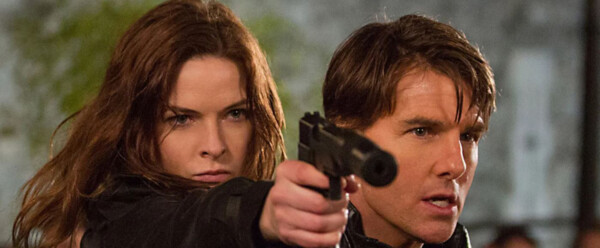
Image courtesy of Paramount.
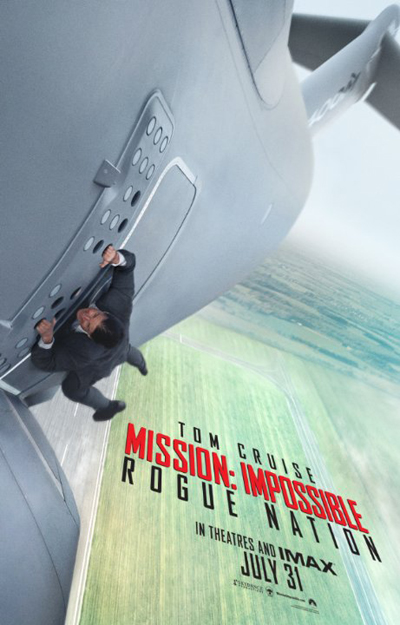
“Mission: Impossible – Rogue Nation” Starring Tom Cruise, Rebecca Ferguson, Jeremy Renner, Simon Pegg, Ving Rhames, Sean Harris and Alec Baldwin. Directed by Christopher McQuarrie. 131 minutes. Rated PG.
Mladen’s take
Del knows where my review of “Mission: Impossible – Rogue Nation” (MI V) is heading. I won’t disappoint him entirely, but he’ll have to be patient.
The movie summary first. MI V is a smooth spy thriller. Solid plot. Well acted. Top notch real stuntman stunts. In short, the discredited and disavowed IMF (Mission Impossible Force) dukes with the CIA and “Rogue Nation” – aka The Syndicate – of allegedly dead spies and hitmen to keep societies from sliding into revolts and wholesale slaughter.
The Syndicate, headed by misguided former British MI6er (I assume) Solomon Lane (Sean Harris) wants to create a New World Order by first destroying the Current World Order. The IMF, led by Ethan Hunt (Tom Cruise), takes on the task of keeping the Rogue Nation from succeeding, though no one or institution, including the CIA, believes it exists. In fact, the CIA, incarnate in the movie as its very stiff, somewhat unconvincing director Alan Hunley (Alec Baldwin), sends a “Special Projects Team” to hunt Hunt and the rest of the IMF.
Hunt’s outlawed IMF, if that’s the way to describe an agency of spooks that legally never existed, ends up a player in a globe-trotting good guys versus bad guys game deftly manipulated by the most intelligent, beautiful, and kick-your-ass woman spy – Ilsa Faust (Rebecca Ferguson) – ever put on the big screen or, for that matter, any size screen anywhere. Is she an angel or Lucifer? Who cares. It was good that the MI V script was clean and comprehensible because I could barely keep my focus on the movie’s turns and twists when Ferguson was on the screen.
There is a generous dose of humor in the film and stunts that only occasionally foray into the impossible. From what I noticed, MI V has one absurd piece of CGI action. It involves a Beamer launched backwards at high speed during a superbike chase through the streets and open roads of Casablanca, Morocco. Thank goodness for German engineering or Hunt and sidekick Benji Dunn (Simon Pegg) would’ve been deader than the pancake-flat squirrel down the road from my home.
Also annoying was the coincidence during the very same motorcycle chase that saw Hunt and Benji re-unite with fellow IMFers William Brandt (Jeremy Renner) and Luther Stickell (Ving Rhames).
Finally, and forgive me for repeating myself, MI V would’ve been a better movie had it been made for an R rating. Cussing and blood splatter are musts for films that involve lots of gunfire, treachery, ambitious Government officials pursuing nothing more than power, and mayhem that unfolds in cities full of passing bystanders.
MI V won’t win any Oscars. But, I’ll say this. It’s well worth seeing in the theater. The B+/A- movie, I can’t decide and I’m trying to stay level headed despite images of Ferguson floating through my mind, also continues Cruise’s streak of very good performances. See or re-see 2014’s “Edge of Tomorrow” to understand what I’m talking about.
Del’s take
I was hoping Mladen would take a cold shower before writing his review of “Rogue Nation.” Instead, I get to mop up his Pavlovian drool – in this case a babe, not a bell, infused his report with such salivary gusto.
I heard before going in that “Rogue Nation” was as good, if not better, than “Mad Max.”
Ahem.
Let me put it this way: If the femme fatales from both movies squared off in a death match, Mladen’s little Ilsa would be roadkill flatter and deader than that squirrel down the road from his house. Furiousa would blow Ilsa to bits with one of those badass canons she carries, then flatten her 18 times with her kickass war rig, and war boys would blast her pancaked remains into smithereens with explosive pig-stickers.
That’s not to say “Rogue Nation” isn’t a good movie. It is, and you should see it in a theater, and if you get the senior citizen discount good on you because once again they mistook me for a younger, more financially capable person, and I paid full matinee price.
“Rogue Nation” features some amazing stunts. We’ve all seen the clip where Tom Cruise clings to the side of an Airbus as it takes off. I found a motorcycle chase sequence to be a lot more hair-raising. And, of course, there were the required heights scenes where Cruise is jumping off something taller than Oprah Winfrey’s couch – c’mon, Tom, I think we get the fact you like dangling from high places. You should run for president.
Sean Harris was a deliciously evil bad guy. I haven’t enjoyed a movie villain that much since Hans Gruber. The MI team members were all capable and funny – would Simon Pegg be anything BUT funny? Tom Cruise continues as an affable movie star – and he IS a movie star. Mladen was right about “Edge of Tomorrow” – you gotta see it.
In the run-up to “Rogue Nation” we caught a preview for “Spectre,” the new James Bond movie. In the lobby was a poster for “The Man from U.N.C.L.E.” All these spy movies trace their origins to the 1960s, the us-vs.-them mentality of the Cold War, and the very real fear we would fall to the communists. James Bond, Napoleon Solo and Jim Phelps were all that stood between us and Red Square and the Little Red Book. They took their job seriously, and we took them seriously.
THAT is what’s missing from these movies.
We’re not afraid of world domination by a soul-less entity. (We do, after all, shop at Walmart.) We’re afraid our 401(k)s will be eaten up by the looming financial crash. We’re afraid the boss will hand us a pink slip. We’re afraid we’ll end up on the street.
Spy movies no longer have the ability to conjure urgency – at least not like they did in the 1960s. And that’s what I think is missing from “Rogue Nation” – a sense of urgency. Not for Ethan Hunt and his team of comical do-gooders, but for the world itself.
That’s why I’m going to give “Rogue Nation” a B. It’s an entertaining movie, but for me it lacked urgency.
Oh, and it lacked Furiosa.
Mladen Rudman is a former journalist and technical editor. Del Stone Jr. is a former journalist and author.
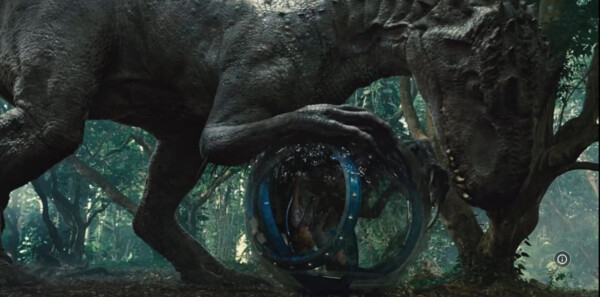
Image courtesy of Universal Pictures.
“Jurassic World” Starring Chris Pratt, Bryce Dallas Howard and Vincent D’Onofrio. Directed by Colin Trevorrow. 124 minutes. Rated PG-13.
Del’s take
Mix equal parts “Jurassic Park,” “The Lost World” and “Jurassic Park III.” Boil for two hours. Voila! You’ve just prepared an inoffensive addition to the Jurassic canon, one that breaks no new ground but commits no great sin.
“Jurassic World” is the vanilla custard of the series, meaning it is a simple dish that offers a taste everyone can love. It presents an everyman hero; a beautiful damsel in distress; children whose peril reunites their parents; and a big, scary dinosaur, all of it frocked in a thin cloak of subtext about the hubris of genetic engineering and corporate greed. In other words, just another day at the Democratic National Convention.
Chris Pratt’s Owen is an animal trainer who is brought to the new Jurassic World theme park by Claire (Bryce Dallas Howard), his former love interest who serves as a kind of Effie Trinket for the park. Seems their newest creation, Indominus rex, has broken out of its paddock and is eating the tourists. Very bad for publicity. The hope is Owen can figure out what Indominus will do next so they can recapture the beastie and return it to its cage.
But as everyone but the characters in all Jurassic movies have learned, things go awry as Claire’s nephews, Gray (Ty Simpkins) and Zach (Nick Robinson) became stranded in the weeds with Indominus in hot pursuit, and a slyly amoral Hoskins (Vincent D’Onofrio) maneuvers and manipulates to take over the park from its helicopter driving CEO, Simon Masrani (Irrfan Khan).
Pratt manages his role with minimal swagger, and Claire transitions from a sweet corporate mouthpiece to somebody who has discovered the benefits of work/life balance. D’Onofrio walks a thin line between evil and ambition. Of the kids, Simpkins evokes the most emotion, from his energetic embrace of the park to a heartbreaking acknowledgement that his parents may part company. Robinson is an unlikable, selfish teen who only comes around once the teeth snap a little too close.
I could nitpick this movie to death. Claire spends her time running through the jungle in a dress and heels, which my female friends assure me is about as likely as balanced budget. Some of the flying reptiles feature a T-rex head, a weird and unexplained departure from previous movies. And we have yet another set of siblings with parents either divorced or on the verge, and somehow their experience of being dinosaur kibble is supposed to mend the frayed bonds of their parents’ relationship.
Overall, the movie serves up nothing new. In fact, it seems frankensteined of scenes and themes from the previous films. But for some reason that did not bother me much. The Jurassic movies have never been anything more than an amusement park thrill ride, and this one certainly provided its share of stomach-looping chills.
Throughout the first and second acts we are told the park must offer a new “asset,” aka a new dinosaur, to stimulate the public’s interest and spike ticket sales. That could be said of the Jurassic franchise as well. And while “Jurassic World” is no Indominous rex of a movie, it has just enough of its DNA to take a huge chomp out of the box office.
I give it a solid B.
Mladen’s take
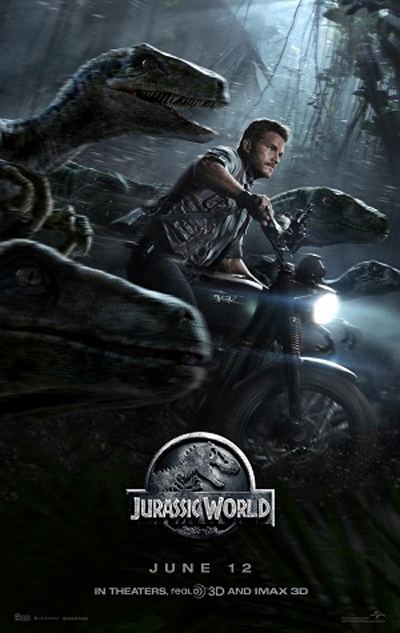
Websites dedicated to movies fail to list the most intriguing actors in newly released “Jurassic World.” They are: Charlie; Echo; Delta; and Blue, the velicoraptors. More on the hunter four-pack in a moment.
“Jurassic World” is good enough to be entertaining.
There’s a bit of suspense in the film, though, unfortunately, no jump-from-your-seat moments.
The human characters are likable, though not enthralling. Owen (Chris Pratt), the animal trainer, is charming, if not hypocritical. Claire, the corporate number cruncher and Jurassic World theme park manager, is beautiful as hell, but stiff. The two boys incorporated into the movie to draw one of the demographics that tends not to watch this sort of flick – teenaged girls – do an OK job. But, frankly, if any of the folks mentioned above had been eaten, I wouldn’t have cared.
There’s the obligatory animal rights morality tale. The dinosaurs, de-extincted through genetic engineering or not, are creatures worthy of respect and compassion, not merely assets owned by a big mean corporation that runs the amusement park that erupts into mayhem when a hyper-predator escapes to threaten 22,000 well-healed guests.
And, there’s the old adage, don’t fool with Mother Nature unless you want to get the horns, or something like that. Here are people manufacturing dinosaurs as though nothing had happened 20 years earlier (see “Jurassic Park”).
The visual effects are excellent approaching terrific. If only them CGI folks would have given the theropods and sauropods in the film color and patterns. No stripes, no spots, no feathers, no counter-shading. There was nothing to give the dinos a pinch of flair.
Still, the raptors. It’s all about the raptors from my perspective.
About the height of a man and smarter, the bipedal predators are imbued with a whole lot of character. Yes, they were trained by our hero, Owen, to respond to commands, but he could never quite be certain that Blue will follow orders. All the pack’s matriarch had to do was snort or bark and, bam, Charlie, Echo, and Delta would have Owen carved and ready to swallow in the blink of their reptilian eyes.
The scene in “Jurassic World” with the raptors being used as bloodhounds is absolutely stunning. Man, if these bad girls were half the hunters in real life as they’re depicted in this movie (and the three that preceded it), they were the Mesozoic era’s apex predator. Allosaurus, Tyrannosaurus rex, the toothy saurischian with the big sail on its back my ass. Velicoraptors are the bee’s knees of evolution. Damn that asteroid.
I could see why one of the characters, Hoskins (Vincent D’Onofrio), in the movie wanted to turn raptors into … never mind. Don’t want to spoil it for you. By the way, Hoskins can also be credited with one of the most obscure references ever placed in a movie. Quick, why is Tora Bora significant? Thought so. You have no idea.
“Jurassic World” should be seen at the theater. The film is a solid B, but don’t spring for the 3-D version. All the panoramic shots look silly. A blue helicopter flying low above a lush green jungle looks like a 1/48th scale UAV buzzing in front of a painted landscape. Thousands of people walking along the amusement parks main boulevard look like a bunch of figurines with operating legs. A 2-D viewing will be satisfying enough. Use the money you save, $3, to buy a 1.5-ounce drink at the concession stand.
Mladen Rudman is a former journalist and technical editor. Del Stone Jr. is a former journalist and author.

Image courtesy of Disney Studios.
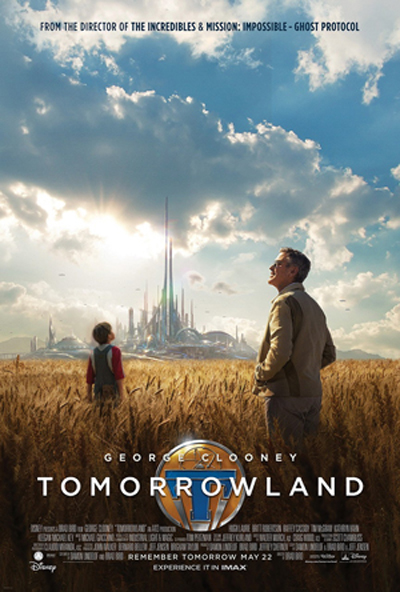
“Tomorrowland” Starring George Clooney, Britt Robertson, Raffey Cassidy, and Hugh Laurie. Directed by Brad Bird. 130 minutes. Rated PG.
Mladen’s take
I disliked the film “Tomorrowland,” but it’s my fault. I’m a bigot. There’s nothing anyone can say or do to make me like people. Del’s influence, in that regard, by the way, only feeds my bigotry.
That’s the task the actors and actress in “Tomorrowland” were given. They had to convince me – for I am Audience – that humanity was worth saving, that a society can choose its destiny, that we can reverse climate change, end food deprivation, and stop fighting wars. It was something about deciding which “wolf to feed,” the one of darkness and despair or the one of light and hope, according to this Disney sci-fi adventure.
In the film, Frank (George Clooney) and Casey (Britt Robertson), both humans, and Athena (Raffey Cassidy), a robot, struggle against the governor of Tomorrowland and his tachyon-fired machine, which sees the future. According to the orb with blue streams of light that attach it, I assume, to spacetime, Mankind will expire in roughly 59 days.
My response to the countdown was, “Hallelujah, about goddamned time humanity took it full-fist on the chin.” It’s vital that we kill ourselves before infesting space with our spore. Let us end ourselves before we end everything else.
But, no.
Do-gooder Casey, a STEM whiz kid of the first order, ends up cajoled by automaton Athena into trying to reverse mankind’s headlong plunge into the abyss. Along the way, Casey meets Frank, who was once like her – an optimist and believer in the wonderfulness of technology, which could turn savages (us) into hearts of gold and empathy. Frank, like Casey, also used to never give up. The vibrant youngster and disillusioned old timer, protected by Athena, go on a spectacular adventure that includes an epic scene involving the Eiffel Tower and battles with cyborgs wielding sound-pulse handguns and beam rifles. I must confess I was amused by the terminator that smiled at all the wrong times.
Does the trio save mankind? Eh, it doesn’t matter.
You should drop a dime to see “Tomorrowland” at the theater, not because the film is intelligible or uplifting or leaves you with a sense of wonder and hope. See the movie to support two fine young actresses – Robertson and Cassidy. There’s a risk that if the film bombs at the box office, it’ll slow their ascent in Hollywood. Moore and Bullock ain’t going to be around forever.
And, yes, Clooney does pull off something remarkable in the film. He’s his usual charming self even when playing the role of a curmudgeon exiled from a spit-and-polish utopia embedded somewhere out there in another dimension.
Del’s take
The world is going to hell in a handbasket – yes, we get that. But what are YOU doing to fix it?
That is the message, delivered with blunt force trauma, of “Tomorrowland.” The movie, a two-hour 12-step program for recovering Negative Nellies, correctly asks us to believe each and every one of us must take action to ensure a golden future. But the message is delivered with such clumsy ham-handedness I wonder if “Tomorrowland’s” target demographic isn’t that 12-year-old whose brain has been damaged by “Grand Theft Auto.”
In “Tomorrowland” a young woman (Britt Robertson’s Casey) who is trying to make the world a better place catches a glimpse of a bright and shiny future complete with jet packs, levitating trains, rockets to the stars and a multi-cultural, egalitarian society consisting of peace-loving PhDs who have figured out how mankind can live in harmony with nature. But the accidental snake in this garden of Eden (George Clooney’s Frank), conjures a machine that sees the past and the future. It’s vision of what follows becomes self-fulfilling, and the countdown to mankind’s extinction has begun.
The two young female actors deliver excellent performances, as does Hugh Laurie as Gov. Nix. George Clooney delivers George Clooney, and while that’s not objectionable it doesn’t do a lot to advance the storytelling planchette.
“Tomorrowland” is typical Disney fare – wholesome and uplifting. You’ll hear no cursing, and most of the violence is robot on robot. The only deviation from the Disney credo is our young heroine’s penchant for committing acts of vandalism, all in the name of good, of course.
“Tomorrowland’s” problems are its complexity, with stories within stories that must be worked out. At times it was hard to connect the dots and I simply went with what was on the screen, hoping realization would dawn.
The bigger problem was the movie’s lack of subtlety. At times the characters seemed to be saying, “This is what the movie is about.” All this was capped off by a Gov. Nix soliloquy toward the end where he does tell us what the movie’s about. That’s when I decided I was watching “Tomorrowland” the wrong way. As a children’s movie it works just fine.
My thinking is “Tomorrowland” may find a place in the digital libraries of illegally downloaded movies among the John Green crowd, but for adults it’s thin gruel.
I grade it a C+.
Mladen Rudman is a former journalist and technical editor. Del Stone Jr. is a former journalist and author.

Image courtesy of Enviornment American Research & Policy Center by way of a Creative Commons license
Confession: A couple of weeks ago I committed the high crime of sharing a photo to the job’s Facebook page of a young girl feeding a Goldfish cracker to a seagull. You would have thought I had nominated Charles Manson for the Nobel Prize.
The epic outpouring of rage and hate almost compelled me to delete my FB page and swear off social media. Only your feedback prevented me from doing so.
Today, the first batch of stories in a package about the fate of the monarch butterfly appeared on the job’s website. The monarch migration, if you didn’t know, is in danger of extinction. Monarchs could become few and far between in the Florida Panhandle if the situation doesn’t change.
Apart from a very few messages from friends (which I appreciate, by the way), you could have heard the crickets chirping.
I ask myself, “Why would so many people care about the possible arteriosclerosis of a single seagull when an entire species is in danger of extinction from our local area?”
I can only conclude that people no longer read and process information anymore. They merely react to Internet memes and photos and ideas presented to them by their keepers.
That’s a shame, because while that seagull is probably just fine, the monarch is not. And the monarch is deserving of an equivalent level of concern.
About the author:
Del Stone Jr. is a professional fiction writer. He is known primarily for his work in the contemporary dark fiction field, but has also published science fiction and contemporary fantasy. Stone’s stories, poetry and scripts have appeared in publications such as Amazing Stories, Eldritch Tales, and Bantam-Spectra’s Full Spectrum. His short fiction has been published in The Year’s Best Horror Stories XXII; Alfred Hitchcock’s Mystery Magazine; the Pocket Books anthology More Phobias; the Barnes & Noble anthologies 100 Wicked Little Witch Stories, Horrors! 365 Scary Stories, and 100 Astounding Little Alien Stories; the HWA anthology Psychos; and other short fiction venues, like Blood Muse, Live Without a Net, Zombiesque and Sex Macabre. Stone’s comic book debut was in the Clive Barker series of books, Hellraiser, published by Marvel/Epic and reprinted in The Best of Hellraiser anthology. He has also published stories in Penthouse Comix, and worked with artist Dave Dorman on many projects, including the illustrated novella “Roadkill,” a short story for the Andrew Vachss anthology Underground from Dark Horse, an ashcan titled “December” for Hero Illustrated, and several of Dorman’s Wasted Lands novellas and comics, such as Rail from Image and “The Uninvited.” Stone’s novel, Dead Heat, won the 1996 International Horror Guild’s award for best first novel and was a runner-up for the Bram Stoker Award. Stone has also been a finalist for the IHG award for short fiction, the British Fantasy Award for best novella, and a semifinalist for the Nebula and Writers of the Future awards. His stories have appeared in anthologies that have won the Bram Stoker Award and the World Fantasy Award. Two of his works were optioned for film, the novella “Black Tide” and short story “Crisis Line.”
Stone recently retired after a 41-year career in journalism. He won numerous awards for his work, and in 1986 was named Florida’s best columnist in his circulation division by the Florida Society of Newspaper Editors. In 2001 he received an honorable mention from the National Lesbian and Gay Journalists Association for his essay “When Freedom of Speech Ends” and in 2003 he was voted Best of the Best in the category of columnists by Emerald Coast Magazine. He participated in book signings and awareness campaigns, and was a guest on local television and radio programs.
As an addendum, Stone is single, kills tomatoes and morning glories with ruthless efficiency, once tied the stem of a cocktail cherry in a knot with his tongue, and carries a permanent scar on his chest after having been shot with a paintball gun. He’s in his 60s as of this writing but doesn’t look a day over 94.
Contact Del at [email protected]. He is also on Facebook, twitter, Pinterest, tumblr, TikTok, Ello and Instagram. Visit his website at delstonejr.com .
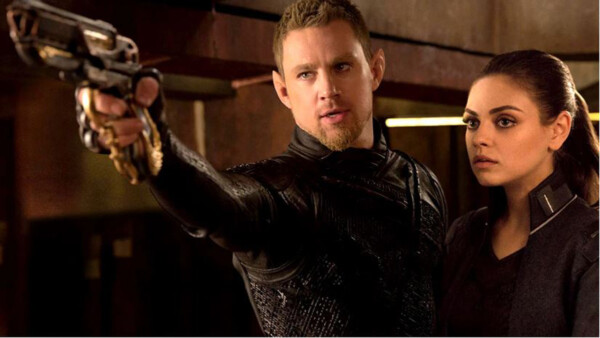
Image courtesy of Warner Brothers.
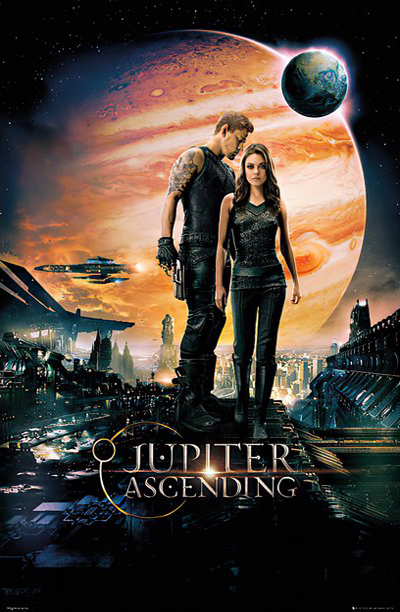
“Jupiter Ascending” Starring Mila Kunis, Channing Tatum, Sean Bean, Eddie Redmayne, Douglas Booth, and Tuppence Middleton. Directed by Andy and Lana Wachowski. 127 minutes. Rated PG-13.
Mladen’s take
Ignore the critics – except me and Del, if he agrees with me – on this one. “Jupiter Ascending” is a good movie. You just have to be patient.
Like another solid film, “Cloverfield,” with a crappy beginning, “JA” starts poorly, but makes up for its first 15 minutes with good acting and spectacular, if sometimes overwhelming, visual effects for the duration.
The plot: Housekeeper Jupiter Jones, portrayed by Mila Kunis, becomes a pawn in a power struggle between three well-heeled siblings. Rather than agreeing to share, each sibling maneuvers to gain legal ownership of Earth. Why is Earth important? Us. Mankind is valuable to the feuding House of Abrasax because we’re the essential ingredient of Fountain of Youth baths that the siblings, and others who can afford the gene-repairing topical, use to live forever. Each sibling wants Earth to himself, or herself, to harvest Homo sapiens for a profit. The problem? Jupiter, a “recurrence,” is technically Earth’s owner. She has to sign over the rights before anyone can start distilling people for their life forces. Add Caine Wise, played by Channing Tatum, as Jupiter’s guardian and, eventually, main squeeze, and you’ve the ingredients for a raucous, FTL-traveling, city-busting movie that hits the Bull’s Eye more often than it misses.
“JA” owns its watchability to Kunis. She’s wonderful. Along with a pretty face and lovely voice, her acting renders the movie’s silliness and science implausibilities perfectly acceptable.
When Wise explains to Jupiter how his airskates work, she retorts with a straight face that all she heard was “gravity” and “surf,” or something to that effect. With a throaty giggle, Jupiter wonders at the beauty of a swarm of bees becoming an extension of her arms so that they look like wings. Her ability to playful neutralize an event’s absurdness comes into play throughout the film and it works every time.
The film’s principal weakness, one shared today by all movies of the sci-fi kind, is its CGI battles. So much happens so fast and each component of the battle rendered in such fine detail that the contrast between elements of the fight disappears. Sound effects, however, are superb. Also helpful would have been a battle between capital ships, but that ain’t a big flaw.
I found it goofy that the Wachowskis decided to keep Wise’s shirt off as he fought mercenaries on Earth, traveled through space in a dimension-busting vessel’s cargo hold or something like that, and then fought a squad of palace guardians on another planet. He’s buff, but come on. In the name of gender equality, the script writers could have devised a reason to put Jupiter in a bikini for 20 or 30 minutes.
Finally, I wasn’t entirely enamored with the film’s fusion of sci-fi with mythology-like creatures. It was sort of Thor-ish and Lord of the Ring-esque. The movie also had bits of “Brazil,” lots of machines shape-shifting Transformer-like and a couple of other movies that slip my mind.
“Jupiter Ascending” is frenetic and worth seeing. It’s been unfairly, and spitefully, panned like one of the Wachowski’s other good films, “Speed Racer.” “JA” is an epic for the big screen, but I plan to add it to my Blu-Ray library. I imagine I’ll find something fresh every time I watch it, which is typical of Wachowski productions. The grade? B for Better than Bargained for.
Del’s take
They hate Channing Tatum’s eyeliner.
The plot, they say, is too complex.
One of them called the movie a “hot mess.”
Another suggested the Wachowskis should be banned from moviemaking.
Bottom line? As usual, they don’t know what they’re talking about.
The folks who write reviews on Airbooks as they sip Merlot from soap bubble-thin crystal fairy goblets are having a hard time embracing “Jupiter Ascending,” the raucous actionfest engineered by the Wachowskis. That suits me fine. Sometimes you just want to be entertained, not edified. That’s the kind of movie the Wachowskis have given us.
Mladen summed up the plot nicely. You do have to wade through some explanation before things kick into gear, but so what? Are we no longer capable of embracing complexity? I do every time I sign into my phone.
“Jupiter Ascending” is gorgeous to look at. Virtually every frame is a visual extravaganza that will leave you swooning amid its depth and color. In terms of its visual composition I’d compare it to “Casshern,” another beautiful movie.
And it continues the Wachowskis’ assault on the oppressive, soul-smothering system they believe enslaves us all, a theme they explored in the “Matrix” movies, “V for Vendetta” and “Cloud Atlas” (which, by the way, was another criminally underrated Wachowski project). Jupiter is an individual trapped between forces much larger and stronger than her own puny self. She fights back with pluck and virtue, and in the Wachowskis’ universe there can be only one outcome.
Mark your calendars, folks, because on this date Mladen and I agree: “Jupiter Ascending” is well worth seeing in the theater, then owning once the DVD is released. Everyone in our group enthusiastically embraced the movie, the fairy cup sippers notwithstanding.
I too give it a solid B, maybe a B+, for sheer entertainment value.
Mladen Rudman is a former journalist and technical editor. Del Stone Jr. is a former journalist and author.