Animal ( a short horror story )
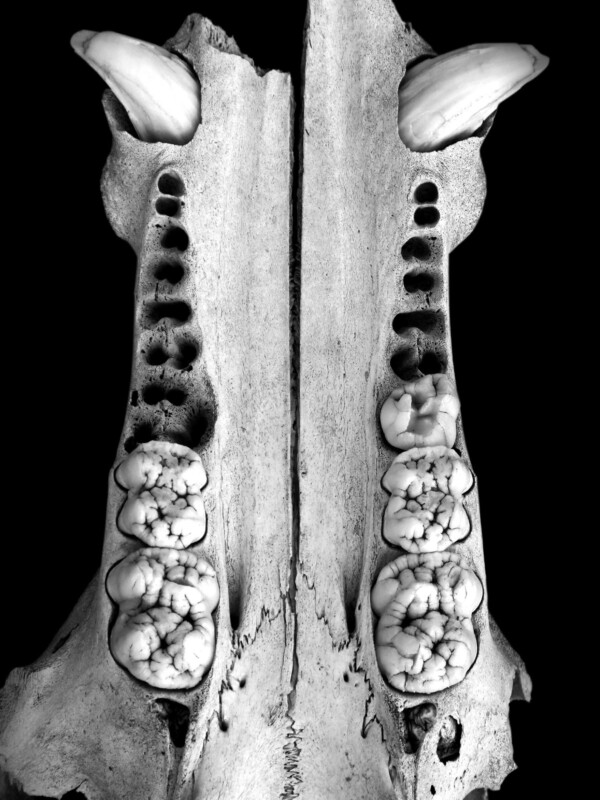
Photo courtesy of ph.
INTRODUCTION
I say this story was written in 1988 but don’t quote me on that.
It was written in the 1980s, of that I’m sure. It has the tone of my ’80s fiction – bleak sketches set in a rural back road or bar. I worked the night shift at the local newspaper and afterwards, we night-shifters would venture out in search of an inexpensive watering hole or, if not a bar, a convenience store with ice cold beer, and off we’d go, into the hinterlands, because it was there a beer-drinker was less likely to be pulled over by the boys with the blue-and-red lights atop their cars.
Out there in that rural dark – the real dark folks don’t see these days because cities are too damned illuminated – I found a mysterious tint to the world, what Yeats might have called that glowing afterimage of the realm which lies beside this one, visible only to young children who have not had their senses dulled by maturity and experience. Except this glow was of the darker variety, and I wonder if Yeats could have appreciated that, too, given his musings about the nature of the new messiah.
To me, there were mysteries to be discovered in the implacable dark of the countryside, mysteries to be glimpsed and felt, not articulated but sensed in the way you know to stay out of that abandoned house in the woods, the one that looks something terrible might have happened there decades ago, resulting in it being scorned by humanity. Your ability to sense hidden dangers depended on your willingness to believe.
Which is what this short story is about.
When I was a kid there was mystery in the world, things we did not understand and places we had not seen. But we wondered about them. There might be jungles and dinosaurs on the Venus, or spindly, water-starved creatures on the surface of Mars. Who knew what lay in that jungle heart of darkness, or the deepest ocean trench? Were flying saucers winging overhead, always when we’d left the damn camera sitting on the table by the front door?
But as time went by and we learned more, the world began to shrink and the mystery fade, replaced with cold facts (or hot facts in the case of Venus, a roasting hell hole of carbon dioxide). Poor Mars became an icy desert with air so thin there might as well not be any. Flying saucers became swamp gas and ocean trenches are filled with nothing but silt and a scattering of weird, glow-in-the-dark shrimp.
Think “Excaliber,” and the world of magic giving way to the world of men.
I liked the world better when I didn’t know so much about it, just as I liked my friends better when their thoughts weren’t paraded across a glaring panoply of social media. Didn’t we get along better before we found out so-and-so voted for that evil bastard Trump?
The lack of knowing every stinking detail about every stinking thing – and the curious imaginings that filled in those gaps – made life so much more magically delicious, to borrow a breakfast cereal jingle. And that’s what this story is about, in a darkly roundabout way.
Maybe there’s still a bit of mystery – and magic – left in the world.
Lord, I hope so.
—
ANIMAL
Earl’s Tavern and Package Store. It was the last place Billy Stafford wanted to be.
He took in the bar with a sullen stare. Most nights he’d have been happy to stop off at Earl’s, knock back a couple of long-necked Buds and crook quarters from the high school kids who weren’t supposed to be there shooting pool. He worked the graveyard shift at John Sandusky’s BP station, and it was SOP to wheel in the big racks of recaps and the cartons of motor oil, lock up the pumps and the front door, then shag ass for Earl’s.
But not tonight.
Not when he had the carb rebuild staring him in the face at eight the next morning. Christ, he hated carbs – especially the ones greasy thick with buildup in just the right places to bugger up the works. And you don’t rebuild scummy carburetors when it pains you to bend over and your skull is throbbing and the taste of stale cigarettes and too many beers keeps coming back up on you until the really sweaty part of the afternoon.
Which was the shape he’d be in tomorrow if he stayed here much longer. Listening to Bob Decker.
He’d all but finished hosing off the concrete around the pumps and was thinking he might make a clean getaway when the office phone rang. He hadn’t wanted to answer it, but he knew sometimes Sandusky called a little before midnight to make sure whoever was on the clock didn’t close up early – “We ain’t no all-nighter, but by God we’ll keep ’er open to midnight,” Sandusky was always preaching.
Only it had been Bob. Drunk. His day off, and he’d been sniffing the cork so to speak, and now he wanted company because he had lots on his mind, and couldn’t Billy drop by Earl’s for a couple of brews? C’mon, Billy Boy. Be a sport.
“Sorry, buddy,” Billy had told him. “I’m broke and I gotta carb to do first thing.”
“One – one beer. That’s all. And I’m buyin’.”
There was no point arguing. Bob was drunk. “OK man. Half an hour.”
That had been an hour ago.
One beer had become two, then three, and Bob had gone on and on, cheerfully flipping dollar bills to the empty-headed brunette behind the bar. Earl’s was dark tonight, a humid kind of dark – like somebody’s basement. It was sparsely populated. Three men were sitting at the other end of the bar, giving the brunette a hard time in a friendly way. They didn’t look familiar to Billy. He’d given them a thorough looking over in his search for some excuse to get up and leave.
“‘Course,” Bob was pawing at his shoulder, his hand as insistently nagging as his voice, “I s’pose you don’t think much about that, do you?”
“About what?”
“About whatever’s out in that lake.”
“What lake?”
Bob sighed. “That lake over in England. Scotland. Goddamned Lock Nesh. Got ’em a monster over there. I even saw a picture of it.”
Billy fingered the rim of his Budweiser bottle. The men across the way were laughing loudly and whispering things to the barmaid Billy couldn’t hear. She tittered. The men gobbled laughter again.
“Betcha don’t think much about that.”
Billy started to say he didn’t but remembered that come tomorrow, a monster of a headache would be pounding against the walls of his skull if he didn’t lay off the brew and get some shut-eye. But Bob didn’t wait for an answer.
“I do. I think about that stuff.”
The barmaid shrieked, a sound like a nail file sawing through a Coke bottle, and said breathlessly, “An animal? What kind of animal?” Bill caught a fragment of the man’s reply – ”out in my Jeep” – and then Bob shoved an elbow into his ribs and slumped heavily to the bar, his eyes rotating in the sockets as if he were too sickly drunk to turn his head to face Bill.
“It’s the same – with flying saucers. An’ Big Shot …” He frowned. “Big Foot. And those damned yetis and giant squid that crawl up outta the ocean and grab boats. They pick sailors off the boats like flies on shit … and swallow ‘em up, one by one.”
Billy turned away. He’d never seen Bob like this. Drunk, sure. But not incoherent. All this babbling about sea monsters and flying saucers. Bob had always been sort of a square peg back in high school. He got along OK with most people. But he’d been a thinker who made straight A’s on his report card, and that put distance between him and everybody else. Later on, when they’d needed an accountant at the only place in town that passed for industry, the Texas Instruments plant out by the old railroad spur, Bob Decker was the man they hired.
But this was not Bob Decker.
Snatches of words drifted to their side of the bar. The barmaid was saying, “Oh, go get it. I want to see it.” The men were sniggering. One of them warned her, “It might bite!” and the barmaid uttered a tiny, squeeze-toy cry of terror. The man in the middle stood and shouted, “All right then. But I warned you fair and square.” The other two chortled. He strode across the carpet for the door. He got it open, turned and winked, then stepped outside. The door clicked shut behind him.
Bob pawed Billy’s arm and whispered, “I guess you think I’m nuts, huh?”
Billy said, “No. I think you’re drunk.”
Bob shook his head and almost knocked over his beer. He steadied the bottle. “It ain’t the beer talkin’, Billy. It’s what I’ve been thinking.”
The door swung open abruptly and the man came through. He had a burlap bag in one hand. His other hand was hidden inside the bag. He bugged out his eyes at the barmaid; his friends snickered.
Bob said, “When I was a kid my mom gave me this coloring book, you see, and it had this puzzle where you had to find the elephants in the picture – hidden in the picture – ”
The man sat down heavily at the bar, an inscrutable smile pulling at the corners of his mouth. The barmaid stepped back, uttering a cartoon chipmunk giggle.
“I spotted ’em right away, but Dad couldn’t. Couldn’t find a damn one of ’em. No sir.”
The fellow sitting on the far right leaned and peeked inside the bag. His face wrinkled into a grimace. He pushed a tentative finger inside then snatched it out, his grimace deepening into a thing of pain, and he hissed, “Goddamn sonovabitch bit me!” The barmaid stepped back. Again, the nervous laugh.
“Here’s my dad, see, and he’s got a mortgage payment and two car payments – no, no, that old Dodge was paid for outright – but he had groceries and utilities and insurance and clothes and everything it takes to keep a family going, and just when I’d begun to think he was the smartest sumbitch in the whole world for being able to do all that, I find out he can’t see an elephant hidden in an 8-year-old’s coloring book.”
Billy cleared his throat. This was ridiculous. He couldn’t fathom what long-winded point Bob was leading up to. He only wanted to be back at the boarding house, in his bed.
The man squeezed the bag hard against the hemisphere of his beer gut. Something seemed to wriggle inside. Billy wondered what the hell he had in there – if, in fact, he had anything. Billy doubted it was a wild animal. The man’s grin was too conniving, too shit-eating, and his friends were yukking it up as if they’d seen him pull this trick many, many times before.
“It’s a part of growing up, I s’pose,” Bob said absently. His stare was cemented on nothing in particular. “A kid is able to believe all kinds of things. You see what I’m getting at?”
No, Billy thought.
“A kid doesn’t have to see something for himself to believe it. Like Santa. The Easter bunny. And that goes the same for monsters in the closet.” He looked Billy straight in the eye. “You ever think there was a monster in your closet, Billy Boy?”
Billy shook his head. No monsters in the closet. But there was the crawlspace … the door with the latch he wouldn’t go near. …
Bob took a long pull on his beer. He used his sleeve to wipe his mouth. “Of course you did. Every kid does. You never saw a monster in the closet, but when your mom turned out the lights and closed the door and suddenly the only thing you could hear in the whole world was the sound of your heart trying to jump out of your chest, you damn well didn’t need to see nothing to know there was a damn monster in the closet.
“That’s what they call faith.”
Bob’s voice had taken on the urgent, roller-coaster cadence of a TV evangelist. He wasn’t slurring his words so much anymore. He seemed seized with purpose.
“The kids, Billy Boy. They don’t have any problem believing in things you can’t see, but by God they know they’re there. Good and bad things.”
Across the bar, the men had become strangely silent. The barmaid was approaching them … carefully. The bag was on the bar top. The man kept his hand inside it.
“But when you get older, you stop believing in those things. A part of you seems to pass away, and it’s like switching from stereo to mono. Suddenly, there’s no mystery left. Plenty of good and bad to be found, but all the mystery is gone and everything seems flat and ordinary.”
The barmaid was standing opposite the men. She said, “You won’t let it bite me, willya?”
“That’s when you gotta tote that barge and lift that pail, Billy boy. You gotta get yourself a job so you can pay the rent and put steaks on the table and keep the kids in Nike hightops, and once a year you and the old lady and the kids load up the stationwagon and shag it for Epcot Center. What a life.”
Billy stared across the bar with a vengeance. He didn’t want to look at Bob. The sound of his voice alone was enough to set a person’s teeth on edge, not to mention the topic of conversation.
“Sure. OK.” Bob mumbled. “So I like to think there might be little green men out there, or apes hiding in the Oregon backwoods. Seems kinda childish, doesn’t it? But it isn’t. Flying saucers, sea monsters. Those are my elephants in the puzzle and monsters in the closet. They make the world seem special, that there are still things I don’t understand and have to take on faith.”
The man jerked his hand out of the bag. The waitress went as rigid as a slab of ice, a sawed-off cry of terror twitching out of her throat.
“You have to believe in some things, Billy boy, because when you stop it’s nothing but watching TV and getting drunk, and you end up wondering where all the money went and what happened to all those years you thought you had … you stop living.”
It was a puppet. A damned puppet, one of those Muppets, Billy thought. Bert or Ernie. The one with bushy eyebrows.
The other men were cawing loudly. The one with the puppet made snarling noises as he opened its mouth and made to bite the barmaid, who was tittering in the throaty way people who’d almost pissed their drawers from a bad scare titter.
Bob tapped two fingers on Billy’s wrist. Billy swiveled in his seat. Bob was hunched over the bar, but looked more alert than at any other time that night. He pointed to the barmaid, his face desperately serious. “Like her, Billy. You gotta believe.”
Billy nodded. It was a gesture he’d learned a long time ago. It didn’t convey agreement. It meant, Yes, I know my friend is plastered and it’s way past bedtime and I’ve got that frigging carb to rebuild first thing in the morning, and why the hell don’t I just stand up and walk, for Christ’s sake? He looked at his watch. Both hands were on the two.
So he stood. He flipped a one – it was all he had – onto the bar top. “I’ll tell you what I do believe,” he said. “I believe you could use a ride home.”
Bob scowled and waved him away. “I’m gonna close ‘er down tonight, Billy boy. Don’t need to get up tomorrow. Got some comp-time owed me. If I’m too skunked to drive, I’ll sleep it off in the car.”
Muffled snorts carried across the room, and then Billy distinctly heard the big man bray, “Got me another animal out in the Jeep. A flesh-and-blood, real animal.”
“Oooh, I want to see it,” the barmaid purred. She had the puppet in her arms and was stroking its head, as if it were somebody’s cat.
“I dunno. This sucker is pretty awful. Part grizzly bear and part octopus – ”
The others sniggered like coughing lawnmower engines.
“ – part God-only-knows-what. Had to give it both barrels of No. 4 shot to make it stay dead, and I’m gonna sell it to the government for a million dollars.”
The barmaid hopped once, twice. “I want to see it.”
“I dunno. …”
Billy slapped Bob’s back and said, “Stay off the roads, pal.” He made his way across the room quickly, before Bob had a chance to remember any more words of wisdom. He had his hand on the doorknob when he heard Bob call to him. A little shudder of dread shook him. The others, he saw, had paused to stare. Bob was leaning waaay back in his chair.
“Remember what I said, OK?”
Billy offered him a mock salute, then stepped outside.
The cool air washed over him, blowing away the odor of cigarettes and spilled beer. He felt his thoughts begin to congeal. Time to go home. Get some sleep. Lock the front door, or there’d be hell to pay the next morning. Drink a few glasses of water and taken an aspirin before turning in.
Get some sleep. …
A big CJ-7 was parked by the front door. He had to practically climb over the thing’s bumper to get around it. He guessed it belonged to the big guy.
You gotta believe.
Billy blew air out of his cheeks with an explosive snort and shook his head. Old Bob, the square peg. Martians and sea monsters, for God’s sake. Billy knew what life was about. He knew damn well what it was about because he’d been doing it the past 23 years. Life was working your butt off so you could play – unless you had carburetors to rebuild the next morning. Life was pulling down $5.65 an hour – better than what a lot of people were doing. It was paying your own way and drinking with the boys and maybe shooting the shit with that little number at the Circle K, maybe doing more than that if you played your cards right.
That’s what life was about. Not kiddie nightmares about monsters in the closet, for God’s sake. The only monsters Billy ever saw were monsters of the two-legged variety, and that, too, was what life was all about, because when you grew up you had to put all those childhood fantasies behind you – the good and the bad. There was no such thing as monsters … just as there was no such thing as fairy tales.
No such thing as monsters. No such things as dreams come true.
He edged between the CJ and an old LTD next to it. His Nova was parked across the lot so some asshole wouldn’t ding the door. He was halfway across the lot when the sound hit him. It was not so much a sound as a dull, shuddering throb that he felt rather than heard. It started at the base of his skull and worked its way down the bumps of his spine, scraping the bones together. It was a foghorn moan of agony and, he couldn’t help but believe, anger.
It was coming from the CJ.
He stopped dead on the asphalt. He was unable to work his legs, and the breath lodged in his throat like dried cement. He thought he saw something move inside the Jeep, against the uncertain neon light of the Earl’s sign above the front door. He squinted. The Jeep seemed to jiggle on its springs. And then a heavy cable of dark uncurled along the plastic sheeting of the rear window panel, and the entire window was thrown into eclipse as something big gathered itself inside the Jeep, something bigger than a man and very much alive … maybe something that had taken both barrels of No. 4 shot and hadn’t stayed dead after all and now was half out of its mind with pain. …
A single claw divided the Jeep’s canvas top, cutting it as neatly as a letter opener. Something began to probe at the opening, to nuzzle its way out. Something strangely serpentine.
– part grizzly bear and part octopus –
Something with suckers the size of teacups.
– you gotta believe –
A storm of whickering tentacles exploded inside the Jeep, claw tips slicing into the canvas and plastic and twanging loudly against bare metal, like a nest of live wires.
Billy turned away. His brain seemed to float in his skull, as if it had been disconnected from his body. He felt like a spectator to some grim horror-movie scene.
He walked to his car, quietly. Once inside, he closed the door and locked it. His first thought was to start the engine and idle out of the parking lot like he’d done a hundred times before. No such thing as monsters.
His second thought landed on the pistol in the glove box.
Sandusky had given it to him, those many moons ago when he’d started working at the station, filling gas tanks and checking oil and taking cash from people as part of Sandusky’s weird insistence in returning the word “service” to the phrase “service station.” Sandusky had given him the snub-nosed .38 Smith and Wesson, which he’d kept in his glove box since moving up to mechanic, because there were people who were too greedy or lazy or desperate to earn their way in the world through the salt of their own sweat, and if Sandusky – or anybody who worked for him – could put in an honest 10 hours a day for an honest buck, no two-bit hood with a hogleg was going to take that away from him – not without a fight, anyway.
No such thing as monsters.
Billy started the Nova. He backed it into a half U, shifted into drive and idled toward the Jeep. He stopped. The Jeep looked like any other Jeep that might have been parked at Earl’s, its owner inside sucking down long-necked Budweisers and crooking games of pool from teenagers who really weren’t supposed to be in there.
Monsters.
Everything looked familiar and ordinary … and tomorrow morning he had that carb to rebuild and he needed to remember the water and aspirin, and he needed to remember to lock the front door or there’d be hell to pay. …
He opened the glove box. He pulled the Smith and Wesson from the leather holster. He checked the cylinder. Fully loaded … six 110-grain high-power hollow tips. Monster killers. It was against the law to carry a concealed firearm … funny how he’d never worried too much about that.
He climbed out of the Nova. Whatever was in the Jeep had quieted down, but he could still see it there, a dark shape against the light, like the suggestion of something horrible lurking in the closet after the lights had been turned out.
No such thing as monsters, Bob, old buddy. Just the two-legged variety.
He drew a bead on the shape and fired. Everything happened very quickly: The muzzle flash was lightning to the gunshot’s clap of thunder, and the thing inside the Jeep uttered a bone-grinding wail of agony and began to thrash insanely and Billy emptied the cylinder into the thing with five more ruthless pulls on the trigger. …
The door to Earl’s banged open and people were barging out, the big guy and his pals, the barmaid, and finally Bob.
“It wasn’t dead,” Billy said quietly, his ears ringing, his thoughts dreamily disconnected from the words. “It wasn’t dead yet.”
The big guy stared into the Jeep and ran a hand over his head. He looked pissed. “Goddamn thing,” he muttered. “Trashed my rig pretty good. It wasn’t even a grown one.”
Then Billy heard the distant warble of a police siren, and saw that Bob was smiling like a kid on Christmas morning, and heard him say something about coming back inside for another beer, that nothing else was important right now. They had a lot more to talk about.
Billy thought a moment. And then he sighed and headed for the door.
About the author:
Del Stone Jr. is a professional fiction writer. He is known primarily for his work in the contemporary dark fiction field, but has also published science fiction and contemporary fantasy. Stone’s stories, poetry and scripts have appeared in publications such as Amazing Stories, Eldritch Tales, and Bantam-Spectra’s Full Spectrum. His short fiction has been published in The Year’s Best Horror Stories XXII; Alfred Hitchcock’s Mystery Magazine; the Pocket Books anthology More Phobias; the Barnes & Noble anthologies 100 Wicked Little Witch Stories, Horrors! 365 Scary Stories, and 100 Astounding Little Alien Stories; the HWA anthology Psychos; and other short fiction venues, like Blood Muse, Live Without a Net, Zombiesque and Sex Macabre. Stone’s comic book debut was in the Clive Barker series of books, Hellraiser, published by Marvel/Epic and reprinted in The Best of Hellraiser anthology. He has also published stories in Penthouse Comix, and worked with artist Dave Dorman on many projects, including the illustrated novella “Roadkill,” a short story for the Andrew Vachss anthology Underground from Dark Horse, an ashcan titled “December” for Hero Illustrated, and several of Dorman’s Wasted Lands novellas and comics, such as Rail from Image and “The Uninvited.” Stone’s novel, Dead Heat, won the 1996 International Horror Guild’s award for best first novel and was a runner-up for the Bram Stoker Award. Stone has also been a finalist for the IHG award for short fiction, the British Fantasy Award for best novella, and a semifinalist for the Nebula and Writers of the Future awards. His stories have appeared in anthologies that have won the Bram Stoker Award and the World Fantasy Award. Two of his works were optioned for film, the novella “Black Tide” and short story “Crisis Line.”
Stone recently retired after a 41-year career in journalism. He won numerous awards for his work, and in 1986 was named Florida’s best columnist in his circulation division by the Florida Society of Newspaper Editors. In 2001 he received an honorable mention from the National Lesbian and Gay Journalists Association for his essay “When Freedom of Speech Ends” and in 2003 he was voted Best of the Best in the category of columnists by Emerald Coast Magazine. He participated in book signings and awareness campaigns, and was a guest on local television and radio programs.
As an addendum, Stone is single, kills tomatoes and morning glories with ruthless efficiency, once tied the stem of a cocktail cherry in a knot with his tongue, and carries a permanent scar on his chest after having been shot with a paintball gun. He’s in his 60s as of this writing but doesn’t look a day over 94.
Contact Del at [email protected]. He is also on Facebook, twitter, Pinterest, tumblr, TikTok, and Instagram. Visit his website at delstonejr.com .
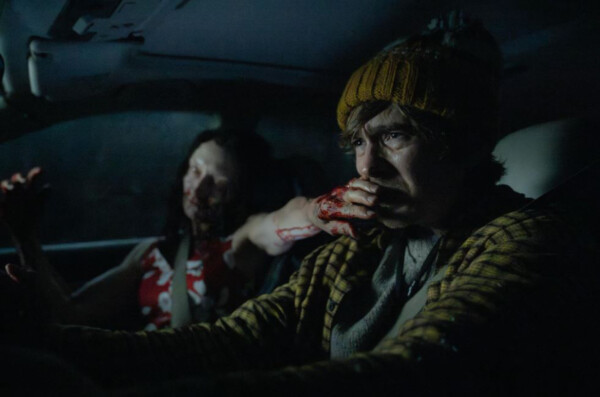
Sony
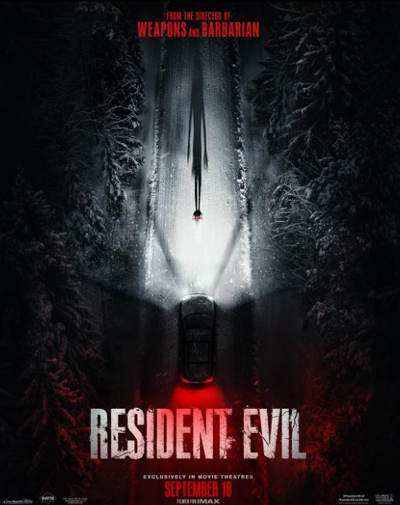
“Resident Evil” Starring Austin Abrams as Bryan, Zach Cherry as Carl, Kali Reis as Maxine, and others. Directed by Zach Cregger. Written by Zach Cregger and Shay Hatten. Score by Zach Cregger, Hays Holladay and Ryan Holladay. 1 hour, 35 minutes. Rated R. Theatrical release.
Plot summary: A medical courier assigned to deliver a mysterious package to winter‑bound Raccoon City General Hospital finds himself trapped in a zombie apocalypse.
Spoilers: Oh, what the hell. Why not?
Del’s take
This is not Milla Jojovich’s “Resident Evil.”
This is Zach Cregger’s “Resident Evil,” and with it, Cregger, who also directed the well‑regarded “Weapons” and “Barbarian,” makes a clean break from its predecessor’s franchise, offering a lean, wry action horror story deserving of a franchise of its own.
Cregger is a one-man band – he not only directs “Resident Evil” but co-wrote the screenplay and even had a hand in crafting the Ennio Morricone‑like score. The result is a movie that feels very different from the Jojovich films. This story is much more personal and accessible. You suffer right along with Bryan (Austin Abrams) as he shambles from one plot complication to the next.
The story takes place in a single night. Bryan is assigned to deliver a high-priority medical package to Raccoon City General Hospital, which is socked in by a winter storm. As he is driving up an icy mountain road, Bryan collides with a woman who stumbles into his path. He helps the injured woman into his car and is driving her to help when he’s stopped by a law enforcement officer who agrees to carry the woman in his cruiser as he “escorts” Bryan to the hospital. Minutes later the cruiser crashes. When Bryan goes to help, he discovers the lawman is dead and the woman is nowhere to be found – until she reappears, hungry for human flesh. From that point events careen downhill in an ever‑escalating story arc of tension and violence.
There’s much to like here. As in the Jojovich films, “Resident Evil” is based on the video game of the same name. I haven’t played the game but I understand it’s broken down into levels of difficulty – complete the tasks on one level and players get to advance to the next. Cregger’s “Resident Evil” is structured the same way. As Bryan successfully avoids death in one situation he flees to the next, which presents him with even more complicated threats to his existence. What that does is create an ever-escalating cycle of tension.
That tension is leavened by a wry, often funny script that presents Bryan as a relatable everyman who’s been thrown into a horrible situation and just wants to complete his assignment, i.e. “mission,” so he can go home and continue an argument with his girlfriend over whether she should continue or abort her pregnancy. As each plot complication draws him farther away from the idea that he’ll ever make it back home, Bryan becomes more desperate, and his actions more reckless, until nothing remains except his overwhelming desire to deliver the package to Raccoon City General.
The cinematography is often striking, with long, beautiful shots of a snowcapped landscapes at night, completely isolated and reminiscent of “The Shining” and “Let the Right One In.” And the sparse, menacing score seems inspired by Morricone’s soundtrack for another snowbound epic, “The Thing.”
What really makes the film work is Austin Abrams, whose honest and visceral portrayal of Bryan makes him instantly likeable, and better, worthy of our sympathy. Bryan isn’t a superman who can take a bullet to the arm and still save the day. He’s a regular guy, like you and me, who finds a way to survive despite increasingly desperate odds. You’ll want him to live because he deserves to live.
My only gripe with “Resident Evil” is that it loses some of its visual and emotional authenticity in the third act and lapses into more familiar, Hollywood-style monster movie territory. CGI-saturated scenes and too-good-to-be-true outcomes diminish the story’s believability. And, of course, there’s the ending that serves only to advertise an inevitable sequel. That was a disappointment for me.
Still, “Resident Evil” is a terrific 95 minutes of entertainment, created by an up‑and‑coming directorial talent. It’s gory and violent, but it’s also fun.
I’m giving it a B+. Just like last week’s “Hope,” it’s not a perfect movie, but it has a lot going for it. If you’re a fan of video games and horror movies, “Resident Evil” is made for you.
Mladen’s take
Another horror movie, Del?
Ain’t there enough horror in the real world to satisfy your appetite for the macabre (e.g., MAGA, social media, influencers, AI, genome manipulation, inheritance, dog lovers); the disgusting (e.g., MAGA, social media, influencers, AI, genome manipulation, inheritance, dog lovers); and the absurd (e.g., MAGA, social media, influencers, AI, genome manipulation, inheritance, dog lovers)?
No? Well, then, maybe your goal was to distract me from all of the above by suggesting we review “Resident Evil.” That was awfully nice of you because it worked.
Compared to the degeneracy of mankind, the tumbling mass of aggregated, partially consumed and regurgitated, bloodied, disfigured, raggedy, and mindless corpses chasing our regular‑guy hero in “Resident Evil” is a relief.
It also helped that Bryan said “fuck,” oh, 200 times in the movie to demonstrate all sorts of emotions. There’s the “fuck” of disbelief. There’s the “fuck” of exasperation. There’s the “fuck” of resignation and there’s the “fuck” of hope, just to name a few of the ways “fuck” can be used tactically. In fact, as I’ve always admonished my children, “fuck” must not be used as a common word. “Fuck” has a purpose and that function is a one‑word route, coupled with facial expressions, that tells the story of the human condition. Fuck, mankind is doomed because we have no self‑control, show no restraint, and line‑up behind buffoons ready to greet the new day with another shrug of the shoulders as Earth adjusts to get rid off us altogether. In the last sentence, as a demonstration, I used “fuck” to convey disbelief.
Del complimented the atmospherics in “Resident Evil.” I wholeheartedly agree. It is a pretty film at times, even if the pine forest or open field covered in snow is CGI. Del also complimented the movie’s score. I agree there, too. It was “The Thing”‑like. And to be “The Thing”‑like in any way is good. That film was made some 46 years ago. It remains in the Top 3 of the best horror sci-fi recorded on cellulose. It’s terrific from top to bottom with one of the best Top 3 endings of any movie … ever.
If “Resident Evil” has a weakness, it’s that Milla Jojovich is not in it. Among all the – what are they called, Easter eggs? – in the film, a bit of homage to Alice Abernathy would’ve been nice.
Still, holy moly, what an effort. Grotesque and gross. Funny and dire. Plausible and unrealistic (see No. 5 in my list above of the macabre, disgusting, and absurd to understand why). I couldn’t get enough of zombies jumping from tall buildings to bomb Bryan. Sure, it has been done before, “The Matrix Resurrections” (2021) comes to mind, but who cares? The zombie barrage is a hoot. Their softened bodies splatter but have enough mass to make the parked cars they hit rock on their suspensions. Jolly great scene.
There’s no question that the movie is derived from a video game franchise. Though technically “Resident Evil” is a third‑person shooter game, there a several scenes in the film that reminded me of a couple of “Doom” movies and the video games. Here and there, the audience gets a viewpoint from the perspective of a GoPro attached to the receiver of a double‑barrel shot gun. Loved it. Very first‑person shooter, it is.
Del is right. “Resident Evil” is a B+. However, unless you have a stout home theater set‑up driving a bunch of speakers – no, shitty little soundbars will not suffice – see this film in a theater. The soundscape, both its score and sound effects, are terrific. They are as critical to “Resident Evil” as Bryan’s unfortunate exposure to gene engineering.
Mladen Rudman is a former journalist and technical writer. Del Stone Jr. is a former journalist and writer.

Introduction to “Lighting the Corpses”
I don’t remember what went into the creation of this story.
I was in the throes of love withdrawal.
I was angry and wanted to hit back at the world.
I was beginning to find my feet as a writer.
I wanted to sell a story to the Horror Writers Association anthology “Robert Bloch’s Pyschos.” So “Lighting the Corpses” came to pass.
(By the way, I hate that title. I went with it because I couldn’t think of something better.)
This story is a tad overwritten but reading it all these years later, I’m surprised at how good it is. I mean, it’s really good. It works on multiple levels and I’m happy with it.
That’s all. A brief introduction.
Except this – I hope you’re happy with it too.
—
LIGHTING THE CORPSES
Searching, searching, Zeke roared across the night, pausing only to burn a man and watch him die.
So easy, now, in the focus of his rage. So viciously fun. But he couldn’t linger too long. He had others to burn. And one, a very special man Zeke called “Father Baptist,” a man who could not wait Zeke’s tenuous grasp on this world, would burn cell by cell, molecule by molecule, down to the ash of his soul.
Once Zeke found him.
Like this man, who was dying slowly and horribly as Zeke watched him, on the sidewalk outside Zeke’s old apartment. Zeke had come here hoping to find Father Baptist gloating over his crime, but the apartment had been empty. Instead, he’d seen this man. A 53-year-old CPA, divorced a year-and-a-half, who was slowly losing touch with his life for the want of companionship. The man was loitering on the sidewalk, two doors down from his own unit, hoping the woman in 3F would open her door and step outside. If she did, he’d talk to her a moment, just a moment, and not ask her for a date – he wanted to do this thing gradually – and build on the innocence of another encounter tomorrow. He wanted to believe he was an attractive and witty and intelligent man, and he wanted to believe she would recognize those qualities in him, and he wanted to believe she would be the solution to his loneliness.
Zeke could see it. He could see it all, as if it had been printed in careful block letters on a third-grader’s blue-ruled writing pad. He could see into the man’s heart.
And this is how Zeke burned the man:
You are a fat, over-the-hill, dumb bastard, and you’re gonna be alone until you finally get sick of it and ram the business end of a 9mm up your trap and pull the trigger.
Zeke chuckled as the man suddenly frowned, unsure of himself, and turned, shuffling unsteadily to his apartment, one hand lightly brushing the wall and dragging a little, as if he were about to faint and wanted to catch himself. The man saw himself differently now. Gone was the hope he might have a chance at this woman, or any other woman. His hair seemed to bleach gray as Zeke watched; his stomach sagged over his belt and his spine softened and he aged to death in an instant, the flesh sliding from his bones in slippery, wet clumps of despair.
The man went back into his apartment. Six months from now, on a night that would have no end, the man would load three hollow-tipped bullets into the clip of a Reuger. …
Zeke smiled. So easy, now, in the focus of his rage.
So easy, now that Zeke was dead.
—
Fire.
Fire was the great reducer, making everything simple, a brief rage of combustion and then a satisfied ash that could be reduced further to a mere black mark, a scar of carbon that said nothing more than something was burned by somebody.
Zeke likes fire.
He likes his fires.
A pile of leaves raked into the gutter. A candle made from melted crayons. His sister’s Barbie Beauty Salon, spirited out of the house and into a weedy lot down the street as she and Mom sit in the pediatrician’s waiting room to have a fake pearl tweezered out of her ear, stupid brat.
Zeke likes his fires. They say to him: Something was burned by Zeke. A nightmare, scorched from memory.
If Father knew, if Father knew, if Father knew … oh God, if Father knew.
And Zeke likes that, too.
—
Zeke roared across the night, stopping at a convenience store he’d stopped at weeks ago, hoping Father Baptist would be there, reliving his own torment or renewing his hatred. The store was closed and vacant and dark. A large patch of floor tiles by the counter had been scraped up. Zeke remembered why.
Zeke had always wanted to put the match to somebody. Sidle next to them, unnoticed, as they picked through undercooked scrambled eggs and grease-soaked fingers of sausage at a Shoney’s breakfast bar, for instance, and scrape the business end of a kitchen match against the zipper of his Levis and touch the flame to the trailing edge of their shirt sleeve and watch the whole works go up in a cough of combustion, their sudden intake of breath and their screams tickling that part of his brain no other act of pleasure ever touched. …
Zeke chuckled and did not hear himself. He never heard sounds now – the crack of a jalousie window as he worked the pane from its frame, the breaking-bone sound of a door jamb being chiseled away from a deadbolt. He could no longer taste the bitter highball of perfume and sweat; he could not feel a woman’s fingernails digging trails of fire across his cheek, the vibrating spasms of her throat shaking loose with a scream as he ripped her panties from her thighs. …
But he could see, the living people around him and the fears about themselves that secretly ate out the center of their lives. The deadness in them. They were corpses of hope and self-delusion and fantasy. Touch a flame to those things and you burned off the good parts about themselves people so desperately needed to believe and you uncovered the real person hiding inside, a tight little cinder of terror.
But there would be no second burning at the convenience store. Nobody was home, not even a security guard to keep away the curious from the scene of Zeke’s final crime.
Certainly not Father Baptist.
—
It is time to burn something again.
Mom and his sister are gone somewhere. They’re gone a lot after Father gets home from work. Funny, how they’re gone so much after Father gets home from work.
Now Zeke is going somewhere too. The weedy lot. To burn something. He has one of Father’s empty Falstaff beer cans, filled with charcoal starter, and a book of matches. Maybe he will burn the lot, or write his name in flames.
Maybe he will make an effigy of Father in twigs and leaves and burn that.
But he will burn something.
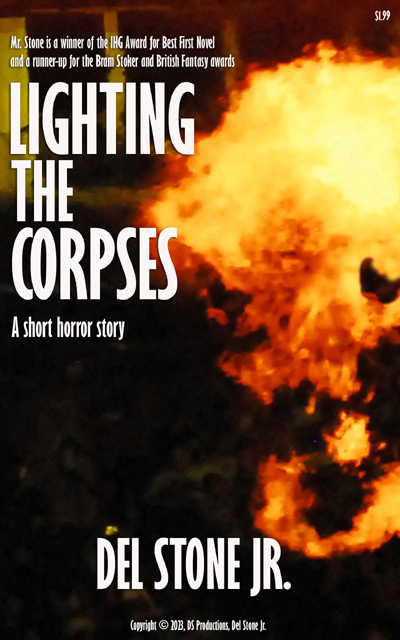
He is walking away from the house, the beer can hidden in front of his thigh, when he hears the front door bang open and a deep voice boom across the yard, “Where are you going?”
Instantly, his heart becomes a slab of meat in his chest.
“Just down the street,” he squeaks out.
“Come here,” his father commands.
He pivots to the left and sets down the beer can behind the bole of a pine tree.
“And bring that with you,” Father says.
The slab of meat in his chest rots in a way he can feel throughout his body. He trudges back to the house, feeling as though he his walking to his execution.
—
Zeke roared. He dipped briefly at the hospital to see if Father Baptist had burned himself. While there he paused to show a 9-year-old girl that she would not beat the cancer spreading through her rickety bones, and for good measure he showed the girl’s mother that yes, it was true, she really was to blame for what had happened to her daughter. The girl became a skeleton before Zeke’s eyes. The mother grew fangs and began to eat herself, ripping chunks of flesh from her arms, her calfs, and swallowed them in bloody lumps.
Zeke crossed the interstate and torched a truck driver with the realization that he’d failed as a medical student and there was never, ever any chance he’d pass his GRE for that master’s in counseling. The trucker became a cloud of fly-blown ash.
He torched a waitress who had dreams of becoming a model. He torched a would-be jet jockey. And the pale little man who looked like a boy and rocked himself to sleep with idiotic visions of becoming a golf pro – Zeke lit him up with a bolt of self-doubt and the man-boy popped like a 100-watt bulb.
They were all dead. Burned out and dead.
Except Father Baptist.
—
Father sniffs the can. His nose wrinkles.
“There’s something in there,” Zeke offers meekly, “but I wasn’t going to drink it.”
“Empty your pockets,” Father whispers. Zeke’s stomach drops a couple of notches, because the matches are in his pocket, and Father is not stupid.
And because he knows his father will search his pockets anyway, no matter what Zeke does to satisfy him or please him, Father will search his pockets because he is speaking in the doctor whisper he uses to search Zeke for cancer the way every good father searches his son, or the policeman whisper he uses to search Zeke for concealed drugs, or the coach whisper when he must check to make sure Zeke is still a boy and didn’t change into a girl overnight, so Father will search his pockets and then search beneath his T-shirt and then into his Fruit of the Looms and then. …
The whisper is strangely hoarse, coming from deep within the voice box, and it is all rattly and trembly as if Father were afraid of something.
“What’s this?” Father says, producing the matches as if he had just performed a magic trick. “Let’s see now … lighter fluid and matches. Were you planning to have a barbecue?”
Zeke stares at the floor, not saying anything.
So Father says, “Let’s see what else you’re hiding.”
—
Dead.
It was a stupid thing, really. After being so careful for so many months, Zeke had screwed up. Once. Just once.
The cops had given him a name: “The Backroads Killer,” because he worked the rural roads, the isolated house trailers, the yuppie castles in the woods with satellite dishes aimed through gaps in the trees and BMWs parked beneath enclosed patios. “The Backroads Killer.” A joke to Zeke. Cops always named criminals they couldn’t catch, as if a name implied mystical abilities. The cops hadn’t caught Zeke.
But Father Baptist had.
Zeke had been careful. Pantyhose over his head, the car parked off in the distance, that sort of thing. But he’d screwed up with the girl at the convenience store at that intersection between two state roads, the intersection giving a reason, he guessed, for the convenience store and a boarded-up John Deere distributorship. That and a traffic light that blinked yellow for one direction and red for the other, and you had what passed for a “town.”
Zeke could have continued on to the farmhouses and shanties he knew were hidden in the woods downroad, or he could have turned left or right. But he’d stopped, there where the roads intersected like the crosshairs in the scope of some celestial hunting rifle.
The girl behind the counter was pretty and nervous and he liked them that way, and he liked her, and he liked dragging her by the hair of the head to the storage room at the back of the building, her screaming and crying and the way she knocked over the stacked six-packs of Evian only inflaming his lust. She begged him not to hurt her and she told him her father was a minister at the Klamath Briggs Baptist Church and how could he do this to a minister’s daughter, but it was afterwards, as he was wiping off his dick on her shredded blouse, that she turned mean and said she’d have the law on him and there were a hundred men in the community, her father included, who would track him down and cut off his balls, and that she hoped the video camera had gotten a good picture of him.
Video camera.
God, that had pissed him off. A video camera, a fucking video camera. How could he have been so stupid?
He stalked out into the store and found the camera, hidden above the coolers so that it filmed anybody who came through the door. Jesus Christ! he swore. Stupid! He ripped the camera from its mount and smashed it against the floor, and at that moment the girl made a dash for the front door. A spike of anger shot through him, from his stomach into his throat, and he hurled himself at her, knocking her into the counter. He grabbed her by the side of the head and slammed her skull against the floor and bellowed at her to tell him where the recorder was, but all she did was whimper, the spittle bubbling between her lips like beer foam, so he pounded her head against the floor, again and again, then one more time.
Finally, he stopped. She was out. Her body was limp. Her hair had created Rorscach dragons and thalidomide bats in an orangish-red smear of blood on the dingy floor tiles.
He yanked a set of keys from her belt and went behind the counter, where the safe was hidden. The recorder was inside another locked box. When he popped the cassette, the breath rushed out of him in a relieved gush. For a moment, he considered simply taking the cassette with him, but as he went around the counter, past the magazine racks, he paused by the neat rows of Zippo lighter fluid cans. The idea alone suffused him with a kind of energy that transcended sexual pleasure.
He torched her. He left the cassette on her chest and doused her with three cans of lighter fluid and then set her off like a Fourth of July barbecue.
And as he shifted his car from reverse into drive and headed off down the yellow light-blinking road, his heart pulling in a multitude of directions, a white Ford turned into the parking lot.
A white Ford.
He’d forgotten about the white Ford as the days, then weeks went by after he’d burned up the clerk and then watched as his handiwork played on the six o’clock news and the local newspapers. He felt the secret swell of potency crest as the cops and state Department of Law Enforcement agents fumbled about, clueless as usual, and all the delicious details of those murderous minutes began to fall out of memory.
Zeke would have to do it all again.
But he never had the chance.
A knock on the door. A nervous peek through the Venetian blinds. A white Ford parked in the guest space in front of his apartment, too battered and rusted for a government car, or a cop’s. Zeke opened the door. A man in a red-and-blue flannel shirt, blue jeans, hiking boots – nothing special about him. Except his eyes. His eyes were so old, so filled with some emotion that had gone beyond hate that Zeke actually felt a tittering thrill of terror squiggle up his spine.
Then Zeke saw that the man was holding a gun.
The man said, “You do understand,” and pulled the trigger.
Zeke felt something – the bullet, a force, something so elemental that it couldn’t be resisted, slam him into the wall, and then the joints in his knees came unpinned and he slumped to the floor, waves of pain crashing over him and threatening to send him under.
The man loomed above him. He looked as big as God, but he looked meaner, crazier than any brimstone-preaching backwoods Baptist’s version of God. He’d put away the gun. Now he had a gallon can of gasoline. He was unscrewing the lid.
“I’ve been looking for you,” he said, his voice barely above a whisper. “All these weeks. I saw your car. After you, you – ” and his voice split into a sob, “killed my – my – daughter – ”
He splashed gasoline, and Zeke’s terror rose convulsively above the pain and he tried to crawl away, a hitching groan gurgling out of his throat. The man spilled a trail of gasoline to the door, tossed the can aside and fumbled a Bic butane lighter out of his jeans pocket.
“You force me to do this,” he said with a wistful smile. “But I want you to understand something.”
He spun the flint wheel.
“As a servant of God, I love you.”
Zeke roared.
—
Father is searching and mumbling in his sweaty voice, “You could have something here or maybe something in here and it’s my responsibility to find out what’s going on, and if punishment is required then punishment it will be, because it’s my job to raise you right; you know that, don’t you? Don’t you? You’ve put me in this position – you’ve forced me to do this and I’m only doing what every good father should do. …”
Zeke is half-sitting, half-lying in the bathtub, his clothes tossed hurriedly on the bathroom floor, and Father is searching him, and Zeke’s mind is a blood blister hidden somewhere beneath a callus of fear and shame as he waits for Father to groan suddenly and twitch as if he were having a seizure and then finish his search. His father’s words sink into Zeke’s thoughts like thunder muffled by distance, and with some kind of fevered half-awareness Zeke knows a storm is out there and he must seek refuge, so he imagines a wall of fire rising all around him, a protective ceiling of flame that evaporates the rain and absorbs the lightning and scours clean the dirty, nasty things falling from the sky of Father’s eyes.
—
Zeke roared across the night. Dead. Burned and dead and revived by his rage, a force of hatred now. He blew into the Klamath Briggs Baptist Church and burned each and every person there, from the matronly choir director who knew she would hear the angels sing when she went to her sweet bye-and-bye, to the church softball coach who lived alone and gave teen-age boys rides to games and someday planned to have a private session in the dugout with his 15-year-old star pitcher.
He torched them all, moving silently and invisibly through the pews, the back rooms, the musty basement stacks of hymnals and cheap Bibles that were passed out to the homeless. And as he drifted back upstairs and swept down the aisle, his rage gathered about him like cassock, he encountered an elderly couple who had just arrived, who had come looking for news after hearing the terrible story about Reverend Lockwood, and did the county jail allow visitors because they wanted to see him, to talk to him, to hear it from his own lips that he’d murdered that man because they just couldn’t believe it, they couldn’t.
The county jail. Zeke smiled. Then roared.
—
The fire flickers and dies.
The search is over.
Father is saying, “This is your doing. You know that, don’t you? You were sneaking off to start a fire. Fires are bad things, and you should know that. I thought I’d taught you better than that, but apparently I haven’t. It’s my responsibility as your father to raise you right, to make sure you know the difference between good and bad. Fires are bad things and you were going to do a bad thing, and now I have to make sure you never do such a thing again. Until you demonstrate to me that I can trust you, I’ll have to search you every day. Do you understand? And I want you to realize that this is your doing, that you are forcing me to do this. If I were you, I’d be ashamed. I’d be very, very ashamed. I’d be so ashamed that I’d never breath a word of this to anyone, because if you do everybody will make fun of you, or worse, they’ll think you’re crazy and send you off to reform school or jail or the insane asylum. So if I were you I’d just keep my mouth shut, and as long as you keep your mouth shut, I’ll keep my mouth shut. Do you understand?”
Zeke nods. His thoughts are consumed by a single idea.
“I want you to understand something else, too,” Father says in a firm voice. “I want you to understand that I’m doing this because I love you. I really do.
“I love you.”
Zeke’s thoughts are consumed by a vision of fire.
—
He burned them. Stupid wads of people, eaten alive with fear. He left a trail of fire across the land, and when he arrived at the jail it was like a hot breath of desert wind, stirring papers and swinging open doors shut and setting the overhead lamps to penduluming, so that surly deputies looked up with frowns and inmates tossed in their bunks or cut loose with inexplicable snarls. A deeper shade of gloom seemed to fall over the place.
Zeke drifted down the corridors. An embezzler was here, and a man who had grabbed a moneybag from a restaurant manager, and a man who’d beaten his wife, and a car thief, and even a couple of drunks.
He passed them by.
It was in the final cell, in the deepest recess of the building, that Zeke found his prize. Lying on a bunk, his hands behind his head, his eyes closed but his mind deliciously open, notions of God and sin and the frailty of human spirituality spinning in his absurd circle of thoughts. Zeke became a shadow beneath the bunk and listened to Father Baptist, the former father, the former emissary of piety and forgiveness, dance around the rotten core of doubt that lurked beneath everything he was telling himself.
Zeke sent inquiring tendrils of himself snaking up the bunk posts, pouring through the wire mesh that supported the mattress and curling beneath the sweat-soaked, olive-drab blanket that covered Father Baptist, and he took his time doing this because, like the man he’d torched back at his old apartment, he wanted it to be a gradual thing, a search across the night and now a slow, stealthy approach, building the anticipation to a climax that would surpass the hatred he felt for this man. He went patiently, parts of him sliding up the wall like a curtain being raised, flowing into then out of cracks and cemented joints between cinderblocks, and parts of him drooping from the ceiling in leechlike, squirming gobbets that slipped silently beneath Father Baptist’s flesh.
There.
Zeke could see it clearly. All the things this man had done to cover it up, and still, Zeke could see it, could touch it, could burn away the deeds and convictions this man had formed over his lifetime to bring the terror squirming to the surface, into the light of what passed for truth, everything else withering in the heat of awareness.
This is what Zeke told him: What you fear about yourself is true. You are your devil.
Zeke backed away.
The man’s eyelids snapped open. His muscles cinched into rigid cords, the way an epileptic’s body galvanizes during a seizure, and the humanity flowed out of his face, a cold shock of terror freezing his expression into a stare so blank, so devoid of any human quality that Zeke actually moved back another step, fascinated but at the same time a little apprehensive, the way he’d felt when he torched Father Baptist’s daughter and the fire began to spread to the counter and the surrounding racks of candy bars and potato chips.
Father Baptist’s hands crawled beetlelike to his chest, where his heart slammed against the walls of his ribs like a diesel engine torn loose from its mounts. Flames that only Zeke could see began to consume Father Baptist’s body, whipping higher, through the ceiling, wrapping into a funnel of heat that scoured the flesh from his bones and the bones from his soul and transformed the tiny room into a smelter from which a lifetime of pain began to melt and run. Zeke retreated to the opposite wall. The heat was too intense, the light too bright, and he looked away. But still, he loved it. He loved it more than the look on a woman’s face when he broke down her door, more than watching flames ripple across the prone body of the girl at the convenience store, more than any of the dumb bastards he’d torched tonight. This is what he’d waited for, the depths of this man’s convictions fueling the pyre of his doubt, and it was beyond anything he could call satisfaction to watch the need that had given purpose to this strange afterlife flame up with such cataclysmic agony. He settled into the pits in the cinderblock wall and shouted gleefully into the inferno, “How does it feel, you son-of-a-bitch? How does it feel for a man like you, a goddamned minister, to know the devil inside you?
“How does it feel to burn?”
The room winked black and a voice that sounded like a doctor’s voice as he searches a patient for cancer, a policeman’s voice as he frisks a suspect for drugs … or a father’s voice as he searches his son for matches, “It feels pretty good, Zeke.”
Visions of fire.
Zeke liked his fires.
Something was moving on the bunk. Something he couldn’t quite make out. Something plated over with snake scales and bristling with stingers, and it skewered Zeke with a ray’s tail that sent pulses of raw pain scalding through him, jerking him aloft, an acid tendril slithering into a hangman’s noose around his neck.
“I want you to understand something,” it whispered. It had Father Baptist’s eyes, but that was all, and when Zeke’s rabbiting gaze darted into them he saw fire that only a minister could imagine.
“You force me to do this,” it whispered again, wrapping him with more tendrils, and pulling him closer.
Then closer still.
“But I’m doing this because I love you,” it said.
“Yes,” Zeke whispered, understanding again the ragged agony of this peculiar love as it licked over him in a smear of pain, reducing everything to its most simple form, a black ash that said nothing more than: Something was burned here.
Zeke roared.
About the author:
Del Stone Jr. is a professional fiction writer. He is known primarily for his work in the contemporary dark fiction field, but has also published science fiction and contemporary fantasy. Stone’s stories, poetry and scripts have appeared in publications such as Amazing Stories, Eldritch Tales, and Bantam-Spectra’s Full Spectrum. His short fiction has been published in The Year’s Best Horror Stories XXII; Alfred Hitchcock’s Mystery Magazine; the Pocket Books anthology More Phobias; the Barnes & Noble anthologies 100 Wicked Little Witch Stories, Horrors! 365 Scary Stories, and 100 Astounding Little Alien Stories; the HWA anthology Psychos; and other short fiction venues, like Blood Muse, Live Without a Net, Zombiesque and Sex Macabre. Stone’s comic book debut was in the Clive Barker series of books, Hellraiser, published by Marvel/Epic and reprinted in The Best of Hellraiser anthology. He has also published stories in Penthouse Comix, and worked with artist Dave Dorman on many projects, including the illustrated novella “Roadkill,” a short story for the Andrew Vachss anthology Underground from Dark Horse, an ashcan titled “December” for Hero Illustrated, and several of Dorman’s Wasted Lands novellas and comics, such as Rail from Image and “The Uninvited.” Stone’s novel, Dead Heat, won the 1996 International Horror Guild’s award for best first novel and was a runner-up for the Bram Stoker Award. Stone has also been a finalist for the IHG award for short fiction, the British Fantasy Award for best novella, and a semifinalist for the Nebula and Writers of the Future awards. His stories have appeared in anthologies that have won the Bram Stoker Award and the World Fantasy Award. Two of his works were optioned for film, the novella “Black Tide” and short story “Crisis Line.”
Stone recently retired after a 41-year career in journalism. He won numerous awards for his work, and in 1986 was named Florida’s best columnist in his circulation division by the Florida Society of Newspaper Editors. In 2001 he received an honorable mention from the National Lesbian and Gay Journalists Association for his essay “When Freedom of Speech Ends” and in 2003 he was voted Best of the Best in the category of columnists by Emerald Coast Magazine. He participated in book signings and awareness campaigns, and was a guest on local television and radio programs.
As an addendum, Stone is single, kills tomatoes and morning glories with ruthless efficiency, once tied the stem of a cocktail cherry in a knot with his tongue, and carries a permanent scar on his chest after having been shot with a paintball gun. He’s in his 60s as of this writing but doesn’t look a day over 94.
Contact Del at [email protected]. He is also on Facebook, twitter, Pinterest, tumblr, TikTok, and Instagram. Visit his website at delstonejr.com .
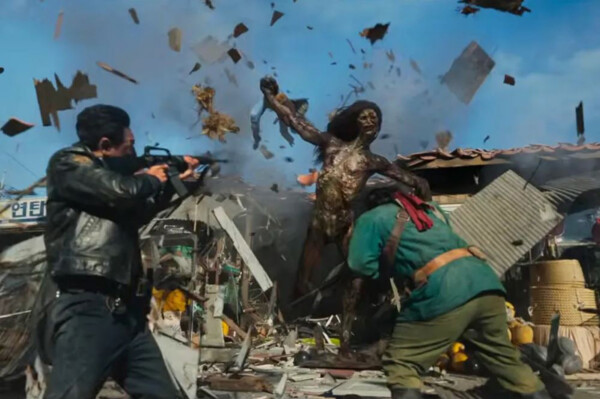
Forged Films, PM Entertainment & Neon
“Hope” starring Hwang Jung-min as our reluctant, somewhat mean hero and police chief Beom Seok; Hoyeon as the perky, cute, and balls‑to‑the‑wall rookie cop Sung Ae; Zo In‑sung as ridiculously indestructible Sung Ki; Eum Moon-suk as somewhat dimwitted but good shot Yang Bae; Alicia Vikander as spikey and now‑childless royal priestess J’aur; Micheal Fassbender as morphing royal lackey Ma’veyyo; and others. Directed and written by Na Hong-jin. Score by Michael Abels. 2 hours, 40 minutes. Rated R. Theatrical release. Captions.
Plot summary: South Korea in, oh, the 1980s, is invaded, though not by North Korea. The extraterrestrials were minding their own business, more or less, hunkered in a forest until one of their younglings disappears. Momma deploys a search party. The search party of humanoid creatures wastes a coastal village trying to find the not‑of‑this‑earth tyke. But not all humans are eviscerated. Some fight back, setting up a sequel.
Spoilers: It’s tough to spoil this movie. You have to see it, to believe it.
Mladen’s take
“Hope” is an imaginative, bold, and compelling movie that fails for the silliest reason – poor editing. Did you catch the film’s run time in the opening info dump above? Two hours, 40 minutes.
The managing editor at the first daily newspaper where I was a reporter once told me that, sometimes, you have to kill the “babies” in your copy to make a story readable and interesting.
Well, that’s where the “Hope” director misfired. There is way too much of a couple of things happening in this film. He should’ve killed those babies, not matter how much he adored them. Why? Because they slowed the movie’s storytelling momentum.
The first baby that should’ve been trimmed in the film is its beginning. The dead bulls, people and then the assault on the hamlet of Hope is at least 15 minutes too long. Our villagers run around too much trying to find the critters that were the cause of all the blood on the walls and streets. There’s the scene of the accidental shooting of a human that could’ve been cut from the film completely, saving 5 minutes. Also significant time‑wasters are two prolonged chase scenes, one in the forest and one on a roadway. The effect on me, each time one of these scenes hit its enough‑already threshold – I hate to say this – was boredom.
At best, “Hope” should’ve been no more than a couple of ticks beyond 2 hours. Damn, the movie is just too long for the story it’s telling.
No doubt, Del will bemoan the shades of other movies that Hope seems to mimic. The movie has resemblance to the best South Korea monster flick so far made, “The Host” (2006). You may notice bits 2009’s “Avatar,” “A Quiet Place” (2018), and “Prometheus” (2012). Hell, there might even be a bit of 2015’s “Jupiter Ascending” or any other sci‑fi or monster movie were big critters squash human because they’re searching for their missing puppies, kittens, cubs, joeys, chicks, calves … whatever the hell alien babies are called. But who cares? All those are good movies. Why not shave a little from each to make such a wonderful, odd movie.
With all my bellyaching, why do I give “Hope” an A-. See the first paragraph.
This film must be watched to be appreciated, flaws and all. That you had to read captions to understand the dialogue bothered me not a whit.
It’s strange and a touch creepy. Wait until you see the faces of the aliens.
“Hope” is bloody and wistful.
“Hope” is down‑to‑earth and otherworldly, a point driven home at the end of the film, which brings me to my last point.
What I see in “Hope” is the South Korea version of “Dune.” Can’t wait for movies 2 and 3. What are the Gertu up to, anyway? How are humans going to foil their plan? Stay tuned. I am.
Del’s take
Mladen gives “Hope” an A- while devoting 99 percent of his review to fussing about the movie’s shortcomings? I believe that’s why God invented Aricept.
But I’m giving it an A- too because while “Hope” does have its problems, it’s one of the most audacious, unpredictable, edge-of-your-seat thrilling films I’ve seen in awhile. And yes, Mladen, it has the same bonkers, balls-to-the-wall creative vision of other really good South Korean monster flicks, like “The Host” and “Train to Busan.” Please sir, may I have more?
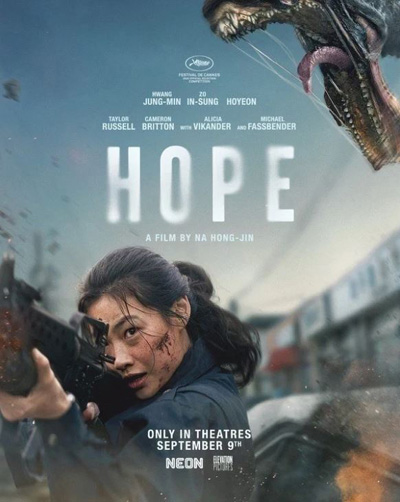
Is the movie too long? It sure is. I’m usually a fan of the slow-burn approach to building tension but “Hope” takes it to ridiculous excess. An hour into the movie and we still haven’t caught a glimpse of the monster. Plus, banter between the characters, which is supposed to be witty, goes on for too long, far past the point when it stops being funny.
Speaking of which, I had a hard time figuring out which genre “Hope” fit into. Was it a monster movie with elements of humor, or a comedy with elements of horror and science fiction? Nor am I a big fan of movies that dump a shitload of questions in the viewer’s lap and hint those questions might be answered in a sequel. “Hope” did that and yes, it was aggravating.
But, and this is an all-caps BUT, the virtues of “Hope” vastly outweigh its shortcomings.
It’s one of the most original movies you’ll see all year. Every time I thought I knew what director Na Hong-jin had in store for us, he delightfully surprised me. The movie’s frantic pacing makes it impossible not to watch and greatly complicated my two trips to the men’s room. Creature effects are bizarre and otherwordly. Special effects are pretty good, although there were a couple of scenes that tested my suspension of disbelief. The movie’s second and third acts aren’t as adrenalized as the first, but the momentum of that initial hour carried me through to the end and I didn’t mind the relative lull.
“Hope” is a raucously entertaining film that does not feel like its 2 hour, 40 minute runtime. Catch it in theaters because its scope was made for the big screen. I’m on board with a sequel, and this time I won’t drink two Diet Pepsi’s and a cup of Starbucks Decaf House Blend before heading to the theater.
Mladen Rudman is a former journalist and technical writer. Del Stone Jr. is a former journalist and writer.
A24
“Onslaught” Starring Adria Arjonna as Celeste, Dan Stevens as Hans Kammler, Eric Wareheim as Kovacks, Blake Kennedy as Daisy, Michael Biehn as Baylor, Rebecca Hall as Hanna Kammler, Drew Starkey as Cyrus and others. Written by Simon Barrett and Adam Wingard. Directed by Adam Wingard. 1 hour, 32 minutes. Rated R. Theatrical release.
Plot summary: A former Army soldier battles a trio of murderous cyborgs who have escaped a secret corporate test facility.
Spoilers: Of course.
Del’s take
“Onslaught” is the little engine that couldn’t: Is it a grindhouse movie? A quirky, off‑kilter near‑comedy? A siege movie?
It’s none of them, actually. It tries, but fails, and you’ll walk out of the theater feeling the way you do when you leave a sushi restaurant – temporarily full but hungry for a cheeseburger.
The story is about Celeste (Adria Arjonna), an ex-soldier with a world-class case of PTSD who manages a run-down trailer park in the dusty wilds of New Mexico – I’m sorry, I meant “New America,” according to the Kumquat Infection’s latest missive. When she isn’t battling her ex for custody of their daughter Daisy (Blake Kennedy) she’s grappling with a pantheon of weirdoes living at the park – a cop who drives drunk and never pays his rent, a vet with a hard-on against the VA, an oversexed young couple with tattoos and loud motorcycles, and other members of the fringe who’ve escaped to the desert.
Meanwhile, at a nearby installation occupied by a military subcontractor, an insane, Nazi‑esque scientist by the name Hans Kammler (Dan Stevens) is testing his latest creation, an evil troika of ex-soldiers who’ve been modified with computer chips and prosthetics to become compassionless and unstoppable killing machines – in other words, Republicans. As luck would have it, something goes wrong (I didn’t say it was good luck) and the cyborgs escape to wreak havoc on the general population, first at a nearby truck stop, then on to the Windy Oasis Trailer Park. What they don’t know is that awaiting them at the park is another compassionless and unstoppable killing machine in the form of Celeste.
What follows is an orgy of not-very-creative bloodletting that would put Robert Rodriguez to shame, pretty much what you’d expect from a grindhouse-style movie. But there’s something off about “Onslaught” and I haven’t quite put my finger on it. It looks like a grindhouse film but wanders from its focus a little too much to be considered a grindhouse film. For instance, much attention is paid to the quirkiness of its characters (Kammler’s fetishistic sexual appetites and Cyrus’s [Drew Starkey] weird mannerisms), putting “Onslaught” within the orbit of movies like “Iron Sky.” Also, it takes too long and introduces too many subplots to be a siege movie. It’s as if director Wingard wanted it to belong to multiple genres simultaneously and ended up with a movie that belongs to none.
The characters are so thinly sketched I struggled to care about any of them. Celeste’s story is told through flashbacks and apart from one vignette, I couldn’t figure out exactly what had happened to her and what had scarred her, so her current bad luck didn’t resonate with me. The other characters, with the exception of Cyrus, are mere placeholders. Cyrus is not much more – he oscillates between amoral monster and somebody you could possibly have a beer with if you could get past the fact he kills people for a living.
“Onslaught’s” thesis statement – that America’s unholy alliance between government and corporations is transforming the country into a fascist state resembling Nazi Germany – is indifferently expressed. I don’t disagree with the idea but not much attention was paid to what could have been a much larger and more important movie message.
Overall, there’s nothing here you haven’t seen before. I liked parts, thought other parts were stupid, and if you ask me for details a month from now I won’t be able to tell you any because the movie is pretty much forgettable.
I’m giving “Onslaught” a C+. I’m all for seeing movies in theaters – once again, Mladen and I were the only two members of the audience – but this one could have waited for streaming.
Mladen’s take
Meet Michael, Jason, and Freddy. No, not the slashers from “Halloween” (1978), “Friday the 13th” (1980), and “Nightmare on Elm Street” (1984) but the Michael‑, Jason‑, and Freddy‑wannabes in “Onslaught.”
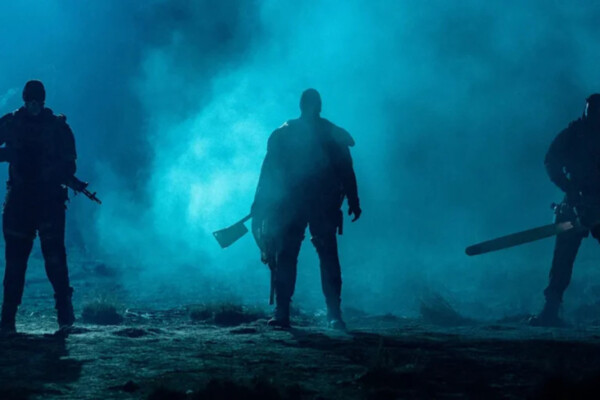
Good God, there’s even a shot in “Onslaught” that shows The Frankensteinian Trio standing nearly shoulder‑to‑shoulder while silhouetted at the edge of the trailer park they’re about to annihilate. You could see their breaths as The Not‑Terminators scan the area through their glow‑in‑the‑dark eyeballs like the Furyan Riddick in “Pitch Black” (2000). The one in the middle is holding a cleaver the size of a surfboard. The one on the right, you guessed it, is wielding a chainsaw with a blade as long as my beautiful car. At least the one on the left is packing a SAW. Rat‑a‑tat, motherfucker.
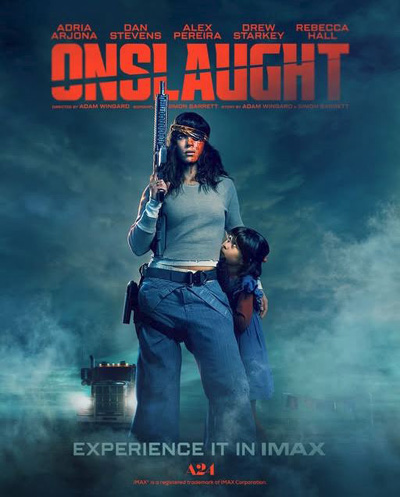
What a crappy movie. Everything about “Onslaught” is derivative, including the notion of bringing soldiers back to life ala 1992’s “Universal Soldier.” The only things that get onslaught‑ed in “Onslaught” are good ideas for dystopian sci‑fi, originality, salient script writing, decency, and likeable characters. What a crappy movie.
“Onslaught” started with promise, if you’re captivated by strangeness as I am. The weirdness is the demented scientist, a third‑generation offspring from the Nazi Party scientists ferreted to America after World War II to help us prepare for World War III.
From the get-go amid the film’s rocking sound effects, rollicking score, and some decent songs, there’s Herr Kammler dropping to his knees to crawl to his wife. To do what? Lick Frau Kammler’s right foot. Come to think of it, maybe I’d lick the Frau’s foot, too, if she’s portrayed by Rebecca Hall, that is.
Unfortunately, after the opening scenes of austere landscapes, shotguns blowing away pumpkins, the wind howling, and the Frau Foot Incident, “Onslaught” degenerates toward, ah, degeneracy. Starkey’s Cyrus, some kind of government or corporate enforcer, is introduced via sadomasochism. Then, the squalid violence takes flight.
There they go, The Trio of Lobotomy, their uniforms ragged like zombie apparel or the ragers in “28 Days Later” (2002), blasting away folks at a truck stop after killing a bunch of private military contractors at a secret test facility in the middle of an arid land.
Frankly, I’m pissed. I suspect the screenwriters simply wanted to put to film a wad of pointless violence but had to disguise the pointlessness somehow. What was the schtick? That a corporation, in cahoots with a fascist U.S. government, is building soulless but fleshy human‑based automatons that kill anyone until commissioned to stop. Apparently, the Not‑Soldiers would be used to suppress civil disobedience and, I imagine, all other forms of disobedience, too.
I don’t know what A24 studio was thinking when it produced “Onslaught.” Everything the movie wants to be, assuming you can determine what that is, never happens. A24 must be embarrassed to list “Onslaught” as part of its portfolio when it includes such magnificent filmmaking as cerebral and transfixing “Ex Machina” (2015), 2019’s absurd and hallucinogenic “The Lighthouse,” and best picture winner “Everything Everywhere All at Once” (2022), which introduces us all to the simultaneity of events.
Yeah, “Onslaught” is a D because it would’ve been a much, much better film if it told a story rather than exposing us to a bunch of gratuitous blood splatter.
Mladen Rudman is a former journalist and technical writer. Del Stone Jr. is a former journalist and writer.
About the author:
Del Stone Jr. is a professional fiction writer. He is known primarily for his work in the contemporary dark fiction field, but has also published science fiction and contemporary fantasy. Stone’s stories, poetry and scripts have appeared in publications such as Amazing Stories, Eldritch Tales, and Bantam-Spectra’s Full Spectrum. His short fiction has been published in The Year’s Best Horror Stories XXII; Alfred Hitchcock’s Mystery Magazine; the Pocket Books anthology More Phobias; the Barnes & Noble anthologies 100 Wicked Little Witch Stories, Horrors! 365 Scary Stories, and 100 Astounding Little Alien Stories; the HWA anthology Psychos; and other short fiction venues, like Blood Muse, Live Without a Net, Zombiesque and Sex Macabre. Stone’s comic book debut was in the Clive Barker series of books, Hellraiser, published by Marvel/Epic and reprinted in The Best of Hellraiser anthology. He has also published stories in Penthouse Comix, and worked with artist Dave Dorman on many projects, including the illustrated novella “Roadkill,” a short story for the Andrew Vachss anthology Underground from Dark Horse, an ashcan titled “December” for Hero Illustrated, and several of Dorman’s Wasted Lands novellas and comics, such as Rail from Image and “The Uninvited.” Stone’s novel, Dead Heat, won the 1996 International Horror Guild’s award for best first novel and was a runner-up for the Bram Stoker Award. Stone has also been a finalist for the IHG award for short fiction, the British Fantasy Award for best novella, and a semifinalist for the Nebula and Writers of the Future awards. His stories have appeared in anthologies that have won the Bram Stoker Award and the World Fantasy Award. Two of his works were optioned for film, the novella “Black Tide” and short story “Crisis Line.”
Stone recently retired after a 41-year career in journalism. He won numerous awards for his work, and in 1986 was named Florida’s best columnist in his circulation division by the Florida Society of Newspaper Editors. In 2001 he received an honorable mention from the National Lesbian and Gay Journalists Association for his essay “When Freedom of Speech Ends” and in 2003 he was voted Best of the Best in the category of columnists by Emerald Coast Magazine. He participated in book signings and awareness campaigns, and was a guest on local television and radio programs.
As an addendum, Stone is single, kills tomatoes and morning glories with ruthless efficiency, once tied the stem of a cocktail cherry in a knot with his tongue, and carries a permanent scar on his chest after having been shot with a paintball gun. He’s in his 60s as of this writing but doesn’t look a day over 94.
Contact Del at [email protected]. He is also on Facebook, twitter, Pinterest, tumblr, TikTok, and Instagram. Visit his website at delstonejr.com .
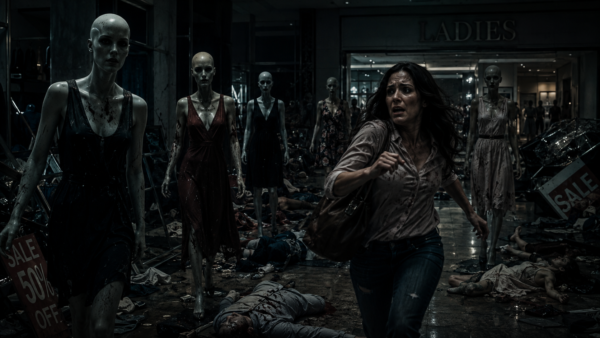
ChatGPT
INTRODUCTION
Have you ever been creeped out by a mannequin?
I have.
I don’t care what anybody says – they’re creepy.
Every time I find myself in the presence of a mannequin I can feel the thing watching me. Sometimes, from the corner of my eye, I see them move. I swear.
They’re sneaky. They know when to stand still – still as a piece of plastic.
They know when it’s OK to tilt their hands back and spread their fingers.
And in “Mall of the Dead,” they know when it’s OK to kill.
I want to point out an episode of the old Twilight Zone series that features mannequins who spring to life when the lights go out. I did not see that episode until a couple of years ago, and I wrote this story in 1997. So no, I didn’t plagiarize it.
I guess great minds think alike, or, when comparing Rod Serling to Del Stone Jr., strange minds think alike.
Oh, and do me this favor: Next time you’re in a store, keep an eye on the mannequins. Be discreet. Don’t let them see you looking.
Tell me if you see them move.
—
MALL OF THE DEAD
When Beverly came out of the department store fitting room, she found the sales associate sprawled in the aisle, a mannequin knocked over and a colorful heap of sweaters lying around her.
The lady was dead.
Beverly gulped a solid lump of breath and backed away, staggering to the cash register kiosk.
The associate there was dead, too.
A madman, Beverly thought, and almost simultaneously she realized that if a madman were on a killing spree, she might become his next victim. She ducked below the sales tables and crawled for the entrance to the mall center court.
As she made her way she spotted more bodies – women and men – blocking the aisles, every one of them frozen in rigid postures of stark terror. Impossible, she thought. No man could have done this alone. It must have been a gang. Mannequins lay amid the chaos, their wigs knocked off, staring with blank eyes at the ceiling tiles. What had they seen, she wondered, and if they could speak, what would they tell her?
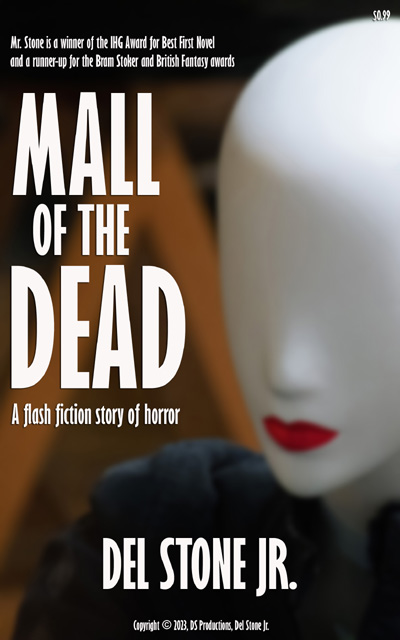
https://www.pexels.com/@brett-sayles/
She reached the store front. The mall spread out before her, a fresco of corpses, scattered packages and smashed windowfronts.
A clot of bodies lay by the counter at Morrow’s, surrounded by scatterings of candy-coated peanuts that still trickled from the broken display case. Packages and articles of clothing lay in a confused jumble. Even mannequins from stores two or three windows down the concourse lay by the counter. Beverly guessed that whatever had killed these people had blown through with the suddenness and violence of a tornado.
She darted across the concourse and held up at a pillar that separated Morrow’s from a tuxedo-rental shop. She could see the mall entrance, and there, piled by the doors, was a huge mound of bodies. The glass in the doors had been shattered. Outside, she could see the blue strobe of police lights. She thought she saw movement – huddled figures training guns on the doors.
She began edging along the front of the tuxedo rental shop. The windows there had been broken too, the silk-clad mannequins leaning in well-dressed apposition to the chaos and death that surrounded them. As she stepped closer to the slaughter at the front door, she heard a voice shouting through a bullhorn:
“This is the police. If you can hear me, you must leave the mall at once.”
No shit, Sherlock, she thought morosely.
“If anybody inside can hear me, this is the police …” the voice boomed.
She glanced at the shadowy figures outside and saw them point to her. They began waving to her, motioning for her to run. Several of them scurried toward the mall entrance.
At that moment, something touched Beverly on the shoulder.
The knobs of her spine glazed over with a sudden coating of ice, and she stopped, willing every molecule of her body into absolute stillness. She peeked at her shoulder. …
She had bumped into the tuxedo-clad mannequin.
The breath hiccuped out of her in a sob, and she felt her knees going weak with relief. That was when she noticed the jumble of bodies at the door consisted partly of human beings. The rest were mannequins.
And some of them had their plastic hands around people’s throats.
Beverly stopped breathing. She turned, and the mannequin in the tuxedo was staring at her.
The scream that had been simmering at the back of her throat boiled out now, and she jerked away and ran madly for the doors as a stampede sound of plastic feet against carpeting and tiles arose behind her, and the piles of bodies at the door began to stir sluggishly. She threw herself onto the pile and began to scramble for the top, stepping in the soft, pliant faces of people, and the hard, shifting torsos of dummies. Something grabbed her ankle and she screamed again and kicked as a shot blew just past her ear and something behind her exploded into plastic shrapnel. The grip on her ankle tightened and she could feel its remorseless strength and knew she would never be able to pull herself free, that she would be drawn into that pile and strangled and –
A hand grabbed her and hauled her over the top – the cop, the cop, thank God it was the cop, and other cops were shooting through the entrance to the mall as the officer dragged her through the broken glass and into the blessed dark, where men in flak vests swarmed around her and helped her to her feet as the shooting rose to a roar –
“It’s happening all over!” one of the cops screamed at her, but all she could think of was: Get it off, get it off me –
The plastic hand around her ankle, trailing a broken connecting rod, still squeezing, squeezing—
– as the war continued. …
About the author:
Del Stone Jr. is a professional fiction writer. He is known primarily for his work in the contemporary dark fiction field, but has also published science fiction and contemporary fantasy. Stone’s stories, poetry and scripts have appeared in publications such as Amazing Stories, Eldritch Tales, and Bantam-Spectra’s Full Spectrum. His short fiction has been published in The Year’s Best Horror Stories XXII; Alfred Hitchcock’s Mystery Magazine; the Pocket Books anthology More Phobias; the Barnes & Noble anthologies 100 Wicked Little Witch Stories, Horrors! 365 Scary Stories, and 100 Astounding Little Alien Stories; the HWA anthology Psychos; and other short fiction venues, like Blood Muse, Live Without a Net, Zombiesque and Sex Macabre. Stone’s comic book debut was in the Clive Barker series of books, Hellraiser, published by Marvel/Epic and reprinted in The Best of Hellraiser anthology. He has also published stories in Penthouse Comix, and worked with artist Dave Dorman on many projects, including the illustrated novella “Roadkill,” a short story for the Andrew Vachss anthology Underground from Dark Horse, an ashcan titled “December” for Hero Illustrated, and several of Dorman’s Wasted Lands novellas and comics, such as Rail from Image and “The Uninvited.” Stone’s novel, Dead Heat, won the 1996 International Horror Guild’s award for best first novel and was a runner-up for the Bram Stoker Award. Stone has also been a finalist for the IHG award for short fiction, the British Fantasy Award for best novella, and a semifinalist for the Nebula and Writers of the Future awards. His stories have appeared in anthologies that have won the Bram Stoker Award and the World Fantasy Award. Two of his works were optioned for film, the novella “Black Tide” and short story “Crisis Line.”
Stone recently retired after a 41-year career in journalism. He won numerous awards for his work, and in 1986 was named Florida’s best columnist in his circulation division by the Florida Society of Newspaper Editors. In 2001 he received an honorable mention from the National Lesbian and Gay Journalists Association for his essay “When Freedom of Speech Ends” and in 2003 he was voted Best of the Best in the category of columnists by Emerald Coast Magazine. He participated in book signings and awareness campaigns, and was a guest on local television and radio programs.
As an addendum, Stone is single, kills tomatoes and morning glories with ruthless efficiency, once tied the stem of a cocktail cherry in a knot with his tongue, and carries a permanent scar on his chest after having been shot with a paintball gun. He’s in his 60s as of this writing but doesn’t look a day over 94.
Contact Del at [email protected]. He is also on Facebook, twitter, Pinterest, tumblr, TikTok, and Instagram. Visit his website at delstonejr.com .