Who installed this fridge? A team of Republicans?
So they brought the new fridge and Mom hates it. It’s too small the doors have inset handles, which she doesn’t like. I wish she’d noticed that at the store but whatever.
More troubling … they didn’t turn on the water. Apparently they turned it on briefly, enough to make one batch of ice, but then turned it off. Makes me think they saw the line was leaking and turned it off to let the next person deal with it.
Mom said they didn’t seem to know what they were doing. They didn’t realize there was a water line hooked up to the old fridge. What were they gonna do? Rip it out of the wall? They didn’t level the fridge; it wobbles.
She’ll be at Lowe’s tomorrow to get it replaced with a fridge she likes. They’d better send somebody out who knows what he’s doing.
About the author:
Del Stone Jr. is a professional fiction writer. He is known primarily for his work in the contemporary dark fiction field, but has also published science fiction and contemporary fantasy. Stone’s stories, poetry and scripts have appeared in publications such as Amazing Stories, Eldritch Tales, and Bantam-Spectra’s Full Spectrum. His short fiction has been published in The Year’s Best Horror Stories XXII; Alfred Hitchcock’s Mystery Magazine; the Pocket Books anthology More Phobias; the Barnes & Noble anthologies 100 Wicked Little Witch Stories, Horrors! 365 Scary Stories, and 100 Astounding Little Alien Stories; the HWA anthology Psychos; and other short fiction venues, like Blood Muse, Live Without a Net, Zombiesque and Sex Macabre. Stone’s comic book debut was in the Clive Barker series of books, Hellraiser, published by Marvel/Epic and reprinted in The Best of Hellraiser anthology. He has also published stories in Penthouse Comix, and worked with artist Dave Dorman on many projects, including the illustrated novella “Roadkill,” a short story for the Andrew Vachss anthology Underground from Dark Horse, an ashcan titled “December” for Hero Illustrated, and several of Dorman’s Wasted Lands novellas and comics, such as Rail from Image and “The Uninvited.” Stone’s novel, Dead Heat, won the 1996 International Horror Guild’s award for best first novel and was a runner-up for the Bram Stoker Award. Stone has also been a finalist for the IHG award for short fiction, the British Fantasy Award for best novella, and a semifinalist for the Nebula and Writers of the Future awards. His stories have appeared in anthologies that have won the Bram Stoker Award and the World Fantasy Award. Two of his works were optioned for film, the novella “Black Tide” and short story “Crisis Line.”
Stone recently retired after a 41-year career in journalism. He won numerous awards for his work, and in 1986 was named Florida’s best columnist in his circulation division by the Florida Society of Newspaper Editors. In 2001 he received an honorable mention from the National Lesbian and Gay Journalists Association for his essay “When Freedom of Speech Ends” and in 2003 he was voted Best of the Best in the category of columnists by Emerald Coast Magazine. He participated in book signings and awareness campaigns, and was a guest on local television and radio programs.
As an addendum, Stone is single, kills tomatoes and morning glories with ruthless efficiency, once tied the stem of a cocktail cherry in a knot with his tongue, and carries a permanent scar on his chest after having been shot with a paintball gun. He’s in his 60s as of this writing but doesn’t look a day over 94.
Contact Del at [email protected]. He is also on Facebook, twitter, Pinterest, tumblr, TikTok, and Instagram. Visit his website at delstonejr.com .

Image courtesy of Flickr user Tim Sheerman-Chase by way of a Creative Commons license. https://www.flickr.com/photos/tim_uk/
So.
The guys came over to refurbish the exterior of our units at the townhouse complex. In the process they caused a lot of destruction, namely:
1. They destroyed my potted plant, Methuselah, that had been with me since 1996.
2. They hammered around the sliding glass door so hard the plaster inside the frame cracked and fell off.
3. Knocked the shelf off the wall in the laundry room.
4. Destroyed the dryer vent.
5. Tore a rip in the sliding screen door upstairs.
6. Punched a nail through the wall of my upstairs bedroom.
7. Broke the globe around my downstairs front-door porch light.
Now I come to find they’ve done more:
1. Cracked the wall by my front door.
2. Destroyed the wind chimes I had hanging off the patio.
3. Damaged the electrical connection to my AC so that it no longer works.
Then, I go out with Matt for wings and the next day I’m suffering from a mild case of food poisoning.
TODAY, I go over to Mom’s to figure out who stole her ladder (turns out it wasn’t stolen) and why her car AC comes on by itself (turns out it’s set to come on when she uses the defroster) and see antifreeze gushing out of my SUV. This would be the same SUV I recently had overhauled to the tune of $1,800.
I know this isn’t just a coincidence. I know during the process of doing all the work they did something happened to cause this hose to leak. Problem is, how do I prove it?
Because I know they will say, “It’s a cracked hose and the repair bill is $300.”
I DID ask them to inspect the hoses, and that may be my saving grace.
But I wish things would settle down for a week or so.
I’m really tired of drama.
About the author:
Del Stone Jr. is a professional fiction writer. He is known primarily for his work in the contemporary dark fiction field, but has also published science fiction and contemporary fantasy. Stone’s stories, poetry and scripts have appeared in publications such as Amazing Stories, Eldritch Tales, and Bantam-Spectra’s Full Spectrum. His short fiction has been published in The Year’s Best Horror Stories XXII; Alfred Hitchcock’s Mystery Magazine; the Pocket Books anthology More Phobias; the Barnes & Noble anthologies 100 Wicked Little Witch Stories, Horrors! 365 Scary Stories, and 100 Astounding Little Alien Stories; the HWA anthology Psychos; and other short fiction venues, like Blood Muse, Live Without a Net, Zombiesque and Sex Macabre. Stone’s comic book debut was in the Clive Barker series of books, Hellraiser, published by Marvel/Epic and reprinted in The Best of Hellraiser anthology. He has also published stories in Penthouse Comix, and worked with artist Dave Dorman on many projects, including the illustrated novella “Roadkill,” a short story for the Andrew Vachss anthology Underground from Dark Horse, an ashcan titled “December” for Hero Illustrated, and several of Dorman’s Wasted Lands novellas and comics, such as Rail from Image and “The Uninvited.” Stone’s novel, Dead Heat, won the 1996 International Horror Guild’s award for best first novel and was a runner-up for the Bram Stoker Award. Stone has also been a finalist for the IHG award for short fiction, the British Fantasy Award for best novella, and a semifinalist for the Nebula and Writers of the Future awards. His stories have appeared in anthologies that have won the Bram Stoker Award and the World Fantasy Award. Two of his works were optioned for film, the novella “Black Tide” and short story “Crisis Line.”
Stone recently retired after a 41-year career in journalism. He won numerous awards for his work, and in 1986 was named Florida’s best columnist in his circulation division by the Florida Society of Newspaper Editors. In 2001 he received an honorable mention from the National Lesbian and Gay Journalists Association for his essay “When Freedom of Speech Ends” and in 2003 he was voted Best of the Best in the category of columnists by Emerald Coast Magazine. He participated in book signings and awareness campaigns, and was a guest on local television and radio programs.
As an addendum, Stone is single, kills tomatoes and morning glories with ruthless efficiency, once tied the stem of a cocktail cherry in a knot with his tongue, and carries a permanent scar on his chest after having been shot with a paintball gun. He’s in his 60s as of this writing but doesn’t look a day over 94.
Contact Del at [email protected]. He is also on Facebook, twitter, Pinterest, tumblr, TikTok, Ello and Instagram. Visit his website at delstonejr.com .

Twitter is crap.
People call Twitter a “valuable tool.” No, a bottle opener is a valuable tool. Twitter is the magnet on the bottle opener that degausses your flash drive.
With Twitter you get – what? – 175 characters to say something meaningful? You can configure these “tweets” to show up on your cell phone. Wow. T-Mobile charges 20 cents per text message. I can see myself paying 20 cents to see “I had a painful BM this morning.”
I’m gonna start a new social media service. Call it “Crap.” You’re limited to three words and two punctuation marks. Each message will be called a “fart.”
Several possibilities come to mind. Remember that line from Arnold Schwarzenegger in “The Terminator”? Not “I’ll be back,” but the one where he’s in his hotel room and somebody knocks on the door and says, “Hey buddy, you got a dead cat in there?” That would make a cool fart. Or there’s the ever-popular KMA.
Speaking of T-Mobile I had a message stuck in my outbox that kept sending to Robbyn and the brain trust at T-Mobile couldn’t get rid of it so they told me to do a hard reset on my phone. Great, except that wiped out all my pix and videos and ringtones except the ones that came with the phone.
So I’m at work the other day and the phone rings and it’s using the default ringtone, which just happens to be “The Beer Barrel Polka.”
Can you imagine my humiliation?
I refuse to pay $2.34 to download a 10-second clip from “Viva la Vida” – hell, the entire album only cost $10.
Why couldn’t they include a ringtone that sounds like a tweet?
Or a fart?
About the author:
Del Stone Jr. is a professional fiction writer. He is known primarily for his work in the contemporary dark fiction field, but has also published science fiction and contemporary fantasy. Stone’s stories, poetry and scripts have appeared in publications such as Amazing Stories, Eldritch Tales, and Bantam-Spectra’s Full Spectrum. His short fiction has been published in The Year’s Best Horror Stories XXII; Alfred Hitchcock’s Mystery Magazine; the Pocket Books anthology More Phobias; the Barnes & Noble anthologies 100 Wicked Little Witch Stories, Horrors! 365 Scary Stories, and 100 Astounding Little Alien Stories; the HWA anthology Psychos; and other short fiction venues, like Blood Muse, Live Without a Net, Zombiesque and Sex Macabre. Stone’s comic book debut was in the Clive Barker series of books, Hellraiser, published by Marvel/Epic and reprinted in The Best of Hellraiser anthology. He has also published stories in Penthouse Comix, and worked with artist Dave Dorman on many projects, including the illustrated novella “Roadkill,” a short story for the Andrew Vachss anthology Underground from Dark Horse, an ashcan titled “December” for Hero Illustrated, and several of Dorman’s Wasted Lands novellas and comics, such as Rail from Image and “The Uninvited.” Stone’s novel, Dead Heat, won the 1996 International Horror Guild’s award for best first novel and was a runner-up for the Bram Stoker Award. Stone has also been a finalist for the IHG award for short fiction, the British Fantasy Award for best novella, and a semifinalist for the Nebula and Writers of the Future awards. His stories have appeared in anthologies that have won the Bram Stoker Award and the World Fantasy Award. Two of his works were optioned for film, the novella “Black Tide” and short story “Crisis Line.”
Stone recently retired after a 41-year career in journalism. He won numerous awards for his work, and in 1986 was named Florida’s best columnist in his circulation division by the Florida Society of Newspaper Editors. In 2001 he received an honorable mention from the National Lesbian and Gay Journalists Association for his essay “When Freedom of Speech Ends” and in 2003 he was voted Best of the Best in the category of columnists by Emerald Coast Magazine. He participated in book signings and awareness campaigns, and was a guest on local television and radio programs.
As an addendum, Stone is single, kills tomatoes and morning glories with ruthless efficiency, once tied the stem of a cocktail cherry in a knot with his tongue, and carries a permanent scar on his chest after having been shot with a paintball gun. He’s in his 60s as of this writing but doesn’t look a day over 94.
Contact Del at [email protected]. He is also on Facebook, twitter, Pinterest, tumblr, TikTok, Ello and Instagram. Visit his website at delstonejr.com .

Image courtesy of Del Stone Jr.
So I am restored to two functioning vehicles.
Why does one person need two vehicles, you ask? How does that affect your carbon footprint on the earth? How can you afford two vehicles? And what exactly do you mean by “restored”?
Notice my impeccable punctuation in the previous paragraph. That should count for something. Surely a person of impeccable punctuation should be allowed the luxury of two vehicles.
But if that explanation is insufficient, consider the following:
“Why does one person need two vehicles?” Well, truth be told, one person doesn’t need two vehicles. But that’s where I find myself – with a practical vehicle for today’s volatile and unfriendly fuel prices, and a trusted old friend that can haul a 5,000-watt generator in the back seat.
“How does that affect your carbon footprint on the earth?” When I look at my peers driving gigantic pickup trucks, SUVs and vans, I find it hard to feel guilty I am adversely affecting the carbon footprint of the earth. In fact, one of my peers who drives a Prius recently chided me about my carbon footprint. I reminded him that he recently drove a Suburban. If a Prius is a Xanax for earth-guilt, my Scion tC is a vitamin C pill.
“How can you afford two vehicles?” I refuse to feel guilty about this. Vehicle No. 1 was purchased in 1995 and has been paid off for many years. Vehicle No. 2 was purchased in 2006 and was paid for in cash, which I saved for years.
“Restored.” That means I recently turned in vehicle No. 1 to the shop, which restored it to functioning order – for a price – which I will be paying the rest of the year. Vehicle No. 2 was vandalized at work, but luckily insurance paid for the bulk of the work.
So now I am merely paranoid about which vehicle to drive. No. 1 is old but I only have liability on it. One wreck on the way to work and it’s off to the junkyard. No. 2 has full coverage but if I take it to work, the vandalizer may return.
I dunno. I guess in the pantheon of worries, these are the minor gods.
About the author:
Del Stone Jr. is a professional fiction writer. He is known primarily for his work in the contemporary dark fiction field, but has also published science fiction and contemporary fantasy. Stone’s stories, poetry and scripts have appeared in publications such as Amazing Stories, Eldritch Tales, and Bantam-Spectra’s Full Spectrum. His short fiction has been published in The Year’s Best Horror Stories XXII; Alfred Hitchcock’s Mystery Magazine; the Pocket Books anthology More Phobias; the Barnes & Noble anthologies 100 Wicked Little Witch Stories, Horrors! 365 Scary Stories, and 100 Astounding Little Alien Stories; the HWA anthology Psychos; and other short fiction venues, like Blood Muse, Live Without a Net, Zombiesque and Sex Macabre. Stone’s comic book debut was in the Clive Barker series of books, Hellraiser, published by Marvel/Epic and reprinted in The Best of Hellraiser anthology. He has also published stories in Penthouse Comix, and worked with artist Dave Dorman on many projects, including the illustrated novella “Roadkill,” a short story for the Andrew Vachss anthology Underground from Dark Horse, an ashcan titled “December” for Hero Illustrated, and several of Dorman’s Wasted Lands novellas and comics, such as Rail from Image and “The Uninvited.” Stone’s novel, Dead Heat, won the 1996 International Horror Guild’s award for best first novel and was a runner-up for the Bram Stoker Award. Stone has also been a finalist for the IHG award for short fiction, the British Fantasy Award for best novella, and a semifinalist for the Nebula and Writers of the Future awards. His stories have appeared in anthologies that have won the Bram Stoker Award and the World Fantasy Award. Two of his works were optioned for film, the novella “Black Tide” and short story “Crisis Line.”
Stone recently retired after a 41-year career in journalism. He won numerous awards for his work, and in 1986 was named Florida’s best columnist in his circulation division by the Florida Society of Newspaper Editors. In 2001 he received an honorable mention from the National Lesbian and Gay Journalists Association for his essay “When Freedom of Speech Ends” and in 2003 he was voted Best of the Best in the category of columnists by Emerald Coast Magazine. He participated in book signings and awareness campaigns, and was a guest on local television and radio programs.
As an addendum, Stone is single, kills tomatoes and morning glories with ruthless efficiency, once tied the stem of a cocktail cherry in a knot with his tongue, and carries a permanent scar on his chest after having been shot with a paintball gun. He’s in his 60s as of this writing but doesn’t look a day over 94.
Contact Del at [email protected]. He is also on Facebook, twitter, Pinterest, tumblr, TikTok, Ello and Instagram. Visit his website at delstonejr.com .
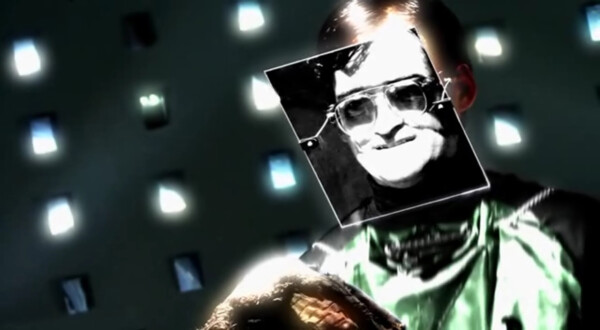
Image courtesy of Double Edge Films.
“Ink.” Starring Christopher Soren Kelly, Quinn Hunchar, Jessica Duffy, Jennifer Batter, and others. Directed by Jamin Winans. 107 minutes. Not rated. Amazon Prime
Mladen’s take
My boss recommended that I watch “Infinity Chamber.” I did and liked the film enough to see what other movies starred Christopher Soren Kelly, the computer hacker and insurrectionist in “Infinity Chamber.” The film “Ink” popped up. It was accompanied by an interesting summary, so I watched it. I did not regret my decision and Del better not either.
He and I take turns choosing which movies to review. While Del often picks losers, I seldom do. “Ink” is no exception to my sterling track record, but Del may disagree, albeit ineffectively.
“Ink” is a parable about right and wrong. The film tackles the notion of ambition and the way it can not only destroy those who are stepped on, but those who do the stepping. Trump should watch the movie. “Ink” explains in a Brothers Grimm sort of way why he’s so fucked now that he’s no longer occupying the White House. U.S. senators Tumbleweed Cruz, Rabid Rand, Lilting Lindsey, Himmler Hawley, and Murine McConnell, to name a few, would also benefit from watching the movie. In the end, “Ink” shows the way to redemption, which those boys will need badly before it comes time for them to meet their Maker.
Kelly plays two characters in “Ink,” terrible husband John, who’s even worse as a father, and Ink, a junior partner to the Grim Reaper. Toss in the supernatural kidnapping of John’s daughter Emma, portrayed very nicely by then-young Quinn Hunchar, by Ink; a group of fairy-like do-gooders trying to rescue Emma from Ink; and some very interesting others who side either with goodness or badness as this other earthly story unfolds, and you have a movie that reaches A-.
I was charmed by the film’s low-budget special effects, though using electrical tape to make X’s across the life rhythm keeper’s eyes annoyed me. It’s the life rhythm keeper, however, who is central to one of the film’s neatest pieces. He initiates an event that causes a chain reaction of incidents that result in John helping his daughter recover from her Ink-induced exposure to the dastardlier aspect of Dreamworld, the cabal of Incubi. The way the Incubi are depicted, by the way, is cool and psychedelic. It reminded me of the scenes in “Brazil” where the servants of the totalitarian state use information processing equipment fitted with magnifying glasses to read material used to destroy lives. Or were magnifying screens part of the setting of the movie version of “1984”?
It took me a moment to adapt to the way “Ink” works. But, I’m not particularly bright and Del less so. It may be easier for you to orient yourself. Be patient for the first, oh, 15 minutes of the film. By then you should be fully immersed in the realm the movie creates. Keep in mind that this movie must have had a small budget. It relies on drab urban landscapes, inner-city plots, and industrial workspaces to convey its fantastical world. I can’t recall the soundtrack, which is OK.
“Ink” is Aesop-like storytelling that serves as its own unadorned tool for teaching us all a lesson.
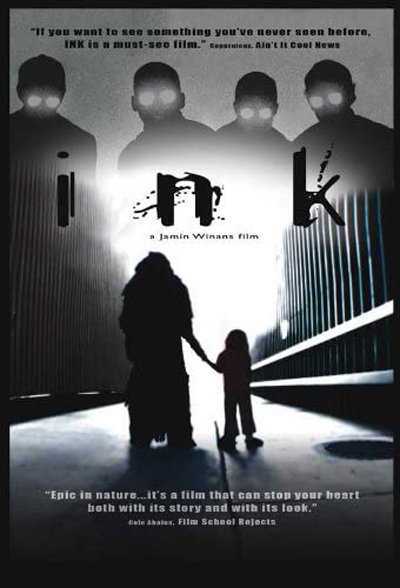
Del’s take
Oh yes, Mladen’s taste in movies is impeccable. He recommended “Bone Tomahawk” and I’m still in therapy. But with “Ink” he proved the old adage that if you give a monkey a typewriter, one day it’ll type Shakespeare. “Ink” is one of his rare winning suggestions.
I too was charmed by the movie, which is, as Mladen accidentally stumbled upon, a modern parable. And I agree that you need to give the movie a chance. Stick with it and you’ll be rewarded with explanations about Storytellers, Incubi and Pathfinders, all denizens of an alternate reality that rule supreme over your dreams.
“Ink” is one of those movies that requires attention, and yes, it operates on many different levels. But unlike “Tenet” it is not indecipherable. The keen eye will discern a very neat synchronicity bound in metaphors for good, evil, and more importantly, the loyalty and dedication borne of love.
The pacing is brisk but populated with moments of quiet introspection. But what impressed me most was the look of the film – gritty black and white and some very cool retro tech that reminded me of the John Wick films and Ridley Scott’s “Bladerunner.”
Hunchar is brilliant as Emma, the little girl whose soul is plucked from her body by the titular character Ink as he seeks entré to the world of the Incubi. Also brilliant is Jeremy Make as the blind Pathfinder Jacob (after falling – “Hello dirt. How are we today?”). Kelly is effective as the high-strung, hard-charging John / Ink, who spends the movie rediscovering his humanity.
Less impressive were the Storytellers, who seemed cut from the cloth of the ninja/warrior/apprentice template. They were there and they were honorable, and that was about it. Except Jessica Duffy as Liev, who sacrifices everything to save young Emma. Her character stepped out of the stereotype to make an impression.
“Ink” creates its own lexicon of morality and honor, and articulates those values in ways you likely have never seen. For an indie film it casts a long shadow, and I expect it will someday join the ranks of those quiet cult films beloved by fans of science fiction, horror and fantasy. You know the ones I’m talking about – “THX 1138,” “Code 46,” “Pumpkinhead” and “City of Ember,” all terrific little films nobody knows about but nonetheless advanced their genres.
I think “Ink” falls into the A- category. I don’t think it’s everyone’s cup of tea, but for those willing to do the work it’s a happy anecdote that will make that bottle of melatonin worth its weight in gold.
Mladen Rudman is a former journalist and technical writer. Del Stone Jr. is a former journalist and author.

Image by Mass Communication Specialist 1st Class Chad J. McNeeley
Sometimes working for a newspaper sucks. You don’t get to sit back and enjoy events like today’s inauguration. You’re too busy trying to come up with local angles, scrounging for art, installing live video feeds and coordinating with reporters in the field. Inaugurations, hurricanes, terrorist attacks – they’re occasions for work – massive amounts of work. Sometimes I think it would be nice to simply plant my increasingly ample backside on the couch and watch it all unfold on TV. Let somebody else worry about fresh copy, databases and high–resolution photos. But that would make me a bad journalist and I hope when it’s all said and done, I wasn’t a bad journalist.
Throughout the day I saw a gamut of reaction: proud black Americans celebrating the ascendancy of one of their own … proud white Americans declaring an end to racism … angry black Americans decrying the election of an “Uncle Tom” … angry white Americans dressed in black to mourn the death of America.
It’s all so stupid.
We need to get past this hangup about race – and that goes for whites and blacks. Racism, just like tolerance, is color blind. Plenty of racists to go around on both sides of the ethnicity fence. Until that stops nothing will really change.
What’s important is this: that Obama do a good job as president. This country has a lot of problems and while it’s fashionable to believe no one man can make a difference, that’s not true. Just look at what George W. Bush did in eight years.
I want Obama to restore America’s stature in the world. I’m tired of being berated as a warmonger and a voracious consumer of resources. I’d like to be able to dress like an American while traveling abroad and not worry about having my head blown off.
I want Obama to do something about the debt. America is owned by the Chinese, the British and Japan. The government has operated like a kid with Mom and Dad’s credit card for decades. It’s got to stop. Interest payments on the debt will eat up half the budget in the near future. Can’t do much good when you’re sending half your income to Visa and not even paying down the principal.
I want Obama to do everything he can short of socialism to encourage alternate energy development. The oil swill has got to stop. We’ve known that for decades. Oil is a finite resource and it’s causing irreparable environmental damage. Now is as good a time as any to work on its replacement.
I want the environment to be cleaner. I nearly choked on my TV dinner when I heard Bush tout his environmental record during his farewell address. Bush’s environmental record is the equivalent of an asteroid strike – it’ll take decades to undo the damage he’s done.
I want white collar workers to be held accountable for their crimes. I guy who sticks up a convenience store for a couple of hundred bucks does more jail time than a guy who steals millions from an investment firm. That’s just classism, pure and simple. It’s wrong.
I don’t care about rhetoric and speeches. I don’t care about a person’s race. I want quality leadership, which springs from intelligence, courage and integrity.
Is Obama all those things? I hope so. All the “Uncle Tom” haters or the people dressed in black should give the man a chance.
Notice I said “man.” Not black. Not Democrat.
Just man.
Let’s hope for the best.
About the author:
Del Stone Jr. is a professional fiction writer. He is known primarily for his work in the contemporary dark fiction field, but has also published science fiction and contemporary fantasy. Stone’s stories, poetry and scripts have appeared in publications such as Amazing Stories, Eldritch Tales, and Bantam-Spectra’s Full Spectrum. His short fiction has been published in The Year’s Best Horror Stories XXII; Alfred Hitchcock’s Mystery Magazine; the Pocket Books anthology More Phobias; the Barnes & Noble anthologies 100 Wicked Little Witch Stories, Horrors! 365 Scary Stories, and 100 Astounding Little Alien Stories; the HWA anthology Psychos; and other short fiction venues, like Blood Muse, Live Without a Net, Zombiesque and Sex Macabre. Stone’s comic book debut was in the Clive Barker series of books, Hellraiser, published by Marvel/Epic and reprinted in The Best of Hellraiser anthology. He has also published stories in Penthouse Comix, and worked with artist Dave Dorman on many projects, including the illustrated novella “Roadkill,” a short story for the Andrew Vachss anthology Underground from Dark Horse, an ashcan titled “December” for Hero Illustrated, and several of Dorman’s Wasted Lands novellas and comics, such as Rail from Image and “The Uninvited.” Stone’s novel, Dead Heat, won the 1996 International Horror Guild’s award for best first novel and was a runner-up for the Bram Stoker Award. Stone has also been a finalist for the IHG award for short fiction, the British Fantasy Award for best novella, and a semifinalist for the Nebula and Writers of the Future awards. His stories have appeared in anthologies that have won the Bram Stoker Award and the World Fantasy Award. Two of his works were optioned for film, the novella “Black Tide” and short story “Crisis Line.”
Stone recently retired after a 41-year career in journalism. He won numerous awards for his work, and in 1986 was named Florida’s best columnist in his circulation division by the Florida Society of Newspaper Editors. In 2001 he received an honorable mention from the National Lesbian and Gay Journalists Association for his essay “When Freedom of Speech Ends” and in 2003 he was voted Best of the Best in the category of columnists by Emerald Coast Magazine. He participated in book signings and awareness campaigns, and was a guest on local television and radio programs.
As an addendum, Stone is single, kills tomatoes and morning glories with ruthless efficiency, once tied the stem of a cocktail cherry in a knot with his tongue, and carries a permanent scar on his chest after having been shot with a paintball gun. He’s in his 60s as of this writing but doesn’t look a day over 94.
Contact Del at [email protected]. He is also on Facebook, twitter, Pinterest, tumblr, TikTok, and Instagram. Visit his website at delstonejr.com .
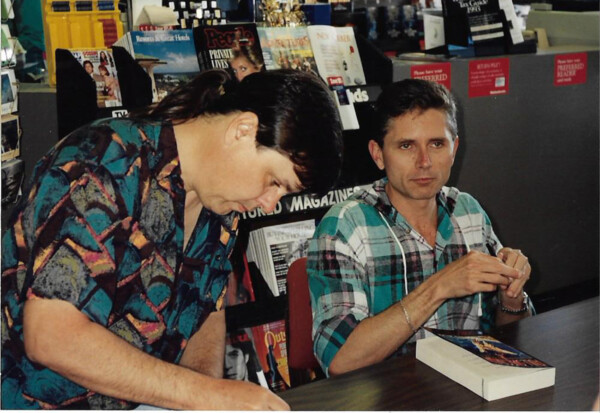
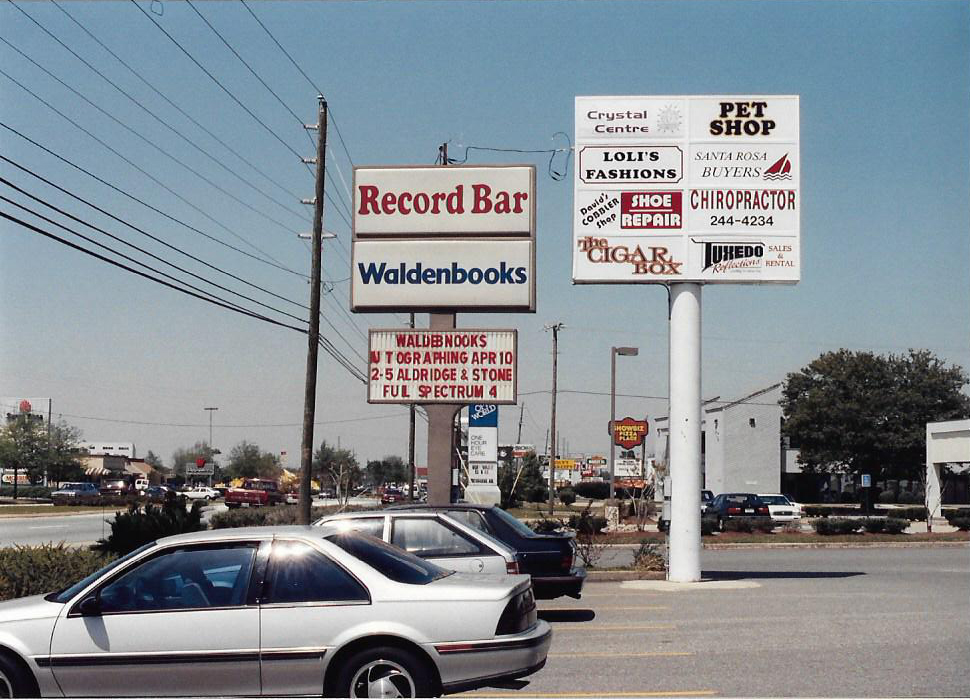
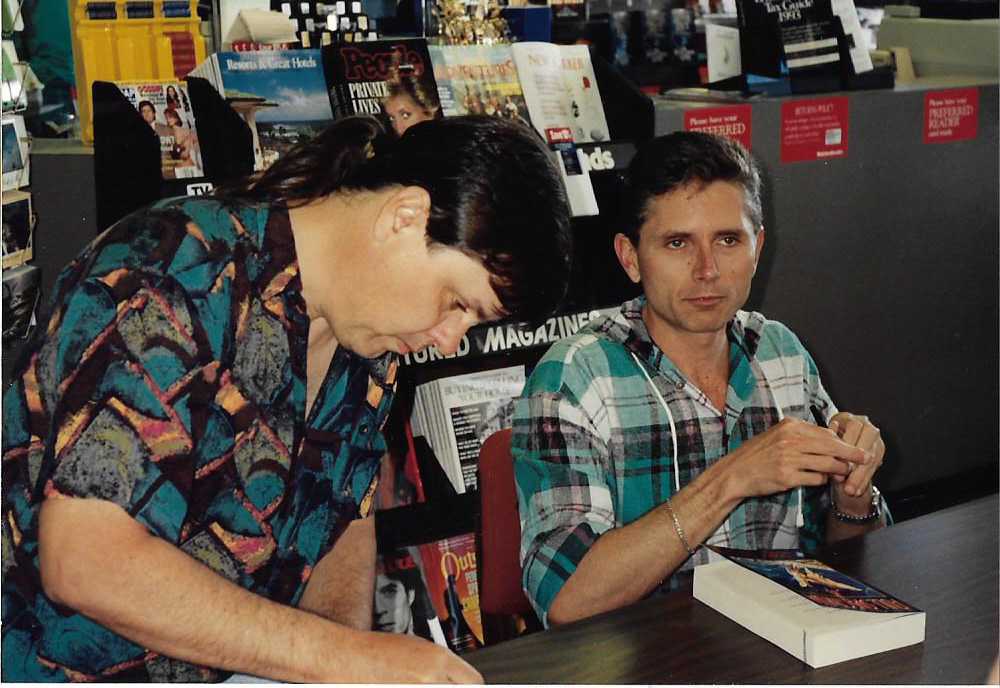
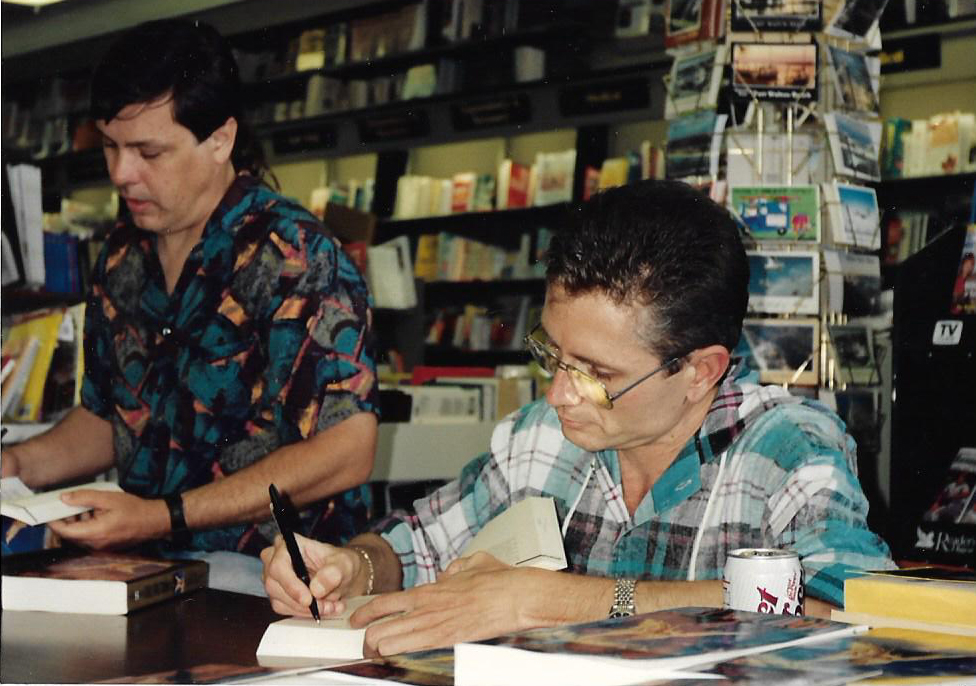
Yours truly (right) signs copies of "Full Spectrum 4" with Ray Aldridge (left) at a signing event at the Waldenbooks at Santa Rosa Mall in Mary Esther, Fla., in 1993. I don't know who took this photo.
I have been writing since the eighth grade. I began selling professionally in the mid–’90s and as recently as last year made the finals of the British Fantasy Award.
Around 2000 I began to wonder if there was any point in continuing. My sense was books were headed in the same direction as newspapers and magazines – marginalized by the web and video games and cell phones … and I guess the general illiteracy that seems to be overtaking the world.
I’ve dedicated a significant portion of my life to learning the use of words as an art form and lately I miss doing that. I suppose it has something to do with work, which has gone from providing an outlet for my creativity to confronting me with a relentless assembly line of button–pushing and software configuring.
But again, is there any point? I pose this question to the professional writers on my friends list who are still writing and, presumably, selling. Are there markets for novels? Do writers get paid for their work? Is the book an end or merely a means to an end, like a movie deal?
I would like to start writing again but I don’t want to do that if it means giving away my work or worse, having it lie fallow in my computer.
I know. That violates every tenet of the artist who is compelled to create regardless of markets and advances and licensing rights issues. Still, when I hear that Bantam Books has been shut down and mid–list writers are being muscled out of the business I wonder if my time wouldn’t be better spent at the local vocational–technical school learning a trade.
So … if you have any thoughts on the subject and would like to comment, I’d appreciate the input.
About the author:
Del Stone Jr. is a professional fiction writer. He is known primarily for his work in the contemporary dark fiction field, but has also published science fiction and contemporary fantasy. Stone’s stories, poetry and scripts have appeared in publications such as Amazing Stories, Eldritch Tales, and Bantam-Spectra’s Full Spectrum. His short fiction has been published in The Year’s Best Horror Stories XXII; Alfred Hitchcock’s Mystery Magazine; the Pocket Books anthology More Phobias; the Barnes & Noble anthologies 100 Wicked Little Witch Stories, Horrors! 365 Scary Stories, and 100 Astounding Little Alien Stories; the HWA anthology Psychos; and other short fiction venues, like Blood Muse, Live Without a Net, Zombiesque and Sex Macabre. Stone’s comic book debut was in the Clive Barker series of books, Hellraiser, published by Marvel/Epic and reprinted in The Best of Hellraiser anthology. He has also published stories in Penthouse Comix, and worked with artist Dave Dorman on many projects, including the illustrated novella “Roadkill,” a short story for the Andrew Vachss anthology Underground from Dark Horse, an ashcan titled “December” for Hero Illustrated, and several of Dorman’s Wasted Lands novellas and comics, such as Rail from Image and “The Uninvited.” Stone’s novel, Dead Heat, won the 1996 International Horror Guild’s award for best first novel and was a runner-up for the Bram Stoker Award. Stone has also been a finalist for the IHG award for short fiction, the British Fantasy Award for best novella, and a semifinalist for the Nebula and Writers of the Future awards. His stories have appeared in anthologies that have won the Bram Stoker Award and the World Fantasy Award. Two of his works were optioned for film, the novella “Black Tide” and short story “Crisis Line.”
Stone recently retired after a 41-year career in journalism. He won numerous awards for his work, and in 1986 was named Florida’s best columnist in his circulation division by the Florida Society of Newspaper Editors. In 2001 he received an honorable mention from the National Lesbian and Gay Journalists Association for his essay “When Freedom of Speech Ends” and in 2003 he was voted Best of the Best in the category of columnists by Emerald Coast Magazine. He participated in book signings and awareness campaigns, and was a guest on local television and radio programs.
As an addendum, Stone is single, kills tomatoes and morning glories with ruthless efficiency, once tied the stem of a cocktail cherry in a knot with his tongue, and carries a permanent scar on his chest after having been shot with a paintball gun. He’s in his 60s as of this writing but doesn’t look a day over 94.
Contact Del at [email protected]. He is also on Facebook, twitter, Pinterest, tumblr, TikTok, and Instagram. Visit his website at delstonejr.com .
ChatGPT
I haven’t seen my friend Dale since we were in middle school. He’s married now, to Danita, and I get a Christmas card from them every year. It just arrived today.
Danita included their e-mail address so I decided to write them a long, long note. This is what I wrote:
Dear Dale and Danita,
As you’ve probably figured out I’m a crappy correspondent. I guess typing at work all day discourages me from coming home and typing all night. Still, I should have done a better job of keeping in touch.
Let’s see, Dale, I think it was 1969 or 1970 that I last saw you – a lot of catching up to do. And Danita, we’ve never met so this will all be new and probably boring as hell. I’ll try to keep the last 40 years as short as possible.
When we moved across town to the “roach shack” as Dad called it I was forced to switch from Pryor Junior High to Meigs. I hated that place. I didn’t know anybody there and the school was run-down … but then so was Pryor. But it was a run-down I was familiar with. Luckily I moved to Choctawhatchee High School the next year, which seemed like heaven compared to Meigs. Choctaw was air-conditioned and had working equipment. Plus, I renewed friendships with some of my pals from Pryor. I took three years of ROTC at Choctaw – not a fun time to be seen marching in uniform as the Vietnam War was in full, hellish swing and everybody hated the military. I can’t count the number of times I was cussed and spit at. But my grades improved dramatically at Choctaw and I even came in second for a scholarship. While I didn’t have a car I got to do some fun things – for instance, a group of us traveled to Cape Canaveral to watch the Apollo 17 moon mission blast off.
I graduated from Choctaw in 1973 and went to OWCC for two years. I majored in playing spades, and minored in smoking cigarettes. My grades were pretty terrible but I wasn’t too worried – I was paying for it, having worked summer jobs on an assembly line at Texas Instruments, washing dishes at a restaurant or delivering newspapers. The latter two jobs were nightmares but the TI job was actually quite good. I paid for almost all of my expenses at OWCC with the money I made that summer.
I then attended the University of West Florida for two years. I majored in communication arts with a minor in English education. I was really into writing by then and wanted some kind of job that would allow me to write, though newspapers weren’t on my radar. My plan was to get a teaching job and write novels at night. UWF was hard because I had to commute from Fort Walton Beach every day. That meant a constant scramble for car pools, or borrowing Dad’s truck. I had run out of money by then so Mom and Dad floated my tuition. Later, when I tried to pay them back, they refused. I sure felt guilty at the time.
During my last quarter at UWF I did my student teaching, and you’ll never guess at what school: Pryor. It was strange because some of my old teachers during the seventh and eighth grades were still there. It was weird sitting in the teachers’ lounge with them. I became the master of the mimeograph machine and soon everybody wanted me to run off their copies for them. But I was less successful in the classroom – I couldn’t control the kids, who looked at me and treated me as though I were a slightly older version of themselves. I guess that was true. They were all 14 and 15 – I was 20. Needless to say I received a terrible evaluation from my supervising teacher and spent the next two years substitute teaching and fruitlessly searching for a teacher’s job.
Finally in 1979, with only a few bucks in the bank, I was offered a job at the Playground Daily News. I had become involved with the Fort Walton Beach Tennis Club and wrote their weekly column. I dropped it off each week at the Daily News. They had an opening for a police reporter. I wasn’t interested in that and turned it down, but later they offered me a job as a copy editor and I accepted it. I planned to stay only through the summer.
Something weird happened, however. I got used to having a regular paycheck. Dad insisted I buy my own vehicle – I was still borrowing his truck! – and my sister sold me her old Pontiac Astre. Now I had car payments. So I stayed.
My job required that I design pages, and I quickly discovered I had a knack for that. The job actually started to be fun. After my first three months the chief of the copy desk departed and I moved up to second in command. I began laying out the front page and the local leadoff page, in addition to inside news pages. I also trained others who came to work on the copy desk. Life became a comfortable routine of going to work Sunday through Thursday from 2 p.m. to midnight, and playing tennis Friday and Saturday. I got to be a pretty good tennis player and before it was all said and done I had won about 50 or 60 tournaments, and at one point had a state ranking. Bear in mind this was strictly at the club B-level. John McEnroe had nothing to fear from me.
Three years into my job I was promoted to design editor and had four other people working for me. I remained in that position for a long time, though I forget exactly how long. We won several awards for page design. In 1987 I redesigned the Daily News and we kept that design until 2006, an unusually long run for a design concept. It worked well.
It was during that time I had my only real relationship, with my girlfriend Sandee. We dated about three years and it seemed inevitable we would get married, but things didn’t work out and I didn’t seriously date anyone after that.
Throughout all this I maintained an interest in writing fiction. I had begun to write short stories when we moved to the “roach shack” in 1969. I sold my first story professionally in 1987, then a poem, to “Amazing Stories,” in 1989. But it wasn’t until 1993 that my writing career really took off. I sold a script to Marvel Comics for their “Hellraiser” series of books based on the Clive Barker movie, and a short story to Bantam Books’ “Full Spectrum” anthology. Afterwards I sold a number of short stories and comic book scripts to publishers like Pocket Books, DAW, Donald I. Fine, Barnes & Noble, Penthouse Comix and Penguin-Putnam, to name a few. My first novel, “Dead Heat,” was published in 1995 and won the International Horror Guild Award for best first novel. It was a runner-up for the Bram Stoker Award. I’ve also had stories in anthologies that won the Stoker and the World Fantasy Award, and just this year was a finalist for the British Fantasy Award. I published two more books, “The Uninvited” in 2000 and just last year, “Black Tide.” I just sold the movie rights to that book and while it hasn’t been greenlighted for a film, I continue to hope that will happen.
Meanwhile at work, I was promoted to assistant managing editor in 1993. The newsroom was restructured in the early 2000s and I became the features editor, then in February of this year I graduated to online editor. I was recently named the assistant editor of the newsroom.
That all sounds very lofty but the truth is changes in the industry have not been kind to newspapers. Our staff has been cut dramatically and while I still have a job, we have fewer reporters than we did when I started at the Daily News in 1979. By the way, the name of the paper has been changed to the Northwest Florida Daily News. Our website continues to experience good growth. When I started as online editor the site recorded a monthly page-view average of just over 2 million; now it is closer to 3 million, and sometimes over that.
Life for me has become fairly quiet. In my 20s and 30s I was a bit of a partier and Del’s house was always Ground Zero for whoever wanted to go out and have a good time. Now, I am content to come home, get some work done, have a few beers and kick back.
Back in the early ’90s I had the big idea of adopting a couple of cats from the local animal shelter. Those cats were with me a long time. Maggie died of renal failure in 2005, and Pavlov is suffering from the same condition right now. After he goes I doublt I’ll be getting any more pets – the sadness of watching them go through this is too much!
I have two more novels in the works and I’m hopeful the day will come when I can write full time. I’m not sure there’ll be a market for them but it’s something I enjoy doing and I can’t think of a better way to spend my retirement – grubbing around in the dirt and writing.
My dad died in 1998 but Mom is still going strong. In fact, she just bought a new car – a Nissan Versa – which should serve her well as gas prices start to inch back upward. I have a clunky old Nissan Pathfinder which I can’t bear to part with, and a 2006 Scion tC.
My sister Pat lives in Crestview with her husband, George. She has three kids: Christopher, a recording studio technician, and Michael, who’s in the Air Force Reserve and is married. He has three kids. Pat’s oldest is Liz, who lives in Utah and has a son. My other sister, Sandie, lives in Ohio with her husband, Frank. They have one daughter, Susan, who’s a doctor and married to Dan. They have two boys.
And that’s it! Quite a mouthful, huh? You should drop me a line and let me know how life has been treating you the past 40 years.
OK, time to go. There’s something in the fridge with my name on it.
Take care,
Del
About the author:
Del Stone Jr. is a professional fiction writer. He is known primarily for his work in the contemporary dark fiction field, but has also published science fiction and contemporary fantasy. Stone’s stories, poetry and scripts have appeared in publications such as Amazing Stories, Eldritch Tales, and Bantam-Spectra’s Full Spectrum. His short fiction has been published in The Year’s Best Horror Stories XXII; Alfred Hitchcock’s Mystery Magazine; the Pocket Books anthology More Phobias; the Barnes & Noble anthologies 100 Wicked Little Witch Stories, Horrors! 365 Scary Stories, and 100 Astounding Little Alien Stories; the HWA anthology Psychos; and other short fiction venues, like Blood Muse, Live Without a Net, Zombiesque and Sex Macabre. Stone’s comic book debut was in the Clive Barker series of books, Hellraiser, published by Marvel/Epic and reprinted in The Best of Hellraiser anthology. He has also published stories in Penthouse Comix, and worked with artist Dave Dorman on many projects, including the illustrated novella “Roadkill,” a short story for the Andrew Vachss anthology Underground from Dark Horse, an ashcan titled “December” for Hero Illustrated, and several of Dorman’s Wasted Lands novellas and comics, such as Rail from Image and “The Uninvited.” Stone’s novel, Dead Heat, won the 1996 International Horror Guild’s award for best first novel and was a runner-up for the Bram Stoker Award. Stone has also been a finalist for the IHG award for short fiction, the British Fantasy Award for best novella, and a semifinalist for the Nebula and Writers of the Future awards. His stories have appeared in anthologies that have won the Bram Stoker Award and the World Fantasy Award. Two of his works were optioned for film, the novella “Black Tide” and short story “Crisis Line.”
Stone recently retired after a 41-year career in journalism. He won numerous awards for his work, and in 1986 was named Florida’s best columnist in his circulation division by the Florida Society of Newspaper Editors. In 2001 he received an honorable mention from the National Lesbian and Gay Journalists Association for his essay “When Freedom of Speech Ends” and in 2003 he was voted Best of the Best in the category of columnists by Emerald Coast Magazine. He participated in book signings and awareness campaigns, and was a guest on local television and radio programs.
As an addendum, Stone is single, kills tomatoes and morning glories with ruthless efficiency, once tied the stem of a cocktail cherry in a knot with his tongue, and carries a permanent scar on his chest after having been shot with a paintball gun. He’s in his 60s as of this writing but doesn’t look a day over 94.
Contact Del at [email protected]. He is also on Facebook, twitter, Pinterest, tumblr, TikTok, and Instagram. Visit his website at delstonejr.com .
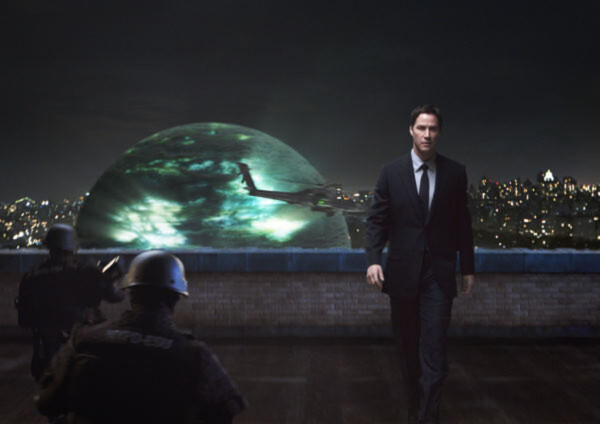
Klaatus (Keanu Reeves) arrival on Earth via a giant sphere, triggers a global upheaval.
Image courtesy of 20th Century Fox.
—
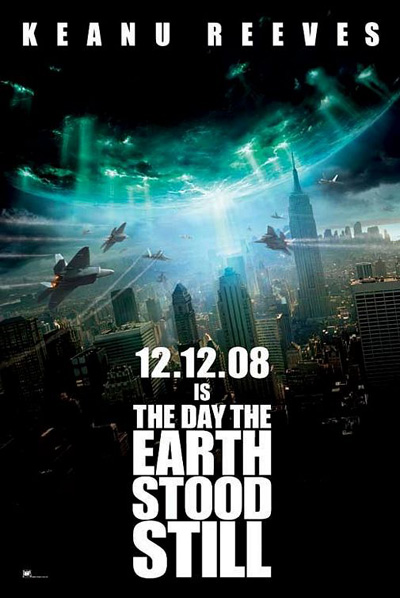
“The Day the Earth Stood Still,” starring Keanu Reeves, Jennifer Connelly, Kathy Bates, Jaden Smith, and John Cleese. Directed by Scott Derrickson, 103 minutes, rated PG-13.
Mladen’s take
Add the recently released re-make of “The Day the Earth Stood Still” to the ever-growing list of hokey films about redemption.
In fact, if you’re tired of watching Rudolph the red-nosed reindeer and his dwarf friend discover that they’re wonderful beings no matter what anyone else believes, consider “The Day the Earth Stood Still” as alternative holiday viewing fare. Here, the whole of humanity is redeemed.
There are no subtleties in this sci-fi movie.
Klaatu, the alien portrayed by Keanu Reeves, arrives aboard a cloudy, sparkling sphere. He’s an interstellar diplomat without portfolio sent by a god-like cabal of deep-space civilizations.
Klaatu’s mission is to evaluate Earth’s health. The prognosis ain’t good.
It isn’t too long before he tells astrobiologist and unwitting ally Helen Benson, played by Jennifer Connelly, that extra-galactic help would be needed to save the planet.
Benson assumes that means helping humanity but eventually figures out she’s mistaken. Klaatu had concluded that the only way to save Earth is by eradicating mankind.
The universal diplomat, protected by GORT, a very impressive gigantic automaton comprised of nano-sized wasps behaving as a single being, initiates Operation Roach Motel after explaining to Benson that, in essence, humanity is a cosmic error.
Meanwhile, what does the U.S. Defense Department do when it encounters hyper-intelligent, unbelievably technologically sophisticated entities from distant worlds? It tries to kill them, of course.
Throughout the movie, Klaatu or GORT turn military target acquisition devices, laser illuminators and high-performance aircraft against the troops using them. The aliens – masters of the electro-magnetic spectrum, severe traumatic injury repair, pure reason, and unemotive faces – gain control of the weapons systems by wireless hacking.
It takes Benson’s unceasing effort to protect her belligerent young stepson and a brief exchange of mathematical equations and a little conversation with a Nobel Prize-winning scientist for Klaatu to start recognizing that humanity ain’t all bad.
It seems – and this has never, ever, been expressed in other movies, books, poems, pamphlets, hieroglyphics or pre-Sumarian script – that humanity can become its best only after demonstrating its worst. The Nobel laureate argues that mankind has some kind of intrinsic sense that will let it know when there has been enough bloodletting and destruction of the environment, as well as the moral fortitude to correct those mistakes when the time comes.
Klaatu starts seeing the microscopic good among the overwhelming evil around him and reverses his decision to obliterate all traces of humanity. The mechanism for scraping clean the Earth’s surface is the neatest visual part of the movie. GORT dissolves into a swarm of flying nano-bots that consumes everything in its path, organic or inorganic.
The swarm is one of a few transparently biblical references in “The Day the Earth Stood Still.” Hell, at one point Klaatu even walks on water. Hallelujah.
“The Day the Earth Stood Still” is an OK movie, probably worth the price of a matinee ticket. But, I’m worried about Reeves. Come on, man, next time give me something as spectacular and revolutionary as “The Matrix.”
Del’s take
It isn’t the Earth that’s standing still – it’s Hollywood.
Talk about a movie that didn’t need remaking. “The Day the Earth Stood Still” circa 1951 is a Robert Wise classic that to this day presents a quietly dignified message about the follies of war.
“The Day the Earth Stood Still” circa 2008 is a diabetic coma-inducing fried Snickers bar of a mess, covered with sugar-dot cliches and gluey nuggets of contrived melodrama – all of it wrapped in a cloying caramel blanket of unconvincing CGI.
I’m still trying to figure out which cliché most nauseates me – the save-the-environment cliché, the racial-harmony cliché, the empowered woman cliché, the all-government-employees-are-evil cliché, the stupid-military cliché … see what I mean? One more cliche and you’d have a C-bomb big enough to do the aliens’ work for them.
Most of the characters in “The Day the Earth Stood Still” are cardboard cut-outs with Keanu Reeves winning the Oscar for Best Performance by a Stoned-Out Quualude Refugee. The lone exception is Will Smith’s kid, Jaden, who plays the rebellious and disrespectful stepson of Jennifer Connelly’s Helen Benson character (has there ever been a stepchild who liked his new mom or dad?).
Let’s not talk about logic flaws … well heck, let’s do.
Here’s the deal: The aliens have come to Earth because there are few habitable planets in the galaxy and humanity is ruining this one. To fix everything the aliens plan to unleash a biblical horde of tiny robots that will dismantle mankind molecule by molecule, restoring the earth to pristine form … presumably to serve as home base for a future alien megalopolis.
Stop and think about it – if E.T. has that kind of technology, why not unleash it on an uninhabitable world, making it habitable? Science calls the process “terraforming,” a piece of cake for Klaatu and pals.
But then there’d be no movie – albeit a stupid movie, and be $8 to the richer. And I could use that $8 to make the world a better place so we’d never again be afflicted with Keanu Reeves.
Or I could just buy beer to wash away the taste of this nasty movie.
Mladen Rudman is a former journalist and technical writer. Del Stone Jr. is a journalist and author.
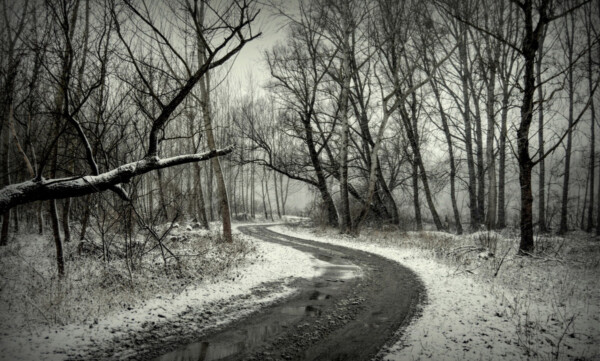
It was like climbing out of bed to discover that sometime during the night the sun had come out, melting just enough of the snow to reveal something you thought you had lost.
In this case, a magazine that featured articles.
Not factoids, text bites, or quick hits.
Actual, honest-to-God articles that sprawled across glossy page after page, the words unwinding like bird tracks across a field of fresh, downy flakes.
What delicious warmth in the long winter of my discontent. I sat back and started to read, and as I did so I felt my brain beginning to thaw, the sweating ice cracking and falling away in noisy chunks to reveal the succulent pink flesh of contemplation.
Good God. What was I doing? Text messages needed sending, e-mails answered, blogs posted and TV shows DVRed and videos edited and games played and songs downloaded and .. and. …
Screw it. I was reading. Wasting half an hour of my life on the thoughts of another. As the storm of technology howled unanswered, I basked in my snuggly oasis and allowed my mind to slip away from the present.
What an unaccustomed wonder this was and how sad I had ever set it aside – except I hadn’t set it aside, at least not in spirit. As my thoughts turned from reading to not reading I began to realize I had been stupid and lazy. I had seen this technological nor’easter approaching many years ago and did nothing to prepare. Now I was stuck.
Was it fear? I asked myself. Fear of being left behind by those immaculate creatures on park benches, their laptops humming with stock trades and pirate videos from the Beijing biterati? Would I never babble into a cell phone and bark orders to the car stereo, or sit in a restaurant wearing a Bluetooth-enabled earpiece and ignore my dinner mates to chat with Sophie in Bucharest? Would I become the source of pitying stares, like the “old people” I know who cannot customize a MySpace page or attach photos to their telephone contacts?
Would I become irrelevant?
Or was I merely seduced by all the talk and glitter – buy this device, go to this Web site, join the 21st century and multitask, or your life will no longer hold meaning?
My life is not meaningless but I think it odd and somewhat ominous that I clearly remember events from my unwired youth but, were it not for my blog, cannot recall much of what I did last year. I know that my days began around 6 and ended at midnight.
I know I was online.
I know I was not very happy.
When I was a kid I read – books that promised a future of flying cars, labor-saving gadgets and a race of poets and philosophers who would no longer discriminate or persecute or fight wars.
It hasn’t worked out that way.
The future has become a place where people no longer think because they have no time to think. They are busy doing more with less, grimly slogging through the demands technology has placed upon us, economic and cultural. The time people spent preparing dinner, meeting their neighbors and, yes, reading to their children, has been replaced by “customer care” live chats, inscrutable documentation, and the insipid prattle of wireless and online “dialogue.”
To paraphrase Garrison Keillor, technocracy has bestowed a profound ugliness on the land, and it would make you ugly too.
I am tired of hearing that people no longer read. I am tired of watching newspapers fail and turn to America’s inner 12-year-old for salvation. I am tired of buying a magazine that publishes nothing meatier than three paragraphs.
And mostly I am tired of hearing people ask: What has gone wrong?
Isn’t it obvious? We grapple with issues like crime, addiction, war, illiteracy, and turn to Big Brother for answers. Yet it is Little Sister, corporate America, that pimps and sells and tells us to click here for solutions.
Stupidly, and lazily, we click.
The written word is an art form. More importantly it is a discipline – to produce and consume. It requires cognitive shoveling, and that is the very thing that cannot be done when one is distracted by every little blinking, blaring, pulsating thing.
As we frantically scrabble for some hint of Warholian worth in this wired world, the distraction never stops flying.
We have turned on, tuned in and dropped out, but Timothy Leary must be tripping in his grave. Our grip on this world has become a fat wallowing in narcissism encouraged by the people who give us concealer and star status on YouTube.
Meanwhile, it’s a damn cold day outside. But I am warming myself by a fire, about to throw on another log, maybe a collection of essays or even a book.
As the freezing white pixels swirl around me.
About the author:
Del Stone Jr. is a professional fiction writer. He is known primarily for his work in the contemporary dark fiction field, but has also published science fiction and contemporary fantasy. Stone’s stories, poetry and scripts have appeared in publications such as Amazing Stories, Eldritch Tales, and Bantam-Spectra’s Full Spectrum. His short fiction has been published in The Year’s Best Horror Stories XXII; Alfred Hitchcock’s Mystery Magazine; the Pocket Books anthology More Phobias; the Barnes & Noble anthologies 100 Wicked Little Witch Stories, Horrors! 365 Scary Stories, and 100 Astounding Little Alien Stories; the HWA anthology Psychos; and other short fiction venues, like Blood Muse, Live Without a Net, Zombiesque and Sex Macabre. Stone’s comic book debut was in the Clive Barker series of books, Hellraiser, published by Marvel/Epic and reprinted in The Best of Hellraiser anthology. He has also published stories in Penthouse Comix, and worked with artist Dave Dorman on many projects, including the illustrated novella “Roadkill,” a short story for the Andrew Vachss anthology Underground from Dark Horse, an ashcan titled “December” for Hero Illustrated, and several of Dorman’s Wasted Lands novellas and comics, such as Rail from Image and “The Uninvited.” Stone’s novel, Dead Heat, won the 1996 International Horror Guild’s award for best first novel and was a runner-up for the Bram Stoker Award. Stone has also been a finalist for the IHG award for short fiction, the British Fantasy Award for best novella, and a semifinalist for the Nebula and Writers of the Future awards. His stories have appeared in anthologies that have won the Bram Stoker Award and the World Fantasy Award. Two of his works were optioned for film, the novella “Black Tide” and short story “Crisis Line.”
Stone recently retired after a 41-year career in journalism. He won numerous awards for his work, and in 1986 was named Florida’s best columnist in his circulation division by the Florida Society of Newspaper Editors. In 2001 he received an honorable mention from the National Lesbian and Gay Journalists Association for his essay “When Freedom of Speech Ends” and in 2003 he was voted Best of the Best in the category of columnists by Emerald Coast Magazine. He participated in book signings and awareness campaigns, and was a guest on local television and radio programs.
As an addendum, Stone is single, kills tomatoes and morning glories with ruthless efficiency, once tied the stem of a cocktail cherry in a knot with his tongue, and carries a permanent scar on his chest after having been shot with a paintball gun. He’s in his 60s as of this writing but doesn’t look a day over 94.
Contact Del at [email protected]. He is also on Facebook, twitter, Pinterest, tumblr, TikTok, and Instagram. Visit his website at delstonejr.com .