My one and only San Diego Comicon
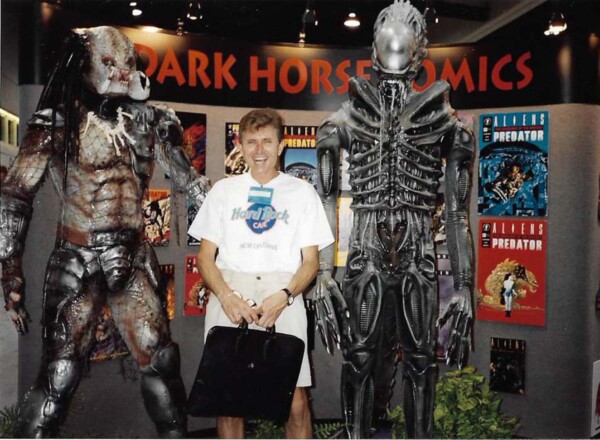
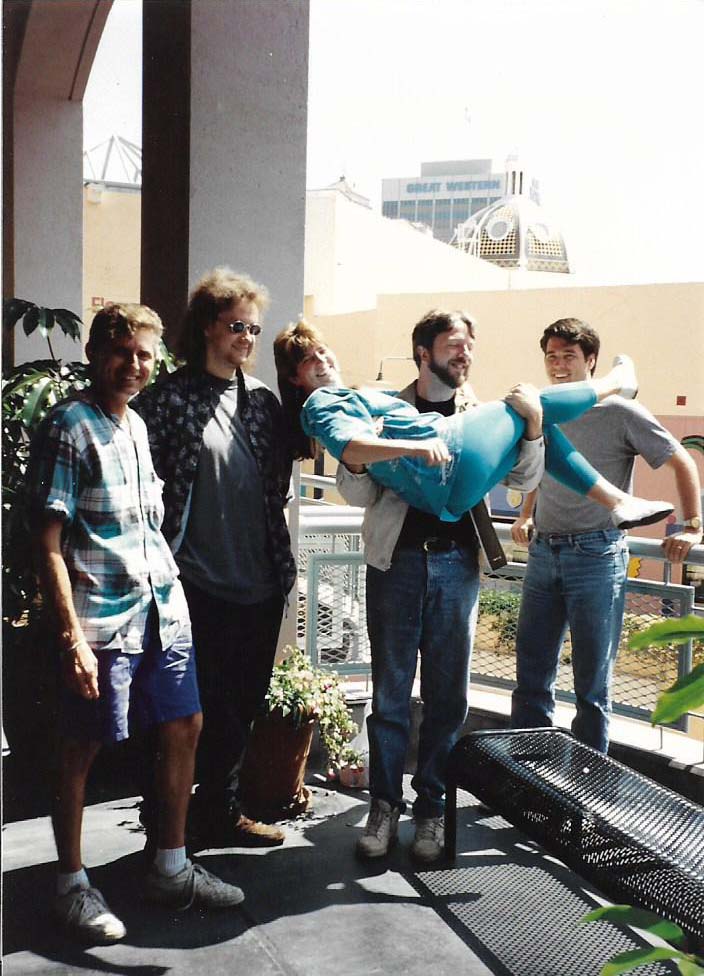
The author at the '94 San Diego Comicon. Image courtesy of Lurene Haines
In the summer of 1994 I participated in the San Diego Comicon as a guest. It was to be my first and last visit.
My credentials hardly qualified me as a “guest.” I went there largely on the coattails of cover artist Dave Dorman and his then-wife, Lurene Haines. I’d known Dave and Lurene since the early ‘90s; Lurene joined our science fiction-horror writers group, which at the time consisted of me, my friend Ray Aldridge, Ed Sears and his daughter Vicki, and Richard Bamberg. We usually met at a local saloon named Chan’s, which sat on the limb of a tranquil bayou. Our meetings were anything but tranquil. Fueled by too much beer, we raucously critiqued each other’s work, and usually extended the meeting to a nearby poolhall, Starcade. Sometimes Dave would join us. That’s how we met.
Lurene was constantly encouraging us to try our hands at scripting comic books. As a kid I’d read comics – in Spain, where there was no TV and precious little radio. We had no other option … well, I suppose I could’ve read a book, but c’mon! I was 6 years old. But as I grew older and passed through my TV-watching stage, I turned to books, and as I began writing my own stories it was in the narrative style of novels and short stories, not the scripted style of comics.
Still, when Lurene told us about the money to be made, I was tempted – especially when she floated a possible project with Marvel Comics. Seems their Epic imprint was looking for scripts for Clive Barker’s “Hellraiser” series. I’d read Barker’s “Books of Blood” and “The Hellbound Heart” upon which “Hellraiser” was based, and I knew the basic premise – successfully manipulate the Lament Configuration (and you could do so only if you were deservingly evil) and a lifetime of torment followed.


I sat down and wrote my first script, modeled on the style of a script Dave and Lurene loaned me. When I was done I gave it to Lurene, who submitted it with a script she had written for “Hellraiser” editor Dan Chichester. A few weeks later, voila! Both were accepted and suddenly I was a comic book writer. About the same time I sold my first short story to a professional publisher, Bantam-Spectra’s “Full Spectrum” anthology series. Now I as a dual-track writer – comics and prose.
A year or so later I was commiserating with Dave and Lurene about my future as a writer, and how I’d like to do the job full-time. They’d been encouraging me to take on more work in comics, and they wanted me to start going with them to conventions. I knew from experience that if you wanted writing jobs you had to attend conventions – that’s where you meet editors, make impressions, and get future jobs. It’s also where you learn about future projects that aren’t advertised to the public body of writers. That was one of my greatest frustrations as a beginning writer – it seemed a vast body of markets existed just beyond my reach, simply because I didn’t know about them, or hadn’t been invited to submit. And that was because none of these editors knew I existed. I didn’t attend conventions.
So I sat down with Dave and Lurene one afternoon and basically said “Yes, I’ll go to conventions with you. I want to get into comics.” Hence, my departure for San Diego one summer morning in 1994.
I really didn’t know how lucky I was – to have an entre to the professional world of comic book publishing at the hands of Dave Dorman, one of the greatest cover artists of our time … he opened far more doors for me than I deserved. I’ve never had a good opinion of myself as a writer. Bottom line? I’m not really very smart. Most writers I know are smart people who can not only come up with a story idea but conceive it both artistically and mechanically, something that was impossible for me to do. My approach was to jump in, see what worked, and rewrite – not the most efficient process. And if you asked what I was attempting to “say” with a particular work I likely couldn’t tell you. I just didn’t know. I didn’t know because I wasn’t very smart.
But I did know comic book artists were perhaps not the best storytellers – visually, yes. But plot-wise? Maybe not. Some were. But based on what I was seeing in contemporary comics, the stories to a large extent seemed thin, the artwork overpowering. So maybe there was a place in comics for a prose writer, even a lame, half-assed prose writer like myself.
You may remember in the late ’80s through the mid-’90s comics enjoyed a renaissance thanks to the collectibles market. We were part of that boom. There was good money to be made – excellent money – if you could get the work. And Dave was getting the work, so much he couldn’t keep up with it all. This was prior to the wave of comics-to-movies but you could see that coming down the road as science fiction, fantasy and horror inserted themselves into the popular entertainment medium. It really did look like the sky was the limit.
In 1994 Comicon was not the gigantic multi-media con it is today. Mostly it concentrated on comics and graphic novels. You did see the occasional celebrity but nothing like the extravaganza that just played out in San Diego.
Here are my impressions:
The flight to San Diego: I could never become a habitue of the convention circuit because I hate flying, and most of the big cons are located across country. Comicon is in San Diego. Chicago hosts another big comic convention. The World Fantasy, World Horror and World Science Fiction conventions travel around the country.
I remember the flight from Pensacola to San Diego as an endurance test of counting the minutes. In fact, it inspired me to write a short story, “The Fear of Fear Itself,” which was published in the Pocket Books anthology “More Phobias.”
As we were on final approach to San Diego International Airport, Lurene said, “Hey Del, look out the window.” I did, and all I could see were buildings – we were flying between skyscrapers! The airport sits in the middle of town, right on the water, and sometimes the approach takes you through buildings on the hills around the harbor. It was very scary for somebody who doesn’t like to fly.
The airport: I was astonished at how small the airport was. Space is at a premium in San Diego, and the tiny airport is a product of that confined area. Our plane didn’t even park next to a skyramp – we climbed down stairs and walked across the tarmac to the terminal, which was very dark and somewhat run-down. As I looked back to the airplane I saw a fluid dripping from one of the engines. Thank God I hadn’t seen that before we took off.
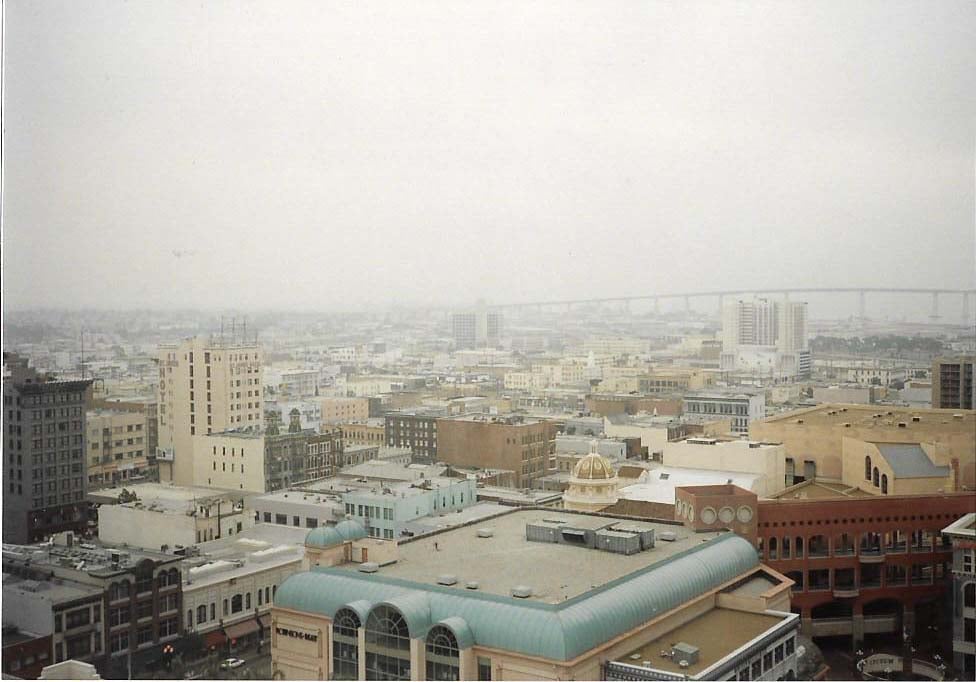
San Diego itself: Because of its small area for such a large city, San Diego is very tightly and efficiently laid out. It’s got lots of restaurants, hotels and shopping areas, including a very neat vertical shopping center, Horton Plaza, that lay within walking distance of the Westin San Diego, where we were staying.
Jogging with a DC editor: Every morning Lurene and I arose before sunup and went jogging with an editor from DC. I believe it was John Nee though I may be mistaken. He set a “brisk pace,” which is to say I was nearly exhausted by the time we finished. I remember talking with him in the hotel lobby one morning. I turned the subject to comic books and he very quickly said, “That’s work. Let’s not talk about work.” I learned at that moment many editors attend conventions to socialize, not network per se, and that knowledge served me well over the coming years.
The Convention Center: The San Diego Convention Center epitomizes what convention centers should be about. It’s a large, modern structure, right on the water, and becomes the focal point of the hotel, restaurant and shopping district. I also remember it being very hot inside – you cram 10,000 fanboys-girls into a confined space with multi-media platforms running at virtually every booth and you get some serious heat. I remember sweating the entire time I was there. I remember when I was there peeking behind a curtain at a Ford display of the new model Mustang. Interesting!
The fans: Even in 1994 the convention was packed! You could barely navigate the walkways and it was difficult to approach a booth. Many fans were dressed in costumes, which is not unusual. I’d attended enough conventions to become inured to that reality. Many of the costumes I couldn’t identify – I simply wasn’t that familiar with comics.
Kij Johnson: I met one other prose writer there, Kij Johnson. We were so relieved to run into one another. We chatted for a few minutes then went our separate ways, but it was nice to encounter a kindred soul of prose.
The celebrities: I encountered only two celebrities while I was there, Clive Barker and John Ritter. Barker was making his way through a crowd and I didn’t get to speak to him. You’ll laugh when I saw this, but I thought he’d be taller. Ritter was standing in the Westin parking garage with a passel of kids, waiting for his car to be brought to him by the valet. I didn’t get a chance to talk to him either.
The convention: I say this for the sake of honesty: I felt like a fish out of water. I was unfamiliar with the comic book monde and I knew none of these people. Lurene was pressuring me to “do business” and I’m sure any “business” I did was counterproductive as there was no way to disguise my ignorance. The extent of my comic book work consisted of one “Hellraiser” story and a novella titled “Roadkill,” published by Caliber. Consequently, nobody knew who I was either and they were not willing to waste time on an unknown quantity like yours truly. So I spent the first two days wandering the convention hall, picking up as many business cards as I could and talking to whomever would listen to me. It didn’t seem my time there was very productive yet I was spending a small fortune on plane fare, the hotel, and eating at pricey restaurants. So finally on Day 3 I said to hell with it and spent the day at Horton Plaza, shopping. I was exhausted and more than a little depressed. It seemed I had no place there and wouldn’t have until I’d educated myself about the world of comics, and published a few more projects. I spent one more day at the convention, basically accomplishing nothing, and thankfully we left the next day.
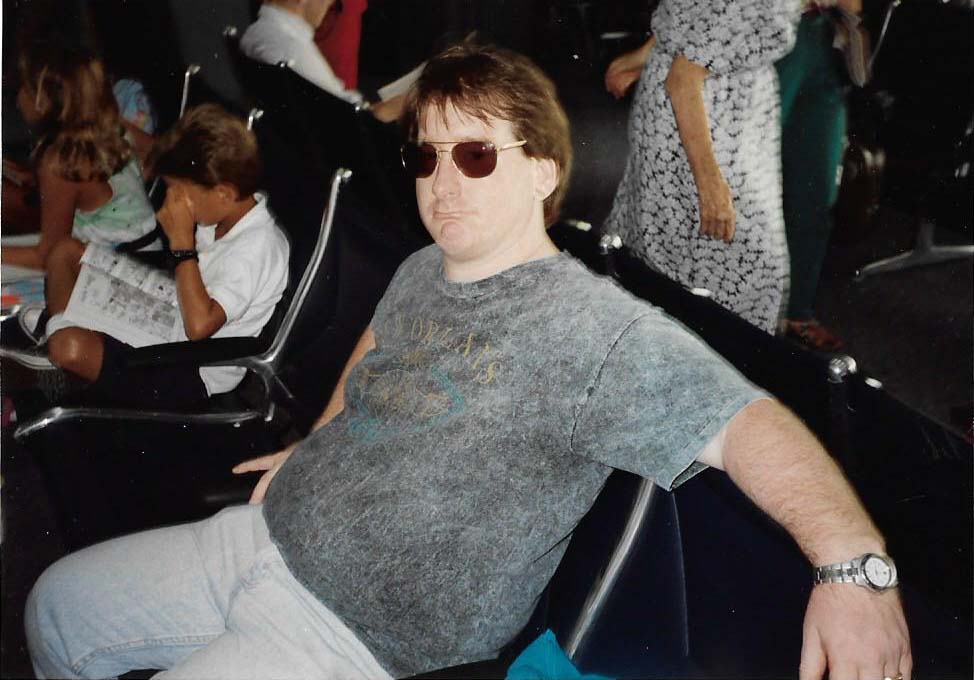
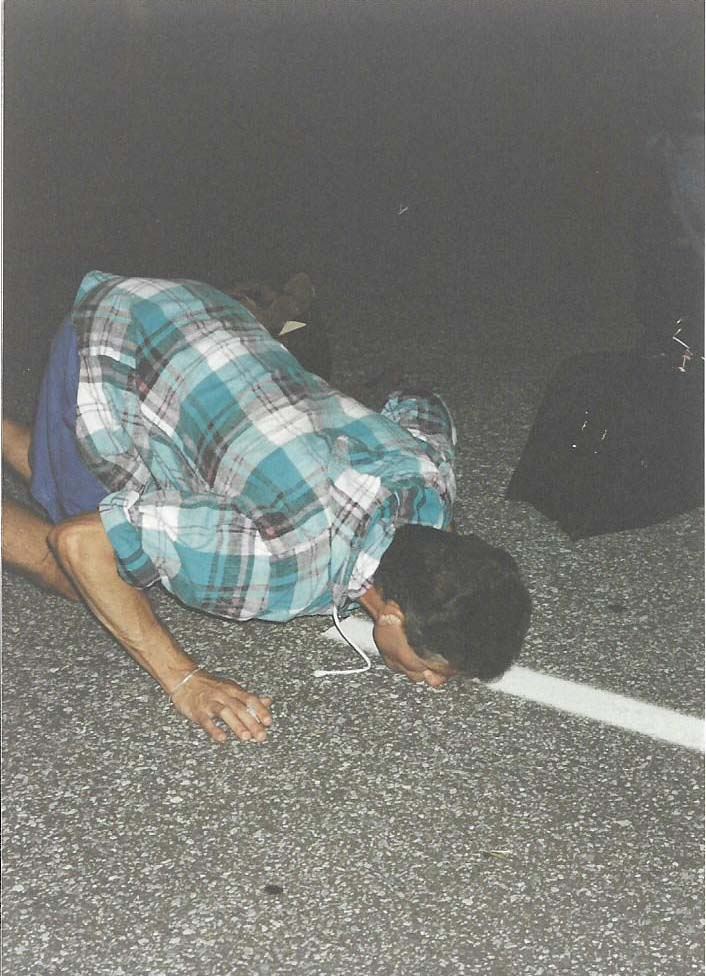
The ride back: The flight out of San Diego was turbulent. By this time Lurene had assumed the role of official Calmer of Del on the Plane Flight and spent the first 30 minutes assuring me these bumps and bounces were perfectly normal. My God, I couldn’t think of anything more awful than being trapped in a metal tube five miles above the ground with nowhere to go and nothing to do if anything went wrong. When we arrived in Pensacola that night I dropped to my knees in the parking lot and kissed the ground. It was the end of our convention travels for the year. I think they got a picture of that.
Shortly thereafter I suffered a kind of existential overload and temporarily called an end to my convention travels. Work was overwhelming, I was experiencing a great deal of turmoil in my personal life, and I was not happy with my writing life. Dave was getting me tons of work, but over time I began to realize that while my ego and my bank account liked comics, my heart belonged to prose. But all was not well in the prose world either. I was receiving invitations to themed anthologies, but found myself balking at the write-a-story-to-fit-the-premise requirement. Worse, I had just gotten access to the Internet and found myself wondering if the web would allow time in anyone’s day to read a book, and if reading itself would fall out of fashion. The prospects for a barely competent writer like myself making a living of novels seemed daunting at best.
Toward the end of the ’90s and into the 2000s, I found myself writing less. I was constantly distracted by online stuff, and the idea of sitting behind the computer for hours on end, doing something that was similar to what I did at work all day, struck me as unfathomable. I did manage to finish a novella which became a finalist for the British Fantasy Award, and I took a great deal of pride in that (although it was savaged by British critics). I managed to publish a short story here and there. But it seemed the momentum was lost. Today, I wouldn’t even know how to go about submitting a written work to a publication, and I know nothing about the self-publishing industry. Seeing as how that’s where books like “Twilight” and “Fifty Shades of Gray” came from, perhaps I should.
I always be indebted to Dave and Lurene for trying to help me.
But I don’t think I’ll be attending any more Comicons.
About the author:
Del Stone Jr. is a professional fiction writer. He is known primarily for his work in the contemporary dark fiction field, but has also published science fiction and contemporary fantasy. Stone’s stories, poetry and scripts have appeared in publications such as Amazing Stories, Eldritch Tales, and Bantam-Spectra’s Full Spectrum. His short fiction has been published in The Year’s Best Horror Stories XXII; Alfred Hitchcock’s Mystery Magazine; the Pocket Books anthology More Phobias; the Barnes & Noble anthologies 100 Wicked Little Witch Stories, Horrors! 365 Scary Stories, and 100 Astounding Little Alien Stories; the HWA anthology Psychos; and other short fiction venues, like Blood Muse, Live Without a Net, Zombiesque and Sex Macabre. Stone’s comic book debut was in the Clive Barker series of books, Hellraiser, published by Marvel/Epic and reprinted in The Best of Hellraiser anthology. He has also published stories in Penthouse Comix, and worked with artist Dave Dorman on many projects, including the illustrated novella “Roadkill,” a short story for the Andrew Vachss anthology Underground from Dark Horse, an ashcan titled “December” for Hero Illustrated, and several of Dorman’s Wasted Lands novellas and comics, such as Rail from Image and “The Uninvited.” Stone’s novel, Dead Heat, won the 1996 International Horror Guild’s award for best first novel and was a runner-up for the Bram Stoker Award. Stone has also been a finalist for the IHG award for short fiction, the British Fantasy Award for best novella, and a semifinalist for the Nebula and Writers of the Future awards. His stories have appeared in anthologies that have won the Bram Stoker Award and the World Fantasy Award. Two of his works were optioned for film, the novella “Black Tide” and short story “Crisis Line.”
Stone recently retired after a 41-year career in journalism. He won numerous awards for his work, and in 1986 was named Florida’s best columnist in his circulation division by the Florida Society of Newspaper Editors. In 2001 he received an honorable mention from the National Lesbian and Gay Journalists Association for his essay “When Freedom of Speech Ends” and in 2003 he was voted Best of the Best in the category of columnists by Emerald Coast Magazine. He participated in book signings and awareness campaigns, and was a guest on local television and radio programs.
As an addendum, Stone is single, kills tomatoes and morning glories with ruthless efficiency, once tied the stem of a cocktail cherry in a knot with his tongue, and carries a permanent scar on his chest after having been shot with a paintball gun. He’s in his 60s as of this writing but doesn’t look a day over 94.
Contact Del at [email protected]. He is also on Facebook, twitter, Pinterest, tumblr, TikTok, and Instagram. Visit his website at delstonejr.com .
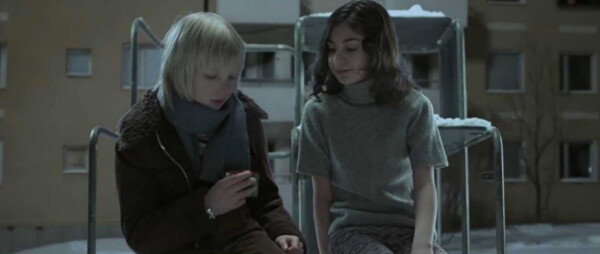
Image courtesy of EFTI, Sveriges Television and Filmpool Nord.
—
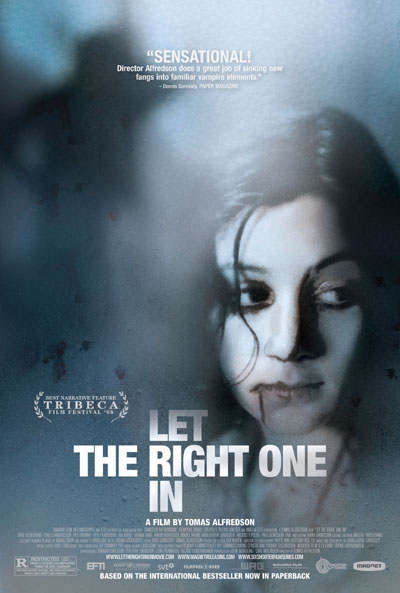
“Let the Right One In” Starring Kare Hedebrant, Lena Leandersson, Per Ragnar, Karen Bergquist. Directed by Tomas Alfredson. 115 minutes. Rated R.
Del’s take
You’re a 12-year-old boy and the bullies at school are eating your lunch. Wouldn’t it be nice if you could invoke the powers of your vampire girlfriend for a bloody session of attitude adjustment?
That’s the premise of “Let the Right One In,” a Swedish vampire flick that eerily and effectively reminds us that love comes along when it’s least expected, and from the unlikeliest of angles.
Oskar (Kare Hedebrant) is a pale, frail wisp of a boy who receives the unwanted attentions of a trio of bad boys at his school in the Stockholm suburb of Blackeberg. He fantasizes about revenge, sticking a knife into a tree and clipping newspaper articles about murders.
His home life isn’t much better. His parents are divorced. His alcoholic father lives in the country with a male friend while his mother works full-time and comes through the front door frazzled and worried. He spends much of his time at his apartment complex’s playground, dreaming of the escape he will never make happen.
He meets Eli (Lena Leandersson), the strange girl who has moved into the unit next door. She only comes out at night and seems impervious to the Swedish cold. Despite her pronouncement that she doesn’t want to be friends the two are drawn to each other, perhaps by their mutual strangeness.
Soon, bizarre murders haunt the streets of Blackeberg and Oskar, with Eli’s encouragement, stands up to his tormentors – the results are tragic. Still, “Let the Right One In” provides an option for hope.
But its most powerful virtue is the subtle elegance of its storytelling. “Let the Right One In” is flecked with moments of brutality, as any good 21st century vampire story must be. But it is also a serene journey through quiet, nighttime snowfalls, the unremitting gray of winter and the inevitable slide into dissolution that in this case is tempered by a weird redemption.
American audiences will not like the subtitles but never fear, in the tradition of “The Ring” and “The Grudge,” an Americanized version is due out this year.
“Let the Right One In” is not a movie for children or adults with timid constitutions. For everyone else it is a strange poem that will leave an uneasy impression that like water – or blood – love finds a way into the hardest of hearts.
Mladen’s take
It’s clear by watching “Let the Right One In” that a vampire-friend would be useful if you’re the victim of bullies in middle school. Any middle school. Even a middle school in Sweden, where this very good, intermittently troubling film was made.
Before proceeding, let me stress that the penultimate scene in “Let the Right One In” offers one the finest pieces of cinematic slaughter ever created. Like much of the rest of the movie, its director, Tomas Alfredson, filmed the segment sparingly but punctuated it with bits of vivid dismemberment. The soundless incident was mesmerizing, not ghastly, though the victims were a couple of pre-teenagers and one adolescent.
“Let the Right One In” defies Hollywood-homogenized vampire film plots. It isn’t a sappy romance such as “Twilight” or a bloodletting similar to “30 Days of Night.”
It’s a movie about friendship, exploring the nature of honesty, loyalty, and trust. The protagonists are 12 years old but their struggles resonate with what we face as adults.
In one scene the dark-haired vampire cutie Eli accepts Oskar’s unvoiced gesture to enter his home, though he knows she must be invited verbally. Eli willingly placed her life in his hands by crossing the threshold and endured near-disintegration before he blurted “Come in” to end the horror.
Friendships have a darker side, too.
There’s the matter of making choices that close doors leading to other forms of happiness. There’s the urge to reciprocate. And, we inevitably become a little like the people considered friends.
Eli, shortly after the threshold incident, pounces on Oskar. She urges him too become more like her, something that, in fact, had been happening since the two met. Pay attention. At this moment and a couple of others, Eli’s young, creaseless face transforms, betraying the true age of her worn soul.
The movie ends with the impression that Eli had become more mankind-like and Oskar, more vampire-like, but both were human. Each of the two beings, it seems, had let the right one in.
Mladen Rudman is a former journalist and technical editor. Del Stone Jr. is a former journalist and author.
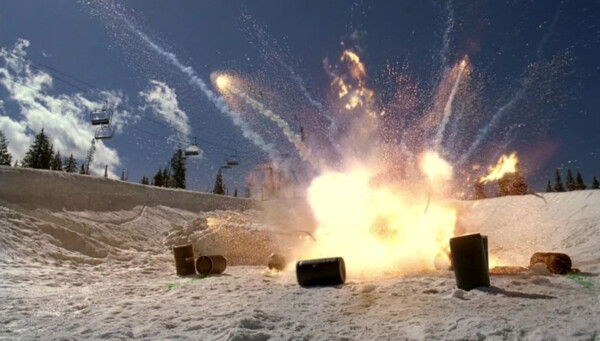
Image courtesy of Sony Home Entertainment.
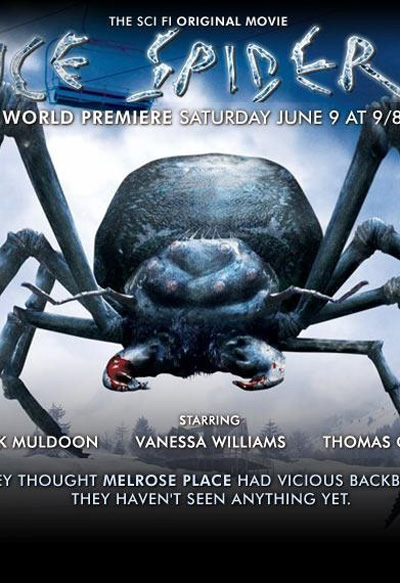
“Ice Spiders” Starring Vanessa Williams, Patrick Muldoon, Thomas Calabro. Directed by Tibor Takacs. Amazon Prime. 90 minutes. Rated R.
Del’s take
Dude, didn’t we just review this movie?
Ski bums, bimbos and crazy old coots trapped at a ski lodge by a band of marauding. …
Wait … wait … it’s coming back to me. …
Sharks! That’s what I was thinking. “Avalanche Sharks.”
Except this isn’t “Avalanche Sharks,” not by a long shot, which is not a criticism of “Avalanche Sharks” though the movie deserves every bit of scorn I can shovel on its wriggling carcass.
This is “Ice Spiders,” an equally wretched presentation that nonetheless comforts me. All those bad feelings about none of my books being picked up by Hollywood? It ain’t because they suck. Maybe they don’t suck enough.
I’m trying to figure out who plagiarized whom because “Ice Spiders” and “Avalanche Sharks” are essentially the same movie. Change a few character names and you’ve got “Avalanche Spiders” or “Ice Sharks.” I actually prefer “Ice Sharks” as a title.
The plot goes something like this: Dan “Dash” Dashiell (Patrick Muldoon) is a ski instructor at a hidden mountain resort watching newbies to the slopes crash into each other on the bunny run. Once, he was an Olympics downhill hopeful, but a dreadful injury dashed those aspirations.
Dr. April Sommers (Vanessa Williams) is a biologist at a hidden military laboratory who is trying to make spiders bigger so they’ll spin more silk, which can be used to make bulletproof vests for the troops. But her boss, Professor Marks (David Millbern), has secretly amped up the growth hormones being fed to the spiders. See what they did there? They de-eviled Dr. Sommers, so that when the spiders escape the lab and start devouring the bunny run bumblers, she can sermonize about the evils of ambition (too bad it wasn’t corporate America – THAT I could believe).
Did I say something about spiders eating people? Oh yes, it’s a bloody arachnabuffet as killer spiders the size of Saint Bernards gallop across the ski runs, munching on those who aren’t aspiring Olympics downhill racers. You can see where this is going.
“Ice Spiders” has another quality in common with “Avalanche Sharks”: It too is a lo-fi cash grab by producers with modest aspirations. The script is dreadful, as is the acting (with the exception of Williams, who struggles gamely through the train wreck of dialogue as if she were trying not to laugh). The special effects are crappy even for CGI. And the plot is thoroughly, reprehensibly predictable.
I spent 90 minutes constantly checking the status bar to see how much time remained of this stupid flick. It was that bad.
Don’t blame me. Mladen chose this clinker. I give it a D-, which if memory serves is what I graded “Avalanche Sharks.”
I get to choose the next movie and if Mladen doesn’t step up his movie review selection game, I will punish him with another “Jane Austen Book Club.”
Mladen’s take
Del, you’re so off the mark with your review of “Ice Spiders” that I’m forced to conclude the following: You must think Trump is intelligent and human.
The difference between “Ice Spiders” (IS) and “Avalanche Sharks” (AS) is akin to the difference between Star Wars Episode 4 and Star Wars Episode 1. AS is a poor script wrapped by horrible acting and zapped in a microwave oven until everything explodes into a big, fat mess. IS is, well, not.
And, the star of IS isn’t Vanessa Williams. Hell, Vanessa Williams isn’t even Vanessa Williams. When the acting credits rolled at the beginning of the movie and Vanessa Williams’s name popped up, I thought, “Woohoo, it’s that Vanessa Williams. Miss USA. Singer. Model.” A 1980s bombshell, she was. Instead, I got a Vanessa Williams, the crappy actor and millennial, or whatever her generation moniker is, with, I must concede, decent cleavage.
IS avoids becoming AS because of the acting by Patrick Muldoon, who portrays Dash the ski instructor. He had, oh, panache. Muldoon converts dialogue that could’ve been utterly banal into something that seems close to plausible. His facial expressions and ever so slightly effete gestures as he delivers his lines adds a lighter mood to the film without turning it into a joke. Well done, Muldoon. You carried the day.
Muldoon’s performance is strong enough to overcome the movie’s weaknesses. But, Del, in one instance, is correct. The CGI spiders in this film are terrible. All six of them. They look like shitty animation added to a live-action film. Plus, the cockroaches in my kitchen are bigger than the spiders in the movie. I was far from terrified by the suspense of people placing themselves unknowingly in position to get attacked and dismembered. I take that risk every time I get up in the middle of the night to use the bathroom. My cockroaches are as big as helicopters and fly just as well. The practical effects in IS aren’t much better either, but they sure as hell are better than those in AS. At least the fake blood in IS was the color of blood. In AS, the blood was, I don’t know, a subdued fluorescent pink.
Also, you can’t overlook the political message in IS. The mad scientist uses the fascistic argument of national security to justify the spider mutation program, rationalize the deaths of fellow Americans, and openly threaten the lives of the survivors, if they said anything about the dangers they faced. Huh. Sounds like Trump and his justifications for his miserable COVID pandemic response.
“Ice Spiders” gets a B from me because of Muldoon’s acting, the production company’s insight to steal the plot from the very good movie “Deep Blue Sea” – enlarge an animal to get it to produce more of the substance you need to make a lot of money … I mean help humanity – and its R rating. Del gets an F for being Del in his review.
Mladen Rudman is a former journalist and technical writer. Del Stone Jr. is a former journalist and author.
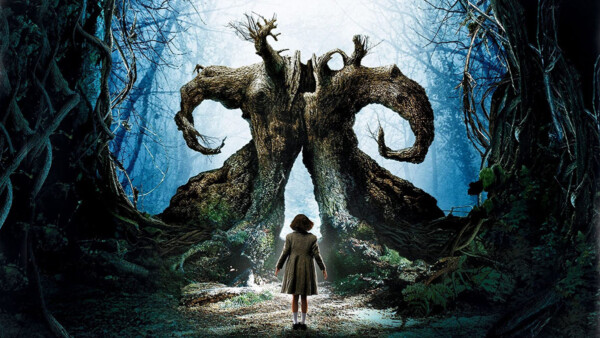
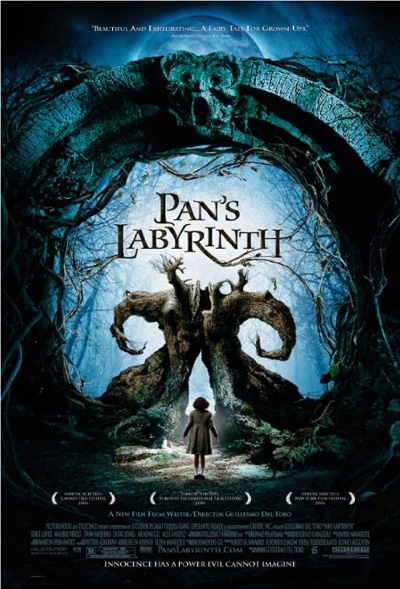
“Pan’s Labyrinth” Starring Ivana Baquero, Ariadna Gil, and Sergi Lopez. Directed by Guillermo del Torro. 119 minutes. Rated R.
Mladen’s take
Beautifully shot, captivatingly acted, the film “Pan’s Labyrinth” has to be more complex than what appears on the surface, as gripping as the surface can be.
At face value the movie is about a smart, upstanding 12-year-old girl descending into a fantasy world below and about the abandoned mill where she’s staying with her desperate mother and vile step-father, a captain in the Spanish army of fascist Generalissimo Francisco Franco.
It’s 1944 and the captain and his unit are mopping up communists hiding in the mountains. As he flattens a less-than-subservient suspect’s nose with a beer bottle, shoots others with his pistol and tortures a captured partisan, the captain’s pregnant wife ignores the bloodshed and prepares for child birth.
Her daughter tries to escape the horror through imagination. In her thoughts, she encounters Pan, the tattooed, goat-like guardian of a utopian kingdom long dead. He promises the girl eternal life and happiness, as long as she executes three deeds.
On the surface, “Pan’s Labyrinth” is about a girl turning inward to forget the brutal world engulfing her. Trouble is, her adventures in fantasy land aren’t all that wonderful. During her quest, the girl encounters all sorts of creatures – one beast, with drooping skin and eyes in the palms of its hands, eats two of the girl’s dainty fairies.
“Pan’s Labyrinth” strongly suggests, if not outright screams, that even the imaginary places we contrive for peace of mind are tainted by exposure to civilization. We’re viciously human even when we don’t have to be, though in this case the girl eventually journeys to a happier land.
Del’s take
What’s to understand, Mladen? This girl’s life really, really sucks.
Her name is Ofelia and she’s the quintessential stepchild – her real father was murdered by fascists, her mother has taken up with those very same fascists and Ofelia’s only escape is the brutal and scary fantasy world of Pan’s Labyrinth, which is about as much fun as a two-for-one root canal.
While performing the three tasks to prove her worthiness to Pan, Ofelia makes mistakes, disobeys orders, and brings pain and even death into her life … wow, sounds like a shopping adventure at Wal-Mart.
But what matters is where she’s at when the movie ends, and I guess it’s safe to say she’s in a better place.
What I took from this movie is that life – even a fantasy life – extracts its pound of flesh. Sometimes you have to go through hell to get to heaven. Sometimes it’s worth it.
“Pan’s Labyrinth” is dark by American standards but it reminded me that even a can of Spam can taste like a banquet when you haven’t had anything to eat in a long time.
Mladen Rudman is a former journalist and technical editor. Del Stone Jr. is a journalist and author.
Video
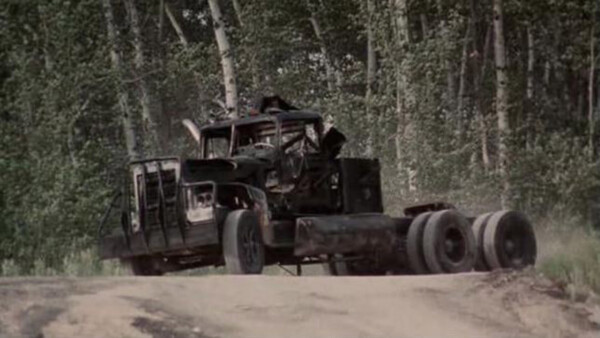
Image courtesy of Credo Entertainment Group and USA Pictures.
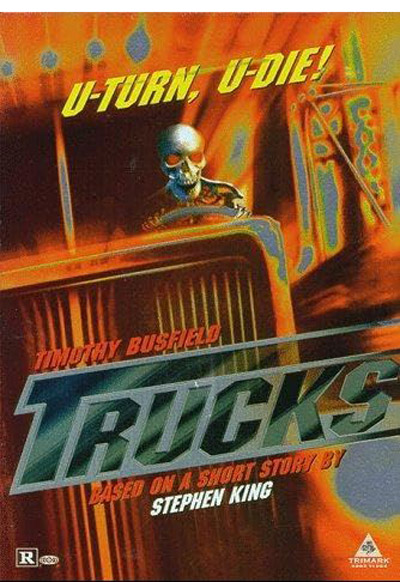
“Trucks” stars Timothy Busfield as Ray, Brenda Blake as Hope, Brendan Fletcher as Logan, Amy Stewart as Abby, and others. Directed by Chris Thomson. Rated PG-13 with a 95-minute run time. See it on Amazon Prime, Tubi, Apple TV and Vudu.
Mladen’s take
To recuperate my manliness after Del forced me to watch and review “Barbie” and “Wham!,” I made him watch 1997’s “Trucks.” And, what a film it is. From its big rig practical effects to the bonkers scene involving a Tonka-looking radio-controlled toy truck, the movie plows through your disbelief and eye rolling like a convoy of rabid Teamsters through a school zone.
Here, feel free to skip to the next paragraph. Del wants a movie summary in each review, so I’m giving you one, like it or not. “Trucks” is based on a Stephen King short story. In “Trucks,” trucks come alive, herding people into crappy buildings in a dusty town not far from Area 51. The trucks terrorize the huddled humans and, when needed, run over or otherwise murder a few. The self-driving, bloodthirsty machines, who talk to each other by flashing their headlights and switching windshield wipers on and off, are animated by … I’m not sure. The victims talk about mysterious satellite dishes erected at the nearby Air Force base, aliens attracted to Earth by SETI, a stolen election for president, the contents of Hunter Biden’s laptop, and, wait, I think I’m confusing one government conspiracy with another.
“Trucks” has flaws that go unremedied. There’s no nudity. The swearing is mild. The violence is not as graphic as it could’ve been, though the fire axe-wielding hazmat suit scene in a disaster response van is pretty damn terrific. And, let’s not forget the toy truck and mailman incident that unfolds about half-way through the film. It’s imaginative. It’s ridiculous. It’s carnage laced. In short, it’s perfect.
“Trucks” also has flaws that get remedied. For example, the killer trucks are autonomous but have no way of refueling themselves. So, through much of the film, I’m like, “Stupid rednecks, sit tight until the monstrous machines run out of gas.” Then comes along our principal scared, bewildered, and desperate protagonist (“Ray” portrayed by Timothy Busfield) who notices that the trucks had chances to kill him but didn’t. Why? Why did he live while some of his fellow captives died? Well, the trucks signal the answer to him. You see, Ray is the town’s gas station owner. The machines spared Ray because they needed him to refuel them. If he didn’t, they’d splatter his son and nascent girlfriend all over the desert sand. Come on, concede that’s a clever way for the trucks (and the movie’s plot) to overcome their lack of hands with opposable thumbs to pump diesel.
Because “Trucks” is based on a King short story and King often sways toward the bleak, the film’s ending is somewhat discombobulating. But, don’t worry, the ending is nothing like the heavily traumatizing conclusion of another movie based on King’s writing, “The Mist.”
Del’s take
I was confused.
Fifteen minutes into “Trucks” and still no Emilio Estevez. What the hell was going on?
A quick dive into the Internet Movie Database disabused me of my mental fog. “Trucks” is not “Maximum Overdrive,” the cheesy ’80s-vintage scifi-horror movie directed by none other than horror author Stephen King. Instead, “Trucks” is a cheesy ’90s-vintage scifi-horror movie based on the same short story, “Trucks,” that inspired “Maximum Overdrive.” And that story was written by none other than horror author Stephen King.
That’s about as clear as my soap-scum infused glass shower doors.
I’d describe “Trucks” as a genre hybrid, falling somewhere between a classic ’50s big bug movie and a Robert Rodriguez grindhouse gorefest, Why anybody thought “Trucks” was worthy of a remake escapes me, especially when King wrote many other memorable stories – the one about the guy who drinks bad beer and turns into a giant escargot comes to mind every time I pop the tab on a can of Natty Light. But then, why are there 27 “Children of the Corn”s or 91 “Lawnmower Man”s? The answer, of course, is that Americans have no bottom when it comes to schlock.
And that’s what “Trucks” is – schlock. It’s one of those movies that’s so bad, it’s good – except “Trucks” isn’t good. It’s terrible, and Mladen owes me big time. At least when I make him watch something out of his comfort zone it’s something decent, and good. “Trucks” is a Baby Ruth bar floating in the swimming pool of moviedom. The acting is awful. The script is laughably inept. No cliché is left behind. And there are plot holes big enough to … ahem … drive a truck through. It’s like watching political aides trying to teach Ron DeSantis how to eat pudding with chopsticks. In other words, it’s a mess.
Here’s an example of the breathtaking dialogue:
Teenage girl: “Why does everybody keep dying?” (Hmmm? Could it possibly have anything to do with the fact that they’re being RUN OVER BY TRUCKS?)
Old man: “I don’t know. I’m just an old hippie.”
??????????????????????
The trucks, we are told, have been brought to life by either Area 51, a toxic gas cloud, the Earth sailing through a comet’s tail, aliens … or maybe “Trucks” is a cautionary tale, warning against the unintended consequences of electing a fascist as president of the United States and then letting him skate when his crimes become public knowledge. Either way, I think everyone involved in the movie sailed through a comet’s tail because if “Maximum Overdrive” proves that horror authors should stick to writing horror stories and not directing horror movies, “Trucks” proves that even dedicated filmmakers can sometimes screw up, and “Trucks” is a Godzilla-sized Phillips-head of a screw(up).
Mladen didn’t assign a letter grade to “Trucks” so I’ll assume he’s giving it an F. I’ll be generous and award a D- seeing as how it’s truer to the short story than “Maximum Overdrive.”
When they come out with a scifi-horror movie titled “Night of the Killer Prius,” I’m there. But “Maximum Overdrive” and “Trucks” is a two-movie convoy of 18-wheeled schlock. For a vastly superior killer truck movie, check out “Duel.” Meantime, I’ll stick to the passing lane.
Mladen Rudman is a former journalist and technical writer. Del Stone Jr. is a former journalist and writer.
[ Main image courtesy of SplitShire at Pexels by way of a Creative Commons license ]
The genesis of my story, “I Feel My Body Grow,” in “100 Wicked Little Witch Stories” was simple: I wanted to sell a story to “100 Wicked Little Witch Stories.”
During the ‘90s writer and editor Stefan Dziemianowicz edited a number of anthologies for Barnes & Noble, all of them centered around very short stories. Seems publishers love short shorts, and I’m not sure if that’s because they can get more in each books or that readers prefer very short stories. As a reader I have no druthers either way, though I will pause before committing to a novelette or novella. I didn’t read Stephen King’s “The Mist” for many years because of that bias.
When I heard Dziemianowicz was editing a book of witch stories I tried to come up with something that would fit his premise. I knew nothing about witches except what I’d seen in movies or TV. I knew a couple of people who claimed to be witches but their witchhood had less to do with eye of newt and hair of bat but the whole Mother Earth and Gaia thing, which I dismissed as a New Age hippie trend.
What I wanted was a witch for the modern ages, maybe not an evil witch but one who was vengeful. I came up with just such a creature:
Cancer.
Cancer is the modern scourge. We think of it as evil though it has no conscious intent – it merely is.
But I asked: What if it did have conscious intent?
“I Feel My Body Grow” is the answer.
This is a creepy story and when I re-read it recently I was gratified to see it holds up well, from 1995 to this writing in 2023. I think it would make a terrific feature in a horror anthology movie like “Tales from the Crypt” or “Twilight Zone.”
I don’t believe “I Feel My Body Grow” will leave you lying awake tonight jumping at every sound. I do hope it stays with you.
Oh, and one more thing. This story was converted into a vlog, which is posted on YouTube. Check it out! Witchy voice and all. Follow this link.
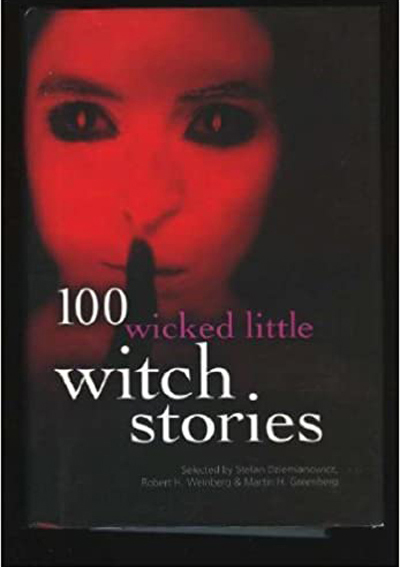
From Amazon
“I admit that when I bought this book, I didn’t have very high expectations for it. I mean, I’d never heard of it before, but I took a chance and bought it anyway. And I loved it. The stories are all so different; some were funny, others were dark and foreboding, and some were exciting.“
– Chayleen Anderson
The witches who populate these 100 delightfully scary stories include practitioners of white witchcraft and devotees of black magic. Most are female, some are male, and a few are thoroughly unclassifiable. They can be born witches or made witches, and may mix simple love potions or volatile concoctions that threaten all we hold dear. Some resent not receiving the treatment they feel they deserve from lesser mortals; yet other witches don’t even realize that they wield any special influence at all. The many writers who take on this ever-fascinating character (so fundamentally human unlike her more paranormal, ghostly brethren) include Juleen Brantingham (“Burning in the Light”), Joe R. Landsdale (“By the Hair of the Head”), Simon McCaffery (“Blood Mary”), Terry Campbell (“Retrocurses”), Lawrence Shimel (“Coming Out of the Broom Closet”), and a coven of others.
About the author:
Del Stone Jr. is a professional fiction writer. He is known primarily for his work in the contemporary dark fiction field, but has also published science fiction and contemporary fantasy. Stone’s stories, poetry and scripts have appeared in publications such as Amazing Stories, Eldritch Tales, and Bantam-Spectra’s Full Spectrum. His short fiction has been published in The Year’s Best Horror Stories XXII; Alfred Hitchcock’s Mystery Magazine; the Pocket Books anthology More Phobias; the Barnes & Noble anthologies 100 Wicked Little Witch Stories, Horrors! 365 Scary Stories, and 100 Astounding Little Alien Stories; the HWA anthology Psychos; and other short fiction venues, like Blood Muse, Live Without a Net, Zombiesque and Sex Macabre. Stone’s comic book debut was in the Clive Barker series of books, Hellraiser, published by Marvel/Epic and reprinted in The Best of Hellraiser anthology. He has also published stories in Penthouse Comix, and worked with artist Dave Dorman on many projects, including the illustrated novella “Roadkill,” a short story for the Andrew Vachss anthology Underground from Dark Horse, an ashcan titled “December” for Hero Illustrated, and several of Dorman’s Wasted Lands novellas and comics, such as Rail from Image and “The Uninvited.” Stone’s novel, Dead Heat, won the 1996 International Horror Guild’s award for best first novel and was a runner-up for the Bram Stoker Award. Stone has also been a finalist for the IHG award for short fiction, the British Fantasy Award for best novella, and a semifinalist for the Nebula and Writers of the Future awards. His stories have appeared in anthologies that have won the Bram Stoker Award and the World Fantasy Award. Two of his works were optioned for film, the novella “Black Tide” and short story “Crisis Line.”
Stone recently retired after a 41-year career in journalism. He won numerous awards for his work, and in 1986 was named Florida’s best columnist in his circulation division by the Florida Society of Newspaper Editors. In 2001 he received an honorable mention from the National Lesbian and Gay Journalists Association for his essay “When Freedom of Speech Ends” and in 2003 he was voted Best of the Best in the category of columnists by Emerald Coast Magazine. He participated in book signings and awareness campaigns, and was a guest on local television and radio programs.
As an addendum, Stone is single, kills tomatoes and morning glories with ruthless efficiency, once tied the stem of a cocktail cherry in a knot with his tongue, and carries a permanent scar on his chest after having been shot with a paintball gun. He’s in his 60s as of this writing but doesn’t look a day over 94.
Contact Del at [email protected]. He is also on Facebook, twitter, Pinterest, tumblr, TikTok, Ello and Instagram. Visit his website at delstonejr.com .

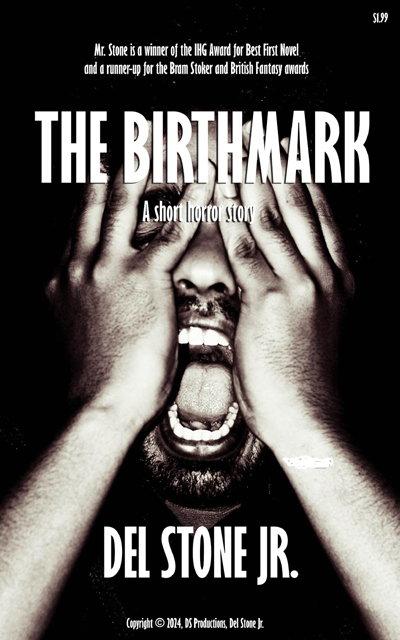
THE BIRTHMARK
A short horror story
By Del Stone Jr.
—
Introduction
I can trace the lineage of “The Birthmark” easily enough.
I wrote it sometime in the early ’90s. It was published in Pat Nielsen’s small press magazine “Crossroads,” which would also publish my short story “Companions.” That story appeared in Karl Edward Wagner’s “The Year’s Best Horror Stories XXI.”
I can’t remember the genesis of this story, but I know it is about every flytrap hole-in-the-wall bar I have ever been to, and I have been to quite a few. They all have commonalities: They’re dark, the acoustics are muffled, the air is unbreathable with smoke and the odor of beer – in fact, it is this odor of alcohol that permeates everything, from the cheap vinyl upholstery on the chairs to the peeling wallpaper, beer-soaked tabletops and even the flooring, be it fake wood or some kind of cracked, peeling vinyl. Just walking into the joint is enough to give you a hangover.
I wrote this during my bar phase. I worked at a newspaper, and down the road not half a mile was one of those neighborhood bars that were ubiquitous back in “the olden days.” This bar was called The Stardust, and every night, after the paper was put to bed, a small group of us night shift folks would troop down to The Stardust to “dust off a few.” I think every story I’ve written that features a bar was in some way fashioned after The Stardust.
Speaking of which, The Stardust closed sometime in the ’90s and now the building is a bank branch.
Barf.
I preferred it as a bar.
—
THE BIRTHMARK
I’m not sure why I stopped.
It was one of those flytrap beer joints that springs up and shrivels along the surface roads that parallel the interstate, cut off from humanity as surely as the two-horse towns going to rot out there, where nobody who had a plan for his life would go.
I guess I was tired … tired of looking away from headlights and fighting the wheel as tandem rigs blew by me in squalls of howling rubber and diesel fumes. I had a hundred miles to go before I could look for a motel and reasonably expect to be up tomorrow morning for the stretch to Miami Beach, and nothing waited for me there but another useless reconciliation, Patsy’s smile flickering and growing dim as reality settled in, squashing any hope that this time we might find a comfortable compromise.
So I’d stopped. For a quick beer, and some thinking.
It was called the Four Corners Tavern, which was stupid because one of the roads that formed the corners dead-ended against the interstate. A few cars were parked outside, old Fords and a Chrysler as big as a brontosaurus, dim shapes in the grainy dark.
Inside, it wasn’t much brighter. Neon beer signs sputtered and gave off a vague smell of cooked insulation, and the sour odor of spilled beer seemed to rise from the floor, staining and warping the ceiling panels. A battleship of a woman looked up from behind the bar as I came in, and two men parked behind shot glasses and a bottle of Jim Beam turned to see who I was. Another man, slumped over a beer down the bar, away from everybody else, ignored me. A plume of cigarette smoke rose above him and gathered into a mushroom cloud that drifted sluggishly toward a ceiling fan at the other end of the room.
I sat to his right.
He was muttering something and I almost didn’t notice that the woman was asking me what I wanted. I ordered a draft. The man continued to mutter, and from the sidelong glances he was getting from the other two, I guessed he wasn’t a Four Corners Tavern regular, which was OK by me. Maybe they’d watch him and leave me alone.
I heard him say, “Stupid shits,” and then the lady brought me my beer.
“I told them not to waste their time,” the man whispered, and he sniggered, a sound somewhere between a sneeze and a gasp.
I sipped the beer and let the cold feel of it roll down my throat. I needed to think, to make plans … to wait for the alcohol to undo what 12 hours of driving had done. A hundred miles to go. Then Patsy. I took a long pull from the beer.
“It was that bitch, that fucking monster,” the man said, out loud this time, and the others indeed turned to stare at him, as I was staring. He had a baseball cap pulled low over his forehead, and he was wearing a jacket – odd, because the night was steamy with the kind of bug-filled humidity that makes you want to take a shower every five minutes. It was then I noticed the mark that encircled his wrist and spread to his fingers, as if he’d dipped his hand in red dye. A birthmark – what did they call those? Port wine stains?
“She did this to me,” he exclaimed, clenching his red fist and shaking it at his reflection in the mirror behind the bar. One fellow at the other end of the bar, his face long and narrow like a weasel’s, whispered to the other. I turned back to my beer. I’d heard his story a hundred times before; hell, I’d lived it. Everybody had a problem.
“She said I’d never get rid of her,” the man went on, “and that was the only truthful thing to come out of her mouth. And the warden says, `C’mon, pardner! We’re gonna make a new man outta you. Zap that thing off! Shrink says you’re a socio something-or-other; we get rid of that hot hand of yours, it’ll change your whole attitude. They got this new laser gadget up at the clinic in Farmington they’re just dying to try out. They say they can remove that damn birthmark.’ Bullshit.”
I knocked back the rest of the beer. I nodded at the lady for another round, and she hesitated, as if she didn’t want to walk past the man. I couldn’t blame her, really. He was starting to get on my nerves too.
“Farmington’s where they take the `volunteers’ every time there’s a new drug or a fat sucker the docs want to work the bugs out of,” the man said, almost in a sneer. “That stuff the shrink said about removing this mark – ” again, he shook the fist – “to help me adjust, that was a load of crap. Warden promised he’d take six months off my sentence if I let them zap me with their Star Trek machine. Prison overcrowding; state’s gotta make way for all the new dumb bastards who get themselves in a fix because of some monster bitch – ” He choked off the rest of the words and took a hissing drag from his cigarette, blowing the smoke in great, billowing clouds.
“Man, I loved her,” he continued, and for the first time he looked at me, and caught me watching him. “Really. I did. Until things started going wrong.”
He shook his head and sucked at the thin rind of foam floating on the surface of his beer. He started talking again before he’d finished swallowing, so the words, until he cleared his throat, came out sounding gargly. “At first, it was just piddly shit, you know, the little stuff. Sometimes I’d be out with the boys and forget to call her, or I’d oversleep and show up late for some thing she wanted to do. So she’d keelhaul my ass and I’d toe the line until some other little, fucking thing” – he accented the last three words with fingertaps to the bar – “would happen and she’d get bent out of shape.”
“Then she’d blow this stuff all out of proportion, and suddenly it was: I didn’t love her, I didn’t put her before everything else … all that crap.”
I swallowed half my beer in a single gulp. I glanced at my watch and saw it was going on 10, and I considered getting up and leaving. But what was the rush, anyway? Patsy would still be there tomorrow, and so would the dirty tide that had come between us. A simple technicality of geography hadn’t changed that.
“I loved her, but I was starting not to, what with her being such a bitch and all,” he said, his voice sliding into a mumble. “And that’s when she decided I was some kind of bastard for not treating her the way she wanted to be treated, and she was gonna punish me, make me pay. And by God, she did it. In spades, the bitch.
“She’d get mad and not speak and make me ask her what the hell was wrong, and we’d talk about it until things got smoothed out, and then she’d do it again, and again, until she was more pissed off than nice.
“So after months of this shit I decided to hell with it. I couldn’t please her. So to hell with it.”
The others were watching him intently now, their pale faces reflecting the blue and red light of a neon Michelob sign, like scouts gathered around a campfire at night while the troop leader whispered ghost stories.
“I cut her loose. She said I’d never be rid of her, and I had to slap her around a little bit, you know, just to show her who’s boss, and when I walked out her door that last night she said she’d die before I got off with fucking up her life the way I had.
“I probably should’ve killed her right then. …”
The two men at the other end of the bar glanced at each other, then turned to the woman behind the bar, who closed her eyes wearily and shook her head. I kind of knew what they were thinking; the strange ironies that living long enough allows you to experience, that one man’s passing fancy becomes another’s obsession, and how life can become engraved around a center of gravity that is more illusory than real.
“She’d drive by my place – just slow enough so I’d see her. Or the garage where I worked. She’d buy her gas there. Shoot pool at my pool hall. Eat at the diner where I had my grits and coffee every morning, the goddamned movie theater where I’d take my dates, and that place on old what’s-his-name’s farm where we’d go after the movies – that is if she hadn’t let the air out of my tires, or tipped off the cops that I’d had a tootfull at Jimmy’s, or any of the other rotten, shitty things she did to make my life miserable.
“But – ” he said, his voice jumping in decibels, so suddenly that it spooked a twitch out of me. “When she moved into the place across the street from mine, for Christ’s sake, I knew I had to do something … something drastic.”
“I tried to talk to her, but she – she – ” His expression became confused and angry, as if he were trying to sort out the words and couldn’t make sense of any of them. “She had these letters she was gonna send people. She was gonna tell them everything I’d ever said about them. She was gonna tell the sheriff about that little number I pulled three years ago, down in Harrisburg – Christ! I was drunk. I didn’t know what the hell I was doing. I knocked over a Circle K. For 33 lousy bucks. Nobody got hurt. No harm came of it. But she was gonna tell ‘em, all the personal stuff I let her in on when we were together, and she was laughing about it, laughing her ass off, her squinty eyes glittering like those marbles the taxidermists use when they stuff a ferret, and then she turned mean and reminded me of how I’d fucked up her life, that I’d turned her into this monster, and wasn’t I proud of myself? Wasn’t this the best piece of hatchet work I’d ever done on another human being?”
His voice began to tremble, and beneath the counter I could see his right knee jumping, as if an electric current had set the muscles to twitching. He lit another cigarette and took a jittery drag, exhaling with an audible pop. Patsy had drifted far from my thoughts.
“I don’t know,” he went on, falling back to a stage whisper. “I just lost it. You know? She’d fucked with me to the point I couldn’t take it anymore.” He paused and shook his head. “I shouldn’t’ve done it, but I did, and that can’t be undone. See, I had this eight-inch locking-blade knife I carried around to scare off the assholes who’ll try to whip up on you in the pool halls and such, and I just took this mother fucker and I just – I just slammed it into her chest – ”
I felt the blood drain from my skull, leaving a socket of emptiness. The bartender’s eyes widened to almost comical proportions.
“I was crazy, I was a fucking lunatic, and I just slammed it into her, hard as I could, and her ribs split like rotten two-by-fours and my hand sank into her chest – I could feel her poisonous heart coiled in there like a goddamned snake … Oh Christ, oh Jesus calamity Christ!”
I could see all this happening in my mind’s eye and I didn’t want to hear any more, but he kept talking.
“Her eyelids flapped and her tongue oozed out of her mouth like a snail, and when she arched her back I could hear bones snapping. I tried to jerk my hand out but it was like her ribs had become teeth – they were biting at me, and I cut the living shit out of my arm getting away, my blood mixing with hers, up to my wrist in blood. …”
Enough of this. I leaned on one buttock to get my wallet. It was time to go.
“They shipped me off to prison for life with parole after 25 years. I didn’t get the electric chair. I thought that was a lucky thing, until this,” He said, turning the burgundy hand this way and that, rotating it in the dim light so that his scrutiny took on overtones of a museum curator appraising some artifact.
“About three months into my term this happened, so I know it ain’t no goddamned birthmark. It’s her, goddamnit. Her poison. Her blood, inside me. And you know what else?”
He took a ferocious hit from the cigarette.
“I can hear her talking to me. From inside me. Telling me the bad things she’s gonna do to me. And sometimes I wake up at night and find my hand doing things I don’t want it to do, and I know I’m never gonna be rid of her. That’s why I said it was a waste of time. Nothing’s gonna get rid of this but me, flat on my back in a casket.”
I dug a five from wallet and flipped it onto the calendar. That simple gesture seemed to break a spell that hung over the tavern. The weasel-faced man coughed and muttered, “Crazy bastard.” The bartender turned and began wiping the counter. The talker, without looking, seemed to sense he was losing his audience and shouted, “They’re all dead now, all those doctors at Farmington. That’s where I just came from, not two hours ago. You can call the law and find out for yourself. They’re all dead.”
The bartender stopped. Her face pinched into a look of thin-blooded astonishment. I was in the middle of standing when he spoke and I simply froze, unsure of whether to collapse back into the chair or run for my life. Everything inside the tavern seemed to pause so that a heavy silence descended over the five of us, tempered only by the buzzing of the neon signs.
“They strapped me down and rigged up their gear,” he went on, his voice warbling between a cry and a shout, “and when they flipped the switch to burn off that sucker, she – ” he thrust the hand into the air – “went berserk and tore off the straps and – and – she found this.” He reached into his jacket and whipped out what appeared to be a very thin-bladed filet knife, except the blade was curved, like a toy scimitar, and angled so as to reach those hard-to-cut places. “And she began cutting at them, swinging the knife like a tennis racket. You could hear it snicking through their bleached white lab coats and the turkey wattles around their throats. Snick, snick, snick.”
A sick numbness settled along my spine and spread across my body, killing any thought of doing anything, even breathing. The two men at the other side of the bar traded glances of sheer terror; the farthest man pushed back his chair, clearing a space for escape. The woman behind the bar was surreptitiously groping beneath the counter.
“She killed them all, and when she got through there was nothing for me to do but run, and that’s what I did. Stole a car and ran like hell.” He wound down to a barely audible whisper. “And now I’m here.”
I knew that I couldn’t move, that he was bug-fuck crazy and if I dared move all that craziness would come boiling out and I would be his focal point. I wouldn’t make it to the door before he was on me with his peculiar knife, hacking and swinging and probably not even looking at me while he did it, his gaze trapped in a faraway, disconnected perspective of self-absorption.
The man snickered. He almost sobbed. His eyes dropped to the cigarette smoldering in his ash tray. The knife blade reflected a tapered C of hot magenta neon light.
“She’s gonna kill you too,” he sing-songed, almost wistfully. “Every damn one of you. She’ll keep doing it until they fry me. Fucking bitch. Fucking monster.”
Something clicked beneath the counter and the barkeep unlimbered a sawed-off shotgun. She aimed it at the man and I swear to God, at that moment I could have kissed her till she died. She announced, “Mister, I’ve heard about all I care to hear for one evening. Now you just sit tight and we won’t have any trouble. Bobby!” she snapped her head at weasel-face. “Get on the horn and call Bill Hutchison; tell him we got a live one and to bring the squad car with the mesh cage.” He slithered out of his chair and hurried toward a pay phone on the opposite wall. “And you, Teddy,” she nodded at the other. “You got your 9 mil in the Chrysler?”
“Yes ma’am,” he answered quickly.
“Well go get the damn thing. I think we can use it.”
He started to get up and then everything happened quickly, so quickly that I’m not sure I remember it the way it actually happened or with the embellishments terror decorates your memory of events. Portions seem compressed into the stop-action narrative of a music video, while everything else runs together in a senseless, expositionless blur.
I remember Teddy standing and I remember the man snarling something, his voice spiraling into an animal wail, and I remember a very bright flash of chromed light as the blade came up and the man’s chair flew back with a crash and he was up, his legs bending and bringing him down to a crouch, and he was about to lunge, to pounce, the knife out in front of him now and his face sucked into a vacuum of undiluted rage. Then the room exploded with a booming crash that seemed to pulverize the bones in my ears. A spray of blood the color of tar arced across the bar, spattering everything, and the man spasmed, as if invisible strings running through his arms and neck had been suddenly jerked taut. An empty shotgun shell spun onto the counter and wobbled on its axis like an off-kilter gyroscope. The man took one step, two steps forward – my stomach did a belly flop and I felt a lump of pure nausea shimmy up my throat, cold spit gathering beneath my tongue, and I looked away as the gun whammed again, and from the edge of vision I saw the knife fall and somebody keeling over – no, I thought I saw two people going down and my impression was that Teddy had been shot or the man had stabbed him or maybe Teddy had simply fainted.
I staggered for the door. My ears were ringing, but I could still hear the bartender moaning, “Oh Jesus! Oh sweet Jesus!” and then I was outside, the soggy night air whistling through the knot in my throat, my shirt unsticking itself from my sweaty ribcage. I dumped myself into the car and fired up the engine. The radio blared to life and I didn’t so much as flinch.
As I drove away, the tavern’s front door opened, revealing a dim rectangle of blue and red luminescence. A figure stood there a moment, then disappeared.
The door swung shut. I looked away.
—
That was two days ago.
I drove a hundred and fifty miles that night – north, away from Miami Beach. I found a Red Roof Inn off the interstate, rented a room, locked the door and hid under the covers. I must’ve slept, but I can’t really be sure.
The next afternoon, I called Patsy and told her goodbye. Was it important anymore? I don’t think so. I don’t think I’ll ever be afraid of things I understand. Not now. We all reach those junctures in life, those four corners, if you will, where hard decisions must be made, and whether we’re dragged there, kicking and screaming, or whether we go there willingly doesn’t seem to matter. I turned off the interstate onto a tiny, lost road, and now I’ll never be the same.
Because it came back to me as I lay in my bed at the Red Roof Inn, stirring in that restless state between sleep and fatigue, my thoughts going back to what I had seen, over and over, like your tongue probing a cold sore at the rim of your lip, despite the pain, or perhaps because of it.
I hear the gun going off, the thud of concussion. I see in slow-motion the fatal trajectories of individual blood droplets, flying everywhere, and I see falling bodies … the man with the red hand, except the hand is no longer red.
And the other body is not Teddy.
It is something else, something larger than either men, a scorched burgundy in color, with wild hair and a thicket of teeth that resemble curved bones filed to a point.
I can see its teeth because it is laughing. It has the man by his wrist and it is directing his hand like an orchestra conductor waving a baton, and it is laughing with a kind of lunatic glee as the man folds into himself and slumps to the floor.
It is too much to understand what real fear is. I knew this even before I discovered the fleck of dried blood on my left hand.
So I told Patsy goodbye. I hope I’m not too late.
—
About the author:
Del Stone Jr. is a professional fiction writer. He is known primarily for his work in the contemporary dark fiction field, but has also published science fiction and contemporary fantasy. Stone’s stories, poetry and scripts have appeared in publications such as Amazing Stories, Eldritch Tales, and Bantam-Spectra’s Full Spectrum. His short fiction has been published in The Year’s Best Horror Stories XXII; Alfred Hitchcock’s Mystery Magazine; the Pocket Books anthology More Phobias; the Barnes & Noble anthologies 100 Wicked Little Witch Stories, Horrors! 365 Scary Stories, and 100 Astounding Little Alien Stories; the HWA anthology Psychos; and other short fiction venues, like Blood Muse, Live Without a Net, Zombiesque and Sex Macabre. Stone’s comic book debut was in the Clive Barker series of books, Hellraiser, published by Marvel/Epic and reprinted in The Best of Hellraiser anthology. He has also published stories in Penthouse Comix, and worked with artist Dave Dorman on many projects, including the illustrated novella “Roadkill,” a short story for the Andrew Vachss anthology Underground from Dark Horse, an ashcan titled “December” for Hero Illustrated, and several of Dorman’s Wasted Lands novellas and comics, such as Rail from Image and “The Uninvited.” Stone’s novel, Dead Heat, won the 1996 International Horror Guild’s award for best first novel and was a runner-up for the Bram Stoker Award. Stone has also been a finalist for the IHG award for short fiction, the British Fantasy Award for best novella, and a semifinalist for the Nebula and Writers of the Future awards. His stories have appeared in anthologies that have won the Bram Stoker Award and the World Fantasy Award. Two of his works were optioned for film, the novella “Black Tide” and short story “Crisis Line.”
Stone recently retired after a 41-year career in journalism. He won numerous awards for his work, and in 1986 was named Florida’s best columnist in his circulation division by the Florida Society of Newspaper Editors. In 2001 he received an honorable mention from the National Lesbian and Gay Journalists Association for his essay “When Freedom of Speech Ends” and in 2003 he was voted Best of the Best in the category of columnists by Emerald Coast Magazine. He participated in book signings and awareness campaigns, and was a guest on local television and radio programs.
As an addendum, Stone is single, kills tomatoes and morning glories with ruthless efficiency, once tied the stem of a cocktail cherry in a knot with his tongue, and carries a permanent scar on his chest after having been shot with a paintball gun. He’s in his 60s as of this writing but doesn’t look a day over 94.
Contact Del at [email protected]. He is also on Facebook, twitter, Pinterest, tumblr, TikTok, and Instagram. Visit his website at delstonejr.com .
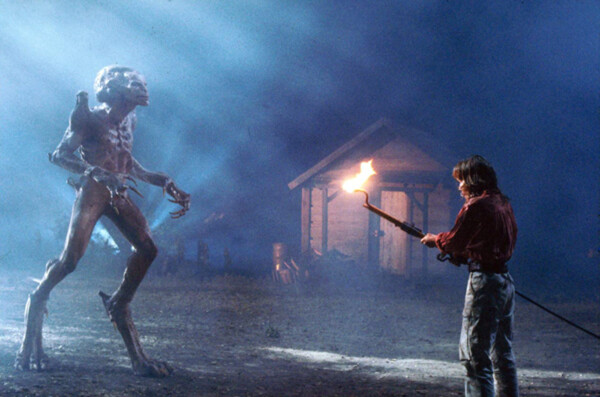
Image courtesy of MGM/UA.
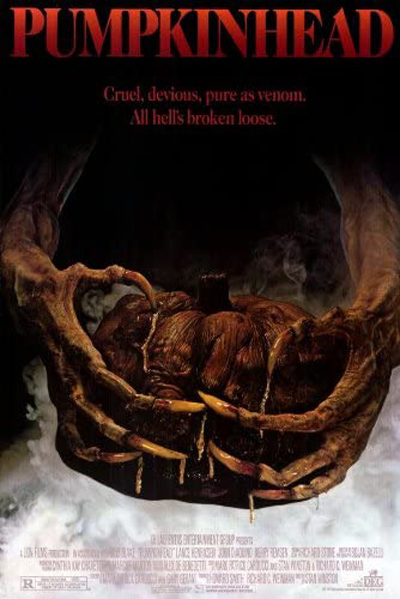
“Pumpkinhead” Starring Lance Henriksen, Jeff East, John D’Aquino and Florence Shauffler. Directed by Stan Winston. 86 minutes. Rated R. Amazon Prime.
Del’s take
They had me at the cicadas.
If I remember the South for anything it will be sluggish July afternoons, when the chore of taking a breath is like sucking a wad of steamed broccoli into your lungs, as cicadas hidden within the needles of longleaf pines screech and screech and screech screech screech. According to folklore the infernal bugs “hibernate” underground for 17 years until one night they awaken to scale a nearby slash pine – yes, it’s always at night – squeeze from their shell, pump up their wings and fly away to enjoy a brief yet incandescent third act of noisy fornication.
That rhythmic screeching, like chalk chalk chalk on a blackboard, is stamped onto my brain. So, when I heard it used as an audio effect in “Pumpkinhead” I knew the story was taking place somewhere below the Mason-Dixon, where the ever-increasing heat has baked the brains out of everybody who lives there, transforming them into Trump supporters.
The horror.
I didn’t let that stop me from enjoying “Pumpkinhead’s” other charms. The movie, which was released way back in 1989, has become a cult favorite despite early panned reviews. The directorial debut of special effects wizard Stan Winston, “Pumpkinhead” inspired a straight-to-video sequel, two made-for-TV sequels, a comic book from Dark Horse and even a video game.
Plus, it stars one of my favorite underrated actors, Lance Henriksen, who appeared in several James Cameron movies along with Bill Paxton and Jeanette Goldstein. He brings just the right touch of doom to his role as grieving father Ed, who sets off the horrific chain of events in “Pumpkinhead.”
The story goes like this: As a young boy, Ed witnessed a man being killed by a monster and knows that with the help of the right people, he can summon a demon to avenge the death of his young son Billy, who was accidentally run over by a dirt bike rider who had come to the back woods with his friends to party.
With the guidance of Haggis (Florence Shauffler), a crone who lives in the deep woods, Ed summons the Pumpkinhead demon and sets it loose on the teens, choosing to disregard her warning that Pumpkinhead is as dangerous to those who evoke its presence as those intended to receive its wrath.
The result is well-choreographed and photographed slaughter that follows a predictable path with only a slight deviation there at the end. Lessons will be taught and for some, learned, while for others there may be no moral to this story.
“Pumpkinhead” is one of those fun B movies that works if you can get past the threadbare writing and horror movie clichés. It calls forth an eerily gothic atmosphere you have never seen from Henry James or even V.C. Andrews. Henriksen delivers his patented emotionally wounded performance – you can’t help but sympathize with the guy, even if events leading up to his actions follow a corny, well trodden horror movie trail.
The real star here is the Pumpkinhead demon, which I thought worked very, very well. It’s a movie monster you haven’t seen before and in ways reminded me of the atavistic horror of “Alien.” It produces a similar quality of dread, even if the cornpone story doesn’t.
“Pumpkinhead” has lots of gross and gore, which should forestall whiny lectures from Mladen about R ratings and blood spatter. It’s a necessity for any serious horror movie collector or fan. Watch it in 2021 about mid-October, after the real horror of 2020 has mostly faded from memory.
I give it a B.
Mladen’s take
Del and I have been friends for a long time. And, still, he’s simply unable to judge the depth and breadth of my intolerance for inadequate moviedom mayhem, violence, and cussing.
“Pumpkinhead” is a good movie. I throw it an A- for the superb creature effects, which offset the movie’s quasi-“Deliverance” vibe. However, there are no dismemberments or intestines spilling from sliced abdomens. Shoot, plenty of blood is spilled, but no depictions of arterial pulse squirting. Sure as hell there is very little swearing, if any, that I recall and there is definitely no damned nudity. So, forgive me Del, but I’m whining, anyway, though, really, it’s closer to satisfied grumbling because the “Pumpkinhead” plot is solid.
In fact, I had little trouble overlooking the plot’s trigger, a grieving father mischaracterizing the city slickers’ accidental mistreatment of his geeky son. What unfolds is horror movie commentary on the ruin that engulfs those seeking revenge. For, you see, Ed the father becomes entwined with the monster he unleashes. When Pumpkinhead kills, Ed feels it.
—
Quick, what excellent recent movie uses the same type of symbiotic relationship between man and beast as an integral part of the story? Answer: “Sputnik.”
—
It’s Pumpkinhead who has me enamored by this late 1980s film. This is a lovingly, carefully, patiently, and nicely crafted terror animal. The only non-practical, i.e. without makeup, and non-mechanical visual effect in the movie is blurred and swaying filmography showing Ed sensing that Pumpkinhead is about to strike.
Pumpkinhead, by the way, is a tall guy in a costume. The creature is a decaying pink and skeletal. It has no hair, a tail, claws for hands, pseudo-hooves for feet, and long bony protrusions from the shoulders. Its legs at the knees bend like a heron’s, forward, if I recall accurately. Its teeth are long, crooked, and cracked and eyes white, opaque, and all-seeing. Pumpkinhead is a conjured beast, maybe risen from the fires of hell, making a living in the material world. Pay attention to the shrunken monster’s face when it’s re-buried.
Pumpkinhead’s interaction with reality as we understand it is very nicely executed in its namesake film.
There’s our nightmare walking past a window as though taking a leisurely stroll while the kid killers inside the cottage talk about what to do. When Pumpkinhead prowls through the house, it ducks beneath doorways. It swivels and tilts its head to listen. And, Pumpkinhead has no trouble looking straight at you while contemplating, I imagine, what to do next. It kills your ass and then hangs around for a moment to watch the reaction of your friends. There are no rampages. Just a methodical hunt to pick off the offending, big-hair youths. Wait till you see how the monster decides to handle a rifle. Pumpkinhead is scary as hell because it’s very human.
To me, Pumpkinhead has a subtler charisma than the Xenomorph in “Alien,” more natural finesse than the Predator in “Predator,” and a finer malevolence than Freddy in “A Nightmare on Elm Street.”
It’s my hope that no dumbass 21st century producer decides to re-make “Pumpkinhead.” This is a story and a monster that stand on their own. The beast borne of revenge shouldn’t be risked by a crappy re-do.
Mladen Rudman is a former journalist and technical editor. Del Stone Jr. is a former journalist and author.
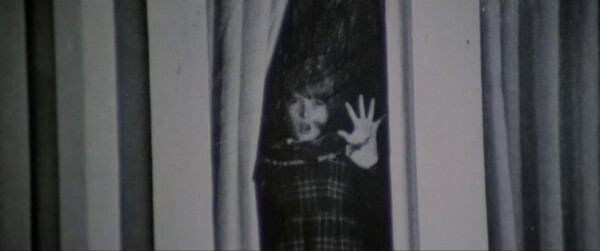
Image courtesy of De Paolis In.Co.R. Studio.
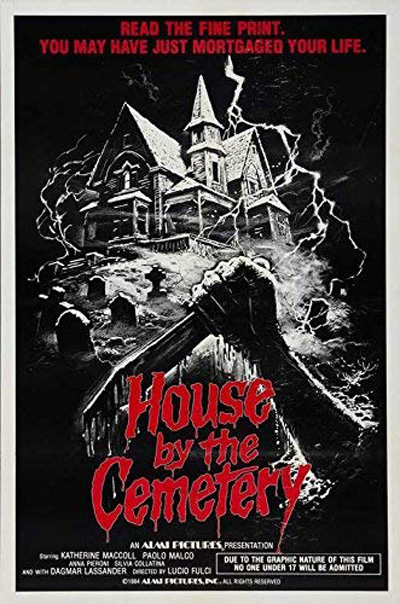
“The House by the Cemetery” Starring Catriona MacColl, Paola Malco and Ania Pieroni. Directed by Lucio Fulci. 86 minutes. Not rated.
Del’s take
“The House by the Cemetery” is a film only a horror purist could love, and love it they do, in gushing online paeans that celebrate its blood-drenched genius. Written by legendary screenwriter Dardano Sacchetti and directed by the Godfather of Gore, Lucio Fulci, “House” is itself a paean to violence, splashing its audience with viscera, maggots, and other gory tropes of Italian horror cinema.
It is part of Fulci’s Gates of Hell trilogy, which also includes “City of the Living Dead” and “The Beyond” – entries in a catalog of horror movies, spaghetti westerns and comedies that make up the erstwhile communist agitator’s body of work. Fulci passed away in 1996 due to complications from diabetes after suffering a life nearly as tragic as his horror films, but he has developed a cult following over the years and many of his fans rate “The House by the Cemetery” one of his best works.
The story is about a young academic, Dr. Norman Boyle, who brings his wife and son to a small, rural town so that he may resume the work of a colleague, identified only as Dr. Petersen. Petersen was researching the notorious Dr. Freudstein, a 19th century medical practitioner who allegedly conducted forbidden experiments resulting in disfigurement, death and, shall we say, supernatural complications. During his investigation, Petersen inexplicably loses his mind, kills his girlfriend and hangs himself from the rafters of the town library. Now Dr. Boyle has arrived to finish Petersen’s work. He has even moved his family into the house that was previously occupied by Dr. Freudstein.
The Boyles are joined by Ann, ostensibly a babysitter for young Bob, the Boyles’ blindingly blonde-haired son. But she may be in league with the supernatural forces that rule the Freudstein house. Bob’s mother, Lucy, seems to sense something is off about Ann. In fact, she knows something is off about the entire house but she soldiers on, the loving if weary spouse of an obsessed academic.
The Boyles’ presence rekindles the ghostly inhabitant of Freudstein House and all manner of jump scares, sudden spooks and not-so-ethereal attacks commence, culminating in an inevitable showdown between man and boogeyman.
The film was released in 1980, which dates it. More substantially – and jarringly – its Italian roots, and its Italian horror sensibility, establish a distance between movie and audience that “House by the Cemetery” may not be able to overcome in the United States. Its case is not helped by the oceans of blood and horrifically graphic violence that, even by today’s standards, will present a challenge to weak-stomached audience members. It could have been worse. According to lore, Fulci was mandated to slay at least some of his darlings to keep the movie at an R rating in the U.S.
More puzzling are the weird lapses in cognition experienced by the characters. For instance, in one scene a woman is brutally (and bloodily) murdered. Her body is dragged across the kitchen and down into the cellar, leaving a blood trail wide as an interstate highway. The next morning Ann, the suspicious au pair, sets about cleaning up the mess (without inquiring as to its cause, which to my mind casts her in league with the devil). Lucy walks into the kitchen, sees Ann down on the floor with her bucket and scrub brush, and asks her what she is doing. Ann says, “I made coffee,” and that answer seems satisfactory to Lucy, who turns and heads toward the stove. Blood trail? What blood trail? The movie is rife with such oversights.
Replete with overly dramatic acting, a musical score that will strike Americans as intrusively silly, and inexplicable gaps in storytelling, “House by the Cemetery” falls more into grindhouse mockery than art house storytelling.
For those reasons I won’t recommend it. I watched out of a sense of duty to Fulci and Sacchetti, but in retrospect, “House by the Cemetery” wasn’t very good.
If you are a horror purist or a collector of oddball cinema, you might enjoy the movie. Otherwise, try something a bit more modern, and a lot more consistent with reality.
“House by the Cemetery” is available on Shudder.
I rate it a D+.
Del Stone Jr. is a former journalist and author.
Image courtesy of Flickr user Electroholunder https://www.flickr.com/photos/67342500@N00/
INTRODUCTION
This story went through several iterations before it became the tale you see here.
I started it in the early 1980s – exact date unknown; my memory is hazy but I vaguely remember seeing U2’s “New Year’s Day” on MTV while taking smoke breaks from writing. That would put it in the vicinity of 1983.
I based the viewpoint character on a woman I knew from work. She was small and looked frail but was anything but – tough as nails! You didn’t screw with her. Oh, and her name was Rocky, just like the character in this book.
I wanted to write a story about the ultimate horror, at least for a parent: that of losing a child. I was warned to stay away from stories that put children in peril, but I thought “Sitters” might avoid that prohibition by its resolution.
One other feature that’s notable about “Sitters” – if in fact anything is notable about “Sitters” – is that it represents what horror used to be, not what horror is now. I grew up in a time when horror was external – a monster, a supernatural agency, just something out there that presented a threat to you and I.
These days it seems horror is more internal – modern horror stories seem to focus on a vague sense of unease, the suggestion that something may not be quite right, or a feeling of out-of-place or disaffection within the viewpoint character.
Maybe an easier way to say it is that in the past, horror was a monster. Today, horror is a mental illness.
I got feedback from various editors and, through their suggestions, I created the story you’re about to read.
“Sitters” eventually found a home at Northern Horror, a Canadian magazine. They did a good job presenting it.
—
SITTERS
Rocky was sitting on the corner of the mattress, trying to get an earring fastened to her ear, when the kid began bouncing on the bed.
She had it – no, she didn’t, damn it – she almost had it, but a jolt sent the earring spinning out of her fingers. It bounced and rolled across the efficiency’s narrow floor. It disappeared beneath the fold-out card table.
Judi, who was babysitting the kid again tonight, offered a tired smile and settled into the worn-out La-Z-Boy. Judi was youngish, but something about her seemed old, Rocky thought. Maybe it was her clothes. Her jeans were frayed at the pockets and mere threads held the knees together; her sweater was unravelling at the shoulder seam. Maybe it was the rattiness of her clothes that rubbed off on her, so that she resembled a much older imposter, masquerading as a young, down-on-her-luck divorcee.
Misery loves company, Rocky told herself, and got up to look for the earring. God, if she ruined this last pair of pantyhose crawling under there … well, that would be a bitch. Because there was no money to buy a new pair and she needed to look good – to be honest, she needed to look perfect. Because Mr. Deaton liked all his clerks to look perfect. He said a nice-looking clerk might encourage customers to linger, and when customers linger they buy things. And because Mr. Deaton was the manager, what he wanted was important.
“I wanna GO!” the kid shouted. Rocky stretched and groped beneath the table, felt something hard, and came up with the plastic head to a toy robot. She pitched it aside and the kid yelled, “Hey! That’s mine!” His voice was quavering between tears and anger, but he wasn’t whining yet, whining in that tone which always meant he was about to throw a tantrum, and for that Rocky was thankful. She didn’t want to deal with a tantrum. Not half an hour before her shift started at K mart.
She found the earring. She stood and fastened it. She smoothed her skirt.
“I wanna go too,” the kid repeated. She composed a smile and sat down beside him. She mussed his hair. He made a face and rolled away, but when he looked at her again he was smiling too. God, if there was anything that could shine through the despair she’d been feeling these past few months, it was the kid.
Rocky said, “I’m going to work, honey. You remember what I told you about work?”
He nodded.
“I can’t take you to work with me because Mr. Deaton wouldn’t like it, and then he might fire me and we wouldn’t have any money. What would happen to us if we didn’t have any money?”
The kid recited, “We wouldn’t have a roof over our heads.”
Judi sighed.
Rocky nodded. She felt a small ache of guilt that the kid had to learn this kind of lesson so early in life, but circumstances had forced her hand, and she was alone, and sometimes she had to share her burdens, even if it mean sharing them with a 6-year-old.
“Mommy,” the kid said. “Does Judi have any money?”
Judi almost laughed. Rocky snorted, “With what I’m paying her? You’ve got to be kidding.”
“Well … if you don’t pay her much money, why’s she here?”
“Because,” Rocky cuffed his chin. “She likes you. Now you and Judi are going to have a good time. Isn’t that right, Judi?” She cast an inquiring glance across the room, and Judi nodded yes. Rocky noticed she had her touchstone in hand and was rubbing it absently, as if it were a cat she was scratching behind the ears. Rocky’s gaze lingered on the stone. It was black as anything she could imagine, and polished to a smooth luster by Judi’s persistent rubbing. Judi was never without it. She would not let anybody touch it. She said once that if it ever left her grasp it might lose the magic or charm or whatever it was the thing held over her. She said it was the one thing in life she could rely on.
The one thing in life she can rely on. Rocky turned away. I guess if anybody has a right to feel that way, it’s Judi. Rocky wondered what she would do if her ex-husband snatched the kid on one of his infrequent visitations. Would she be haunting police stations and badgering detectives to find the bastard? Would she be babysitting at night to pad her meager income and take her mind off things? Or rubbing magic rocks to prop up her sanity?
Rocky realized she was shivering.
Judi smiled uncertainly. “I’ll take care of everything.” She said nothing more, and then an uncomfortable silence descended over the room, interrupted only by the sound of their breathing.
“Well!” Rocky announced a little too cheerfully. “I want your fanny in bed early, kiddo. You and Judi can watch TV and then you shag it for the sack.”
“I can stay up late!” he shouted.
“No. You stay up late and I might have to hock your fanny.”
“To the boogeyman,” Judi added.
And I could use the bucks, Rocky thought morosely, but she only said, “That’s right.”
Judi smiled. “I’ve seen the boogeyman.”
The kid’s eyes widened. He said wondrously, “You have?” and Rocky frowned.
“Yes,” Judi continued. “Once. But I can call him back. With this.” She held up the touchstone. “You’ve seen fortune tellers on TV who use crystal balls to contact the spirit world? Well, this is my crystal ball, and with this I can call the boogeyman. Would you like to see the boogeyman?”
The kid looked fearfully at Rocky. He whined, “No.”
Judi was silent a moment. “Then you’ll have to do what your mother says and get to bed early.”
Rocky stared at the woman, unsure for a moment if she should go along with this deception. Something like this could scare the hell out of the kid, give him a complex or something. It could stay with him the rest of his life. So Rocky finally said, “Honey, Judi’s just teasing. There’s no such thing as the boogeyman – but if I come home from work and find you still up, you’ll wish there was.” She glanced furtively at Judi, who was rocking in the La-Z-Boy, then back at the kid. “Now don’t be a little pain and maybe we’ll get ice cream tomorrow.” She almost hated herself when she saw his snaggle-toothed grin. There wouldn’t be any ice cream tomorrow, of course – not when she could barely keep a roof over their heads, as even the kid had learned to say. There was never enough money and she was tired of worrying about it and it seemed she never knew what to do, what was right and best and proper, and if somebody would just tell her what to do, for God’s sake –
No. She told herself to stop. That was no way to think. She struggled to concoct a smile. So. She’d get money, somehow. Maybe the old man would come through with a child-support payment; maybe she’d find a better job and take her kid and move to a new town. Start a new life.
Yeah, she thought desultorily. Maybe I’ll win the lottery and marry Donald Trump.
Rocky got her purse. She stood before the mirror, fiddling with a strand of hair, gave herself a good looking over and headed for the door. The kid had planted himself stomach-down on the floor in front of the old black-and-white TV. The tuner was shot, so the picture faded in and out. Judi was rocking herself gently in the recliner, staring at the TV and rocking, her slender legs barely moving as she stared and rocked. It isn’t her clothes that make her look older, Judi decided, but she said only, “Any word from the cops? About your little girl?”
Judi shook her head. She said, “But one of the detectives told me something I still can’t believe. He said they arrested a woman for selling her daughter so she could buy crack. Cocaine. Can you believe that?” She looked up at Rocky, her eyes red and glistening around the edges. “How could anybody do such a thing?” She looked away.
Rocky stared at her a long moment. She’d heard of women like that, women who beat their children senseless for crying too much, women who gave away their children or starved them to teach them God’s love or stayed married to wife beaters and kid beaters because they didn’t know what to do. Fearful women. Selfish. Women who were crazy.
“I don’t know how anybody could do that,” Rocky finally answered. “I guess they don’t know any better. Or they just don’t care.”
Then she opened the door and stepped out into the night.
—
Later, much later, Rocky was back at the door, trying to fit the key into the lock. It wouldn’t work right, and she hoped she remembered to tell the landlord to fix the damn porch light so she could see what she was doing.
She got the door open. The end-table lamp was on. The TV was watching over the room like a dead, gray eye, nothing but interference crossing the screen. Judi was not in the La-Z-Boy.
The kid wasn’t in bed.
A little sigh of exasperation whistled through Rocky’s lips. She dropped her keys, her purse, just dropped them there at the door, and stalked across the room to the bathroom.
She called to him.
But he wasn’t in the bathroom. He wasn’t under the card table. The closet. Under the bed; he wasn’t there either.
He wasn’t in the apartment.
Suddenly, Rocky had no feeling in her body. Thoughts jumped into her head, each more terrifying than the one before. Her gaze flitted, bat-like, around the room. A note was lying on the end table. It was held in place by Judi’s touchstone – no, it looked like the touchstone. But it was smaller somehow, and dull, its luster used up. Rocky snatched the piece of paper; the stone clattered against the base of the lamp with an awful ringing sound.
The note read: Please I’m sorry Touch the stone youll know what to do.
The note slipped from her fingers. It see-sawed through the air and ticked against the cracked linoleum. Rocky’s gaze wandered aimlessly and unfocused, until it fell upon the stone.
She took it in her hand.
A current snapped from the stone, shocking her, but she could not let it go. The room began to sway – no, she was swaying, careening, toppling drunkenly onto the bed. Weird images fizzled and popped behind her eyelids. She was seeing through somebody else’s eyes. She heard echoes of thoughts and emotions, fading, then gaining in volume, like the sounds of a party drifting across the night. She felt pinches of physical sensation. Judi. Judi’s eyes. Judi’s thoughts. Judi’s body. It was as if some residue of Judi were in the stone, and by touching it Rocky had allowed whatever was there to enter her mind.
It is a night months in the past, and Rocky can see and feel Judi going into the run-down basement apartment she rents, and the place is deserted, the woman who was babysitting her daughter gone, her daughter gone, and only the woman’s touchstone remains, a taunt, a watchdog, something more than a stone. A spike of emotions – confusion, panic, dread – scrambles the image. It returns. Judi is holding the stone. Somehow, it is communicating to her; the past – vague images of an endless succession of women who have held the stone before; the future – what Judi must do. And Judi is thinking, Yes, yes, anything for my child. So she takes the stone and, following its mysterious imperatives, unbuttons her jeans and slides it up into her. Rocky can feel its smooth warmth inside Judi, as if it were made to fit that orifice. The warmth spreads along her nerve endings and the sensation is both repulsive and erotic. She feels it burrowing deeper, the warmth intensifying, her unwilling receptiveness to it sending it deeper still. There are other sensations: friction and sliding and a thick fluid filling her, so that she looks down and sees a black, slimy substance flowing out of her. Ropes of the stuff slither up her arms, down her legs, across her stomach, building upon itself until a shape begins to form, almost human but almost something else. She feels pressure on her shoulders, rough and unyielding, as huge hands pin her to the floor. And then … and then the pressure builds in her, the warmth replaced by scalding heat. Her legs twitch apart as a reflex to the pain and it is too much and she tries to scream, but her muscles spasm uselessly. She thinks her spine is splitting. She knows it is splitting, right down the middle, and boiling water is sluicing up the raw nerves of the spinal cord to explode inside her brain in exquisite agony.
The vision mercifully fades. Others appear and retreat like ghosts on the old black-and-white TV. One quick picture: Judi, lying on the floor, legs apart, body throbbing, simultaneously amazed and sickened to be alive. The touchstone is lying between her legs, and when she touches it she is stung, only this time the transfer is not from stone to flesh. She feels something flow out of her and into it, a reservoir in the odious thing beginning to fill, a spark of energy.
The scene blurs. Others from the months to follow whip past, the threat of the stone continuing to grow, until the near-present swims into focus. Rocky sees herself leaving for work earlier that day. Judi is fingering the touchstone, and it is huge now and alive and crawling with a strange power. The image dissolves and is replaced by another. The kid is lying on his stomach watching TV, a “Blue’s Clues” rerun. Judi’s stare moves from door to closet to window, as if in anticipation of something. “Well?” she asks. “Where are you?” The touchstone lies in her palm like a fat tick, gorged on … what? Blood? No, but some part of her, something more elemental than blood. The kid looks up, puzzled, and mumbles, “Huh?” She hushes him. Then, “Where are you? I’ve done what I was supposed to do. The stone is ready. And I’ve got a fair trade.” Rocky can taste her fear, intermingling with hope and desperation.
Rocky can feel her tired soul.
Flicker. Another scene. The kid is clutching her arm. He whimpers, “I’m scared, Judi. I want Mom,” and she can see the fear crawling in his eyes. The front door bangs open. The kid lets out a piping little shriek. A plague of shadows slithers into the apartment, sliding up the walls and around the furniture in sinuous tendrils of black. The kid sinks his fingers into Judi’s arms. The lights are on but the room is suddenly mausoleum dark. The kid is screaming, screaming, and incredibly, Judi is pushing him away from her, giving him to the shadows, and then Rocky hears herself screaming, summoning all her rage and terror, until the shadows envelope everything and the image fades.
Lights, again. The TV is babbling. A little girl is standing in the doorway. Judi’s little girl. A line of spit is about to drip from her chin. Judi sucks in a breath and chokes. Her joy, her anguish are like a punch in the stomach. She exclaims, “Oh! Oh God!” The image becomes grainy. Whatever of Judi is left in the stone is waning. Judi rushes across the room. The connection unravels. Now only fragments of images come to Rocky. Judi scribbling the note. Judi leaving the stone. Judi hurrying down a poorly lit sidewalk, the girl dangling from her arms. A bus, somewhere, wheezing to a halt. Judi climbing aboard. Gone.
Rocky opened her eyes. She felt a tear slide down her cheek and catch at the corner of her mouth. The TV hissed in the background. Her heart thumped irregularly, like a piece of machinery about to break down.
The touchstone was lying next to her, on the bedspread. She raised a limp finger to touch it, but hesitated, her instincts battling with reason.
Eventually, she did what she thought she had to do.
—
“Rocky? You sure you’re up to this?” the woman asked, spooning another egg into the saucepan of boiling water. “You look like hell, if you don’t mind me saying.”
The woman’s name was Lisa. She was a cocktail waitress at a downtown strip joint. She had a son, Bobby.
“I’m all right. I was up all night,” Rocky lied.
“It’s OK if you don’t want to bother,” Lisa said. The kitchen table was littered with squeeze bulbs of food coloring, a bottle of vinegar, and bowls. “I can get him some of those candy Easter eggs and a chocolate rabbit – God knows he’d rather have that stuff anyway instead of this,” she said, indicating the pan on the stove. “But the money. …”
“No. Really,” Rocky said. “I don’t mind. I’m just a little tired. The cops, they – they – “
Lisa’s frown was full of sympathy. “No luck, huh?”
Rocky shook her head. She hated herself. All these lies.
Lisa snorted. “God! I hope they find the creep. I hope you get your kid back. Your ex – he must’ve been a real shithead.”
“Yes,” Rocky agreed.
“If my ex-husband ever tries that shit, I’ll – I’ll – “ She feigned a right hook. And then she was collecting her car keys and purse and jacket.
“Now don’t give Aunt Rocky a hard time,” she shouted into the next room, where Bobby was watching TV.
Rocky slid her hand into her jacket and grasped the touchstone. Thankfully, it took nothing from her. Lately, she hadn’t been sure she could give any more. But it was fully alive now, throbbing with power. It was ready to be … it was ready. It occurred to Rocky that a few hours from now, Lisa would probably be hearing these thoughts. She wondered if she should apologize. Maybe not. Any woman who truly loved her child would do what Rocky was about to do. Lisa would understand, wouldn’t she?
“You give Aunt Rocky a hard time, mister, and I’ll – I’ll – “
Hock his fanny to the boogeyman, Rocky thought dejectedly.
Lisa snorted again. “I don’t know what I’ll do,” she yelled. “But you won’t like it, mister.”
The kid grunted in reply.
Lisa rolled her eyes in apparent disgust and left. Rocky locked the door behind her and went back to the kitchen. Water gurgled sluggishly in the saucepan and a column of steam gathered into a fog bank beneath the range hood. Bobby shuffled in and took a seat at the table. He said, “Can we start doing the eggs now?”
“Not yet,” Rocky answered. “They’re not cooked.” She checked the burner and turned up the heat. The water seemed to boil a little more vigorously.
“I don’t like being alone all the time. Why won’t Mommy take me to her job with her?” Bobby asked, and Rocky’s heart sank when she started to give him the same answer she’d given her own kid a few months before. God, it had been a thousand years since he’d … been gone, but in a little while, just a little while longer, she’d have him back and the problem would be in somebody else’s lap.
Lisa’s, she reminded herself grimly. How can I do this to Lisa?
“I like Mommy,” Bobby said, absently tapping the vinegar bottle with a spoon. “Don’t you?”
Rocky started to say yes but the word caught on something in her throat. She pretended to stir eggs. She wondered when it would end, this passing along of misery and fear to women who already dealt with more than their share of those things on a day-to-day basis, and she wondered if anybody would ever have the courage to say no, to sacrifice their sanity and possibly the only thing they loved in the world to break the lineage of pain. She wondered if she could do such a thing, and her soul flinched at the thought of it. She wondered if she could stand to live with herself for having done such a thing. Probably not. But she wondered how she would cope with the alternative.
“I like you too,” Bobby said, with the earnestness of a little kid. “But I think I like my mommy a little bit more.” He pinched a paper-thin slice of air with his thumb and forefinger. “This much more,” he explained.
Rocky stared at without seeing the boiling water. It was raging now, and a caul of foam had collected at the top. She didn’t know what to do, and it seemed she had never known what to do, even when the choices were clearly laid out for her, and maybe that was why she had fallen into this predicament. She fingered the touchstone and it felt soft and diseased and overripe, so much unlike the hard little pellet Judi had left for her.
“Aunt Rocky? Do you hear something?” Bobby said uncertainly.
The water was boiling and the foam was spilling over the side of the pan and flashing into steam as it cascaded over the burner. The eggs bounced in the turbulence, their shells clicking together like little teeth snapping.
“Aunt Rocky?”
Foam and scalding water flowed down onto the burner. Rocky fingered the touchstone and thought of women who sell their babies to buy cocaine. She didn’t know what to do.
“Aunt Rocky,” Bobby said, his voice a squeaky whisper. “I think I hear something. Outside.”
Her fingers formed a cage around the touchstone. She thought of women who beat their children senseless –
“Somebody’s outside, trying to get in!” Bobby insisted breathlessly.
– women who give away their children because they no longer love them –
“Somebody’s trying to get in, Aunt Rocky!”
– women who starve their children –
“Aunt Rocky! Aunt Rocky! Somebody’s – “
– women who stay married to their wife beaters and their child beaters because they don’t know what to do –
“I want Mommy!”
– and all the women who aren’t like that –
The saucepan was a volcano of steam and foam. Rocky snatched the touchstone from her pocket and held it above the hissing cauldron – Here you go, bastard – and started to let it drop.
She heard, rather, she felt the word NO whistle past her ear, seeming to grind through her body, and then every window in the place exploded inward, every light bulb detonated like a rifle shot, and something darker than the sudden night brushed by her, a shadowy, sinister touch that chilled her to the bone, and snatched the touchstone from her fingers.
Then Bobby was wailing for his mommy, and from the living room another small voice, achingly familiar, began calling for his mother too.
About the author:
Del Stone Jr. is a professional fiction writer. He is known primarily for his work in the contemporary dark fiction field, but has also published science fiction and contemporary fantasy. Stone’s stories, poetry and scripts have appeared in publications such as Amazing Stories, Eldritch Tales, and Bantam-Spectra’s Full Spectrum. His short fiction has been published in The Year’s Best Horror Stories XXII; Alfred Hitchcock’s Mystery Magazine; the Pocket Books anthology More Phobias; the Barnes & Noble anthologies 100 Wicked Little Witch Stories, Horrors! 365 Scary Stories, and 100 Astounding Little Alien Stories; the HWA anthology Psychos; and other short fiction venues, like Blood Muse, Live Without a Net, Zombiesque and Sex Macabre. Stone’s comic book debut was in the Clive Barker series of books, Hellraiser, published by Marvel/Epic and reprinted in The Best of Hellraiser anthology. He has also published stories in Penthouse Comix, and worked with artist Dave Dorman on many projects, including the illustrated novella “Roadkill,” a short story for the Andrew Vachss anthology Underground from Dark Horse, an ashcan titled “December” for Hero Illustrated, and several of Dorman’s Wasted Lands novellas and comics, such as Rail from Image and “The Uninvited.” Stone’s novel, Dead Heat, won the 1996 International Horror Guild’s award for best first novel and was a runner-up for the Bram Stoker Award. Stone has also been a finalist for the IHG award for short fiction, the British Fantasy Award for best novella, and a semifinalist for the Nebula and Writers of the Future awards. His stories have appeared in anthologies that have won the Bram Stoker Award and the World Fantasy Award. Two of his works were optioned for film, the novella “Black Tide” and short story “Crisis Line.”
Stone recently retired after a 41-year career in journalism. He won numerous awards for his work, and in 1986 was named Florida’s best columnist in his circulation division by the Florida Society of Newspaper Editors. In 2001 he received an honorable mention from the National Lesbian and Gay Journalists Association for his essay “When Freedom of Speech Ends” and in 2003 he was voted Best of the Best in the category of columnists by Emerald Coast Magazine. He participated in book signings and awareness campaigns, and was a guest on local television and radio programs.
As an addendum, Stone is single, kills tomatoes and morning glories with ruthless efficiency, once tied the stem of a cocktail cherry in a knot with his tongue, and carries a permanent scar on his chest after having been shot with a paintball gun. He’s in his 60s as of this writing but doesn’t look a day over 94.
Contact Del at [email protected]. He is also on Facebook, twitter, Pinterest, tumblr, TikTok, and Instagram. Visit his website at delstonejr.com .