Controlling urban sprawl should be everyone’s mission
My greenlining correspondent, Gayle Melich, sends a copy of a recent Washington Post editorial that provides more fodder for the notion of restricting urban sprawl.
The editorial points out that local and state officials in Maryland are feeling the sting of conflicting interests – “… it’s called sprawl, and it’s killing treasuries, urban areas, forests and farmlands at an alarming pace,” opposed to policies that control “living patterns.”
Reaction was predictably political. “… the governor told a gathering of municipal officials that his intention is not to dictate prescriptions for halting sprawl but to lay some political groundwork for debate, recommendations and action over the coming months.”
What a load.
But the editorial continues along a more heartening path. The governor of Maryland wants money for encouraging development in communities that already exist, which would save those municipalities huge development and upkeep costs for infrastructure.
The editorial ends with this directive: “… the answers should not lie in exhausting the remaining spaces as well as public funds with open invitations to clear and build at will.”
If folks inside the Beltway can understand this common-sense frugality, why can’t the paragons of conservative virtue who rule the roost in Northwest Florida do the same?
Movies, movies, movies! This unwavering summer heat has driven me indoors, where I’ve seen more movies in the past month than I usually see in a year. Here’s my report.
“Independence Day”: A shameless parade of clichés, but who cares? This movie is more fun than cinematic pedantry allows. See the White House get obliterated! Watch Los Angeles disappear in a well-earned lake of fire! There’s much much more! Terror (the laboratory scene is about as spooky as they come); humor (did you catch the homage to “2001: A Space Odyssey?”), and action – on a scale that will even leave Arnold What’s-His-Name out of breath. A “Star Wars” kind of classic.
“Eraser”: Speaking of Arnold What’s-His-Name, here he is with Vanessa Williams, and they’re on the run from … and the bad guys are trying to … and the government wants to … does it really matter? “Eraser” has got bullets and explosions and Arnold. What else does a growing baby need with this formula?
“Phenomenon”: This movie was a test. Could I or could I not stay awake to watch John Travolta mumble and shuffle, like Jimmy Stewart on muscle relaxers, through this stultifying tribute to celluloid boredom? I didn’t fall asleep, but I wish I had.
“The Cable Guy”: I don’t like Jim Carrey. He’s more annoying that funny. But in “The Cable Guy” he has his moments, which I attribute to the streaky genius of the script, not Carrey’s manic comedy. I don’t know what to make of this movie; it was hysterical in parts, dark in others, and largely entertaining.
“The Frighteners”: Creepy special effects and the occasional witty line are no substitute for story, and that’s the big problem with this movie. It gives you no sense of place, no sense of character, no sense of story. It is to movies what malls are to shopping: You see one, you’ve seen ’em all.
This column was originally published in the July 24, 1996 edition of the Northwest Florida Daily News and is used with permission.
About the author:
Del Stone Jr. is a professional fiction writer. He is known primarily for his work in the contemporary dark fiction field, but has also published science fiction and contemporary fantasy. Stone’s stories, poetry and scripts have appeared in publications such as Amazing Stories, Eldritch Tales, and Bantam-Spectra’s Full Spectrum. His short fiction has been published in The Year’s Best Horror Stories XXII; Alfred Hitchcock’s Mystery Magazine; the Pocket Books anthology More Phobias; the Barnes & Noble anthologies 100 Wicked Little Witch Stories, Horrors! 365 Scary Stories, and 100 Astounding Little Alien Stories; the HWA anthology Psychos; and other short fiction venues, like Blood Muse, Live Without a Net, Zombiesque and Sex Macabre. Stone’s comic book debut was in the Clive Barker series of books, Hellraiser, published by Marvel/Epic and reprinted in The Best of Hellraiser anthology. He has also published stories in Penthouse Comix, and worked with artist Dave Dorman on many projects, including the illustrated novella “Roadkill,” a short story for the Andrew Vachss anthology Underground from Dark Horse, an ashcan titled “December” for Hero Illustrated, and several of Dorman’s Wasted Lands novellas and comics, such as Rail from Image and “The Uninvited.” Stone’s novel, Dead Heat, won the 1996 International Horror Guild’s award for best first novel and was a runner-up for the Bram Stoker Award. Stone has also been a finalist for the IHG award for short fiction, the British Fantasy Award for best novella, and a semifinalist for the Nebula and Writers of the Future awards. His stories have appeared in anthologies that have won the Bram Stoker Award and the World Fantasy Award. Two of his works were optioned for film, the novella “Black Tide” and short story “Crisis Line.”
Stone recently retired after a 41-year career in journalism. He won numerous awards for his work, and in 1986 was named Florida’s best columnist in his circulation division by the Florida Society of Newspaper Editors. In 2001 he received an honorable mention from the National Lesbian and Gay Journalists Association for his essay “When Freedom of Speech Ends” and in 2003 he was voted Best of the Best in the category of columnists by Emerald Coast Magazine. He participated in book signings and awareness campaigns, and was a guest on local television and radio programs.
As an addendum, Stone is single, kills tomatoes and morning glories with ruthless efficiency, once tied the stem of a cocktail cherry in a knot with his tongue, and carries a permanent scar on his chest after having been shot with a paintball gun. He’s in his 60s as of this writing but doesn’t look a day over 94.
Contact Del at [email protected]. He is also on Facebook, twitter, Pinterest, tumblr, TikTok, and Instagram. Visit his website at delstonejr.com .
Image by Del Stone Jr.
Note: This was an essay I wrote that later became the basis of a short story, “Aunt Edna’s Cats,” which was published in the Barnes & Noble anthology “101 Crafty Cat Capers.”
—
As I stand in my kitchen, hands on hips, gazing across the 900-square-foot empire of my townhouse, I see things bumped out of place, the dust rings showing like chalk outlines of crime victims, proof I’ve murdered my life with the appearance of neatness.
I can’t believe I’m living like this — everything disorganized and messy and, as I said, out of place. I swore I’d never live like this. What’s going on?
It’s those cats.
—
I never liked cats. I was a dog man. My sisters were dog men. My parents, and their parents too, were dog men. We were all dog men, except my aunt, who had three or five or 40 cats.
She was the nutty aunt. The one with all the cats.
Now I have two cats. It was a calculated move, which acquits me of insanity charges. I live in a townhouse, alone, and I’m gone most of the day. A dog would become an ax murderer under those conditions, and a bird would drive its owner crazy with all its screeching and seed-flinging. And you can’t pick up a tropical fish and scratch it behind the ears — you could, I guess, but I defy you to enjoy the experience.
So I have cats. I don’t talk about them much. I intentionally don’t talk about them. I know pet stories are the equivalent of summer-vacation slides. And I know people wouldn’t believe me if I said I had two of the most amazing felines God ever let slip into an earthly state.
If I were anyone else, I wouldn’t believe me either.
—
My female cat’s name is Magpie. I call her Maggie. She’s an orange tabby Manx, and her most famous accomplishment is this: When she was spayed, she had the smallest ovaries of any cat the vet had ever seen.
The male is anthracite black. His name is Pavlov — Pav for short. He was put on this earth to teach me patience, and lately I only threaten to kill him two or three times a day. The trend is downward.
He waits for me at the door when I come home at night. Crazy cat.
—
Every moving thing is a game to cats, be it a catnip-laced flannel mouse dangling from an elastic string, or a human foot sliding beneath the covers. I discovered that early one morning as I awoke to the feel of Pav performing a biopsy on my big toe, his claws hooked knuckle-deep in my flesh and his ears laid back against his skull, his BB shot-sized brain rattling around in there like a pachinko machine down to its last marble.
Pav and Maggie have been excommunicated from the bedroom.
—
I won’t tell you the worm story. It’s too gross. But I noticed none of the presidential candidates was talking about pet health-care subsidies during the last election, which was smart because with the money I’ve spent on vet bills I could have bought myself one of those baboon heart-transplant operations.
For example: Maggie had worms, which she got from fleas. I hadn’t seen any fleas, but we had a “smoking gun,” or in this case a “smoking worm,” to prove they were there. The fleas had to go, which meant Bob the carpet guy had to come to clean the carpet before Charlie from the pest-control place could spray for fleas while the cats were at the vet being dipped and dewormed and inoculated.
So $175 later, I found a flea dying on the kitchen table.
Be still, my baboon heart.
—
Assuming I go straight home from work, a moment arrives between the time I open the front door and the time I close the bedroom door when the day unreels before me. Lightning does not strike, nor does the earth move, but I have my quiet celebrations of things done well, and my regrets for the mistakes I’ve made.
And always, no matter how wonderful or rotten I’ve been, I can lie on the couch and close my eyes and within moments feel the pressure of small paws on my chest, the spreading glow of a kitten lying down, the vibrating compression of a purr monster warming up.
It is love at its very best, for no reason other than its own, simple transcendence.
I am amazed.
About the author:
Del Stone Jr. is a professional fiction writer. He is known primarily for his work in the contemporary dark fiction field, but has also published science fiction and contemporary fantasy. Stone’s stories, poetry and scripts have appeared in publications such as Amazing Stories, Eldritch Tales, and Bantam-Spectra’s Full Spectrum. His short fiction has been published in The Year’s Best Horror Stories XXII; Alfred Hitchcock’s Mystery Magazine; the Pocket Books anthology More Phobias; the Barnes & Noble anthologies 100 Wicked Little Witch Stories, Horrors! 365 Scary Stories, and 100 Astounding Little Alien Stories; the HWA anthology Psychos; and other short fiction venues, like Blood Muse, Live Without a Net, Zombiesque and Sex Macabre. Stone’s comic book debut was in the Clive Barker series of books, Hellraiser, published by Marvel/Epic and reprinted in The Best of Hellraiser anthology. He has also published stories in Penthouse Comix, and worked with artist Dave Dorman on many projects, including the illustrated novella “Roadkill,” a short story for the Andrew Vachss anthology Underground from Dark Horse, an ashcan titled “December” for Hero Illustrated, and several of Dorman’s Wasted Lands novellas and comics, such as Rail from Image and “The Uninvited.” Stone’s novel, Dead Heat, won the 1996 International Horror Guild’s award for best first novel and was a runner-up for the Bram Stoker Award. Stone has also been a finalist for the IHG award for short fiction, the British Fantasy Award for best novella, and a semifinalist for the Nebula and Writers of the Future awards. His stories have appeared in anthologies that have won the Bram Stoker Award and the World Fantasy Award. Two of his works were optioned for film, the novella “Black Tide” and short story “Crisis Line.”
Stone recently retired after a 41-year career in journalism. He won numerous awards for his work, and in 1986 was named Florida’s best columnist in his circulation division by the Florida Society of Newspaper Editors. In 2001 he received an honorable mention from the National Lesbian and Gay Journalists Association for his essay “When Freedom of Speech Ends” and in 2003 he was voted Best of the Best in the category of columnists by Emerald Coast Magazine. He participated in book signings and awareness campaigns, and was a guest on local television and radio programs.
As an addendum, Stone is single, kills tomatoes and morning glories with ruthless efficiency, once tied the stem of a cocktail cherry in a knot with his tongue, and carries a permanent scar on his chest after having been shot with a paintball gun. He’s in his 60s as of this writing but doesn’t look a day over 94.
Contact Del at [email protected]. He is also on Facebook, twitter, Pinterest, tumblr, TikTok, and Instagram. Visit his website at delstonejr.com .
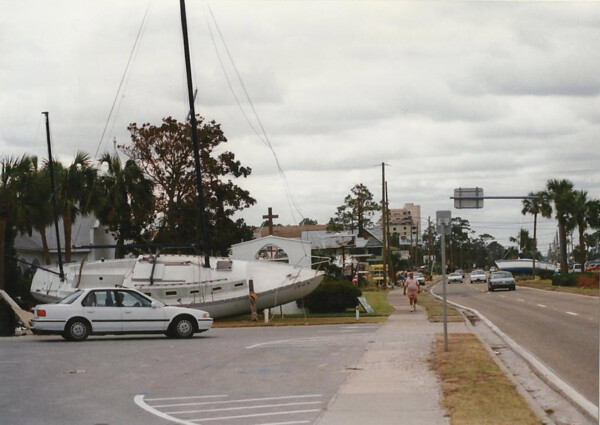
Photo by Del Stone Jr.
On Tuesday, Oct. 4, 1995, I was sitting in a staff meeting listening to the disaster plan should Hurricane Opal come our way.
I remember that day for two reasons. O.J. Simpson had just been found innocent of murder and Opal was in the southwest Gulf of Mexico, a trifling 90 mph storm predicted to move northeast and strike the north-central Gulf Coast sometime Thursday.
I remember the wrongness of it all – the wrongness of the verdict and the wrongness of the forecast. Surely after everything that had happened with Simpson a rational jury would convict. Hadn’t he tried to flee before a national television audience? And how could the National Hurricane Center believe Opal would dither in the gulf until Thursday when a vigorous cold front was approaching. Hadn’t previous experience suggested cold fronts act as siphons, pulling tropical weather systems along their boundaries at high rates of speed?
On the way back to the newsroom I told the editor I thought Opal would arrive much sooner – as of Wednesday. He expressed surprise. That wasn’t in the forecast. And of course I’m not a weather forecaster. Still, I’d seen it before, most notably with Eloise in ’75. I was sure the storm would strike the next day.
I don’t remember what I did that night but I remember being awakened at 5:30 Wednesday morning by the telephone. It was one of my feature writers, whose voice sounded thin as cellophane. Opal had intensified rapidly during the night and was racing for the Northwest Florida coast with winds of 135 mph. She wanted to evacuate – could she please evacuate?
Now now, I laughed. Let me take a look at the forecast and I’ll call you back.
I turned on the TV and dialed in The Weather Channel. There sat TWC’s septuagenarian hurricane expert, John Hope, who gravely confirmed everything my feature writer had told me. In fact the news was worse – Opal could further strengthen before moving onshore.
I called her back and said yes, she could evacuate. “OK thanks ‘bye” she blurted. No comma stops in that declaration. I imagine 30 seconds later her car was screeching out of the driveway.
Then I called my parents. They live close to the water and Mom has no love of hurricanes. I knew they’d want to evacuate. The sound of a phone ringing early in the morning can bring nothing but bad news but they took my storm warning in stride. The day would mean a long drive to Huntsville, Ala., where they’d rent a hotel room and watch it unfold on TV. At least they wouldn’t be here, where I’d worry about them.
I showered, shaved and drove to work. It was a dark, gloomy morning, but traffic was light and I made the trip quickly. I worried a little about my cats back at the townhouse. Would they be OK if I had to remain at the office during the storm?
The time was 6:30 a.m.
When I got to work few people were about. I called the editor and roused him from bed. He called the publisher. We’d have a meeting at 7:30. The telephones were ringing like crazy, people wanting to know what was going on and old coworkers who had moved on to other locales calling to ask if we were OK. Well, no, we weren’t OK. We were about to be clobbered by a category 3 hurricane. That’s never OK.
The editor and publisher showed up. We met. We discussed options – publishing a special edition before the storm, or another special edition after the storm.
Then, one of our columnists burst through the newsroom door and shouted, “The winds are up to 150 mph and it could become a category 5!”
I could think of nothing else to say except, “You’re lying.”
“No! I’m not! Check The Weather Channel!”
We turned the TV to The Weather Channel and sure enough, there sat John Hope announcing Opal had continued its rapid intensification and was now a category 4 storm with winds of 150 mph. Further intensification was possible and Opal could become a category 5 storm as it struck the Florida Panhandle later that afternoon. He said, “If you’re in the Florida Panhandle you need to get out. You’ve got to get out of there.” Or something to that effect.
My stomach turned to mush. Category 5. What would that do to our community?
At that point the publisher made his decision. We would not publish a Thursday edition. Most of the staff had left – not just the reporters but the press crew, mailroom employees and carriers too. Even if we could produce a special section, nobody would be available to print it or distribute it. And who would be available to read it? He urged everybody to evacuate. We were told we could shelter at the building or go to our homes. God help us.
About 8 a.m. I left the newspaper. I knew better than to shelter there. I would be up all night with no sleep. When the real work was needed, the next day, I’d be in horrible shape to do it. I decided to go home, ride out the storm with my cats, and report to work the next morning.
I drove to the main thoroughfare through town. All three lanes heading north were jammed bumper-to-bumper with cars moving at about 3 mph. All three lanes heading south were empty. I think that was the moment I became most scared – as I turned right and began heading south, the lone car on the road. It was as if the people in those cars heading north knew something I didn’t. I felt utterly and terribly alone.
I had to drive to the southernmost intersection of town to find a place where I could cross to the other side of the road. I took back streets until I found myself sitting in my parents’ driveway. Their car was gone and the house locked up. I became even more frightened. I was truly on my own.
I drove to my townhouse. There, everything seemed normal. The lights were on, the AC running and my cats were nonchalantly curious as to why I was interrupting their solitude on a work day. I vacuumed the house, made a pot of coffee and for the first time ever, filled up a five-gallon jug with drinking water.
Throughout the morning vicious rain bands rolled onshore dumping copious amounts of water. At one point the parking lot where I live began to flood. I knew from previous experience the storm drain gutter must be plugged up – it traps leaves and debris preventing the rain from draining. So I donned my wet shoes, grabbed a plastic bag and went outside to clean out the drain. It needed to be done. If not I might have a foot of stormwater sloshing around in the townhouse.
As I stuffed handsfulls of leaves into the bag a Jeep Grand Cherokee plowed through a lake in the road, sending a tsunami of foul stormwater crashing over me. I stopped, gazed balefully at the Jeep and shook my fist. The Jeep driver had stopped, but having thought escape was the better part of valor he drove off, leaving me standing there soaking wet.
Luckily the parking lot emptied once I got the storm drain cleaned out and I was able to return home and take the last hot shower I’d enjoy for the next four days. Then, perversely, the battery in my TV remote went dead. You wouldn’t think a dead remote battery would be a major concern with a category 4 storm approaching but to me it was a crisis – I needed a new battery. Otherwise I’d have to get off the couch and manually change the channel. Horrors!
I live across the street from a major shopping center – one with a Radio Shack – so I decided to stroll over there and buy a new battery.
Surprise. All the stores were closed.
That’s when the enormity of the impending disaster struck me – when I couldn’t buy a stupid battery for my TV remote.
This is the end of Part 1 of this narrative. I will post Part 2 later.
I was sitting in my Nissan Pathfinder, staring at a deserted shopping center at 11 o’clock in the morning, and I thought, This is what the end of the world will look like.
The parking lot, which should have been jammed with cars, was empty. Dim lights shone from the stores but no shoppers browsed the aisles. The streets on either side of the shopping center were empty. I was the only moving thing in that forlorn rectangle of commerce except for the stray piece of trash picked up the wind.
The sky to the south was the color of a nasty bruise, the deep bluish-gray some people describe as purple. A brisk southeasterly wind came in fits and starts, shaking the Pathfinder as I nudged it through the parking lot. Pools of standing rainwater rippled with the gusts.
I debated trying to find another store that might be open but finally decided to get myself back home and finish storm preparations. I had much to do. The computer needed protection and my floppy discs, which contained a lifetime of writing, would have to be put somewhere so that if a window shattered they wouldn’t be destroyed by water.
When I arrived the parking lot was blessedly free of lakes. I guess a dowsing was worth the peace of mind. Inside, the TV continued a never-ending, manic outpouring of storm “information,” most of it bullshit as the reporters and talking heads ad libbed their way into realms of coverage for which they were not adequately prepared. Disgusted, I turned to The Weather Channel. At least John Hope knew what he was talking about, even if he were a doomcaster.
At one point I found myself praying the storm would weaken. I am not an atheist but I don’t believe in organized religion. Don’t get me wrong. I think religion does a lot of good, despite the obvious bad wrought in the name of Jesus, Mohammed and other prophets. But I think God looks out for us after a fashion and I called upon him to look out for me and my community as this cyclonic devil bore down on us.
The 11 a.m. advisory had just come in and saints be praised, Opal had weakened! Winds were down to a mere 135 mph. Later I would learn Opal had passed over the “Gulf loop,” a whorl of super warm water in the central gulf that sometimes develops from currents flowing up from the Caribbean. That had contributed to Opal’s latest burst of intensification. But now Opal was undergoing what weathermen call an “eyewall replacement cycle” in which a tight inner eye cannot be sustained by the available heat and moisture so it collapses, to be replaced by a larger eye that diffuses the wind field.
Given time and energy Opal would redevelop that tight, inner eye. With luck she’d go inland before that happened.
I trudged upstairs and encased the computer in a plastic garbage bag. I put the floppies in a zipper-top bag and relocated them to the bathroom linen closet. Then I set about covering the windows with rows of masking tape. I glared balefully at my neighbor’s upstairs patio. The asshole had left a potted impatien in one of those macrame holders swinging from the railing. I could picture it being snatched up by the wind and dashed against my upstairs sliding glass door. I wanted to strangle her.
Sometime between 11 a.m. and noon the power went off. I felt myself frowning. The weather didn’t seem that bad just yet. Why had the power gone off? And it wasn’t as if I could call Gulf Power and report an outage. I shook my head and got out the candles and flashlights. Luckily I had set the thermostat to 68 degrees so the AC had been running all morning. It would be a few hours until the temperature inside the townhouse became clammy and uncomfortable.
Now there was nothing to do but wait.
At about 1 p.m. the wind began blowing really hard. The trees were gyrating so violently I wondered why they didn’t snap in half and crash to the ground. The air was filled with flying leaves – that and the notorious sideways rain you hear about. Once or twice that afternoon I stepped outside to witness the storm firsthand. Just opening the door was an ordeal – apparently the pressure inside the house was greater than outside because I had to put some muscle into getting the door open.
You can’t really know what a hurricane is like until you’ve experienced one. The world outside your door is a cacophony of swishing – the wind is hurling itself against your house, your car and the trees in your yard. Anything unable to withstand the gale is swept away. Meanwhile a basso roar insinuates itself beneath the higher frequency hissing of wind. That would be the Gulf of Mexico thundering against the barrier island that protects Fort Walton Beach, my hometown. The island, which we call Okaloosa Island, lies a mere half mile from shore. It is a thin ribbon of sand that stretches from Destin all the way to Pensacola, 45 miles to the west. It rises above sea level a mere 3 or 4 feet, except where sand dunes tower to as high as 30 feet. Thanks to development many of these sand dunes have been leveled. The gulf is free to visit the mainland.
I could hear this as I stood on the front porch, and truth be told it terrified me. A hurricane’s most insidious power over a human being is its assertion of authority. You have absolutely no control over what’s happening. You can tape windows, light candles and pray, but the hurricane will do to you what it chooses. I felt tiny, almost insectile, as I stood there watching the world fly by me.
The next four hours were probably the worst four hours of my life. The townhouse shivered as gusts of wind over 120 mph battered the building. I heard loud knocks and thuds as debris struck the roof. The windows began leaking around the edges. At times the entire townhouse seemed to shrink, then expand, and the air pressure changed from one minute to the next causing my ears and sinuses to pop. I saw objects flying through the air – I didn’t know what they were. I went upstairs a few times to call the newspaper and make sure everybody was OK – I had a landline phone up there that was still working – and the building shimmied beneath my feet. I felt the constant urge to duck as something heavy and loud rumbled across the roof.
About 5 o’clock that afternoon the sky turned a sickening shade of green. Clouds raced overhead and I could see small objects sailing overhead – for God’s sake they were birds, flocks of birds! What would birds be doing out in a storm of this magnitude? Then I looked closer and realized they weren’t birds at all. Debris. Roofing shingles. Flashing. Flotsam and jetsam, picked up by the wind. I wondered how many miles they would sail, and who would puzzle over them once they descended to earth.
Then an incredible thing happened. I heard whoops of joy and saw a group of men dash from a nearby townhouse and hurl themselves into the courtyard swimming pool. They were GIs, probably from nearby Eglin Air Force Base. I guess they were having a hurricane party and had gotten drunk and would now enjoy a brisk splash in the pool as the eye of Hurricane Opal crossed the coast.
And indeed that was what happened. I’d brought downstairs my boombox and was listening to a local radio station that had a correspondent stationed at the local emergency operations center. The center of Opal crossed the coastline somewhere near Navarre Beach, about 20 miles to our west, at about 5 p.m. Finally – blessedly – the worst was behind us.
Darkness fell. I lit candles and turned on the flashlight. At one point I turned off the radio – I couldn’t stand listening to the frantic declarations of the announcer. Any and all rumors were being broadcast. Somebody had reported a major bridge had been toppled and they broadcast the information without any verification – turns out no bridge had collapsed. They reported a body had washed up on the northern shore of Choctawhatchee Bay. That wasn’t true either, although the real story was far more interesting. A truck driver trying to make the dash from Destin to Fort Walton Beach had been tossed from his rig and floated across the bay to land on its northern shore. What they did report, and what turned out to be true, was that the Gulf of Mexico had breached Okaloosa Island. Never in my decades of living in this area had that happened.
Late that night I trudged upstairs and went to bed. It was difficult finding sleep. The wind howled through the pergola on my upstairs patio and it sounded too much like a human being screaming … or maybe not a human being. At some point I fell asleep. …
… To awaken to gloriously blue skies and refreshing fall temperatures. Apparently the cold front that had sucked up Opal and spit her out on our shores had passed through. Our weather was splendid. I took a freezing cold shower, got dressed, cleaned out the litter boxes, gave the kitties an extra helping of food and water, then headed out.
My first stop was Mom and Dad’s house. I wanted to make sure everything was OK there. The drive over was dicey – trees were down and floodwaters still made some of the roads impassible. In some spots the road was clogged with debris or fallen power lines. Eventually I got there and was shocked by what I saw – giant trees I’d known all my life lay like fallen brontosauruses in the back yard. Something big had taken off the corner of the roof. The fence was crushed in several locations. Overall the damage appeared manageable but Dad would have his hands full the next few days.
I toured the neighborhood. I was horrified to see the water from Choctawhatchee Bay had come up over the street abutting Mom and Dad’s back yard. A few more hours of southerly winds and my folks might have had the bay in their house.
The trip to work was equally revelatory. Damage was everywhere – buildings with their roofs torn off, signs down, trees lying prone, debris wrapped around telephone poles. Each time my tires crunched over mounds of shingles I wondered if a nail would immobilize my Pathfinder.
When I got to work I was greeted by what struck me as an insurmoutable tableau of chaos. A Honda generator chugged on the sidewalk with extension cords running through the door to inside. The newsroom was pitch black. Reporters who had sheltered there staggered about, sleep deprived and unable to function. One reporter was bleery-eyed drunk, as was one of the management team. The phone rang endlessly. Most ominously, I was the senior editor present. How the hell would I make sense of this?
As the morning wore on the news became grim, then grimmer. The Gulf of Mexico had breached the island and everything there was in a state of destruction. We’re talking million-dollar-an-acre real estate, home to McMansions, giant condos and pricey restaurants. The main thoroughfare from Fort Walton Beach to Destin – U.S. Highway 98 – had been utterly destroyed. Boats and hotels were lying in the roadway in downtown Fort Walton Beach. The Sheriff’s Office had set up a blockade on the county’s borders.
I took out a yellow legal pad and began breaking down the catastrophe into manageable chunks. Our coverage would mirror our beats. We would fill the newspaper with stories and photos – especially photos – of what had happened. Every municipality around us would get its own story, unless the reporter covering that beat failed to make an appearance. I felt like a triage nurse, salvaging what could be salvaged. But I believed it was the only manageable way to deal with the situation.
Throughout the day editors and reporters came in and the business of managing the crises became easier and easier. It was all falling into place. What had seemed like a disaster of news coverage that morning had become a manageable – albeit difficult – issue of coordination by late afternoon.
Speaking of which, about 5 p.m. I stepped outside to smoke a cigarette. I strolled past the electric meter on the side of the building and noticed an orange glow inside the meter. The proverbial light bulb clicked. Electricity. Somehow electricity was reaching the meter but not being transferred to the building itself. I tracked down the maintenance man and made him come outside with me. When I showed him the meter he slapped his head and declared, “Damn, I forgot!”
Prior to Opal’s arrival he’d shut off the main circuit breakers, fearing damage to the computers and AC systems. We made our way into the mailroom, where the breaker box was located. He shoved the switches up and the lights burst forth in a blaze of fluourescent glory! The ACs kicked into gear. We had electricity!
You could hear the cheer reverberate throughout the building.
Because we were a “priority customer,” due to our public information role, Gulf Power had worked hard to get us back online. Never was an electric pencil sharpener more welcome.
After that, getting out the newspaper became a snap. Our reporters were able to write their stories at their own PCs. Our paginators were able to design the pages. Our photographers could develop their film. The press crew could print the paper, and what carriers showed up could deliver it.
I drove home at midnight in utter blackness. Traffic signals weren’t working so we relied on the honor system at intersections. Those of us who remained behind fastidiously observed this system in negotiating major byways in town. When I arrived home the kitties were just fine. It was cool inisde. I had a lovely dinner of soggy, half-thawed hotdog buns and chicken bullion.
Over the next few weeks we would cover Opal like we’d never covered any story before. We were national news. Opal had killed 63 people and caused $3 billion in damage. Our shorelines were in ruins. And to this day we are still dealing with the aftermath – Opal wiped out many of the dunes on Okaloosa Island, which means every tropical storm that visits the Florida panhandle threatens to overwash the island, damaging the properties there and bringing floods to the mainland. Hurricanes Ivan, Dennis and Katrina exacerbated the problem. Even Hurricane Ike, which came nowhere near us, overwashed part of the highway between Fort Walton Beach and Destin.
But we are still here.
I remember a letter to the editor shortly after Opal struck. I can’t quote it verbatim but it went something like this: “No lights, no phone, no TV, no water. But by God my newspaper was in the driveway.”
I felt proud to be a journalist.
About the author:
Del Stone Jr. is a professional fiction writer. He is known primarily for his work in the contemporary dark fiction field, but has also published science fiction and contemporary fantasy. Stone’s stories, poetry and scripts have appeared in publications such as Amazing Stories, Eldritch Tales, and Bantam-Spectra’s Full Spectrum. His short fiction has been published in The Year’s Best Horror Stories XXII; Alfred Hitchcock’s Mystery Magazine; the Pocket Books anthology More Phobias; the Barnes & Noble anthologies 100 Wicked Little Witch Stories, Horrors! 365 Scary Stories, and 100 Astounding Little Alien Stories; the HWA anthology Psychos; and other short fiction venues, like Blood Muse, Live Without a Net, Zombiesque and Sex Macabre. Stone’s comic book debut was in the Clive Barker series of books, Hellraiser, published by Marvel/Epic and reprinted in The Best of Hellraiser anthology. He has also published stories in Penthouse Comix, and worked with artist Dave Dorman on many projects, including the illustrated novella “Roadkill,” a short story for the Andrew Vachss anthology Underground from Dark Horse, an ashcan titled “December” for Hero Illustrated, and several of Dorman’s Wasted Lands novellas and comics, such as Rail from Image and “The Uninvited.” Stone’s novel, Dead Heat, won the 1996 International Horror Guild’s award for best first novel and was a runner-up for the Bram Stoker Award. Stone has also been a finalist for the IHG award for short fiction, the British Fantasy Award for best novella, and a semifinalist for the Nebula and Writers of the Future awards. His stories have appeared in anthologies that have won the Bram Stoker Award and the World Fantasy Award. Two of his works were optioned for film, the novella “Black Tide” and short story “Crisis Line.”
Stone recently retired after a 41-year career in journalism. He won numerous awards for his work, and in 1986 was named Florida’s best columnist in his circulation division by the Florida Society of Newspaper Editors. In 2001 he received an honorable mention from the National Lesbian and Gay Journalists Association for his essay “When Freedom of Speech Ends” and in 2003 he was voted Best of the Best in the category of columnists by Emerald Coast Magazine. He participated in book signings and awareness campaigns, and was a guest on local television and radio programs.
As an addendum, Stone is single, kills tomatoes and morning glories with ruthless efficiency, once tied the stem of a cocktail cherry in a knot with his tongue, and carries a permanent scar on his chest after having been shot with a paintball gun. He’s in his 60s as of this writing but doesn’t look a day over 94.
Contact Del at [email protected]. He is also on Facebook, twitter, Pinterest, tumblr, TikTok, and Instagram. Visit his website at delstonejr.com .

[ Main image courtesy of SplitShire at Pexels by way of a Creative Commons license ]
The genesis of my story, “I Feel My Body Grow,” in “100 Wicked Little Witch Stories” was simple: I wanted to sell a story to “100 Wicked Little Witch Stories.”
During the ‘90s writer and editor Stefan Dziemianowicz edited a number of anthologies for Barnes & Noble, all of them centered around very short stories. Seems publishers love short shorts, and I’m not sure if that’s because they can get more in each books or that readers prefer very short stories. As a reader I have no druthers either way, though I will pause before committing to a novelette or novella. I didn’t read Stephen King’s “The Mist” for many years because of that bias.
When I heard Dziemianowicz was editing a book of witch stories I tried to come up with something that would fit his premise. I knew nothing about witches except what I’d seen in movies or TV. I knew a couple of people who claimed to be witches but their witchhood had less to do with eye of newt and hair of bat but the whole Mother Earth and Gaia thing, which I dismissed as a New Age hippie trend.
What I wanted was a witch for the modern ages, maybe not an evil witch but one who was vengeful. I came up with just such a creature:
Cancer.
Cancer is the modern scourge. We think of it as evil though it has no conscious intent – it merely is.
But I asked: What if it did have conscious intent?
“I Feel My Body Grow” is the answer.
This is a creepy story and when I re-read it recently I was gratified to see it holds up well, from 1995 to this writing in 2023. I think it would make a terrific feature in a horror anthology movie like “Tales from the Crypt” or “Twilight Zone.”
I don’t believe “I Feel My Body Grow” will leave you lying awake tonight jumping at every sound. I do hope it stays with you.
Oh, and one more thing. This story was converted into a vlog, which is posted on YouTube. Check it out! Witchy voice and all. Follow this link.

From Amazon
“I admit that when I bought this book, I didn’t have very high expectations for it. I mean, I’d never heard of it before, but I took a chance and bought it anyway. And I loved it. The stories are all so different; some were funny, others were dark and foreboding, and some were exciting.“
– Chayleen Anderson
The witches who populate these 100 delightfully scary stories include practitioners of white witchcraft and devotees of black magic. Most are female, some are male, and a few are thoroughly unclassifiable. They can be born witches or made witches, and may mix simple love potions or volatile concoctions that threaten all we hold dear. Some resent not receiving the treatment they feel they deserve from lesser mortals; yet other witches don’t even realize that they wield any special influence at all. The many writers who take on this ever-fascinating character (so fundamentally human unlike her more paranormal, ghostly brethren) include Juleen Brantingham (“Burning in the Light”), Joe R. Landsdale (“By the Hair of the Head”), Simon McCaffery (“Blood Mary”), Terry Campbell (“Retrocurses”), Lawrence Shimel (“Coming Out of the Broom Closet”), and a coven of others.
About the author:
Del Stone Jr. is a professional fiction writer. He is known primarily for his work in the contemporary dark fiction field, but has also published science fiction and contemporary fantasy. Stone’s stories, poetry and scripts have appeared in publications such as Amazing Stories, Eldritch Tales, and Bantam-Spectra’s Full Spectrum. His short fiction has been published in The Year’s Best Horror Stories XXII; Alfred Hitchcock’s Mystery Magazine; the Pocket Books anthology More Phobias; the Barnes & Noble anthologies 100 Wicked Little Witch Stories, Horrors! 365 Scary Stories, and 100 Astounding Little Alien Stories; the HWA anthology Psychos; and other short fiction venues, like Blood Muse, Live Without a Net, Zombiesque and Sex Macabre. Stone’s comic book debut was in the Clive Barker series of books, Hellraiser, published by Marvel/Epic and reprinted in The Best of Hellraiser anthology. He has also published stories in Penthouse Comix, and worked with artist Dave Dorman on many projects, including the illustrated novella “Roadkill,” a short story for the Andrew Vachss anthology Underground from Dark Horse, an ashcan titled “December” for Hero Illustrated, and several of Dorman’s Wasted Lands novellas and comics, such as Rail from Image and “The Uninvited.” Stone’s novel, Dead Heat, won the 1996 International Horror Guild’s award for best first novel and was a runner-up for the Bram Stoker Award. Stone has also been a finalist for the IHG award for short fiction, the British Fantasy Award for best novella, and a semifinalist for the Nebula and Writers of the Future awards. His stories have appeared in anthologies that have won the Bram Stoker Award and the World Fantasy Award. Two of his works were optioned for film, the novella “Black Tide” and short story “Crisis Line.”
Stone recently retired after a 41-year career in journalism. He won numerous awards for his work, and in 1986 was named Florida’s best columnist in his circulation division by the Florida Society of Newspaper Editors. In 2001 he received an honorable mention from the National Lesbian and Gay Journalists Association for his essay “When Freedom of Speech Ends” and in 2003 he was voted Best of the Best in the category of columnists by Emerald Coast Magazine. He participated in book signings and awareness campaigns, and was a guest on local television and radio programs.
As an addendum, Stone is single, kills tomatoes and morning glories with ruthless efficiency, once tied the stem of a cocktail cherry in a knot with his tongue, and carries a permanent scar on his chest after having been shot with a paintball gun. He’s in his 60s as of this writing but doesn’t look a day over 94.
Contact Del at [email protected]. He is also on Facebook, twitter, Pinterest, tumblr, TikTok, Ello and Instagram. Visit his website at delstonejr.com .

Maybe it was Capt. James Tiberius Kirk, commander of the starship Enterprise, who said: “Into each life a little raw sewage must fall.”
At least now I know Capt. Kirk’s middle name, thanks to the mobs who descended by telephone, mail or on foot to gleefully jab forefingers into my chest with that “How could you be such a moron” tone of jab and shout, “IT’S TIBERIUS!”
OK, OK. It’s Tiberius. You hear that, Charles? Charles left a message on my voice mail: “IT’S THADDEUS.” Thaddeus? No, Charles, you Treknophobe. IT’S TIBERIUS. Consider yourself poked in the chest. And Charlotte called to say she didn’t know squat about “Star Trek” but wanted to discuss it. Well, Charlotte, why don’t you let Charles fill you in on Capt. James Thaddeus Kirk, Dr. Spock, Mr. Checkout, Snotty the chief engineer, etc., etc.
Somebody else said, “It’s Tee.”
TEE?
You’re fired.
At this point you’re wondering, “What does Capt. Kirk’s middle name have to do with falling raw sewage?”
The connection is this: I was home, massaging forefinger stab wounds to my chest, when the upstairs toilet plugged up and overflowed onto the bathroom floor. I won’t go into details except to say it happened at the worst possible moment, and I was so stunned that for 10 seconds I simply stood there, my jaw unhinged, as this catastrophe unfolded before my disbelieving eyes.
Ten seconds. Then I stumbled into action, crashing downstairs for a bucket and sponge. When I returned, the mess had all but disappeared.
Where did it go?
IT WENT UNDER THE FLOORBOARDS, that’s where it went.
Because when I returned to the kitchen I could hear it spattering on the sheetrock, like thousands of tiny Esther Williams rats doing the breaststroke behind the walls, and I thought: Gosh, that could leak through into the kitchen.
Talk about self-fulfilling prophecy. Sewer water began dripping onto the counter, the Christmas presents, the telephone … INTO MY COFFEEMAKER!
I hurled stuff out of the way and hot-footed it to the damp telephone to call the plumber, who ran a snake through the pipes and told me plumbing horror stories (“Hey, you wouldn’t believe the stuff I’ve pulled out of these lines. Once, I found Jimmy Hoffa’s head!”).
Hours later, as I cleaned up the sewer spill, I heard a sound emanating from the hallway. It was the sound an inept home repair guy makes when he inserts a screwdriver into a wall outlet and discovers the full power of Mr. Ready Killowatt.
The circuit-breaker box was sizzling like a bag of microwave popcorn. Dad came over to check it for water leakage, but lucky, lucky me. It was an entirely unrelated problem that would necessitate all kinds of unrelated hassles.
About 7:30 that night I finished the cleanup. My joints ached and I was light-headed from breathing poisonous “fresh-scent” cleaner fumes. As I prepared to collapse onto the couch, I heard a sound: GLUK, GLUK, GLUK … GOOOOORK … GAAAAACK!
Oh, God.
The cat had tossed his kitty cookies in about eight different locations.
I looked heavenward and wondered how Capt. James Tiberius Kirk, orbiting way up there, would deal with these hassles. And then it hit me.
“Beam me up, Scotty.”
—
Cover image courtesy of Desilu Productions.
Author’s note: Contact me at [email protected]. To read more of my opinion and humor pieces, visit delstonejr.com . In addition to my humor columns and opinion pieces, I write fiction – horror, science fiction and contemporary fantasy. If you’re a fan of such genres please check out my Amazon author’s page. Print and e-books are both available, and remember: You don’t need a Kindle device to read a Kindle e-book. Simply download the free Kindle app for your smart phone or tablet.

THE BIRTHMARK
A short horror story
By Del Stone Jr.
—
Introduction
I can trace the lineage of “The Birthmark” easily enough.
I wrote it sometime in the early ’90s. It was published in Pat Nielsen’s small press magazine “Crossroads,” which would also publish my short story “Companions.” That story appeared in Karl Edward Wagner’s “The Year’s Best Horror Stories XXI.”
I can’t remember the genesis of this story, but I know it is about every flytrap hole-in-the-wall bar I have ever been to, and I have been to quite a few. They all have commonalities: They’re dark, the acoustics are muffled, the air is unbreathable with smoke and the odor of beer – in fact, it is this odor of alcohol that permeates everything, from the cheap vinyl upholstery on the chairs to the peeling wallpaper, beer-soaked tabletops and even the flooring, be it fake wood or some kind of cracked, peeling vinyl. Just walking into the joint is enough to give you a hangover.
I wrote this during my bar phase. I worked at a newspaper, and down the road not half a mile was one of those neighborhood bars that were ubiquitous back in “the olden days.” This bar was called The Stardust, and every night, after the paper was put to bed, a small group of us night shift folks would troop down to The Stardust to “dust off a few.” I think every story I’ve written that features a bar was in some way fashioned after The Stardust.
Speaking of which, The Stardust closed sometime in the ’90s and now the building is a bank branch.
Barf.
I preferred it as a bar.
—
THE BIRTHMARK
I’m not sure why I stopped.
It was one of those flytrap beer joints that springs up and shrivels along the surface roads that parallel the interstate, cut off from humanity as surely as the two-horse towns going to rot out there, where nobody who had a plan for his life would go.
I guess I was tired … tired of looking away from headlights and fighting the wheel as tandem rigs blew by me in squalls of howling rubber and diesel fumes. I had a hundred miles to go before I could look for a motel and reasonably expect to be up tomorrow morning for the stretch to Miami Beach, and nothing waited for me there but another useless reconciliation, Patsy’s smile flickering and growing dim as reality settled in, squashing any hope that this time we might find a comfortable compromise.
So I’d stopped. For a quick beer, and some thinking.
It was called the Four Corners Tavern, which was stupid because one of the roads that formed the corners dead-ended against the interstate. A few cars were parked outside, old Fords and a Chrysler as big as a brontosaurus, dim shapes in the grainy dark.
Inside, it wasn’t much brighter. Neon beer signs sputtered and gave off a vague smell of cooked insulation, and the sour odor of spilled beer seemed to rise from the floor, staining and warping the ceiling panels. A battleship of a woman looked up from behind the bar as I came in, and two men parked behind shot glasses and a bottle of Jim Beam turned to see who I was. Another man, slumped over a beer down the bar, away from everybody else, ignored me. A plume of cigarette smoke rose above him and gathered into a mushroom cloud that drifted sluggishly toward a ceiling fan at the other end of the room.
I sat to his right.
He was muttering something and I almost didn’t notice that the woman was asking me what I wanted. I ordered a draft. The man continued to mutter, and from the sidelong glances he was getting from the other two, I guessed he wasn’t a Four Corners Tavern regular, which was OK by me. Maybe they’d watch him and leave me alone.
I heard him say, “Stupid shits,” and then the lady brought me my beer.
“I told them not to waste their time,” the man whispered, and he sniggered, a sound somewhere between a sneeze and a gasp.
I sipped the beer and let the cold feel of it roll down my throat. I needed to think, to make plans … to wait for the alcohol to undo what 12 hours of driving had done. A hundred miles to go. Then Patsy. I took a long pull from the beer.
“It was that bitch, that fucking monster,” the man said, out loud this time, and the others indeed turned to stare at him, as I was staring. He had a baseball cap pulled low over his forehead, and he was wearing a jacket – odd, because the night was steamy with the kind of bug-filled humidity that makes you want to take a shower every five minutes. It was then I noticed the mark that encircled his wrist and spread to his fingers, as if he’d dipped his hand in red dye. A birthmark – what did they call those? Port wine stains?
“She did this to me,” he exclaimed, clenching his red fist and shaking it at his reflection in the mirror behind the bar. One fellow at the other end of the bar, his face long and narrow like a weasel’s, whispered to the other. I turned back to my beer. I’d heard his story a hundred times before; hell, I’d lived it. Everybody had a problem.
“She said I’d never get rid of her,” the man went on, “and that was the only truthful thing to come out of her mouth. And the warden says, `C’mon, pardner! We’re gonna make a new man outta you. Zap that thing off! Shrink says you’re a socio something-or-other; we get rid of that hot hand of yours, it’ll change your whole attitude. They got this new laser gadget up at the clinic in Farmington they’re just dying to try out. They say they can remove that damn birthmark.’ Bullshit.”
I knocked back the rest of the beer. I nodded at the lady for another round, and she hesitated, as if she didn’t want to walk past the man. I couldn’t blame her, really. He was starting to get on my nerves too.
“Farmington’s where they take the `volunteers’ every time there’s a new drug or a fat sucker the docs want to work the bugs out of,” the man said, almost in a sneer. “That stuff the shrink said about removing this mark – ” again, he shook the fist – “to help me adjust, that was a load of crap. Warden promised he’d take six months off my sentence if I let them zap me with their Star Trek machine. Prison overcrowding; state’s gotta make way for all the new dumb bastards who get themselves in a fix because of some monster bitch – ” He choked off the rest of the words and took a hissing drag from his cigarette, blowing the smoke in great, billowing clouds.
“Man, I loved her,” he continued, and for the first time he looked at me, and caught me watching him. “Really. I did. Until things started going wrong.”
He shook his head and sucked at the thin rind of foam floating on the surface of his beer. He started talking again before he’d finished swallowing, so the words, until he cleared his throat, came out sounding gargly. “At first, it was just piddly shit, you know, the little stuff. Sometimes I’d be out with the boys and forget to call her, or I’d oversleep and show up late for some thing she wanted to do. So she’d keelhaul my ass and I’d toe the line until some other little, fucking thing” – he accented the last three words with fingertaps to the bar – “would happen and she’d get bent out of shape.”
“Then she’d blow this stuff all out of proportion, and suddenly it was: I didn’t love her, I didn’t put her before everything else … all that crap.”
I swallowed half my beer in a single gulp. I glanced at my watch and saw it was going on 10, and I considered getting up and leaving. But what was the rush, anyway? Patsy would still be there tomorrow, and so would the dirty tide that had come between us. A simple technicality of geography hadn’t changed that.
“I loved her, but I was starting not to, what with her being such a bitch and all,” he said, his voice sliding into a mumble. “And that’s when she decided I was some kind of bastard for not treating her the way she wanted to be treated, and she was gonna punish me, make me pay. And by God, she did it. In spades, the bitch.
“She’d get mad and not speak and make me ask her what the hell was wrong, and we’d talk about it until things got smoothed out, and then she’d do it again, and again, until she was more pissed off than nice.
“So after months of this shit I decided to hell with it. I couldn’t please her. So to hell with it.”
The others were watching him intently now, their pale faces reflecting the blue and red light of a neon Michelob sign, like scouts gathered around a campfire at night while the troop leader whispered ghost stories.
“I cut her loose. She said I’d never be rid of her, and I had to slap her around a little bit, you know, just to show her who’s boss, and when I walked out her door that last night she said she’d die before I got off with fucking up her life the way I had.
“I probably should’ve killed her right then. …”
The two men at the other end of the bar glanced at each other, then turned to the woman behind the bar, who closed her eyes wearily and shook her head. I kind of knew what they were thinking; the strange ironies that living long enough allows you to experience, that one man’s passing fancy becomes another’s obsession, and how life can become engraved around a center of gravity that is more illusory than real.
“She’d drive by my place – just slow enough so I’d see her. Or the garage where I worked. She’d buy her gas there. Shoot pool at my pool hall. Eat at the diner where I had my grits and coffee every morning, the goddamned movie theater where I’d take my dates, and that place on old what’s-his-name’s farm where we’d go after the movies – that is if she hadn’t let the air out of my tires, or tipped off the cops that I’d had a tootfull at Jimmy’s, or any of the other rotten, shitty things she did to make my life miserable.
“But – ” he said, his voice jumping in decibels, so suddenly that it spooked a twitch out of me. “When she moved into the place across the street from mine, for Christ’s sake, I knew I had to do something … something drastic.”
“I tried to talk to her, but she – she – ” His expression became confused and angry, as if he were trying to sort out the words and couldn’t make sense of any of them. “She had these letters she was gonna send people. She was gonna tell them everything I’d ever said about them. She was gonna tell the sheriff about that little number I pulled three years ago, down in Harrisburg – Christ! I was drunk. I didn’t know what the hell I was doing. I knocked over a Circle K. For 33 lousy bucks. Nobody got hurt. No harm came of it. But she was gonna tell ‘em, all the personal stuff I let her in on when we were together, and she was laughing about it, laughing her ass off, her squinty eyes glittering like those marbles the taxidermists use when they stuff a ferret, and then she turned mean and reminded me of how I’d fucked up her life, that I’d turned her into this monster, and wasn’t I proud of myself? Wasn’t this the best piece of hatchet work I’d ever done on another human being?”
His voice began to tremble, and beneath the counter I could see his right knee jumping, as if an electric current had set the muscles to twitching. He lit another cigarette and took a jittery drag, exhaling with an audible pop. Patsy had drifted far from my thoughts.
“I don’t know,” he went on, falling back to a stage whisper. “I just lost it. You know? She’d fucked with me to the point I couldn’t take it anymore.” He paused and shook his head. “I shouldn’t’ve done it, but I did, and that can’t be undone. See, I had this eight-inch locking-blade knife I carried around to scare off the assholes who’ll try to whip up on you in the pool halls and such, and I just took this mother fucker and I just – I just slammed it into her chest – ”
I felt the blood drain from my skull, leaving a socket of emptiness. The bartender’s eyes widened to almost comical proportions.
“I was crazy, I was a fucking lunatic, and I just slammed it into her, hard as I could, and her ribs split like rotten two-by-fours and my hand sank into her chest – I could feel her poisonous heart coiled in there like a goddamned snake … Oh Christ, oh Jesus calamity Christ!”
I could see all this happening in my mind’s eye and I didn’t want to hear any more, but he kept talking.
“Her eyelids flapped and her tongue oozed out of her mouth like a snail, and when she arched her back I could hear bones snapping. I tried to jerk my hand out but it was like her ribs had become teeth – they were biting at me, and I cut the living shit out of my arm getting away, my blood mixing with hers, up to my wrist in blood. …”
Enough of this. I leaned on one buttock to get my wallet. It was time to go.
“They shipped me off to prison for life with parole after 25 years. I didn’t get the electric chair. I thought that was a lucky thing, until this,” He said, turning the burgundy hand this way and that, rotating it in the dim light so that his scrutiny took on overtones of a museum curator appraising some artifact.
“About three months into my term this happened, so I know it ain’t no goddamned birthmark. It’s her, goddamnit. Her poison. Her blood, inside me. And you know what else?”
He took a ferocious hit from the cigarette.
“I can hear her talking to me. From inside me. Telling me the bad things she’s gonna do to me. And sometimes I wake up at night and find my hand doing things I don’t want it to do, and I know I’m never gonna be rid of her. That’s why I said it was a waste of time. Nothing’s gonna get rid of this but me, flat on my back in a casket.”
I dug a five from wallet and flipped it onto the calendar. That simple gesture seemed to break a spell that hung over the tavern. The weasel-faced man coughed and muttered, “Crazy bastard.” The bartender turned and began wiping the counter. The talker, without looking, seemed to sense he was losing his audience and shouted, “They’re all dead now, all those doctors at Farmington. That’s where I just came from, not two hours ago. You can call the law and find out for yourself. They’re all dead.”
The bartender stopped. Her face pinched into a look of thin-blooded astonishment. I was in the middle of standing when he spoke and I simply froze, unsure of whether to collapse back into the chair or run for my life. Everything inside the tavern seemed to pause so that a heavy silence descended over the five of us, tempered only by the buzzing of the neon signs.
“They strapped me down and rigged up their gear,” he went on, his voice warbling between a cry and a shout, “and when they flipped the switch to burn off that sucker, she – ” he thrust the hand into the air – “went berserk and tore off the straps and – and – she found this.” He reached into his jacket and whipped out what appeared to be a very thin-bladed filet knife, except the blade was curved, like a toy scimitar, and angled so as to reach those hard-to-cut places. “And she began cutting at them, swinging the knife like a tennis racket. You could hear it snicking through their bleached white lab coats and the turkey wattles around their throats. Snick, snick, snick.”
A sick numbness settled along my spine and spread across my body, killing any thought of doing anything, even breathing. The two men at the other side of the bar traded glances of sheer terror; the farthest man pushed back his chair, clearing a space for escape. The woman behind the bar was surreptitiously groping beneath the counter.
“She killed them all, and when she got through there was nothing for me to do but run, and that’s what I did. Stole a car and ran like hell.” He wound down to a barely audible whisper. “And now I’m here.”
I knew that I couldn’t move, that he was bug-fuck crazy and if I dared move all that craziness would come boiling out and I would be his focal point. I wouldn’t make it to the door before he was on me with his peculiar knife, hacking and swinging and probably not even looking at me while he did it, his gaze trapped in a faraway, disconnected perspective of self-absorption.
The man snickered. He almost sobbed. His eyes dropped to the cigarette smoldering in his ash tray. The knife blade reflected a tapered C of hot magenta neon light.
“She’s gonna kill you too,” he sing-songed, almost wistfully. “Every damn one of you. She’ll keep doing it until they fry me. Fucking bitch. Fucking monster.”
Something clicked beneath the counter and the barkeep unlimbered a sawed-off shotgun. She aimed it at the man and I swear to God, at that moment I could have kissed her till she died. She announced, “Mister, I’ve heard about all I care to hear for one evening. Now you just sit tight and we won’t have any trouble. Bobby!” she snapped her head at weasel-face. “Get on the horn and call Bill Hutchison; tell him we got a live one and to bring the squad car with the mesh cage.” He slithered out of his chair and hurried toward a pay phone on the opposite wall. “And you, Teddy,” she nodded at the other. “You got your 9 mil in the Chrysler?”
“Yes ma’am,” he answered quickly.
“Well go get the damn thing. I think we can use it.”
He started to get up and then everything happened quickly, so quickly that I’m not sure I remember it the way it actually happened or with the embellishments terror decorates your memory of events. Portions seem compressed into the stop-action narrative of a music video, while everything else runs together in a senseless, expositionless blur.
I remember Teddy standing and I remember the man snarling something, his voice spiraling into an animal wail, and I remember a very bright flash of chromed light as the blade came up and the man’s chair flew back with a crash and he was up, his legs bending and bringing him down to a crouch, and he was about to lunge, to pounce, the knife out in front of him now and his face sucked into a vacuum of undiluted rage. Then the room exploded with a booming crash that seemed to pulverize the bones in my ears. A spray of blood the color of tar arced across the bar, spattering everything, and the man spasmed, as if invisible strings running through his arms and neck had been suddenly jerked taut. An empty shotgun shell spun onto the counter and wobbled on its axis like an off-kilter gyroscope. The man took one step, two steps forward – my stomach did a belly flop and I felt a lump of pure nausea shimmy up my throat, cold spit gathering beneath my tongue, and I looked away as the gun whammed again, and from the edge of vision I saw the knife fall and somebody keeling over – no, I thought I saw two people going down and my impression was that Teddy had been shot or the man had stabbed him or maybe Teddy had simply fainted.
I staggered for the door. My ears were ringing, but I could still hear the bartender moaning, “Oh Jesus! Oh sweet Jesus!” and then I was outside, the soggy night air whistling through the knot in my throat, my shirt unsticking itself from my sweaty ribcage. I dumped myself into the car and fired up the engine. The radio blared to life and I didn’t so much as flinch.
As I drove away, the tavern’s front door opened, revealing a dim rectangle of blue and red luminescence. A figure stood there a moment, then disappeared.
The door swung shut. I looked away.
—
That was two days ago.
I drove a hundred and fifty miles that night – north, away from Miami Beach. I found a Red Roof Inn off the interstate, rented a room, locked the door and hid under the covers. I must’ve slept, but I can’t really be sure.
The next afternoon, I called Patsy and told her goodbye. Was it important anymore? I don’t think so. I don’t think I’ll ever be afraid of things I understand. Not now. We all reach those junctures in life, those four corners, if you will, where hard decisions must be made, and whether we’re dragged there, kicking and screaming, or whether we go there willingly doesn’t seem to matter. I turned off the interstate onto a tiny, lost road, and now I’ll never be the same.
Because it came back to me as I lay in my bed at the Red Roof Inn, stirring in that restless state between sleep and fatigue, my thoughts going back to what I had seen, over and over, like your tongue probing a cold sore at the rim of your lip, despite the pain, or perhaps because of it.
I hear the gun going off, the thud of concussion. I see in slow-motion the fatal trajectories of individual blood droplets, flying everywhere, and I see falling bodies … the man with the red hand, except the hand is no longer red.
And the other body is not Teddy.
It is something else, something larger than either men, a scorched burgundy in color, with wild hair and a thicket of teeth that resemble curved bones filed to a point.
I can see its teeth because it is laughing. It has the man by his wrist and it is directing his hand like an orchestra conductor waving a baton, and it is laughing with a kind of lunatic glee as the man folds into himself and slumps to the floor.
It is too much to understand what real fear is. I knew this even before I discovered the fleck of dried blood on my left hand.
So I told Patsy goodbye. I hope I’m not too late.
—
About the author:
Del Stone Jr. is a professional fiction writer. He is known primarily for his work in the contemporary dark fiction field, but has also published science fiction and contemporary fantasy. Stone’s stories, poetry and scripts have appeared in publications such as Amazing Stories, Eldritch Tales, and Bantam-Spectra’s Full Spectrum. His short fiction has been published in The Year’s Best Horror Stories XXII; Alfred Hitchcock’s Mystery Magazine; the Pocket Books anthology More Phobias; the Barnes & Noble anthologies 100 Wicked Little Witch Stories, Horrors! 365 Scary Stories, and 100 Astounding Little Alien Stories; the HWA anthology Psychos; and other short fiction venues, like Blood Muse, Live Without a Net, Zombiesque and Sex Macabre. Stone’s comic book debut was in the Clive Barker series of books, Hellraiser, published by Marvel/Epic and reprinted in The Best of Hellraiser anthology. He has also published stories in Penthouse Comix, and worked with artist Dave Dorman on many projects, including the illustrated novella “Roadkill,” a short story for the Andrew Vachss anthology Underground from Dark Horse, an ashcan titled “December” for Hero Illustrated, and several of Dorman’s Wasted Lands novellas and comics, such as Rail from Image and “The Uninvited.” Stone’s novel, Dead Heat, won the 1996 International Horror Guild’s award for best first novel and was a runner-up for the Bram Stoker Award. Stone has also been a finalist for the IHG award for short fiction, the British Fantasy Award for best novella, and a semifinalist for the Nebula and Writers of the Future awards. His stories have appeared in anthologies that have won the Bram Stoker Award and the World Fantasy Award. Two of his works were optioned for film, the novella “Black Tide” and short story “Crisis Line.”
Stone recently retired after a 41-year career in journalism. He won numerous awards for his work, and in 1986 was named Florida’s best columnist in his circulation division by the Florida Society of Newspaper Editors. In 2001 he received an honorable mention from the National Lesbian and Gay Journalists Association for his essay “When Freedom of Speech Ends” and in 2003 he was voted Best of the Best in the category of columnists by Emerald Coast Magazine. He participated in book signings and awareness campaigns, and was a guest on local television and radio programs.
As an addendum, Stone is single, kills tomatoes and morning glories with ruthless efficiency, once tied the stem of a cocktail cherry in a knot with his tongue, and carries a permanent scar on his chest after having been shot with a paintball gun. He’s in his 60s as of this writing but doesn’t look a day over 94.
Contact Del at [email protected]. He is also on Facebook, twitter, Pinterest, tumblr, TikTok, and Instagram. Visit his website at delstonejr.com .

Image courtesy of Flickr user Dennis Church by way of a Creative Commons license. https://www.flickr.com/photos/dfc_pcola/
When I want to experience nature in the flesh NATURE’S flesh, that is, not mine – I don’t hike in the woods. I go to the golf course.
Such was the case the other day when Scott, my golfing accomplice, descended on a local course for “a day at the links.” I say “accomplice” because Scott is one of the few people I can actually beat, provided we both cheat in a consistent manner. Once, Scott hit his ball in a sand trap and took so many strokes trying to get out that the course manager demanded he purchase drilling rights before continuing.
But enough of ridiculing Scott, who owns a 5-iron that would probably wrap nicely around my neck. On the day in question we approached the first tee with all the happy expectations of any golfer who has not actually struck a ball yet. There had been a terrible storm the night before. Trees were down all over the course. We dubbed it “Road Warrior Golf.”
Our playing partners, two guys “from Hurlburt” (I didn’t know if they were here for a little R&R after blowing up bridges in Iraq or bagging groceries at the commissary) told us there was a dead possum in the garbage can on the fourth hole.
Sure enough, when we reached the fourth hole there lay the possum, nestled amid the banana peels and Coke cans. I’d never seen a possum anywhere but beside a major highway, flattened to the thickness of a video rental card, so I was curious. … Actually, I was horrified, because Scott used his putter to poke the thing and it bared its fangs and hissed, which in possum means the same thing as rattlesnake, as in “Climb the nearest tree.”
Well, Scott turned over the garbage can and the possum trotted off in the direction of a nearby four-lane highway, where it was probably flattened by a truck.
Meanwhile, on the fairway we found another creature. Can you guess what it was? A rabbit nibbling on fresh grass blades? A goat? A herd of bison? Oh, you readers are so comically unimaginative. Of course, it was a FISH, dried to the hardness of a space shuttle re-entry tile. Apparently a nearby canal had flooded during the previous night’s storm and when the water retreated the fish was … well, ha ha, it was like a fish out of water!
But even that doesn’t compare to what awaited us on the next green. Let’s just say it was short and fat and had a forked tongue and two venom-filled teeth. No, you cynical readers, it wasn’t Roseanne Barr! It was a water moccasin. (To tell the truth, I don’t know the difference between a water moccasin and a plumber’s snake, but I do know one I’d pick up and the other I’d run over with a golf cart.)
This snake was major-league angry, possibly because I was clubbing it with my putter. When it tried to BITE my putter, I decided to “return to the game,” which in golf parlance means, “Leave the snake alone and putt out, since there are golfers backed up to the parking lot waiting for you to get out of the way so they can club the snake.”
So it was a “Wild Kingdom” kind of day at the golf course, and I’m trading in my spikes for hip-waders.
This column was originally published in the April 4, 1991 Northwest Florida Daily News and is used with permission.
About the author:

Del Stone Jr. is a professional fiction writer. He is known primarily for his work in the contemporary dark fiction field, but has also published science fiction and contemporary fantasy. Stone’s stories, poetry and scripts have appeared in publications such as Amazing Stories, Eldritch Tales, and Bantam-Spectra’s Full Spectrum. His short fiction has been published in The Year’s Best Horror Stories XXII; Alfred Hitchcock’s Mystery Magazine; the Pocket Books anthology More Phobias; the Barnes & Noble anthologies 100 Wicked Little Witch Stories, Horrors! 365 Scary Stories, and 100 Astounding Little Alien Stories; the HWA anthology Psychos; and other short fiction venues, like Blood Muse, Live Without a Net, Zombiesque and Sex Macabre. Stone’s comic book debut was in the Clive Barker series of books, Hellraiser, published by Marvel/Epic and reprinted in The Best of Hellraiser anthology. He has also published stories in Penthouse Comix, and worked with artist Dave Dorman on many projects, including the illustrated novella “Roadkill,” a short story for the Andrew Vachss anthology Underground from Dark Horse, an ashcan titled “December” for Hero Illustrated, and several of Dorman’s Wasted Lands novellas and comics, such as Rail from Image and “The Uninvited.” Stone’s novel, Dead Heat, won the 1996 International Horror Guild’s award for best first novel and was a runner-up for the Bram Stoker Award. Stone has also been a finalist for the IHG award for short fiction, the British Fantasy Award for best novella, and a semifinalist for the Nebula and Writers of the Future awards. His stories have appeared in anthologies that have won the Bram Stoker Award and the World Fantasy Award. Two of his works were optioned for film, the novella “Black Tide” and short story “Crisis Line.”
Stone recently retired after a 41-year career in journalism. He won numerous awards for his work, and in 1986 was named Florida’s best columnist in his circulation division by the Florida Society of Newspaper Editors. In 2001 he received an honorable mention from the National Lesbian and Gay Journalists Association for his essay “When Freedom of Speech Ends” and in 2003 he was voted Best of the Best in the category of columnists by Emerald Coast Magazine. He participated in book signings and awareness campaigns, and was a guest on local television and radio programs.
As an addendum, Stone is single, kills tomatoes and morning glories with ruthless efficiency, once tied the stem of a cocktail cherry in a knot with his tongue, and carries a permanent scar on his chest after having been shot with a paintball gun. He’s in his 60s as of this writing but doesn’t look a day over 94.
Contact Del at [email protected]. He is also on Facebook, twitter, Pinterest, tumblr, TikTok, Ello and Instagram. Visit his website at delstonejr.com .
The doorbell rang.
He was still young, in his mid-20s now, and taller and heavier than I. She was about the same age, maybe a year or two younger, with wavy blond hair and a million-dollar smile.
I hadn’t seen him in a year. Or was it two? I couldn’t remember. I’d never met her, but I’d read about her in his letters.
They came inside. I offered a prayer to whatever impulse had gotten me out of bed at 8 that morning to clean the house – the laundry was done, the garbage emptied, the dishes washed, the windows cleaned … and that horror of a barbecue grill I hadn’t taken out of the box in four years – the box that was peeling like old paint – was put together and sitting on the patio as if it had always been like that.
Since this was their first visit to my townhouse, I gave them the cook’s tour. There’s the patio – yes, it looks out on the pool. Yes, I have a pair of binoculars. He liked my telephone. He recognized his sister’s writing desk in my office; I’d paid her $150 for it.
We went through my bedroom, and he spotted the tennis racket-clock he and the other kids on my tennis team had given me. What year was that? 1979? Eleven years ago, he observed with an amazed sigh. Where has the time gone? We’re all getting older.
We trooped downstairs and sat around the dining room table. He was drinking beer. He made a comment about her drinking beer and I poured her one, unaware that he was joking. It’s just as well; there was a dead bug in her mug. I drank a Diet Coke.
They’d driven from Illinois, gotten into town last Friday, gone to a wedding Saturday, and apparently shopped for an engagement ring Sunday, Monday or Tuesday. He said they were getting married, but he hadn’t gotten around to asking her yet. She poked him in the arm and smiled. He said he wanted new rims for his BMW but couldn’t afford them now because of her; she punched him in the arm and smiled sweetly. One more errant comment, I thought, and she’ll go for the throat.
He’s a second lieutenant in the Air Force. She manages a clothing store and does some modeling. They were concerned about debts, whether to buy a house or a condo, and if he’d get his master’s and go to work in the private sector.
I told him all this responsibility would be good for him. I told her she’d have to straighten him out. I wasn’t the first to warn her about that, she said apprehensively, and he was astonished anybody would think that he, as an Air Force officer, couldn’t handle responsibility.
He has lots of responsibility, but I couldn’t forget when he was a kid, and I taught him to drive a stick shift, or took him to the county fair, or helped him with that book report on Vonnegut’s “Cat’s Cradle.” I remember his youth, when all he could do was look forward to getting married.
They couldn’t stay. They had a last-minute date with the beach, and then they were heading back to Illinois. I liked her sunglasses.
Eleven years. Had it really been 11 years?
This column was originally published in the Nov. 16, 1990 edition of the Northwest Florida Daily News and is used with permission.
About the author:
Del Stone Jr. is a professional fiction writer. He is known primarily for his work in the contemporary dark fiction field, but has also published science fiction and contemporary fantasy. Stone’s stories, poetry and scripts have appeared in publications such as Amazing Stories, Eldritch Tales, and Bantam-Spectra’s Full Spectrum. His short fiction has been published in The Year’s Best Horror Stories XXII; Alfred Hitchcock’s Mystery Magazine; the Pocket Books anthology More Phobias; the Barnes & Noble anthologies 100 Wicked Little Witch Stories, Horrors! 365 Scary Stories, and 100 Astounding Little Alien Stories; the HWA anthology Psychos; and other short fiction venues, like Blood Muse, Live Without a Net, Zombiesque and Sex Macabre. Stone’s comic book debut was in the Clive Barker series of books, Hellraiser, published by Marvel/Epic and reprinted in The Best of Hellraiser anthology. He has also published stories in Penthouse Comix, and worked with artist Dave Dorman on many projects, including the illustrated novella “Roadkill,” a short story for the Andrew Vachss anthology Underground from Dark Horse, an ashcan titled “December” for Hero Illustrated, and several of Dorman’s Wasted Lands novellas and comics, such as Rail from Image and “The Uninvited.” Stone’s novel, Dead Heat, won the 1996 International Horror Guild’s award for best first novel and was a runner-up for the Bram Stoker Award. Stone has also been a finalist for the IHG award for short fiction, the British Fantasy Award for best novella, and a semifinalist for the Nebula and Writers of the Future awards. His stories have appeared in anthologies that have won the Bram Stoker Award and the World Fantasy Award. Two of his works were optioned for film, the novella “Black Tide” and short story “Crisis Line.”
Stone recently retired after a 41-year career in journalism. He won numerous awards for his work, and in 1986 was named Florida’s best columnist in his circulation division by the Florida Society of Newspaper Editors. In 2001 he received an honorable mention from the National Lesbian and Gay Journalists Association for his essay “When Freedom of Speech Ends” and in 2003 he was voted Best of the Best in the category of columnists by Emerald Coast Magazine. He participated in book signings and awareness campaigns, and was a guest on local television and radio programs.
As an addendum, Stone is single, kills tomatoes and morning glories with ruthless efficiency, once tied the stem of a cocktail cherry in a knot with his tongue, and carries a permanent scar on his chest after having been shot with a paintball gun. He’s in his 60s as of this writing but doesn’t look a day over 94.
Contact Del at [email protected]. He is also on Facebook, twitter, Pinterest, tumblr, TikTok, and Instagram. Visit his website at delstonejr.com .

Image courtesy of pxfuel.
Lately, torch-wielding mobs have been gathering at my front door, demanding to know what I want for Christmas this year.
These mobs are in luck, because after thinking about last year’s very sad Christmas, when I received mere thousands of dollars’ worth of costly and thoughtful gifts, I’ve decided to take the initiative and TELL potential gift-givers what I hope will turn up in my stocking Christmas morning.
Basically, I want a painting.
Not just ANY painting. I want a painting that will transcend the boundaries of convention, a painting that will be to the art world what Tammy Faye Bakker was to Revlon stockholders. I want The Great Emerald Coast Seascape, the kind you see at every local festival and crafts show.
The painting should be a beach scene. We live by the sea, so it’s only natural that I’d want to bring home a little piece of the beach with me and hang it on my wall, rather than tracking in little pieces of the beach all over the carpet, or finding little denizens of the beach writhing inside my swimsuit as I’m cruising at 60 mph down the highway.
But not just ANY beach scene. There should be sand dunes, of course. Huge, Mount Vesuvius-style sand dunes with flags from various nations protruding from the tops where mountain climbers from around the world have scaled these sand dunes and left their marks for the history books.
The sky should be covered with dark, roiling, angry clouds, in a weather pattern reminiscent of Moses parting the Red Sea.
This next part is VERY IMPORTANT. Partly buried in the lee of a sand dune should be a chest of gold doubloons and pearls. The artist could mount little blinking lights to make it seem as if the treasure is glittering.
This treasure is very important because in the background I want to see an intoxicated pirate staggering through the surf, his schooner aground on rocks, and I want a one-legged parrot – well, a peg-legged parrot – perched crookedly on the pirate’s shoulder, with little word balloons featuring parrot curses. This parrot should have its own miniature bottle of rum, and I want the parrot’s eyes to consist of blinking red Christmas tree lights, as if the parrot were suffering from the DTs.
Along the surf line I want the following items: a crab with blinking red lights for eyes, mounted on stalks that wiggle back and forth like antennae when you flick them; a real starfish glued to the canvas; Elvis in crushed velvet; a building permit and survey lines mounted on wooden stakes; the rotted stumps of a demolished pier; one of those knitted ducks that, when squeezed, poops jelly beans; and, lastly, a beach ball featuring the logos of every SEC football team.
This painting should be encased in lucite and mounted on a varnished cypress stump, with a clock and a CB radio in the base, and when you plug in the painting a computer chip should play “The Wreck of the Edmund Fitzgerald.”
You should be able to find one of these paintings at any local festival or art show. Prices are not reasonable, but it’s the thought that counts.
This column was previously published in the Nov. 15, 1990 Northwest Florida Daily News and is used with permission.
About the author:
Del Stone Jr. is a professional fiction writer. He is known primarily for his work in the contemporary dark fiction field, but has also published science fiction and contemporary fantasy. Stone’s stories, poetry and scripts have appeared in publications such as Amazing Stories, Eldritch Tales, and Bantam-Spectra’s Full Spectrum. His short fiction has been published in The Year’s Best Horror Stories XXII; Alfred Hitchcock’s Mystery Magazine; the Pocket Books anthology More Phobias; the Barnes & Noble anthologies 100 Wicked Little Witch Stories, Horrors! 365 Scary Stories, and 100 Astounding Little Alien Stories; the HWA anthology Psychos; and other short fiction venues, like Blood Muse, Live Without a Net, Zombiesque and Sex Macabre. Stone’s comic book debut was in the Clive Barker series of books, Hellraiser, published by Marvel/Epic and reprinted in The Best of Hellraiser anthology. He has also published stories in Penthouse Comix, and worked with artist Dave Dorman on many projects, including the illustrated novella “Roadkill,” a short story for the Andrew Vachss anthology Underground from Dark Horse, an ashcan titled “December” for Hero Illustrated, and several of Dorman’s Wasted Lands novellas and comics, such as Rail from Image and “The Uninvited.” Stone’s novel, Dead Heat, won the 1996 International Horror Guild’s award for best first novel and was a runner-up for the Bram Stoker Award. Stone has also been a finalist for the IHG award for short fiction, the British Fantasy Award for best novella, and a semifinalist for the Nebula and Writers of the Future awards. His stories have appeared in anthologies that have won the Bram Stoker Award and the World Fantasy Award. Two of his works were optioned for film, the novella “Black Tide” and short story “Crisis Line.”
Stone recently retired after a 41-year career in journalism. He won numerous awards for his work, and in 1986 was named Florida’s best columnist in his circulation division by the Florida Society of Newspaper Editors. In 2001 he received an honorable mention from the National Lesbian and Gay Journalists Association for his essay “When Freedom of Speech Ends” and in 2003 he was voted Best of the Best in the category of columnists by Emerald Coast Magazine. He participated in book signings and awareness campaigns, and was a guest on local television and radio programs.
As an addendum, Stone is single, kills tomatoes and morning glories with ruthless efficiency, once tied the stem of a cocktail cherry in a knot with his tongue, and carries a permanent scar on his chest after having been shot with a paintball gun. He’s in his 60s as of this writing but doesn’t look a day over 94.
Contact Del at [email protected]. He is also on Facebook, twitter, Pinterest, tumblr, TikTok, Ello and Instagram. Visit his website at delstonejr.com .

In this photo the author (left) greets a visitor to the Northwest Florida Daily News' booth at a local festival. As you can see, the author is overjoyed by the warm - make that cold - greeting the visitor had to offer, which probably resulted in even more gray hairs appearing in his head. Photo courtesy of the Northwest Florida Daily News
This morning I thought we would take an intimate look at eye crud, but a vastly more important issue has since arisen: Apparently I’ve reached that point in life when, in order to continue looking young, I must give Mother Nature a gentle, helping hand, in the form of bleach and plastic surgery. Either that or buy an expensive sports car.
The sports car is out, as might be the chemicals, depending on how much I’ve got in my wallet and whether anybody in town has beer on sale. But the short of it is: I’m thinking of dying my hair.
Right now you are laughing and saying to yourself, “If this guy is serious about looking better, he should consider demonic possession.” Well, you just go ahead and laugh. When I’m hired to be Rob Lowe’s stuntman in all those steamy movie sex scenes, we’ll see who’s stampeding down to the drugstore to snarf up the Lady Clairol.
The decision to dye my hair was prompted by a serious error in judgment: I looked at my hair in the mirror. What I saw were these moss-like streaks of gray – on the left half of my head. The right side was almost moss-free. It was as if I’d decided to become a punk rocker, then halfway through the process changed my mind.

(Now I want a new) color, which won’t be the first time I’ve humiliated myself in this manner. The first occurred several years ago, when I thought it would be neat to use sun lightener to bring out the true bleached blond in me. Unfortunately, instead of becoming a sun-drenched blond color, my hair turned ORANGE, and to put it politely, my new look became a sure conversation-stopper.
I’m not contemplating anything so radical this time. Just a simple elimination of the gray, maybe a lighter shade of brown, possibly blue eyes and a pouty mouth and muscles like that guy on the Soloflex commercials. OK, OK, so we’ve strayed into the realm of fantasy here.
I’m making a federal case out of this because I don’t want to walk into the newsroom and have everybody stare at me as if I’d just stepped off a UFO and was demanding to meet Elvis.
When it comes to dying hair, society has a double standard. It’s OK for a woman to be blond one day and a redhead the next, but if a man does that, people automatically assume (a) he’s suffering from a glandular disorder, (b) he’s taking part in the federal witness protection program or (c) he’s going through male menopause.
Women might say they’re the victims of a double standard too, because society disdains gray-haired women while gray-haired men are said to look “distinguished.” That may be true, but if I look “distinguished” at age 33, at 43 I’ll look “withered,” and at 53 I’ll look “dead.”
But this won’t be a “do-it-yourself” project. I learned from caulking the bathtub that “do-it-yourself” is a synonym for “lower-your-standard-of-living,” and I refuse to look like I was attacked by bleach-wielding terrorists. So I’ll call in the Hair Color Rapid Deployment Force for a surgical strike on those gray interlopers.
And I’ll tell Rob Lowe you said hello.
This column was published in the Northwest Florida Daily News in 1989 and is used with permission.
About the author:
Del Stone Jr. is a professional fiction writer. He is known primarily for his work in the contemporary dark fiction field, but has also published science fiction and contemporary fantasy. Stone’s stories, poetry and scripts have appeared in publications such as Amazing Stories, Eldritch Tales, and Bantam-Spectra’s Full Spectrum. His short fiction has been published in The Year’s Best Horror Stories XXII; Alfred Hitchcock’s Mystery Magazine; the Pocket Books anthology More Phobias; the Barnes & Noble anthologies 100 Wicked Little Witch Stories, Horrors! 365 Scary Stories, and 100 Astounding Little Alien Stories; the HWA anthology Psychos; and other short fiction venues, like Blood Muse, Live Without a Net, Zombiesque and Sex Macabre. Stone’s comic book debut was in the Clive Barker series of books, Hellraiser, published by Marvel/Epic and reprinted in The Best of Hellraiser anthology. He has also published stories in Penthouse Comix, and worked with artist Dave Dorman on many projects, including the illustrated novella “Roadkill,” a short story for the Andrew Vachss anthology Underground from Dark Horse, an ashcan titled “December” for Hero Illustrated, and several of Dorman’s Wasted Lands novellas and comics, such as Rail from Image and “The Uninvited.” Stone’s novel, Dead Heat, won the 1996 International Horror Guild’s award for best first novel and was a runner-up for the Bram Stoker Award. Stone has also been a finalist for the IHG award for short fiction, the British Fantasy Award for best novella, and a semifinalist for the Nebula and Writers of the Future awards. His stories have appeared in anthologies that have won the Bram Stoker Award and the World Fantasy Award. Two of his works were optioned for film, the novella “Black Tide” and short story “Crisis Line.”
Stone recently retired after a 41-year career in journalism. He won numerous awards for his work, and in 1986 was named Florida’s best columnist in his circulation division by the Florida Society of Newspaper Editors. In 2001 he received an honorable mention from the National Lesbian and Gay Journalists Association for his essay “When Freedom of Speech Ends” and in 2003 he was voted Best of the Best in the category of columnists by Emerald Coast Magazine. He participated in book signings and awareness campaigns, and was a guest on local television and radio programs.
As an addendum, Stone is single, kills tomatoes and morning glories with ruthless efficiency, once tied the stem of a cocktail cherry in a knot with his tongue, and carries a permanent scar on his chest after having been shot with a paintball gun. He’s in his 60s as of this writing but doesn’t look a day over 94.
Contact Del at [email protected]. He is also on Facebook, twitter, Pinterest, tumblr, TikTok, and Instagram. Visit his website at delstonejr.com .