Bank drive-through line wait is proportional to how soon you must be at work

ChatGPT
This is the scenario: If I am not at work in 10 minutes I will no longer have a need for banks, which is where I happen to be right now, cruising in my car across the parking lot at Warp Factor Get-Your-#$%&*-Out-of-My-Way as I race for the convenient drive-through Teller Windows from Hell.
This is not to say the tellers themselves are from hell. The tellers are always very nice to me and do little extras, like slip me an extra $1 million (ha, ha, that’s a teller-related joke for the bank management). But drive-through windows are the spawn of Satan.
As I swerve into the driveway on two wheels I see that three windows are open and two cars are in line at each window. An optimist would say I had a 33.3 percent chance of choosing the window that would become available quickest; a pessimist would say I had a 33.3 percent chance of choosing the slowest, and then he would run over the optimist. I choose the middle window.
But nobody is moving, which means ALL the windows are slowest, and this is beginning to resemble a visit to the Twilight Zone. Since nobody is behind me, I back up and wait.
Immediately, an entire six-lane expressway of cars appears in my rear-view mirror, which means I must commit to a window or be lost forever in Drive-Through Limbo. I choose the window to my right.
The lead car at the far-left window zooms away. Then the lead car at the middle window zooms away. Then the other car at the far-left window zooms away. I am ready to start loading rifles.
Meanwhile, the original lead car at my window is STILL sitting there, its driver probably not aware that if he does not hurry up and conclude the stupid little piece of banking tripe he is conducting; major exploratory surgery on his brain will begin via tire iron.
Finally, the lead car at my window lumbers off, and the person directly ahead of me, who is riding a motorcycle of all things, lumbers up the window.
I wait. And wait. And wait. Generations live and die as I wait. Civilizations rise and fall, the sun explodes, the universe stops expanding as I wait.
I begin studying the person ahead of me, the way a driver who is contemplating shifting his car into gear and running over that person would study him. My acute powers of observation – not to mention the fact that I overhear him – tell me he is making a withdrawal, which everyone knows is the dumbest, most time-consuming business matter you can conduct at a drive-through window, short of having your entire credit history set to the tune of “The Twelve Days of Christmas.”
Finally he finished. He goes through a checklist of motorcycle-related safety measures that would shame most airline pilots, and then he leaves. It’s my turn.
As I insert my money and deposit slip into the handy Pneumatic Tube from Hell, a motorist behind me races his engine.
Hey buddy, I think. Chill out.
This column was published in the Thursday, Aug. 18, 1988 edition of the Northwest Florida Daily News and is used with permission.
About the author:
Del Stone Jr. is a professional fiction writer. He is known primarily for his work in the contemporary dark fiction field, but has also published science fiction and contemporary fantasy. Stone’s stories, poetry and scripts have appeared in publications such as Amazing Stories, Eldritch Tales, and Bantam-Spectra’s Full Spectrum. His short fiction has been published in The Year’s Best Horror Stories XXII; Alfred Hitchcock’s Mystery Magazine; the Pocket Books anthology More Phobias; the Barnes & Noble anthologies 100 Wicked Little Witch Stories, Horrors! 365 Scary Stories, and 100 Astounding Little Alien Stories; the HWA anthology Psychos; and other short fiction venues, like Blood Muse, Live Without a Net, Zombiesque and Sex Macabre. Stone’s comic book debut was in the Clive Barker series of books, Hellraiser, published by Marvel/Epic and reprinted in The Best of Hellraiser anthology. He has also published stories in Penthouse Comix, and worked with artist Dave Dorman on many projects, including the illustrated novella “Roadkill,” a short story for the Andrew Vachss anthology Underground from Dark Horse, an ashcan titled “December” for Hero Illustrated, and several of Dorman’s Wasted Lands novellas and comics, such as Rail from Image and “The Uninvited.” Stone’s novel, Dead Heat, won the 1996 International Horror Guild’s award for best first novel and was a runner-up for the Bram Stoker Award. Stone has also been a finalist for the IHG award for short fiction, the British Fantasy Award for best novella, and a semifinalist for the Nebula and Writers of the Future awards. His stories have appeared in anthologies that have won the Bram Stoker Award and the World Fantasy Award. Two of his works were optioned for film, the novella “Black Tide” and short story “Crisis Line.”
Stone recently retired after a 41-year career in journalism. He won numerous awards for his work, and in 1986 was named Florida’s best columnist in his circulation division by the Florida Society of Newspaper Editors. In 2001 he received an honorable mention from the National Lesbian and Gay Journalists Association for his essay “When Freedom of Speech Ends” and in 2003 he was voted Best of the Best in the category of columnists by Emerald Coast Magazine. He participated in book signings and awareness campaigns, and was a guest on local television and radio programs.
As an addendum, Stone is single, kills tomatoes and morning glories with ruthless efficiency, once tied the stem of a cocktail cherry in a knot with his tongue, and carries a permanent scar on his chest after having been shot with a paintball gun. He’s in his 60s as of this writing but doesn’t look a day over 94.
Contact Del at [email protected]. He is also on Facebook, twitter, Pinterest, tumblr, TikTok, and Instagram. Visit his website at delstonejr.com .
ChatGPT
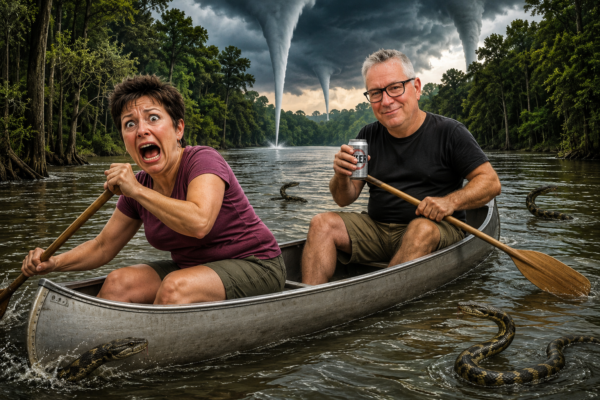
This is the story of a woman, a river, and a concussion.
The woman’s name is Debbie; the river has many names, none of them printable here; and the concussion … I guess it was my fault.
I told Debbie before we got in the canoe that I did NOT know how to steer. I said, “Debbie, before we begin I should warn you: The last time I tried to steer a canoe, there were some problems.”
Oh?
“Yes. A few deaths were involved.”
But no. Not only did she suggest I sit in the back of the canoe, she actually encouraged me to sit in the back of the canoe. “Del, you sit in the back of the canoe,” is what she said. Somehow, she has forgotten that part. Maybe it’s the amnesia.
The back of the canoe is the nerve center of the Canoe Guidance System. The person who sits in the back of the canoe must have the lightning reflexes of a cat that is about to be taken to the vet. He must have the woodlands savvy and bravado of a Marlin Perkins with his premium paid in full. And he must have several beers under his belt.
It was sunny between the downpours. The temperature was 86.8 degrees, the humidity 78 percent, winds variable except near the waterspouts – a perfect day for canoeing down a snake-infested river.
We pushed off from our launch point and within seconds we were gliding effortlessly down the river – sideways. Then, disaster struck. We hit a “stob.”
I tried to tell Debbie, in my best Grizzly Adams voice, that a “stob” is an underwater stump, but she thought I was making up the word. This argument lasted all day. I would say, “HOLD ON, WE’RE ABOUT TO HIT A STOB!” and Debbie would say, “Oh, you’re just making that up!” and then CRASH! The canoe would collide with a stob and Debbie would sustain head injuries.
Anyway, we hit our first stob. We heard a crash. The canoe stopped dead in the water. We held our breath, like U-boat captains waiting for the depth charge to go off. The canoe turned completely around and again we were gliding effortlessly down the river – backward.
That was as good a time as any stop at the handy shoreline, straighten out our canoe and swill beer. We had a bend in the river to negotiate downstream and we would need all our wits.
OK, so we managed to make the turn, but – this is the part Debbie’s attorney wants to hear – I wasn’t able to stop turning (see, I took the rap) and we zoomed into low-hanging branches at Canoe Warp Factor 8. Debbie, remembering what I’d said about snakes lurking in branches just like these, tried to keep them out of her face. But they whipped back and smacked her; she toppled over and banged her head on the side of the canoe. Hence the concussion.
Debbie has foolishly suggested we go canoeing again. Only this time, SHE wants to sit in the back. Every time she says that, a cold, soulless smile creeps into her expression.
So I’d better drop the skeet shooting idea.
This column was published on Thursday, Aug. 11, 1988 in the Northwest Florida Daily News and is used with permission.
About the author:
Del Stone Jr. is a professional fiction writer. He is known primarily for his work in the contemporary dark fiction field, but has also published science fiction and contemporary fantasy. Stone’s stories, poetry and scripts have appeared in publications such as Amazing Stories, Eldritch Tales, and Bantam-Spectra’s Full Spectrum. His short fiction has been published in The Year’s Best Horror Stories XXII; Alfred Hitchcock’s Mystery Magazine; the Pocket Books anthology More Phobias; the Barnes & Noble anthologies 100 Wicked Little Witch Stories, Horrors! 365 Scary Stories, and 100 Astounding Little Alien Stories; the HWA anthology Psychos; and other short fiction venues, like Blood Muse, Live Without a Net, Zombiesque and Sex Macabre. Stone’s comic book debut was in the Clive Barker series of books, Hellraiser, published by Marvel/Epic and reprinted in The Best of Hellraiser anthology. He has also published stories in Penthouse Comix, and worked with artist Dave Dorman on many projects, including the illustrated novella “Roadkill,” a short story for the Andrew Vachss anthology Underground from Dark Horse, an ashcan titled “December” for Hero Illustrated, and several of Dorman’s Wasted Lands novellas and comics, such as Rail from Image and “The Uninvited.” Stone’s novel, Dead Heat, won the 1996 International Horror Guild’s award for best first novel and was a runner-up for the Bram Stoker Award. Stone has also been a finalist for the IHG award for short fiction, the British Fantasy Award for best novella, and a semifinalist for the Nebula and Writers of the Future awards. His stories have appeared in anthologies that have won the Bram Stoker Award and the World Fantasy Award. Two of his works were optioned for film, the novella “Black Tide” and short story “Crisis Line.”
Stone recently retired after a 41-year career in journalism. He won numerous awards for his work, and in 1986 was named Florida’s best columnist in his circulation division by the Florida Society of Newspaper Editors. In 2001 he received an honorable mention from the National Lesbian and Gay Journalists Association for his essay “When Freedom of Speech Ends” and in 2003 he was voted Best of the Best in the category of columnists by Emerald Coast Magazine. He participated in book signings and awareness campaigns, and was a guest on local television and radio programs.
As an addendum, Stone is single, kills tomatoes and morning glories with ruthless efficiency, once tied the stem of a cocktail cherry in a knot with his tongue, and carries a permanent scar on his chest after having been shot with a paintball gun. He’s in his 60s as of this writing but doesn’t look a day over 94.
Contact Del at [email protected]. He is also on Facebook, twitter, Pinterest, tumblr, TikTok, and Instagram. Visit his website at delstonejr.com .

Google AI.
Here is everything you need to know about the contemporary music scene:
(Important note to readers who are about to stop reading and write me nasty letters calling me a tone-deaf burrowing parasite for ridiculing contemporary music: This is not meant to be taken seriously. I am engaging in what is known as “satire.”)
SONGS
All contemporary songs fit into one of these categories:
(A) I want to have sex with you.
(B) Why did you leave me just as I was about to persuade you to have sex with me?
(C) Hey! Let’s have sex and then maybe we will take some drugs.
(D) How can we have sex if you keep overturning my drink in my lap?
(E) I am so happy to be having sex with you, but I don’t think I like you.
(F) Now that we have finished having sex, you can get lost.
(G) I wish I could have sex with some other person.
(H) I like sex almost as much as I like contemporary music.
VIDEOS
When a filmmaker sets out to shoot a music video, these are his priorities:
(A) We will need a naked woman in chains.
(B) We will need a table, and several drinks sitting on top of the table, so the musician can turn over the table, spill the drinks and break the glasses, and we will show this process in slow motion at least 20 times.
(C) We will need a fast car and some sex.
(D) We will need a sunset, into which the musicians will walk at the end of the video, free of any worldly concerns.
(E) We will need jillions of dollars to pay these musicians who are free of any worldly concerns.
VJs
A “video jockey” must admit several intrinsic truths about his job:
(A) I am a parasite, and the world of music is my host.
(B) I am doing this only because I have no musical talent besides pounding out a percussion sequence with a spoon as I listen to the radio and fantasize that I am a rock star.
(C) Because musicians need me to publicize their work, and because I appear on television, I am an important person, and you are not, so I will treat you like an invertebrate.
MUSIC CRITICS
Music critics face a host of concerns about their work:
(A) How can I convince my readers that this album is more important to their personal well-being than the mounting national deficit?
(B) I am interviewing this rock musician, who has a purple Mohawk, a bone in his nose, earrings down to his buttocks, a tattoo on his cheek that says, “I BRAKE FOR NOTHING,” and this musician has fallen off his chair twice and has a big gob of drool sliding down his chin and his eyes are spinning in their sockets like a washing machine tub in the rinse cycle, and this musician writes songs with unforgettable lyrics such as “Oooh oooh, baby, oooh, I want to have sex with youuu,” and I am supposed to write a review praising this musician’s eloquent commentary on the human condition, as opposed to the nihilistic rantings of his contemporaries? Boy, do I love this job!
This column was published in the July 21, 1988 edition of the Northwest Florida Daily News and is used with permission.
About the author:
Del Stone Jr. is a professional fiction writer. He is known primarily for his work in the contemporary dark fiction field, but has also published science fiction and contemporary fantasy. Stone’s stories, poetry and scripts have appeared in publications such as Amazing Stories, Eldritch Tales, and Bantam-Spectra’s Full Spectrum. His short fiction has been published in The Year’s Best Horror Stories XXII; Alfred Hitchcock’s Mystery Magazine; the Pocket Books anthology More Phobias; the Barnes & Noble anthologies 100 Wicked Little Witch Stories, Horrors! 365 Scary Stories, and 100 Astounding Little Alien Stories; the HWA anthology Psychos; and other short fiction venues, like Blood Muse, Live Without a Net, Zombiesque and Sex Macabre. Stone’s comic book debut was in the Clive Barker series of books, Hellraiser, published by Marvel/Epic and reprinted in The Best of Hellraiser anthology. He has also published stories in Penthouse Comix, and worked with artist Dave Dorman on many projects, including the illustrated novella “Roadkill,” a short story for the Andrew Vachss anthology Underground from Dark Horse, an ashcan titled “December” for Hero Illustrated, and several of Dorman’s Wasted Lands novellas and comics, such as Rail from Image and “The Uninvited.” Stone’s novel, Dead Heat, won the 1996 International Horror Guild’s award for best first novel and was a runner-up for the Bram Stoker Award. Stone has also been a finalist for the IHG award for short fiction, the British Fantasy Award for best novella, and a semifinalist for the Nebula and Writers of the Future awards. His stories have appeared in anthologies that have won the Bram Stoker Award and the World Fantasy Award. Two of his works were optioned for film, the novella “Black Tide” and short story “Crisis Line.”
Stone recently retired after a 41-year career in journalism. He won numerous awards for his work, and in 1986 was named Florida’s best columnist in his circulation division by the Florida Society of Newspaper Editors. In 2001 he received an honorable mention from the National Lesbian and Gay Journalists Association for his essay “When Freedom of Speech Ends” and in 2003 he was voted Best of the Best in the category of columnists by Emerald Coast Magazine. He participated in book signings and awareness campaigns, and was a guest on local television and radio programs.
As an addendum, Stone is single, kills tomatoes and morning glories with ruthless efficiency, once tied the stem of a cocktail cherry in a knot with his tongue, and carries a permanent scar on his chest after having been shot with a paintball gun. He’s in his 60s as of this writing but doesn’t look a day over 94.
Contact Del at [email protected]. He is also on Facebook, twitter, Pinterest, tumblr, TikTok, and Instagram. Visit his website at delstonejr.com .

Photo courtesy of the Australian Institute of Marine Science
My ex-best friends Jim Shrine and Joann Schumann, who work here at the newspaper, recently returned from a vacation in Mexico.
They didn’t invite me, of course.
But that’s OK. I don’t mind. Really. Just because those two drain clogs go off to an exotic foreign country for a carefree week of sipping margaritas and reef diving, and leave me here to only dream about such a splendid vacation as I wile away my miserable existence waiting for my $2 Renuzit rebate to come in the mail so I can buy food for another month, well, that’s no reason for me to hold a grudge.
Besides, I’m going to have a fine vacation myself, right here in exotic Fort Walton Beach, a decision cheerfully made for me by my bank account. I’ve made plans for all kinds of exotic adventures during my week off, and I’m sure those two margarita-sipping, reef-diving debauchees will wish they’d never heard of Mexico.
This is my itinerary:
FRIDAY – I get new glasses. YAY! I have to pay for them. BOO! I get a haircut! YAY! I get skillions of little itchy hairs down my back. BOO!
SATURDAY – We’re going canoeing. For those of you who are not rugged outdoorsmen such as I and can’t, say, fell a redwood by gnawing through it, I should explain that a canoe is a boat-like object that you turn over, spilling everything inside the cooler and contributing to the massive Coldwater River beer deficit. This should be fun, as I am told snakes sometimes drop into the canoe, and married couples who cannot maneuver their canoes actually engage in the act of divorce, right there amid the natural splendor of the river!
SUNDAY – We’re having a combination pool-birthday party for Tracy Wenzel, Debbie Lord and Kris Wheeler, YAY! I really should buy them presents, BOO! How long does it take to wrap $5 worth of Pez?
MONDAY – Ray Aldridge and I shoot pool for the Championship of the Known Universe – if he doesn’t take his wife Nancy and his daughter April sailing on their new boat. I’m sure he will make the correct decision and shoot pool.
TUESDAY THROUGH WEDNESDAY – I rent TWO – count ’em – TWO VIDEOS, and make one of my special pizzas, what I call the Cholesterol Express Pizza. The folks at the video store had better save me a copy of “Fatal Attraction.”
THURSDAY – I’m going out to dinner with Sandy and Dave Jacobs – if they invite me. If not, I will probably sit at home, lonely and starving and wondering if I will ever again have a chance to pick up a menu written in a foreign language and place an order for goat nostril flaps.
FRIDAY – This will be a carefree day of scrubbing the toilet and waiting for the mail. Maybe a bill will come. Take that, you reef-diving, margarita swillers!
SATURDAY – For today I’ve scheduled those last-day-of-vacation blues. Maybe I’ll spend the day plotting ways to make Jim and Joann sorry they didn’t invite me to Mexico.
This column was published in the Thursday, July 14, 1988 edition of the Northwest Florida Daily News and is used with permission.
About the author:
Del Stone Jr. is a professional fiction writer. He is known primarily for his work in the contemporary dark fiction field, but has also published science fiction and contemporary fantasy. Stone’s stories, poetry and scripts have appeared in publications such as Amazing Stories, Eldritch Tales, and Bantam-Spectra’s Full Spectrum. His short fiction has been published in The Year’s Best Horror Stories XXII; Alfred Hitchcock’s Mystery Magazine; the Pocket Books anthology More Phobias; the Barnes & Noble anthologies 100 Wicked Little Witch Stories, Horrors! 365 Scary Stories, and 100 Astounding Little Alien Stories; the HWA anthology Psychos; and other short fiction venues, like Blood Muse, Live Without a Net, Zombiesque and Sex Macabre. Stone’s comic book debut was in the Clive Barker series of books, Hellraiser, published by Marvel/Epic and reprinted in The Best of Hellraiser anthology. He has also published stories in Penthouse Comix, and worked with artist Dave Dorman on many projects, including the illustrated novella “Roadkill,” a short story for the Andrew Vachss anthology Underground from Dark Horse, an ashcan titled “December” for Hero Illustrated, and several of Dorman’s Wasted Lands novellas and comics, such as Rail from Image and “The Uninvited.” Stone’s novel, Dead Heat, won the 1996 International Horror Guild’s award for best first novel and was a runner-up for the Bram Stoker Award. Stone has also been a finalist for the IHG award for short fiction, the British Fantasy Award for best novella, and a semifinalist for the Nebula and Writers of the Future awards. His stories have appeared in anthologies that have won the Bram Stoker Award and the World Fantasy Award. Two of his works were optioned for film, the novella “Black Tide” and short story “Crisis Line.”
Stone recently retired after a 41-year career in journalism. He won numerous awards for his work, and in 1986 was named Florida’s best columnist in his circulation division by the Florida Society of Newspaper Editors. In 2001 he received an honorable mention from the National Lesbian and Gay Journalists Association for his essay “When Freedom of Speech Ends” and in 2003 he was voted Best of the Best in the category of columnists by Emerald Coast Magazine. He participated in book signings and awareness campaigns, and was a guest on local television and radio programs.
As an addendum, Stone is single, kills tomatoes and morning glories with ruthless efficiency, once tied the stem of a cocktail cherry in a knot with his tongue, and carries a permanent scar on his chest after having been shot with a paintball gun. He’s in his 60s as of this writing but doesn’t look a day over 94.
Contact Del at [email protected]. He is also on Facebook, twitter, Pinterest, tumblr, TikTok, and Instagram. Visit his website at delstonejr.com .
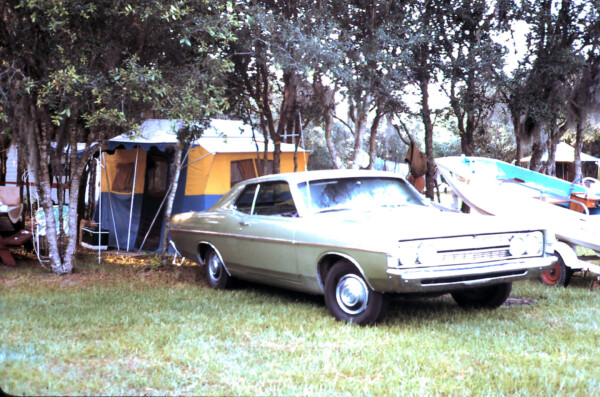
This was our campsite outside of Lessburg, Florida, in the early 1970s The campground was overrun with gnats. Photo by Del Stone Sr.
My camping adventure comes to a merciful close at a campground we christened “Gnat City.”
Gnat City lies somewhere in the vicinity of Leesburg, which lies somewhere in the vicinity of the Twilight Zone. Gnat City is memorable for (A) hordes of gnats that can exist only in your eyes and nostrils, (B) a lake that possibly hosts tiny, amoeba-like creatures that crawl into your eyes and lethally infect your brain, (C) a gigantic watermelon patch featuring real watermelons in various stages of decomposition, (D) wild birds that will actually fly up to you as you eat and take a dump in your plate, and (E) Satan, the goat with devil eyes.
It is hot when we arrive; it is hot after the sun goes down; it is hot the next day, when, for some incomprehensible reason, we decide to stay. Other than that, it is a nice place, except for:
The gnats – We are talking biblical plague here. The gnats crawl into your ears, your eyes and your nose. If you aren’t careful, you breathe and swallow them. This just about covers the gamut of all human functions, rendering life essentially impossible outside of little screened-in enclosures. Sitting in these enclosures is a truly memorable way to spend a vacation in Central Florida.
The lake – The lake is populated with various animals that are not friends to mankind: alligators, snakes and amoebas that eat their way into your brain, just like in that episode of “Night Gallery,” causing a slow, agonizing death. Fortunately, we go swimming only when we have to, such as when we are attacked by gnats while darting from screened-in enclosure to screened-in enclosure and have to seek refuge underwater.
The watermelon path – I feel like Tom Sawyer as I skulk into the patch after dark to steal a watermelon. I chose a likely candidate, pick it up, and hand sinks into it to the wrist.
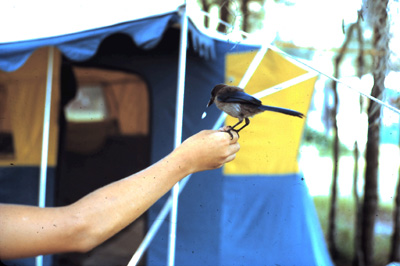
The birds – This is a true story. These wild birds, called scrub jays, are so tame they will perch on your hand and eat Wonder Bread, which may explain why so few of them exist anymore (I’m just kidding, little Wonder Bread elf who will clip this and send it to your corporate dungeon masters).
Satan, the devil goat – I call the goat Satan because it has vertical pupil slits for eyes, which remind me of a rock ’n’ roll album cover. Satan lives in a fenced-in enclosure around what I suspect is an open cesspool, which I believe is how Satan travels back and forth to hell to manufacture rock ’n’ roll albums. I notice the gnats don’t seem to bother Satan. Hmmm. Maybe the goat has something there.
At last, mournfully, it is time for our camping adventure to end. I will return to civilization, with is corrupting influences of color television and Jiffy Marts.
We load up the car, and it is with tears in my eyes that I watch the campground disappear behind us in a cloud of dust and gnats, painfully aware I could have spent the past two weeks in an Econo Lodge.
This column was published in the Thursday, June 16, 1988 edition of the Northwest Florida Daily News and is used with permission.
About the author:
Del Stone Jr. is a professional fiction writer. He is known primarily for his work in the contemporary dark fiction field, but has also published science fiction and contemporary fantasy. Stone’s stories, poetry and scripts have appeared in publications such as Amazing Stories, Eldritch Tales, and Bantam-Spectra’s Full Spectrum. His short fiction has been published in The Year’s Best Horror Stories XXII; Alfred Hitchcock’s Mystery Magazine; the Pocket Books anthology More Phobias; the Barnes & Noble anthologies 100 Wicked Little Witch Stories, Horrors! 365 Scary Stories, and 100 Astounding Little Alien Stories; the HWA anthology Psychos; and other short fiction venues, like Blood Muse, Live Without a Net, Zombiesque and Sex Macabre. Stone’s comic book debut was in the Clive Barker series of books, Hellraiser, published by Marvel/Epic and reprinted in The Best of Hellraiser anthology. He has also published stories in Penthouse Comix, and worked with artist Dave Dorman on many projects, including the illustrated novella “Roadkill,” a short story for the Andrew Vachss anthology Underground from Dark Horse, an ashcan titled “December” for Hero Illustrated, and several of Dorman’s Wasted Lands novellas and comics, such as Rail from Image and “The Uninvited.” Stone’s novel, Dead Heat, won the 1996 International Horror Guild’s award for best first novel and was a runner-up for the Bram Stoker Award. Stone has also been a finalist for the IHG award for short fiction, the British Fantasy Award for best novella, and a semifinalist for the Nebula and Writers of the Future awards. His stories have appeared in anthologies that have won the Bram Stoker Award and the World Fantasy Award. Two of his works were optioned for film, the novella “Black Tide” and short story “Crisis Line.”
Stone recently retired after a 41-year career in journalism. He won numerous awards for his work, and in 1986 was named Florida’s best columnist in his circulation division by the Florida Society of Newspaper Editors. In 2001 he received an honorable mention from the National Lesbian and Gay Journalists Association for his essay “When Freedom of Speech Ends” and in 2003 he was voted Best of the Best in the category of columnists by Emerald Coast Magazine. He participated in book signings and awareness campaigns, and was a guest on local television and radio programs.
As an addendum, Stone is single, kills tomatoes and morning glories with ruthless efficiency, once tied the stem of a cocktail cherry in a knot with his tongue, and carries a permanent scar on his chest after having been shot with a paintball gun. He’s in his 60s as of this writing but doesn’t look a day over 94.
Contact Del at [email protected]. He is also on Facebook, twitter, Pinterest, tumblr, TikTok, and Instagram. Visit his website at delstonejr.com .
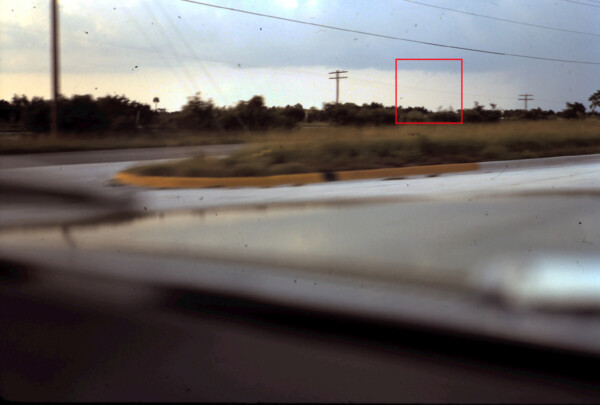
On the way to Camp Do-Not we spotted this waterspout in the distance. Maybe you can see it in the red box. Or maybe I'm lying. By this time we were delerious with heat stroke because Dad refused to turn on the AC in the car because it dropped the gas mileage by 2 mpg. These days I run the car AC in the dead of winter with 8 inches of snow on the ground. Photo by Joyce Stone.
Sadly, it is time for us to end our idyllic week at Manatee Springs State Park and move on to another Campground from Unspoiled Hell.
In the 20 or so seconds it takes us to pack our belongings, I stop to reflect on the highlights of our visit:
(A) I found an opossum skull. Aside from satanic rituals, I could think of no practical use for it, but I kept it anyway. I now proudly display it in a cardboard box in the attic.
(B) Watching moths go up in little balls of fire in the kerosene lantern – an early, crude version of the electronic bug zapper.
(C) Picking up garbage the raccoons scattered during the night – the SAME garbage I picked up the day before, and the day before that, ad infinitum. This vicious cycle of scattering and picking up has been going on since the time Indians roamed the area and had their garbage scattered by raccoons. I think some of the garbage I picked up WAS Indian garbage.
As we depart, we wave a fond farewell to the Bobs, who have threatened to someday return to their home, if they can get Bob out of the lawn chair.
As we head south, despite my fervent desire that we turn north in the direction of home, we pass many fascinating sights. They were too expensive, so I don’t get to see them. But we stop at some of the less interesting sights, which include:
Reptile Land – This linchpin of the Florida tourism industry features, among other things, a caged duck that plays a piano. I am not kidding. You put a quarter in the slot and the duck uses its bill to bash out a tune worthy of any 10-year-old after $5,000 worth of lessons.
I also feel that Reptile Land sells a superior quality plastic alligator, and now one of those is on proud display with the opossum skull in the attic.
Weeki Wachee – I don’t actually see the show, but I use the bathroom in the lobby and I am impressed.
Miles and miles of dead orange groves – There they are in all their natural dead splendor, those famous Florida orange groves you hear are threatened every time the temperature plummets below 85. They are a stark reminder that Anita Bryant no longer lives in Florida.
We arrive at our new home, a campground on Sannibel Island. We call it “Camp Do-Not,” because everywhere you look is a sign telling you what you cannot do. We spend one night there, immobilized in our tent. Although the rules forbid it, we break camp and leave the next day.
We wend our way northeast, to the interior of Florida, where the humidity is always higher than the temperature, even inside most homeowners’ ovens, which few residents use because they find it less expensive and more convenient to do their cooking on the sidewalks.
There, we complete the final leg of our journey across the heart of darkness of Florida, and I promise that next week’s column will be the last I write about camping, at least until I run out of ideas again.
Next week: Satan, the devil goat.
This column was published in the Northwest Florida Daily News on June 9, 1988 and is used with permission.
About the author:
Del Stone Jr. is a professional fiction writer. He is known primarily for his work in the contemporary dark fiction field, but has also published science fiction and contemporary fantasy. Stone’s stories, poetry and scripts have appeared in publications such as Amazing Stories, Eldritch Tales, and Bantam-Spectra’s Full Spectrum. His short fiction has been published in The Year’s Best Horror Stories XXII; Alfred Hitchcock’s Mystery Magazine; the Pocket Books anthology More Phobias; the Barnes & Noble anthologies 100 Wicked Little Witch Stories, Horrors! 365 Scary Stories, and 100 Astounding Little Alien Stories; the HWA anthology Psychos; and other short fiction venues, like Blood Muse, Live Without a Net, Zombiesque and Sex Macabre. Stone’s comic book debut was in the Clive Barker series of books, Hellraiser, published by Marvel/Epic and reprinted in The Best of Hellraiser anthology. He has also published stories in Penthouse Comix, and worked with artist Dave Dorman on many projects, including the illustrated novella “Roadkill,” a short story for the Andrew Vachss anthology Underground from Dark Horse, an ashcan titled “December” for Hero Illustrated, and several of Dorman’s Wasted Lands novellas and comics, such as Rail from Image and “The Uninvited.” Stone’s novel, Dead Heat, won the 1996 International Horror Guild’s award for best first novel and was a runner-up for the Bram Stoker Award. Stone has also been a finalist for the IHG award for short fiction, the British Fantasy Award for best novella, and a semifinalist for the Nebula and Writers of the Future awards. His stories have appeared in anthologies that have won the Bram Stoker Award and the World Fantasy Award. Two of his works were optioned for film, the novella “Black Tide” and short story “Crisis Line.”
Stone recently retired after a 41-year career in journalism. He won numerous awards for his work, and in 1986 was named Florida’s best columnist in his circulation division by the Florida Society of Newspaper Editors. In 2001 he received an honorable mention from the National Lesbian and Gay Journalists Association for his essay “When Freedom of Speech Ends” and in 2003 he was voted Best of the Best in the category of columnists by Emerald Coast Magazine. He participated in book signings and awareness campaigns, and was a guest on local television and radio programs.
As an addendum, Stone is single, kills tomatoes and morning glories with ruthless efficiency, once tied the stem of a cocktail cherry in a knot with his tongue, and carries a permanent scar on his chest after having been shot with a paintball gun. He’s in his 60s as of this writing but doesn’t look a day over 94.
Contact Del at [email protected]. He is also on Facebook, twitter, Pinterest, tumblr, TikTok, and Instagram. Visit his website at delstonejr.com .
The women in the backshop are standing there putting together a jigsaw puzzle, and I want this madness to stop right now because they’ve almost got it finished and I could never get past unwrapping the box.
You’d have to be nuts to sit there for hours trying to fit little hacked-up pieces of cardboard to form a picture of Elvis, when you can go down to a roadside stand and BUY a perfectly good picture of Elvis on purple and black velvet, and it’s already put together.
Jigsaw puzzles are things mothers once used to get the kids out of their hair until television was invented. The problem was that kids couldn’t go more than a few seconds before puzzle-building gave way to hair-pulling, then the pieces would get scattered all over the house and you’d be finding them in the refrigerator or in the bedsheets for months afterwards.
What was worse, children had this terrible habit of asking their parents for help. The standard reply was, “No, dear. Mommy can’t help because that would spoil all the fun for you,” which really meant, “Mommy doesn’t want to put together some dumb jigsaw puzzle of Bambi and Thumper discussing the nature of reality, and why don’t you kids work on it for several years until I get a healthy layer of scar tissue over these ulcers?”
But then Mommy would be passing by and see a piece that fit into a hole, and pretty soon Mommy would be on the floor searching for more pieces that fit and occasionally shrieking “I FOUND ONE!” while the kids are off pulling each other’s hair or testing the cat’s reaction to having its tale inserted into the garbage disposal.
A big problem with jigsaw puzzles is that a piece is always missing. Space aliens from the galactic center of the universe could land in Washington, D.C., and deliver a solid gold jigsaw puzzle as a gift to all mankind, and piece would be missing.
Another thing you have to consider is the personality of a person who enjoys working jigsaw puzzles. Basically, these people sick. Why else would anyone spend a significant portion of his lifetime connecting pieces of cardboard to form pictures of things he would never allow to soil his walls, when he could be doing constructive things such as developing new uses for that stuff that collects in drains, or solving the mounting national deficit?
Which leads me to the mounting crisis of the national deficit. I have hit upon the solution to the deficit problem, which is to have Oliver North shred it into 20 or 30 jillion skillion pieces and mail envelopes of the pieces to all the taxpayers, then throw a national jigsaw puzzle party and invite the entire nation to put the deficit back together.
While everybody is doing this, the government can jack taxes through the roof and nobody will notice because they’ll be busy covering North America with the Mounting Crisis of National Deficit Puzzle, and by the time it’s put together nobody will be around to worry about the deficit.
This column was originally published in the Northwest Florida Daily News and is used with permission.
About the author:
Del Stone Jr. is a professional fiction writer. He is known primarily for his work in the contemporary dark fiction field, but has also published science fiction and contemporary fantasy. Stone’s stories, poetry and scripts have appeared in publications such as Amazing Stories, Eldritch Tales, and Bantam-Spectra’s Full Spectrum. His short fiction has been published in The Year’s Best Horror Stories XXII; Alfred Hitchcock’s Mystery Magazine; the Pocket Books anthology More Phobias; the Barnes & Noble anthologies 100 Wicked Little Witch Stories, Horrors! 365 Scary Stories, and 100 Astounding Little Alien Stories; the HWA anthology Psychos; and other short fiction venues, like Blood Muse, Live Without a Net, Zombiesque and Sex Macabre. Stone’s comic book debut was in the Clive Barker series of books, Hellraiser, published by Marvel/Epic and reprinted in The Best of Hellraiser anthology. He has also published stories in Penthouse Comix, and worked with artist Dave Dorman on many projects, including the illustrated novella “Roadkill,” a short story for the Andrew Vachss anthology Underground from Dark Horse, an ashcan titled “December” for Hero Illustrated, and several of Dorman’s Wasted Lands novellas and comics, such as Rail from Image and “The Uninvited.” Stone’s novel, Dead Heat, won the 1996 International Horror Guild’s award for best first novel and was a runner-up for the Bram Stoker Award. Stone has also been a finalist for the IHG award for short fiction, the British Fantasy Award for best novella, and a semifinalist for the Nebula and Writers of the Future awards. His stories have appeared in anthologies that have won the Bram Stoker Award and the World Fantasy Award. Two of his works were optioned for film, the novella “Black Tide” and short story “Crisis Line.”
Stone recently retired after a 41-year career in journalism. He won numerous awards for his work, and in 1986 was named Florida’s best columnist in his circulation division by the Florida Society of Newspaper Editors. In 2001 he received an honorable mention from the National Lesbian and Gay Journalists Association for his essay “When Freedom of Speech Ends” and in 2003 he was voted Best of the Best in the category of columnists by Emerald Coast Magazine. He participated in book signings and awareness campaigns, and was a guest on local television and radio programs.
As an addendum, Stone is single, kills tomatoes and morning glories with ruthless efficiency, once tied the stem of a cocktail cherry in a knot with his tongue, and carries a permanent scar on his chest after having been shot with a paintball gun. He’s in his 60s as of this writing but doesn’t look a day over 94.
Contact Del at [email protected]. He is also on Facebook, twitter, Pinterest, tumblr, TikTok, and Instagram. Visit his website at delstonejr.com .
I recently had an opportunity to take a midwinter vacation, and because I didn’t want to spend a lot of money traveling somewhere, I decided to spend this week right here in Florida, the tourist capital of the United States,
So … what does one do when vacationing in Florida? He goes to the beach, naturally, and that’s what I did. But early February isn’t exactly a boom season for beach-lounging.
I picked up garbage.
At this point you must be thinking, “He’s finally done something to earn one of those jackets with no sleeves and permanent residency in a padded cell.” Picking up garbage might not constitute a vacation you write home about, but if nothing else, it was an education for me.
A few years ago I took another midwinter vacation, and I spent that week exploring nearby places I had never seen. One stretch of beach particularly impressed me with its unspoiled beauty. It must have looked that way for hundreds of years. Except for the garbage.
The garbage had been left there by boaters and explorers like myself who were less appreciative of the natural wonder about them. It made me angry, and this time I decided to do something about it.
I spent only four days picking up garbage. It rained three days and I took off a day because I hurt my back with all that bending over and lifting. But in those four days I hauled 30 bags of garbage from a stretch of land I’d estimate to be 200 yards in length.
In a way it was fun, because you wouldn’t believe some of the junk I found. Empty flare cartridges. Light bulbs – who takes light bulbs to the beach? Disposable diapers (yech!). Shot cups from shotgun shells. Broken toys. Shoes. Socks. Photos that apparently had fallen from somebody’s wallet. Somebody’s boat registration (It was sealed in a plastic bag, and the owner’s address was printed on the front, So I returned it to him. Water had gotten inside the bag, but I think he could dry it in the oven).
But 90 percent of the garbage consisted of bottles and plastic, and I am now convinced this state needs a bottle deposit law. You simply would not believe the number of bottles I found. Some had been broken in horrifying ways. It was commonplace to find huge, jagged pieces of glass protruding from the sand. If someone had stepped on the glass, he would have needed a trip to the hospital.
And the plastic! Bags and pieces of rope and plastic containers were scattered everywhere. They were ensnarled in tree roots; they littered the dunes and thatches of beach scrub.
Seeing this kind of thing can give you an unhealthy disrespect for your fellow man.
You read stories and you watch television programs about the environment and how mankind’s disregard for the world around him is laying nature to waste. You never see those stories about this area, though. Everything is supposed to be generally OK in these parts.
Well, if this is OK, I’d hate to see the really bad places. Because nothing must live there, not even people.
This column was originally published in the March 3, 1988 edition of the Northwest Florida Daily News and is used with permission.
About the author:
Del Stone Jr. is a professional fiction writer. He is known primarily for his work in the contemporary dark fiction field, but has also published science fiction and contemporary fantasy. Stone’s stories, poetry and scripts have appeared in publications such as Amazing Stories, Eldritch Tales, and Bantam-Spectra’s Full Spectrum. His short fiction has been published in The Year’s Best Horror Stories XXII; Alfred Hitchcock’s Mystery Magazine; the Pocket Books anthology More Phobias; the Barnes & Noble anthologies 100 Wicked Little Witch Stories, Horrors! 365 Scary Stories, and 100 Astounding Little Alien Stories; the HWA anthology Psychos; and other short fiction venues, like Blood Muse, Live Without a Net, Zombiesque and Sex Macabre. Stone’s comic book debut was in the Clive Barker series of books, Hellraiser, published by Marvel/Epic and reprinted in The Best of Hellraiser anthology. He has also published stories in Penthouse Comix, and worked with artist Dave Dorman on many projects, including the illustrated novella “Roadkill,” a short story for the Andrew Vachss anthology Underground from Dark Horse, an ashcan titled “December” for Hero Illustrated, and several of Dorman’s Wasted Lands novellas and comics, such as Rail from Image and “The Uninvited.” Stone’s novel, Dead Heat, won the 1996 International Horror Guild’s award for best first novel and was a runner-up for the Bram Stoker Award. Stone has also been a finalist for the IHG award for short fiction, the British Fantasy Award for best novella, and a semifinalist for the Nebula and Writers of the Future awards. His stories have appeared in anthologies that have won the Bram Stoker Award and the World Fantasy Award. Two of his works were optioned for film, the novella “Black Tide” and short story “Crisis Line.”
Stone recently retired after a 41-year career in journalism. He won numerous awards for his work, and in 1986 was named Florida’s best columnist in his circulation division by the Florida Society of Newspaper Editors. In 2001 he received an honorable mention from the National Lesbian and Gay Journalists Association for his essay “When Freedom of Speech Ends” and in 2003 he was voted Best of the Best in the category of columnists by Emerald Coast Magazine. He participated in book signings and awareness campaigns, and was a guest on local television and radio programs.
As an addendum, Stone is single, kills tomatoes and morning glories with ruthless efficiency, once tied the stem of a cocktail cherry in a knot with his tongue, and carries a permanent scar on his chest after having been shot with a paintball gun. He’s in his 60s as of this writing but doesn’t look a day over 94.
Contact Del at [email protected]. He is also on Facebook, twitter, Pinterest, tumblr, TikTok, and Instagram. Visit his website at delstonejr.com .

Image courtesy of Quinn Dombrowski by way of a Creative Commons license. https://www.flickr.com/photos/quinnanya/
As a homeowner, I have had my eyes opened to a range of marvelous new experiences, many of them requiring the absence of money. One such experience is a clogged drain.
In the halcyon days of my youth, a clogged drain meant waiting until 2:30 when Dad would come home from work to fix it. Now, a clogged drain means that I, as an adult male and, by default, the head of the household, am expected to flail at the accursed thing for at least an hour before calling Dad, who must come home from work and then drive across town to my house to fix it.
I was taking a shower recently when I noticed that my kneecaps were submerged. My keen powers of perception told me that water was not draining from the bathtub, and with my equally acute powers of deductive reasoning, I swiftly determined that something – probably a big wad of mutant hairballs – had plugged the drain.
Minutes later I entered the bathroom dressed for battle: a plumber’s snake dangled from my fist like a bullwhip. The furrows in my forehead, plowed there by grim determination, were dotted with beads of sweat, or perhaps bath water, because I had forgotten to towel off.
You are probably asking yourself: What is a plumber’s snake? Is it one of those things you read about that swims up into toilets and gives elderly ladies heart attacks?
No. Basically, a plumber’s snake is a long metal device that you use to damage shower tiles and small children if they happen to be in the same voting precinct when you are cranking it.
I began ramming the snake down the drain. I immediately encountered an obstruction, because the snake kept wanting to spring back out of the drain as if it were some mad jack-in-the-box. The obstruction turned out to be a bend in the pipe.
More of the snake began to slip into the drain. I could hear it clearly … so clearly that my powerful intellect was able to guide me to the conclusion that it had gone UP the pipe instead of DOWN, and would have inserted itself into my ear had it not been for a metal plate covering the opening beneath the faucet.
I reasoned that if I could remove that metal plate, I could force the snake DOWN, and it could go nowhere but into the drain pipe, unless it bored through the pipe and into Earth’s crust.
So I set about unscrewing the screw that held the plate in place. I did not know the screw hadn’t been moved since man developed metallurgy, and no sooner than I could say, “What hath God wrought,” the screw broke, the plate fell off and I was staring at a slime-encrusted hole that resembled a biblical description of hell.
Ever the opportunist, I inserted the plumber’s snake into the hole and began merrily plunging away, and half an hour later I had slime all over the bathroom, the drain was plugged worse than ever and it was almost time to go to work.
That’s when I called Dad.
I’m happy to report the drain is now clear and the lid to hell has been capped and you can all return to your homes. Except the kitchen faucet is dripping.
This column was originally published in a February 1988 edition of the Northwest Florida Daily News and is used with permission.
About the author:
Del Stone Jr. is a professional fiction writer. He is known primarily for his work in the contemporary dark fiction field, but has also published science fiction and contemporary fantasy. Stone’s stories, poetry and scripts have appeared in publications such as Amazing Stories, Eldritch Tales, and Bantam-Spectra’s Full Spectrum. His short fiction has been published in The Year’s Best Horror Stories XXII; Alfred Hitchcock’s Mystery Magazine; the Pocket Books anthology More Phobias; the Barnes & Noble anthologies 100 Wicked Little Witch Stories, Horrors! 365 Scary Stories, and 100 Astounding Little Alien Stories; the HWA anthology Psychos; and other short fiction venues, like Blood Muse, Live Without a Net, Zombiesque and Sex Macabre. Stone’s comic book debut was in the Clive Barker series of books, Hellraiser, published by Marvel/Epic and reprinted in The Best of Hellraiser anthology. He has also published stories in Penthouse Comix, and worked with artist Dave Dorman on many projects, including the illustrated novella “Roadkill,” a short story for the Andrew Vachss anthology Underground from Dark Horse, an ashcan titled “December” for Hero Illustrated, and several of Dorman’s Wasted Lands novellas and comics, such as Rail from Image and “The Uninvited.” Stone’s novel, Dead Heat, won the 1996 International Horror Guild’s award for best first novel and was a runner-up for the Bram Stoker Award. Stone has also been a finalist for the IHG award for short fiction, the British Fantasy Award for best novella, and a semifinalist for the Nebula and Writers of the Future awards. His stories have appeared in anthologies that have won the Bram Stoker Award and the World Fantasy Award. Two of his works were optioned for film, the novella “Black Tide” and short story “Crisis Line.”
Stone recently retired after a 41-year career in journalism. He won numerous awards for his work, and in 1986 was named Florida’s best columnist in his circulation division by the Florida Society of Newspaper Editors. In 2001 he received an honorable mention from the National Lesbian and Gay Journalists Association for his essay “When Freedom of Speech Ends” and in 2003 he was voted Best of the Best in the category of columnists by Emerald Coast Magazine. He participated in book signings and awareness campaigns, and was a guest on local television and radio programs.
As an addendum, Stone is single, kills tomatoes and morning glories with ruthless efficiency, once tied the stem of a cocktail cherry in a knot with his tongue, and carries a permanent scar on his chest after having been shot with a paintball gun. He’s in his 60s as of this writing but doesn’t look a day over 94.
Contact Del at [email protected]. He is also on Facebook, twitter, Pinterest, tumblr, TikTok, Ello and Instagram. Visit his website at delstonejr.com .
Who knew I had such deep thoughts?
Filmmakers would have you believe every hour of every day is fraught with adventure. The typical cinematic day begins with an illicit love affair followed by a mysterious telephone call, a car chase and a narrowly thwarted assassination attempt.
But life rarely imitates art. This occurred to me recently as I was standing in an office supply store. The clerk had just told me IBM manufactures a ribbon cassette that is compatible with my Royal typewriter. That made me happy – inordinately happy. And I didn’t know why.
After all, small success stories such as these are not the stuff of which entertainment is made. Had I not been taught by 25 years of watching television and movies that a person could not be truly happy unless he were realizing his most extravagant dreams?
It had been a good day, so far, and as I went over the events that had made it that kind of day, I began to remember something many of us often forget under the barrage of video and celluloid fantasies.
That morning, I finally discovered a place where our writers’ group could meet. I belong to the Redneck Riviera Writers Group. We get together twice a month and compare notes on the business of writing. We had been meeting at people’s homes, or local eateries, but it soon became obvious that if we were to expand beyond our current membership of five people, we would have to find a permanent meeting place. After a fruitless search, we found a new home at the YMCA, courtesy of Joe Lukaszewski. That made me feel good.
Something else nice happened that morning. I found a book of Ramsey Campbell short stories I hadn’t known existed. I’m a student of the short story and Campbell is a bona fide master. The book should be fascinating.
I also picked up what I think will be the perfect gift for a friend. It, too, is a book of short stories, but these are special. I had never seen the book outside of the one copy I’d been hoarding for myself. Now she can enjoy it too.
Pop artist Andy Warhol died recently. In one of his obituaries I came across a reference to a movie of his titled “Sleep.” The movie depicted a person sleeping. That’s it. Two hours of a person sleeping. The entertainment virtues of the film are less than dubious and the artistic virtues debatable, but I think I understand what Warhol might have been saying.
The small, mundane successes and failures – things that would end up on the cutting room floor – are the body and texture of life. They are what make life an endlessly fascinating experience. Spilling coffee on the living room carpet. Finding a letter from a friend in your mailbox. The thousand things that you forget a day after they’ve happened. They are what get us through accomplishments to crises.
So it was a pretty good day. Not great, but not horrible. Just something to be thankful for.
This column was published in the Sunday, January 10, 1988 edition of the Northwest Florida Daily News and is used with permission.
About the author:
Del Stone Jr. is a professional fiction writer. He is known primarily for his work in the contemporary dark fiction field, but has also published science fiction and contemporary fantasy. Stone’s stories, poetry and scripts have appeared in publications such as Amazing Stories, Eldritch Tales, and Bantam-Spectra’s Full Spectrum. His short fiction has been published in The Year’s Best Horror Stories XXII; Alfred Hitchcock’s Mystery Magazine; the Pocket Books anthology More Phobias; the Barnes & Noble anthologies 100 Wicked Little Witch Stories, Horrors! 365 Scary Stories, and 100 Astounding Little Alien Stories; the HWA anthology Psychos; and other short fiction venues, like Blood Muse, Live Without a Net, Zombiesque and Sex Macabre. Stone’s comic book debut was in the Clive Barker series of books, Hellraiser, published by Marvel/Epic and reprinted in The Best of Hellraiser anthology. He has also published stories in Penthouse Comix, and worked with artist Dave Dorman on many projects, including the illustrated novella “Roadkill,” a short story for the Andrew Vachss anthology Underground from Dark Horse, an ashcan titled “December” for Hero Illustrated, and several of Dorman’s Wasted Lands novellas and comics, such as Rail from Image and “The Uninvited.” Stone’s novel, Dead Heat, won the 1996 International Horror Guild’s award for best first novel and was a runner-up for the Bram Stoker Award. Stone has also been a finalist for the IHG award for short fiction, the British Fantasy Award for best novella, and a semifinalist for the Nebula and Writers of the Future awards. His stories have appeared in anthologies that have won the Bram Stoker Award and the World Fantasy Award. Two of his works were optioned for film, the novella “Black Tide” and short story “Crisis Line.”
Stone recently retired after a 41-year career in journalism. He won numerous awards for his work, and in 1986 was named Florida’s best columnist in his circulation division by the Florida Society of Newspaper Editors. In 2001 he received an honorable mention from the National Lesbian and Gay Journalists Association for his essay “When Freedom of Speech Ends” and in 2003 he was voted Best of the Best in the category of columnists by Emerald Coast Magazine. He participated in book signings and awareness campaigns, and was a guest on local television and radio programs.
As an addendum, Stone is single, kills tomatoes and morning glories with ruthless efficiency, once tied the stem of a cocktail cherry in a knot with his tongue, and carries a permanent scar on his chest after having been shot with a paintball gun. He’s in his 60s as of this writing but doesn’t look a day over 94.
Contact Del at [email protected]. He is also on Facebook, twitter, Pinterest, tumblr, TikTok, and Instagram. Visit his website at delstonejr.com .