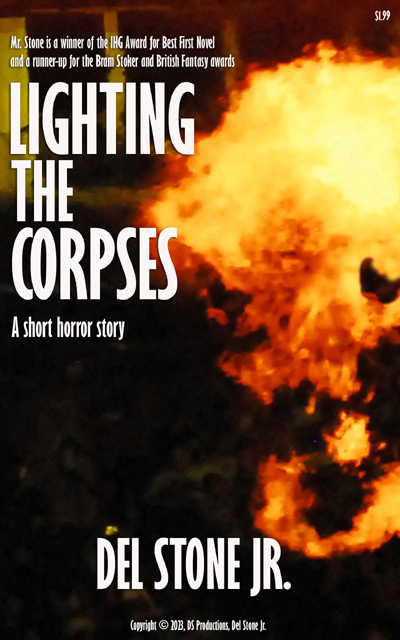
‘Lighting the Corpses’ (a short horror story)

Introduction to “Lighting the Corpses”
I don’t remember what went into the creation of this story.
I was in the throes of love withdrawal.
I was angry and wanted to hit back at the world.
I was beginning to find my feet as a writer.
I wanted to sell a story to the Horror Writers Association anthology “Robert Bloch’s Pyschos.” So “Lighting the Corpses” came to pass.
(By the way, I hate that title. I went with it because I couldn’t think of something better.)
This story is a tad overwritten but reading it all these years later, I’m surprised at how good it is. I mean, it’s really good. It works on multiple levels and I’m happy with it.
That’s all. A brief introduction.
Except this – I hope you’re happy with it too.
—
LIGHTING THE CORPSES
Searching, searching, Zeke roared across the night, pausing only to burn a man and watch him die.
So easy, now, in the focus of his rage. So viciously fun. But he couldn’t linger too long. He had others to burn. And one, a very special man Zeke called “Father Baptist,” a man who could not wait Zeke’s tenuous grasp on this world, would burn cell by cell, molecule by molecule, down to the ash of his soul.
Once Zeke found him.
Like this man, who was dying slowly and horribly as Zeke watched him, on the sidewalk outside Zeke’s old apartment. Zeke had come here hoping to find Father Baptist gloating over his crime, but the apartment had been empty. Instead, he’d seen this man. A 53-year-old CPA, divorced a year-and-a-half, who was slowly losing touch with his life for the want of companionship. The man was loitering on the sidewalk, two doors down from his own unit, hoping the woman in 3F would open her door and step outside. If she did, he’d talk to her a moment, just a moment, and not ask her for a date – he wanted to do this thing gradually – and build on the innocence of another encounter tomorrow. He wanted to believe he was an attractive and witty and intelligent man, and he wanted to believe she would recognize those qualities in him, and he wanted to believe she would be the solution to his loneliness.
Zeke could see it. He could see it all, as if it had been printed in careful block letters on a third-grader’s blue-ruled writing pad. He could see into the man’s heart.
And this is how Zeke burned the man:
You are a fat, over-the-hill, dumb bastard, and you’re gonna be alone until you finally get sick of it and ram the business end of a 9mm up your trap and pull the trigger.
Zeke chuckled as the man suddenly frowned, unsure of himself, and turned, shuffling unsteadily to his apartment, one hand lightly brushing the wall and dragging a little, as if he were about to faint and wanted to catch himself. The man saw himself differently now. Gone was the hope he might have a chance at this woman, or any other woman. His hair seemed to bleach gray as Zeke watched; his stomach sagged over his belt and his spine softened and he aged to death in an instant, the flesh sliding from his bones in slippery, wet clumps of despair.
The man went back into his apartment. Six months from now, on a night that would have no end, the man would load three hollow-tipped bullets into the clip of a Reuger. …
Zeke smiled. So easy, now, in the focus of his rage.
So easy, now that Zeke was dead.
—
Fire.
Fire was the great reducer, making everything simple, a brief rage of combustion and then a satisfied ash that could be reduced further to a mere black mark, a scar of carbon that said nothing more than something was burned by somebody.
Zeke likes fire.
He likes his fires.
A pile of leaves raked into the gutter. A candle made from melted crayons. His sister’s Barbie Beauty Salon, spirited out of the house and into a weedy lot down the street as she and Mom sit in the pediatrician’s waiting room to have a fake pearl tweezered out of her ear, stupid brat.
Zeke likes his fires. They say to him: Something was burned by Zeke. A nightmare, scorched from memory.
If Father knew, if Father knew, if Father knew … oh God, if Father knew.
And Zeke likes that, too.
—
Zeke roared across the night, stopping at a convenience store he’d stopped at weeks ago, hoping Father Baptist would be there, reliving his own torment or renewing his hatred. The store was closed and vacant and dark. A large patch of floor tiles by the counter had been scraped up. Zeke remembered why.
Zeke had always wanted to put the match to somebody. Sidle next to them, unnoticed, as they picked through undercooked scrambled eggs and grease-soaked fingers of sausage at a Shoney’s breakfast bar, for instance, and scrape the business end of a kitchen match against the zipper of his Levis and touch the flame to the trailing edge of their shirt sleeve and watch the whole works go up in a cough of combustion, their sudden intake of breath and their screams tickling that part of his brain no other act of pleasure ever touched. …
Zeke chuckled and did not hear himself. He never heard sounds now – the crack of a jalousie window as he worked the pane from its frame, the breaking-bone sound of a door jamb being chiseled away from a deadbolt. He could no longer taste the bitter highball of perfume and sweat; he could not feel a woman’s fingernails digging trails of fire across his cheek, the vibrating spasms of her throat shaking loose with a scream as he ripped her panties from her thighs. …
But he could see, the living people around him and the fears about themselves that secretly ate out the center of their lives. The deadness in them. They were corpses of hope and self-delusion and fantasy. Touch a flame to those things and you burned off the good parts about themselves people so desperately needed to believe and you uncovered the real person hiding inside, a tight little cinder of terror.
But there would be no second burning at the convenience store. Nobody was home, not even a security guard to keep away the curious from the scene of Zeke’s final crime.
Certainly not Father Baptist.
—
It is time to burn something again.
Mom and his sister are gone somewhere. They’re gone a lot after Father gets home from work. Funny, how they’re gone so much after Father gets home from work.
Now Zeke is going somewhere too. The weedy lot. To burn something. He has one of Father’s empty Falstaff beer cans, filled with charcoal starter, and a book of matches. Maybe he will burn the lot, or write his name in flames.
Maybe he will make an effigy of Father in twigs and leaves and burn that.
But he will burn something.
He is walking away from the house, the beer can hidden in front of his thigh, when he hears the front door bang open and a deep voice boom across the yard, “Where are you going?”
Instantly, his heart becomes a slab of meat in his chest.
“Just down the street,” he squeaks out.
“Come here,” his father commands.
He pivots to the left and sets down the beer can behind the bole of a pine tree.
“And bring that with you,” Father says.
The slab of meat in his chest rots in a way he can feel throughout his body. He trudges back to the house, feeling as though he his walking to his execution.
—
Zeke roared. He dipped briefly at the hospital to see if Father Baptist had burned himself. While there he paused to show a 9-year-old girl that she would not beat the cancer spreading through her rickety bones, and for good measure he showed the girl’s mother that yes, it was true, she really was to blame for what had happened to her daughter. The girl became a skeleton before Zeke’s eyes. The mother grew fangs and began to eat herself, ripping chunks of flesh from her arms, her calfs, and swallowed them in bloody lumps.
Zeke crossed the interstate and torched a truck driver with the realization that he’d failed as a medical student and there was never, ever any chance he’d pass his GRE for that master’s in counseling. The trucker became a cloud of fly-blown ash.
He torched a waitress who had dreams of becoming a model. He torched a would-be jet jockey. And the pale little man who looked like a boy and rocked himself to sleep with idiotic visions of becoming a golf pro – Zeke lit him up with a bolt of self-doubt and the man-boy popped like a 100-watt bulb.
They were all dead. Burned out and dead.
Except Father Baptist.
—
Father sniffs the can. His nose wrinkles.
“There’s something in there,” Zeke offers meekly, “but I wasn’t going to drink it.”
“Empty your pockets,” Father whispers. Zeke’s stomach drops a couple of notches, because the matches are in his pocket, and Father is not stupid.
And because he knows his father will search his pockets anyway, no matter what Zeke does to satisfy him or please him, Father will search his pockets because he is speaking in the doctor whisper he uses to search Zeke for cancer the way every good father searches his son, or the policeman whisper he uses to search Zeke for concealed drugs, or the coach whisper when he must check to make sure Zeke is still a boy and didn’t change into a girl overnight, so Father will search his pockets and then search beneath his T-shirt and then into his Fruit of the Looms and then. …
The whisper is strangely hoarse, coming from deep within the voice box, and it is all rattly and trembly as if Father were afraid of something.
“What’s this?” Father says, producing the matches as if he had just performed a magic trick. “Let’s see now … lighter fluid and matches. Were you planning to have a barbecue?”
Zeke stares at the floor, not saying anything.
So Father says, “Let’s see what else you’re hiding.”
—
Dead.
It was a stupid thing, really. After being so careful for so many months, Zeke had screwed up. Once. Just once.
The cops had given him a name: “The Backroads Killer,” because he worked the rural roads, the isolated house trailers, the yuppie castles in the woods with satellite dishes aimed through gaps in the trees and BMWs parked beneath enclosed patios. “The Backroads Killer.” A joke to Zeke. Cops always named criminals they couldn’t catch, as if a name implied mystical abilities. The cops hadn’t caught Zeke.
But Father Baptist had.
Zeke had been careful. Pantyhose over his head, the car parked off in the distance, that sort of thing. But he’d screwed up with the girl at the convenience store at that intersection between two state roads, the intersection giving a reason, he guessed, for the convenience store and a boarded-up John Deere distributorship. That and a traffic light that blinked yellow for one direction and red for the other, and you had what passed for a “town.”
Zeke could have continued on to the farmhouses and shanties he knew were hidden in the woods downroad, or he could have turned left or right. But he’d stopped, there where the roads intersected like the crosshairs in the scope of some celestial hunting rifle.
The girl behind the counter was pretty and nervous and he liked them that way, and he liked her, and he liked dragging her by the hair of the head to the storage room at the back of the building, her screaming and crying and the way she knocked over the stacked six-packs of Evian only inflaming his lust. She begged him not to hurt her and she told him her father was a minister at the Klamath Briggs Baptist Church and how could he do this to a minister’s daughter, but it was afterwards, as he was wiping off his dick on her shredded blouse, that she turned mean and said she’d have the law on him and there were a hundred men in the community, her father included, who would track him down and cut off his balls, and that she hoped the video camera had gotten a good picture of him.
Video camera.
God, that had pissed him off. A video camera, a fucking video camera. How could he have been so stupid?
He stalked out into the store and found the camera, hidden above the coolers so that it filmed anybody who came through the door. Jesus Christ! he swore. Stupid! He ripped the camera from its mount and smashed it against the floor, and at that moment the girl made a dash for the front door. A spike of anger shot through him, from his stomach into his throat, and he hurled himself at her, knocking her into the counter. He grabbed her by the side of the head and slammed her skull against the floor and bellowed at her to tell him where the recorder was, but all she did was whimper, the spittle bubbling between her lips like beer foam, so he pounded her head against the floor, again and again, then one more time.
Finally, he stopped. She was out. Her body was limp. Her hair had created Rorscach dragons and thalidomide bats in an orangish-red smear of blood on the dingy floor tiles.
He yanked a set of keys from her belt and went behind the counter, where the safe was hidden. The recorder was inside another locked box. When he popped the cassette, the breath rushed out of him in a relieved gush. For a moment, he considered simply taking the cassette with him, but as he went around the counter, past the magazine racks, he paused by the neat rows of Zippo lighter fluid cans. The idea alone suffused him with a kind of energy that transcended sexual pleasure.
He torched her. He left the cassette on her chest and doused her with three cans of lighter fluid and then set her off like a Fourth of July barbecue.
And as he shifted his car from reverse into drive and headed off down the yellow light-blinking road, his heart pulling in a multitude of directions, a white Ford turned into the parking lot.
A white Ford.
He’d forgotten about the white Ford as the days, then weeks went by after he’d burned up the clerk and then watched as his handiwork played on the six o’clock news and the local newspapers. He felt the secret swell of potency crest as the cops and state Department of Law Enforcement agents fumbled about, clueless as usual, and all the delicious details of those murderous minutes began to fall out of memory.
Zeke would have to do it all again.
But he never had the chance.
A knock on the door. A nervous peek through the Venetian blinds. A white Ford parked in the guest space in front of his apartment, too battered and rusted for a government car, or a cop’s. Zeke opened the door. A man in a red-and-blue flannel shirt, blue jeans, hiking boots – nothing special about him. Except his eyes. His eyes were so old, so filled with some emotion that had gone beyond hate that Zeke actually felt a tittering thrill of terror squiggle up his spine.
Then Zeke saw that the man was holding a gun.
The man said, “You do understand,” and pulled the trigger.
Zeke felt something – the bullet, a force, something so elemental that it couldn’t be resisted, slam him into the wall, and then the joints in his knees came unpinned and he slumped to the floor, waves of pain crashing over him and threatening to send him under.
The man loomed above him. He looked as big as God, but he looked meaner, crazier than any brimstone-preaching backwoods Baptist’s version of God. He’d put away the gun. Now he had a gallon can of gasoline. He was unscrewing the lid.
“I’ve been looking for you,” he said, his voice barely above a whisper. “All these weeks. I saw your car. After you, you – ” and his voice split into a sob, “killed my – my – daughter – ”
He splashed gasoline, and Zeke’s terror rose convulsively above the pain and he tried to crawl away, a hitching groan gurgling out of his throat. The man spilled a trail of gasoline to the door, tossed the can aside and fumbled a Bic butane lighter out of his jeans pocket.
“You force me to do this,” he said with a wistful smile. “But I want you to understand something.”
He spun the flint wheel.
“As a servant of God, I love you.”
Zeke roared.
—
Father is searching and mumbling in his sweaty voice, “You could have something here or maybe something in here and it’s my responsibility to find out what’s going on, and if punishment is required then punishment it will be, because it’s my job to raise you right; you know that, don’t you? Don’t you? You’ve put me in this position – you’ve forced me to do this and I’m only doing what every good father should do. …”
Zeke is half-sitting, half-lying in the bathtub, his clothes tossed hurriedly on the bathroom floor, and Father is searching him, and Zeke’s mind is a blood blister hidden somewhere beneath a callus of fear and shame as he waits for Father to groan suddenly and twitch as if he were having a seizure and then finish his search. His father’s words sink into Zeke’s thoughts like thunder muffled by distance, and with some kind of fevered half-awareness Zeke knows a storm is out there and he must seek refuge, so he imagines a wall of fire rising all around him, a protective ceiling of flame that evaporates the rain and absorbs the lightning and scours clean the dirty, nasty things falling from the sky of Father’s eyes.
—
Zeke roared across the night. Dead. Burned and dead and revived by his rage, a force of hatred now. He blew into the Klamath Briggs Baptist Church and burned each and every person there, from the matronly choir director who knew she would hear the angels sing when she went to her sweet bye-and-bye, to the church softball coach who lived alone and gave teen-age boys rides to games and someday planned to have a private session in the dugout with his 15-year-old star pitcher.
He torched them all, moving silently and invisibly through the pews, the back rooms, the musty basement stacks of hymnals and cheap Bibles that were passed out to the homeless. And as he drifted back upstairs and swept down the aisle, his rage gathered about him like cassock, he encountered an elderly couple who had just arrived, who had come looking for news after hearing the terrible story about Reverend Lockwood, and did the county jail allow visitors because they wanted to see him, to talk to him, to hear it from his own lips that he’d murdered that man because they just couldn’t believe it, they couldn’t.
The county jail. Zeke smiled. Then roared.
—
The fire flickers and dies.
The search is over.
Father is saying, “This is your doing. You know that, don’t you? You were sneaking off to start a fire. Fires are bad things, and you should know that. I thought I’d taught you better than that, but apparently I haven’t. It’s my responsibility as your father to raise you right, to make sure you know the difference between good and bad. Fires are bad things and you were going to do a bad thing, and now I have to make sure you never do such a thing again. Until you demonstrate to me that I can trust you, I’ll have to search you every day. Do you understand? And I want you to realize that this is your doing, that you are forcing me to do this. If I were you, I’d be ashamed. I’d be very, very ashamed. I’d be so ashamed that I’d never breath a word of this to anyone, because if you do everybody will make fun of you, or worse, they’ll think you’re crazy and send you off to reform school or jail or the insane asylum. So if I were you I’d just keep my mouth shut, and as long as you keep your mouth shut, I’ll keep my mouth shut. Do you understand?”
Zeke nods. His thoughts are consumed by a single idea.
“I want you to understand something else, too,” Father says in a firm voice. “I want you to understand that I’m doing this because I love you. I really do.
“I love you.”
Zeke’s thoughts are consumed by a vision of fire.
—
He burned them. Stupid wads of people, eaten alive with fear. He left a trail of fire across the land, and when he arrived at the jail it was like a hot breath of desert wind, stirring papers and swinging open doors shut and setting the overhead lamps to penduluming, so that surly deputies looked up with frowns and inmates tossed in their bunks or cut loose with inexplicable snarls. A deeper shade of gloom seemed to fall over the place.
Zeke drifted down the corridors. An embezzler was here, and a man who had grabbed a moneybag from a restaurant manager, and a man who’d beaten his wife, and a car thief, and even a couple of drunks.
He passed them by.
It was in the final cell, in the deepest recess of the building, that Zeke found his prize. Lying on a bunk, his hands behind his head, his eyes closed but his mind deliciously open, notions of God and sin and the frailty of human spirituality spinning in his absurd circle of thoughts. Zeke became a shadow beneath the bunk and listened to Father Baptist, the former father, the former emissary of piety and forgiveness, dance around the rotten core of doubt that lurked beneath everything he was telling himself.
Zeke sent inquiring tendrils of himself snaking up the bunk posts, pouring through the wire mesh that supported the mattress and curling beneath the sweat-soaked, olive-drab blanket that covered Father Baptist, and he took his time doing this because, like the man he’d torched back at his old apartment, he wanted it to be a gradual thing, a search across the night and now a slow, stealthy approach, building the anticipation to a climax that would surpass the hatred he felt for this man. He went patiently, parts of him sliding up the wall like a curtain being raised, flowing into then out of cracks and cemented joints between cinderblocks, and parts of him drooping from the ceiling in leechlike, squirming gobbets that slipped silently beneath Father Baptist’s flesh.
There.
Zeke could see it clearly. All the things this man had done to cover it up, and still, Zeke could see it, could touch it, could burn away the deeds and convictions this man had formed over his lifetime to bring the terror squirming to the surface, into the light of what passed for truth, everything else withering in the heat of awareness.
This is what Zeke told him: What you fear about yourself is true. You are your devil.
Zeke backed away.
The man’s eyelids snapped open. His muscles cinched into rigid cords, the way an epileptic’s body galvanizes during a seizure, and the humanity flowed out of his face, a cold shock of terror freezing his expression into a stare so blank, so devoid of any human quality that Zeke actually moved back another step, fascinated but at the same time a little apprehensive, the way he’d felt when he torched Father Baptist’s daughter and the fire began to spread to the counter and the surrounding racks of candy bars and potato chips.
Father Baptist’s hands crawled beetlelike to his chest, where his heart slammed against the walls of his ribs like a diesel engine torn loose from its mounts. Flames that only Zeke could see began to consume Father Baptist’s body, whipping higher, through the ceiling, wrapping into a funnel of heat that scoured the flesh from his bones and the bones from his soul and transformed the tiny room into a smelter from which a lifetime of pain began to melt and run. Zeke retreated to the opposite wall. The heat was too intense, the light too bright, and he looked away. But still, he loved it. He loved it more than the look on a woman’s face when he broke down her door, more than watching flames ripple across the prone body of the girl at the convenience store, more than any of the dumb bastards he’d torched tonight. This is what he’d waited for, the depths of this man’s convictions fueling the pyre of his doubt, and it was beyond anything he could call satisfaction to watch the need that had given purpose to this strange afterlife flame up with such cataclysmic agony. He settled into the pits in the cinderblock wall and shouted gleefully into the inferno, “How does it feel, you son-of-a-bitch? How does it feel for a man like you, a goddamned minister, to know the devil inside you?
“How does it feel to burn?”
The room winked black and a voice that sounded like a doctor’s voice as he searches a patient for cancer, a policeman’s voice as he frisks a suspect for drugs … or a father’s voice as he searches his son for matches, “It feels pretty good, Zeke.”
Visions of fire.
Zeke liked his fires.
Something was moving on the bunk. Something he couldn’t quite make out. Something plated over with snake scales and bristling with stingers, and it skewered Zeke with a ray’s tail that sent pulses of raw pain scalding through him, jerking him aloft, an acid tendril slithering into a hangman’s noose around his neck.
“I want you to understand something,” it whispered. It had Father Baptist’s eyes, but that was all, and when Zeke’s rabbiting gaze darted into them he saw fire that only a minister could imagine.
“You force me to do this,” it whispered again, wrapping him with more tendrils, and pulling him closer.
Then closer still.
“But I’m doing this because I love you,” it said.
“Yes,” Zeke whispered, understanding again the ragged agony of this peculiar love as it licked over him in a smear of pain, reducing everything to its most simple form, a black ash that said nothing more than: Something was burned here.
Zeke roared.
About the author:
Del Stone Jr. is a professional fiction writer. He is known primarily for his work in the contemporary dark fiction field, but has also published science fiction and contemporary fantasy. Stone’s stories, poetry and scripts have appeared in publications such as Amazing Stories, Eldritch Tales, and Bantam-Spectra’s Full Spectrum. His short fiction has been published in The Year’s Best Horror Stories XXII; Alfred Hitchcock’s Mystery Magazine; the Pocket Books anthology More Phobias; the Barnes & Noble anthologies 100 Wicked Little Witch Stories, Horrors! 365 Scary Stories, and 100 Astounding Little Alien Stories; the HWA anthology Psychos; and other short fiction venues, like Blood Muse, Live Without a Net, Zombiesque and Sex Macabre. Stone’s comic book debut was in the Clive Barker series of books, Hellraiser, published by Marvel/Epic and reprinted in The Best of Hellraiser anthology. He has also published stories in Penthouse Comix, and worked with artist Dave Dorman on many projects, including the illustrated novella “Roadkill,” a short story for the Andrew Vachss anthology Underground from Dark Horse, an ashcan titled “December” for Hero Illustrated, and several of Dorman’s Wasted Lands novellas and comics, such as Rail from Image and “The Uninvited.” Stone’s novel, Dead Heat, won the 1996 International Horror Guild’s award for best first novel and was a runner-up for the Bram Stoker Award. Stone has also been a finalist for the IHG award for short fiction, the British Fantasy Award for best novella, and a semifinalist for the Nebula and Writers of the Future awards. His stories have appeared in anthologies that have won the Bram Stoker Award and the World Fantasy Award. Two of his works were optioned for film, the novella “Black Tide” and short story “Crisis Line.”
Stone recently retired after a 41-year career in journalism. He won numerous awards for his work, and in 1986 was named Florida’s best columnist in his circulation division by the Florida Society of Newspaper Editors. In 2001 he received an honorable mention from the National Lesbian and Gay Journalists Association for his essay “When Freedom of Speech Ends” and in 2003 he was voted Best of the Best in the category of columnists by Emerald Coast Magazine. He participated in book signings and awareness campaigns, and was a guest on local television and radio programs.
As an addendum, Stone is single, kills tomatoes and morning glories with ruthless efficiency, once tied the stem of a cocktail cherry in a knot with his tongue, and carries a permanent scar on his chest after having been shot with a paintball gun. He’s in his 60s as of this writing but doesn’t look a day over 94.
Contact Del at [email protected]. He is also on Facebook, twitter, Pinterest, tumblr, TikTok, and Instagram. Visit his website at delstonejr.com .

Leave a Reply